Nimitz Carrier Group Sails into Indo-Pacific Command
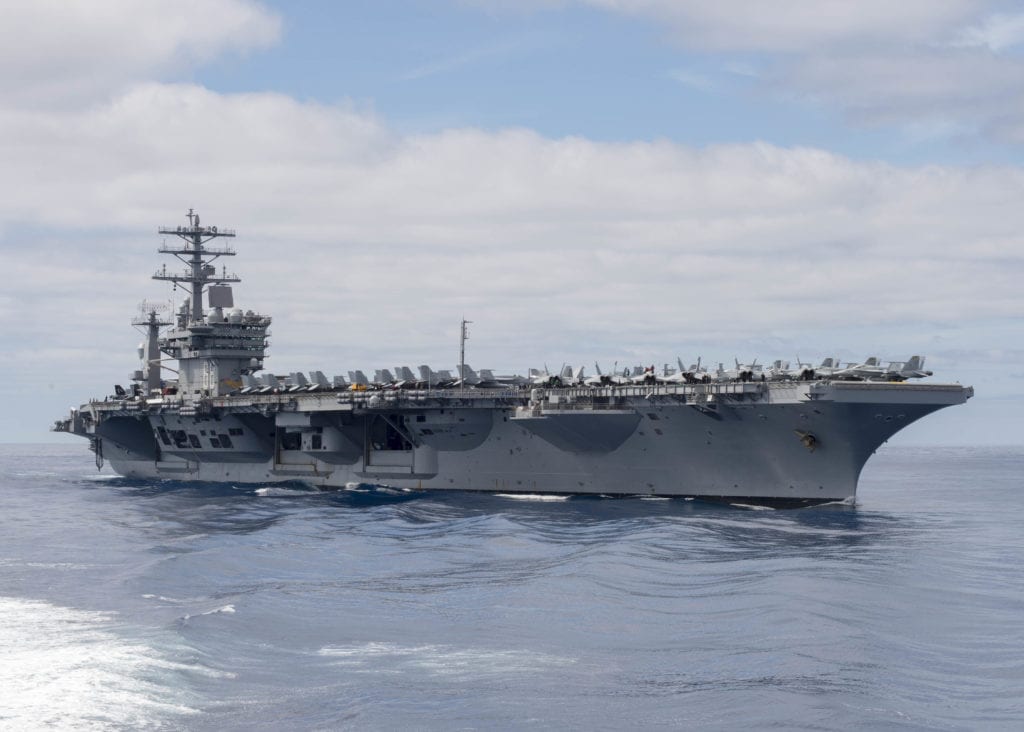
The aircraft carrier USS Nimitz (CVN 68) transits alongside the Arleigh Burke-class guided-missile destroyer USS Pinckney (DDG 91) after a replenishment-at-sea in this 2017 photo. U.S. Navy / Mass Communication Specialist 2nd Class Craig Z. Rodarte
ARLINGTON, Va. — The USS Nimitz Carrier Strike Group is departing the Central Command area of responsibility and moving into the U.S. Indo-Pacific region, Pentagon Press Secretary John F. Kirby announced Feb. 4.
“We want to thank all the men and women aboard the ships in that strike crew and the squadrons who supported Central Command now for more than 270 days, ensuring our national security and deterring conflict in a very critical region of the world,” Kirby said.
The carrier is homeported in Bremerton, Washington. It is now in the 7th Fleet area of responsibility and can be called upon for operations, training or humanitarian exercises there.
The Nimitz’s departure means there is no U.S. carrier operating in the Central Command area of operations. Kirby said Secretary of Defense Lloyd J. Austin III believes America has “a robust presence in the Middle East.” U.S. service members are based in many nations in the Persian Gulf and there is more than enough airpower to counter any adversary.
Kirby said Austin has constant discussions with U.S. Central Command commander Marine Corps Gen. Frank McKenzie, as well as other combatant commanders. Austin must balance requirements from various parts of the world, and the United States doesn’t have an unlimited number of aircraft carriers.
These decisions are carefully weighed, the press secretary said. “Every decision that we make with military forces — air, ground or naval — and certainly, decisions that you make with respect to a capital asset, like an aircraft carrier and its associated, supporting Strike Group is a decision driven by a frank assessment of the threats in the area, and also a frank consideration of the capabilities themselves,” Kirby said. “So, absolutely, the secretary was mindful of the larger geostrategic picture when he approved the movement of the Carrier Strike Group from the Central Command area responsibility.”
Also playing into the decision is the length of the deployment for the Nimitz sailors and their families. The Nimitz and supporting ships have been deployed longer than is typically required. Austin and CentCom and Navy officials must consider the wear and tear on the sailors, the ships and the aircraft.
Navy Seeking Innovation in New Places Despite Challenges, ONR Director Says
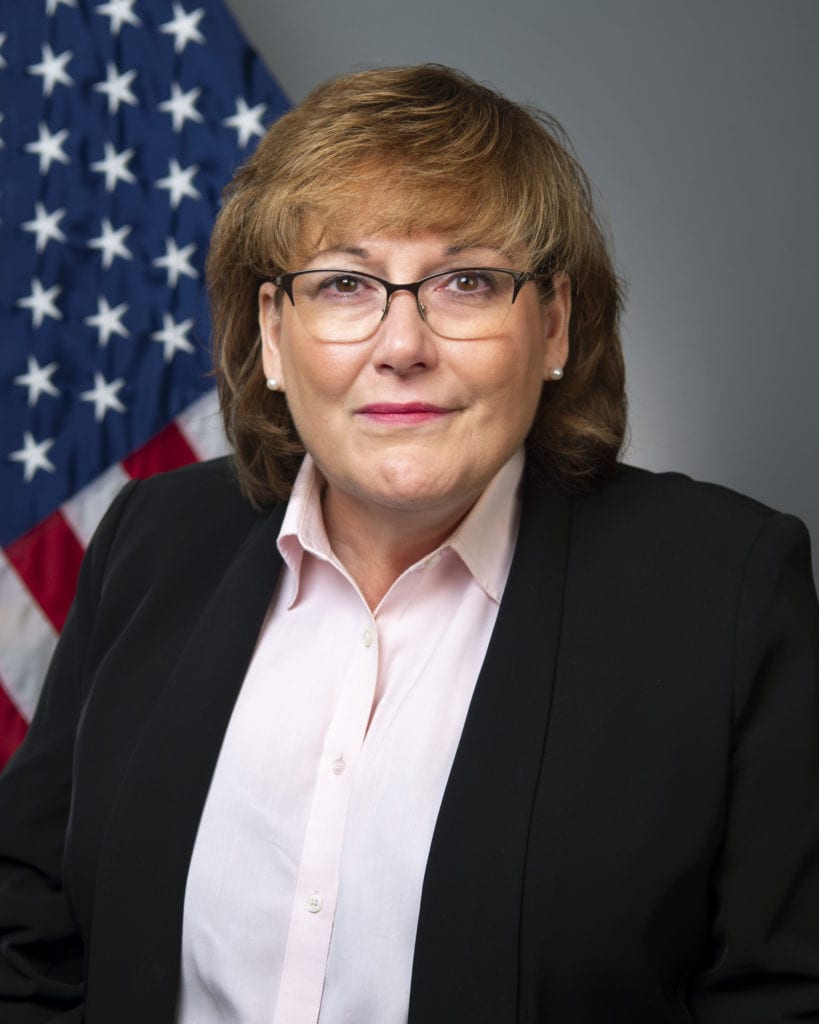
Anne Sandel, executive director, Office of Naval Research. U.S. Navy / John F. Williams
While there is a new administration and leadership, the Office of Naval Research’s executive director said she does not expect any major changes in the Department of the Navy’s priorities, and the acquisition team will continue to be focused on delivering and sustaining lethal capability, increasing agility, driving affordability and developing a work force to compete and win.
Anne Sandel, also the acting principal civilian deputy to the assistant secretary of the Navy for research, development and acquisition, spoke at the National Defense Industrial Association’ s Expeditionary Warfare Conference, which took place virtually Feb. 2 and 3.
Sandel said the Navy acquisition and research and development enterprise, like everyone else, was challenged by the global pandemic during 2020. COVID 19 had a big impact on the work environment. But, she said, through adaptation and process, the Navy has continued to execute.
“We’ve leapfrogged ahead to embrace that virtual and electronic environment,” Sandel said. “Our outreach, communication and our collaboration has actually increased. Although people like to be in room with one another, I have seen much more collaboration across the board, whether it’s Navy, Marine Corps, or any of our industry partners or allies. We are able to reach out on a moment’s notice and do what we’re doing today with one another. Many times, it’s a force multiplier, because we can include people who personally would not have been available because of travel, cost or schedule demands. Today, they can log on, be part of a phone call, and be there instantaneously. It’s multiplied our ability to communicate and move forward in a format that is unusual for those of us who grew up in an industrial infrastructure. We’ve had to transcend that with the acquisition, design, engineering and construction efforts. It’s improved our processes.”
Sandel has a long career in shipbuilding, maintenance and repair, but in her current role, she has a view of the many evolving technologies and concepts to address current and future warfighting requirements across all of the warfare domains.
In her job at ONR, Sandel said she came to better appreciate just how much of ONR’s portfolio is focused on the expeditionary mission and in support of Marines. In fact, the vice chief of naval research is a Marine who also commands the Marine Corps Warfighting Laboratory.
“We are very closely aligned with the Marine Corp and the expeditionary portfolio,” she said.
Leveraging innovation
Sandel talked about finding and leveraging innovation. The NavalX organization, established by then-Assistant Secretary of the Navy for Research, Development and Acquisition James Guerts, focuses on embracing non-traditional agility methods across the DON workforce, and linking up isolated or disparate pockets of excellence and subject matter experts. As a part of NavalX, the Navy established storefront “TechBridge” offices — “agility cells” to broaden the network to help the Navy and Marine Corps learn and act faster in key locations.
The TechBridge storefront concept applies both internally within the Department of the Navy, but also externally, with other federal, state, regional and local government organizations, academia, nonprofits, trade and professional organizations and industry.
“Think of NavalX as the ‘network,’ and the TechBridges as the nodes on the network,” Sandel said.
While she said the Navy is committed to developing and supporting America’s industrial base, she also is looking at capabilities that are available on the global market, including government-to-government and international commercial collaboration.
Sandel said Rear Adm. Lorin Selby, the Chief of Naval Research, has an international component to his job, and ONR Global has offices around the world to connect with academia, industry and governments to share developing technologies. The first TechBridge outside the U.S. has been established in the U.K., collocated with ONR Global at Northwood, to help make connections and find innovative technologies.
Another way to accelerate getting technology into the hands of warfighters is through experimentation. The Navy and Marine Corps are planning an ambitious array of exercises in the months and years ahead, including Trident Warrior, RIMPAC, Sea Dragon, Bold Alligator, Valiant Shield, Valiant Blitz, Large Scale Exercise 2020, to name a few, along with Advanced Naval Technology Exercises (ANTX) and Joint Interagency Field Exercises.
Originally planned for 2020, the Navy is looking to leverage Large Scale Exercise 2021 to operationalize concepts like Distributed Maritime Operations (DMO), Expeditionary Advanced Base Operations (EABO), and Littoral Operations in a Contested Environment (LOCE), naval operational architecture, and command and control in a contested environment to develop and test alternative warfare concepts.
“We’re putting tools and kit in the hands of the actual operators, experiment with it, and give us feedback directly,” she said.
Sandel discussed some of the ways the Navy in general, and ONR specifically, can move quickly to find, develop and field new technology. She pointed to ONR’s TechSolutions program as an example of how ONR can act promptly on ideas from deckplate Sailors or Marines to improve mission effectiveness. TechSolutions has resources to rapidly address suggestions and ideas from the fleet, investigate available technologies, and deliver prototype solutions.
She also recognized the importance of small business, such as those participating in the Small Business Innovation Research (SBIR) program. “During my tenure at ONR, and now at the enterprise level, I have seen how we have been able to leap forward greater agility using the SBIR funding than I was aware of in all my years in the engineering and acquisition organizations. I knew they were there, and how to get innovation from small companies that couldn’t compete as primes, but I’ve learned that they’re more agile than I recognized, The SBIR program, the way its architected and funded, has the agility to take innovative technologies and leapfrog forward,” she said.
DLA Awards Crowley Fuel Delivery Contract to Remote Aleutian Air Station
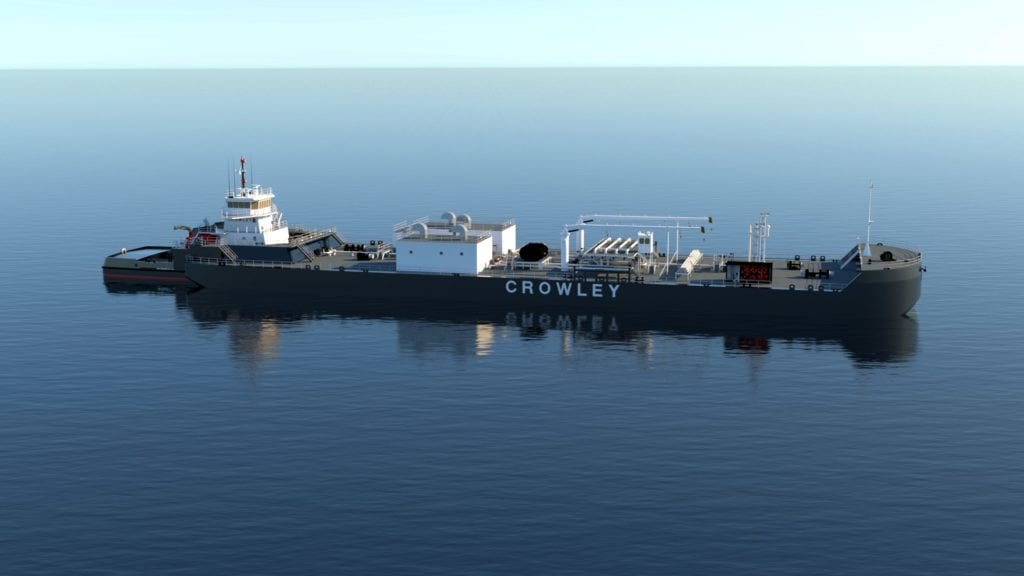
Crowley will provide transformational improvements and cost efficiencies through the utilization of the company’s new, purpose-built articulated tug-barge. Crowley
ANCHORAGE, Alaska — Crowley Solutions has been awarded the five-year contract to deliver military specification fuel to the Eareckson Air Station located on the remote Aleutian Island of Shemya, Alaska, the company said in a Feb. 1 release.
Under the U.S. Defense Logistics Agency-Energy contract, beginning in 2021, Crowley will provide lightering and transportation of 4 million gallons of fuel annually for the radar and aircraft refueling station and its 180 military, contractors and civilians who operate it.
Crowley has consistently transported and delivered the fuel since 1956 to the base 1,200 miles from Anchorage in the remote western reaches of the Aleutian Island archipelago. The U.S. government has counted on the company’s experience and innovative logistics capabilities in remote and austere environments, including a unique over-the-shore evolution successfully developed and executed by Crowley in 2020 as featured in this video. However, under the new contract term, Crowley will provide transformational improvements and cost efficiencies through the utilization of the company’s new, purpose-built articulated tug-barge (ATB) in a joint service by Solutions and Crowley Fuels, the company’s Alaska-based fuel transportation and distribution business unit.
The 55,000-barrel capacity (2.3 million-gallon) ATB Aurora/Qamun will serve the air station and Crowley’s customers throughout western Alaska and the Arctic. The 410-foot ATB is specifically designed to meet Ice Class and Polar Code requirements in order to safely and effectively operate in Western Alaska year-round.
“Crowley’s record of dependability and high performance will add a new chapter under this contract when Aurora/Qamun enters service to the government and military,” said Sean Thomas, vice president for Crowley Solutions. “It is an honor to continue serving our warfighters by safely providing value through a resilient and dependable supply chain whenever and wherever they need fuel.”
“We appreciate the confidence the government continues to show in Crowley,” said Rick Meidel, vice president and general manager, Crowley Fuels. “The new contract award reflects the proficiency and skill of the dedicated men and women of Crowley Fuels, and the strong collaboration by the Fuels and Solutions teams.”
The ATB, which was designed by Crowley Engineering Services powered by subsidiary Jensen Maritime, is undergoing its final outfitting prior to entering service this year. The tug is being constructed by Master Boat Builders of Bayou La Batre, Alabama. The barge is being built by Gunderson Marine LLC, a wholly owned subsidiary of the Greenbrier Companies Inc., in Portland, Oregon.
USS Philippine Sea Interdicts Over $2.8 Million of Heroin in North Arabian Sea
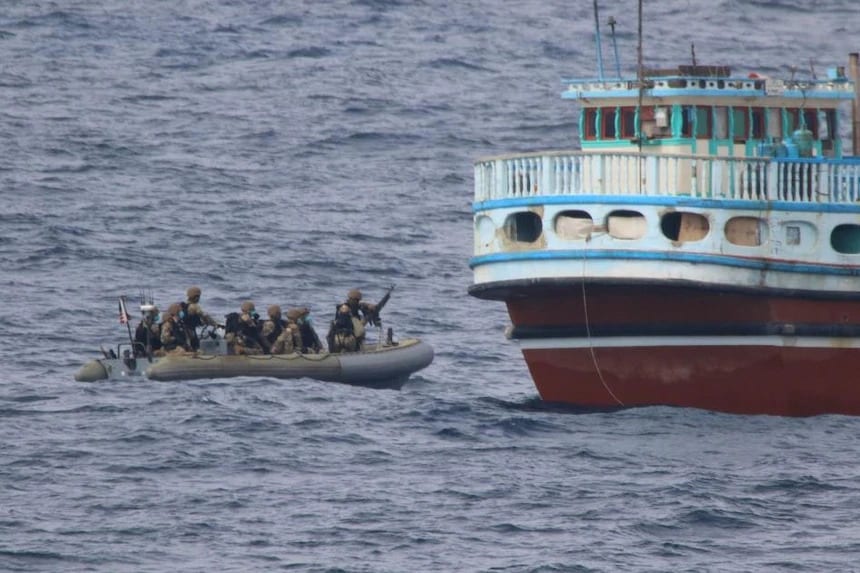
Sailors assigned to the visit, board, search and seizure Sailors team of the guided-missile cruiser USS Philippine Sea (CG 58) board a dhow suspected of carrying narcotics in the international waters of the north Arabian Sea, Jan. 31, 2021. U.S. Navy
BAHRAIN — The guided-missile cruiser USS Philippine Sea (CG 58), deployed to U.S. Fifth Fleet and operating in support of the Combined Maritime Forces (CMF), interdicted a shipment of more than 600 pounds (275 kilograms) of suspected narcotics from a dhow in the international waters of the North Arabian Sea, Jan. 30, the CMF said in a Feb. 2 release.
Seven bags of suspected narcotics were seized and tested, resulting in a seizure of approximately 600 pounds (275 kilograms) of suspected heroin, worth $2.89 million wholesale. This seizure, conducted in direct support of CMF’s Combined Task Force (CTF) 150, marks the seventh CMF drug seizure since October 2020.
To mitigate the risk of contracting and spreading COVID-19, the boarding team undertook carefully executed precautionary measures during and after the boarding, to include decontamination of all seized contraband.
CTF-150 conducts maritime security operations outside the Arabian Gulf to disrupt criminal and terrorist organizations, ensuring legitimate commercial shipping can transit the region, free from non-state threats. CTF-150 is currently commanded by the Royal Canadian Navy, now leading the task force for a fifth time.
Galinis: Navy Considering Land-Based Test Site for Integration of Frigate Systems
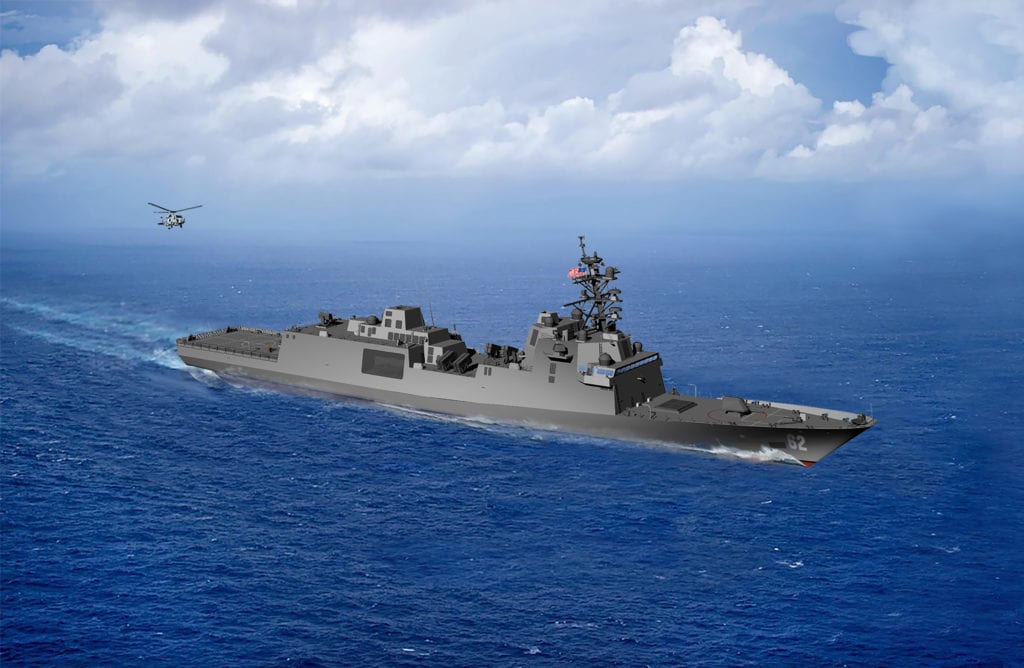
An artist’s rendering of the Constellation-class guided-missile frigate (FFG), which may have some of its systems tested on land. U.S. Navy
ARLINGTON, Va. — The commander of Naval Sea Systems Command (NAVSEA) praised the risk-mitigation qualities of land-based testing and prototyping of ship systems and said the Navy said the Navy is considering it for some level for the Constellation-class guided-missile frigate (FFG).
NAVSEA Commander Vice Adm. William Galinis, speaking during a webinar of the National Defense Industrial Association’s Expeditionary Warfare Conference, said the Navy is using more land-based testing and integration to reduce risk before the systems are installed on a ship.
Land-based testing “is not something we can do for every platform, but judicious use of land-based testing where it makes sense is a good engineering development tool and a risk mitigator.”
Galinis noted that extensive land-based testing is being conducted for the Flight III Arleigh Burke-class guided-missile destroyer (DDG) at the Naval Surface Warfare Center Philadelphia Division.
“As we upgrade to the Flight III [of the Arleigh Burke class], we need additional cooling capacity, additional power-generation capacity, higher voltage level,” he said. “That electric plant is being tested right now in Philadelphia from the prime mover all the way to the power conversion modules.”
The SPY-6 radar, built by Raytheon Technologies for the Flight III DDG, is being tested at the Lockheed Martin Aegis test site in Moorestown, New Jersey, with the combat systems software, “from the power-conversion unit all the way out through the array face.”
Major propulsion components of the new Columbia-class ballistic-missile submarine, being built by General Dynamics Electric Boat, also are going through extensive land-based testing at Philadelphia.
“We will probably do something along that line for the Constellation-class frigate,” Galinis said. “We’re working through the details of that right now.”
Because the hull and propulsion of the Constellation is from a proven, parent design — the Fincantieri FREMM frigate — land-based testing is likely to focus on integration of systems, particularly combat and sensor systems.
Galinis said there are changes to the frigate in terms of “buy America” requirements and certain Navy requirements.
GA-ASI Plans to Demonstrate Maritime Capability in the United Kingdom
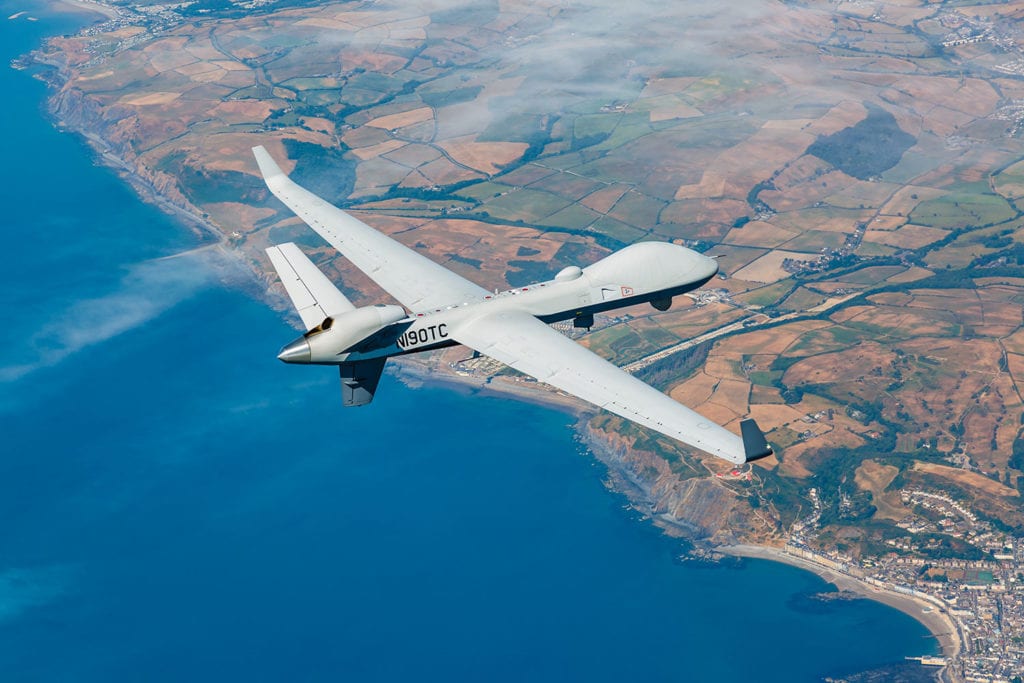
General Atomics Aeronautical Systems Inc.’s SkyGuardian remotely piloted aircraft. GA-ASI
SAN DIEGO — General Atomics Aeronautical Systems Inc. (GA‑ASI) plans to take a company-owned SkyGuardian remotely piloted aircraft to the United Kingdom later this year to undertake a series of operational capability demonstrations for NATO allies, including The Netherlands, the company said in a Feb. 3 release. The U.K.’s Protector program is a derivative of SkyGuardian with a range of U.K. modifications and the Royal Air Force (RAF) is supporting this visit.
The GA-ASI aircraft will be configured with maritime capability, including a multi-mode maritime surface-search radar with Inverse Synthetic Aperture Radar imaging mode, an Automatic Identification System receiver, and a High-Definition, Full-Motion Video sensor equipped with optical and infrared cameras. This will build on previous GA-ASI demonstrations showcasing the unmanned advantage, which include the transatlantic flight of SkyGuardian in 2018, maritime demonstrations in Greece in 2019 and last year’s validation flights in Japan.
“GA-ASI will work closely with multiple European allies to demonstrate the capabilities of MQ-9B, including in the maritime environment, and how MQ-9B can complement and team within a networked environment with other national assets,” said Tommy Dunehew, vice president of International Strategic Development for GA-ASI.
The series of civilian and military capability events is expected to kick off in July at the Royal Air Force’s Waddington Air Base and will culminate with the MQ-9B’s participation in the U.K.-led Joint Warrior exercise that will showcase how maritime capabilities can be integrated with other air, surface and land platforms. SkyGuardian flights will further develop GA-ASI’s revolutionary Detect and Avoid capability, which will enable Protector to fly in unsegregated UK airspace. It will also assist RAF Waddington, the future home of the RAF Protector fleet, to best prepare to integrate the new aircraft into its daily operations.
MQ-9B represents the next generation of remotely piloted aircraft (RPA) system having demonstrated airborne endurance of more than 40 hours, automatic takeoffs and landings under SATCOM-only control and the detect and avoid system. Its development is the result of a company-funded effort to deliver an RPA that can meet the stringent airworthiness certification requirements of various military and civil authorities.
Northrop Grumman, Ultra Demonstrate ASW Using Unmanned Helicopter
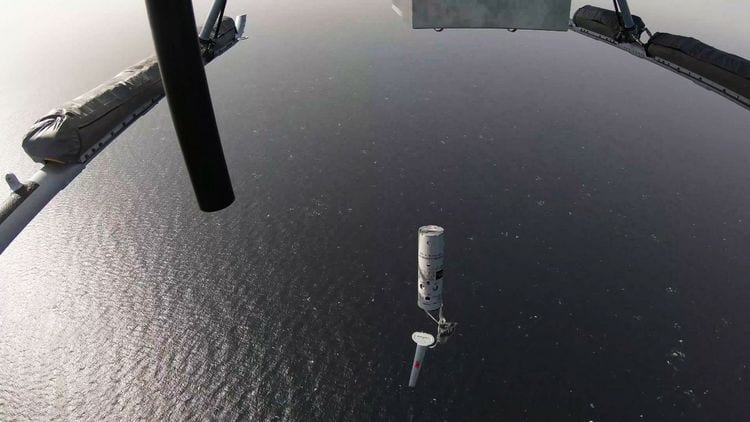
Northrop Grumman collaborates with Ultra to demonstrate unmanned anti-submarine warfare capability. Northrop Grumman
SAN DIEGO — Northrop Grumman Corp. and U.K.-based Ultra equipped a modified, manned Bell 407 (acting as an MQ-8C Fire Scout surrogate) platform with Ultra sonobuoys, receiver and processor to complete an unmanned aircraft systems (UAS) anti-submarine warfare (ASW) capability demonstration, Northrop Grumman said in a Feb. 2 release.
This successful demonstration of the UAS ASW mission on Oct. 29 was the first time a vertical takeoff surrogate unmanned aerial system had been used to conduct a large area multi-static acoustic search. The mission payload and effects were controlled from the ground with the resultant ASW picture disseminated to locations across the globe.
“Adding an ASW capability to Fire Scout’s existing multi-mission capabilities would further enhance this highly-versatile platform,” said Dan Redman, Fire Scout maritime mission expansion lead, Northrop Grumman. “This ASW capability would offer commanders flexibility to employ not only UAS systems in this particular ASW role, but also utilize the increased availability of crewed aircraft more incisively against an expanded mission set. This would increase the total available effect of the manned/unmanned teamed force mix.”
By jointly developing and demonstrating UAS ASW capabilities, initially on an MQ-8C Fire Scout manned surrogate as part of an industry-led initiative, the two companies are combining their world-leading expertise and experience with the aim of bringing unique ASW solutions to global customers. While the U.S. Navy has not yet identified a clear requirement for UAS ASW capability, it has shown interest in the development and continues to support and monitor progress.
“Operating prototype hardware in a high-pressure real-world environment can be challenging,” said Thomas Link, president of Ultra Maritime. “Our partnership will bring an innovative and leading ASW capability into operation, combining both manned and unmanned ASW systems that will help defend our warfighters and provide increased capability to our forces.”
The MQ-8C Fire Scout can fly missions in excess of 12 hours, providing commanders an unrivaled level of layered multi-source/sensor intelligence, surveillance, reconnaissance and command and control/comms relay capabilities over land and sea. When operating in a manned-unmanned teaming concept, Fire Scout enables commanders to employ manned assets in a more focused manner, allowing them to exploit hybrid manned/unmanned teaming opportunities.
Ultra’s applications engineers are trusted partners in the design, development and production of the key elements of mission critical, intelligent and highly regulated systems.
Marine Corps Commandant wants Marines to trust technology
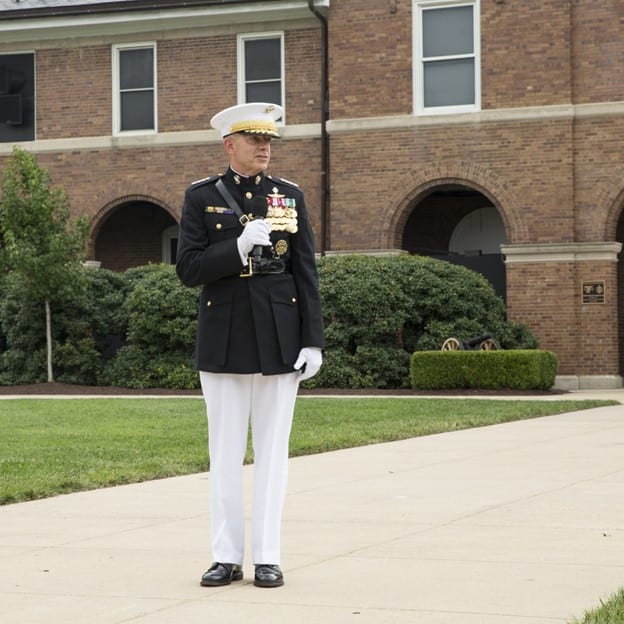
Commandant of the Marine Corps Gen. David H. Berger addresses the crowd during a change of command ceremony at Marine Barracks Washington, D.C., July 11, 2019. U.S. Marine Corps / Lance Cpl. Morgan L. R. Burges
Commandant of the Marine Corps Gen. David Berger said cooperation, innovation and trust are keys to future success for the sea services.
“Going forward in a great power competition, no single service is going to keep our advantage,” said Berger, speaking at the National Defense Industrial Association’s virtual Expeditionary Warfare Symposium, being held Feb. 2-3. “Only by the Marine Corps and the Navy working together as a naval force will we be able to maintain our margin. Add the innovative technologies, that’s how you get an asymmetric advantage against a near peer or a peer adversary.”
Berger said despite the arrival of a new administration, the premise or foundation of the current National Defense Strategy — to discourage malignant military countries that want to challenge the international security environment — is solid.
In his view, the future operating environment is going to be characterized by a maturing and more proliferating precision strike regime in a maritime region. That’s going to require the Marine Corps, as the Joint Force’s stand-in force, to be forward deployed and distributed.
“If a conflict comes, then I think that our near peer competitors are not going to allow us to build up and set the theater and take a couple of months to do that,” said Berger. “Where you start from in a great power competition is where you were the day before. They’re not going to allow a flow of forces, because the know how that’s going to work. So, our forward standing in forces have to be ready immediately respond to a crisis. If we don’t start posturing and strengthening the naval services today, we’re going to fall behind. And that’s not going to happen.”
Altering our trajectory
Innovation is being driven by the threat, and by available resources.
“All of us in the Navy and Marine Corps recognize the same challenges in the emerging operating environment that’s before us. There is an urgent need for innovation and rapid change,” said Berger. “We are being driven by a pacing threat. We have to do it with no additional funding or resources.”
Berger expressed confidence in the force structure changes as set out in the Marine Corps Force Design 2030 effort, which examines the right mix of hardware, but also unmanned systems, artificial intelligence and sophisticated and survivable networks. “That’s how our force in readiness will alter our trajectory to create an advantage for the fleets and the overall force.”
“That force design — the major overhaul of the Marine Corps — provides the nation a force that’s capable of denying key maritime terrain to an adversary because of our forward presence, and its going to force our competitors to think twice before challenging our interests,” Berger said. “That is the essence of deterrence.”
To achieve that, Berger said the service needs to reset is systems and equipment.
“The Marine Corps has to modernize, not just our equipment, but we’ve got to modernize our training, our forces and our equipment. I am convinced that yesterday’s force will not compete effectively with tomorrow’s adversary, especially in the maritime gray zone. Putting it bluntly, just making our legacy platforms better, or just making more of them available will not allow us to maintain an advantage against either China or Russia in the maritime domain.”
Berger said that Marines operate in an expeditionary distributed operational environment, and operating in that environment with repurposed kit or repurposed equipment would be “irresponsible, and it’s not good enough. We can’t continue to invest in programs that don’t support force design and where we’re going.”
This is where Berger said he needs help from industry to “creatively find the solutions that will get us there. I’m not just talking about a better version of what we’ve got, but how can we disrupt; how can we deter an adversary — especially on the high end. A new and improved version of the light armored vehicle is not going to solve the problem. We have to look at building totally new capabilities, and use technologies in new ways to solve these complex future problems,” he said. “We have to outthink and outmaneuver a pretty capable adversary.”
Confidence and trust
“I’m a believer in manned and unmanned teaming,” Berger said. “That’s where we’re headed. But technology is not going to replace the individual Marine, of course. It will enable the Marine to be more lethal.”
Berger said it’s a matter of confidence and trust. In some instances, Berger said we don’t trust the machines.
“There are systems that offer fully automated sensor to shooter targeting, but we don’t trust the data,” he said. “We still ensure there is human intervention, which adds more time and opportunities for mistakes.”
Berger talked about emergency medical evacuations, which are today conducted using manned helicopters to get a wounded Marine from the battle front to a medical facility safely in the rear. He alluded to expensive manned helicopters, such as the CH-53K helicopter, which may be too big to risk in a hostile environment, but there are unmanned options, like the unmanned K-Max helicopter, that have been demonstrated to carry patients to safety.
“In the same way a squad leader has to learn to trust his or her Marines, a squad leader is going to have to learn to trust the machines.”
Mine Warfare Director: Detect-to-Engage Timeline Needs to be Speeded Up
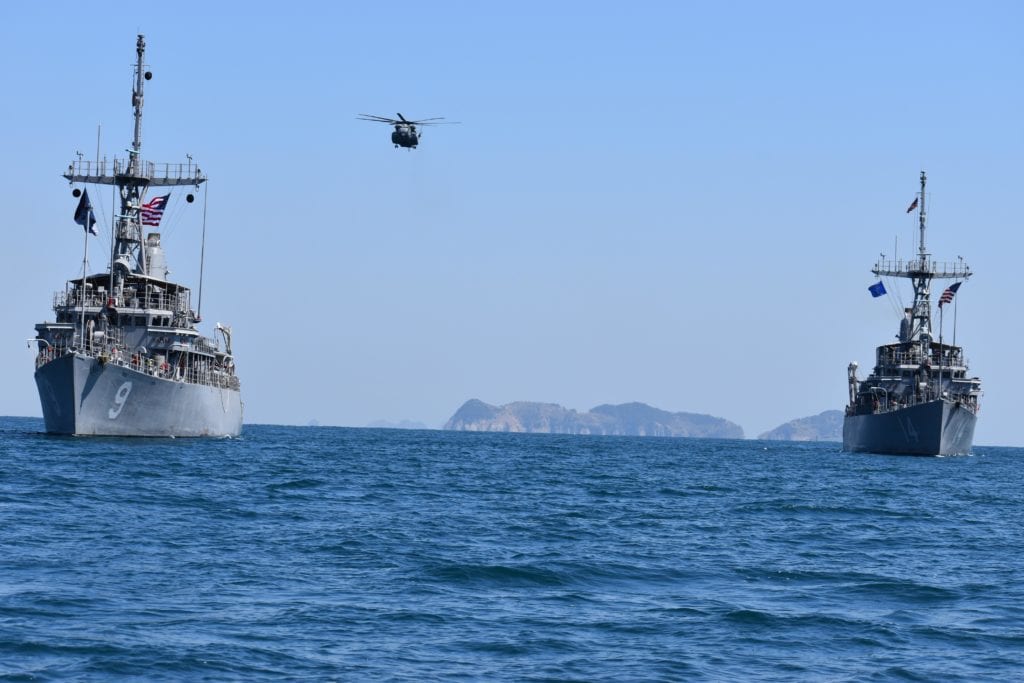
Avenger-class mine countermeasure ships USS Pioneer (MCM 9), USS Chief (MCM 14) and an MH-53 helicopter from Helicopter Mine Countermeasures Squadron 14 conduct mine hunting training exercises in this 2020 photo. U.S. Navy / Information Systems Technician 2nd Class James Greeves
ARLINGTON, Va. — The Navy official in charge of mine warfare development said strides are needed to decrease the search and neutralization time of mine counter-measures operations.
“We need to get faster; we need to speed the timeline up,” said Capt. Robert Baughman, director, Mine Warfare Division at the Naval Surface and Mine Warfighting Development Command in San Diego, speaking at a Feb. 2 webinar of the National Defense Industrial Association’s Expeditionary Warfare Conference. “Improving the detect-to-engage timeline is vital as we shift from a ship in a minefield to off-board and autonomous systems.”
For single-pass detect-to engage, with “on-board processing and high-end autonomous target recognition, we can neutralize the mine immediately,” Baughman said. “Machine learning is improving this capability, but we need systems to either pass contacts during the mission cycle, or immediately upon recovery in the interim, telling what it assesses to be a mine.
“In the meantime, industry can help us with in-stride data transfer, transmitting high-quality data beyond line of sight that will help us get data back to the ship to start the post-mission analysis, and not wait till the end of a 20-hour mission, which then requires 20 hours of post-mission analysis on the back side,” he said.
The captain also said, “capabilities need to be smaller, more expeditionary, and more reliable. Unmanned systems need to be highly modular, built with open architecture in mind, with hi-rez sensors, and to be networked systems of systems. Sailors must be able to fix them on the ship and easily modify them for specific missions. We can’t rely on a team of contractors or Ph.D.’s to effect repairs or change out sensors in the field.”
Being acoustically quiet and having a low signature overall are important, Baughman said.
Single-use minesweepers are not affordable at this point, he said. “All future systems and enabling technologies should have this as a consideration in their design and development.
“Communications and navigation systems must be resilient and also be able to operate in denied environments for sustained periods of time,” he said. “Having a clandestine capability can help with this, especially when we talk about mining technology. If they’re networked, we can control them better, turning them on or off as required to avoid detection at a time of our choosing.
“For all of these systems, power and portability are extremely important,” the captain said. “We need systems with long duration that can conduct surveys and persistent station keeping for whatever we tack UUVs to do. We need to be platform agnostic.
“We are a more expeditionary, off-board, distributive force than we were even five years ago, and regularly integrate with our coalition partners,” Baughman said. “So, being able to rapidly and seamlessly share info and make timely decisions as necessary though our tactical decision support aids, up and down the decision process. File size, classification, bandwidth and latency constraints can’t hinder our ability to share data across the force. Data management is becoming more and more of an issue.”
DMO is Navy’s Operational Approach to Winning the High-End Fight at Sea
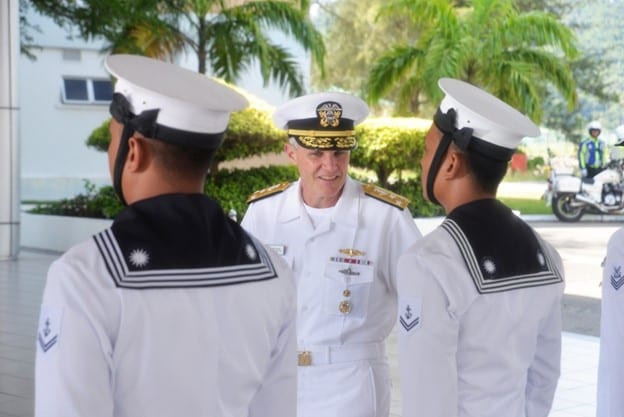
Vice Adm. Phil Sawyer inspects sailors of the Royal Malaysian Navy in this 2018 photo. U.S. Navy / Mass Communication Specialist 1st Class Chris Krucke
Navy Vice Adm. Phil Sawyer says the Chief of Naval Operation’s Navigation Plan 2020 and the Distributed Maritime Operations (DMO) concept are central for the Navy going forward and for the Navy and Marine Corps team’s ability to conduct enduring sea control and power projection missions.
Speaking at the NDIA Expeditionary Warfare Conference on Feb. 2, Sawyer, the deputy CNO for Operations, Plans and Strategy, said enduring means as a maritime nation, “the sea control and power projection mission hasn’t changed in 200 years, but the way we do it today has.”
The Navigation Plan 2020, released last month by CNO Adm. Mike Gilday, and the Tri-Service Maritime Strategy released last year, assert that the U.S. and Navy are “involved in a long-term competition that threatens our security and our way of life. Russia and China are both undermining the free and open conditions that has enabled the world to largely prosper since the end of World War II.”
Both countries are attempting to unfairly control sea-based resources, intimidate their neighbors, and both are turning incremental gains into long-term advantages, with Crimea and the South China Sea as examples.
Although we must be clear-eyed about both Russia’s and China’s actions and intentions, Sawyer said China is the long-term strategic threat to the U.S. “That is not to discount Russia, but it looks like China is our pacing threat.”
“The nation needs a larger hybrid fleet — consisting of manned and unmanned platforms,” Sawyer said “But, it’s not just the number, but it’s about the composition of the fleet.”
Sawyer said unmanned platforms will play a very important role, from ISR above, on and below the sea, to platforms that are large weapons batteries to aerial refuelers.
He said it’s easy to fixate on numbers, but the mix is also very important. “Getting the right mix of platforms is just as important as the total number.”
The Navigation Plan calls for a lethal, better connected fleet — a fleet that is able to deliver synchronized lethal and nonlethal effects across all domains. That includes distributed weapons of increasing range and lethality Hypersonic and directed energy weapons are key R&D efforts for the Navy, he said.
Tying the Navigation Plan to theme of the NDIA conference, “Distributed Maritime & Expeditionary Operations in a Peer Contested Environment,” Sawyer said, “DMO is principally a warfighting concept. It’s our operational approach to winning the high-end fight at sea.”
According to Sawyer, DMO is geographically distributed naval forces integrated to synchronize operations across all domains. “DMO is a combination of distributed forces, integration of effects, and maneuver. DMO will enhance battle space awareness and influence; it will generate opportunities for naval forces to achieve surprise, to neutralize threats and to overwhelm the adversary; and it will impose operational dilemmas on the adversary.”
A key capability to achieving DMO is the Naval Operational Architecture, which Sawyer said will enable decision superiority at speed in a high-end fight. “It’s the connective tissue between sensors, platforms and weapons, and its central to our DMO operating concept,” Sawyer said. It’s more than “every sensor connected to every shooter.”
It includes the infrastructure (computing power and data storage); the network (data links, antennas, routers, and protocols); a data architecture and a data strategy; and finally, the tool (tactical decision aids to help analyze and display data with understandable and actionable information to the operators).
The ability to communicate and share information is critical in a contested environment, he said.
“In peacetime, or against lesser adversaries, we know how to C2 distributed forces. We do it all the time. We know how to synchronize effects in time. We know how to dynamically maneuver our forces. What we working on is how to do this — assuming every domain is contested, or denied — and with speed, such that we decision superiority.”
Another DMO imperative is logistics, and an enterprise to operate and sustain us in a contested space. That will require new platforms, manned and unmanned, to sustain small, dispersed units far to the front.
DMO is not a Navy or Marine Corps problem. “DMO is a naval concept. Navy and Marine Corps integration is pivotal to us winning the high-end fight, particularly in the Pacific,” Sawyer said. “In the future, the Marine will be able to project power in order to support sea control or sea denial efforts.”
Sawyer said the Navigation Plan fully supports DMO, and fueling those capabilities necessary to fully realize the DMO concept. “New capabilities are important. But while the fleet waits for the introduction of these capabilities, we are moving out and exercising with what we have.”