MARAD Announces Funding Opportunity for Small Shipyard Grant Program
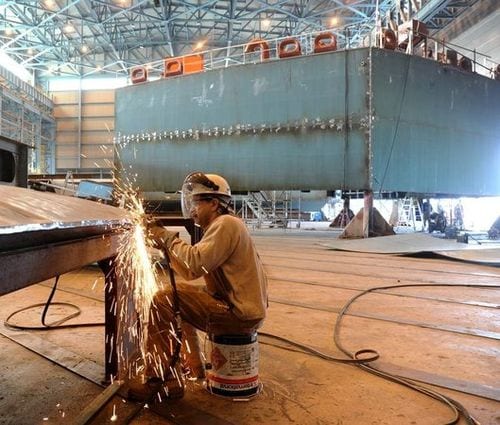
MARAD has announced the availability of $19.6 million in federal funding for small shipyards. USDOT
WASHINGTON — The U.S. Department of Transportation’s Maritime Administration (MARAD) announced in a Jan. 19 release the availability of $19.6 million in federal funding to U.S. small shipyards through the Small Shipyard Grant Program.
These investments support efficiency improvements and modernizations that allow U.S. shipyards to compete more effectively in the global marketplace.
Since its inception in 2008, the department’s Small Shipyard Grant Program has awarded more than $243 million through 268 grants to assist U.S. shipyards and their workers reap the benefits of increased production capabilities.
The Small Shipyard Grant Program supports a variety of projects, including capital and related improvements and equipment upgrades that foster ship construction, repair and reconfiguration in small shipyards across the United States. The grants also can be used to support maritime training programs that improve technical skills to enhance shipyard worker efficiency and productivity. The grants, which are limited to no more than 75 percent of the estimated improvement costs, are available to U.S. shipyards with fewer than 1,200 production employees.
“America’s shipyards are a vital foundation for both our national security and our Nation’s economy. U.S.-flag commercial vessels — built and maintained right here in the U.S. — carry not only military equipment and supplies, but many carry commercial goods in both contiguous and non-contiguous trade,” said Doug Burnett, the MARAD chief counsel who is acting in lieu of the administrator.
Applications for the grants are due by 5 p.m. EST on Thursday, Feb. 25, 2021. MARAD intends to award grants no later than Monday,April 26, 2021. Additional information can be found in the Federal Register at https://www.federalregister.gov/documents/2020/01/09/2020-00163/small-shipyard-grant-program-application-deadlines, or by contacting David M. Heller, Director, Office of Shipyards and Marine Engineering, Maritime Administration, at Room W21-318, 1200 New Jersey Ave., SE, Washington, DC 20590; or at [email protected].
MARAD Authorizes Construction of Two Additional National Security Multi-Mission Vessels
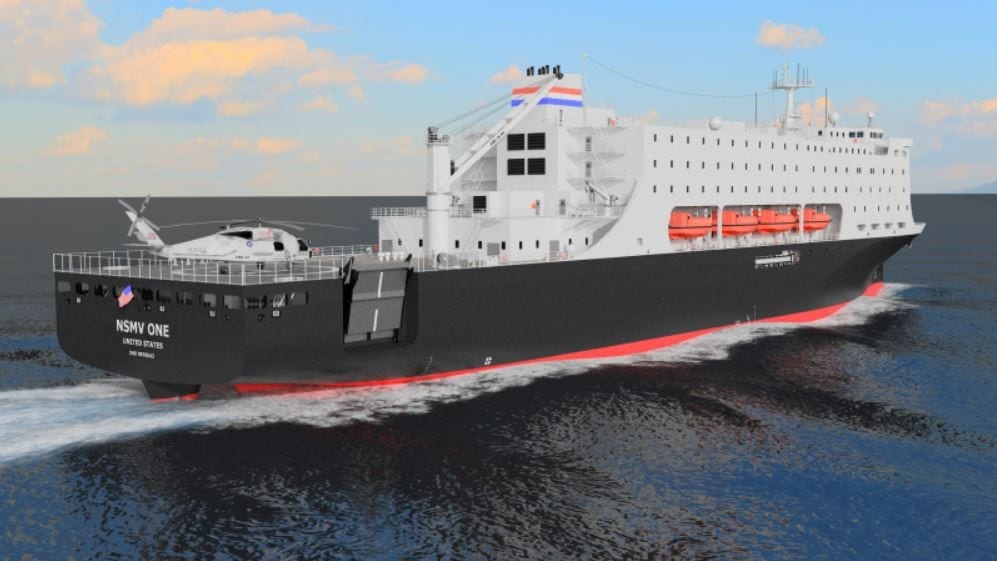
An artist’s conception of the NSMV. MARAD
WASHINGTON — The U.S. Department of Transportation’s Maritime Administration (MARAD) authorized the construction of two additional National Security Multi-Mission Vessels (NSMV), which will replace aging training vessels at Maine Maritime Academy in Castine, Maine, and Texas A&M Maritime Academy in Galveston, Texas, MARAD said in a Jan. 19 release.
MARAD previously authorized the construction of the first two NSMVs, destined for SUNY Maritime College in Bronx, New York, and Massachusetts Maritime Academy, in Bourne, Massachusetts, on April 8, 2020.
“The NSMV is part of a strategy to bolster maritime education, revitalize U.S. shipbuilding, and provide a much-needed shot in the arm to the U.S. maritime industry,” added Doug Burnett, the chief counsel of MARAD, who is acting in lieu of the administrator. “America must be a maritime nation if it is to continue to lead the world in this century.”
With this authorization, recapitalization of our nation’s aging maritime training fleet is nearly complete. Construction of all authorized vessels at Philly Shipyard Inc. will also strengthen America’s industrial base while supporting more than 1,200 shipyard jobs in Philadelphia.
The NSMV will feature numerous instructional spaces, a full training bridge, and have space for up to 600 cadets in a first-rate maritime academic environment at sea. State maritime academies graduate approximately 70 percent of all new officers each year — the merchant mariners who help keep cargoes and the U.S. economy moving. Many also support U.S. national security by crewing military sealift vessels.
The NSMV is also a highly functional national asset that includes modern medical facilities, a helicopter pad, the ability to accommodate up to 1,000 people in times of humanitarian need, and roll-on/roll-off and container storage capacity for use during disaster relief missions.
In May 2019, MARAD awarded TOTE Services LLC a contract to be the vessel construction manager for the NSMV program. This contract is an innovative approach to federal shipbuilding where the government benefits from commercial best practices for ship design and construction. In April 2020, TOTE Services awarded Philly Shipyard Inc. a contract to construct up to five NSMVs with fixed prices and schedules.
SECNAV Names Future Vessels while aboard Historic Navy Ship
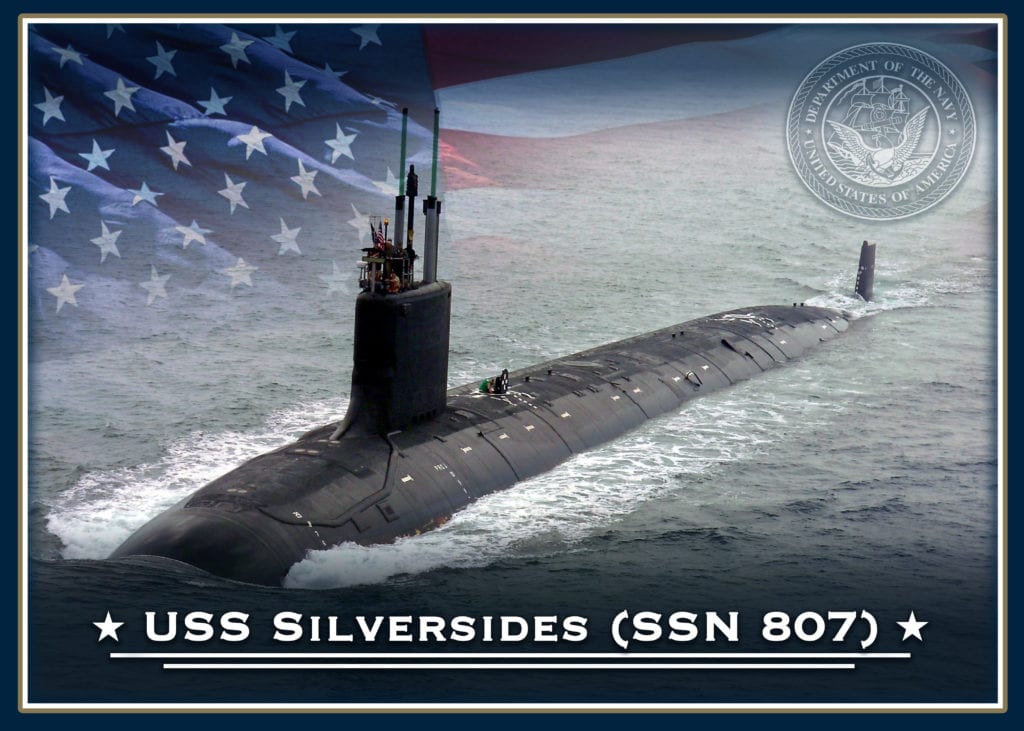
A graphic illustration of the future Virginia-class attack submarine USS Silversides (SSN 807). U.S. Navy
BOSTON – Secretary of the Navy Kenneth J. Braithwaite announced Jan. 15 that the Navy will name three future vessels after ships steeped in naval history and two others after a after a Medal of Honor recipient and a Native American tribe.
Braithwaite detailed the announcement Jan. 8 during a visit to one of the Navy’s first heavy frigates and oldest commissioned ship afloat – USS Constitution.
“The decks and lines of this proud ship speak to our storied past, and the Sailors who operate her reveal the strength of our future,” said Braithwaite. “We must always look to our wake to help chart our future course. Together, these future ships will strengthen our Navy and carry on our sacred mission to secure the sea lanes, stand by our allies, and protect our nation against all adversaries.”
The future ships will bear the names and hull numbers: USS Chesapeake (FFG 64); USS Silversides (SSN 807); USS Pittsburgh (LPD 31); USNS Lenni Lenape (T-ATS 9); and USS Robert E. Simanek (ESB 7).
The future Constellation-class frigate USS Chesapeake (FFG 64) will be named for one of the first six Navy frigates authorized by the Naval Act of 1794. The first USS Chesapeake served with honor against the Barbary Pirates in the early 1800. Following an at-sea battle with HMS Shannon in 1813, the ship was captured by the Royal Navy and commissioned her HMS Chesapeake. Braithwaite recently travelled to England where he retrieved a piece of the original frigate from the Chesapeake Mill in Hampshire.
“Like Constitution and Constellation, the first Chesapeake was a mighty sailing ship that declared our nation a maritime power,” said Braithwaite. “The new USS Chesapeake, FFG-64, will proudly carry on the legacy of that name into the new era of great power competition.”
Last year, Braithwaite named future Constellation-class frigates USS Constellation (FFG 62) and USS Congress (FFG 63) to honor the first six heavy frigates.
To honor the Silent Service, the future Virginia-class attack submarine USS Silversides (SSN 807) will carry the name of a WWII Gato-class submarine. The first Silversides (SS 236) completed 14 tours beneath the Pacific Ocean spanning the entire length of WWII. She inflicted heavy damage on enemy shipping, saved downed aviators, and even drew enemy fire to protect a fellow submarine. A second Silversides (SSN 679) was a Sturgeon-class submarine that served during the Cold War. This will be the third naval vessel to carry the name Silversides. The name comes from a small fish marked with a silvery stripe along each side of its body.
“Those who run silent and deep in this new attack submarine will inherit a proud legacy, and the capabilities to forge a strong future for our nation and our allies,” said Braithwaite.
The future San Antonio-class amphibious transport dock USS Pittsburgh (LPD 31) will be the fifth Navy vessel to bear the name. The first was an ironclad gunboat that served during the American Civil War. The second USS Pittsburgh (CA 4) was an armored cruiser that served during WWI, and a third USS Pittsburgh (CA 72) was a Baltimore-class cruiser that served during WWII, including supporting the landing at Iwo Jima. The fourth USS Pittsburgh (SSN 720) was a Los Angeles-class submarine that served the Navy from December 1984 to August 2019.
To honor the Lenape Nation of Pennsylvania, a future Navajo-class towing, salvage, and rescue ship will be named USNS Lenni Lenape (T-ATS 9). This will be the first naval vessel to carry the name of the Lenni Lenape tribe who are indigenous people of the Northeastern Woodlands, and the first tribe to sign a treaty with the United States in 1778.
“As a resident of the Keystone State, I know that Pittsburgh is a proud city with a strong legacy of service. I am confident that the crew of the future Pittsburgh will demonstrate the same excellence in support of amphibious and littoral operations around the world,” said Braithwaite. “And, the future USS Lenni Lenape will carry the legacy of the Lenape people for generations to come.
The future USNS Lenni Lenape will join USNS Muscogee Creek Nation (T-ATS 10), USNS Navajo (T-ATS 6), USNS Cherokee Nation (T-ATS 7), and USNS Saginaw Ojibwe Anishinabek (T-ATS 8) providing a wide range of missions including open ocean towing, oil spill response, humanitarian assistance and wide area search and surveillance.
Also joining the fleet will be the first Expeditionary Sea Base USS Robert E. Simanek (ESB 7), carrying the name of Marine Corps Medal of Honor recipient Private First Class Robert Ernest Simanek, who earned the nation’s highest medal for valor for his actions during the Korean War when he unhesitatingly threw himself on a deadly missile to shield his fellow Marines from serious injury or death.
“Private Simanek stands in the unbroken line of heroes extending from the early Marines who once stood in the fighting tops of our original frigates, to the Marines holding the line around the world today, and those who will deploy from the future USS Robert Simanek for years to come,” said Braithwaite. “This Expeditionary Sea Base continues the honored legacy of warriors from the sea, exemplified by her namesake.”
Simanek, a Detroit, Michigan, native, joined the Marine Corps in August 1951. He was just 22 years old when he sailed for Korea, joining Company F, 2d Battalion, 5th Marines in May 1952 to serve as a rifleman and as a radioman when needed. In addition to the Medal of Honor and Purple Heart, he was also awarded the Korean Service Medal with two bronze stars. Simanek, now 90, lives in Farmington Hills, Michigan.
Along with the ship names, Braithwaite also selected individuals who will be recognized as sponsors for several ships he recently named. The sponsor plays an important role in the life of each ship and is typically selected because of a relationship to the namesake or the ship’s current mission. The following individuals were identified as sponsors:
Melissa Braithwaite will sponsor the future USS Constellation (FFG 62).
Barbara Strasser will sponsor the future USS Chesapeake (FFG 64).
Gail Fritsch will sponsor the future USS Barb (SSN 804).
Mimi Donnelly will sponsor the future USS Tang (SSN 805).
Michelle Rogeness will sponsor the future USS Wahoo (SSN 806).
Cindy Foggo will sponsor the future USS Silversides (SSN 807).
Kelly Geurts will sponsor the future USS Wisconsin (SSBN-827).
Nancy Urban will sponsor the future USS Pittsburgh (LPD 31).
SBA announces Tibbets Awards for SBIR/STTR excellence
The U.S. Small Business Administration has announced 38 companies, seven organizations and 14 individuals as the winners of the prestigious Tibbetts Award for their accomplishments in creating cutting-edge technologies through the Small Business Innovation Research (SBIR) and Small Business Technology Transfer (STTR) programs.
The Tibbetts Awards, named after Roland Tibbetts, the founder of the SBIR Program, honors these awardees for the exceptional successes they achieved through SBIR/STTR programs administered by DoD and other federal agencies.
In the individuals category, three civilians from the Department of the Navy received Tibbets Awards. They were Anthony Brescia, Naval Air Warfare Center Aircraft Division, Patuxent River, Maryland; Thomas Hill, Naval Air Systems Command, Lakehurst, New Jersey; and Dave Noel, Navy Expeditionary Combat Command, Virginia Beach, Virginia.
Of the small business recognized as Tibbets Award winners, seven of them have participated in the Navy’s SBIR/STTR Transition Program, which helps small companies build upon the Navy’s SBIR investment to create capability for warfighters and value for the companies. The winning Navy companies are:
Colorado Engineering Inc., Colorado Springs, Colorado
KCF Technologies Inc., State College, Pennsylvania
Orbit Logic, Greenbelt, Maryland
SubUAS LLC, Hillsborough Township, New Jersey
The products and services developed across various industries include artificial intelligence, genetics, nanotechnology, pharmaceuticals, semiconductors, clean energy, sensors, aerospace and telecommunications. Details on each of the winners can be found on www.tibbettsawards.com.
“For nearly four decades, the SBIR and STTR programs have been assisting small businesses with launching ideas from conception to market. The Tibbetts Awards highlight our nation’s next generation of competitive creators who help push the U.S. economy into the future,” said SBA Administrator Jovita Carranza. “SBA continues to play a key role in administering these research and technology funding programs, providing ‘seed money’ to help our nation’s greatest and most innovative research entrepreneurs start, grow and transition into high-growth companies. The companies and the technologies they create played a unique role in job creation, the building of new industries and communities and addressing the nation’s most pressing challenges.”
In addition to DoD, other federal agencies such as the National Institutes of Health, Department of Homeland Security and Department of Energy take advantage of SBIR/STTR funding to help small companies deliver innovation technology.
According to the SBA, the SBIR/STTR program has awarded over 170,000 awards with over $50 billion in funding to small businesses through the 11 participating federal agencies since its inception in 1982. It boasts one of the highest returns on taxpayer investment when measuring federal funding and economic impact, the SBA statement said.
Navy Planning Major Combat System Upgrades to Littoral Combat Ships
An MH-60S Sea Hawk assigned to the “Wildcards” of Helicopter Sea Combat Squadron 23 picks up pallets of food from Chilean Navy replenishment oiler CNS Almirante Montt (AO 52) to deliver to the Independence-class littoral combat ship USS Gabrielle Giffords (LCS 10) during a vertical replenishment Nov. 25, 2020. U.S. Marine Corps / Cpl. Camila Melendez
ARLINGTON, Va. — While grappling with reliability and maintainability of its littoral combat ships (LCSs), the Navy this year is planning major upgrades to the ships’ combat systems in 2023.
Rear Adm. Casey Moton, program executive officer for Unmanned and Small Combatants, speaking Jan. 15 at a webinar in the Surface Navy Association virtual symposium, said the LCSs “right now are starting to get Over-the-Horizon [for the RGM-184 Naval Strike Weapon) but starting in [fiscal 2023] they will get a more comprehensive update to improve their lethality and survivability. Design efforts are proceeding in earnest this year along with PEO IWS [Integrated Warfare Systems].”
The admiral said the current main focus of the LCS program is improving the reliability and maintainability of the ships.
“The bottom line is that the availability of the ships to the fleet commanders has not been what it needs to be in reliability areas such as propulsion, cranes, radars and some other areas,” Moton said. “We set up a strike team that is a cross-functional mix of our shipbuilders and sustainers and they are working very hard going after specific problems, an effort first looks at reliability to makes sure that we have all the feedback from our recent deployments in terms of what systems need to be reworked.”
The admiral said the program also is “working hard to reduce the amount of time once a system does go down how long it’s going to take to get that system up.”
He said the team is “working with industry how to get the original equipment manufacturers out there where we need to get the repairs. The other aspect is to improve the Navy’s self-sufficiency.”
A specific focus of the strike team is the Freedom-class LCS’s combining gear, which is being looked at as a material issue.
“We’re very close to wrapping up a root-cause assessment,” he said. “Clearly, coming through hat is going to be critical.”
Moton said the LCSs are proceeding well through trials.
Fabrication has begun on all but two LSCs, both Independence-class ships being built at Austal USA in Mobile, Alabama.
INDO-PAC Commander Says Chinese Aggressiveness Helps U.S. Make More Friends
A Royal Australian Navy MH-60R Sea Hawk helicopter takes off from the Arleigh Burke-class guided-missile destroyer USS John S. McCain during exercise Malabar 2020 in the Bay of Bengal, Nov. 3, 2020.Ships, aircraft and personnel from Australia, Japan, the United States and host nation India took part. U.S. Navy / Mass Communication Specialist 2nd Class Markus Castaneda
ARLINGTON, Va. — China’s political, economic and military aggressiveness is driving Asian countries like India and Vietnam toward closer ties with the United States, the head of U.S. Indo-Pacific Command says.
In recent years, China has locked horns politically and sometime physically with the Philippines, Vietnam and other nations bordering the South China Sea where the People’s Liberation Army Navy has built military outposts on artificial islands in disputed waters. Last summer China exchanged gunfire with India over their ill-defined border in the Himalayan region, leaving at least 20 Indian soldiers dead.
“The Communist Party of China represents the greatest long term strategic threat to security in the 21st Century,” Indo-Pac Commander Adm. Philip Davidson told the Surface Navy Association virtual symposium Jan. 12 in a live-streamed appearance from his headquarters in Hawaii.
The new U.S. Navy, Marine Corps and Coast Guard Maritime Strategy focuses on China and Russia, as the two most significant threats to global peace and prosperity. But in its introduction, the document singles out China “due to its growing economic and military strength, increasing aggressiveness, and intent to dominate its regional waters and remake the international order.”
The ill will China is generating has made several nations in the Indo-Pacific region reconsider their relations with the United States, Davidson said, citing particularly India and Vietnam.
“The strategic opportunity for the United States in the century going forward is a budding and building relationship with India,” he said, adding, “when you think about the economic potential, the opportunity for collaboration on issues that challenge the whole of the Indo-Pacific and around the globe, having India more closely cooperating with the United States — where possible — I think is a very important strategic opportunity.”
As for former enemy, and not-quite-ally Vietnam, Davidson said the relationship “has advanced greatly over the course of the last several years. In the near term, we’re very focused on immediate needs they have.” In addition to some military-to-military training, U.S. help included the remediation of dioxin contamination and unexploded ordnance left over from the war.
“We continue the accounting for our missing in action from the Vietnam War as well. That’s a gateway to deeper collaboration in the future,” Davidson said.
Davidson said there are a number of other countries with deep interest in the Pacific that the United States is working with, including Japan, the U.K., France, New Zealand, Australia and Canada.
“We can’t forget the Philippines is our ally, Thailand is our ally,” he said, adding there’s also more opportunity with Singapore, which supports the forward-deployment of U.S. Navy littoral combat ships.
SOUTHCOM Chief: Maintaining Ties with Latin American Partners is Key in Great Power Competition
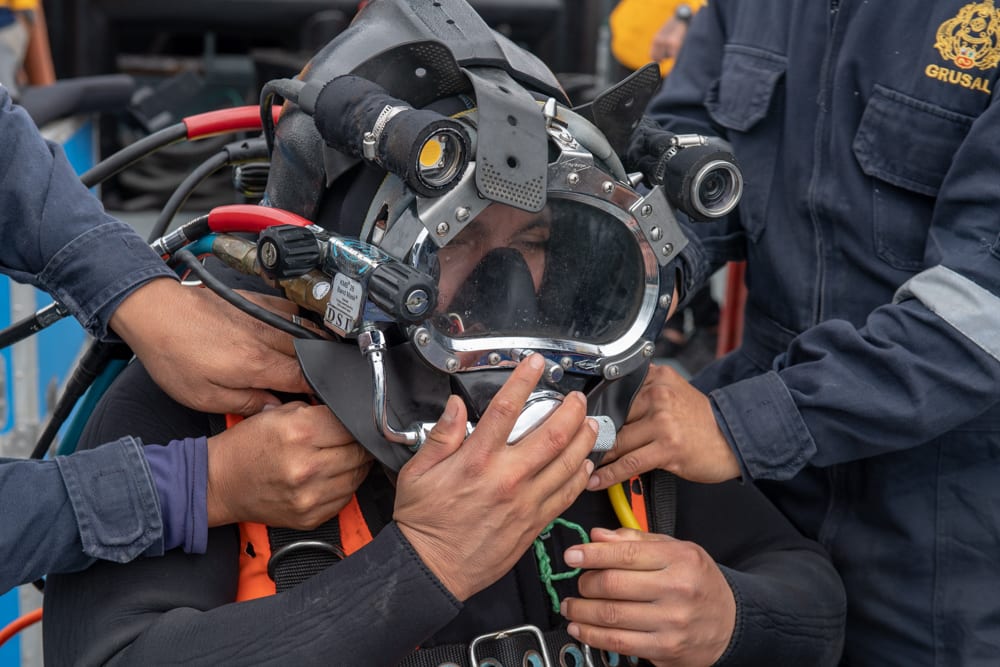
Peruvian navy divers check diving equipment prior to entering the water, during a subject matter expert exchange with U.S. Navy divers from Mobile Diving and Salvage Unit (MDSU) 2, as part of Southern Partnership Station 2019. Competition with Russia and China is spurring the United States to seek a global advantage through partnerships in Latin America. U.S. Navy / Mass Communication Specialist 1st Class Peter Lewis
ARLINGTON, Va. — Great power competition with an emerging China and a resurgent Russia is driving the United States to seek an all-domain, global positioning advantage, through alliances and partnerships in Latin America, the head of U.S. Southern Command (SOUTHCOM) says.
“Russia has interest in Cuba, Nicaragua and Venezuela, and some legacy interests in other [Western Hemisphere] countries,” U.S. Navy Adm. Craig Faller, said Jan. 14 at the Surface Navy Association Virtual Symposium. “Their interest really is to counter U.S. interest, while China’s interest “is economic dominance,” he said.
There are 31 countries in SOUTHCOM’s area of responsibility — Central and South America, south of Mexico, and the Caribbean Basin — 28 of them democracies, and the United States has good relations with most of them, the admiral said. However, China has been actively engaging several of those countries with economic and land deals leading to large infrastructure projects with possible military and diplomatic implications.
“Why would China want to achieve a deep-water seaport off El Salvador, Jamaica, perhaps the Dominican Republic?” Faller asked. “Their long term interest is economic dominance, and they’ll do what it takes,” he said.
“The Panama Canal is key terrain in all of this,” Faller said, noting China is negotiating deals for ports at either end of the canal. “South America has a positive water ratio and much, much excess arable land. China has none of that,” Faller said, noting that China “is working river access, energy access. Access to soybeans.
“Additionally, hundreds of Huawei systems are in place, in Latin American cities, well ahead of any competitor in that space,” Faller said. The Chinese telecom giant is the world’s second largest phone maker. American officials are concerned Huawei networks will give the Chinese government new avenues of surveillance. Huawei says that it does not spy for the Chinese government. The Pentagon is worried Chinese telephonic equipment sold to South American governments could make communication between the U.S. and partner nations less secure.
“The U.S. is responding in a good way with a clean network program by the State Department,” Faller said.
The best way to counter Chinese influence in Latin America and the Caribbean is to build and maintain military-to-military partnerships, continue joint naval exercises, cooperate in counter narcotics operations and maintain constant U.S. presence in the region, Faller said.
Admiral: Earlier Contract Awards to Help Shipyard Planning a ‘Sea Change’ for Navy
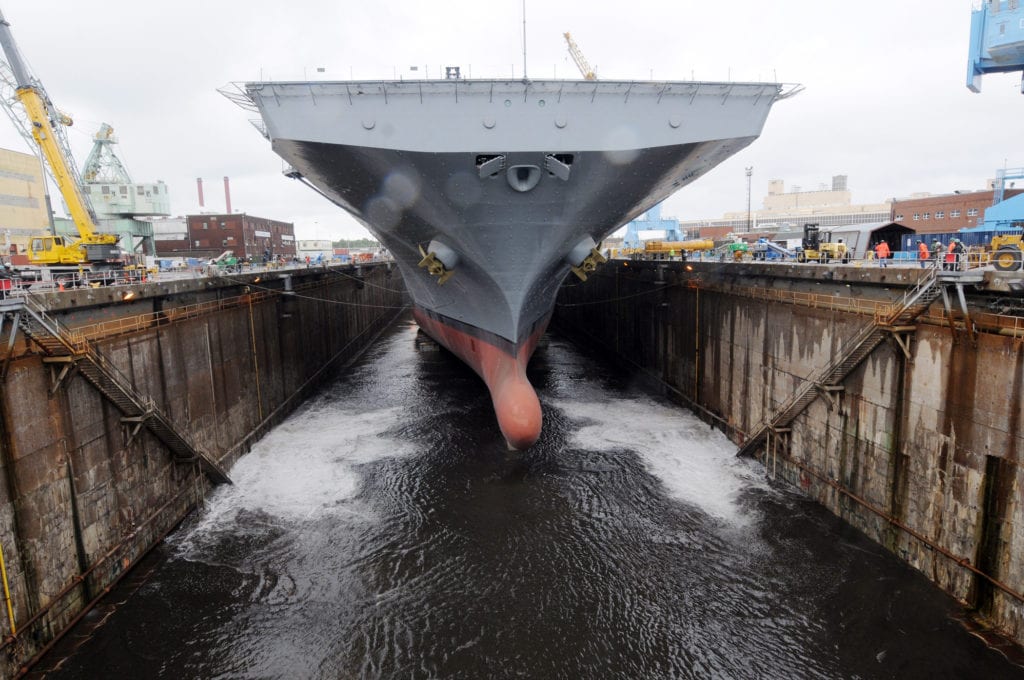
The amphibious assault ship USS Kearsarge is shown commencing a dry dock flooding operation at Norfolk Naval Shipyard in this 2009 photo. The Navy is moving to award ship maintenance contracts of at least 120 days in advance of the work, to help shipyards plan and order materials. U.S. Navy / Petty Officer 1st Class Emmitt Hawks Jr.
ARLINGTON, Va. — The Navy admiral in charge of maintenance of surface warships is pushing to award ship maintenance contracts at least 120 days in advance of the start of work in order to help shipyards plan the work and order materials and to improve the delivery time of ships back to the fleet.
“We are on track this year to award at an average 120 days prior to avail [availability, or maintenance period] start,” said Rear Adm. Eric Ver Hage, commander, Regional Maintenance Centers, speaking Jan. 14 in a webinar of the Surface Navy Association convention.
“That is a sea change for us,” Ver Hage said. “Just a couple of years ago we were averaging around 60 days. That time allows industry to plan, get subcontractors aboard, to develop a quality integrated master schedule, procure the materials that they need to execute the mission.”
Ver Hage also praised the use of horizontal bundling, where the shipyard leadership is given planning funds and involved in planning for a subsequent availability well in advance.
“The admiral said that as of Jan. 13, of the next 24 maintenance availabilities ahead, only one has long lead time material behind schedule “and we know by the use of data what corrective action we need to take.”
Ver Hage said that best value criteria have been applied to awarding most contracts.
“What that allows us to do is avoid a race to the lowest price that is technically acceptable,” he said. “That’s not always in our interests and it’s not always in industry’s interests. It’s harder to do; we have more training to take before we have all of the evaluation criteria.”
Ver Hage also advocates expanding rotatable pools of large ship components, such as propeller shafts, main reduction gear components and major diesel overhaul kits that take a long time to procure.
“We’d like to reduce time in dock and the time in the yard [overall],” he said. “If we can just pull out a shaft and stick a brand new one or a recently overhauled one in [the ship], vice including the overhaul time [of the shaft] in the overall project, that is where we want to be.”
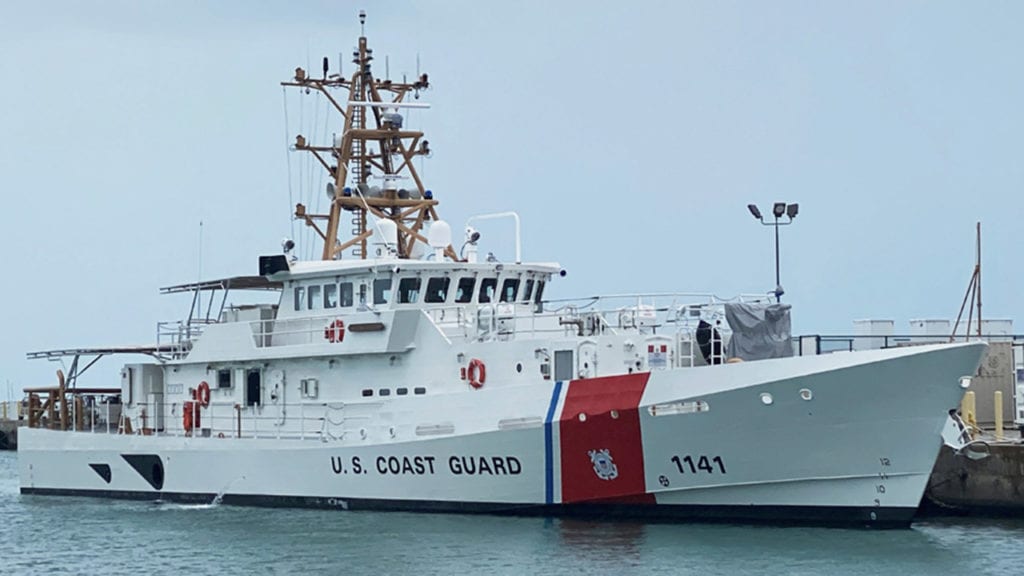
Bollinger Shipyards LLC delivered the USCGC Charles Moulthrope to the U.S. Coast Guard in Key West, Florida. This is the 41st Fast Response Cutter delivered under the current program. The FRC is the first of six to be home-ported in Manama, Bahrain, supporting the Patrol Forces Southwest Asia. Bollinger Shipyards
ARLINGTON, Va. — The U.S. Coast Guard will bring a less militaristic face to the persistent global presence of U.S. naval power outlined in the new Tri-Service Maritime Strategy, the Coast Guard’s commandant says.
The strategy, unveiled in mid-December, seeks an integrated, all-domain naval power consisting of the U.S. Navy, Marine Corps and Coast Guard, that will maintain freedom of navigation globally, defend the homeland and “prevail across a continuum of competition — composed of interactions with other nations from cooperation to conflict.”
The Tri-Services strategy focuses on an emerging China and resurgent Russia as “the most significant threats” to the rules-based international system that existed since the end of World War II.
“The Coast Guard is poised today, more than ever, to seamlessly integrate into our nation’s joint maritime naval force, as captured in this document,” Adm. Karl L. Schultz, the Coast Guard’s commandant, said Jan. 13 at the Surface Navy Association’s Virtual Symposium.
With its unique law enforcement and military authorities, multi-mission capabilities, wealth of multilateral and bilateral agreements and partnerships, the Coast Guard has unfettered access to the global commons, he added, making the agency “a perfect complement to the lethality of the Navy and Marine Corps. And united, we bring a range of maritime capabilities to employ across the cooperation, competition, lethality continuum.”
The Coast Guard operates generally below the level of conflict or lethality and that’s the bridge between “State Department diplomacy and Defense Department lethality,” Schultz said. “Coast Guards offer a less militaristic face of state power in disputed maritime areas. They present options. They’re like Swiss Army Knives,” he said.
Other maritime nations have also recognized the agility and capability of their coast guards to operate along this continuum below lethality, Schultz said. Between 2010 and 2016, China increased the tonnage of its Coast Guard by 73% percent, and Japan did so by 50%, he said, citing RAND Corp. research.
While the U.S. Coast Guard is part of the Department of Homeland Security, charged with law enforcement at sea, fisheries protection, marine safety and maritime security, the tri-service strategy noted Navy and Coast Guard ships conduct freedom of navigation operations globally, challenging excessive and illegal maritime claims. Coast Guard cutters and law enforcement detachments aboard Navy and allied ships exercise unique authorities to counter terrorism, weapons proliferation, transnational crime and piracy, the strategy document stated.
Coast Guard cutters have supported all six combatant commands from Indo-Pacific Command to Africa Command, Schultz said, noting the next commissioned Fast Response Cutter will be the first of that class sent to Bahrain. “We’ve been operating in that theater since 2003 and we will bring additional capabilities and additional capacity with these new cutters,” he said.
The Coast Guard’s fleet modernization, including acquisition of the Offshore Patrol Cutter, Polar Security Cutter, Arctic Security Cutter and Waterways Commerce Cutter, will provide the capacity and capabilities necessary to facilitate advancing maritime governance and protecting U.S. maritime sovereignty, according to the strategy document.
Wolfe: Navy Plans to Start Development of Nuclear Sea-Launched Cruise Missile in 2022
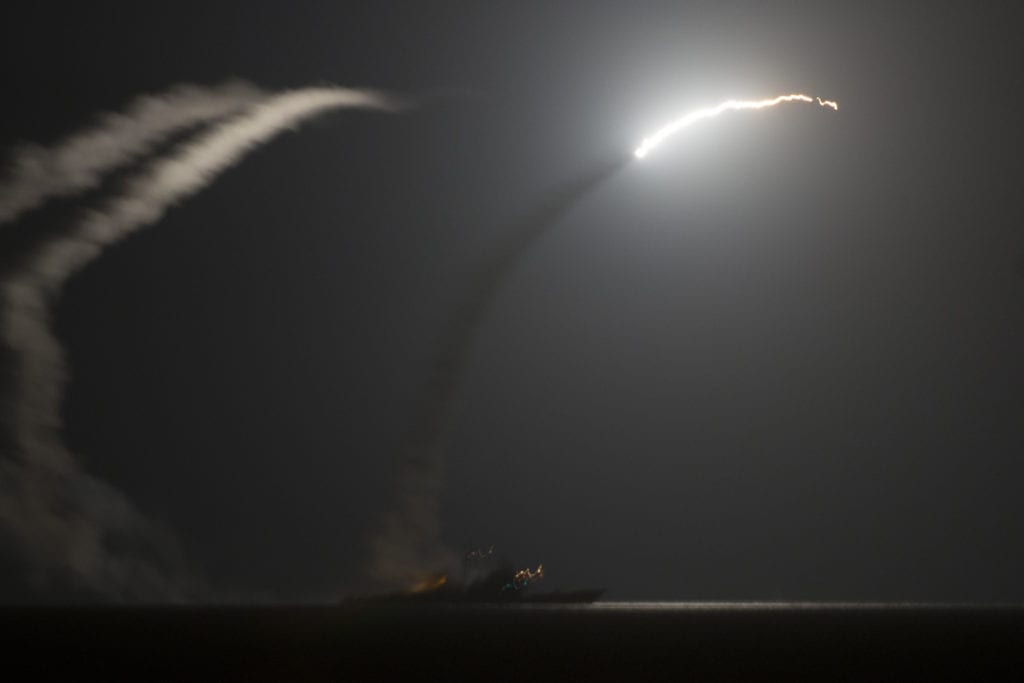
The USS Philippine Sea launches a Tomahawk cruise missile to conduct strikes against ISIL targets as seen from the aircraft carrier USS George H.W. Bush in this 2014 photo. The DoD’s previous nuclear-armed cruise missile was based on the Tomahawk, but development of a new one is expected to begin in 2022. U.S. Navy / Mass Communication Specialist 1st Class Eric Garst
ARLINGTON, Va. — The Navy plans to wrap up an analysis of alternatives (AoA) for a ship-launched nuclear-armed cruise missile in 2021 and begin development of the missile in 2022, said the admiral in charge of strategic weapons .
“We will finish the AoA this year per what was required by the NDAA [National Defense Authorization Act],” said Vice Adm. Johnny Wolfe Jr., director, Strategic Systems Programs, speaking Jan. 14 in a Nuclear Deterrence Forum webinar sponsored by the Mitchell Institute for Aerospace Studies, a Washington think tank. “With that AoA, going forward and with the Department of Defense’s concurrence, design would start in [fiscal] ’22.”
The Defense Department’s (DoD’s) 2018 Nuclear Posture Review (NPR) said the department would pursue a Sea-Launched Cruise Missile – Nuclear (SLCM-N), “leveraging existing technologies to help ensure its cost effectiveness. SLCM will provide a needed non-strategic regional presence, an assured response capability. It also will provide an arms-control compliant response to Russia’s non-compliance with the Intermediate-range Nuclear Forces Treaty, its non-strategic nuclear arsenal, and its other destabilizing behaviors.”
The review asserted that a SLCM “will not require or rely on host nation support to provide deterrent effect. They will provide additional diversity in platforms, range, and survivability, and a valuable hedge against future nuclear ‘break out’ scenarios.
“In the 2010 NPR, the United States announced the retirement of its previous nuclear-armed SLCM, which for decades had contributed to deterrence and the assurance of allies, particularly in Asia,” the 2018 NPR said. “We will immediately begin efforts to restore this capability by initiating a capability study leading to an Analysis of Alternatives (AoA) for the rapid development of a modern SLCM.”
The previous nuclear-armed SLCM was a version of the Tomahawk cruise missile.
Wolfe said the strategic Systems Program Office will be briefed “up through the Navy and OSD [Office of the Secretary of Defense] which will eventually go to the CAPE [Cost Assessment and Program Evaluation]. Based on what the AoA says would be the right course of action to have a sea-launched cruise missile, then we would start taking whatever the AoA said and then start to look how would I design it, how would I start to integrate it.”
The Navy would request funds in the fiscal 2022 budget to develop the SLCM-N based on the decision of the DoD.