USCG Heavy Icebreaker Departs Seattle for Months-Long Deployment to Antarctica
USCGC Polar Star (WAGB 10) is seen moored ahead of deploying for Operation Deep Freeze 2026, Seattle, Nov. 20, 2025. Operation Deep Freeze is a joint service, inter-agency support operation for the National Science Foundation, which manages the United States Antarctic Program. (U.S. Coast Guard photo by Petty Officer 3rd Class Christopher Bokum)
SEATTLE — The USCGC Polar Star (WAGB 10) departed Seattle on Thursday commencing its 29th deployment to Antarctica in support of Operation Deep Freeze.
Operation Deep Freeze is an annual joint military mission to resupply the United States Antarctic stations in support of the National Science Foundation (NSF), the lead agency for the United States Antarctic Program. Historic investment in the Big Beautiful Bill of nearly 25 billion, $9 billion of which is specifically for icebreakers and infrastructure in the high latitudes. This massive investment in icebreakers will secure U.S. access, security, and leadership in the polar regions.
As the U.S. Coast Guard prepares to revitalize its icebreaking fleet, the Polar Star remains the only U.S. vessel capable of breaking a navigable channel through the ice to reach McMurdo Station, the largest Antarctic station and the logistics hub of the U.S. Antarctic Program.
Each year, the cutter serves a vital role in ensuring surface access for fuel and supply ships through the Ross Sea to resupply the U.S. Antarctic bases. Polar Star’s mission directly protects the security, freedom, and prosperity for the U.S., our allies and partners.
“Polar Star’s crew does remarkable work maintaining and operating this ship,” said Capt. Jeff Rasnake, commanding officer of Polar Star. “Each year brings unique challenges, and I’m proud to say this crew has risen to meet them all. The way we’ve come together over the course of maintenance, and our logistical preparations is exciting as we enter the operational phase of our annual deployment cycle.”
Commissioned in 1976, Polar Star is 399 feet, weighing 13,500 tons with a 34-foot draft. Despite reaching nearly 50 years of age, Polar Star remains the world’s most powerful non-nuclear icebreaker with the ability to produce up to 75,000 shaft horsepower.
The continuous effort Polar Star’s crew commits to maintaining the aging cutter ensures the nation’s access to the continent and the economic, environmental, and national security interests in the high latitudes. Polar Star will continue to support Operation Deep Freeze until new Polar and Arctic Security Cutters enter service in the coming decade.
Since 1955, Active, Reserve, and Guard members of the U.S. Coast Guard, Air Force, Navy, and Army have proudly supported the USAP by the air and sea lift of supplies to McMurdo Station.
Coast Guard Cutter Tampa Returns Home After 67-Day Counterdrug Patrol
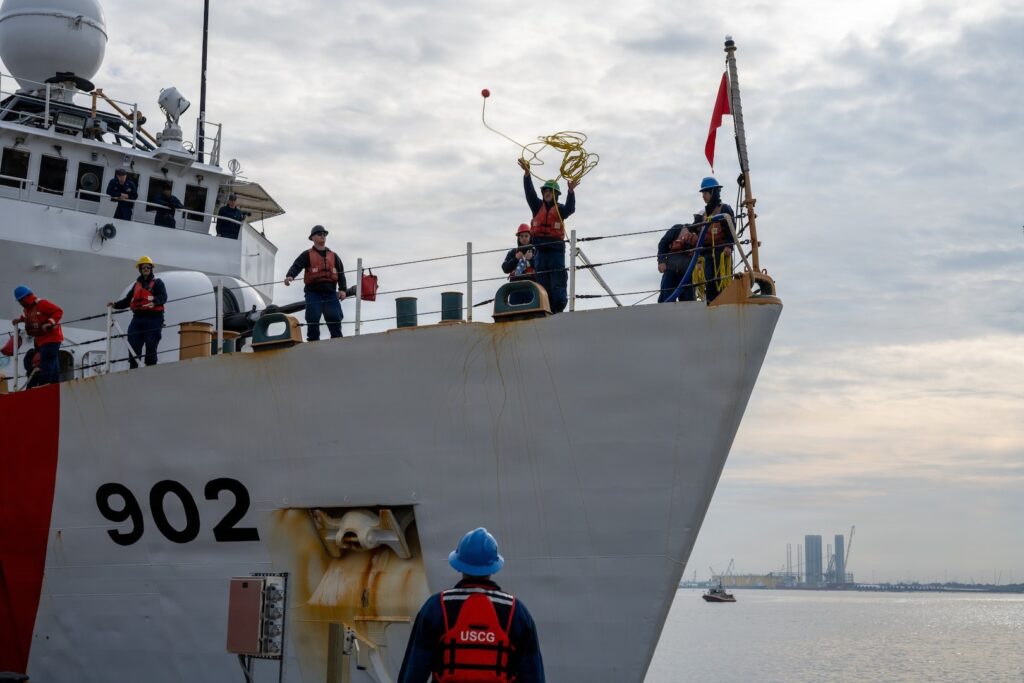
The Coast Guard Cutter Tampa (WMEC 902) returns home to Portsmouth, Virginia, Nov. 21, 2025, following a 67-day deployment. Tampa’s crew deployed in support of counterdrug operations in the Eastern Pacific. (U.S. Coast Guard photo Petty Officer 3rd Class Mason Svitenko)
PORTSMOUTH, Va. — The crew of Coast Guard Cutter Tampa (WMEC 902) returned to their homeport in Portsmouth, Friday, following a 67-day deployment to the Eastern Pacific Ocean in support of the counterdrug mission “Operation Pacific Viper.”
Tampa’s crew deployed in support of Joint Interagency Task Force – South and conducted counterdrug missions in the Coast Guard’s Eastern Pacific area of responsibility. While at sea, Tampa’s crew successfully contributed to protecting Americans by countering transnational criminal organizations and preventing dangerous and illegal narcotics from reaching the United States. The crew worked alongside Coast Guard Cutter Stone (WMSL 758) and their embarked Helicopter Interdiction Tactical Squadron.
On Oct. 8, approximately 270 nautical miles southeast of the Galapagos Islands, Tampa intercepted a 40-foot low-profile vessel suspected of carrying Illicit narcotics. Tampa’s crew intercepted three suspected smugglers, transferring them to Stone. After recovering about 620 kilograms of the cocaine, the boarding team disembarked because the vessel became unseaworthy after it started taking on water. Tampa’s crew conducted a controlled sinking to prevent the vessel from becoming a hazard to navigation.
Tampa made port calls in San Cristobal, Galapagos Islands, hosting members of the Ecuadorian coast guard for tours, and in Panama City, Panama. On Nov. 2, the crew anchored near Isla de Cocos, Costa Rica, exchanging professional experiences with Costa Rican park rangers. This exchange strengthened international relations with Costa Rica and demonstrated the Coast Guard’s commitment to building partnerships throughout the region.
“I am extremely proud of our crew’s dedication and professionalism during this challenging deployment,” said Cmdr. Joshua DiPietro, commanding officer of Tampa. “The Tampa crew displayed exceptional seamanship, tactical expertise and cultural sensitivity while operating across two oceans. Their efforts directly contributed to disrupting criminal networks, keeping dangerous narcotics from reaching American communities and strengthening vital partnerships with our regional partners.”
Tampa is a 270-foot Famous-class medium endurance cutter commissioned in 1984. The cutter’s primary missions include counterdrug and migrant interdiction operations, enforcement of federal fishery laws, and search and rescue operations in support of Coast Guard missions throughout the Western Hemisphere. Tampa operates under U.S. Coast Guard Atlantic Area, based in Portsmouth, Virginia.
Flank Speed Wireless Supports POTUS, Sailors, Sea Power Demonstration
Flank Speed Wireless, born as a Sailor quality-of-life upgrade, proved its strategic power when it quietly enabled secure, seamless communications for the President and First Lady during the Navy’s 250th Birthday celebration at sea.
When the President and First Lady of the United States stepped aboard USS George H. W. Bush (CVN 77) to celebrate the Navy’s 250th Birthday during a high-profile Sea Power Demonstration, much of the world was watching. Behind the scenes, ensuring seamless and secure communications for the Commander-in-Chief and his team was a quiet but powerful capability: Flank Speed Wireless (FSW), formerly known as Sailor Edge Afloat and Ashore (SEA2), a capability led and delivered by Program Executive Office for Digital and Enterprise Services (PEO Digital).
Originally developed to provide Sailors with reliable wireless connectivity at sea, FSW proved to be more than a quality-of-life initiative, it became a mission-critical enabler. During the President’s visit and subsequent speech aboard USS Harry S. Truman (CVN 75), FSW allowed the White House Communications Agency (WHCA) to integrate with shipboard technologies to maintain secure communications for the President, First Lady, White House Military Office, U.S. Secret Service, and senior Department of Defense leadership.
“This event proved that our investments in Sailor-focused digital infrastructure are also strategic assets,” Navy Enterprise Networks (NEN) Deputy Director, Capt. Frederick Crawford said. “Flank Speed Wireless was designed to serve Sailors, and it’s now proving itself mission-critical in high-stakes national operations.”
From MWR to Mission Enabler
FSW began as SEA2, an afloat connectivity initiative launched by PEO Digital as part of the “Get Real, Get Better” campaign. The aim: improve Sailor quality of life, especially during extended deployments, by providing secure, reliable internet access in shipboard environments.
This capability directly addressed persistent challenges related to Sailor isolation, morale, and mental health, and was shaped around the realities of life underway.
“This started as a pilot effort between our afloat Sailors and the engineering community,” said Capt. Kevin White, now Program Manager for PMW 770. “As the Combat Systems Officer aboard the USS Abraham Lincoln, I worked closely with our engineers to design a wireless capability that could actually function in the complex environment of a carrier. We designed Flank Speed Wireless from the deckplates up, built by Sailors for Sailors. Together, we ensured not only the design, but also the security and authorization needed to scale it rapidly across the fleet. What began on a single carrier quickly became a Navy-wide capability through the World Class Alignment Metrics [WAM] initiative.”
“We created Flank Speed Wireless to reduce barriers for Sailors trying to stay connected to family and support networks while deployed,” said FSW Architect, Damon Regan. “It’s a small capability with an outsized impact on mental resilience and readiness.” With installations now underway across the fleet, FSW’s infrastructure is not only improving quality of life, it is enabling fleet-wide operations at the highest level.
Engineering the Presidential Visit
Supporting the President’s embark required close collaboration across the fleet. PEO Digital, together with shipboard IT teams and mission partners, ensured that secure and resilient communications capabilities were in place throughout the event.
In a dynamic and time-constrained environment, the Flank Speed Wireless team executed a series of critical readiness activities to confirm that all necessary systems were prepared and functioning ahead of the Presidential party’s arrival.
“This kind of real-time responsiveness is only possible because of the groundwork we laid with Flank Speed Wireless,” said FSW Product Owner, Brad Terry. “We didn’t build this just to check a box, we built it to meet real-world mission demands, and that’s exactly what it did.”
A Blueprint for Fleet Modernization
PEO Digital’s success with FSW reflects a broader approach to digital modernization, one that starts with Sailors, scales for operations, and adapts to strategic demand.
“The Flank Speed Wireless story shows what happens when we focus on real user needs and deliver with urgency,” Program Executive Officer Louis Koplin said. “That’s what Get Real, Get Better is about, and it’s what digital modernization across the Navy must be.”
Whether enabling a Sailor to video call home or supporting secure comms for the Commander-in-Chief, PEO Digital’s Flank Speed Wireless stands as a powerful example of what agile, user-centered delivery can achieve for the Navy.
About PEO Digital
The Program Executive Office for Digital and Enterprise Services (PEO Digital) delivers services throughout the Department of the Navy that improve performance, security, mobility, and customer experience. PEO Digital embraces business agility to ensure quality, accelerate innovation, continuously deliver value, and meet the dynamic needs of the warfighter.
Our mission is to provide the Marine Corps and Navy with a decisive information advantage through a modern, innovative, and secure digital experience – any data, any time, anywhere.
Our vision is to deliver a world-class digital experience at the speed of mission.
CORAS Awarded ONR Contract to Advance Navy Leadership Assessment, Behavioral Modeling
MCLEAN, Va.– November 25, 2025: CORAS, the only IL5-authorized Agentic AI Decision Intelligence platform in the Department of War (DoW), announced today that it has been awarded a contract with the Office of Naval Research (ONR) to enhance and unify the Navy’s leadership assessment and behavioral modeling capabilities through the Talent Management Nexus effort in support of Naval Personnel Command’s Talent Management Center of Excellence.
This award expands CORAS’s growing portfolio of U.S. Navy partnerships, following its successful deployment of the “Leader’s Compass” application at the U.S. Naval Academy. Under the new ONR contract, CORAS will configure its secure, low-code platform to deliver a unified web application supporting leadership assessment, behavioral modeling, and performance tracking across the fleet.
“This CORAS collaboration will provide the U.S. Navy with a single, data-driven view of potential leadership and development across the force,” said Dan Naselius, President and CTO of CORAS. “By combining IL5-secure Decision Intelligence with behavioral science, the Navy can modernize and optimize how it nurtures, identifies, develops, and deploys its future officers and leaders.”
Through this effort, CORAS will enable ONR to orchestrate and integrate data across multiple Navy systems in real time; administering assessments, conducting automated analyses with built-in Agentic AI, natural language processing (NLP) and machine learning (ML), and visualizing Sailor performance through dynamic briefs. These features will allow the Navy to track leadership growth over time, refine behavioral models, challenge program efficiency and effectiveness, and continuously improve the development processes for all Sailors.
The CORAS platform built on a FedRAMP High and IL5 environments supports advanced security controls, multi-user access for administrators, panelists, and participants, and seamless integration with the Authoritative Data Environment (ADE) and other MyNavy HR data sources. As a Commercial-Off-The-Shelf (COTS) solution, CORAS is rapidly configured and deployed within days, providing immediate operational value to ONR and the Navy’s Manpower, Personnel, Training, and Education Information Sciences (MPTE-IS) portfolio.
“The ONR award underscores CORAS’s expanding role as a trusted enabler of data-driven decision and readiness SaaS platform within the Department of War,” said Moe Jafari, CEO of CORAS. “From the PMO to the Pentagon, CORAS empowers the U.S. Navy to harness its data, identify future leaders, and make faster, more informed decisions.”
CORAS and its Agentic Agent GARY operate at IL5 and FedRAMP High in government environments including NIPR and SIPR, offering profound ROI and 50+x productivity. Agencies can acquire CORAS and GARY through GSA, NASA SEWP, SBIR Phase III, Tradewinds AI Marketplace, Carahsoft, and AWS partner channels. Learn more at www.coras.ai.
First Air Force T-38 Talon Arrives at Fleet Readiness Center Southeast for Overhaul and Repair
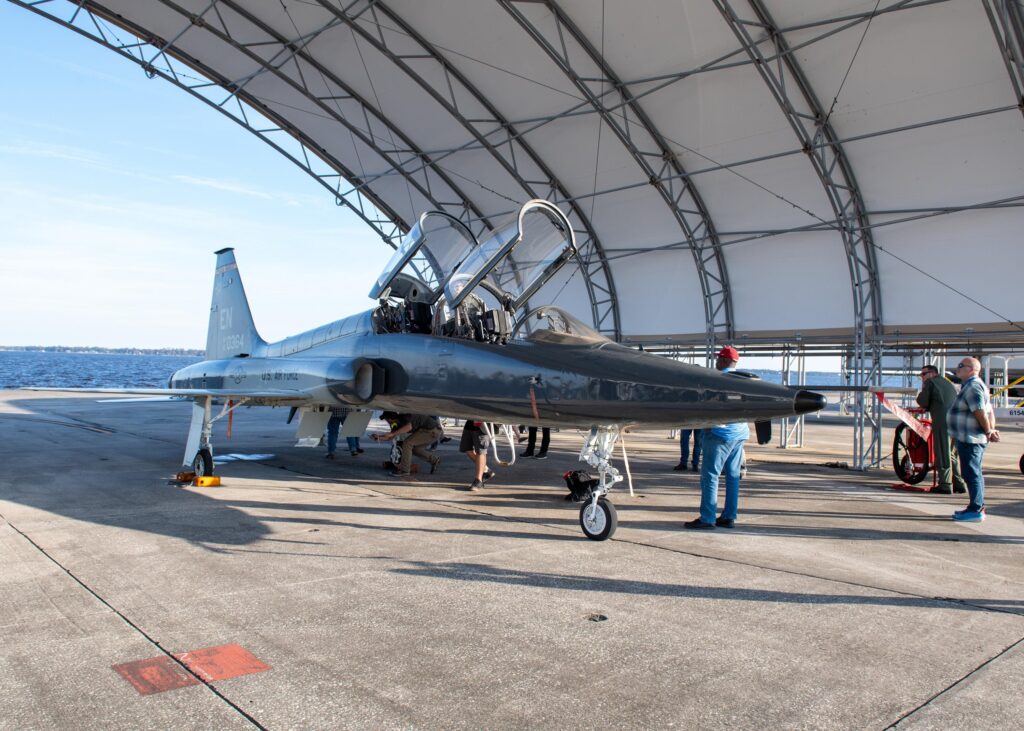
An Air Force T-38 Talon arrives at Fleet Readiness Center Southeast (FRCSE). This is FRCSE’s first T-38, which will undergo overhaul and repair as part of the Talon Repair, Inspection, and Maintenance program (TRIM). The TRIM program is an Air Force repair initiative that involves inspecting and replacing key structural components across the entire T-38 fleet, with the goal of extending the operational life of the aircraft by five to 10 years. (U.S. Navy photo byToiete Jackson)
JACKSONVILLE, Fla. — The first Air Force T-38 Talon aircraft arrived at Fleet Readiness Center Southeast (FRCSE) Nov. 24 for overhaul and repair as part of the Talon Repair, Inspection and Maintenance program (TRIM).
The TRIM program is an Air Force repair initiative that involves inspecting and replacing key structural components across the entire T-38 fleet, with the goal of extending the operational life of the aircraft by five to 10 years.
Currently, the Air Force performs the bulk of T-38 TRIM repairs at its aviation depot facility at Joint Base San Antonio-Randolph, Texas. In August 2024, Air Force representatives from the T-38 Program Office reached out to FRCSE to see if it could take a portion of the workload.
“When the Air Force asked us if we could support working on their T-38s, our team took a hard look at it and agreed we could assist,” said Capt. Mike Windom, FRCSE commanding officer. “Taking on this workload is another testament to our workforce’s commitment to doing whatever it takes to support our nation’s warfighters.”
The T-38 Talon is a twin-engine, high-altitude, supersonic jet trainer used in a variety of roles. The Air Force uses the T-38 to prepare pilots to fly front-line fighter and bomber aircraft.
“The Air Force has approximately of 270 aircraft they need to perform the TRIM package on by 2030, with the goal being 50 inductions per year,” said Paul Skinner, an FRCSE business management specialist. “FRCSE is going to take on a portion of those aircraft inductions to help them reach that goal.”
Since August 2024, more than 160 process engineers, logisticians, components and manufacturing experts, production leaders and support personnel from FRCSE have been working together and with Air Force representatives to ensure the command had the necessary support equipment, technical data, software and qualifications to ensure the command was prepared to work on the new airframe. Additionally, FRCSE personnel made several visits to both Air Force and NASA T-38 repair sites to see maintenance and repair operations firsthand.
“During the visit to El Paso to visit the NASA facility, their sheet metal mechanics were especially helpful,” said Troy James, an FRCSE sheet metal mechanic. “They took the time to walk me through several areas of the aircraft, explain component layouts and share practical knowledge of their day-to-day work.”
The bulk of the TRIM work at FRCSE will be performed by seasoned artisans who already have a wide range of experience working on a very similar aircraft, the F-5 Tiger II. While the two aircraft are not the same, they possess enough similarities that some of the tools and support equipment can be used on both airframes, which gives the F-5 artisans a leg up in starting their work on T-38.
“We discovered that while the F-5 and T-38 share similarities, they can also differ significantly, which requires us to be cautious to avoid confusion,” said Steve Clayton, FRCSE’s F-5/T-38 ground check supervisor.
In October, Naval Air Systems Command, Maryland, designated FRCSE as a secondary Depot Source of Repair for the T-38, which authorized the command to perform the requested repair work.
“There’s been a lot of work put into getting to this point,” said Skinner. “We submitted over 180 pieces of support equipment to our manufacturing and plant services departments for them to make from scratch to ensure our artisans have the right equipment. This included things such as wiring harnesses, fixtures, and installation and removal tools.”
The FRCSE T-38 capability establishment team has been working over the past 15 months to ensure the command was ready to receive its first T-38, and the arrival of the first aircraft felt like the culmination of the team’s efforts.
FRCSE expects to induct a second aircraft later this year with the production line ultimately growing to six inductions per year.
About Fleet Readiness Center Southeast
Fleet Readiness Center Southeast (FRCSE) is Northeast Florida and Southeast Georgia’s largest maintenance, repair, overhaul and technical services provider, employing approximately 5,000 civilian, military and contract workers. The organization serves as an integral part of the greater U.S. Navy, Naval Air Systems Command, and Commander, Fleet Readiness Centers by maintaining the combat airpower for America’s military forces.
Dahlgren Division Engineers Capture First Live Data on Projectile and Shockwave Interaction
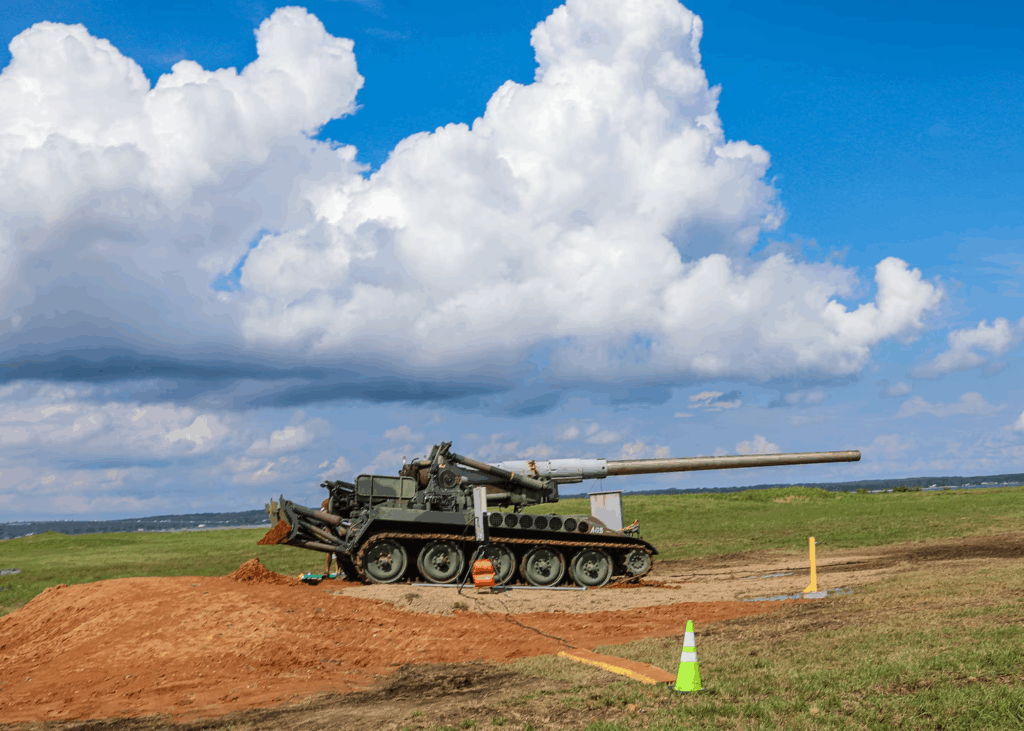
DAHLGREN, Va. – Naval Surface Warfare Center Dahlgren Division scientists and engineers used a M110 Howitzer modified with a 155 mm barrel to launch projectiles traveling nearly four times the speed of sound toward controlled blasts of 30 to 100 pounds of dynamite. The groundbreaking test was used to study how shockwaves affect high-speed rounds. (NSWCDD Photo)
By Kristin Davis, NSWCDD Corporate Communications, Nov. 21, 2025
DAHLGREN, Va. – Naval Surface Warfare Center Dahlgren Division recently fired high-speed projectiles into timed explosions to study how shockwaves affect high-speed rounds in a groundbreaking test.
Over two days, a team of scientists and engineers at Dahlgren Division used a M110 Howitzer modified with a 155 mm barrel to launch projectiles traveling nearly four times the speed of sound toward controlled blasts of 30 to 100 pounds of dynamite.
“We took a high-speed projectile and did what Dahlgren does best — we shot it from a gun,” said Lyn Thomas, Distinguished Scientist for Surface Engagement Systems (Acting) at NSWCDD. “The new part was studying what happens when the projectile meets a blast wave mid-flight.”
The mission was practical: gathering data to improve computer models that simulate missile and blast behavior.
Coordinating the projectile’s flight with the explosion’s detonation required split-second accuracy.
“As we prepared for the test, there was very little question if we could get the projectile to fly where we wanted it to fly and very little question if we could get the explosive to detonate at the right time,” Thomas said. “It was really about whether we could get those two things to coincide at the right time and place.”
Because the team was using shadowgraphy, a high-speed imaging technique that makes normally invisible shockwaves visible and allows engineers to see how the blast moves around a fast-moving projectile, “we had only a tiny window where everything had to line up perfectly,” he said.
To prepare, the team conducted a series of practice firings and static detonations before the main event. During the final shots, onboard sensors and high-speed cameras recorded how the shockwave and projectile interacted — data never captured during a live-fire event.
Everything used in the test, from the launch package to the projectile’s internal electronics that collect and transmit data, was designed and built at NSWCDD, Thomas said. “We did all of it right here at Dahlgren.”
The experiment took place at Pumpkin Neck, a range typically used for explosive warhead testing. Because this project required both gun firing and controlled detonations, Dahlgren Division combined two of its specialties — precision gun testing and high-explosive research — in one operation.
The team was able to conduct two to three instrumented shots per day, producing an exceptional amount of data quickly and affordably.
Though the test itself occurred over two days, safety planning took nearly a month. Engineers analyzed every possible outcome — from flight path variations to failed detonations — and designed multiple safety layers into the setup, Thomas said, “We analyze every possible failure mode and build in layers of protection. Each successful test builds confidence in our process — but nothing ever gets rubber-stamped.”
For Thomas, the experiment highlights the range of talent and collaboration across NSWCDD’s workforce.
“The interesting thing about Dahlgren is we’re over here doing this type of testing, and across base people are doing computer programming on very complex systems and combat systems work. There is just such a variety of work going on to support the Navy and support all our activities,” Thomas said. This was a test for a customer outside of the Navy, but they sought us out for our expertise, our ability to execute the test and build the projectile with onboard data to get the data they need. This is an example of Dahlgren expertise that can be applied across the board, which I find very rewarding.”
Navy Awards SAIC $242M Contract to Operate, Maintain, Upgrade Propulsion Test Facility
From SAIC, Nov. 24, 2025
Contract enables essential operations of Navy’s premiere undersea weapon facility, including testing & production of Mk 48, Mk 45, UUV, sensors and more
RESTON, Va., Nov. 24, 2025 (GLOBE NEWSWIRE) — Science Applications International Corp. (NASDAQ: SAIC) has been awarded a $242 million contract by the Naval Undersea Warfare Center Division, Newport (NUWCDIVNPT) to enable the continued operation, maintenance and modernization of the Propulsion Test Facility (PTF), in support of the Undersea Warfare (USW) Weapons, Vehicles and Defensive Systems Department.
The U.S. Navy’s award of this 5-year, follow-on contract underscores their trust in SAIC’s engineering, technical and logistics experts to sustain, modernize and optimize the PTF’s complex mission environment. This includes multiple specialized testing facilities for torpedo components, submarine systems and propulsion technologies, such as the Deep Depth Test Facility, the Navy’s only land-based testing system capable of evaluating an Mk 48 torpedo afterbody throughout its entire operational envelope.
“Supporting the Propulsion Test Facility and the Navy’s torpedo enterprise as a mission integrator has given SAIC the opportunity to deliver innovation directly where our customers need it most—from Mk 48 production to advanced test-equipment design and other critical programs across NUWC Division Newport. For more than a decade, we’ve partnered closely with the PTF to help it grow and modernize, strengthening our own capabilities to better serve the Navy,” said Barbara Supplee, SAIC executive vice president of the Navy Business Group. “This new contract allows us to further support our customers through next-generation torpedo test-set production for domestic and FMS maintenance facilities. Our success reflects SAIC’s customer-driven, technology-forward mission integration approach to solving the Navy’s toughest challenges and the strength of our engineering, technical, and logistics teams. We’re committed to helping the U.S. Navy sustain the world’s most advanced undersea weapons advantage.”
Under the contract, SAIC will provide testing, Torpedo Test Equipment and Engineering and Technical services in the operation, maintenance and upgrading of facilities that comprise the NUWCDIVNPT PTF Complex in support of the MK 48 Heavyweight Torpedo, MK 54 Lightweight Torpedo, Undersea Targets and Sensors, Unmanned Underwater Vehicles and Submarine Sensors and Equipment. The company will deliver engineering and technical services, including prototyping, systems integration and digital engineering to ensure the PTF remains capable of supporting emerging Navy research and development needs.
U.S., Qatar and Allies Enhance Regional Defense During Exercise Ferocious Falcon 6
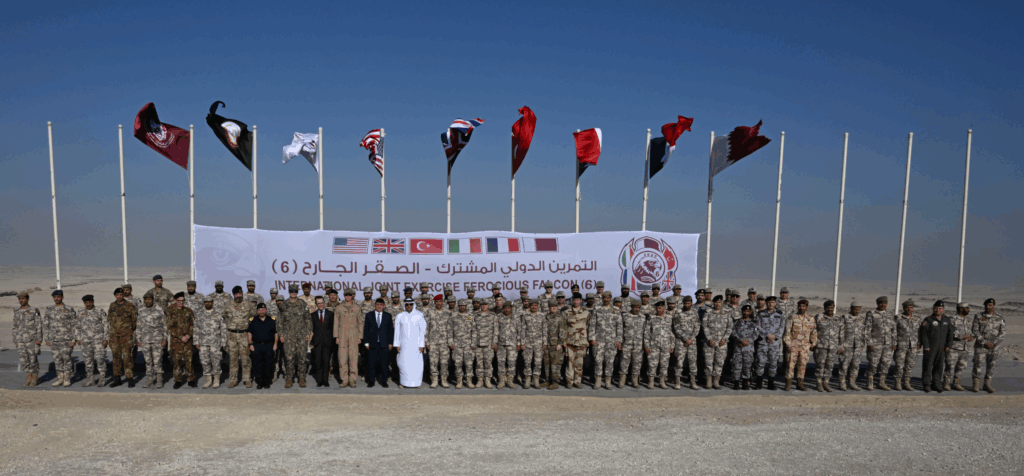
Senior military leaders from the U.S., Qatar, Italy, the United Kingdom, Turkey and France attend the exercise Ferocious Falcon 6 live-fire demonstration within the U.S. Central Command area of responsibility, Nov. 20, 2025. Ferocious Falcon 6 is a biennial, Qatar-hosted multinational joint exercise designed to enhance lethality and combat efficiency among U.S. and allied forces. (U.S. Air Force photo by Senior Master Sgt. Richard P. Ebensberger) (Photo by Senior Master Sgt. Richard P. Ebensberger)
By Ninth Air Force (Air Forces Central) Public Affairs and Fifth Fleet (U.S. Naval Forces Central Command) Public Affairs | November 22, 2025
AL UDEID AIR BASE and UMM AL-HOUL NAVAL STATION, Qatar (Nov. 22, 2025) – More than 1,300 military personnel from the U.S., Qatar, Italy, United Kingdom, Turkey and France participated in Exercise Ferocious Falcon 6, a biennial, Qatar-hosted multinational joint exercise, Nov. 16-20.
“Exercise Ferocious Falcon 6 showcased our ability to operate as a unified, lethal and agile force against regional threats,” U.S. Navy Commander Joseph W. Hontz, U.S. Naval Forces Central spokesperson, said. “Our commanders and battle staff received valuable training on the critical aspects of planning and management and using integrated command and control systems for effective unified operations, in order to enhance our collective combat readiness while building crucial partnerships across air, land and sea domains throughout the Middle East.”
Both U.S. air and naval assets participated in the multi-domain exercise, which included a Bomber Task Force integration to demonstrate global power and a stake in the region, as well as surface, air and expeditionary forces, who executed multiple field exercises and maritime drills.
Ferocious Falcon 6 integrated cutting-edge technology and methodologies to address modern challenges. The exercise was an opportunity for information-sharing across warfare domains and exemplifies partner nations’ shared commitment to adapting collective defense strategies in order to safeguard and strengthen regional commitments.
“This exercise is as much about building relationships as it is about tactics and operations,” U.S. Air Force Maj. Katrina J. Cheesman, U.S. Air Forces Central spokesperson, said. “By exercising our shared defense capabilities, the United States and its regional partners seek to sustain trust, stabilize the Middle East, and reinforce the principles of peace and cooperation fundamental to rules-based international order.”
Designed to enhance lethality and combat efficiency among allied forces, Ferocious Falcon 6 further solidified the enduring partnership between the U.S., Qatar and its allies by focusing on interoperability, warfighting readiness and overall maritime security in the region. The exercise provided vital training opportunities for all participants to test collaborative techniques within the U.S. Central Command area of responsibility.
Training opportunities encompassed a command post exercise to train on integrated command-and-control; combined field training exercises involving multiple nations’ land, air and naval forces; air interdiction, escort and defensive counter-air training; tactical combat casualty care cross training; and Visit, Board, Search, and Seizure rehearsals among partners.
U.S. Air Force assets were comprised of F-16 Fighting Falcons, KC-135 Stratotankers and a B-52 Stratofortress, while U.S. Naval Forces assets included the Independence-class littoral combat ship USS Tulsa (LCS 16), the fast-response cutter USCGC Clarence Sutphin Jr. and one P-8A Poseidon maritime patrol and reconnaissance aircraft.
Ferocious Falcon 6 aimed to advance the operational capabilities of participating forces, strengthen coordinated defense strategies, and expand capabilities in maritime security and infrastructure protection. The exercise has evolved over the years to become a cornerstone of U.S.-Qatar and allied security cooperation.
Navy Relieves USNA Commandant of Midshipmen
From U.S. Naval Academy Public Affairs, Nov. 24-2025
ANNAPOLIS, Md.- United States Naval Academy SuperintendentLt. Gen. Michael Borgschulte relieved the Commandant of Midshipmen Capt. Gilbert Clark Jr. today due to a loss of confidence in his ability to effectively lead the Brigade of Midshipmen.
The naval service maintains the highest standards for leaders and holds them accountable when those standards are not met.
Clark assumed the role as Commandant of Midshipmen in June 2025. Capt. Austin Jackson, Deputy Commandant of Midshipmen, has assumed duties as the interim Commandant.
The Naval Academy Commandant is responsible for the day-to-day conduct, military training, and professional development of approximately 4,400 midshipmen.
For questions related to this release, please contact United States Naval Academy Public Affairs at [email protected].
HII Delivers Virginia-Class Submarine Massachusetts (SSN 798) to U.S. Navy
NEWPORT NEWS, Va., Nov. 21, 2025 (GLOBE NEWSWIRE) — HII (NYSE: HII) announced today that its Newport News Shipbuilding division has delivered Virginia-class fast-attack submarine Massachusetts (SSN 798) to the U.S. Navy.
Massachusetts is the 12th Virginia-class submarine delivered by NNS, and the 25th built as part of the teaming agreement with General Dynamics Electric Boat. It is the fifth Navy vessel named for the commonwealth of Massachusetts.
“Delivering Massachusetts after its rigorous sea trials is an important milestone commitment for our team this year,” NNS President Kari Wilkinson said. “We are absolutely steadfast in our resolve to increase the pace of submarine construction and see this as a solid step toward our overall objective.”
More than 10,000 shipbuilders from NNS and Electric Boat participated in the construction of Massachusetts, alongside thousands of suppliers across the country, including more than 20 in Massachusetts that support Virginia-class submarine construction at NNS.
Nuclear-powered fast attack submarine Massachusetts was christened in May 2023 at NNS by ship’s sponsor Sheryl Sandberg, founder of Lean In, and former chief operating officer of Meta (formerly Facebook).