HII Completes Acceptance Trials for Destroyer Ted Stevens
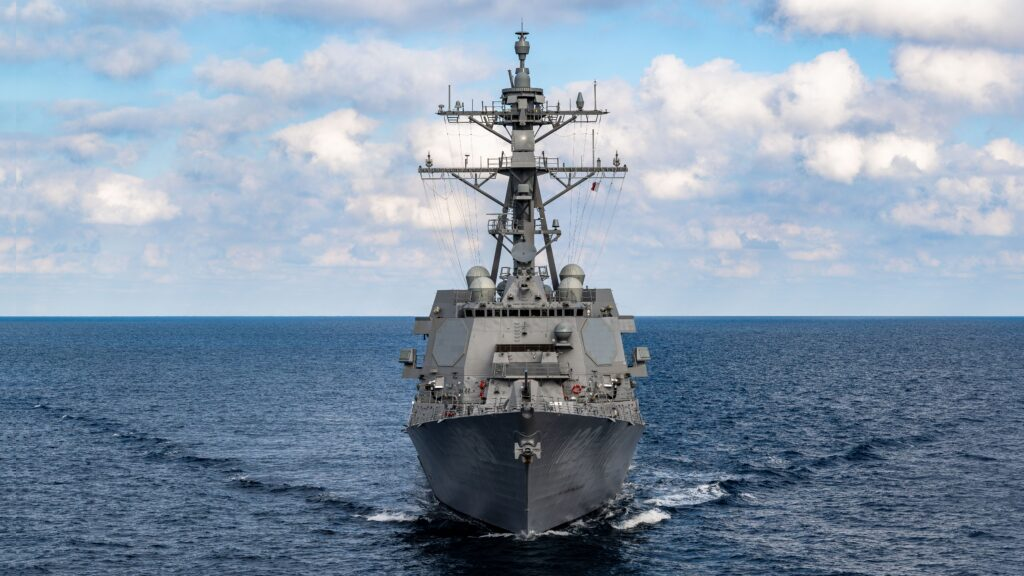
PASCAGOULA, Miss., Nov. 21, 2025 (GLOBE NEWSWIRE) — HII’s (NYSE: HII) Ingalls Shipbuilding division successfully completed the final round of sea trials for Arleigh Burke-class guided missile destroyer Ted Stevens (DDG 128). The Ingalls Test and Trials team spent several days in port and at sea conducting a comprehensive series of acceptance test and evaluations, overseen by the Navy’s Board of Inspection and Survey (INSURV). These trials confirmed that the ship successfully demonstrated required mission capabilities, preparing it for delivery to the U.S. Navy in the coming weeks.
“Our goal is to deliver the most advanced and capable warships to the fleet as quickly as possible, addressing the increasing national security needs of the United States and our allies. The work of the entire DDG 128 team exemplifies our relentless pursuit to achieve this very mission,” Ingalls Shipbuilding President Brian Blanchette said. “Our shipbuilders take great pride in reaching this milestone, which stands as a testament to the teamwork and skill that define our destroyer program at Ingalls.”
DDG 128, the second Flight III Arleigh Burke-class destroyer built by Ingalls, represents the next generation of surface combatants for the U.S. Navy and features the second-in-class Flight III AN/SPY-6 (V)1 radar system and the Aegis Baseline 10 combat system designed to counter threats well into the 21st century.
Northrop Grumman Celebrates 30 Years of E-2 Collaboration with Potez Aéronautique
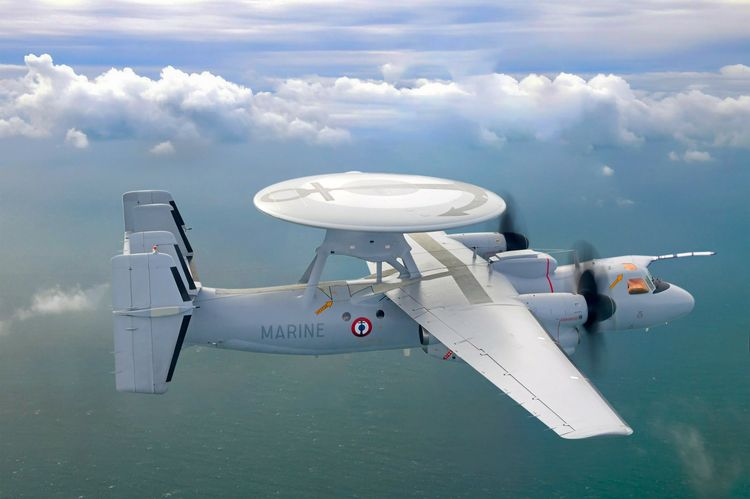
French E-2D Artist Rendering (Photo Credit: Northrop Grumman)
AIRE-SUR-L’ADOUR, France – Nov. 20, 2025 – Northrop Grumman Corporation (NYSE: NOC) recently commemorated its 30-year collaboration with empennage supplier Potez Aéronautique on E-2 Airborne Command and Control aircraft programs. This collaboration continues today with Potez producing empennages that will be fitted on E-2D Advanced Hawkeye aircraft manufactured by Northrop Grumman for the French Navy.
The ceremony hosted by Potez Aéronautique—which brought together representatives from the French and U.S. Navy, the Direction Générale de l’armement, and Northrop Grumman, marked the completion of the empennage that will be fitted on the French Navy’s first E-2D at Northrop Grumman’s St. Augustine, Fla. manufacturing facility.
Northrop Grumman is contracted to produce three E-2D aircraft for the French Navy, the first of which is scheduled for delivery in 2027. Advanced Hawkeyes will replace France’s E-2C Hawkeye 2000 fleet, which has been in operation for over 25 years.
Potez Aéronautique is a supplier for Northrop Grumman’s E-2D Advanced Hawkeye, manufacturing empennages for all E-2Ds produced for the United States and international customers, and has produced these components for E-2C Hawkeye variants. The company earned Northrop Grumman’s Performance Excellence Award in 2022.
Expert:
“Our three-decade collaboration with Potez reflects our commitment to building global industrial partnerships,” said Janice Zilch, vice president of multi-domain command and control programs at Northrop Grumman. “We look forward to providing the French Navy a generational leap in decision dominance with the E-2D Advanced Hawkeye, the world’s premier airborne command and control aircraft.”
Details on Program:
Northrop Grumman’s E-2C Hawkeye 2000, which entered service with the French Navy in 1998, provides air defense and supports the Charles de Gaulle carrier strike group. France is the only country other than the U.S. to operate its E-2C Hawkeyes from an aircraft carrier. This capability has enabled interoperability exercises that support Hawkeyes and other aircraft from the French and U.S. fleets.
Northrop Grumman’s E-2D Advanced Hawkeye is the latest in a line of Airborne Early Warning aircraft that stretches back over 60 years. The E-2D is the world’s premier Airborne Command & Control aircraft, effective over land and sea. Northrop Grumman has evolved the E-2D into a cutting-edge platform, capable of facing threats anywhere in the world.
E-2 variants are operated by Air Forces and Navies around the world. With an active production line and an excellent delivery history, the E-2D continues to introduce new technology to outpace ever-evolving threats.
Coast Guard Continues to Break Records, Offloading Over $362M in Illicit Drugs
From Coast Guard Southeast District – Nov. 19, 2025
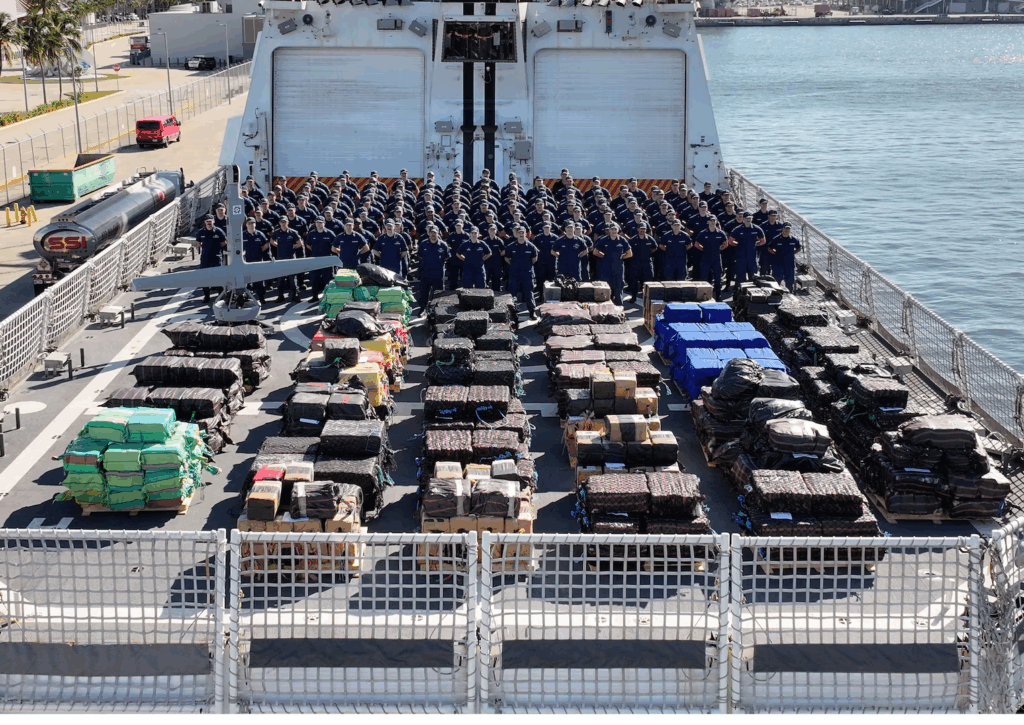
MIAMI – U.S. Coast Guard Cutter Stone’s crew offloaded approximately 49,010 pounds of illicit narcotics worth more than $362 million at Port Everglades, Wednesday.
This offload marks the most amount of cocaine seized by a single cutter in one patrol in Coast Guard history.
The seized contraband was the result of 15 interdictions in international waters of the Eastern Pacific Ocean.
“I am extremely proud of the crew’s incredible performance during this deployment,” said Capt. Anne O’Connell, commanding officer, Coast Guard Cutter Stone. “This offload demonstrates our increased posture and continued success in the fight against narco-terrorism and transnational criminal organizations. The Coast Guard, in conjunction with our inter-agency and international partners, continues to patrol areas commonly associated with drug trafficking in the Eastern Pacific, denying smugglers access to maritime routes by which they move illicit drugs to our U.S. land and sea borders.”
The following assets and crews were involved in the interdiction operations:
80% of interdictions of U.S.-bound drugs occur at sea. This underscores the importance of maritime interdiction in combatting the flow of illegal narcotics and protecting American communities from this deadly threat. U.S. Southern Command’s Joint Interagency Task Force -South based in Key West, conducts the detection and monitoring of aerial and maritime transit of illegal drugs. Once interdiction becomes imminent, the law enforcement phase of the operation begins, and control of the operation shifts to the U.S. Coast Guard throughout the interdiction and apprehension. Interdictions in the Eastern Pacific Ocean are performed by members of the U.S. Coast Guard under the authority and control of the Coast Guard’s Southwest District, headquartered in Alameda, California.
To protect the Homeland from ongoing trafficking of illicit narcotics from South America to the United States, the Coast Guard is accelerating our counter-drug operations in the Eastern Pacific Ocean in support of Operation Pacific Viper.
The Coast Guard continues increased operations to interdict, seize and disrupt transshipments of cocaine and other bulk illicit drugs by sea. These drugs fuel and enable cartels and transnational criminal organizations to produce and traffic illegal fentanyl, threatening the United States.
These interdictions deny criminal organizations more than half a billion dollars in illicit revenue. They provide critical testimonial and drug evidence as well as key intelligence for their total elimination. These interdictions relate to Panama Express, an initiative of HSTF Tampa, investigations in support of Operation Take Back America. PANEX identifies, disrupts, and dismantles the highest-level criminal organizations that threaten the United States using a prosecutor-led, intelligence-driven, multi-agency approach.
USCGC Stone is one of four 418-foot Legend-class national security cutters homeported in Charleston, South Carolina, under U.S. Coast Guard Atlantic Area Command.
War Department Narrows Technology Development Focus to Half Dozen Areas
Nov. 19, 2025 | By C. Todd Lopez, DoW News
Directed energy, hypersonics and artificial intelligence are among the six technology focus areas for the War Department meant to ensure America’s warfighters will quickly have what’s needed to fight and win on the battlefield.
“Our adversaries are moving fast, but we will move faster,” said Emil Michael, undersecretary of war for research and engineering. “The warfighter is not asking for results tomorrow; they need them today. These six critical technology areas are not just priorities; they are imperatives. The American warfighter will wield the most advanced technology to maximize lethality.”
Among those technology areas are applied AI, biomanufacturing, contested logistics technology, quantum battlefield information dominance, scaled directed energy, and scaled hypersonics.
President Donald J. Trump’s Winning the Race: America’s AI Action Plan, released July 23, 2025, directs the War Department to aggressively adopt AI to maintain global military preeminence, and to ensure the use of AI is both secure and reliable.
“When adopted rapidly, AI will fundamentally transform the department from the enterprise level to intelligence synthesis and to warfighting,” Michael said.
Biomanufacturing uses specially designed genetically modified living organisms, such as bacteria, to manufacture needed materials.
” harnesses living systems to produce capabilities at scale,” Michael said. ” will accelerate the development and deployment of biomanufacturing solutions to support critical missions of the department.”
With biomanufacturing, he said, the department can expect development of bio-based alternatives for critical chemicals, minerals and energetics for use in warfighting systems.
With a focus on directed energy, Michael said, the department will enable the rapid scaling of high-energy lasers and high-power microwave systems with widely accessible, low-cost-per-shot response options. And with scaled hypersonics, the department will focus on scaling production, lowering costs and widely fielding hypersonic weapons to the force.
Secretary of War Pete Hegseth said the new, more narrowly defined technology focus areas will give America and its warfighters a battlefield advantage and secure the future of American technological dominance.
“Our nation’s military has always been the tip of the spear,” Hegseth said. “Undersecretary Emil Michael’s six critical technology areas will ensure that our warriors never enter a fair fight and have the best systems in their hands for maximum lethality. The War Department is committed to remaining the most deadly fighting force on planet Earth.”
NOAA-Led Ocean Mapping Expedition in Cook Islands Hailed as a Resounding Success
By Kim Doster,Nov. 20, 2025
RAROTONGA, Cook Islands – Exploration Vessel Nautilus, operated by the Ocean Exploration Trust, successfully completed a groundbreaking three-week mission to map and explore the Cook Islands’ Exclusive Economic Zone (EEZ). This collaborative effort, led by the National Oceanic and Atmospheric Administration (NOAA) through its Ocean Exploration program and supported by a grant to the Ocean Exploration Cooperative Institute (OECI), marks a significant milestone in strengthening U.S.-Cook Islands partnerships in marine resource management.
Guided by priorities set by the Cook Islands Seabed Minerals Authority (SBMA), the expedition employed remotely operated vehicles, advanced mapping technology, and telepresence to collect critical data on abyssal plain habitats. Seven Cook Island-based scientists joined the mission, which included imaging and cataloging seabed and biological compositions, providing valuable insights into diverse seafloor habitats. This publicly available data will help inform and advance the responsible management of marine resources in the region.
The mission concluded with a port event hosted by the Cook Islands Government, showcasing the expedition’s findings to the local community. U.S. representatives, including Embassy New Zealand Chargé d’Affaires David Gehrenbeck, NOAA Principal Deputy Assistant Secretary for Oceans and Atmosphere Erik Noble, and International Trade Administration Deputy Assistant Secretary for Textiles, Consumer Goods, Materials, Critical Minerals & Metals Joshua Kroon, joined Cook Island leaders to celebrate the mission’s findings.
“The success of this expedition underscores the power of international collaboration in advancing ocean exploration and sustainable resource management,” said NOAA Administrator Neil Jacobs, Ph.D. “We deeply value our relationship with the Cook Islands and we are proud to be a key partner in their mission to understand and manage the marine environment while prioritizing environmental stewardship and identifying areas for economic development.”
About NOAA Ocean Exploration
As part of NOAA’s Office of Oceanic and Atmospheric Research, NOAA Ocean Exploration is the only U.S. federal program dedicated to exploring the unknown ocean. For over 20 years, it has led deep-water mapping and exploration, delivering data and insights to advance U.S. leadership in ocean science and resource management.
About the Ocean Exploration Cooperative Institute and Ocean Exploration Trust
The Ocean Exploration Cooperative Institute (OECI), hosted by the University of Rhode Island, collaborates with consortium members, including the Ocean Exploration Trust (OET), to support NOAA’s mission through exploration, technology development, and data utilization. OET, founded in 2007 by Dr. Robert Ballard, operates the 224-foot E/V Nautilus, a state-of-the-art exploration vessel equipped with remotely operated vehicles and acoustic mapping systems. Live broadcasts of expeditions via OET’s website enable global participation from scientists and the public.
Cubic Announces Collaboration with SNC to Redefine Naval Aviation Training
The Freedom Trainer provides a digitally designed, modern and cost-effective aircraft
From Cubic Defense
SAN DIEGO – November 19, 2025 – Cubic Defense, the world’s leading provider of advanced air combat training, is honored to be part of SNC’s Freedom Trainer team of distinguished industry partners for the U.S. Navy UJTS competition. Freedom promises uncompromising training excellence, cost efficiency and advanced capabilities as the only aircraft capable of Carrier touch-and-go and Field Carrier Landing Practice (FCLP) to Touchdown.
“The SNC Freedom Trainer Jet exemplifies how leveraging the capabilities of mid-tier companies can lead to superior training solutions,” stated Russ Marsh, President, Cubic Defense. “We are proud to be part of the agile and proven team bringing innovation, speed with discipline, impeccable engineering, and on-cost and accelerated deliveries to revolutionize naval aviation training.”
“SNC’s Freedom Trainer boasts a range of key features that sets it apart as the premier choice for UJTS. In addition to meeting the U.S. Navy’s traditional rigorous landing requirements, this innovative aircraft offers significantly reduced lifecycle costs, with engine-related expenses that are 40% lower than the U.S. Navy’s current trainers and half the cost of land-centric trainers. Its advanced design and robust reliability, with an airframe life of 16,000 hours, eliminate the need for unplanned Service Life Extension Programs (SLEP), while still allowing for 30-40% longer average sortie duration.” SNC
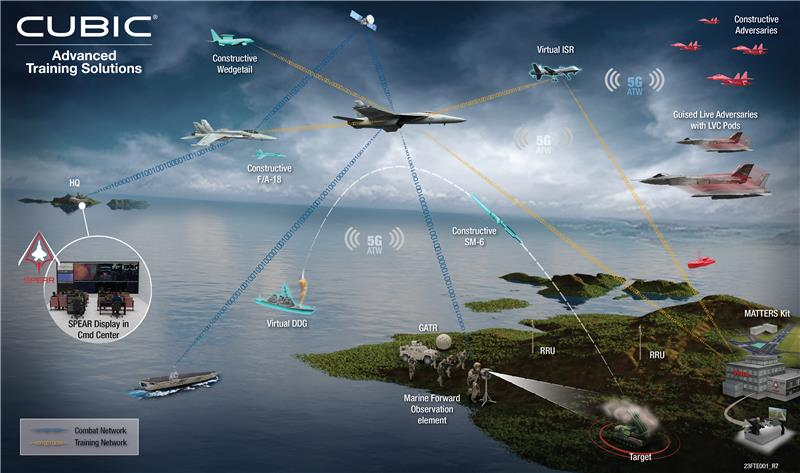
Cubic’s contribution will include Synthetic Inject to Live – Live, Virtual and Constructive (SITL-LVC) and Simplified, Planning, Execution, Analysis, Reconstruction (SPEAR). SITL-LVC training is a revolutionary approach to training and simulation. Integrating computer-generated (synthetic) elements, or scenarios, into live training exercises, SITL-LVC augments the realism and complexity of the training environment and enhances the efficiency and effectiveness of the training experience. The SITL-LVC solution has been validated in operational U.S. Air Force and U.S. Navy fighter aircraft during over 97 sorties, distinguishing Cubic as the lone company to demonstrate the ability to inject virtual and constructive synthetic entities into live fighter cockpit displays at Large Force Employment (LFE) scale.
SPEAR is a proven common data model and data collection platform that provides a comprehensive and congruent common operational picture during live and post mission training by seamlessly integrating data from LVC feeds, multi-domains, kinetic and non-kinetic effects, objective and subjective data, with analytics. The solution provides unparalleled insights and optimization opportunities for mission rehearsal, real-time training enhancement, post-mission debriefs, and resource management. SPEAR enables next level learning to exercise participants and has achieved demonstrated success at major international training events, including Checkered Flag, Red Flag, Cobra Warrior, and Talisman Sabre.
Wikoff Relieves Munsch as Commander, U.S. Naval Forces Europe and Africa
LAGO PATRIA, Italy – U.S. Navy Adm. Stuart B. Munsch was relieved by Adm. George M. Wikoff as Commander, U.S. Naval Forces Europe and Africa (NAVEUR/NAVAF) during a change of command ceremony held at Allied Joint Force Command (JFC) Naples, Nov. 19, 2025. Adm. Munsch was the second longest serving commander of Naval Forces Europe since the Command was established in 1917.
The ceremony marked the conclusion of Adm. Munsch’s tenure as commander of NAVEUR/NAVAF and JFC Naples, during which he led U.S. naval forces across Europe and Africa through a period defined by the principles of trust, deterrence, and defense since June 2022. Under his leadership, NAVEUR/NAVAF enhanced the Navy’s combat readiness, fostered trust, and advanced deterrence through unity, lethality, and sustained maritime operations alongside Allies and partners.
During the ceremony, Munsch emphasized that trust remains the cornerstone of deterrence and defense in an increasingly complex maritime environment.
“Trust is the cornerstone of the collective defense of our homeland and our Alliance,” said Munsch. “Trust is built, layer by layer, over generations, and cannot be surged in times of crisis or conflict. When we come together and when work together, we reinforce the bonds that fuel our warfighting strength into the future.”
Throughout his command, Munsch prioritized deepening partnerships across Europe and Africa while enhancing the Navy’s ability to defend the homeland. He oversaw the establishment of Commander, Task Force 66, and Commander, Task Force 166, which bring together every U.S. Fleet with European nations to integrate advanced technologies and best-of-breed maritime capabilities in robotics and autonomous systems, which improves the combat lethality in defense of the nation and the Alliance.
Munsch also spearheaded significant enhancements in the Navy’s operational posture across Europe. Under his leadership, U.S. naval forces significantly increased operations in the Arctic and the High North, expanding operational reach and reaffirming the Navy’s commitment to freedom of navigation in vital waters. The first-ever U.S. submarine port visit to Iceland underscored this renewed focus, showcasing the United States’ ongoing commitment to Arctic cooperation and maritime security.
His tenure was marked by key milestones in regional defense, including the transfer of authority for Aegis Ashore Poland to NATO and the full operational integration of Aegis Ashore Romania. These accomplishments further strengthened NATO’s layered missile defense system and enhanced deterrence across the European theater.
As commander, Munsch also reinforced the Navy’s commitment to learning, innovation, and intellectual rigor. Through partnerships with institutions such as the Naval Postgraduate School, Naval War College, and Oxford University, he championed an enduring “cycle of learning” that extended beyond traditional naval boundaries and ensured the Navy remained adaptable, informed, and forward-looking.
Munsch’s tenure demonstrated the Navy’s ongoing engagement with Allies and partners through key multinational events that foster trust and interoperability. He hosted the annual Black Sea Maritime Forum, uniting regional partners with Allies to address security challenges and advance shared maritime goals. In Africa, he led the African Maritime Forces Summit inaugural in 2023, encouraging cooperation among African nations and strengthening collective maritime security across the continent.
He also led NAVEUR/NAVAF through multiple commemorations of the D-Day Landings in Normandy, France, including the 80th and 81st anniversaries, where he honored the maritime component of Operation Overlord and the enduring sacrifice of Allied forces. These commemorations reflected his dedication to remembering the past while preparing the fleet for the future.
In 2024, Munsch presided over events marking NATO’s 75th anniversary, reaffirming the Navy’s commitment to collective defense and the unity of the Alliance. Under his leadership, NAVEUR/NAVAF’s contributions to NATO exercises and operations underscored the continuing importance of maritime power in defending every inch of Allied territory.
Throughout his tour, Munsch aligned his command philosophy with the Chief of Naval Operations’ vision of sustaining combat at sea and ensuring the Navy remains built to last—today, tomorrow, and into the future. His leadership emphasized readiness, sustainment, and the ability to project power decisively across the maritime domain in defense of the U.S. homeland and the NATO Alliance.
Allied nations recognized Munsch’s service throughout his tenure for his commitment to partnership and deterrence, including being awarded the Norwegian Defence Service Medal with Laurel Branch, the German Badge of Honour of the Bundeswehr, and the Order of Merit of the Italian Republic. These honors reflected the trust and respect he earned among both U.S. and Allied forces during his time in command.
Over the last three and half years, Munsch has employed the U.S. Naval Forces Europe and Africa Band through an unprecedented 838 musical engagements across 35 nations, successfully projected the U.S. Navy’s warrior ethos, countered adversarial narratives, and secured strategic access by leveraging non-kinetic “Phase 0” power to achieve military and diplomatic objectives in Europe and Africa.
In addition to the band’s operational achievements, Munsch commissioned three original musical works as tributes to the enduring values of service, Alliance, and sacrifice: “Trust, Deter, Defend,” “Sailor Mettle and Ship Metal,” and “Courage, Crossing and Bombardment on D-Day. Concluding the Change of Command ceremony, the U.S. Naval Forces Europe and Africa Band performed one of these compositions, “Trust, Deter, Defend,” honoring the leadership philosophy that defined his tenure.
Wikoff, who most recently served as Commander, Naval Forces Central Command, U.S. 5th Fleet and Combined Maritime Forces, expressed his gratitude to Munsch for his leadership and dedication, and outlined his priorities upon assuming command.
“It is an honor to join this extraordinary team at a pivotal time for our Navy,” said Wikoff. “”I look forward to relentlessly enhancing our nation’s defense through an innovative focus on warfighting, readiness, and partnerships.”
For more than 80 years, NAVEUR/NAVAF has forged strategic relationships with Allies and partners, leveraging a foundation of shared values to share the duties of preserving security and stability. Headquartered in Naples, Italy, NAVEUR/NAVAF operates U.S. naval forces in the U.S. European Command and U.S. Africa Command areas of responsibility.
Test Squadrons Prove ATAWS Ready for Legacy Hornet Pilots
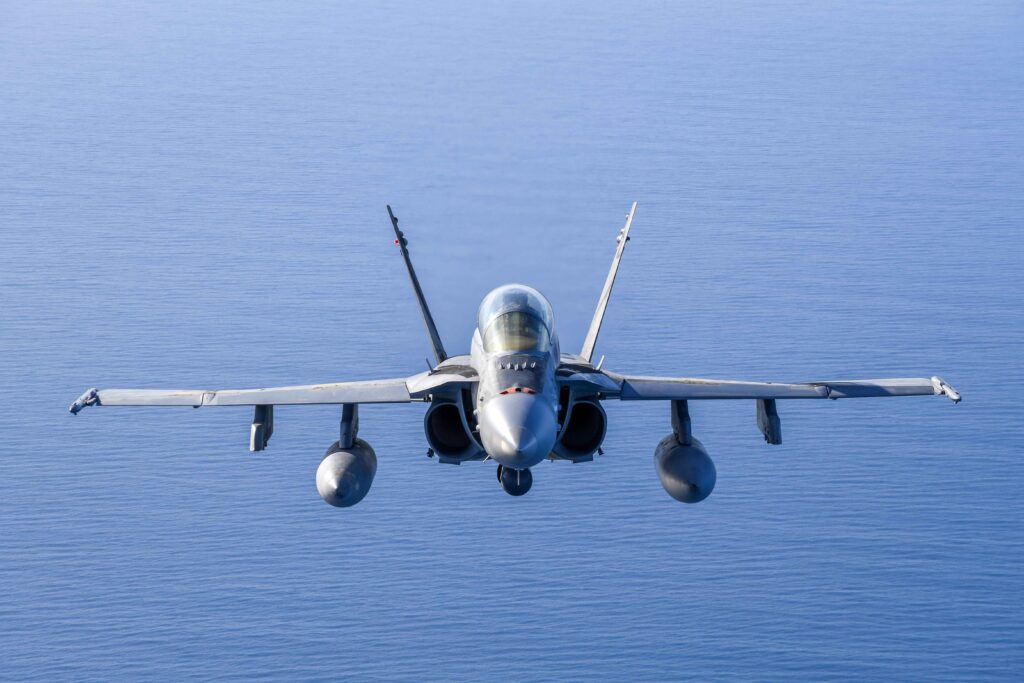
This F/A-18D was used for ATAWS testing. (U.S. Navy)
CHINA LAKE, Calif. — An F/A-18 Hornet raced low across the China Lake desert during a simulated terrain collision. Seconds later, the jet pulled up and climbed to safety. The recovery proved the Automatic Terrain Awareness and Warning System could take over when a pilot no longer has time to respond.
The recovery was part of a joint test program by the “Dust Devils” of Air Test and Evaluation Squadron (VX) 31 at Naval Air Warfare Center Weapons Division, in partnership with the “Salty Dogs” of VX-23 at Naval Air Station Patuxent River, Maryland.
Controlled Flight Into Terrain has long been one of tactical aviation’s most unforgiving hazards. It occurs when a fully functional aircraft is unintentionally flown into the ground.
Between 2010 and 2016, the Navy and Marine Corps lost several F/A-18 Hornets in training and operational mishaps. Each loss reinforced the need for an automatic safeguard that could save aircrew and aircraft when human limits are reached.
The Marine Corps recognized that need after seeing the Air Force’s Automatic Ground Collision Avoidance System save multiple F-16 pilots. Marine aviators and flight test teams pushed for a similar capability in the F/A-18A–D, launching development under the Navy’s program office for the aircraft, PMA-265, to protect pilots and extend the life of a platform no longer in production.
“The Marine Corps F/A-18A–D legacy Hornet community was the driving force behind ATAWS,” said Lt. Col. Timothy Burchett, commanding officer of VX-31. “Every Hornet saved means one more aircraft and aviator available for combat.”
How ATAWS works
ATAWS builds upon the Hornet’s existing Terrain Awareness Warning System. It continuously predicts the aircraft’s flight path relative to the earth’s surface, using terrain data, altitude, speed and attitude to calculate when a collision is certain without pilot action.
When a crash is nearly imminent, the system issues visual and audible warnings. If the pilot fails to respond, ATAWS levels the wings automatically. It then instructs a rapid pull-up to clear the terrain. Control is returned to the pilot once the aircraft is at a safe altitude.
Since legacy Hornets use manual throttles, ATAWS intervenes through flight control inputs only. The system engages only after a pilot has missed all visual and auditory cues, providing automatic recovery when there’s no longer time for a human response.
“Any time a system is designed to intentionally take control of the aircraft away from the pilot, extreme diligence is required,” Burchett said. “We had to be absolutely certain it would not interfere with a mission or take action when it shouldn’t.”
Testing the system at China Lake
From 2023 to 2025, VX-31 partnered with VX-23. They conducted a joint test campaign to ensure ATAWS operated safely and predictably in various flight conditions.
The team executed three phases.
VX-23 completed 32 flights evaluating system logic responses to different dives and recoveries. VX-31 flew 16 flights focused on nuisance testing over flat desert and mountainous terrain to make sure the system would not trigger false warnings or recoveries. The final phase combined both squadrons at China Lake for 16 full-performance flights over seven consecutive weeks.
“The team executed 177 test points that challenged and stressed the system,” said David Pineda, a VX-31 flight test engineer. “Those test points validated that ATAWS met or exceeded the modeled performance.”
Maj. Brian “Wedge” Walpole, VX-31 Legacy Hornet department head, said the system’s consistency between simulator and actual performance confirmed its readiness.
“Regardless of terrain or flight profiles, the system flew like the simulator, and we verified the model through flight test,” Walpole said.
Throughout those weeks, pilots did high-G maneuvers and low-angle strafing runs. Flight test engineers in the test bay watched telemetry. Meanwhile, chase plane crews provided visual backup to ensure safety and effectiveness. The team observed only minor anomalies, none requiring design changes.
Seamless collaboration
The ATAWS test effort united VX-31’s mission systems experts with VX-23’s flight sciences team into one integrated test unit. Two separate approaches merged into a shared plan built on trust and communication.
“This was the best test program I have ever been a part of,” said Burchett. “The teams from Patuxent River and China Lake were so well integrated that you couldn’t tell where each team member came from if you didn’t already know the people involved.”
Walpole called collaboration the foundation for success.
“We turned the challenge of two different test methods into an advantage by working face to face and keeping communication open,” he said.
Direct impact on fleet readiness
Following PMA-265’s approval, ATAWS will begin fleet rollout in early calendar year 2026. The benefits to the Marine Corps are immediate: fewer lost pilots and aircraft, higher readiness and greater combat availability.
“ATAWS directly advances warfighter capability by ensuring assets are available for forward-deployed power projection,” Burchett said. “Every time an aircraft is lost to a mishap, it directly degrades the ability of the Marine Corps to forward project power.”
For test pilots and fleet squadrons alike, ATAWS represents a readiness gain that enhances safety without altering established tactics or habit patterns.
Maj. Ken “Lloyd” Endicott, VX-9 operational test director, said the system “makes protection from CFIT far more robust, but it doesn’t replace disciplined flight planning and conduct.”
Looking ahead
ATAWS sets the stage for future integration of the Automatic Ground Collision Avoidance System in the F/A-18E/F Super Hornet and EA-18G Growler. VX-31 and VX-23 will apply lessons learned from the legacy Hornet to these newer platforms, incorporating system improvements based on the legacy Hornet test results and taking advantage of additional functionality that the newer platforms have available, such as potentially automating a throttle response in a way that was not possible in the older aircraft.
Burchett said the same teamwork that drove ATAWS testing will carry forward into these next efforts.
“The results of the test were incredibly successful, which is an absolute testament to the whole team of designers, engineers, and test pilots who diligently worked the program for many years,” he said. “ATAWS will save lives. There’s no higher return on investment than that.”
SAIC, HavocAI Partner to Link Autonomous Fleets to Global Command and Control Infrastructure
RESTON, Va., Nov. 19, 2025 (GLOBE NEWSWIRE) — Science Applications International Corp. (NASDAQ: SAIC), a premier Fortune 500 mission integrator, and HavocAI, the leader in collaborative maritime autonomy, today announced an effort to integrate SAIC’s real-time, multi-domain communications and data backbone with HavocAI’s fully-autonomous, problem-solving fleets. This collaboration will drastically improve maritime domain awareness within the joint, unified warfighting network for the U.S. Navy.
This integration connects HavocAI’s collaborative autonomy stack — which currently powers dozens of autonomous vessels in self-organizing teams with the potential to scale to thousands — to broader command and control infrastructure through SAIC’s advanced Joint Range Extension (JRE) system. JRE extends the range and interoperability of Link 16 (TADIL-J), which enables U.S. armed forces and allied air, ground, and maritime platforms to collect and exchange vast amounts of tactical data in real-time for faster decision-making.
Adding maritime systems enabled with HavocAI’s autonomy to Link 16 can ultimately connect huge, heterogeneous fleets of globally-networked sensors, lethal platforms, and command and control systems to the infrastructure of all military services and allies seamlessly and instantaneously. This meets multiple objectives of the U.S. military’s Combined Joint All Domain Command and Control (CJADC2) effort to close all-domain kill chains near machine speed and provide U.S. and allied warfighters with unparalleled decision dominance.
“This is a significant leap forward in expanding the capability of large-scale collaborative autonomy,” said Paul Lwin, CEO and co-founder of HavocAI. “By integrating with SAIC’s proven JRE infrastructure, we’re not just connecting our autonomous vessels to existing systems—we’re fundamentally enhancing how autonomous maritime systems receive and provide real-time tactical data within joint and coalition C2 systems.”
“SAIC’s JRE has been the backbone of advanced joint interoperability for two decades and this partnership to bring HavocAI’s innovative autonomous platform into the fold will provide immediate operational value and drive the future of maritime operations for the U.S. Navy,” said Barbara Supplee, SAIC Executive Vice President of Navy Business Group. “The ability to seamlessly integrate dozens of autonomous vessels into our C2 architecture will provide warfighters with an unprecedented level of maritime domain awareness, sea denial, and sea control.”
The integrated solution is being prepared for demonstrations and exercises where HavocAI’s autonomous fleet will showcase its ability to provide real-time situational awareness data through JRE to maritime operations centers, supporting the Navy’s vision for hybrid fleet operations.
Scientific Systems’ Autonomy Software Achieves Major Milestone in Test with Unmanned Boats
Advanced Software Enables Coordinated, Autonomous Execution of Complex Maritime Operations During Real-World Ocean Trial
From Scientific Systems
BURLINGTON, Mass., November 18, 2025 — Scientific Systems, a defense software prime with expertise in maritime and multi-domain operations, announced today that its distributed AI-powered OPTIMUS autonomy software successfully executed a recent on-water test of multiple unmanned surface vessels (USVs) performing end-to-end cooperative mission activities. The weeklong maritime test demonstrates that Scientific Systems’ scalable autonomy software is ready now to support “intelligent affordable mass” — the deployment of swarms of autonomous low-cost platforms that use edge-based AI to dynamically coordinate, rapidly adapt, and dramatically increase survivability & lethality, to achieve mission intent in relevant scenarios.
The August demonstration featured a fleet of nine boats equipped with Scientific Systems’ AI-powered collaborative autonomy software. The software enabled the vessels to operate as an intelligent swarm, searching, monitoring, and engaging targets while avoiding obstacles with dynamic rerouting. This activity was a result of seamless integration of real-time sensing, sense-making, and AI decision-making in the decentralized system. Scientific Systems’ unique, decentralized autonomy software enables the formation of “smart swarms” — collaborative, adaptive teams of platforms that can execute complex missions in degraded communications environments. A single remote operator defines only the mission rules, intent, and key authorities, while the intelligent coordination and execution occur autonomously among the platforms within the contested network. This decentralized approach delivers major advantages over communications-dependent, centrally controlled systems, enabling mission plans to continue even with intermittent or lost communications and eliminating vulnerability to the loss of any single “leader” vessel—all while providing superior resilience, scalability, and security.
“This test underscores the critical role software plays in enabling affordable mass and autonomy at sea,” said Scientific Systems Chief Executive Officer Kunal Mehra. “We’re proud to support the mission of maritime operators and to advance the readiness of scalable, autonomous USV squadrons.”
Today’s announcement follows July’s unveiling of the VENOM small Unmanned Surface Vehicle (sUSV), developed to meet the Navy’s operational need for high-performance sUSV interceptors.
Scientific Systems’ software, integrated with the VENOM sUSV family—offered in 6-, 9-, and 13-meter models and extendable to other USVs—provides a flexible, mission-ready solution built around a modular, scalable autonomy stack tailored to customer-defined objectives.