Defense Department Shores Up Shipbuilding Industrial Base With $56 Million
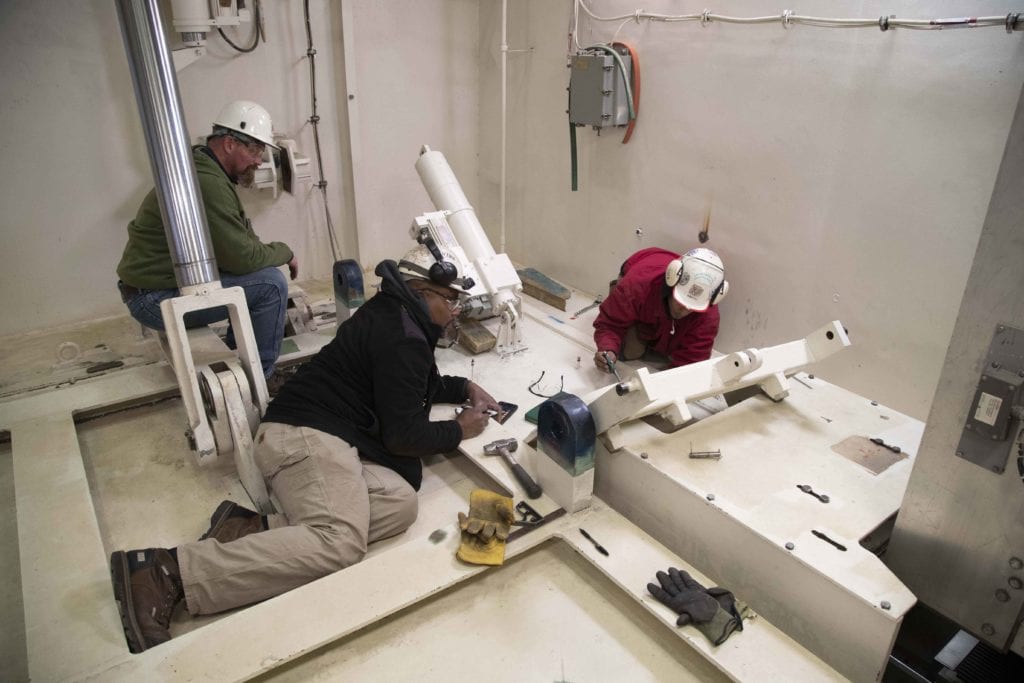
Huntington Ingalls Industries-Newport News Shipbuilding Division contractors aboard the aircraft carrier USS Gerald R. Ford (CVN 78) in February 2020. U.S. NAVY / Mass Communication Specialist Seaman Apprentice Riley McDowell

ARLINGTON, Va. — The Defense Department is taking another Defense Production Act Title III action to shore up the nation’s shipbuilding industrial base in the midst of the COVID-19 pandemic. 

The action is one of seven announced July 10 by the Defense Department “to help sustain and strengthen essential domestic industrial base capabilities and defense-critical workforce. … These actions will help to retain critical workforce capabilities throughout the disruption caused by COVID-19 and to restore some jobs lost because of the pandemic,” the release said. 

DoD is investing $56 million in ArcelorMittal Inc. to sustain critical domestic industrial base shipbuilding capability and capacity. ArcelorMittal, headquartered in Chicago, Illinois, is a steel and mining company with a major facility in Coatesville, Pennsylvania. 

“This investment will expand ArcelorMittal’s plate processing footprint and heat-treating capability, subsequently increasing its alloy steel plate production and ensure the U.S. Government gets dedicated long-term industrial capacity to meet the needs of the nation,” the release said, noting that the investment “will protect jobs in a region hit hard by the COVID-19 pandemic and ensure critical capabilities are retained in support of U.S. Navy operational readiness.” 


Aircraft Carrier Theodore Roosevelt Returns From Deployment

The Theodore Roosevelt returns to San Diego on July 9. U.S. NAVY / Mass Communication Specialist 2nd Class Jessica Paulauskas

SAN DIEGO — The Nimitz-class aircraft carrier USS Theodore Roosevelt returned to San Diego on July 9, marking the end of its deployment to the U.S. 7th Fleet area of operations, the commander of 3rd Fleet public affairs said in a release. 

More than 6,000 Sailors from Theodore Roosevelt Strike Group and embarked Carrier Air Wing (CVW) 11 deployed Jan. 17 to conduct operations in the Indo-Pacific and maintain security and stability in the region. 

“I am incredibly proud of the Theodore Roosevelt Strike Group and all they’ve accomplished over the deployment,” said Rear Adm. Doug Verissimo, commander of Carrier Strike Group 9. “They operated in a variety of complex environments ranging from how to respond to an international pandemic to operating safely throughout the Indo-Pacific, including the South China Sea.” 

Theodore Roosevelt sailed over 31,835 nautical miles, deploying dynamically to support dual-carrier operations, expeditionary strike force operations, air defense exercises, and joint-service interoperability exercises. 

Theodore Roosevelt made a historic port visit to Da Nang, Vietnam, only the second time a U.S. carrier has visited the country since the Vietnam War, to commemorate 25 years of U.S.-Vietnam diplomatic relations. 

Theodore Roosevelt had an outbreak of coronavirus in early March and pulled into Guam ahead of a scheduled port visit. The carrier responded and moved more than half of the crew off ship to quarantine at various locations on Guam, leaving enough Sailors aboard to stand critical watches and to clean and sanitize the ship. The crew members who met rigorous ‘operational units’ return to work criteria set forth by U.S. Pacific Fleet returned to the ship and were able to get underway and back to their mission on June 4. 

“The crew of TR persevered displaying uncommon fortitude and tenacity in the face of uncertainty to meet expectations in a crisis,” said Capt. Carlos Sardiello, the commanding officer of Theodore Roosevelt. “This recovery of the ship and the crew on deployment is a testament to the professionalism of the young men and women of the TR who turned a potentially demoralizing downward spiral into a symbol of inspiration and hope against adversity.” 

To ensure the success of the deployment extends beyond their return to homeport, Theodore Roosevelt conducted a variety of training classes promoting sound decisions and safety. The information provided in the classes helps individual Sailors and their families know what to expect after returning to homeport. Topics covered included drinking and driving, returning to children, traffic safety, motorcycle safety, car buying, and money management. 


Navy Orders Four Metal Shark Patrol Boats

ARLINGTON, Va. — The U.S. Navy has placed an order for four patrol boats from Gravois Aluminum Boats, doing business as Metal Shark Boats, according to a July 7 announcement from the Pentagon.  

The Navy’s Supervisor of Shipbuilding, Conversion and Repair, Gulf Coast, Pascagoula, Mississippi, awarded a $7.03 million firm fixed-price delivery order for the four 40-foot-long patrol boats, designated PB-2001 through 2004. The order also included design, planning, material support, shipping and documentation. 

The 40-foot welded-aluminum monohull “Defiant” is powered by two Cummins QSB 6.7 diesel inboard engines that use twin disc MG5065SC transmission systems to Hamilton HTX30 waterjets. The boat is designed to achieve a speed of 40 knots. 

The boats will begin to replace up to 160 patrol boats operated by the Navy’s Coastal Riverine Force, offering increased firepower and capabilities to enable crews to operate in hostile environments that preclude operation of current force protection boats. 

The new boats offer ballistic protection; an armored, climate-controlled pilot house; five SHOXS 4800-series whole-body isolation suspension seats to reduce crew fatigue; and an advanced communications, navigation, and situational awareness suite.


More Powerful Laser Systems Are Needed, Navy Technologist Says

The U.S. Navy installed the first ODIN laser weapon system on the guided-missile destroyer USS Dewey. The system is due to be fitted onto eight more ships in the next three years, a Navy technologist said on July 7 during a webinar. CHRIS CAVAS

ARLINGTON, Va. — The U.S. Navy’s official most heavily engaged in the development of directed-energy (DE) weapons said the service is focused on fielding the sea service’s family of laser systems to warfighters but is also working to improve the systems’ power and beam control.  

“We’ve been working hard for the last five to seven years to try to bring directed energy forward in a meaningful sense to the warfighter and the operational community while at the same time advancing the technology,” said Frank Peterkin, senior technologist for directed energy at the Office of Naval Research, speaking July 7 at a Directed Energy Summit webinar sponsored by Booz Allen Hamilton. 

Peterkin said that lasers primarily would be installed on surface combatants, particularly Flight II Arleigh Burke-class guided-missile destroyers but also, potentially, amphibious transport dock ships and littoral combat ships.  “There have been discussions [about] even putting lasers on aircraft carriers,” he added. 

The Navy’s initial mission sets lasers will be dazzling sensors on enemy platforms and engaging and defeating unmanned aerial vehicles. Future missions likely include defeating incoming missiles, including swarms. 

Peterkin said the “exquisite optics” of a laser’s beam director system will augment situational awareness and better direct other weapons as well. 

He said the installation of the laser weapon on the amphibious transport dock ship USS Portland last October has gone well, with the ship’s crew accommodating of Navy engineers amidst the difficulties of working during the COVID-19 pandemic. The Portland’s laser weapon demonstrated its ability to defeat a drone earlier this year. He said the amphib’s crew is quickly learning how to operate and sustain the weapon, with which the ship will deploy in 2021. 

The Navy will install the ODIN [Optical Dazzling Interdictor, Navy] laser weapon system on eight ships over the next three years, Peterkin said. An ODIN already is installed on the Arleigh Burke-class destroyer USS Dewey. 

He also stressed the need for more electrical power as the Navy develops its laser weapons to take on more than one target simultaneously. It was not just a matter of a more powerful beam, he said, but also of directing the weapon to more rapidly respond to incoming threats, such as swarms. “Power will get you faster kills,” he said, noting also that beam control also needed significant improvement.


Indonesia Cleared for Possible Acquisition of MV-22s

An MV-22B Osprey conducts deck landing qualifications aboard the amphibious assault ship USS Bataan on June 28. The State Department has approved the sale of the MV-22 to Indonesia. U.S. MARINE CORPS / Cpl. Tanner Seims

ARLINGTON, Va. — The U.S. State Department has approved the possible sale of Bell-Boeing MV-22 Osprey tilt-rotor aircraft to the Indonesian government, the Defense Security Cooperation Agency said in a release. 

If concluded, Indonesia would be the third nation to procure the MV-22, the others being the United States and Japan. 

Indonesia requested eight Block C Ospreys as well as engines, various avionics, and machine guns, including spares. Also included in the deal, estimated to cost $2 billion, is the Joint Mission Planning System, publications, repair for parts, aircraft ferry and tanker support, support and test equipment, and U.S. government and contractor engineering support. 

“The proposed sale of aircraft and support will enhance Indonesia’s humanitarian and disaster relief capabilities and support amphibious operations,” the release said. “This sale will promote burden sharing and interoperability with U.S. Forces.  Indonesia is not expected to have any difficulties absorbing these aircraft into its armed forces.” 

The prime contractors for the Osprey are a joint venture of Bell Textron Inc. of Amarillo, Texas, and The Boeing Co. Of Ridley Park, Pennsylvania. 


France Cleared for Possible E-2D Procurement

An E-2D Advanced Hawkeye is cleared for takeoff from the flight deck of the aircraft carrier USS Gerald R. Ford. France would become the third nation to fly the E-2D after the U.S. and Japan. U.S. NAVY / Mass Communication Specialist Seaman 3rd Class Zachary Melvin

ARLINGTON, Va. — The U.S. State Department has approved the possible sale of Northrop Grumman-built E-2D Advanced Hawkeye command-and-control aircraft to the government of France, the Defense Security Cooperation Agency said in a release.  

If concluded, France would become the third nation to procure the E-2D after the United States and Japan. 

The French navy operates E-2C Hawkeyes from its aircraft carrier, the Charles De Gaulle. 

The estimated $2 billion sale includes three E-2Ds and their engines and avionics, including spares. Major components include Rolls-Royce T-56-427A turboprop engines, Lockheed Martin APY-9 radars and ALQ-217 electronic surveillance systems. 

The sale also would include the Joint Mission Planning System as well as “air and ground crew equipment; support equipment; spare and repair parts; publications and technical documentation; transportation; training and training equipment; U.S. government and contractor logistics, engineering and technical support services; and other related elements of logistics and program support,” the release said. 

“The proposed sale will improve France’s capability to meet current and future threats by providing its naval air forces with a sustainable follow on capability to their current, legacy E-2C Hawkeye aircraft,” the release said. 

“The E-2D aircraft will continue and expand French naval aviation capabilities and maintain interoperability with U.S. naval forces. As a current E-2C operator, France will have no difficulty absorbing this equipment and support into its armed forces. 

The prime contractor for the E-2D is Northrop Grumman Systems Corp. Aerospace Systems in Melbourne, Florida.


Eleventh National Security Cutter Named for Elizebeth Smith Friedman

The Legend-class national security cutter Waesche during a replenishment-at-sea in April. The Coast Guard is naming its 11th Legend-class NSC in honor of pioneering code-breaker Elizebeth Smith Friedman. U.S. NAVY / Thomas Epps

WASHINGTON — The U.S. Coast Guard is naming the 11th Legend-class national security cutter in honor of pioneering code-breaker Elizebeth Smith Friedman, the sea service said in a July 7 release. 

Friedman was a code-breaker for the Coast Guard during the Prohibition Era and World War II, serving within Cryptanalytic Unit-387. She’s been dubbed “America’s first female cryptanalyst” and in many ways could be considered the founder of the modern-day Coast Guard Intelligence Program.  

Her work with the Coast Guard began soon after the passage of the Volstead Act, which prohibited the manufacture, sale or trade of alcoholic beverages in the United States. Liquor smugglers frequently made use of radios to coordinate their activities and began to encode their messages. 

Friedman was detailed by the Department of Treasury to the Coast Guard, thus beginning a remarkable career. Between 1927 and 1930, she is estimated to have solved over 12,000 smuggling messages in hundreds of different code systems, all by hand, with just pencil and paper. Her work led to 650 federal prosecutions and she personally testified in 33 cases. 

During World War II, she was part of the team that broke the codes generated by the formidable Enigma machine used by Nazi Germany. Friedman exposed a ring of German spies in South America, effectively denying them a foothold in the Western Hemisphere during the war. Her unit eventually moved from Treasury and evolved into the modern Coast Guard Intelligence Program. Only recently was her legacy fully appreciated when a journalist researched declassified papers to learn that she was pivotal in code-breaking the Enigma as well as the Customs prohibition operations. 

The NSC is one of the largest and most technologically sophisticated vessels in the Coast Guard fleet. The 418-foot cutter can operate in the most demanding open ocean environments around the globe, from the hazardous fishing grounds of the North Pacific to the vast approaches of the Eastern Pacific where its crews battle transnational crime.  

With robust command, control, communication, computers, intelligence, surveillance, and reconnaissance equipment, multiple small boat and aviation capabilities including unmanned aerial systems, the NSCs are exceptionally well-suited for complex law enforcement and national security missions while integrating multiple Coast Guard and partner agencies. 

Legend-class cutters honor women and men who have a renowned status in the Coast Guard’s rich history.  

NSCs are replacing 378-foot high-endurance cutters, which have been in service since the 1960s. There are eight Legend-class NSCs in service. The Coast Guard Cutters Bertholf, Waesche, Stratton and Munro are stationed in Alameda, California, Hamilton and James are in Charleston, South Carolina, and Kimball and Midgett are homeported in Honolulu. The ninth cutter, Stone, is slated for delivery in fiscal year 2021. On Dec. 21, 2018, the Coast Guard awarded a fixed-price contract option for the production of the 10th cutter, Calhoun, and the 11th cutter, Friedman.


Coast Guard Interdicts 14 Haitian Migrants

A Coast Guard Station Fort Pierce 33-foot Special Purpose Craft—Law Enforcement crew embarks illegal migrants approximately 26 miles east of St. Lucie County, Florida, July 2, 2020. U.S. COAST GUARD

MIAMI — The Coast Guard interdicted 14 Haitian migrants approximately 26 miles east of St. Lucie County, Florida, July 2, the Coast Guard 7th District said in a July 6 release. 

Coast Guard 7th District watchstanders received a report of a disabled 21-foot pleasure craft with 14 migrants aboard. Watchstanders launched a Coast Guard Station Fort Pierce 33-foot Special Purpose Craft—Law Enforcement crew, a Coast Guard Station Lake Worth Inlet 45-foot Response Boat—Medium crew and a Coast Guard Air Station Miami HC-144 Ocean Sentry airplane crew to search.  

The Air Station Miami airplane crew located the disabled vessel and vectored in Station Fort Pierce, Station Lake Worth Inlet and the Coast Guard Cutter Manatee (WPB-87363) crew. After determining there were no COVID-19 concerns, the cutter Manatee crew embarked the 10 Haitian men and four women. While aboard the cutter Manatee, two Haitian women fainted and were medevaced to a higher level of care. 

The cutter Manatee crew transferred 10 Haitian migrants to Bahamian authorities in Freeport, Bahamas, and two Haitian migrants to U.S. Customs and Border Protection agents in Lake Worth Inlet, Florida. 

“The Coast Guard and our partner agencies’ first priority is safety of life at sea and these voyages, in many situations, aren’t safe,” said Cmdr. Rick DeTar, Sector Miami response department head. “The Coast Guard and our partner agencies maintain their focused and coordinated efforts to interdict and stop these unlawful migration attempts in to the United States.” 

Once aboard a Coast Guard cutter, all migrants receive food, water, shelter, and basic medical attention. 


Esper Announces Stars for Navy, Marine Officers

ARLINGTON, Va. — Defense Secretary Dr. Mark T. Esper announced on July 6 that the president has made the following nominations: 

Navy Capt. Trent R. Demoss for appointment to the rank of rear admiral (lower half). Demoss is serving as vice commander, Fleet Readiness Center, Patuxent River, Maryland. 

Marine Corps Col. David Nathanson for appointment to the rank of brigadier general. Nathanson is serving as the assistant chief of staff, G-4, I Marine Expeditionary Force, Camp Pendleton, California.


Reliance Departs for New Homeport

The Reliance patrols the western Caribbean in 2014. U.S. Coast Guard/Petty Officer 3rd Class Clinton McDonald

KITTERY, MAINE — The U.S. Coast Guard Cutter Reliance crew was to depart on patrol from the Naval Shipyard in Portsmouth, New Hampshire, on July 6 and return in August to its new homeport of Naval Air Station Pensacola, Florida, the Coast Guard’s 1st District said in a release. 

After 32 years homeported in New Hampshire, Reliance will continue service with two other 210-foot medium endurance cutters homeported at Naval Air Station Pensacola, allowing the Coast Guard to better leverage efficiencies gained by clustering vessels of the same class.  

The Reliance has shifted homeports several times since its commissioning in 1964. The cutter has been homeported in Corpus Christi, Texas, Yorktown, Virginia, and Port Canaveral, Florida. More recently, Reliance replaced the utter Vigilant in New Castle, New Hampshire in 1988, and in 1996, shifted berths to the Portsmouth Naval Shipyard.  

During the time in New Hampshire, Reliance has contributed to the Coast Guard’s missions of search and rescue, living marine resource protection, and safeguarding New England port and waterways. 

In 1989, Reliance acted as the on-scene commander for the Narragansett Bay oil spill. Reliance crews coordinated multiple assets and directed the cleanup of over 300,000 gallons of crude oil from the tanker ship, World Prodigy, that ran aground off the coast of Rhode Island. 

In 1991, a crew of the Reliance assumed tactical command for the intersection of the fishing vessel, Hunter, which was spotted 100 miles south of Long Island and caught smuggling more than 5 tons of cocaine.  

Additionally, a Reliance crew was involved with port security operations during the Sept. 11, 2001, terrorist attacks, responded to numerous search-and-rescue cases saving hundreds of lives at sea, and regulated New England’s fisheries to ensure sustainment of fishery stocks. 

The Reliance was originally designed with a stern exhaust system, a 3-inch gun deck capable of manning a 40 mm anti-submarine cannon, a helicopter pad capable of carrying the out of commission HH-52 rotary wing aircraft, and a power plant system that combined diesel and gas combustion. 

After undergoing a major maintenance availability in 1987, she was modified to include two pitch controlled main diesel engines capable of reaching a max speed of 18 knots, an exhaust stack that is presented amidships, an armament of one 25 mm. automatic machine gun and two .50-caliber machine guns, and a flight deck capable of carrying and deploying an MH-65 Dolphin helicopter.