Navy Won’t Restore Relieved Captain to Command of COVID-19-Stricken Carrier
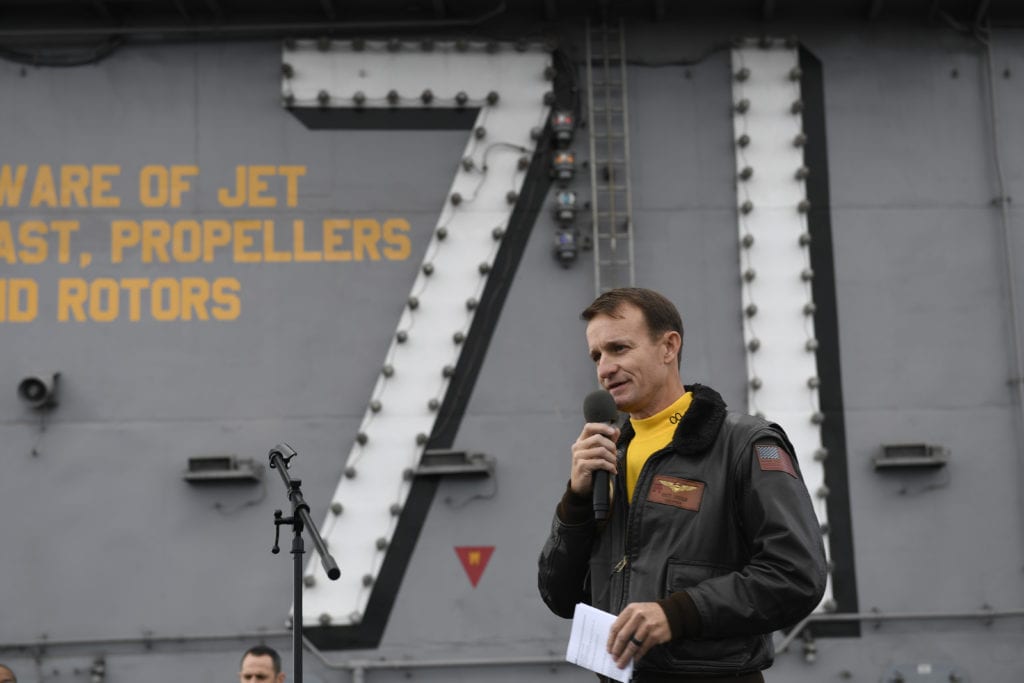
Capt. Brett Crozier, commanding officer of the aircraft carrier USS Theodore Roosevelt (CVN 71), addresses the crew during an all-hands call on the ship’s flight deck. Theodore Roosevelt is conducting routine operations in the Eastern Pacific Ocean. U.S. NAVY / Mass Communication Specialist 3rd Class Nicholas Huynh

ARLINGTON, Va. — Capt. Brett Crozier, the embattled former skipper of the first U.S. Navy warship to suffer a novel coronavirus outbreak at sea, will not be restored to command of the aircraft carrier USS Theodore Roosevelt, top Navy leaders announced June 19.

Chief of Naval Operations Adm. Mike Gilday and Navy Secretary Kenneth J. Braithwaite announced the decision at a Pentagon press briefing on the results of the USS Theodore Roosevelt Command Investigation, begun April 2, the day Crozier was fired. The investigation was conducted by Vice Chief of Naval Operations Adm. Robert Burke.

Gilday said he would not reassign Crozier as the commanding officer of the ship known as the TR, “nor will he be eligible for future command. Capt. Crozier will be reassigned.” Gilday also said the promotion of Crozier’s immediate superior, Rear Adm. Stuart Baker, the Theodore Roosevelt Carrier Strike Group commander, to a second star was being put on hold “pending further review.”

Braithwaite, who was sworn into office just three weeks ago, said he fully supported the report’s findings and recommendations and “I am satisfied that it was conducted in an extremely thorough and fair.”

Gilday conceded that he previously believed that Crozier should be reinstated after conducting an initial investigation following Crozier’s removal, but a wider investigation had a much deeper scope.

“It is my belief that both Admiral Baker and Capt. Crozier fell well short of what we expect of those  in command,” he said. “Had I known then what I know today, I would not have made that recommendation to reinstate Capt. Crozier. Moreover, if Capt. Crozier were still in command today, I would be relieving him,” Gilday added.

Crozier was relieved of command April 2 by then acting Navy Secretary Thomas B. Modly after a March 30 letter that Crozier wrote to top Navy officers and fellow naval aviators, pleading for faster intervention from his superiors to assist his crew, was leaked to a San Francisco newspaper.

In the letter, which was sent, unencrypted, via email, Crozier expressed alarm over the slow pace of disembarking his crew at Naval Base Guam while the coronavirus spread rapidly on the ship, also known as the TR. Publication of the letter in the San Francisco Chronicle sparked an outcry and worldwide media attention over Crozier’s actions and the fate of the carrier’s crew.

Eventually, 1,100 of the TR’s nearly 5,000 crewmembers, including Crozier himself, tested positive for COVID-19. Only a fraction required hospitalization, but one Sailor, Aviation Ordnanceman CPO Charles Thacker Jr., succumbed to the virus.

Crozier was hailed as a hero by his crew — who were seen on video cheering for him as he departed the ship in Guam — while others criticized him for circumventing the Navy’s chain of command. Modly said Crozier was not fired in retaliation for his letter but because the secretary had lost confidence in the captain’s leadership. Crozier, he said, had allowed the complexity of the COVID-19 challenge “to overwhelm his ability to act professionally, when acting professionally was what was needed.”

However, Modly complicated matters by flying to Guam, to defend his actions in an April 6 profanity laced address to the TR’s crew. Modly called Crozier “too naive or too stupid to be the commanding officer of a ship like this,” according transcripts of recordings of Modly’s remarks made by several of the carrier’s crew.

Less than 24 hours after the speech, Modly issued an apology to Crozier, the Roosevelt’s crew and the Navy, and offered his resignation to Defense Secretary Mark Esper, who accepted it.

Gilday directed Burke, the vice CNO, to investigate the circumstances and climate of the entire Pacific Fleet affecting the chain of command. Previously, Gilday spoke of “a potential comms breakdown, wherever it occurred,” adding “we’re not looking to shoot the messenger here, we want to get this right.”

The completed report was delivered April 24 to Modly’s replacement, acting Navy Secretary James McPherson, who directed Gilday to conduct a second investigation, saying he had “unanswered questions that the preliminary inquiry has identified and that can only be answered by a deeper review.”  

COVID-19 was detected on board the aircraft carrier in late March, 15 days after the TR made a port call to Da Nang, Vietnam, the Navy announced March 24. Stopping at Guam for a scheduled visit on March 27, Crozier began disembarking crewmembers as the number of Sailors testing positive continued to rise. Finding suitable accommodations for thousands of personnel on the island was a slow process.

In his letter, Crozier said the carrier had inadequate space to isolate or quarantine Sailors. “We are not at war. Sailors do not need to die,” Crozier wrote. “If we do not act now, we are failing to properly take care of our most trusted asset — our Sailors.”

Testing the entire crew for COVID-19 was completed in mid-May and they began returning to the carrier in waves after 14-days’ isolation and twice testing negative for the virus. Despite those efforts, at least 14 returning Sailors tested positive again for COVID-19. Following a bow-to-stern deep-cleaning process by about 700 crew members, and recertifying aviation activities for its Carrier Air Wing 11, the TR left Guam and resumed it mission on June 4.


HII Awarded $145 Million Advance Procurement Contract for Amphib LHA 9

An MV-22B Osprey lands in April aboard the amphibious assault ship USS America (LHA 6), the first of its class. Ingalls Shipbuilding has received another contract modification for long-lead-time material and advance procurement activities for the fourth ship of the America class, LHA 9. U.S. Navy/Mass Communication Specialist 3rd Class Jomark Almazan

PASCAGOULA, Miss. — Huntington Ingalls Industries’ Ingalls Shipbuilding division has received a third contract modification from the U.S. Navy for $145 million to provide long-lead-time material and advance procurement activities for amphibious assault ship LHA 9, the company announced in a release. This modification brings the total advance funding for LHA 9 to $350 million. 

“This advance procurement contract will help protect the health of our supplier base and strengthen our efforts to efficiently modernize the nation’s amphibious fleet as we continue to build amphibious ships for the Navy,” Ingalls Shipbuilding President Brian Cuccias said. 

Ingalls is the sole builder of large-deck amphibious ships for the Navy. The shipyard delivered its first amphibious assault ship, the Iwo Jima-class USS Tripoli (LPH 10), in 1966. Ingalls has since built five Tarawa-class (LHA 1) ships, eight Wasp-class (LHD 1) ships and the first in a new class of amphibious assault ships, America (LHA 6), in 2014. The second ship in that class, the Tripoli (LHA 7), was delivered to the Navy earlier this year. Bougainville (LHA 8) is under construction. 


Block III Super Hornets Headed for Navy Flight Tests

F/A-18 Block III flight test aircraft F287 makes its first flight in May. Boeing has delivered the first two Block IIIs to the U.S. Navy. Boeing

ARLINGTON, Va. — Boeing has delivered the first two Block III Super Hornet strike fighters to the U.S. Navy. The aircraft, an F/A-18E and two-seat F/A-18F, will go through comprehensive testing by Navy air test and evaluation (VX) squadrons over the next year.  

VX-23 at Naval Air Station Patuxent River, Maryland, will receive the F/A-18F (the 287th built) aircraft for “shore-based carrier testing” and will be used for testing of hardware and aeromechanical aspects, the Program Executive Office-Tactical Aircraft (PEO(T)) said in a June 17 release. 

Once that testing is completed, the F/A-18F will go to VX-31 at Naval Air Weapons Station China Lake, California, to complete Bock III testing. The F/A-18E (the 323rd built) will go to VX-31 for software functionality and network architecture testing. 

The Block III Super Hornet features several major structural and mission system improvements over the Block II, Jennifer Tebo, Boeing’s director of development for F/A-18E/F & EA-18G Programs, said in a June 17 teleconference with media.  

The Advanced Cockpit System includes replacement of a set of displays with a single large touch-screen display for improved user interface and display of the Common Tactical Picture, the PEO said. 

The Advanced Network Infrastructure will have 17 times the computing power of the mission computer of the Block II through the Distributed Targeting Processor Network and Tactical Targeting Network Technology (TTNT). 

Tebo described the TTNT as a “big data pipe — low latency, high-data” for better situational awareness. The infrastructure will be open to accept third-party applications for “speed to the fleet with urgent needs,” she said. 

The Block III Super Hornets will feature an improved radar cross section for better survivability. 

The most distinguishable characteristic of the Block III is the addition of streamlined, low-drag conformal fuel tanks to the upper wing and fuselage junctions. These will be optional for use and will enable the Super Hornet to carry 3,500 pounds more fuel, reducing the need for underwing external fuel tanks and freeing up the pylons to carry more weapons. 

When delivered, each Block III will have a service life of 10,000 flight hours, far more than the 6,000 hours of a Block II strike fighter. 

“In addition to the Block III delivery, Boeing will also perform service life modification (SLM) to hundreds of Block II Super Hornets, to extend their service life and integrate Block III capabilities,” the PEO said. “SLM is key to building the capacity and capability to ensure the Navy has jets ready to fight into the mid-2040s.” 

Tebo said the SLM will extend the life of Block IIs to 10,000 hours and that deliveries of Block IIIs converted from Block IIs will begin in 2023 and continue into the mid-2030s. 

Tebo said the Block III Super Hornet made its first flight on May 14. Delivery of 78 full-up production Block IIIs is planned to begin in mid-2021 at a rate of two per month through early 2024. 

“The first squadron deployment of Block III Super Hornet is anticipated in mid-2023, with a plan in place to have two Block III squadrons, composed of new production and Block IIs that have undergone SLM, accompanying each carrier air wing by 2027,” the PEO said in the release. 

“Now it’s up to our test squadrons and our integration team to verify requirements are met and ensure the engineering behind the Block III is validated prior to full-scale production and delivery of the Block III to the fleet,” Capt. Mike Burks, F/A-18 E/F deputy program manager, said in the release. 

“These new capabilities are essential for ensuring we maintain the tactical advantage in the Great Power Competition,” Capt. Jason Denney, the Navy’s F/A-18 & EA-1G Program Manager, said in the release. “Block III production and SLM for our Block IIs also demonstrate contracting efficiency and solid partnerships with industry — an all-around win for the Navy, for Boeing, and for the warfighter.”


USS Harry S. Truman Returns After 7-Month Deployment

The aircraft carrier USS Harry S. Truman returns to Norfolk Naval Station, Virginia, on June 16 after a seven-month deployment. U.S. Navy/Mass Communication Specialist 1st Class Joshua D. Sheppard

NORFOLK, Va. — The Nimitz-class aircraft carrier USS Harry S. Truman returned home on June 16, marking the end of its deployment after operating in the U.S. 2nd, 5th and 6th Fleets, the 2nd Fleet said in a release. 

Following a return from deployment in March after operating in the U.S. 5th and 6th Fleets, Truman remained underway in the western Atlantic during the sustainment phase of the optimized fleet response plan cycle as a certified and ready carrier force, ready for tasking. 
 
As the COVID-19 pandemic spread across the globe, the Truman continued operations underway while minimizing the potential spread of the virus aboard the ship, to maintain maritime stability and security and ensure access, deter aggression and defend U.S., allied and partner interests. 

Truman sailed more than 56,000 nautical miles, deploying dynamically to support dual-carrier operations, air defense exercises, anti-submarine warfare exercises and interoperability with joint services and with allies and partners. 
 
The ship also completed multiple strait and choke-point transits, including the Strait of Gibraltar, the Suez Canal and the Bab-el Mandeb Strait, while operating under three combatant commanders: U.S. Northern Command (NORTHCOM), U.S. European Command (EUCOM) and U.S. Central Command (CENTCOM). 

The Truman deployed for seven months in support of maritime security operations and theater security cooperation efforts in the U.S. 2nd, 5th and 6th Fleets. U.S. Navy/Mass Communication Specialist 1st Class Joshua D. Sheppard

Truman demonstrated the Navy’s continuing regional commitment to the EUCOM and CENTCOM areas of responsibility by hosting 80 embarked guests, including political and military leaders from eight ally and partner nations. These embarks supported U.S. 5th and 6th Fleet theater security objectives and greatly enhanced U.S. relationships and partnerships with multiple NATO ally and partner nations and Gulf Cooperation Council (GCC) members. 

“I’m so very proud of all our Sailors!” said Capt. Kavon Hakimzadeh, commanding officer of the Truman. “Their resilience, perseverance and utter dedication to mission has been nothing short of exemplary. It has been my greatest honor to serve as Truman’s commanding officer this deployment!” 

Throughout the deployment, Truman performed numerous training exercises to develop tactical competencies. From carrier strike force operations as the flagship of the Harry S. Truman Carrier Strike Group, to exercises with partner navies and forces, the ship developed skill sets to maintain readiness and interoperability. 
 
While conducting stability operations in the CENTCOM area of responsibility, the strike group was called upon during an international crisis to assert American commitment to the region and act as a primary catalyst for de-escalation. 

“The Harry S. Truman Carrier Strike Group has been the ready force for the nation these past months,” said Rear Adm. Ryan Scholl, commander of Carrier Strike Group 8. “Truman operated closely with our allies and partners, supporting our forward commanders in U.S. 5th and 6th Fleets and executing missions supporting homeland defense in U.S. 2nd Fleet.” 

“All the strike group units performed above and beyond what was asked of them and did so with amazing dedication,” Scholl continued. “It is an honor and a privilege to serve with them as their commander!” 

In the western Atlantic, the Truman strike group conducted a week of naval air integration exercises with Marine Corps elements assigned to the 2nd Marine Aircraft Wing. The high-end training was conducted to improve Navy and Marine Corps integration, communication, power projection in the form of strikes and enhance readiness of air defense assets. 

Truman concluded operations underway by participating in a U.S. Northern Command-led exercise Vigilant Osprey, a major service-integrated homeland defense exercise aimed at strengthening operational partnerships alongside forces from Canada, Denmark and the U.S. Air Force. The joint, multidomain operations with allies in the Atlantic demonstrated North American Aerospace Defense Command’s ability to defend Canada and the U.S. and NORTHCOM’s ability to defend the homeland. 

The training operation included aircraft directed by U.S. Strategic Command (STRATCOM) simulating attempts to penetrate U.S. airspace, U.S. Space Command (SPACECOM)-directed capabilities and NORTHCOM using the Truman and her accompanying carrier strike group to exercise combined, high-end, multidomain tactics, techniques and procedures. 

Truman, which calls Naval Station Norfolk, Virginia, as its homeport, has spent at least one day underway for 32 of the last 36 months in support of global security. 

Truman’s return marks the final homecoming for the strike group, which consists of the flagship USS Harry S. Truman with embarked staffs of Carrier Strike Group 8, Carrier Air Wing (CVW) 1 and Destroyer Squadron (DESRON) 28; embarked squadrons of CVW 1; guided-missile cruiser USS Normandy; and DESRON 28 guided-missile destroyers USS Lassen, USS Forrest Sherman and USS Farragut. 

Squadrons of CVW-1 include Strike Fighter Squadron (VFA) 11; VFA-81; VFA-136; VFA-211; Electronic Attack Squadron (VAQ) 137; Carrier Airborne Early Warning Squadron (VAW) 126; Helicopter Maritime Strike Squadron (HSM) 72; Helicopter Sea Combat Squadron (HSC) 11; and a detachment from Fleet Logistics Support Squadron (VRC) 40.


Navy’s Second Next-Gen Landing Craft Exits Acceptance Trials

The first Ship to Shore Connector, Craft 100, has been delivered by Textron Systems. The second, LCAC 101, successfully concluded acceptance trials the week of June 8. Textron Systems

NEW ORLEANS — The U.S. Navy’s next-generation landing craft, the Ship to Shore Connector (SSC), Land Craft, Air Cushion (LCAC) 101, concluded acceptance trials the week of June 8 after completing a series of graded in-port and underway demonstrations for the Navy’s Board of Inspection and Survey (INSURV), the Program Executive Office (PEO) Ships said in a release. 

During the trials, the craft underwent integrated testing to demonstrate the capability of the platform and installed systems across all mission areas to effectively meet its requirements. 

These demonstrations are used to validate the quality of construction and compliance with Navy specifications and requirements prior to delivering the craft. As INSURV is the approving authority for ships and craft undergoing acceptance trials, LCAC 101 can now begin preparing for delivery. 

“The first operational production unit for the next-generation landing craft, LCAC 101, performed well having incorporated lessons learned from the recent Craft 100 at-sea trials,” said Tom Rivers, amphibious warfare program manager for PEO Ships. “LCAC 101 successfully demonstrated the ability to operate both on and off cushion at full load through the full range of speed, payload and maneuvering requirements.” 

The SSC is the replacement for the existing fleet of legacy LCAC vehicles and will primarily transport weapon systems, equipment, cargo and personnel of the assault elements through varied environmental conditions from amphibious ships to and over the beach. 

SSCs are constructed at Textron Systems, Marine & Land Systems in Slidell, Louisiana, and are built with similar configurations, dimensions and clearances to legacy LCAC, ensuring compatibility with existing well deck equipped amphibious ships as well as expeditionary transfer dock and expeditionary sea bases. Textron has delivered Craft 100, has completed testing on LCAC 101 and is in production on 12 craft with an additional 10 on contract.


Three Nominated for Vice Admiral; Other Assignments Made

Rear Adm. Samuel J. Paparo salutes side boys aboard the aircraft carrier USS Dwight D. Eisenhower during a 2017 change-of-command ceremony. Paparo is set to become commander of U.S. Naval Forces, U.S. Central Command, commander of the U.S. 5th Fleet and commander of Combined Maritime Forces in Manama, Bahrain. U.S. Navy/Mass Communication Specialist 3rd Class Nathan T. Beard

ARLINGTON, Va. — Defense Secretary Mark Esper announced on June 16 that the president has made these nominations of U.S. Navy rear admirals to the rank of vice admiral: 

  • Rear Adm. William J. Galinis for appointment to the rank of vice admiral and assignment as commander of Naval Sea Systems Command, Washington, D.C.  Galinis served as program executive officer for ships, Washington, D.C. 
  • Rear Adm. Samuel J. Paparo Jr. for appointment to the rank of vice admiral and assignment as commander, U.S. Naval Forces, U.S. Central Command; commander, U.S. 5th Fleet; and commander, Combined Maritime Forces, Manama, Bahrain. Paparo is serving as director of operations, J3, U.S. Central Command, Tampa, Florida.  
  • Rear Adm. Jeffrey E. Trussler for appointment to the rank of vice admiral and assignment as deputy chief of naval operations for information warfare, N2/N6, Office of the Chief of Naval Operations, and director of naval intelligence, Washington, D.C. Trussler served as director, future plans, N55, Office of the Chief of Naval Operations, Washington, D.C. 

The Navy secretary and chief of naval operations announced the following assignments: 

  • Rear Adm. Michael D. Bernacchi Jr. will be assigned as director, plans and policy, J5, U.S. Space Command, Peterson Air Force Base, Colorado. Bernacchi served as commander, Submarine Group 10, Kings Bay, Georgia. 
  • Rear Adm. Yvette M. Davids will be assigned as chief of staff, U.S. Southern Command, Doral, Florida. Davids served as commander, Carrier Strike Group 11, Everett, Washington.  
  • Rear Adm. Michael P. Holland will be assigned as chief of staff, U.S. Northern Command/North American Aerospace Defense Command, Peterson Air Force Base, Colorado.  Holland is currently serving as director, programming division, N80, Office of the Chief of Naval Operations, Washington, D.C. 
  • Rear Adm. William W. Wheeler III will be assigned as chief of staff, U.S. Strategic Command, Offutt Air Force Base, Nebraska. Wheeler is serving as director, plans and policy, J5, U.S. Cyber Command, Fort Meade, Maryland. 
  • Rear Adm. (lower half) Anne M. Swap, selected for promotion to rear admiral, will be assigned as director, National Capital Medical Directorate, Defense Health Agency, Washington, D.C. Swap is serving as commander, Naval Medical Forces Atlantic, Portsmouth, Virginia. 
  • Rear Adm. (lower half) Joseph A. DiGuardo Jr. will be assigned as commander, Navy Expeditionary Combat Command (NECC), Virginia Beach, Virginia, with additional duties as commander, NECC Pacific. DiGuardo is serving as deputy director of plans and policy for countering weapons of mass destruction, U.S. Special Operations Command, Fort Belvoir, Virginia.  
  • Rear Adm. (lower half) Kevin M. Jones will be assigned as director, Logistics Directorate, J-4, U.S. Africa Command, Stuttgart, Germany.  Jones is currently serving as commander, Defense Logistics Agency Distribution, New Cumberland, Pennsylvania. 
  • Rear Adm. (lower half) Pamela C. Miller will be assigned as fleet surgeon, U.S. Pacific Fleet, and command surgeon, U.S. Indo-Pacific Command, Camp H.M. Smith, Hawaii. Miller is serving as reserve fleet surgeon, U.S. Fleet Forces Command, Norfolk, Virginia. 
  • Rear Adm. (lower half) Douglas C. Verissimo is serving as commander, Carrier Strike Group 9, San Diego. Verissimo served as deputy director for operations, National Joint Operations Intelligence Center, Operations Team Two, J3, Joint Staff, Washington, D.C. 
  • Rear Adm. (lower half) Michael J. Vernazza will be assigned as commander, Naval Information Warfighting Development Center, Norfolk, Virginia. Vernazza is serving as deputy commander, 10th Fleet, Fort Meade, Maryland. 
  • Rear Adm. (lower half) Darin K. Via will be assigned as commander, Naval Medical Forces Atlantic, Portsmouth, Virginia. Via is serving as director, medical systems integration and combat survivability, N44, Office of the Chief of Naval Operations, Washington, D.C. 


Northrop Grumman Receives Orders for Infrared Countermeasures Systems

Northrop Grumman has been awarded an order to provide LAIRCM systems for the U.S. Navy, Marine Corps and Air Force. Northrop Grumman Corp.

ROLLING MEADOWS, Ill. — Northrop Grumman Corp. has been awarded an order to provide Large Aircraft Infrared Countermeasure (LAIRCM) systems for the U.S. Navy, Marine Corps and Air Force, the company said in a June 16 release. The $151.3 million award from the Air Force was received as part of an existing indefinite delivery, indefinite quantity contract, the company. 

“Northrop Grumman has been providing infrared threat protection to the U.S. Air Force for nearly two decades,” said Bob Gough, vice president, navigation, targeting and survivability, Northrop Grumman. “This order helps us to continue providing upgrades, modifications and production installations on numerous aircraft.”  

The LAIRCM system defends domestic and international aircrews by detecting, tracking and jamming incoming infrared threats. The system automatically counters advanced infrared missile systems by directing a high-intensity laser beam into the missile seeker. 

Under this latest order, Northrop Grumman will provide systems to support upgrades, modifications and production installations on a number of aircraft including the C-17, HC/MC-130J, KC-46, P-8, CH-53K, C-37 and head of state aircraft. 

Northrop Grumman’s IRCM systems are installed on more than 1,500 aircraft of more than 80 types worldwide. 


Raytheon Smart Weapon Completes First Guided Release from Navy Super Hornet

StormBreaker has a tri-mode seeker that enables pilots to hit moving targets in adverse weather or low visibility. Raytheon

TUCSON, Ariz. — Raytheon’s Missiles & Defense business recently carried out the first guided release of a GBU-53/B StormBreaker smart weapon from an F/A-18E/F Super Hornet, which will become the second fighter to utilize the weapon when the program reaches initial operational capability later this year, the company said.  

“StormBreaker is the only weapon that enables pilots to hit moving targets during bad weather or if dust and smoke are in the area,” said Cristy Stagg, the StormBreaker program director for Raytheon. “Super Hornet pilots will be able to use poor visibility to their advantage when StormBreaker integration is complete.” 

During the U.S. Navy flight test, StormBreaker safely separated from the fighter and received guidance data from the plane, enabling it to be directed to its target while in flight. 

StormBreaker, formerly known as Small-Diameter Bomb II, features a tri-mode seeker that uses imaging infrared and millimeter wave radar in its normal mode. The weapon can also deploy its semi-active laser or GPS guidance to hit targets. 

The smart weapon gives operators the ability in combat to hit moving targets in some of the worst weather conditions. The winged munition autonomously detects and classifies moving targets in poor visibility situations caused by darkness, bad weather, smoke or dust kicked up by helicopters. 

The weapon’s seeker works in three modes: 

  • Millimeter wave radar detects and tracks targets through weather. 
  • Imaging infrared provides enhanced target discrimination.  
  • Semi-active laser enables the weapon to track an airborne laser designator or one on the ground.  

The tri-mode seeker shares targeting information among all three modes, enabling StormBreaker to engage fixed or moving targets at any time of day and in all weather conditions. 

StormBreaker’s small size enables the use of fewer aircraft to take out the same number of targets as larger weapons that require multiple jets. The weapon can also fly more than 45 miles to strike mobile targets, reducing the amount of time that aircrews spend in harm’s way. 

The F-15E Eagle is the first platform to add StormBreaker; it’s also being integrated on the F-35 joint strike fighter.


Coast Guard Cutter Dauntless Returns Home After 58-Day Patrol

NEW ORLEANS — The crew of the U.S. Coast Guard cutter Dauntless returned to their homeport in Pensacola, Florida, on June 13 after completing a 58-day law enforcement mission, the Coast Guard 8th District said in a release. 

The crew interdicted a Mexican fishing vessel illegally fishing in the United States’ Exclusive Economic Zone and seized more than 300 pounds of illegally caught red snapper and grouper as well over 3,000 feet of illegal longline. 

While patrolling north of Haiti, the crew responded to a migration event, where they successfully interdicted and redirected a vessel transiting known human trafficking routes with over 30 migrants onboard. The vessel was escorted back to the Haitian shore in accordance with COVID-19 protocols. 

The cutter crew also supported efforts off the coast of Puerto Rico, where they led a multi-asset mission and interdicted a vessel with six Dominican migrants onboard. The crew coordinated the response between two Coast Guard cutter crews and two Coast Guard aircraft crews to prevent the illegal landing of Dominican migrants on the U.S. shores.


Coast Guard Offloads $5.6 Million in Seized Cocaine in Puerto Rico

A Coast Guard cutter Donald Horsley crew member helps offload about 150 kilograms of seized cocaine that was subsequently transferred to federal law enforcement officials, who also took custody of three suspected smugglers on June 13. U.S. Coast Guard

SAN JUAN, Puerto Rico — The crew of the Coast Guard cutter Donald Horsley offloaded about 150 kilograms of seized cocaine and transferred custody of three suspected smugglers to federal law enforcement authorities on June 13, the Coast Guard 7th District said in a release. 

The seized drug shipment has an estimated value of more than $5.6 million. The three men apprehended remain in U.S. custody facing criminal charges for drug smuggling. 

The interdiction was the result of ongoing efforts in support of Operation Unified Resolve, the Organized Crime Drug Enforcement Task Force (OCDETF) program and the Caribbean Corridor Strike Force (CCSF). Prosecution is being led by the U.S. Attorney’s Office for the District of Puerto Rico. 

“COVID-19 has presented us with tremendous operational and personal challenges over these past few months and yet the great women and men of the United States Coast Guard continue to do an outstanding job safeguarding this great nation,” said Lt. Joel Wyman, commanding officer of the cutter Winslow Griesser, which carried out the interdiction. 

The interdiction and seizure occurred during a patrol the night of June 8, where the crew of a Customs and Border Protection (CBP) maritime patrol aircraft detected a suspected go-fast vessel with three people aboard about 50 nautical miles southwest of Isla Saona, Dominican Republic. Coast Guard watchstanders at Sector San Juan directed the launch of a Coast Guard HC-144 Ocean Sentry aircraft to acquire the location of the vessel and diverted the Winslow Griesser. 

Once on scene, Winslow Griesser’s over-the-horizon cutter boat stopped the vessel and recovered three bales from the water near it. The recovered bales tested positive for cocaine and weighed about 150 kilograms.  

The detainees and contraband were transferred to the Donald Horsley for transport to Sector San Juan. The cutter’s crew offloaded the contraband and disembarked the suspected smugglers in coordination with CBP officers, Immigration and Customs Enforcement, DEA and CCSF special agents in San Juan.