Burke Leads List as Navy Resumes Flag Officer Announcements

Vice Chief of Naval Operations Adm. Robert Burke at an event in New York City in September. Burke is set for reappointment to admiral and assignment as commander, U.S. Naval Forces Europe and U.S. Naval Forces Africa, among other duties. Vice Adm. William K. Lescher has been tapped to rise to admiral and as Burke’s successor as VCNO. U.S. Navy/Mass Communication Specialist 1st Class Sarah Villegas

ARLINGTON, Va. — The Defense Department has announced some Navy flag officer nominations, resuming a practice that had been suspended for about a year for cybersecurity reasons.  

Such lists of names are routinely provided to Congress, but their public announcement had been suspended by previous Chief of Naval Operations Adm. John M. Richardson. A reversion to a previous policy was made evident May 6 when Defense Secretary Mark Esper made some announcements of senior Navy officer reassignments.  

Current CNO Adm. Mike Gilday reportedly made the decision to resume announcements is response to a query from Sen. Elizabeth Warren (D-Mass). The Marine Corps had been making at least some announcements in the interim. 

These Navy officers have been nominated to their respective positions:  

  • Adm. Robert P. Burke for reappointment to the rank of admiral and assignment as commander, U.S. Naval Forces Europe; commander, U.S. Naval Forces Africa; and commander, Allied Joint Forces Command, Naples, Italy. Burke serves as vice chief of naval operations, directly under Gilday. 
  • Vice Adm. William K. Lescher for appointment to the rank of admiral and assignment as the new vice CNO, succeeding Burke. Lescher is serving as deputy chief of naval operations for integration of capabilities and resources (N8), Office of the Chief of Naval Operations, Washington, D.C. 
  • Vice Adm. Lisa M. Franchetti for reappointment to the rank of vice admiral and assignment as deputy chief of naval operations for warfighting development, N7, Office of the Chief of Naval Operations, Washington, D.C. Franchetti is commander of the 6th Fleet. She is also commander, Task Force 6; Striking and Support Forces NATO, deputy commander; U.S. Naval Forces Europe, deputy commander; U.S. Naval Forces Africa, and Joint Force Maritime Component commander Europe, Naples, Italy. 
  • Rear Adm. Eugene H. Black III for appointment to the rank of vice admiral and assignment as commander, 6th Fleet; commander, Task Force 6; commander, Striking and Support Forces NATO; deputy commander, U.S. Naval Forces Europe; deputy commander, U.S. Naval Forces Africa; and Joint Force Maritime Component commander Europe, Naples, Italy. Black is serving as director, Surface Warfare Division, N96, Office of the Chief of Naval Operations, Washington, D.C.   
  • Rear Adm. Randy B. Crites for appointment to the rank of vice admiral and assignment as deputy chief of naval operations for integration of capabilities and resources (N8), Office of the Chief of Naval Operations, Washington, D.C. Crites is serving as deputy assistant secretary of the Navy for budget (FMB), and director, Fiscal Management Division (N82), Office of the Chief of Naval Operations, Washington, D.C. 
  • Rear Adm. Yancy B. Lindsey for appointment to the rank of vice admiral and assignment as commander, Navy Installations Command, Washington, D.C.   Lindsey is serving as commander, Navy Region Europe, Africa, Southwest Asia; and commander, Maritime Air Forces, Naples, Italy.   
  • Rear Adm. Kenneth R. Whitesell for appointment to the rank of vice admiral and assignment as commander, Naval Air Forces; and commander, Naval Air Force, U.S. Pacific Fleet, San Diego. Whitesell is serving as deputy commander, U.S. Pacific Fleet, in Pearl Harbor, Hawaii.   
  • Reserve Rear Adm. John B. Mustin for appointment to the rank of vice admiral and assignment as chief of Navy Reserve, Washington, D.C. Mustin is serving as commander, Expeditionary Strike Group 2, Norfolk, Virginia. 
  • Rear Adm. (lower half) Stephen D. Barnett is serving as commander, Navy Region Northwest, Silverdale, Washington. Barnett previously served as deputy commander, Navy Installations Command, Washington, D.C.  
  • Rear Adm. (lower half) Christopher S. Gray will be assigned as commander, Navy Region Europe, Africa, Central; and as commander, Maritime Air Forces, Naples, Italy. Gray previously served as commander, Navy Region Northwest, Silverdale.  
  • Rear Adm. (lower half) John E. Gumbleton is serving as deputy assistant secretary of the Navy for budget (FMB); and director, Fiscal Management Division, N82, Office of the Chief of Naval Operations, Washington, D.C. Gumbleton previously served as commander, Expeditionary Strike Group 3, San Diego.  
  • Rear Adm. (lower half) Brendan R. McLane will be assigned as commander, Carrier Strike Group 10, Norfolk. McLane previously served as commander, Navy Recruiting Command, Millington, Tennessee.  
  • Rear Adm. (lower half) Paul J. Schlise will be assigned as director, Surface Warfare Division, N96, Office of the Chief of Naval Operations, Washington, D.C. Schlise is serving as commander, Carrier Strike Group 10, Norfolk.  
  • Rear Adm. (lower half) Philip E. Sobeck is serving as commander, Expeditionary Strike Group 3, San Diego. Sobeck previously served as director, 21st Century Sailor Office, N17, Office of the Chief of Naval Operations, Arlington, Virginia. 
  • Rear Adm. (lower half) Dennis Velez is serving as commander, Navy Recruiting Command, Millington. Velez previously served as senior military assistant, Office of the Secretary of the Navy, Washington, D.C. 
  • Capt. Putnam H. Browne, selected for promotion to rear admiral (lower half), is serving as director, 21st Century Sailor Office, N17, Office of the Chief of Naval Operations, Arlington. Browne previously served as executive assistant to the assistant secretary of the Navy for manpower and reserve affairs, Washington, D.C. 

These Marine officers have been nominated to their respective positions:  

  • Lt. Gen. Lewis A. Craparotta, for appointment to the rank of lieutenant general and assignment as commanding general, Training and Education Command. Craparotta is serving as the commander, U.S. Marine Corps Forces Pacific, and commanding general, Fleet Marine Corps Forces Pacific, at Camp Smith, Hawaii. 
  • Lt. Gen. Steven R. Rudder, for appointment to the rank of lieutenant general and assignment as commander, U.S. Marine Corps Forces Pacific and commanding general, Fleet Marine Corps Forces Pacific. Rudder is serving as the deputy commandant for aviation, U.S. Marine Corps, Washington, D.C. 
  • Maj. Gen. Dennis A. Crall, for appointment to the rank of lieutenant general and assignment as director for command, control, communications and computers (C4)/cyber; and chief information officer, J-6, Joint Staff. Crall is serving as the senior military adviser for cyber to the undersecretary of defense for policy, Washington, D.C. 
  • Maj. Gen. Karsten S. Heckl, for appointment to the rank of lieutenant general and assignment as commanding general, I Marine Expeditionary Force. Heckl is serving as the commanding general, 2nd Marine Aircraft Wing, Cherry Point, North Carolina. 
  • Maj. Gen. David A. Ottignon, for appointment to the rank of lieutenant general and assignment as deputy commandant for manpower and reserve affairs. Ottignon is serving as the director, Manpower Management Division, Headquarters, U.S. Marine Corps, Quantico, Virginia. 
  • Maj. Gen. Mark R. Wise, for appointment to the rank of lieutenant general and assignment as deputy commandant for aviation, U.S. Marine Corps. Wise is serving as the deputy commanding general, Marine Corps Combat Development Command, and as assistant deputy commandant for combat development and integration, Quantico. 
  • Col. Adam L. Chalkley for appointment to the rank of brigadier general. Chalkley is serving as the chief of staff, 2nd Marine Logistics Group, Camp Lejeune, North Carolina. 
  • Col. Kyle B. Ellison for appointment to the rank of brigadier general. Ellison is serving as the director, Expeditionary Warfare School, Marine Corps Base Quantico.  
  • Col. Phillip N. Frietze for appointment to the rank of brigadier general. Frietze is serving as the deputy director, Capabilities Development Directorate, Department of Combat Development and Integration, Marine Corps Base Quantico.  
  • Col. Peter D. Huntley for appointment to the rank of brigadier general. Huntley is serving as the deputy commander, U.S. Marine Corps Forces Special Operations Command, Camp Lejeune, North Carolina.  
  • Col. Julie L. Nethercot for appointment to the rank of brigadier general. Nethercot is serving as the director, Commander’s Action Group, U.S. Northern Command, Colorado Springs, Colorado.  
  • Col. Forrest C. Poole III for appointment to the rank of brigadier general. Poole is serving as the executive assistant to the deputy commandant, installations and logistics, Headquarters, U.S. Marine Corps, Washington, D.C. 
  • Col. Ryan S. Rideout for appointment to the rank of brigadier general. Rideout is serving as the chief of staff, U.S. Marine Corps Forces Command, Norfolk. 


Eastern Shipbuilding Group Performs Keel-Laying for Offshore Patrol Cutter

An artist’s rendering of the offshore patrol cutter. Eastern Shipbuilding Group

PANAMA CITY, Fla. — Eastern Shipbuilding Group held a keel-laying ceremony for the U.S. Coast Guard’s first-of-class offshore patrol cutter (OPC), the Argus, the company said in a release. 

The April 28 ceremony, at Eastern Shipbuilding’s Nelson Street facility in Panama City, was performed and recorded without an audience to comply with U.S. Centers for Disease Control guidelines for combatting the spread of the COVID-19 virus.  

The keel-laying represents the ceremonial start of a ship’s life by commemorating the assembly of the initial modular construction units. Historically, to attest that the keel was properly laid and of excellent quality, the shipbuilder would carve their initials into it. This practice is commemorated by welding the initials of the ship’s sponsor into the keel authentication plate. 

The ship’s sponsor is retired Coast Guard Capt. Beverly Kelley, who was the first woman to command a U.S. military vessel. She commanded the 95-foot patrol boat, the cutter Cape Newagen, in 1979. Throughout her distinguished career, she became the first woman to command both a medium-endurance cutter and a high-endurance cutter in cutters Northland and Boutwell, respectively. 

“Eastern Shipbuilding Group is humbled and proud to have been chosen to build this next-generation ship for the world’s best Coast Guard, and we think today represents a milestone that all those involved in the program can be proud of,” said Eastern’s president, Joey D’Isernia. 

“The steel joined here today is unlike any you or I have seen before. This steel has been ravaged by 162 mph winds, generated by the third most powerful hurricane to make landfall in this country’s history. This steel has borne witness to a pandemic that has caused fear and shaken our core. But through all this, it remains sturdy, it remains resilient, and today it will join with other steel to become stronger, more  defined and more resolute. Today is representative of how we build, and of unwavering resolve in the face of adversity for a Coast Guard and a nation that deserves nothing less.” 

Adm. Charles W. Ray, vice commandant of the Coast Guard, tours the construction of the first offshore patrol cutter, the Argus, in 2019 at the Eastern Shipbuilding Group shipyard in Panama City, Florida. U.S. Coast Guard/Petty Officer 2nd Class Loumania Stewart

D’Isernia was accompanied on the podium by Capt. Andrew Meverden, representing the Coast Guard, and Bradley Remick, the welder charged with fashioning the sponsor’s initials onto the ceremonial keel authentication plate. 

The OPC will provide a capability bridge between the national security cutter, which patrols the demanding open ocean, and the fast-response cutter, which serves closer to shore. The OPC design includes the capability of carrying an MH-60 or MH-65 helicopter and three operational over-the-horizon small boats. The vessel also is equipped with a highly sophisticated combat system and C4ISR suite. 


Coast Guard Cutter Mohawk Returns from Counter-Drug Patrol

KEY WEST, Fla. — The U.S. Coast Guard Cutter Mohawk crew has returned to their homeport in Key West following a 65-day counter-drug patrol throughout the eastern Pacific Ocean and Caribbean, the Coast Guard said in a release. 

The Mohawk crew, with a deployed Coast Guard Helicopter Interdiction Tactical Squadron crew, interdicted four suspected drug vessels, apprehended more than 25 suspected drug smugglers and seized more than 4,500 pounds of cocaine and 1,500 gallons of liquefied cocaine.  

The crew worked with multiple interagency and partner-nation maritime patrol aircraft and surface assets to counter transnational criminal organizations and hinder the illicit flow of drugs, people and other dangerous cargo into the U.S. 

Two of these interdictions were coordinated directly with Central and South American law-enforcement agencies from Costa Rica to strengthen partnerships, promote stability and rule of law in the region and ease pressures on the U.S. southern border and domestic law enforcement. 

Between operational tasking, the cutter crew completed aviation, damage control, seamanship and navigation training to maintain operational readiness and prepare for future multimission deployments. 

On April 1, U.S. Southern Command began enhanced counter-narcotics operations in the Western Hemisphere to disrupt the flow of drugs in support of Presidential National Security Objectives. 

Numerous U.S. agencies from the Departments of Defense, Justice and Homeland Security cooperated in the effort to combat transnational organized crime. The Coast Guard, U.S. Navy, Customs and Border Protection, FBI, Drug Enforcement Administration, and Immigration and Customs Enforcement, along with allied and international partner agencies, play a role in counter-drug operations. 

The fight against drug cartels in the eastern Pacific Ocean requires unity of effort in all phases from detection, monitoring and interdictions, to criminal prosecutions by international partners and U.S. Attorneys in districts across the nation. 

The law-enforcement phase of counter-smuggling operations in the eastern Pacific is conducted under the authority of the 11th Coast Guard District, headquartered in Alameda. The interdictions, including the actual boardings, are led and conducted by members of the Coast Guard. 


Future ‘Workhorse’ Frigate Will Operate Range of Manned, Unmanned Aircraft

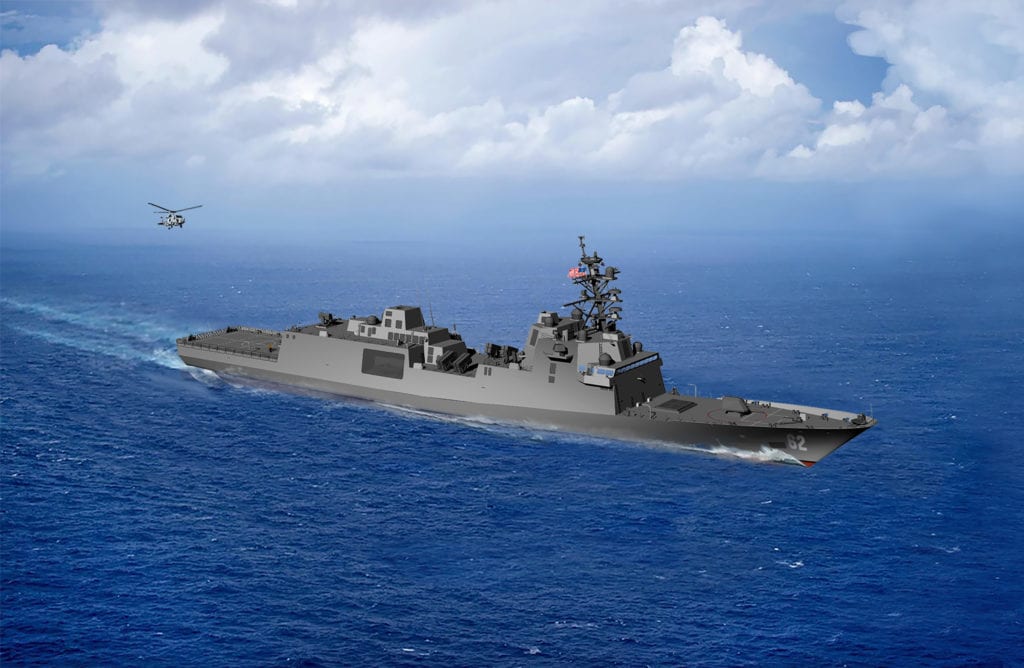
An artist’s conception of the next-generation small surface combatant, the guided-missile frigate, FFG(X). U.S. Navy

ARLINGTON, Va. — The new frigate being designed and built for the U.S. Navy will operate manned and unmanned helicopters from its flight deck and will be able to add new weapon and aviation capabilities as those systems are developed. 

The Navy announced on April 30 that it had awarded a detailed design and construction contract to Marinette Marine of Marinette, Wisconsin, to build the FFG(X) based on Fincantieri’s FREMM frigate design that is in service with the Italian and French navies. Marinette Marine is a Fincantieri company. 

See: Urgency, Discipline Hallmarks of Frigate Selection Process, Geurts Says

“This is going to be a real workhorse for the United States Navy supporting distributed maritime operations in the future,” said Vice Adm. Jim Kilby, the Navy’s deputy chief of naval operations for warfighting requirements and capabilities, speaking April 30 during the teleconference for the contract award. 

“So, we are super excited about this ship, and I can’t think of a better asset to a strike group or strike group commander to give them the flexibility to do what we need to do in the future.” 

Kilby said the frigate “has a requirement for a helo and an unmanned air vehicle but that is not dependent on the landing spot for either one of those. So conceivably, if procured, it could be two helos.” 

“This is going to be a real workhorse for the United States Navy supporting distributed maritime operations in the future.”

Vice Adm. Jim Kilby

James F. Geurts, the Navy’s assistant secretary for research, development and acquisition, who also spoke during the teleconference, emphasized service-life allowance and flexibility in the frigate’s future. 

Geurts said that growth capability was an important element of the source selection and requirements as the program moves forward. 

“That was a design criterion, so we are looking to the future to be able to accommodate all our air vehicles and unmanned vehicles to make this ship what I would call a medium, multimission combatant [so] it can meet all spectrums of potential conflict,” Kilby said. 

The FFG(X) will represent a substantial growth in lethality over the Navy’s previous guided-missile frigates, the Oliver Hazard Perry class. The last of those ships was decommissioned in 2015, but the Perry class could accommodate two H-60 anti-submarine helicopters or one H-60 and at least one MQ-8B Fire Scout vertical takeoff unmanned aerial vehicle.  

“Understanding how fast the threat is advancing means this service-life allowance requirement is so important for us,” Kilby said. “We did not want to define discretely where we’re going in the future so having some margin to include things such as directed energy [weapons] and other systems is why that’s so important.” 

“We have an extensive laser [science and technology] program in the Navy,” he added. “We definitely view it as a requirement for the future as we move into a realm where we want to have our launchers be reserved for offensive weapons and our point-defense systems be rechargeable magazines and the availability for us to sustain them for long periods of time.” 

Kilby also said of the new frigate, “Though it’s classified as a small surface combatant, [the FFX(X)] really falls nicely in between our small surface combatants and our large surface combatants, and I see it doing multiple things.”


Geurts: COVID-19 Crisis Offers Opportunity to Strengthen Acquisition, Sustainment

James F. Geurts, assistant secretary of the Navy for research, development and acquisition, during a 2019 technical conference. For a Navy League webinar on May 4, Geurts said acquisition and sustainment could emerge stronger from the COVID-19 crisis and that metrics are already ahead this fiscal year despite most of his workforce being on telework. U.S. Navy/John F. Williams

ARLINGTON, Va. — A top U.S. Navy official said acquisition and sustainment could emerge stronger, having withstood disruptions during the COVID-19 crisis. 

Speaking May 4 as part of a Navy League webinar sponsored by IBM for small businesses in the defense industry, James F. Geurts, assistant secretary of the Navy for research, development and acquisition, said he views the pandemic as a crucible, where there will be some delays in production and maintenance, but also as an opportunity to strengthen the system. 

See: Potential for 3-Month Slowdown in Defense Acquisition, DoD’s Lord Says

“What new opportunities does that enable for us to leverage?” Geurts asked. “If you would have asked me four months ago, ‘Could the team go 95%-plus telework, increase contract awards 33%, do so with 10% less contracts, and at the same time get their distance learning up by 65%, I would have laughed a little bit. And we’ve [achieved those metrics] in the last seven weeks.” 

“I don’t see it as much as a disruption to our future plans … as an accelerant to our future plans,” Geurts added. “The goal for us is, how do we come out of this stronger than we were, and how do we work now to increase the speed by which we come out of this.” 

Geurts cited the late April award of the FFG(X) frigate contract to Marinette Marine three months ahead of schedule, which brought the total of Navy contract awards $25 billion ahead of the same point last fiscal year. By his recollection, this fiscal year is the first where all financial benchmarks have been exceeded.  

“If you would have asked me four months ago, ‘Could the team go 95%-plus telework, increase contract awards 33%, do so with 10% less contracts, and at the same time get their distance learning up by 65%, I would have laughed a little bit.”

James F. Geurts

“So, I don’t view it as much as a delay as an accelerant,” he said. “We will continue to adapt as the warfighter requires. I don’t see us having to adapt our programs in a major way. We’re going to have to figure out how to capture in a bottle all the great things that have occurred in the last seven or eight weeks where we’ve gained this operational effectiveness and be thoughtful of where we’re going to have to manage risk downstream. But in terms of drastic changes to programs or schedules, I don’t see that.” 

Geurts said the biggest collective challenge will be how to operate if the virus lingers for a long time. 

“We need to create a system that is resilient to disruptions,” he said. “I’m actually very optimistic that this has been a good learning method for us as an enterprise. It’s tremendously painful, horrible to see what is happening at the human element, and I don’t want to downplay any of that at the individual level or at the national level. 

“What it has done is helped shine some spotlights on where we probably were not as aggressive as we needed to be and where we’ve got an opportunity to be more effective. We’ve got to be able to ride through disruption. That’s what our Sailors, Marines and our nation expect of us, and that’s where we’ve got to be focused.” 


Larger, More Capable Navy Needed, SECDEF Says

Defense Secretary Mark Esper prepares to participate in a Brookings Institution webinar on May 4. Defense Department/Marvin Lynchard

ARLINGTON, Va. — The nation’s top defense official said the U.S. armed forces need to shed some legacy forces for a more modern force, one that includes more modern naval forces. 

“We need a larger, more capable Navy that can implement distributed lethality across the seven seas,” Defense Secretary Mark Esper said, speaking May 4 in a webcast hosted by the Brookings Institution, a Washington think tank. “The Marines are doing some really innovative things with regard to how they are adjusting their force.”  

Esper said the Defense Department needs 3% to 5% annual real growth year-over-year in the budget topline to increase readiness and support the National Defense Strategy. 

Noting the probability of flat defense budgets and given the national debt and COVID-19 virus effects on the gross domestic product, Esper said he is worried that the “massive infusion of dollars into the economy … may throw us off that course … and lead to smaller defense budgets in the future.” 

“We need a larger, more capable Navy that can implement distributed lethality across the seven seas. The Marines are doing some really innovative things with regard to how they are adjusting their force.”

Defense Secretary Mark Esper

He said that the Defense Department is at a critical juncture with the “Great Power Competition” against China and Russia. 

“That means shedding the legacy force and moving to a more modern force,” Esper said, noting that a modern force would include completely revitalized strategic forces — including all three legs of the nuclear triad (bombers, intercontinental ballistic missiles and submarine-launched ballistic missiles) — “but also investing a lot of money into [artificial intelligence], into hypersonics, into our space capabilities, cyber, into directed energy.” 

He said that the Air-Land Battle Concept has been replaced by the Joint Warfighting Concept “that will make sure we’re fighting in all domains as a coherent, cohesive joint force. We have new plans to reach out to our allies and partners and make sure they are well-integrated into all of our efforts.” 

The secretary emphasized readiness concepts underway, including immediate-reaction forces and contingency-reaction forces as well as dynamic force employment and “moving toward operational deployments rather than permanently deployed forces.” 

“That said, we do need that topline growth, and if we don’t [get it], we’re just going to have to accelerate that shedding of the legacy force and turning those dollars back into building the force we need in the future.”


New CH-53K Simulator Ready for Training

Marine pilot Lt. Col. Lucas “Amber” Frank takes the CH-53K simulator, the Containerized Flight Training Device (CFTD), for a test drive. The Marine Corps took delivery of the CFTD in April. Naval Air Systems Command

PATUXENT RIVER, Md. — The H-53 heavy-lift helicopter program office has taken delivery of the first training device for the CH-53K King Stallion helicopter, according to a Naval Air Systems Command release. 

Delivered April 14, the Containerized Flight Training Device (CFTD) is housed at Marine Corps Air Station (MCAS) New River in Jacksonville, North Carolina. 

The CFTD, built by Lockheed Martin in partnership with Veraxx, provides realistic in-cockpit system displays (visual resolution, tactile, spatial, audio and functionality) and can simulate weather and tactical environments. The CFTD also can connect with other simulators for enhanced attitude control and other aircraft training scenarios. 

“The CFTD is an amazingly capable training device,” said Col. Jack Perrin, CH-53 program manager. “It is a much less expensive practice than using operational equipment and provides near-aircraft fidelity into a state-of-the-art training simulator for the fleet.” 

The CFTD is the first in a series of new training devices being developed for the CH-53K. All trainers will eventually be located at the Center for Naval Aviation Technology Training at MCAS New River, where all the aircraft’s aircrew and maintenance maintainers will be trained. Delivery of two other CH-53K training devices — the Helicopter Emulation Maintenance Trainer and the Composite Maintenance Trainer — also are expected this year. 

The CH-53K is completing development tests, leading to initial operational test and evaluation in 2021. First fleet deployment will be in 2023 or 2024. The simulation software continuously updates. As the program team makes necessary modifications to the CH-53K into the future, the CFTD also will change. 


Esper: ‘The Safest Place Is on a Deployed Navy Ship’

Hospital Corpsman 2nd Class Shane Miller (left) and Hospital Corpsman 2nd Class Austin Kelly draw blood from a Sailor assigned to the guided-missile destroyer USS Kidd after its arrival in San Diego as part of the Navy’s response to the COVID-19 outbreak on board the ship. U.S. Navy/Mass Communication Specialist 2nd Class Alex Corona

ARLINGTON, Va. — The secretary of defense noted May 4 that — with a couple of notable exceptions — the U.S. Navy’s ships at sea remain unaffected by the spread of the COVID-19 pandemic.   

“The statistics show that the safest place to be is on a deployed Navy ship compared to one that’s in port,” Defense Secretary Mark Esper said, speaking during a webcast sponsored by the Brookings Institution, a Washington think tank. “Of the 90-plus ships at sea, we only have two that have been affected.”

See: Navy Provides Medical Care to Infected Sailors of USS Kidd, Will Disinfect Ship

See: Navy Opens Deeper Inquiry Into Theodore Roosevelt; Move Delays Decision on Captain’s Reinstatement

The Navy has suffered significant outbreaks of the novel coronavirus on the Nimitz-class aircraft carrier USS Theodore Roosevelt and the Arleigh Burke-class guided-missile destroyer USS Kidd. A Sailor off the Roosevelt died from COVID-19 complications in mid-April. 

The cause of the transmission of the virus to the crews of both ships is unknown. The Theodore Roosevelt made a port call to Vietnam soon before Sailors began showing signs of illness. Another possibility: the virus was brought aboard by aircrews and passengers returning to the carrier. 

“We’re not sure where [the USS Kidd] picked [the virus] up,” Esper said. “It may have been through a counter-drug operation.” 

Esper said that “two ships out of 94 is a pretty good record. The Navy has taken a lot of good practices. They’ve learned from the Teddy Roosevelt. Before a ship is deployed it goes through multiple tests of its Sailors. They are quarantined for a couple of weeks. And, of course, we don’t bring a ship back in if it’s being replaced by one that’s going out. So, we’re being very careful of that.”  

“The statistics show that the safest place to be is on a deployed Navy ship compared to one that’s in port.”

Defense Secretary Mark Esper, during a May 4 webinar

The service is keeping the aircraft carrier USS Harry S. Truman away from port following a major deployment to avoid the pandemic. 

“We have had ships that have been portside that have had Sailors infected but that’s not unlike what you might see at an Army base or an Air Force base where you have Sailors out in the community who may get infected by the virus,” Esper said. “Before they go to sea, we bring them in, we test, we quarantine, and we make adjustments to make sure our ships get out on time.”


Lessons Learned From Teddy Roosevelt Outbreak Help Ease COVID-19 Impact on USS Kidd

A Sailor salutes the national ensign as he disembarks the USS Kidd at Naval Base San Diego on April 28 as part of the Navy’s response to the COVID-19 outbreak on board the guided-missile destroyer. While in San Diego, the Navy will provide medical care for the crew and clean and disinfect the Kidd. U.S. Navy/Mass Communication Specialist 2nd Class Alex Corona

ARLINGTON, Va. — The safe return to port of the guided-missile destroyer USS Kidd — with none of its crew needing hospitalization after a COVID-19 outbreak at sea — is due largely to lessons learned from the spread of the virus more than a month ago aboard the aircraft carrier USS Theodore Roosevelt that turned deadly, according to a Defense Department spokesman.

The Arleigh-Burke class destroyer Kidd was participating in counter-narcotics operations in the U.S. Southern Command area of responsibility in the Pacific Ocean when several of its Sailors began exhibiting flu-like symptoms in late April. 

See: Navy Opens Deeper Inquiry Into Theodore Roosevelt; Move Delays Decision on Captain’s Reinstatement

See: A Timeline From the First Month of the Outbreak in the Sea Services

See: Hospital Ship Comfort Departs NYC, Prepared for Future COVID-19 Response

One Sailor aboard the Kidd was evacuated to the U.S. mainland for testing on April 22 after experiencing shortness of breath. The commander of the U.S. Pacific Fleet redirected the amphibious assault ship USS Makin Island — which is equipped with an intensive care unit, ventilators and additional testing capability — to rendezvous with the Kidd. Even before that, an eight-member medical team flew out to the Kidd on a helicopter and began testing the crew for symptoms of the virus. As of April 25, 33 Sailors aboard the Kidd had tested positive for it.

“The effort by the captain and the crew of the Kidd, the Makin Island and the rest of the medical team should be lauded for what they did and how they were able to get that ship back to port and how they were able to get the crew off,” Pentagon spokesman Jonathan Rath Hoffman told a press briefing on May 1. “Right now, there’s a large number of sick but, fortunately, none are hospitalized, and we’re going to continue to hope that everybody recovers quickly.”

The USS Kidd arrives in San Diego on April 28. U.S. Navy/Mass Communication Specialist 2nd Class Alex Millar

The Kidd reached San Diego, not its homeport, on April 28. After testing 100% of the more than 300 crew members, the U.S. Navy said 78 active COVID-19 cases were detected. None of the Kidd’s crew is hospitalized, according to the Navy.

All crew members will complete at least 14 days in quarantine or isolation and must achieve two negative tests for the virus before returning to the ship. Medical professionals, chaplains, a resiliency counselor and a psychologist are supporting the Sailors in isolation and quarantine.

While in San Diego, the USS Kidd will undergo a deep cleaning that balances decontamination with preventing damage to the ship’s systems. It is not known how COVID-19 made its way onto the destroyer.

“Fortunately, we are able to take many of the lessons learned from the Theodore Roosevelt and apply them to the Kidd so that we were able to address the outbreak — obviously, a very different ship, a different size.”

Pentagon spokesman Jonathan Rath Hoffman

“Fortunately, we are able to take many of the lessons learned from the Theodore Roosevelt and apply them to the Kidd so that we were able to address the outbreak — obviously, a very different ship, a different size — but was able to address it rapidly in a way that we were able to get the ship to port,” Hoffman said.

The Theodore Roosevelt, which also was at sea when COVID-19 broke out, is still sidelined in Guam, more than a month after the first Sailors there were diagnosed.

As case numbers spiked, the carrier’s captain sent a lengthy e-mail, which was leaked to a newspaper, complaining that the evacuation of the 4,000-plus Sailors of the Roosevelt was occurring too slowly, endangering the crew. This led then-acting Navy Secretary Thomas Modly to relieve the skipper, Capt. Brett Crozier, of his command. The ensuing controversy and a speech highly critical of Crozier that Modly delivered a few days later to the Roosevelt’s crew sparked Modly’s resignation on April 7.

The Roosevelt’s entire crew has been tested for COVID-19, the Navy said in its May 1 update. There are 1,102 active cases left from the carrier — an increase due to exit testing of Sailors who are asymptomatic, the Navy said, adding that 53 Sailors have recovered after completing at least 14 days in isolation and clearing two successive tests with negative results.

Three Sailors are being treated in U.S. Naval Hospital Guam for COVID-19 symptoms. None of those crew members are in the intensive care unit. A Roosevelt Sailor did die in mid-April from COVID-19 complications.

Hospital Corpsman 2nd Class Shane Miller (left) and Hospital Corpsman 2nd Class Austin Kelly draw blood for COVID-19 testing from a Sailor assigned to the USS Kidd after its arrival in San Diego on April 28. U.S. Navy/Mass Communication Specialist 2nd Class Alex Corona


U.S., British Ships Conduct Anti-Submarine Exercise Above Arctic Circle

The Arleigh Burke-class guided-missile destroyer USS Donald Cook, USNS Supply, the USS Porter and the Royal Navy’s HMS Kent conduct a connected replenishment in the North Atlantic on April 28 ahead of a bilateral anti-submarine warfare exercise. U.S. Navy/Yeoman 3rd Class Anthony Nichols

NORWEGIAN SEA — The U.S. 6th Fleet conducted a bilateral anti-submarine warfare exercise with the U.K. above the Arctic Circle on May 1, U.S. Naval Forces Europe-Africa and the 6th Fleet said. 

Four ships from two nations, a U.S. submarine, and a U.S. P-8A maritime patrol and reconnaissance aircraft worked together in the Norwegian Sea to conduct training in the challenging Arctic conditions. 

For the exercise, Arleigh Burke-class Aegis destroyers USS Donald Cook and the USS Porter and fast combat support ship USNS Supply were joined by the Royal Navy’s HMS Kent. The U.S. sub and the P-8A Poseidon from Patrol Squadron (VP) 4 supported the training. This drill reinforced the combined training that the nations received last month while participating in the U.K.’s Submarine Command Course. 

“For more than 70 years, 6th Fleet has operated forces across the region in support of maritime security and stability. Our regional alliances remain strong because of our regular operations and exercises with partner navies, and we welcome this opportunity to work collaboratively at sea, while enhancing our understanding of Arctic operations,” said Vice Adm. Lisa Franchetti, the 6th Fleet’s commander. 

The multinational anti-submarine exercise in the High North, made up of about 1,200 Sailors from the U.S. Navy and Royal Navy, is the latest in a series of U.S. ships operating above the Arctic Circle. 

In 2018, elements of the USS Harry S. Truman Carrier Strike Group and the USS Iwo Jima Expeditionary Strike Group operated above the Arctic Circle to support a NATO exercise, Trident Juncture. In 2019, the forward deployed destroyer USS Donald Cook and a SAG from U.S 2nd Fleet led by the USS Normandy and the USS Farragut also operated separately above the Arctic Circle. 

“We are working with our partners to enhance our combined capabilities as we conduct maritime security operations and training in the Arctic region,” Franchetti said. “Our ships must be prepared to operate across all mission sets, even in the most unforgiving environments. This is especially critical in the Arctic, where the austere weather environment demands constant vigilance and practice.”