Marine Cyber Official: ‘Our Networks Are Resilient’ in COVID-19 Environment
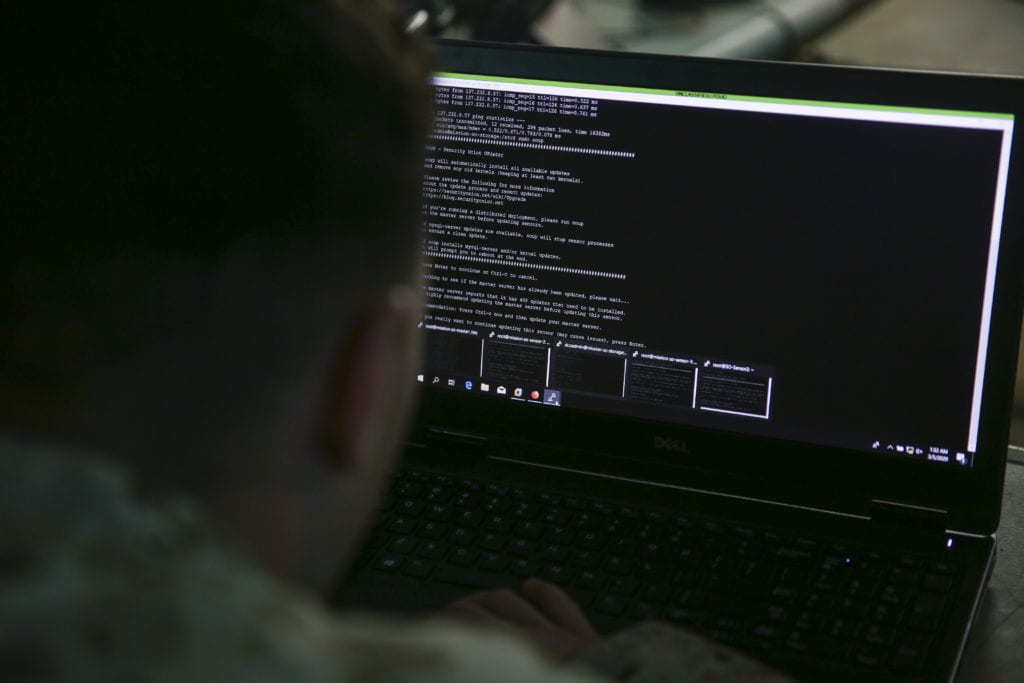
A U.S. Marine assess data during an exercise, Native Fury 20, in the United Arab Emirates on March 5. U.S. Marine Corps/Sgt. Alexis Flores

ARLINGTON, Va. — The U.S. Marine Corps’ cyber networks are being defended and upgraded even as the COVID-19 pandemic forces ad hoc adaptation in their operation, a senior Marine Corps official said. 

“Our networks are good, and they are operating at a good capacity and are resilient,” said Gregg Kendrick, executive director of Marine Corps Forces Cyberspace Command, speaking April 17 in a webcast for Navy League’s Sea-Air-Space 2020: Virtual Edition. 

To register and then watch this Sea-Air-Space 2020: Virtual Edition webinar live online, click here. 

“We’re pleased with our effective efforts in our ability to support the force as it has gone to ad hoc telework or alternate work sites and maintain our capacity and, more importantly, our operational capability to support our warfighters and our commanders that are out there deployed in harm’s way.”  

Kendrick said the Corps is monitoring its networks differently in the current environment. 

“We do look at our virtual private networks and then we look at our physical and transport layer, our network stack from Layer 1 to Layer 4, so from that perspective we’re focused on those types of metrics and really watching our latency,” he said. 

“So, we are very focused on the security. Every decision we have made in regards to supporting the ad hoc telework option has really [been] focused. We’ve had a fundamental security look, and we’ve really looked at our modernization efforts to ensure that we are aware of any of the advanced persistent threats and/or capabilities that are out there to ensure that we have a good, resilient as well as available network.” 

“We’re pleased with our effective efforts in our ability to support the force as it has gone to ad hoc telework or alternate work sites and maintain our capacity.”

Gregg Kendrick, Marine Corps Forces Cyberspace Command

Kendrick said his force is looking at “which applications are in use the most, which are stressed the most at the highest capacity, what exactly are our latent measures, … and our overall bandwidth [including] by bandwidth region. Everything [security metrics] is funneled through our enterprise security desk so that we can rapidly pull metrics and shift resources as needed to support our Marine warfighters.” 

He said Cyberspace Command is starting to see trends in the pandemic environment, “but we are definitely waiting for this to evolve and then we will be able to draw conclusions, but at the same time we don’t want to let a trend propagate to a point where we have to go into a different work cycle.” 

“The bad guys are always looking at what we’re doing, and they are looking to do harm,” Kendrick said. “We protect our workforce. We secure, operate and defend the Marine Corps enterprise networks.” 

Kendrick said that through the Corp’s new command-and-control network structure the service is bringing a “unity of command that provides a much clearer readiness picture of our network, our resiliency picture, and then a better overall visualization of the data flow from the end points all the way to the data centers and then back out where they need to go.” 

The executive director said the Corps is adopting Microsoft Office 365 to achieve a more efficient capability combined with a hybrid cloud architecture, aiming for higher velocity. 

“In the end state the adversary gets a vote,” he said. “They move at speed unconstrained by rules of engagement or the laws of nation states. We need to implement the best infrastructure, the best applications, the best operational processes as efficiently as possible so that we can modernize, provide the best capability to the warfighter, at the same time ensuring security from adversary actions and resiliency across the networks.”

Navy Awards Ship-to-Shore Connector Contract to Textron

WASHINGTON — The U.S. Navy has awarded a contract for the fiscal year 2017-2020 procurement of ship to shore connector craft, the Navy’s Program Executive Office (PEO)–Ships said in an April 16 release. 

Ship to shore connectors are the evolutionary replacement for the existing fleet of landing craft air cushion (LCAC) vehicles and will primarily transport weapon systems, equipment, cargo and personnel of the assault elements through varied environmental conditions from amphibious ships over to the beach. 

“As the program continues to move forward with delivering these important capabilities to the fleet, the procurement of these additional craft is critical,” said Tom Rivers, program manager of the Amphibious Warfare Program Office for PEO-Ships. 

Textron Systems was awarded the $386 million fixed price incentive-firm target and firm fixed price contract modification for the construction of 15 craft. Work will be performed primarily in New Orleans. 

The contract award is one of several recent milestones for the program. The Navy accepted delivery of the first of the next-generation landing craft, Ship to Shore Connector Craft 100, on Feb. 6. Craft 100 is the developmental unit for the next-generation landing craft and will be located in Panama City, Florida, where additional testing and crew training will be conducted. 

The second craft, LCAC 101, is making headway and will head to sea within the next few weeks for builder’s trials for assessment of its operational readiness. During the trials, LCAC 101 will undergo integrated testing in both unloaded and loaded states to ensure the craft will successfully meet all requirements. The detail design and construction contract procured nine craft. Beyond Craft 100 and LCAC 101, an additional seven craft are in the later stages of production.


Marine Corps Makes First Operational MQ-9A Flight in Middle East

SAN DIEGO — U.S. Marine Corps pilots and sensor operators from Marine Unmanned Aerial Vehicle Squadron 1 (VMU-1) conducted their first operational flight of an MQ-9A Reaper unmanned aircraft system in the Middle East on March 20, according to an Aeronautical Systems Inc. (GA-ASI) release. 

The multisensor reconnaissance-equipped MQ-9A UAS produced by General Atomics has provided crucial support to Marine forward operations on the battlefield. 

With oversight from the GA-ASI team, VMU-1 “Watchdog” crews took control of a company owned/company operated (COCO) MQ-9A supporting forward-deployed Marines. This achievement comes shortly after surpassing 7,000 hours of COCO flight operations since September 2018. 

“This achievement represents a unique milestone and example of the Marine Corps’ legacy of innovation,” said David R. Alexander, president of GA-ASI. “As a partner with the Marine Corps, we look forward to expanding the role of medium-altitude, long-endurance UAS in support of maritime littoral missions.” 

VMU-1 leases MQ-9A Reaper aircraft to fulfill its urgent needs request for persistent intelligence, surveillance and reconnaissance (ISR) in Afghanistan. GA-ASI has been working with VMU-1 as the Marine Corps transitions its COCO MQ-9A contract to a government owned/government operated (GOGO) contract in the coming year. 

The GOGO capability fulfills the commandant’s directive for USMC Group 5 persistent ISR capability with strike. VMU-1 will be the test bed and incubator to provide crucial information, lessons learned, requirements, tactics, techniques, and procedures that will aid in the Marine Corps efforts for the successful acquisition and fielding of the Marine Air-Ground Task Force Unmanned Aircraft System Expeditionary Group 5 capability.


HII Begins Fabrication of Amphibious Transport Dock Harrisburg

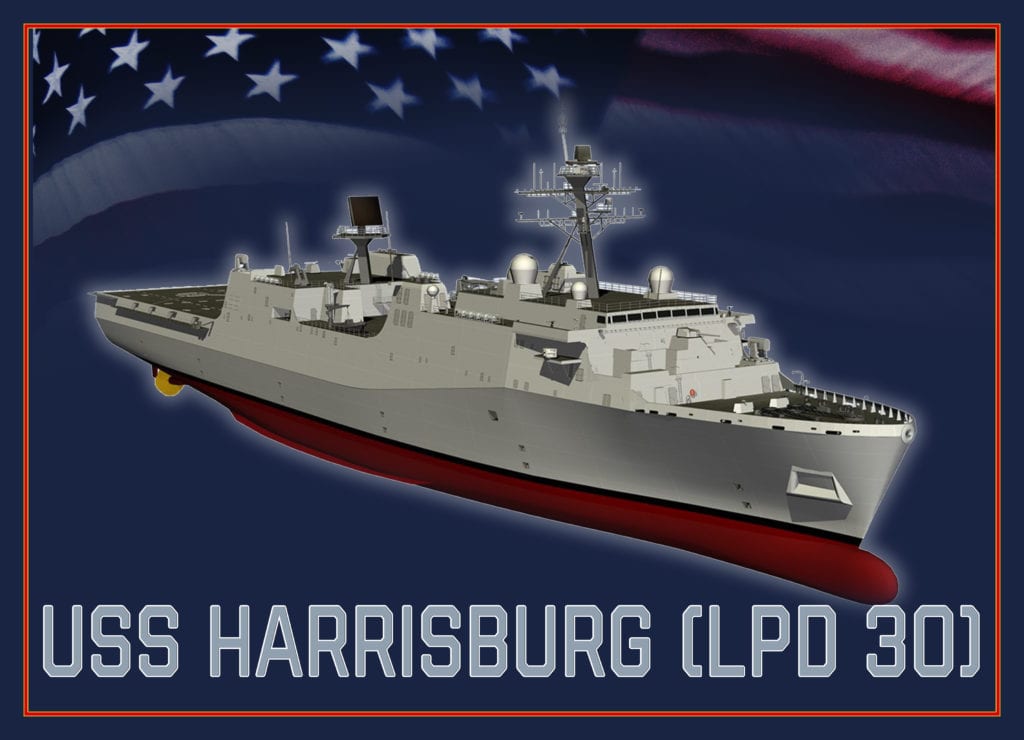
A graphic illustration of the future amphibious transport dock ship Harrisburg (LPD 30). U.S. Navy

PASCAGOULA, Miss. — Huntington Ingalls Industries’ Ingalls Shipbuilding division recently started fabrication of the U.S. Navy’s newest San Antonio-class amphibious transport dock Harrisburg, the company said in an April 16 release. The start of fabrication signifies that the first 100 tons of steel have been cut. 

“LPD 30 is the start of an exciting new era for the San Antonio class,” said Steve Sloan, Ingalls LPD program manager. “The start of fabrication for Harrisburg marks the beginning of the LPD Flight II program. Through learning structured around consistent production, we’ve been able to identify design and construction modifications to make future ships in the class more affordable while fulfilling Navy and Marine Corps requirements.”  

Ingalls has delivered 11 San Antonio-class ships to the Navy and has three more under construction, including the Harrisburg. The ship will be the 14th in the San Antonio class and the first Flight II LPD. Fort Lauderdale (LPD 28) launched in March and is scheduled to be delivered next year. 

LPD 30 will be the second Navy vessel named after the city of Harrisburg, Pennsylvania. The first was a troopship acquired by the Navy during World War I that served in commission from May 29, 1918, to Sept. 25, 1919. That ship also served with the Navy in the Spanish-American War under another name. In addition to being the capital of Pennsylvania, Harrisburg is home to several Defense Department facilities, including the Naval Support Activity, Mechanicsburg.


Ford Weapons Elevators Set for Completion by Summer 2021 Shock Trials

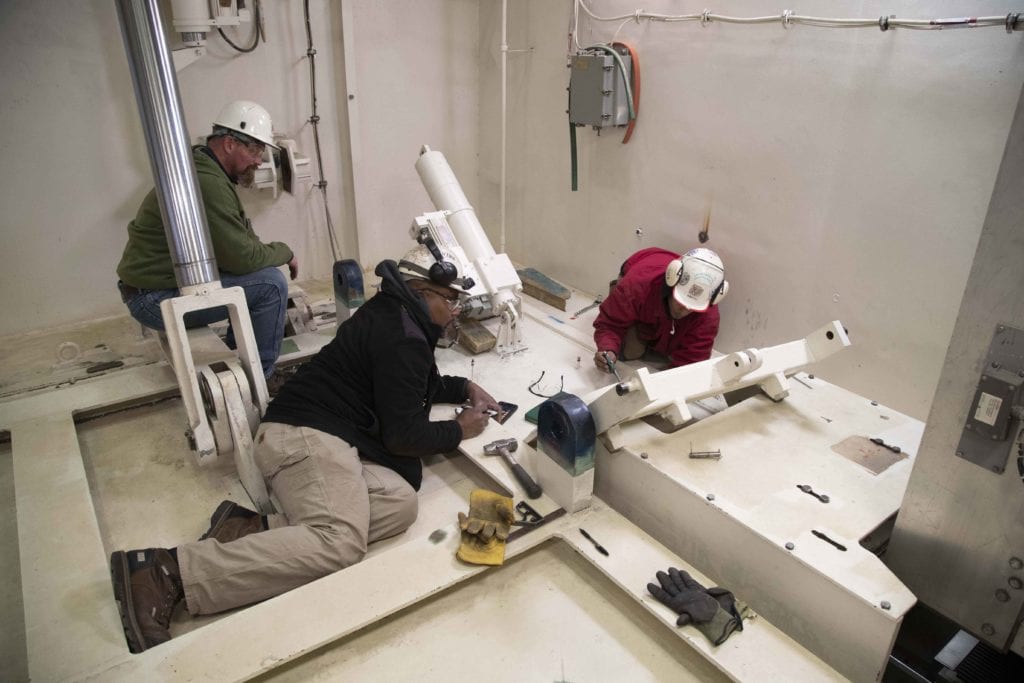
Huntington Ingalls Industries-Newport News Shipbuilding division contractors aboard the aircraft carrier USS Gerald R. Ford test a lower-stage weapons elevator. U.S. Navy/Mass Communication Specialist Seaman Apprentice Riley McDowell

ARLINGTON, Va. — The installation and turnover of the advanced weapons elevators on the aircraft carrier USS Gerald R. Ford is proceeding well, with the goal to complete the work by summer 2021, a top U.S. Navy official said. 

“We need to get all of the elevators up and running prior to her full-ship shock trials planned for [summer 2021],” James. F. Geurts, assistant secretary for research, development and acquisition, told reporters during an April 16 teleconference.  

He said that the carrier had just returned from 32 days at sea where it conducted carrier qualifications for fleet and student pilots, logging 1,352 catapult launches and arrested landings — “generating readiness for the fleet” — and that one lower elevator had completed testing. 

“I’m pleased with the performance of the shipyard,” Geurts said. “Ford in the [post-delivery testing and trials] period deployed at least 50% of the time. I have been very proud of the shipbuilder’s creativeness in getting the elevators worked on while the ship is underway. We’re ahead slightly of the schedule. My main focus is getting these first two lower elevators turned over [to the crew] because that will allow full access from the magazine all the way to the flight deck.” 

Geurts said the priority is to give the crew access to the magazines and the second is adding redundancy and capacity. He said a lesson learned during the elevator installation was to have elevator specialists among the shipbuilder’s work force. 

“You can’t just have any trade work on the elevators,” he said. “What the shipbuilder has done is create essentially an elevator trade [with] a separate schoolhouse. We’re essentially using Ford to build the teams that will then continue and flow all the way through [the subsequent carriers, CVNs 79 through 81]. There is work being done on those follow-on carriers.  

“They’re also going to have to improve their efficiency at getting the work done.”


In Perhaps a First, USS Delaware Commissioned Underwater

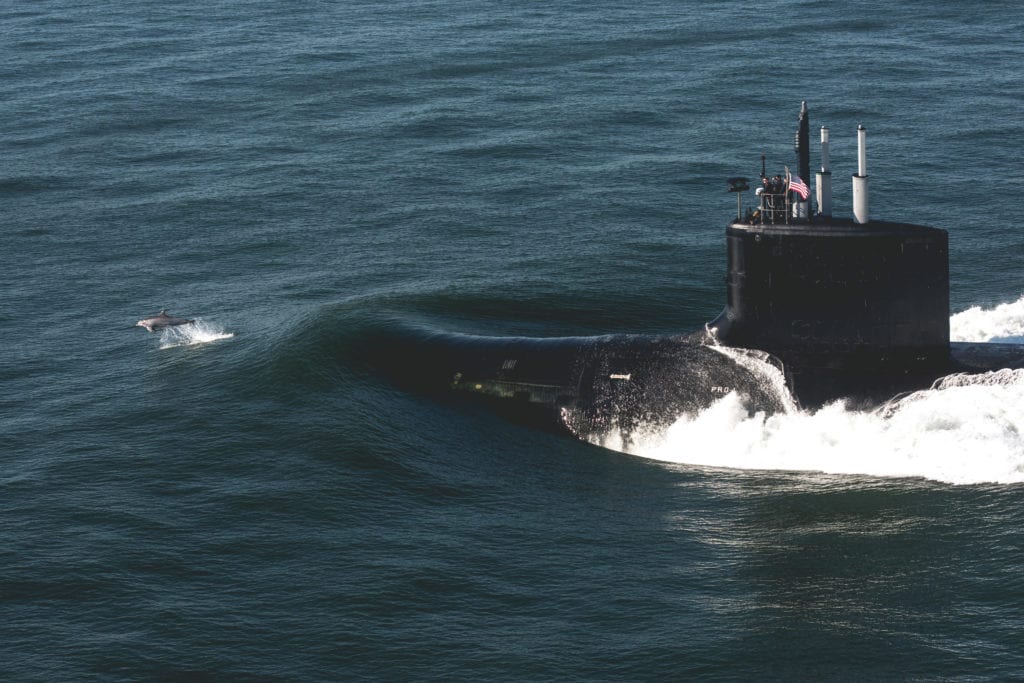
The USS Delaware transits the Atlantic Ocean with some company after departing Huntington Ingalls Industries Newport News Shipbuilding division during sea trials last August. U.S. Navy via Ashley Cowan/Huntington Ingalls Industries

ARLINGTON, Va. — The COVID-19 pandemic is driving the U.S. Navy to adapt some of the ways it conducts business, but the commissioning of a submarine underwater is likely to be a first. 

The Virginia-class attack USS Delaware was commissioned into the Navy on April 4 while the sub was underwater, James F. Geurts, assistant secretary for research, development and acquisition, told reporters during an April 16 teleconference. 

Geurts said the Delaware’s crew replicated commissioning ceremony traditions that could be accomplished beneath the surface, including “bringing the ship to life” and sounding the claxon. The crew also fired water slugs through the Delaware’s torpedo tubes. 

“Due to public health safety and restrictions on large public events, the commissioning ceremonies for the future USS Delaware and future USS Vermont were canceled for April 4 and 18, respectively,” Bill Couch, a spokesman for Naval Sea Systems Command, told Seapower back on March 24. 

A Navy release added: “Although the traditional commissioning ceremony was canceled due to restrictions on large gatherings brought on by the COVID-19 pandemic, the Navy commissioned USS Delaware administratively on April 4 and transitioned the ship to normal operations. Meanwhile, the Navy is looking at an opportunity to commemorate the special event with the ship’s sponsor, crew and commissioning committee.” 

The Delaware is the eighth and last Block III Virginia-class SSN. The Vermont is the first of 10 Block IV Virginia-class subs. The two subs were built jointly by General Dynamics’ Electric Boat and Huntington Ingalls’ Newport News Shipbuilding.


Navy, Marine Officials: AI Will Augment — Not Replace — Humans

Rear Adm. David Hahn, chief of naval research, and Jennifer Edgin, the U.S. Marines Corps’ assistant deputy commandant for information, were the guests on a webcast April 16 for the Navy League’s Sea-Air-Space 2020: Virtual Edition on the two sea services’ possible uses for artificial intelligence.

ARLINGTON, Va. — U.S. Navy and Marine Corps officials close to the effort to develop artificial intelligence in machines say the technology is advancing rapidly and will be used where it can add value. 

Discussing AI in an April 16 webcast of the Navy League’s Sea-Air-Space 2020: Virtual Edition were Rear Adm. David Hahn, chief of naval research, and Jennifer Edgin, the Marines’ assistant deputy commandant for information. They said AI has an “incredible capability” and will have a “huge role to play” in warfighting.

To register and then watch this Sea-Air-Space 2020: Virtual Edition webinar live online, click here. 

Hahn said that AI can help sort the enormous amounts of data available to the warfighter and perform many tasks that previously were performed by humans. 

“Things advance faster when artificial intelligence is applied,” Hahn said. 

He stressed, however, that AI will not replace humans, but will augment them. 

“I don’t think you should look at it as replacing [humans], he said. “I think you should look at it as a value add. That value add will come in speed of decision, or the efficiency of the operation, or the effectiveness of that decision or that event. I think that this [AI] is a force multiplier for the humans who are engaged in these activities. 

“It’s up to us to find the combinations of artificial intelligence and other technologies like autonomy to apply the appropriate ways to naval warfare,” he said. “I don’t think it’s a one-for-one, and we’re not going to trade out a human for a machine. We’re going to make the whole team better with this human-machine teaming concept.” 

“I don’t think you should look at [AI] as replacing [humans]. I think you should look at it as a value add.

Rear Adm. David Hahn

Hahn stressed that AI and autonomy are not the same, but where they intersect, AI can add value to autonomy. 

“Autonomy is going to move along a pathway, and when machine learning or some other method of artificial intelligence can add to that autonomy to accomplish a mission, then there will be an intersection,” he said. If it adds value to the mission, then it will make sense to do it.” 

Humans are still required for many types of decisions and the services are working on the issues that arise with the use of AI. 

“That conversation is maturing,” Hahn said. 

The admiral said that he sees a “democratization” of the tools of AI, in which it becomes the domain not just of academia but will eventually spread to general use by the military and the public. A disadvantage of that democratization is that the AI in use will be available to adversaries, and AI that can be used for beneficial purposes also can be used for nefarious purposes. 

AI “is an incredible capability that we in the Marine Corps seek to harness,” Edgin said. “Our philosophy is how do we want to pair Marines with machines to be more effective on the battlefield. We don’t want Marines to be spending their time putting a whole bunch of data into a spreadsheet. We want Marines to be able to make judgement decisions. We want them to use that Level 4 fusion capability that we have as humans to develop courses of action to lead at the small-unit level.” 

“One of the most beneficial tools we have today is actually the individual Marine,” she added. “What we try to do is unleash their potential to identify technologies, identify problems, and then quickly implement a solution. 

“If there is one truth in AI, there will always be something new and exciting that can potentially provide benefits to us.” 


Space, the Hostile Frontier: Panel Explores Defense of Earth Orbit

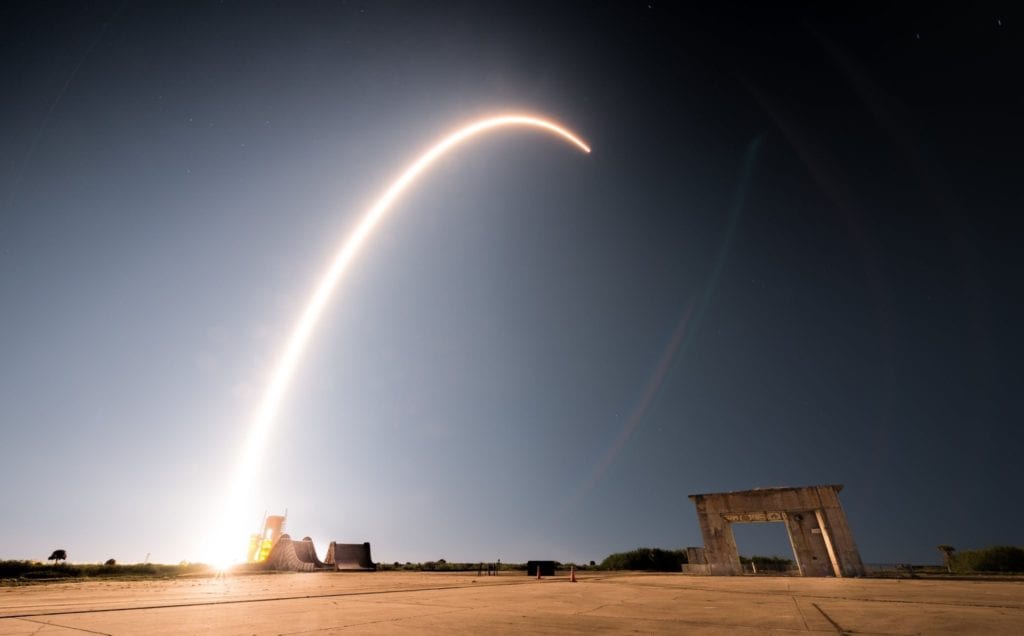
A Falcon 9 rocket launches on Jan. 6 at Cape Canaveral Air Force Station, Florida. The rocket, carrying an installment of Starlink satellites, was the first official launch of the U.S. Space Force. U.S. Air Force/Joshua Conti

Space is not benign — no longer just the domain of unmanned scientific probes and occupied by astronauts in capsules or space stations exploring and conducting research, panelists stressed during a webcast that was aired on April 16 as part of the Navy League’s Sea-Air-Space 2020: Virtual Edition. 

“Space, internationally, is very important to our way of life. It’s of strategic importance. We see our adversaries starting to weaponize space,” said Rear Adm. Marcus Hitchcock, director of strategy, plans and policy at U.S. Space Command, the unified combatant command responsible for American military operations in outer space.

To register and then watch this Sea-Air-Space 2020: Virtual Edition webinar live online, click here. 

Other guests in the panel discussion, which was moderated by Francis Rose, included Derek Tournear, director of the Space Development Agency, and Christian Zur, executive director of the Procurement and Space Industry Council of the U.S. Chamber of Commerce. 

“We’ve seen a massive explosion in everything space, at the national level and in our military,” Hitchcock observed, noting the establishment last year of the newest branch of the military, the U.S. Space Force. “Every morning we leap out of bed and we come in and stand the watch to maintain our space domain.” 

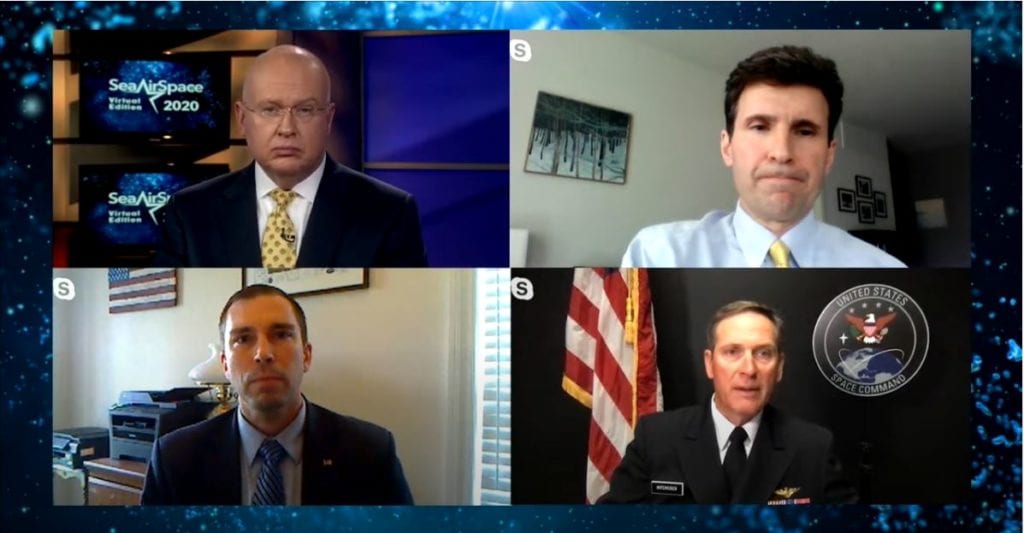
The discussion during the webinar for the Navy League’s Sea-Air-Space 2020: Virtual Edition included (clockwise) moderator Francis Rose, Christian Zur, executive director of the Procurement and Space Industry Council of the U.S. Chamber of Commerce, Derek Tournear, director of the Space Development Agency, and Adm. Marcus Hitchcock, director of strategy, plans and policy at U.S. Space Command.

The admiral observed that space has already seen its share of incidents, such as the 2017 launch of a missile by the People’s Republican of China, a “Great Power Competitor” along with Russia, that shot down a satellite in low-earth orbit. “This is a very real example of our adversaries or potential adversaries developing counter-space offensive weapons that can test our supremacy.” 

A satellite recently launched by Russia also is believed to have the capability to damage or disable U.S. Military assets in orbit, Hitchcock added. 

To maintain America’s strategic high ground in space, Tournear said the U.S. needs to maintain its technological advantage but speed up the frequency of its launches of defense assets. 

“Space, internationally, is very important to our way of life. It’s of strategic importance. We see our adversaries starting to weaponize space.”

Adm. Marcus Hitchcock, U.S. Space Command

“In the last National Defense Strategy, it basically said we have the new technology, we have the best digital base, but we do not have the speed, and our adversaries are able to get capabilities in orbit in three- to five-year timeframes at the longest. At the shortest, we can do it in 10 years [but] usually it’s closer to 15.” 

It’s the mission of the Space Development Agency to field U.S. capabilities to orbit faster, he added. 

Moderator Rose observed that the NASA-based model had “flipped over the past few years,” where instead of U.S. efforts in space being led by the vaunted civilian government agency, space efforts are being pioneered by private industry — scientific and commercial endeavors but most especially defense applications. 

Tournear countered that this development has led to companies building “hundreds of thousands” of satellites, commoditizing them and getting them to orbit quickly. “No longer does the government need to lead to make sure we develop the best technology,” he said. “We need to make sure we can get technology up there every two years.” 

Zur picked up the discussion from private industry’s perspective. 

He said the pairing of industry and defense technology for space started early, in the 1950s. Once the Defense Department started seeking technology for space, notably computer chips, costs per chip started going down. That trend has stretched into today, Zur said. 

Rose touched on the responsibility that commercial industry and governments hold to mind how they maintain low-earth orbit. Zur talked about space debris but also private industry’s role as caretaker. 

“While I could argue that there aren’t really enduring procedures that are accepted among all the players, and in large part militaries around the world have different objectives, we in the U.S. have kind of taken the lead in the commercial use of space. These norms and procedures have to be established, not only from a regulation standpoint, it’s simply best business practices. We’re just at the beginning stages of this.” 

Hitchcock agreed with Rose that it’s important for U.S. Space Command to know what commercial assets are in orbit, where they are and what function they are serving. The U.S. is “getting better at looking up and understanding what is in space,” he added. 

He described a new radar that recently went active that can map and track assets of all kinds — U.S. governmental, foreign and commercial. Older tracking counted some 25,000 objects in orbit, only 2,000 of which were actual satellites or other platforms, he said. “The rest of it was debris, trash. We think our understanding of what’s up there will increase tenfold as this ‘space fence’ comes online, and we might see as many as 250,000 different objects up there.” 


SUPSHIP Turns to Fusion for Facemasks

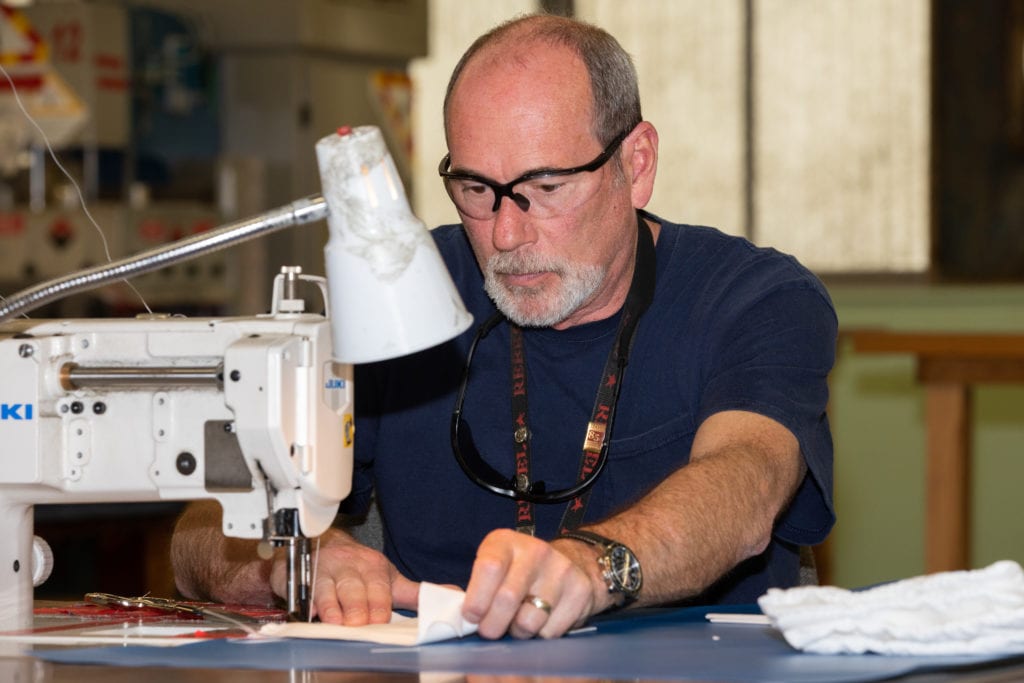
NNSY’s Sail Loft has begun making facemasks to further ensure the health and safety of workforce personnel, with a capacity to produce up to 900 daily. COVID-19-specific Personal Protective Equipment (PPE) has been distributed to the USS George H.W. Bush, USS Wyoming and USS San Francisco projects. NNSY/Danny De Angelis

WASHINGTON — When Supervisor of Shipbuilding, Conversion and Repair Newport News’ supply of protective facemasks to combat COVID-19 dwindled to 30 by the morning of April 9, SUPSHIPNN’s commanding officer, Capt. Jason Lloyd, turned to his staff for a solution, according to Naval Sea Systems Command (NAVSEA). 

An order for more masks had already been placed but they would not arrive until the following week. He needed a solution that would enable the command to continue its fleet support mission. 

His staff turned to Fusion, an internal Navy collaboration tool that is like Facebook and was developed by Naval Information Warfare Systems Command connecting NAVSEA employees virtually throughout the world. 

“As the SUPSHIPNN Command Process Improvement Champion, I have been a fan of the NAVSEA Fusion site since its inception,” said Greg Mitchell, SUPSHIP Newport News’ command process improvement champion. “I immediately posted a plea for help on Fusion early” on the morning of April 9. 

“Fusioneers” — as Mitchell termed his fellow collaborators — responded with numerous recommendations and offers to assist. One of those responses led to Norfolk Naval Shipyard (NNSY), co-located in Norfolk, a command already using its internal capability to sew cloth facemasks for its workforce. 

“I reached out to them,” Mitchell said. “By 1400 that same day, I had 100 brand-new masks made by Norfolk Naval Shipyard’s production resources group in their sail loft I could deliver to my command.” 

In an e-mail to the shipyard’s commanding Officer, Capt. Kai Torkelson, Lloyd thanked his NAVSEA colleague, calling the success of Fusion as a “perfect example of teamwork and knowledge sharing. … Fusion collaboration at its finest.” 

Mitchell said that in order to answer NAVSEA Commander, Vice Adm. [Thomas] Moore’s call to “Expand the Advantage” the command needs to become a High Velocity Learning (HVL) organization. “There is no better way to use HVL than Fusion,” he said. “Thanks to everyone involved who made this a complete Fusion success.  We are and will always be a “One Navy” Team!” 

Supervisor of Shipbuilding, Conversion and Repair, Newport News, is the liaison between the Department of the Navy and Huntington Ingalls Industries Newport News Shipbuilding, the company engaged in the design and construction of new nuclear-powered submarines and aircraft carriers as well as the repair and modernization of active subs and carriers in the fleet.


2nd Fleet Keeps Truman Strike Group at Sea as Ready Carrier Amid Pandemic

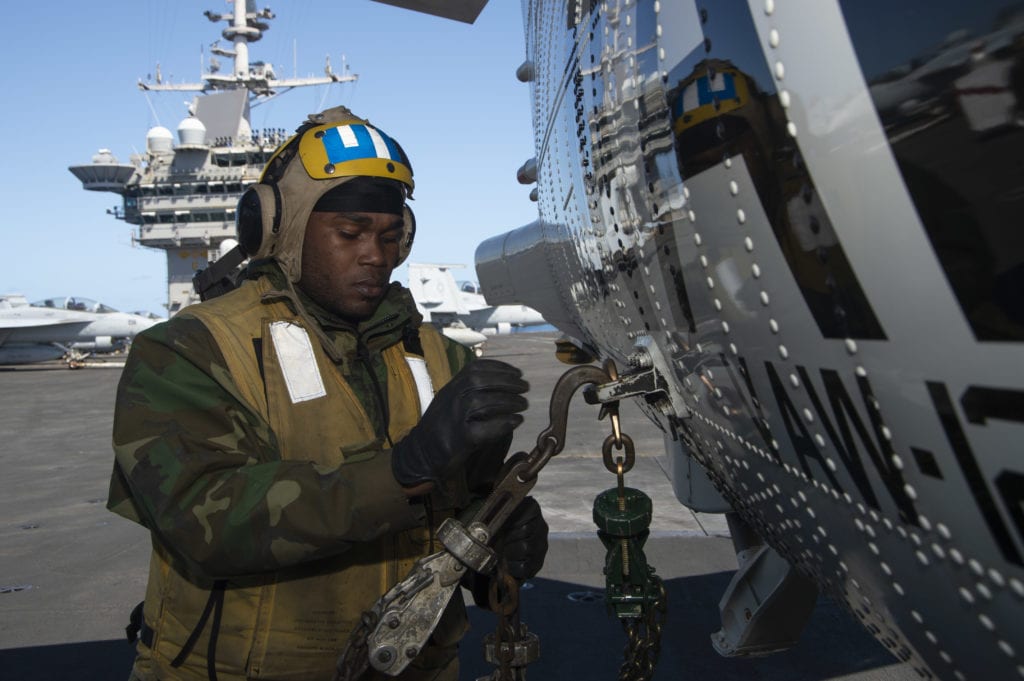
Aviation Boatswain’s Mate (Handling) 2nd Class Albert Gibson chains an E-2D Hawkeye to the flight deck of the USS Harry S. Truman in the Atlantic Ocean on April 11. The Truman Carrier Strike Group is conducting operations there. U.S. Navy/Mass Communication Specialist Seaman Bela Chambers

NORFOLK, Va. — The Harry S. Truman Carrier Strike Group remains at sea in the western Atlantic as a certified carrier strike group force ready for tasking to protect the crew from the risks posed by COVID-19, following their deployment to the U.S. 5th and 6th Fleet areas of operation, the U.S. 2nd Fleet said in a release. 

The Navy is taking this measure to maintain the strike group’s warfighting capability while ensuring the safety of the crew.

See: U.S. Military in All-New Territory in Fight Against Virus, Foggo Says 

The demand for naval assets remains high. Therefore, keeping the Truman strike group at sea as it remains in the sustainment phase of optimized fleet response plan (OFRP) allows the ship to maintain a high level of readiness for a potential rapid surge or forward deployment, providing options to the national command authority during the global pandemic. 

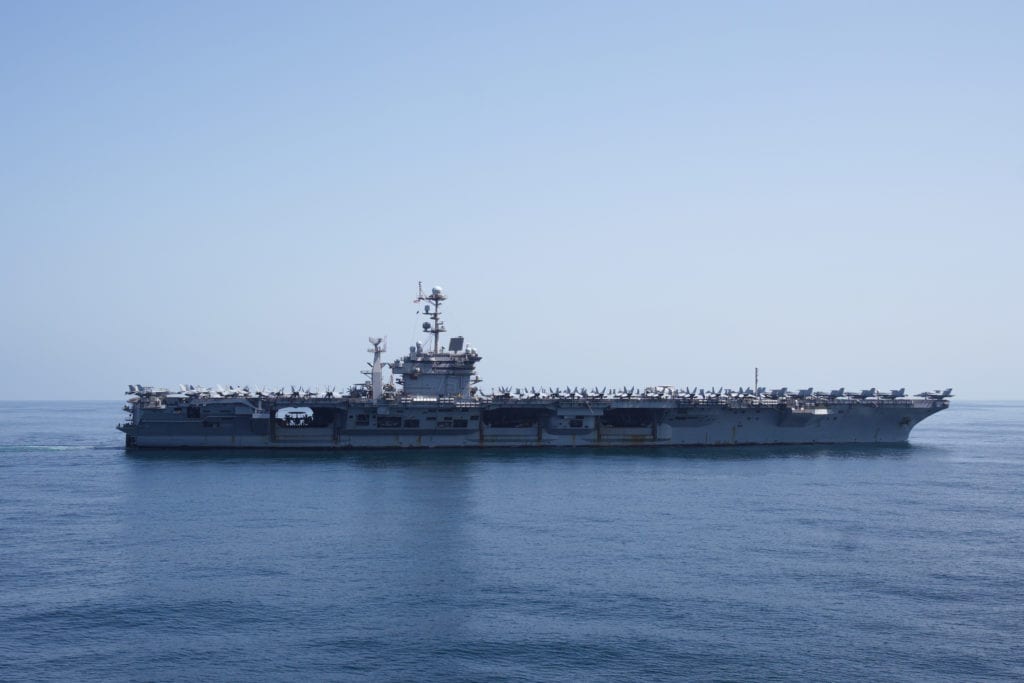
The Truman and its strike group remains at sea in the western Atlantic to protect the crew from the risks posed by COVID-19. U.S. Navy/Aircrew Survival Equipmentman 1st Class Brandon C. Cole

“The ship is entering a period in which it needs to be ready to respond and deploy at any time,” said Vice Adm. Andrew Lewis, commander of the 2nd Fleet. “Normally, we can do that pierside, but in the face of COVID-19, we need to protect our most valuable asset, our people, by keeping the ship out to sea.” 

The Navy will continue to evaluate the situation and will provide an update to the crew and their families in about three weeks. 

“After completing a successful deployment, we would love nothing more than to be reunited with our friends and families,” said Rear Adm. Andrew Loiselle, commander of Carrier Strike Group 8. 

“We recognize that these are unique circumstances and the responsible thing to do is to ensure we are able to answer our nation’s call while ensuring the health and safety of our Sailors. We thank you for your continued love and support as we remain focused on this important mission.”