Foggo: U.S. Military in All-New Territory in Fight Against Virus
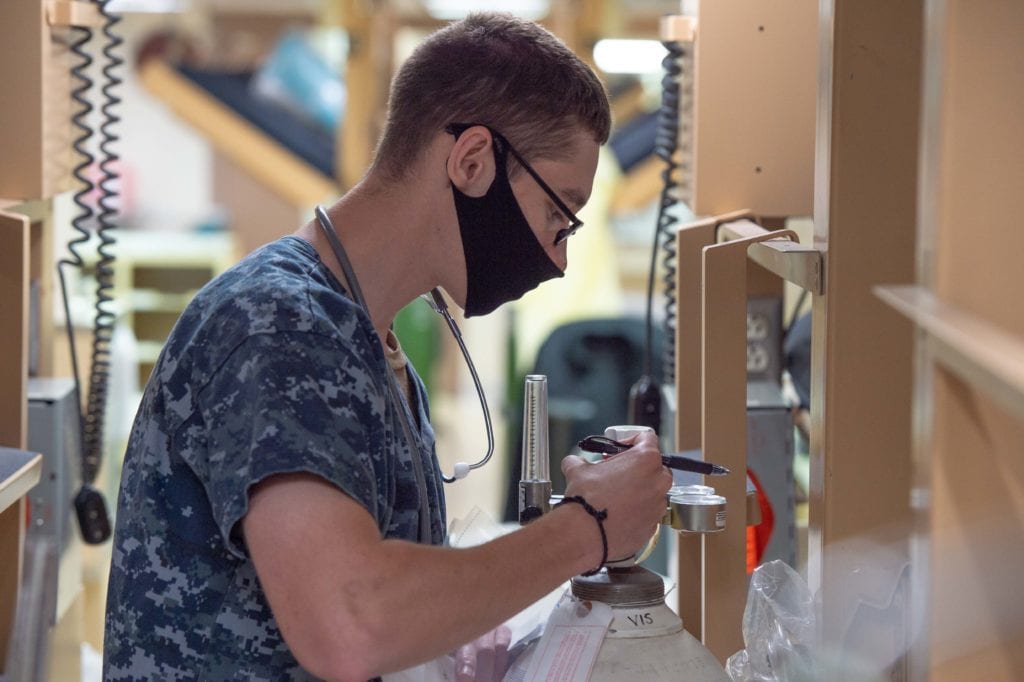
Hospitalman Recruit Jacob Cortes monitors the level of oxygen in a tank aboard the hospital ship USNS Mercy on April 14, docked in Los Angeles in support of COVID-19 response efforts. U.S. Navy/Mass Communication Specialist Seaman Luke Cunningham

ARLINGTON, Va. — The scope of the COVID-19 pandemic shows the new domain that the U.S. military must prepare to operate in, according to the top commander of U.S. naval forces in Europe and Africa.

“That seventh domain is just simply germs. It’s the biosphere we operate in,” Adm. James Foggo III said April 15 during a webcast for Navy League’s Sea-Air-Space 2020: Virtual Edition. “And I think we’re going to have to take that into account in our preparations for deterrence and defense in the future.”

To register and then watch this Sea-Air-Space 2020: Virtual Edition webinar live online, click here.

Foggo, commander of Allied Joint Force Command, which is based in Naples, Italy, as well as U.S. Naval Forces Europe and U.S. Naval Forces Africa, said the challenges of a massive NATO exercise, Trident Juncture 2018, which involved 50,000 personnel, 70 ships, 10,000 ground vehicles and 165 different aircraft, taught him that logistics should be added to the five battlespace domains of land, sea, air, space and cyber. However, the coronavirus outbreak that has sickened 1.9 million people worldwide, killed more than 123,000 and devastated Italy shows that there’s now a seventh domain.

“That seventh domain is just simply germs. It’s the biosphere we operate in.”

Adm. James Foggo III

“It hit us earlier, here in Italy,” where the Joint Force has facilities at Aviano Air Base in the north, Naval Air Station Sigonella in Sicily and Gaeta, near Naples, where the amphibious command ship USS Mount Whitney, the flagship of the 6th Fleet, is based.

Foggo credited Microsoft founder, billionaire and philanthropist Bill Gates for suggesting in a 2015 speech that, in addition to traditional wargames and tabletop exercises, pandemic planning take priority.

Foggo also cited a fast-spreading virus wargame, Urban Outbreak 2019, co-sponsored by the U.S. Naval War College, the Uniformed Services University of the Health Sciences and Johns Hopkins University’s Applied Physics Lab, as “a start in preparation for the future and incorporation into our planning processes.”
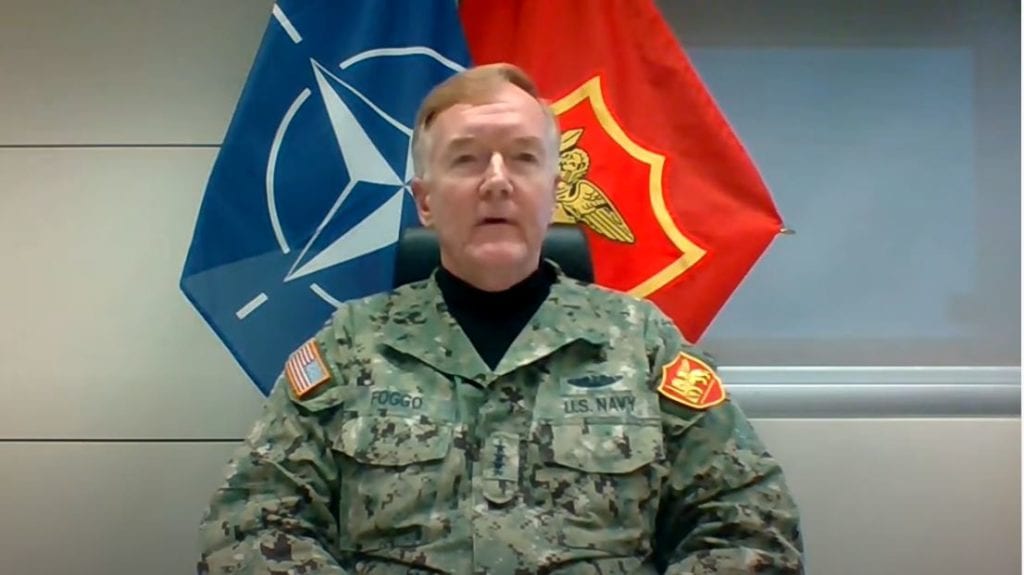
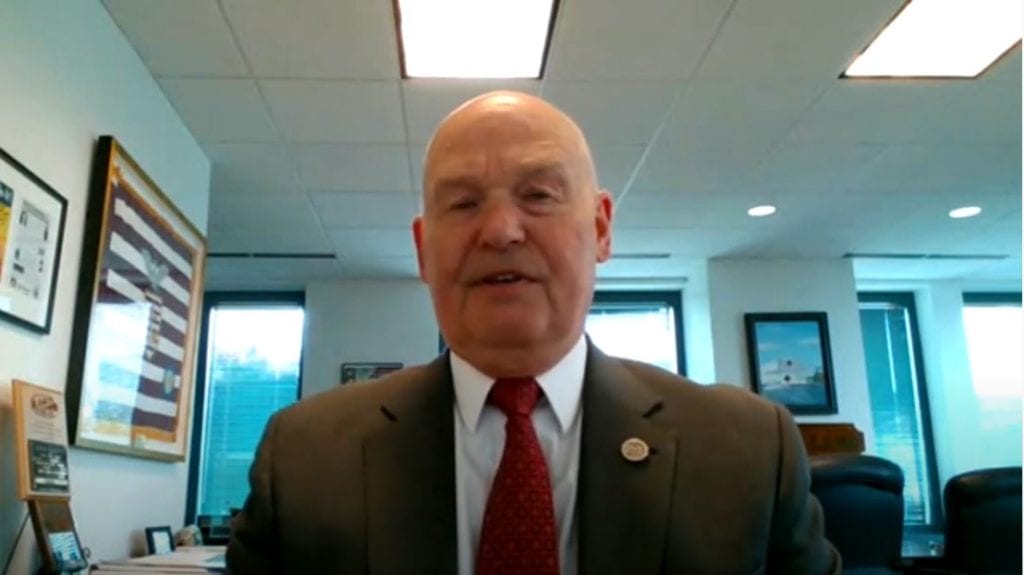
Adm. James Foggo III, commander of Allied Joint Force Command, U.S. Naval Forces Europe and U.S. Naval Forces Africa, spoke on April 15 during a Navy League Sea-Air-Space 2020: Virtual Edition webcast.

The admiral stressed the importance of testing for COVID-19 to determine if someone is infected and whether persons they’ve come in contact with be isolated.

“Testing works in our favor,” Foggo said. “We can’t afford to take anybody off the line in a day of Great Power Competition, where we have adversaries, competitors and, most importantly, we have violent extremists who take advantage of any chink in the armor.”

In the future, “we’re going to have to plan ahead on how we’re going to protect the force against something like the coronavirus until we get a vaccine against COVID-19, and then beyond that there will be a next coronavirus, and I think we’ll be much better prepared for that in the future.”


Geurts: Accelerated Acquisitions Position Navy, Industry for Period After COVID-19 Crisis Wanes

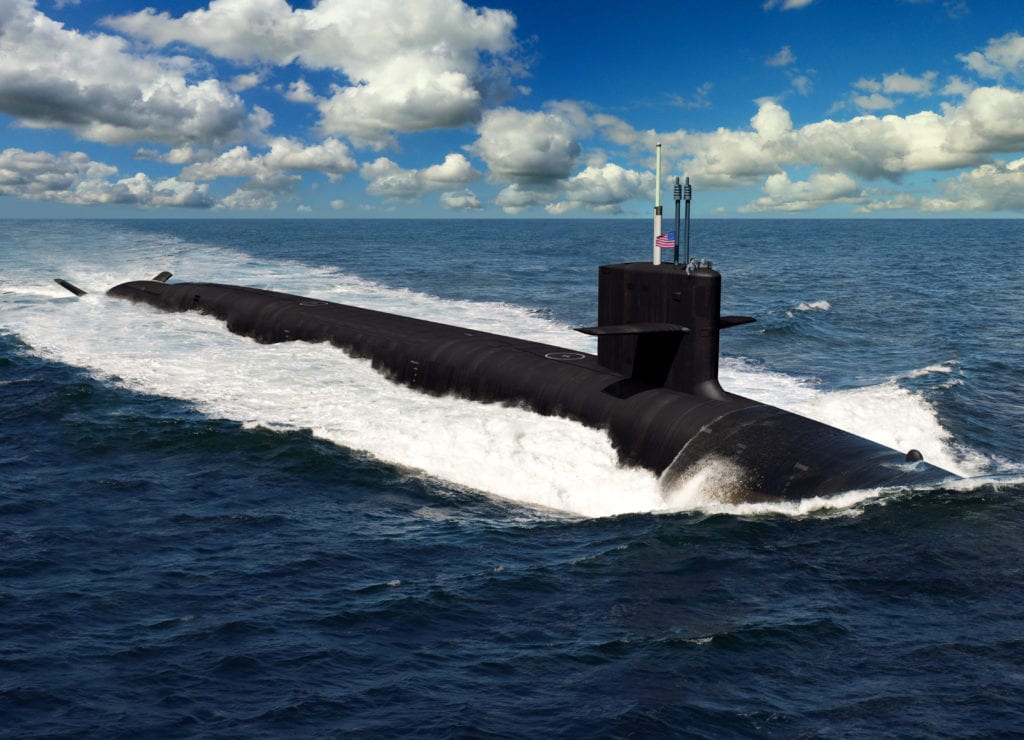
An artist rendering of the Columbia-class ballistic missile submarine. The Navy’s top acquisition official said April 15 during a Navy League Sea-Air-Space 2020: Virtual Edition webcast that work is proceeding on such programs as the Columbia SSBN and the next-generation guided-missile frigate, despite the disruption of COVID-19. U.S. Navy

ARLINGTON, Va. — The U.S. Navy’s top acquisition official said the service’s efforts to accelerate contract awards in the midst of the COVID-19 pandemic are helping the defense industry sustain its economic health at all levels and positioning the Navy and industry to emerge from the crisis without falling behind on work and ready to resume normal operations. 

James F. Geurts, assistant secretary of the Navy for research, development and acquisition, speaking during an April 15 webcast of the Navy League’s Sea-Air-Space: Virtual Edition, said the Navy and the defense industry are working to keep on task and be in a position to accelerate “out of the crisis.”

To register and then watch this Sea-Air-Space 2020: Virtual Edition webinar live online, click here. 

“Ships still have to come out on time,” Geurts said, noting that the Navy can’t afford to lag once the world starts to recover from the crisis. 

Geurts said the Navy has moved up the award of some contracts to inject “a lot of money in the system” to “get funds in the contractor hands” and “bring that work to the left” — meaning getting in started sooner. An example is the award last week — months early — of LPD 31, the second Flight II San Antonio-class amphibious transport dock ship. 

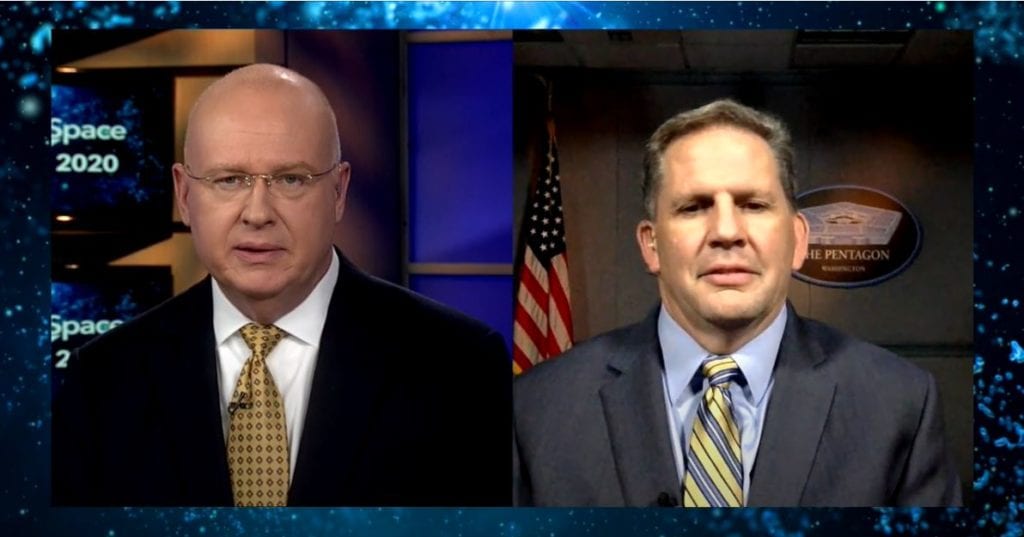
James F. Geurts (right), assistant secretary of the Navy for research, development and acquisition, and Sea-Air-Space 2020: Virtual Edition moderator Francis Rose discuss Navy and defense industry acquisitions preparedness during and after the pandemic.

Accelerating contract awards enables shipyards and other contractors to stack a backlog of work and keep their workers employed. The contractors also can push funds to their lower-tier subcontractors to the same effect. 

Geurts said it was “counterintuitive … that the best way to secure [the health of the defense industrial base] was to accelerate going into a crisis. Most folks would want to slow down, wait and see, and that would exactly create the wrong conditions.” 

“The risk is being too risk-averse in our approach. The other risk is being reckless in our approach.” 

“Ships still have to come out on time,” even as the Navy and industry weather but eventually recover from the pandemic.

James F. Geurts

He said that all of stakeholders are going at the situation “deliberately but urgently and thoughtfully. A challenge for us will be [that] it’s not a one-size-fits-all solution. This crisis hits different areas of the country, different sectors differently at different times. The key to success will be great networks, leveraging the data we have and building on a foundation of trust.”  

As the Navy worked to advance contract awards, Geurts said he saw his now “massively distributed,” largely teleworking work force shows greatly improved performance as it works to help the defense industry get though the pandemic. 

The Navy also is ordering spare parts sooner to build up the supply and to shore up the suppliers who provide them. 

Geurts said he confers with shipyard presidents or CEOs every other day to assess the status of work and provide opportunities to share lessons learned and to discuss best practices, ways to avoid disruption and how to speed up recovery.  

“It’s been awesome,” he said of the response from the defense industry.   

The assistant secretary said the Navy’s acquisition priorities have not changed in the pandemic, citing that work is proceeding on such programs as the Columbia-class ballistic-missile submarine and the next-generation guided-missile frigate. He stressed the Navy’s ongoing efforts to minimize delays and disruptions to the service’s programs.


CACI Awarded $83 Million Task Order to Support Portsmouth Naval Shipyard

ARLINGTON, Va. — CACI International Inc. has been awarded a U.S. Navy contract to provide engineering, technical and planning expertise to the Portsmouth Naval Shipyard in Kittery, Maine, the company said in an April 14 release. The single-award task order is for one base year and four option years, with a ceiling value of more than $83 million. 

Under the task order, which the Navy awarded under its SeaPort-NxG contract vehicle, CACI engineers and technicians will provide expanded mission expertise, including planning maintenance and repair for submarines by assisting the Ships Availability Planning and Engineering Center (SHAPEC) and Deep Submergence Systems Program. The task order is CACI’s first award under the SeaPort-NxG vehicle. 

CACI technical expertise across submarine engineering disciplines, such as structural, mechanical, electrical and combat systems, will help the Navy to safely return submarines to the fleet as quickly as possible. For example, CACI has developed the Shipyard Planning Engineering Automated Reports, the software tool SHAPEC uses to more effectively conduct its planning. 

“CACI engineers and technicians help Navy shipyards overcome hurdles in their maintenance and repair efforts with expertise earned through long-standing support of the mission,” said John Mengucci, CACI president and CEO. “CACI stands ready to support the Navy shipyards in any way they may need, including by providing acquisition and engineering support.” 

CACI Executive Chairman and Chairman of the Board Dr. J.P. (Jack) London, said, “CACI is proud to play a critical role in helping the Navy maintain its submarine fleet and continue to project power around the world.”


Jones Act Defenders Challenge Economic Arguments for Repealing Century-Old Law

The usefulness today of the 100-year-old Jones Act was the main topic of discussion during a webinar aired on April 14 as part of the Navy League’s Sea-Air-Space 2020: Virtual Edition.

ARLINGTON, Va. — The 100-year-old Jones Act is far from an outdated law that keeps shipping prices high and hurts the nation’s economy, a panel of maritime policy experts argued on April 14.

“The biggest misconception of the Jones Act is the cost impact, the final cost to delivered goods,” John McCown, founder of Blue Alpha Capital, a maritime financial services firm, said on a webcast for Navy League’s Sea-Air-Space 2020: Virtual Edition. “Many of the critics have distorted what that number is, cherry picked it, taken it out of context,” McCown added.

To register and then watch this Sea-Air-Space 2020: Virtual Edition webinar live online, click here.

The Jones Act — also known as the Merchant Marine Act of 1920 — bars foreign-built, foreign-owned or foreign-flagged vessels from conducting coastal and inland waterway trade within the United States and between the United States and some of its territories such as Puerto Rico. The law also generally applies restrictions that effectively prohibit Jones Act-compliant ships from being overhauled at foreign shipyards. Ship crews must be composed of U.S. citizens or legal U.S. residents.

John McCown, founder of Blue Alpha Capital, a maritime financial services firm, joined the discussion on the Jones Act during a webcast for the Navy League’s Sea-Air-Space 2020: Virtual Edition.

Opponents say it’s time to repeal the law because it has led to higher shipping costs, which pass along higher prices to vendors, retailers and consumers. They also maintain higher costs have driven the commercial shipbuilding industry overseas, leading to a smaller pool of qualified U.S. merchant mariners.

That claim has turned the Jones Act into a scapegoat for “all sorts of economic ills,” McCown said. He noted that after Hurricane Maria devastated Puerto Rico in 2017, critics claimed the Jones Act was strangling Puerto Rico’s economy and, without the law, there would be a 15% drop in consumer prices. Such a price cut “translates to $9 billion a year,” which, McCown said, was a ludicrous estimate many times the total annual revenue of the Jones Act.

“The biggest misconception of the Jones Act is the cost impact, the final cost to delivered goods. Many of the critics have distorted what that number is, cherry picked it, taken it out of context.”

John McCown, founder of Blue Alpha Capital

U.S. Navy and Coast Guard officials have defended the law, saying that without it, there would be no pool of U.S. noncombat ships — or trained American seafarers to man them — in a war or other national emergency. If cost becomes the deciding factor in maritime trade, leading to elimination of the Jones Act, then commerce on U.S. coastal waters and internal waterways like the Mississippi River would be taken over by another nation, most likely China, the second-biggest economy and shipbuilder in the world, and a “Great Power” competitor, proponents of the law argue.

Given medical supply shortages in the current COVID-19 pandemic, dependence on foreign vessels and foreign crews could pose not just a national security risk, but economic and homeland security risks if the U.S. remains dependent on foreign supply chains, especially for medical equipment and pharmaceuticals, noted former Oklahoma Rep. Ernest Istook, a senior fellow at the Frontiers of Freedom, a conservative think tank. “If they decide to do something that might cut us off, then we are at their mercy,” he added.


NAVSEA, PEO USC Host Virtual Industry Day on Hammerhead Program

WASHINGTON — Naval Sea Systems Command (NAVSEA) and Program Executive Office Unmanned and Small Combatants (PEO USC) hosted a virtual industry day in April, pressing forward with PEO’s mission priorities despite restrictions on gatherings brought on by the COVID-19 pandemic. 

The virtual program discussed the requirements for the design, development and production of the Mine Warfare Program Office’s Hammerhead program, according to an April 13 release from NAVSEA. 

Sixteen companies participated in the industry day in support of the maritime mine deployment system. Hammerhead is designed to deploy from an unmanned underwater vehicle and detect, classify and destroy anti-submarine warfare assets. The day’s objective was to improve industry’s understanding of the Hammerhead program and accelerate the design, development and production of the system. 

The industry day, said PEO USC Rear Adm. Casey Moton, should “stress the importance of the program to the fleet — they want it today, they need it today. … We’re still going to deliver the mission-essential capability, so it’s important that we proceed.” 

Moton said the Hammerhead program is designated both a Middle Tier Acquisition Rapid Prototyping Program and a Navy Maritime Accelerated Acquisition, reflecting the urgent need for the capability the system promises to bring. 

“We’re looking for industry feedback,” said Capt. Danielle George, program manager of Mine Warfare Programs. “That’s how we’re going to be successful” in meeting the program’s aggressive schedule to deliver this new capability to the fleet. 

Chief of Naval Operations Mine Warfare branch Capt. Samuel Davis, resource sponsor for the program, said: “The Hammerhead program will bring important capabilities to the fleet, and we look forward to its development and fielding.” 

The government intends to post the final Hammerhead prototype solicitation later this year. Industry will have about four weeks to submit a full proposal for Hammerhead prototypes. 

Award of a design and test contract for an expected quantity of up to 30 prototypes is anticipated in fiscal year 2021, with delivery of operationally relevant prototypes by the end of fiscal year 2023.


MARAD’s Buzby: Readiness of Sealift, Ready Reserve Force Suffering

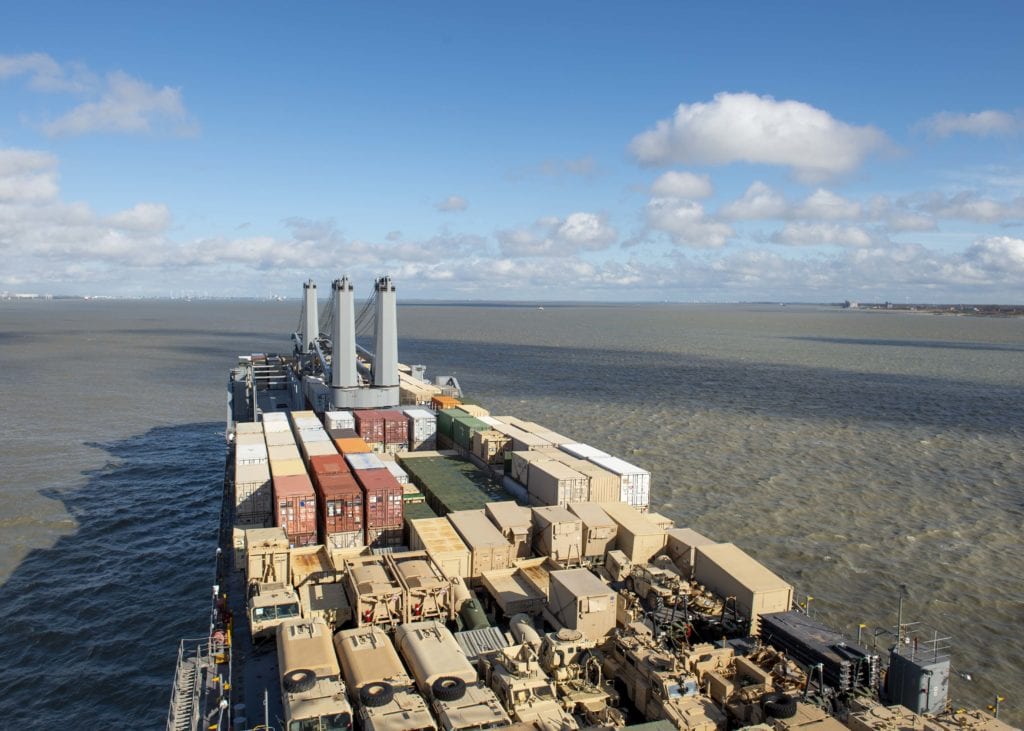
The U.S. Military Sealift Command large, medium speed roll-on/roll-off ship Benavidez transits the English Channel. U.S. Navy/Mass Communication Specialist 3rd Class Jordan R. Bair

ARLINGTON, Va. — U.S. strategic sealift fleets need recapitalization and some increased manning to achieve the readiness that the nation needs to sustain its maritime power, the U.S. maritime administrator said April 14.   

“The readiness is suffering,” a fact that sealift stakeholders recognize, Maritime Administrator Mark H. Buzby said during a webcast that is part of the Navy League’s Sea-Air-Space 2020: Virtual Edition.  

To register and then watch this Sea-Air-Space 2020: Virtual Edition webinar live online, click here.

Buzby pointed out that rusting ships, obsolete equipment, unavailable parts and repairing and replacing ships are the materiel challenges faced by the Maritime Administration (MARAD) and the U.S. Navy’s Military Sealift Command (MSC).  

MARAD’s Ready Reserve Force of 46 ships and MSC’s 15 sealift ships all need recapitalization, Buzby added. 

He said the federal government is taking three approaches to recapitalizing the fleets and that a combination of those “will help us renew the fleet”:  

  • Extending the service lives of some existing ships to possibly 60 years. 
  • Replacing 25 to 26 ships with new or converted used vessels. 
  • Procuring built-for-purpose sealift ships “from the keel up.” 

Recruiting and retaining enough mariners remains a challenge as well, Buzby said. Commercial mariners in the U.S. Merchant Marine — including those in the Ready Reserve Force, on Maritime Security Program ships available for mobilization and the declining U.S.-flag merchant fleet — and the government’s civilian mariners who work for the MSC are part of the pool that man the sealift ships. 

Maritime Administrator Mark H. Buzby participates in a webcast for the Navy League’s Sea-Air-Space 2020: Virtual Edition

He said that 24 ships in the Ready Reserve Force are steam-powered, operated by a shrinking pool of technicians qualified to operate and maintain the obsolete propulsion system.  

Buzby said the mariner pool is “enough for a steady state today” but inadequate for a substantial mobilization requirement.  

Of help would be to place more merchant ships “under the U.S. flag so it gets the pool … where it needs to be,” he added. 

Building up the U.S.-flag merchant fleet is a considerable challenge, he said, because competitors such as China that have state-run enterprises can undercut the U.S. in terms of lower-cost shipbuilding and manning and can therefore compete more effectively for cargo business. 

“We’re asking our merchant marine to play on an unlevel playing field,” he said. 


Elbit Integrates Active Towed Array Sonar Onboard Seagull USV

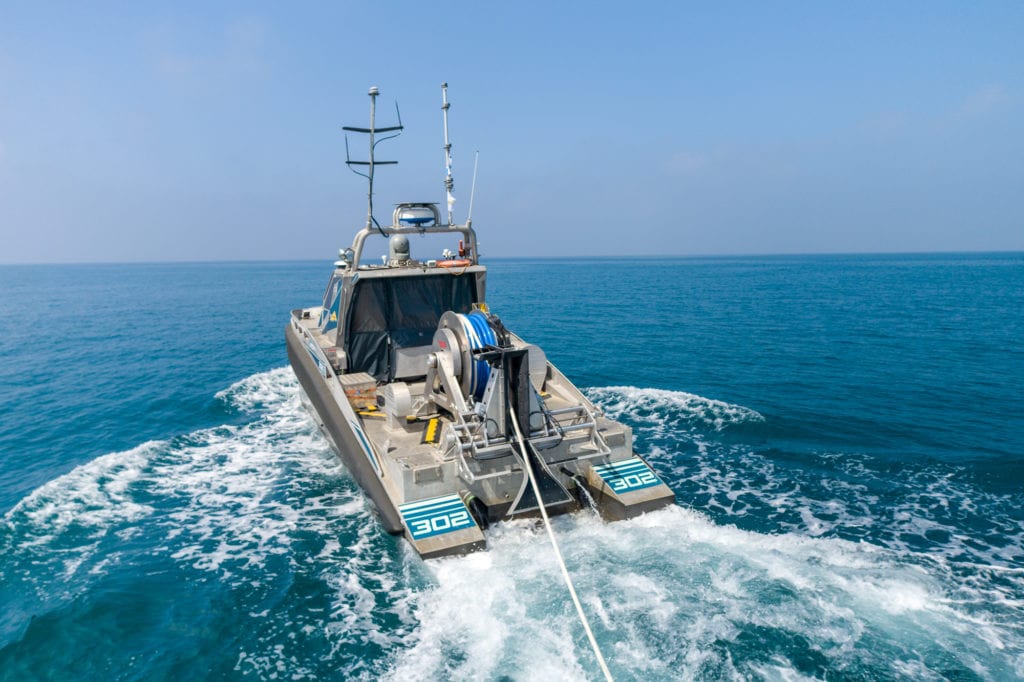
Elbit Systems has integrated the TRAPS-USV with its Seagull unmanned surface vehicle. Elbit Systems

HAIFA, Israel — Elbit Systems has integrated the Towed Reelable Active Passive Sonar for Unmanned Surface Vessels (TRAPS-USV) with its Seagull USV, according to an April 14 company release. The sea trials included several deployment and recovery cycles, towing at different speeds and transmission at various power levels. 

The TRAPS-USV version is a compact variant of the TRAPS, a technology that is intended for detection, classification, localization and tracking of submarines in anti-submarine warfare (ASW) operations. TRAPS versions are containerized or permanent-fit for any size, diverse-purpose vessel. 

The TRAPS-USV variant is lighter weight but maintains all acoustic active sonar capabilities of TRAPS. TRAPS-USV is the compact and powerful low frequency towed sonar that was recently introduced by Geospectrum, Elbit’s wholly owned Canadian subsidiary. 

The Seagull autonomous multimission USV features plug and play, modular mission payload suites and can perform — in addition to ASW — mine countermeasure missions, electronic warfare, maritime security, underwater surveys and other missions using the same vessel, mission control system and data links. 

Integration of the TRAPS-USV enables the Seagull to perform ASW operations on the move, substantially extending its operative range and further enhancing its flexibility. The integration of the TRAPS-USV follows the recent conversion for operation, by Israel’s navy, of helicopter long-range active sonar dipping sonar onboard the Seagull USV.


USMI to Build Special Operations Combatant Craft

ARLINGTON, Va. — United States Marine Inc. (USMI) has been awarded a $108 million contract to build combatant craft for the U.S. Special Operations Command, the Defense Department said in a release.  

The $108 million maximum indefinite-delivery/indefinite-quantity delivery order contract with a five-year ordering period calls for combatant craft assault vessels to support Special Operations Command (USSODOM) missions around the world, the release said. USSOCOM operates a fleet of coastal and riverine craft in support of those operations. 

USMI CEO Barry Dreyfus Jr. said the contract would allow the company to retain and possibly expand its workforce, according to another release from the office of Sen. Roger Wicker (R-Miss.). USMI is based in Wicker’s state in Gulfport. 

“USMI looks forward to continuing our work on behalf of the warfighter, and we appreciate the confidence [USSOCOM] continues to have in us,” Dreyfus said. 

The sole source contract is expected to be completed by April 2025.


Coast Guard, International Partners Seize 1,700 Pounds of Cocaine

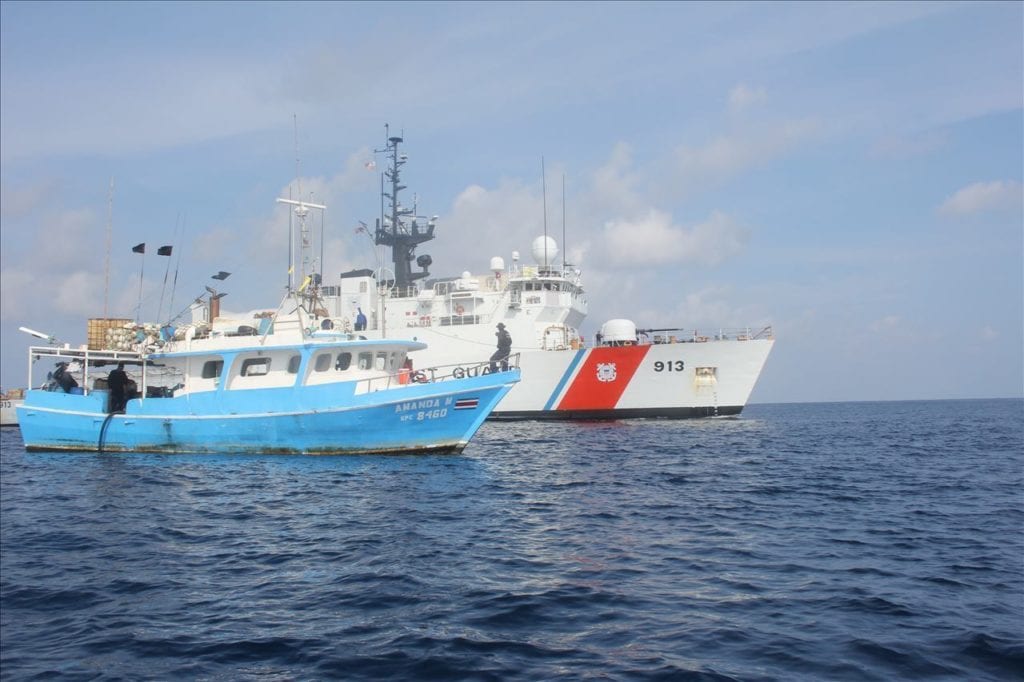
Coast Guard Cutter Mohawk crew members conduct a boarding of the Amanda M fishing vessel in the eastern Pacific Ocean off the coast of Central America on April 9. During the boarding, the crew discovered several false compartments where they were able to uncover 1,700 pounds of cocaine and transfer four suspected smugglers to Costa Rica for legal action. U.S. Coast Guard

ALAMEDA, Calif. — The U.S. Coast Guard and Costa Rican authorities seized about 1,700 pounds of cocaine on April 9 with an estimated value of more than $29 million from a fishing boat in international waters of the Pacific Ocean off Central America, according to the Coast Guard’s 11th District. 

While on patrol, a Coast Guard cutter’s Helicopter Interdiction Tactical Squadron MH-65 Dolphin helicopter crew identified a fishing boat suspected of smuggling narcotics and requested the assistance of a Costa Rican Air Surveillance Service (Servicio de Vigilancia Aérea) maritime patrol aircraft. 

The Coast Guard cutter’s small boat arrived on scene with the fishing vessel, Amanda M, homeported in Costa Rica, with four suspected smugglers and received authorization to board the vessel.  

Coast Guard members discovered several false compartments throughout the fishing boat, where they were able to uncover 1,700 pounds of cocaine. 

“This interdiction is a great example of what we can accomplish with strong international partners,” said Rear Adm. Peter Gautier, the 11th District’s commander.  

The Coast Guard transferred the four suspected smugglers to Costa Rican authorities for further legal actions. 

On April 1, U.S. Southern Command began enhanced counter-narcotics operations in the Western Hemisphere to disrupt the flow of drugs. Numerous U.S. agencies from the Departments of Defense, Justice and Homeland Security cooperated in the effort to combat transnational organized crime.

The Coast Guard, Navy, Customs and Border Protection, FBI, Drug Enforcement Administration, and Immigration and Customs Enforcement, along with allied and international partner agencies, play a role in counter-drug operations.


Coast Guard Academy to Host Virtual Class of 2020 Graduation

NEW LONDON, Conn. — The U.S. Coast Guard Academy announced that it is preparing to hold a virtual graduation ceremony on May 20 due to social distancing restrictions during the COVID-19 pandemic. 

The graduating Class of 2020, along with the rest of the Academy Corps of Cadets, were on spring break when travel restrictions were imposed and were ordered to stay home. The Corps then shifted to virtual remote classes, which are ongoing. 

During the virtual ceremony, Chad Wolf, the acting Department of Homeland Security secretary, is scheduled to deliver the keynote address. Coast Guard Commandant Adm. Karl Schultz also will provide remarks.  

“This decision was made in the best interest of the health and well-being of our entire academy family and our local community,” said Rear Adm. Bill Kelly, the academy’s superintendent. 

“I’d like to thank our faculty and staff who have made it possible to graduate the Class of 2020 on time and deliver them to their duty stations prepared to serve our nation. The entire academy community has come together to match an unprecedented mission with unprecedented effort and innovation. I am enormously proud of them.” 

The Class of 2020 is the largest graduating class with 258 cadets in the academy’s 144-year history as well as the largest class of women at 102.