Coast Guard: Illegal Fishing in Oceans a National Security Issue
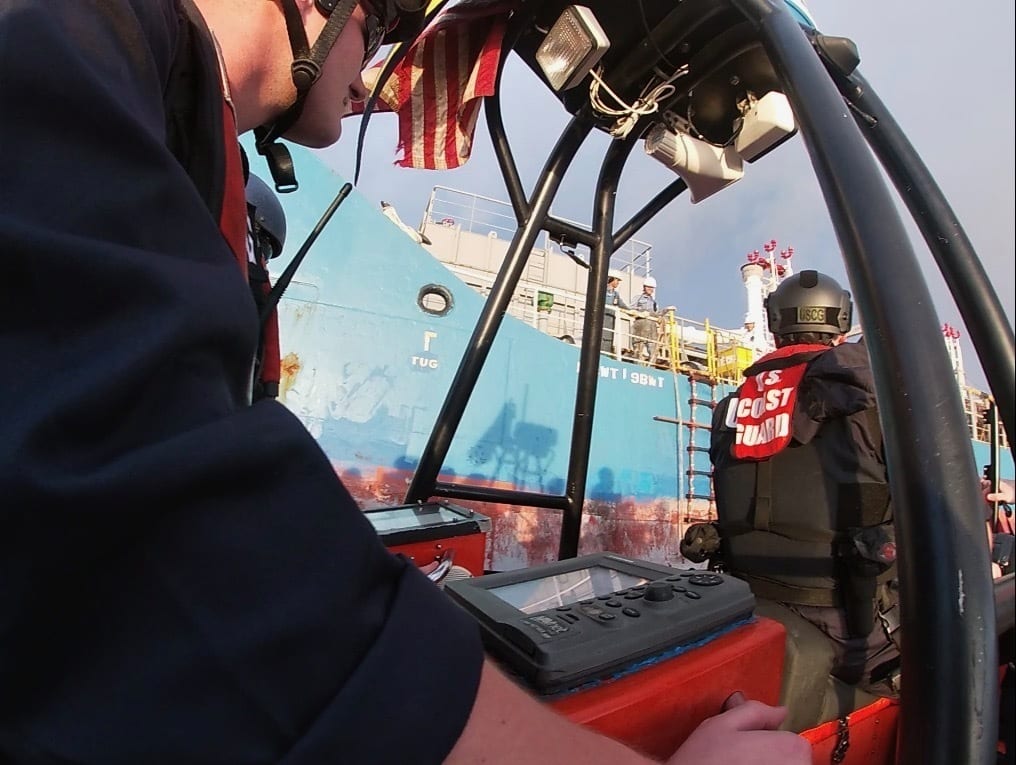
Boarding officers from the U.S. Coast Guard and Canadian Conservation and Protection navigate to board a fishing vessel in the South Pacific in January 2019. Canadian Department of Fisheries and Oceans

WASHINGTON — Illegal, unreported and unregulated fishing (IUU) is a national security issue that threatens global economic order and the sovereignty of nations and that enforcement is over-stretched to counter the threat, U.S. officials said. 

IUU includes fishing without a permit, catching over a legal limit, catching the wrong species and catching fish that are too small.

To register and then watch this Sea-Air-Space 2020: Virtual Edition webinar live online, click here.  

Speaking during a Navy League Sea-Air-Space: Virtual Edition webcast on April 13, Rear Adm. Doug Fears, the Coast Guard’s assistant commandant for response policy, said that IUU “is an issue of sovereignty and a national security issue because the competition for global fish stock and protein is ongoing.” 

Fears said the Coast Guard “is as an internationally trusted partner and is a supporter of an international rules-based governance structure that benefits each country that has an economic exclusion zone.” 
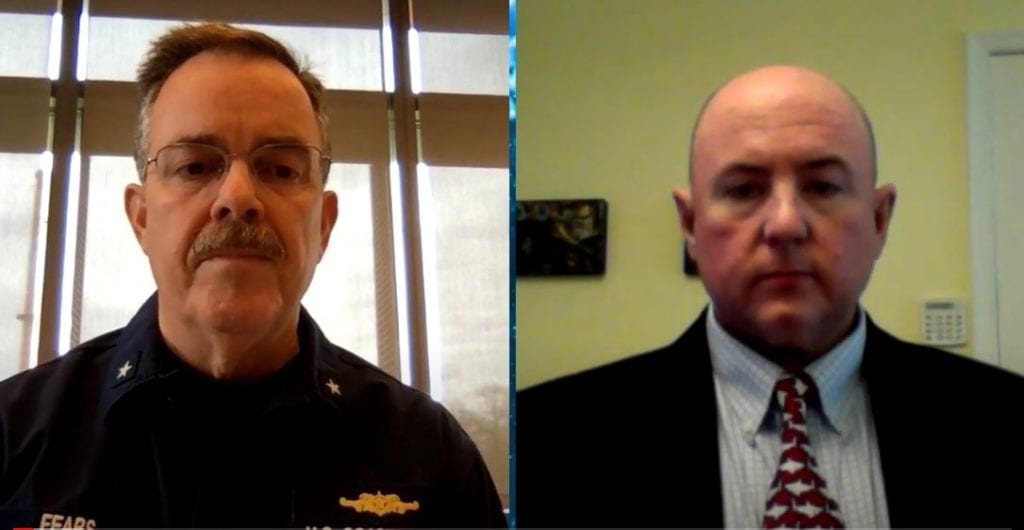
Rear Adm. Doug Fears (left), the U.S. Coast Guard’s assistant commandant for response policy, and Dave Hogan, acting director of the Office of Marine Conservation with the U.S. State Department, discuss Illegal, unreported and unregulated fishing during a Navy League Sea-Air-Space: Virtual Edition webinar.

Dave Hogan, acting director of the Office of Marine Conservation with the U.S. State Department, who also spoke during the Navy League webcast, said the State Department negotiates with international and regional partners to establish the rules to manage the fish stocks on the high seas in cooperation with the National Oceanic and Atmospheric Administration’s Fisheries Service, the Coast Guard and other agencies.  

“Each nation exercises sovereignty over its economic exclusion zone,” Fears said. “When another nation violates that, [IUU] is harming the fish stock that may not be recoverable.” 

Fears also pointed out that some nations are engaging in aggressive behavior against others in driving away fishing boats of other nations that are legally fishing and thus violating the sovereignty of those nations. He cited a recent example of Chinese coast guard activity against an Indonesian fishing vessel. The U.S. Defense Department on April 9 called out China’s coast guard for sinking a Vietnamese fishing vessel

“The United States Coast Guard has the authorities, the capability, the global reach — we’re trusted partners. Our model is a well-respected model. Our limiting factor is capacity.”

Rear Adm. Doug Fears

Hogan said the United States has an ongoing dialogue with China on IUU issues. He said the State Department has asked China to “do better” with its distant-water fleet fishing in the waters of other countries. 

He said IUU fishing is going on in all the world’s oceans, and that the violators include stateless high-seas drift-net vessels in the North Pacific. Whereas most fishing companies worldwide are privately owned, China’s are state-run. 

“The United States Coast Guard has the authorities, the capability, the global reach — we’re trusted partners,” Fears said. “Our model is a well-respected model.” 

“Our limiting factor is capacity,” he added. “While we operate around the world, we can’t operate in all the places that deserve the attention in IUU fishing.” 

Fears cited the South China Sea, the waters off West Africa and the central and western Pacific and the Gulf of Mexico as prime areas where IUU occurs. 

Hogan said the United States is still trying to find a multilateral solution to the competing claims in the South China Sea. He also said he encourages nations to cooperate, despite their disputes, so fish stocks aren’t depleted and that their own economic security and the environment aren’t undermined.  

Fears said that IUU often is networked by organized crime, such as the drug cartels, which have “tentacles” in human trafficking and other smuggling operations. “A lot of the drug cartels and similar organizations monetize illicit activities, whatever they be,” he said. 

Fears also said a Coast Guard presence is an effective counter to IUU fishing but that the sea service needs more ships, aircraft and personnel to project that presence.
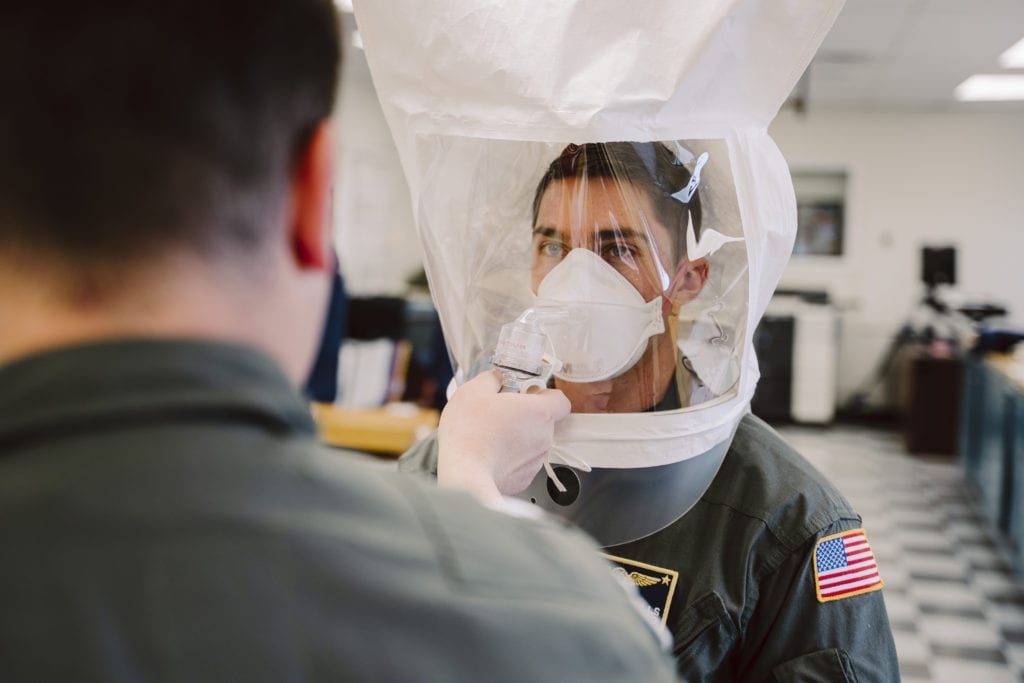


COVID-19 Piles on Coast Guard’s Funding, Readiness Challenges, Says Commandant

Coast Guard Petty Officer 3rd Class Evan Grills is fitted for an N95 respirator at Air Station Kodiak, Alaska, on March 24. Amid the COVID-19 pandemic, aircrews are taking additional measures to reduce potential exposure to the virus while also maintaining full mission readiness. U.S. Coast Guard/Petty Officer 1st Class Bradley Pigage

ARLINGTON, Va. — The U.S. Coast Guard, already facing longer term readiness and funding issues, is shifting manpower and equipment to meet the new challenge of the COVID-19 pandemic, the commandant of the Coast Guard told Navy League’s Sea-Air-Space 2020: Virtual Edition on April 13.

With the novel coronavirus also forcing the U.S. Navy, Marine Corps, Army and Air Force to come up with new ways to shield the force while still protecting the nation, Adm. Karl Schultz said his primary focus is on “maintaining a ready, healthy workforce to accomplish the Coast Guard’s primary missions” to facilitate the marine transportation system.

To register and then watch this Sea-Air-Space 2020: Virtual Edition webinar live online, click here.

See: As Part of Investments, Coast Guard Creates Major S.C. Base  

“Right now, we’re focused on people, readiness and enabling the economic prosperity and security of the nation,” Schultz said, noting the Coast Guard’s role as part of the Department of Homeland Security and its mission.

In addition to safeguarding the nation’s 355 seaports and 25,000 miles of commercial waterways as well as conducting maritime search and rescue and counter-narcotics operations, the constantly moving COVID-19 challenge has added new obstacles like offloading tens of thousands of cruise ship passengers, some of them ill with the virus. Coast Guardsmen did so April 2, helping to escort the cruise ships Zaandam and Rotterdam to port in Port Everglades, Florida.

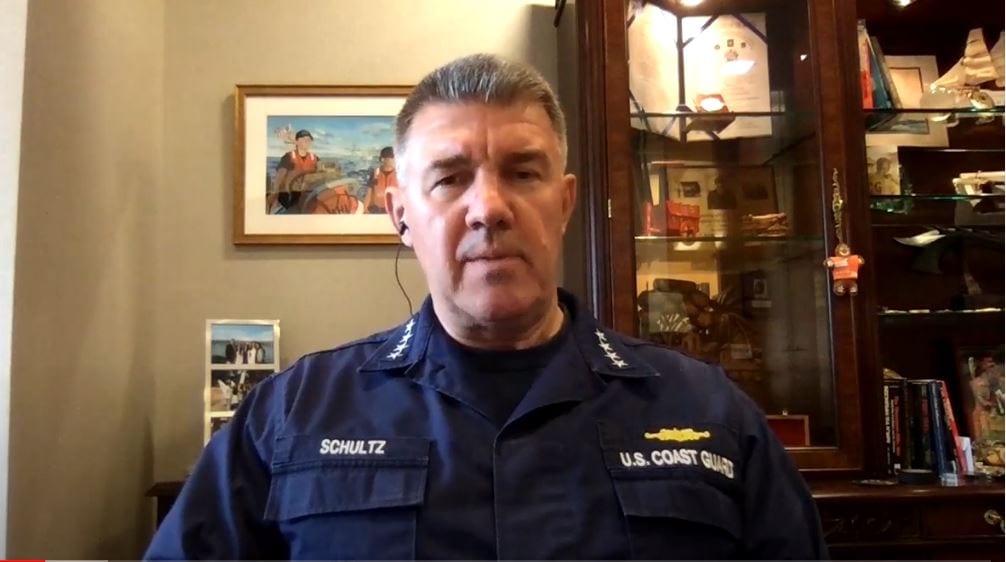
Commandant Adm. Karl Schultz participates in the Navy League’s Sea-Air-Space: Virtual Edition.

Schultz also noted that there are between 75 and 100 commercial vessels in U.S. waters with as many as 100,000 crewmen on board who may need Coast Guard assistance at some point during the crisis.

Before the coronavirus outbreak, the Coast Guard was facing a readiness challenge with aging ships and aircraft,  deteriorating infrastructure ashore and an information-technology system on “the brink of catastrophic failure,” the commandant said in his State of the Coast Guard address in February. 

“But the focus right now is [a] ready Coast Guard, men and women, to get into the fight and get after these COVID-19 challenges that are in our wheelhouse.”

Coast Guard Commandant Adm. Karl Schultz

Schultz said thousands of Coast Guard personnel are now teleworkers because of social-distancing rules, but thousands more are still front-line operators in the air and on the water. “This is really showing just how critical this C5I [command, control, communications, computers, cyber and intelligence] issue is,” Schultz said. “Clearly there’s a money piece to this,” he added. “We’ve got to stop patching old systems.”

When he took command of the Coast Guard in June 2018, Schultz said his focus was on people — getting better facilities and equipment for them, an improved retirement system and recruiting for a more diverse force representative of the nation.

“People remains the absolute center of gravity for Coast Guard readiness,” he said in a live-streamed question-and-answer session during Sea-Air-Space 2020: Virtual Edition.

“But the focus right now is [a] ready Coast Guard, men and women, to get into the fight and get after these COVID-19 challenges that are in our wheelhouse,” he added.

The Sea-Air-Space 2020: Virtual Edition event was created after the annual live exposition had to be canceled due to a prohibition against large gatherings in the wake of the COVID-19 pandemic.


Theodore Roosevelt Sailor Dies of COVID-19 Complications

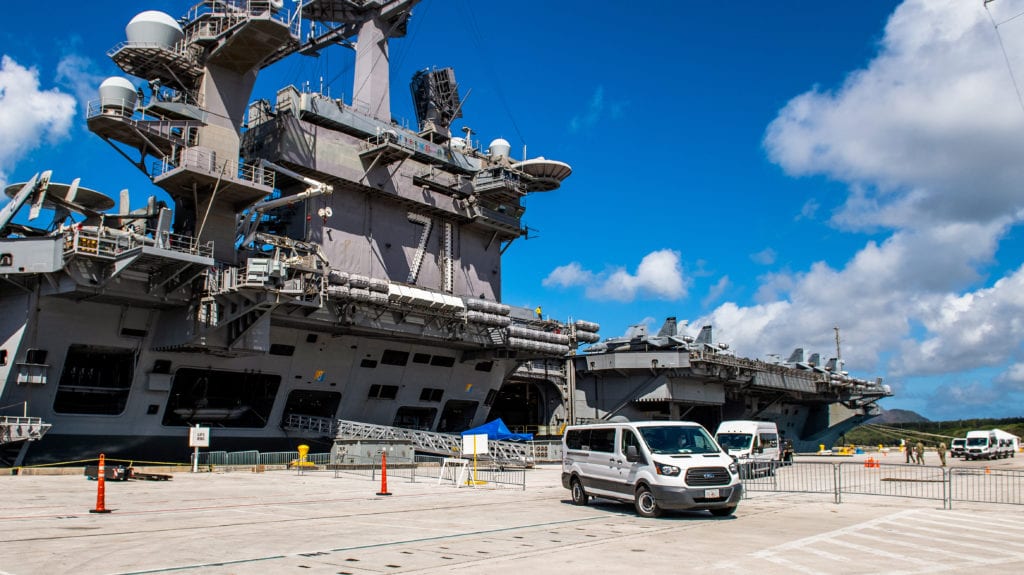
Seabees assigned to Naval Mobile Construction Battalion 1 and 5 coordinate transportation of Sailors assigned to the aircraft carrier USS Theodore Roosevelt who have tested negative for COVID-19 and are asymptomatic from Naval Base Guam to Guam government and military-approved commercial lodging. U.S. Navy/Mass Communication Specialist 1st Class Nathan Carpenter

PEARL HARBOR, Hawaii — A Sailor assigned to the aircraft carrier USS Theodore Roosevelt who was admitted to the intensive care unit at the U.S. Naval Hospital Guam on April 9 died of COVID-related complications on April 13, the U.S. Navy confirmed.

The name of the Sailor is being withheld for 24 hours after the crew member’s family is notified.

The Sailor, who tested positive for COVID-19 on March 30, was removed from the ship and placed in an isolation house on Naval Base Guam with four others from the Theodore Roosevelt. Like other Sailors in isolation, he received medical checks twice daily from Navy medical teams.

At about 8:30 a.m. on April 9, the Sailor was found unresponsive during one of those medical checks. While Naval Base Guam emergency responders were notified, CPR was administered by fellow Sailors and onsite medical team in the house. The Sailor was transferred to U.S. Naval Hospital Guam, where the Sailor was moved to the ICU.

USS Theodore Roosevelt arrived in Guam on March 27 for a scheduled port visit for resupply and crew rest but remains there while its crew members are treated or housed. As of April 12, the Navy reported 945 servicewide cases of COVID-19 — a majority of those, 735, are Sailors, including 550 from the Theodore Roosevelt itself.

The captain of the carrier, Brett Crozier, who later tested positive and went into quarantine himself, drew attention to his Sailors’ plight with a March 30 letter to Navy leadership.

The four-page letter was leaked and ran the next day with a story in the San Francisco Chronicle, drawing worldwide media attention to the ship and setting off a series of events that saw the captain relieved of his command and the acting Navy secretary resigned after criticizing Crozier in a profanity-laced speech in front of his crew.

In an April 13 statement, Chief of Naval Operations Adm. Mike Gilday said, “We mourn the loss of the Sailor from USS Theodore Roosevelt who died today, and we stand alongside their family, loved ones and shipmates as they grieve.”

He continued: “This is a great loss for the ship and for our Navy. My deepest sympathy goes out to the family, and we pledge our full support to the ship and crew as they continue their fight against the coronavirus. While our ships, submarines and aircraft are made of steel, Sailors are the real strength of our Navy.”


Marine Corps CH-53K Passes Air Refueling Tests

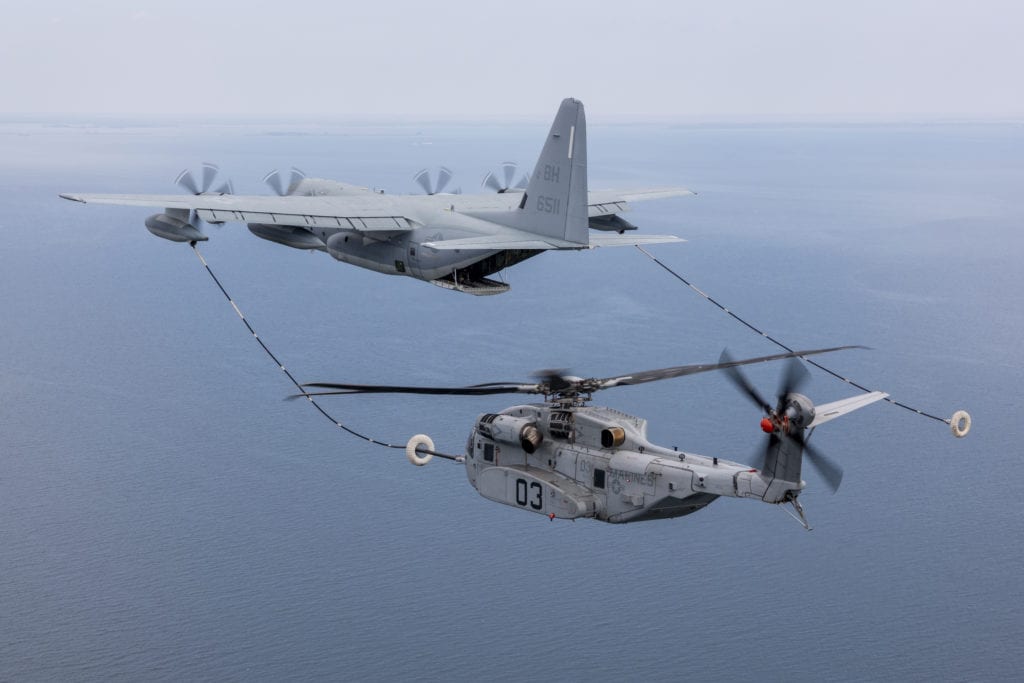
A CH-53K King Stallion heavy lift helicopter refuels from a KC-130J over the Chesapeake Bay on April 6. Sikorsky

NAVAL AIR STATION PATUXENT RIVER, Md. — The CH-53K King Stallion aced an air-to-air refueling test this week, successfully demonstrating long-range logistics support capabilities for the U.S. Marine Corps, Naval Air Systems Command said in a release. The 4.5-hour test was accomplished over the Chesapeake Bay with a KC-130J aerial refueling tanker. 

“The aircraft went to the tanker this week and it was very successful, proving it is a long-range vertical logistic workhorse,” said Marine Col. Jack Perrin, H-53 heavy lift helicopters program manager. 

According to the CH-53K test team, the wake survey test assessed the performance of the aircraft when flying behind the tanker in strong, turbulent air. The aircraft’s crew successfully plugged the drogue, a funnel-shaped basket towed behind the KC-130J. These tests were performed at increasing closure rates to ensure the CH-53K can handle the forces on the refueling probe when contacting the drogue during aerial refueling. 

“The aircraft was able to meet the desired performance for all engagements,” Perrin said. “The ‘K’ is the long-range enabler that we need now and into the future.”  

The CH-53K King Stallion continues to execute within the reprogrammed CH-53K timeline, moving toward completion of developmental test, leading to initial operational test and evaluation in 2021 and first fleet deployment in 2023-2024. 

“The successful air-to-air refueling test reinforces the superior capabilities of the CH-53K heavy lift helicopter and its ability to carry more Marines, cargo and equipment over longer ranges and in more challenging environments than any other rotorcraft in the world,” Bill Falk, Sikorsky program director, CH-53K, said in an April 10 release.

“As the only fully marinized heavy lift helicopter, it will allow the Marines the operational flexibility and reach to fly over open waters to complete long-range missions in support of expeditionary advanced base operations.” 


Pentagon Calls Out China Coast Guard Sinking of Vietnamese Fishing Vessel

ARLINGTON, Va. — The Defense Department spoke out against the recent actions of the China Coast Guard that violated the accepted norms of maritime freedom of navigation and sovereignty. 

“The Department of Defense is greatly concerned by reports of a China Coast Guard vessel’s collision with and sinking of a Vietnam fishing vessel in the vicinity of the Paracel Islands in the South China Sea,” the department said in an April 9 statement. 

“The PRC’s behavior stands in contrast to the United States’ vision of a free and open Indo-Pacific region, in which all nations, large and small, are secure in their sovereignty, free from coercion, and able to pursue economic growth consistent with accepted international rules and norms. The United States will continue to support efforts by our allies and partners to ensure freedom of navigation and economic opportunity throughout the entire Indo-Pacific. 

“The COVID-19 pandemic underscores the importance of the rules-based international order, as it sets the conditions that enable us to address this shared threat in a way that is transparent, focused, and effective,” the statement added. “We call on all parties to refrain from actions that would destabilize the region, distract from the global response to the pandemic or risk needlessly contributing to loss of life and property.”


HII Begins Fabrication of Destroyer Ted Stevens

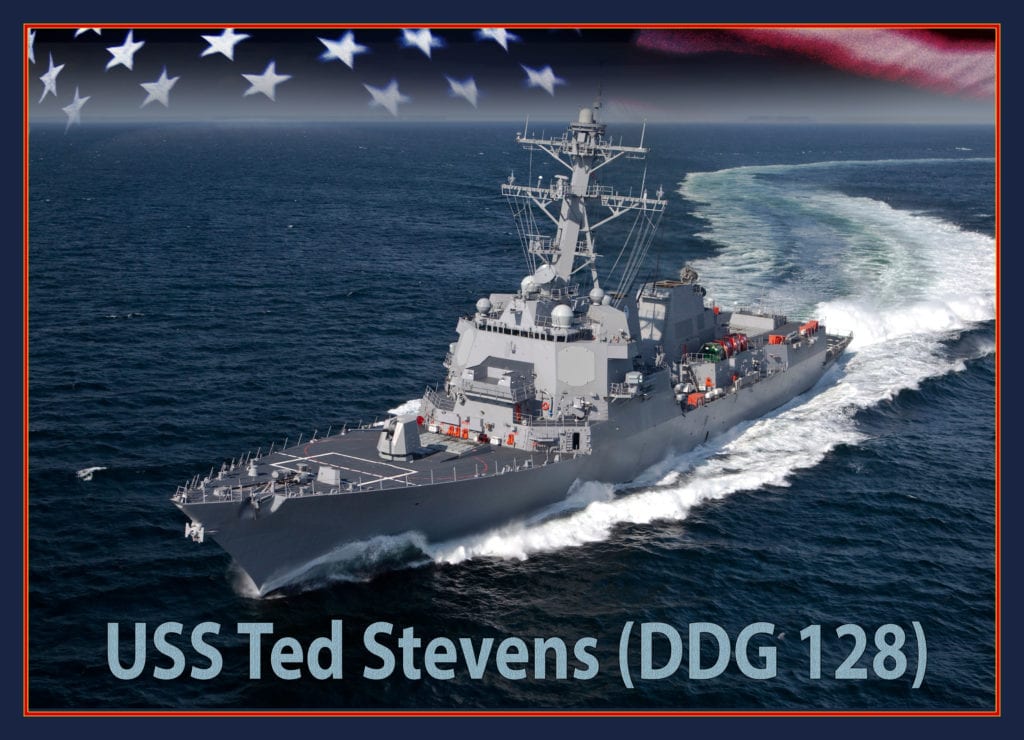
An artist rendering of the future Arleigh Burke-class guided-missile destroyer USS Ted Stevens. U.S. Navy

PASCAGOULA, Miss. — Huntington Ingalls Industries’ Ingalls Shipbuilding division started fabrication of the Arleigh Burke-class destroyer Ted Stevens on April 6, the company said in a release. The start of fabrication signifies that the first 100 tons of steel have been cut. 

“As we begin this important milestone in the construction of another great warship, we look forward to continuing production and carrying on the extraordinary legacy of the Navy destroyer fleet,” said George Nungesser, Ingalls’ DDG 51 program manager. 

The ship honors former U.S. Sen. Ted Stevens, who served as a pilot in World War II and later represented Alaska. At the time he left office in 2009, he was the longest-serving Republican senator in history. 

Ingalls has delivered 31 Arleigh Burke-class destroyers to the Navy. Other destroyers under construction include Delbert D. Black, Frank E. Peterson Jr., Lenah H. Sutcliffe Higbee and Jack H. Lucas. 

Arleigh Burke-class destroyers are highly capable, multimission ships and can conduct a variety of operations, from peacetime presence and crisis management to sea control and power projection, all in support of the U.S. military strategy. The guided missile destroyers are capable of simultaneously fighting air, surface and subsurface battles. The ship contains myriad offensive and defensive weapons designed to support maritime defense needs well into the 21st century. 


AeroVironment Awarded $10.7 Million Puma 3 UAS Contract for Navy, Marines

SIMI VALLEY, Calif. — AeroVironment Inc. received a $10.7 million firm-fixed-price contract award for Puma 3 AE systems and spares in February for the U.S. Navy and Marine Corps Small Tactical Unmanned Aircraft Systems (SUAS) Program, the company said in a release. 

“Puma 3 AE is a combat-proven enabler of U.S. Navy and Marine Corps tactical operations, providing persistent situational awareness, expeditionary reconnaissance, surveillance, and target acquisition, force protection and overwatch — anywhere and at any time,” said Rick Pedigo, AeroVironment’s vice president of business development. 
 
The AeroVironment Puma 3 AE is a man-portable unmanned aircraft system designed for land and maritime operations. The hand-launched Puma 3 AE has a wingspan of 9.2 feet, weighs 15 pounds and can operate for up to 2.5 hours at a range of up to 12.4 miles with a standard antenna and up to 37.2 miles with AeroVironment’s Long-Range Tracking Antenna (LRTA). 

Capable of landing in water or on land, the Puma, with its Mantis i45 EO/IR sensor suite, empowers the operator with extended flight time and a level of imaging capability never available in small UAS. 
 
AeroVironment small UAS make up most of the unmanned aircraft in the Defense Department’s inventory and its rapidly growing international customer base numbers more than 45 allies and partner nations. 


Coast Guard Interdicts Lancha Crews Illegally Fishing U.S. Waters

CORPUS CHRISTI, Texas — Multiple U.S. Coast Guard law enforcement crews detected and interdicted three Mexican lancha boat crews engaged in illegal fishing in federal waters off the coast of southern Texas on April 6. 

Coast Guard crews consisting of air support, a small boat crew and a cutter stopped three lanchas about 50 miles north of the maritime boundary line where a total of 13 lanchamen were engaged in illegal fishing. About 12 miles of longline gear and illegal fishing equipment as well as 2,020 pounds of illegally caught red snapper were seized. 

“The Coast Guard’s continued commitment to protecting wildlife and deterring illegal fishing is highlighted in this case,” said Chief Warrant Officer Homar Barrera, Sector/Air Station Corpus Christi command duty officer. “The teamwork between the command center and assets on scene resulted in the flawless execution of multiple interdictions.” 

A lancha is a fishing boat used by Mexican fishermen that is about 20 to 30 feet long with a slender profile, having one outboard motor and can travel at speeds exceeding 30 mph. Lanchas are frequently used to transport illegal narcotics to the U.S. and illegally fish in the U.S. exclusive economic zone near the U.S./Mexico border in the Gulf of Mexico.


Philly Shipyard Selected to Build NSMV

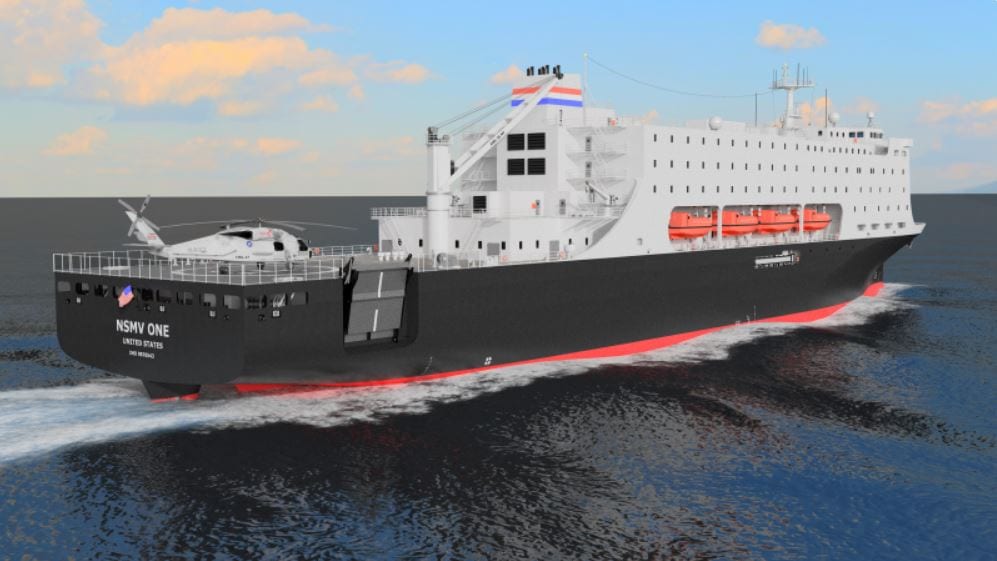
An artist’s rendering of the National Security Multi-Mission Vessel (NSMV). MARAD

WASHINGTON — TOTE Services has selected Philly Shipyard Inc. of Philadelphia to build the newest class of training ship, the National Security Multi-Mission Vessel (NSMV), the Maritime Administration (MARAD) announced April 8. 

The shipyard will construct up to five new ships to provide maritime training for America’s future mariners and to support humanitarian assistance and disaster relief in times of need. 

“This new world-class vessel, constructed at an American shipyard, is part of our much-needed program to replace the aging training vessels currently operated by state maritime academies,” Transportation Secretary Elaine L. Chao said. 

Last May, TOTE contracted with MARAD as the vessel construction manager to deliver one to five NSMVs. This occurred after Congress required that the NSMVs be procured using commercial design and build practices. 

Following construction and delivery of the ships to TOTE, the vessels will be transferred to MARAD for their mission of training future licensed mariners at state maritime academies and responding to humanitarian and natural disasters. 

“Investing in maritime education creates more American jobs,” Maritime Administrator Mark H. Buzby said.  

The NSMV will feature numerous instructional spaces and a full training bridge and have space for up to 600 cadets to train in an at-sea academic environment. 

In its role as a National Defense Reserve Fleet vessel, the NSMV will incorporate medical capabilities, a command-and-control platform and berthing for up to 1,000 first responders and recovery workers. The vessel’s roll-on/roll-off ramp and crane to facilitate container storage capabilities will enable it to provide critical support equipment and supplies to those in need during a disaster. 


RAF Declares IOC for Poseidon Maritime Patrol Aircraft

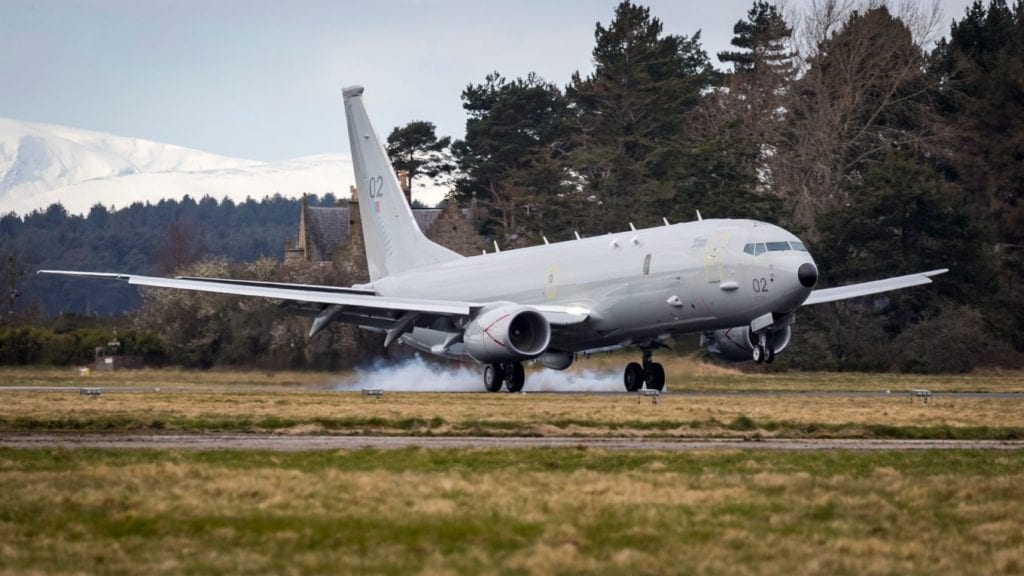
The Royal Air Force receives the newest addition to its P-8A Poseidon fleet, City of Elgin ZP802. Royal Air Force

LONDON — The U.K. Royal Air Force has formally declared an Initial Operating Capability (IOC) of its brand-new Poseidon MRA Mk1 Maritime Patrol Aircraft, the RAF said in a release. The MRA Mk1 is the U.K. designation for the P-8A Poseidon flown by the U.S. Navy. 

“The United Kingdom’s Poseidon fleet, currently comprising of two aircraft with seven more to be delivered, strengthens our maritime security, helping to protect our people and our interests, at home and overseas,” the release said. 

“Poseidon will now be patrolling our seas, hunting potentially hostile submarines and helping to defend our nuclear deterrent. It uses the very latest in cutting-edge technology to detect, identify and monitor hostile contacts both above and below the waves. It can carry up to 129 sonobuoys to search for enemy submarines and can be armed with Mk54 torpedoes if required to attack enemy submarines.” 

“It’s a really exciting time for us in this program, which is moving fast and the team at RAF Lossiemouth has delivered some great results in very quick time,” said Air Commodore Richard Barrow, Poseidon senior responsible owner. 

“We’ve still got a long way to go with introducing this next-generation capability into service, but Poseidon is a game-changer, not just for hunting submarines but for a range of other roles from anti-ship warfare, maritime reconnaissance and long-range search and rescue tasks.”  

The Poseidon aircraft are operated by 54 Squadron and 120 Squadron, who are currently flying from Kinloss Airfield in Moray, Scotland. 

The Poseidons will move to their permanent home at RAF Lossiemouth later this year once the refurbishment work on the runways and airfield infrastructure has been completed, including a new strategic facility. Number 201 Squadron will also stand up later this year.