NAVSEA Bids Farewell to Longest-Serving Civil Servant in Defense Department
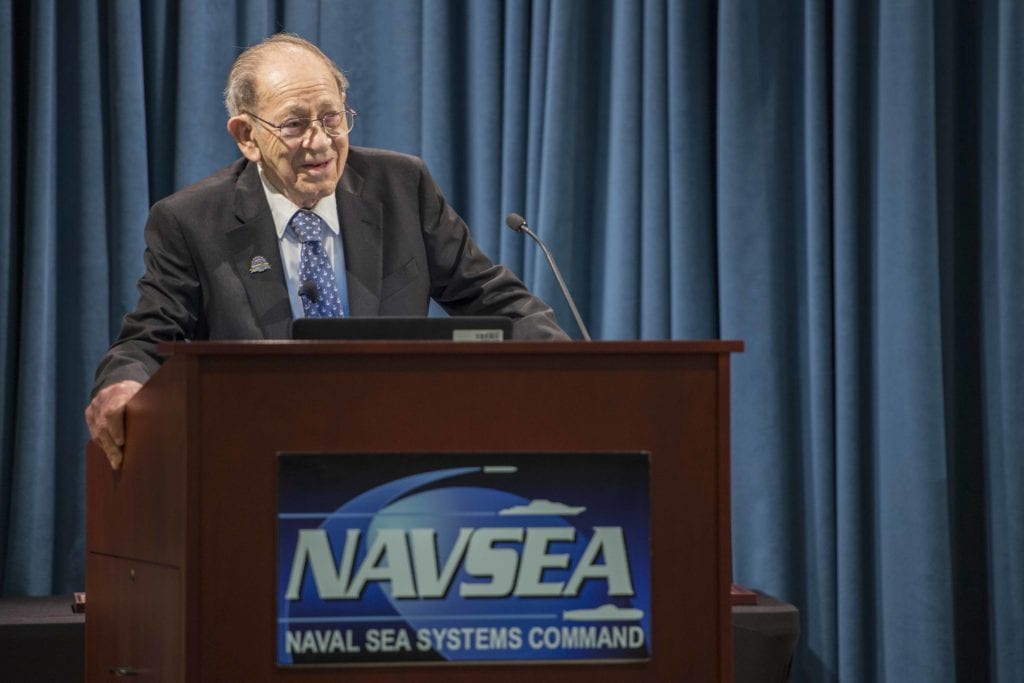
Sarkis Tatigian delivers remarks in 2017 during a celebration of his 75 years of federal service at the Washington Navy Yard. U.S. Navy/Mass Communication Specialist 2nd Class Jackie Hart

WASHINGTON — Sarkis Tatigian, who began his U.S. Navy career at the age of 19 during World War II, passed away earlier this week, leaving behind a nearly 78-year legacy of service to the Department of Defense, Naval Sea Systems Command said in an April 7 release. 

At the time of his death, Tatigian, the longest serving civil servant in the history of the DoD, was serving as NAVSEA’s small business advocate. 

“Mr. Tatigian truly lived a life dedicated to advocacy and the service of others,” said NAVSEA’s executive director, James Smerchansky. 

“His decades of work oversaw the expansion of the small business industrial base and more than $100 billion in contracts awarded to diverse, small businesses. As we bid fair winds and following seas to Mr. Tatigian, NAVSEA will greatly miss his presence, but we will never forget the positive impact he made on this command and the entire U.S. Navy.” 

“Mr. Tatigian truly lived a life dedicated to advocacy and the service of others.”

NAVSEA Executive Director James Smerchansky

Tatigian’s civilian career with the Navy began in July 1942 as a junior radio inspector at the naval aircraft factory in the Philadelphia Navy Yard and the Navy Office of Inspector of Naval Aircraft in Linden, New Jersey. 

He left his position as an inspector in March 1943 and entered the uniformed Navy as an active-duty Sailor. In June 1944, he started working as an aviation electronics technician’s mate in the development of the Navy’s first guided anti-ship munition, the ASM-N-2 “BAT” glide bomb, which later became an operational weapon used by the fleet at the end of World War II. 

In 1946, he left active duty and returned to the Navy department and civil service with the Bureau of Ordnance in Washington, working on the Navy’s first generation of guided-missile systems. From there, he moved on to his life’s passion, helping small businesses, as a small business analyst for the bureau. While in the position, Tatigian developed a small business mobile exhibit that traveled coast-to-coast, visiting all state capitals and cities with populations exceeding 400,000. For his organizational efforts on the exhibit, Tatigian received congressional recognition. 

“I was retirement eligible in October 1973. But when you don’t have something to wake up for, that’s when you start to decline. And, if you love what you do and derive a sense of personal worthiness, it’s not really work.”
Sarkis Tatigian

In June 1979, Tatigian was appointed NAVSEA’s associate director of the Small and Disadvantaged Business Utilization Office. The office was eventually renamed the Small Business Program Office, where he continued to serve as an advocate for small business. 

In 2012, it was announced during a ceremony honoring Tatigian’s 70 years of service that the Navy’s Office of Business Opportunities Director’s Award would be renamed the Sarkis Tatigian Small Business Award. 

The award recognizes outstanding performance by a field activity in creating an organizational climate resulting in the advancement of small business opportunity through exceptionally-managed small business programs and challenging initiatives and who has made significant contributions to the command and the DON small business program. Because of his contributions, Tatigian even won the award that bears his name. 

In 2017, NAVSEA celebrated Tatigian’s 75th anniversary of civil service. A unique service pin was specially made to mark the occasion as one celebrating that many years of service had never been given before to an employee. 

Tatigian, explained upon his 75th anniversary, why he was driven to continue to come to work each day at NAVSEA.  

“I was retirement eligible in October 1973,” Tatigian said. “But when you don’t have something to wake up for, that’s when you start to decline. And, if you love what you do and derive a sense of personal worthiness, it’s not really work.”


Modly Resigns After Backlash Over Insults Directed at Carrier’s Ousted Captain

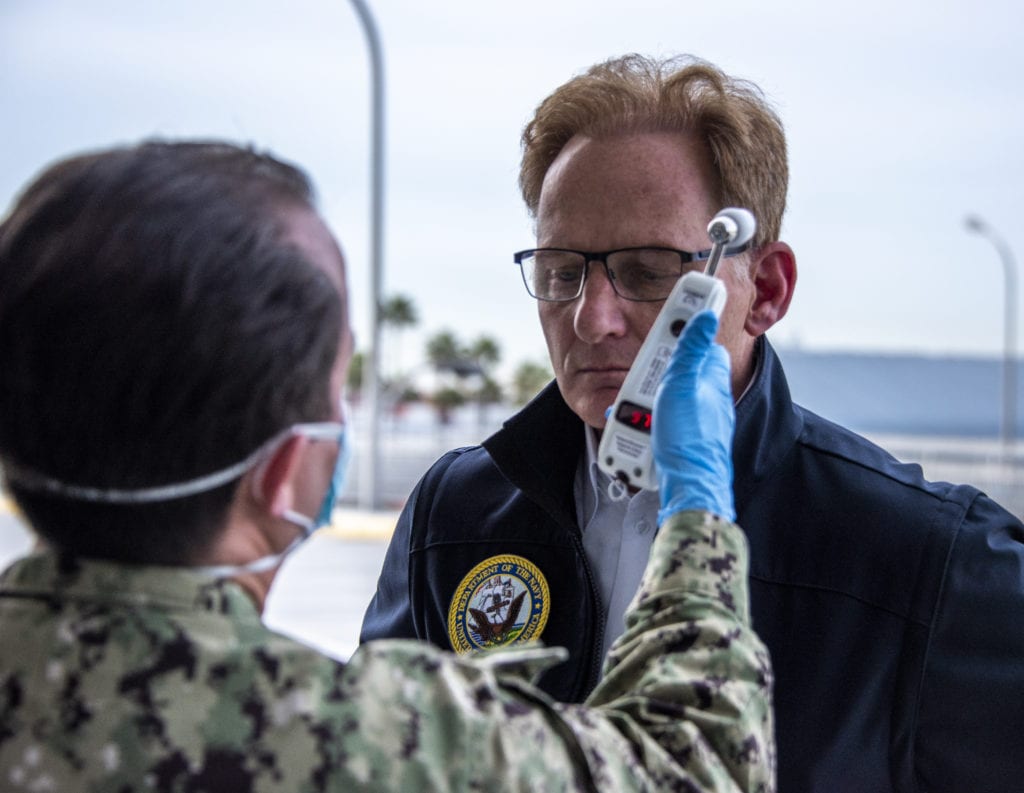
Acting Navy Secretary Thomas B. Modly, who had his temperature checked March 31 during a COVID-19 screening before boarding the hospital ship Mercy in Los Angeles, resigned April 7 after a backlash over his comments toward the former captain of the aircraft carrier USS Theodore Roosevelt. He later apologized for those remarks. U.S. Navy/Mass Communication Specialist 2nd Class Natalie M. Byers

ARLINGTON, Va. — Thomas B. Modly resigned as acting Navy secretary on April 7, a day after calling the ousted captain of the coronavirus-infected USS Theodore Roosevelt “stupid” in a profanity-laced speech to the aircraft carrier’s crew.

Defense Secretary Mark Esper accepted Modly’s resignation, noting in a statement that Modly “resigned on his own accord, putting the Navy and the Sailors above self.”

Esper said he was appointing current Army Undersecretary James McPherson, a retired Navy admiral, as acting Navy secretary until a permanent secretary can be confirmed. McPherson himself was confirmed by the Senate for the Army post only 14 days ago.

In his statement, Esper said he had “the deepest respect for anyone who serves our country, and who places the greater good above all else. Secretary Modly did that today, and I wish him all the best.”

Esper noted that the investigation which Chief of Naval Operations Adm. Mike Gilday had launched into the Roosevelt affair was continuing and any further action regarding its fired commander, Capt. Brett Crozier, “will wait until that investigation is completed.”

Esper said he was appointing current Army Undersecretary James McPherson, a retired Navy admiral, as acting Navy secretary until a permanent secretary can be confirmed.

Modly’s resignation came after a tumultuous series of events that saw him relieve Crozier from command on April 2, fly to Guam, where the ship is docked, and defend his actions in a April 6 address to the ship’s crew that was sprinkled with profanity. In that speech, Modly called Crozier “too naive or too stupid to be the commanding officer of a ship like this,” according transcripts of recordings of Modly’s remarks made by several of the carrier’s crew.

Modly later said, “I stand by every word I said,” even the profanity. However, less than 24 hours after the speech, Modly issued an apology to Crozier, to the Theodore Roosevelt’s crew and the Navy.

“Let me be clear,” Modly said in his statement of apology, “I do not think Capt. Brett Crozier is naive or stupid. I think and have always believed him to be the opposite. I believe, precisely because he is not naive and stupid, that he sent his alarming e-mail with the intention of getting into the public domain in an effort to draw public attention to the situation on his ship.”

Modly “resigned on his own accord, putting the Navy and the Sailors above self.”

Defense Secretary Mark Esper

Crozier’s March 30 letter to dozens of Navy brass and fellow naval aviators sparked the initial controversy that ultimately led to Modly’s resignation a week later.

After three Sailors on the Roosevelt tested positive for COVID-19 — and still more were found to be infected after the carrier made a scheduled port visit at Guam — Crozier believed the carrier had inadequate space to isolate or quarantine Sailors. “The spread of the disease is ongoing and accelerating,” Crozier wrote. He called for disembarking all but a token force of about 10% of the crew until all could be tested for infection, isolated for the required 14 days and the ship sanitized.

The letter was leaked to the San Francisco Chronicle, which published it on March 31, gaining worldwide media attention and highlighting Crozier’s plea: “We are not at war. Sailors do not need to die. If we do not act now, we are failing to properly take care of our most trusted asset — our Sailors.”

The next day, at a Pentagon press briefing, Modly said he was “disappointed” to hear those remarks but added, “We need a lot of transparency in this situation, and we need that information to flow up through the chain of command.”

On April 3, Modly ordered Crozier relieved of his command, saying he had “lost confidence in his ability to lead” during the virus outbreak. Before the letter was published, Navy leadership had already been in touch with Crozier, Modly said. The captain said he wanted his crew evacuated from the ship faster but did not relay “the various levels of alarm that I, along with the rest of the world, learned from his letter when it was published two days later,” Modly said.


Surface Warfare Center Technology Division, Maryland Distillery Partner to Produce Hand Sanitizer

INDIAN HEAD, Md. — The Naval Surface Warfare Center’s Indian Head Explosive Ordnance Disposal Technology Division (IHEODTD) is helping one business give back to emergency responders in dire need of virus-killing hand sanitizers, the division said in an April 6 release. 

Following Maryland Gov. Larry Hogan’s executive order limiting social gatherings and the closing of nonessential businesses, Blue Dyer Distilling Co. of Waldorf, Maryland, saw that in their downtime they could fill a niche in the community. 

Understanding local first responders were running critically low on hand sanitizer, they pivoted their operations from manufacturing spirits to the production of the much-needed sanitizer. An agreement was signed April 6 with IHEODTD to allow the two organizations to speed the release of the product to first responders. 

To date, Dunbar said his distillery has produced about 200 gallons of hand sanitizer, which has been delivered to more than 30 state, local and government agencies. 

“We are providing materials, facilities and operators on-site to aid with the large-scale production of this critical commodity,” said Chris Wilhelm, the IHEODTD Office of Research and Technology Applications lead. “This is an opportunity to help a local business do some good in an area where we have the materials and capabilities to aid them. If we can find a unique way to leverage our assets during this crisis, we are going to find a way to do so.” 

The agreement allows for Blue Dyer to receive raw materials produced at the command for use at their distillery to produce the hand sanitizer. The agreement is in effect for six months, with the potential for more time added based on need. 

Walker Dunbar, the distillery’s founder and co-owner, said that with help from IHEODTD, he and Blue Dyer co-founder Ryan Vierheller are situated to produce large quantities of hand sanitizers to local and federal agencies as well as other organizations serving the public interest. 

“Once we realized there was an immediate need for life, health and public safety, we prepared our facility for full-time production,” Walker said. “The assistance we received from Dr. Wilhelm and the rest of the command has been amazing.”


Coast Guard Cutter Hamilton Returns Home After Drug-Busting Patrol

The crew of Coast Guard Cutter Hamilton returned home to Charleston after completing an 80-day patrol throughout the eastern Pacific Ocean on April 5. Crews offloaded $324 million worth of cocaine and marijuana. U.S. Coast Guard

CHARLESTON, S.C. — The crew of Coast Guard Cutter Hamilton returned home on April 6 to Charleston after completing an 80-day patrol throughout the eastern Pacific Ocean, according to the Coast Guard 7th District. 

The crew offloaded $324 million worth of cocaine and marijuana April 3 at Port Everglades, Florida. 

Hamilton’s crew, along with an aviation detachment from the Coast Guard’s Helicopter Interdiction Tactical Squadron, began their deployment in late January by serving as the first national security cutter (NSC) to participate in a Navy Composite Training Unit Exercise. 

For three weeks, Hamilton integrated with the USS Dwight D. Eisenhower and ships and aircraft of Carrier Strike Group 10 to test the strike group’s ability to carry out sustained combat operations at sea. Hamilton’s commanding officer, Capt. Timothy Cronin, said the event highlighted the capabilities of the 418-foot NSC. 

“Our success in this critical exercise demonstrated how the Coast Guard can seamlessly integrate with joint forces around the globe to advance our national security strategy,” Cronin said. 

During February, Hamilton deployed to the eastern Pacific as part of a partnership that falls under the Joint Interagency Task Force (JIATF) South, a component of U.S. Southern Command. JIATF South oversees the detection and monitoring of illicit traffickers and assists law enforcement agencies with interdiction. 

Hamilton’s crew seized three drug-laden vessels and apprehended eight suspected traffickers. Two of the vessels were semi-submersibles, vessels built low to the waterline to avoid detection. The two suspected smugglers purposely scuttled their vessel in an alleged attempt to prevent Hamilton’s crew from locating any contraband. Hamilton’s law-enforcement team detained the suspects and turned them over to the Drug Enforcement Agency for potential prosecution. 

Hamilton also assisted in the removal of another seven tons of cocaine and 1,400 pounds of marijuana seized from a heavily trafficked transit zone by Coast Guard Cutters Legare, Vigilant, Tampa, Tahoma, Steadfast, Mohawk, Navy vessel USS Tornado, and the Canadian vessel HMCS Nanaimo.


Navy Deploys Medical Personnel to Support COVID-19 Response in New Orleans, Dallas

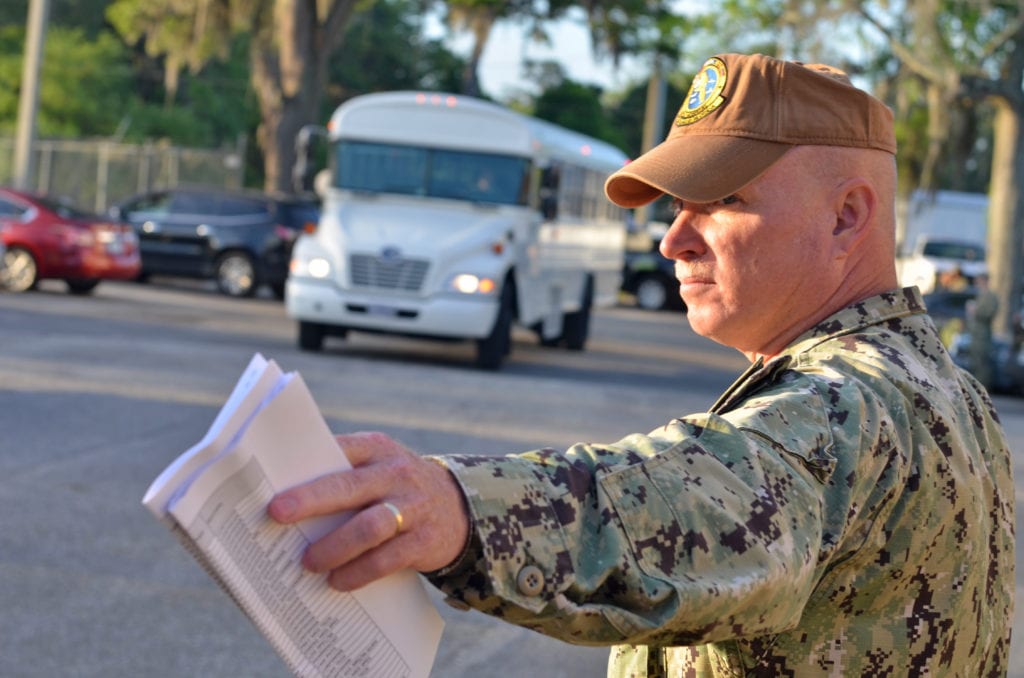
Master Chief Hospital Corpsman Thomas Holder, assigned to a U.S. Navy Expeditionary Medical Facility, directs bus traffic as Sailors prepare to deploy from Naval Air Station Jacksonville, Florida, to Dallas in support of the COVID-19 response. U.S. Navy/Jacob Sippel

WASHINGTON — U.S. Navy medical personnel assigned to Expeditionary Medical Facility-M (EMF-M) have deployed as part of a U.S. Northern Command-led COVID-19 response to support civil health authorities in existing facilities in New Orleans and Dallas, the Navy said in a release.

See: New York Governor Asks for Comfort to Take COVID-19 Patients

The first 50 personnel with EMF-M deployed to New Orleans on April 1, with about 60 more arriving on April 4. They will work at the temporary federal medical station at Ernest N. Morial Convention Center in New Orleans. 

In addition, more than 170 personnel deployed to Dallas to work in a temporary federal medical station established there to assist local medical personnel. 

Personnel assigned to Navy EMFs are trained to provide medical support, such as acute care and emergency care, and will work with local health authorities to support community need.


President Grants New York Governor’s Request for Hospital Ship Comfort to Take COVID-19 Patients

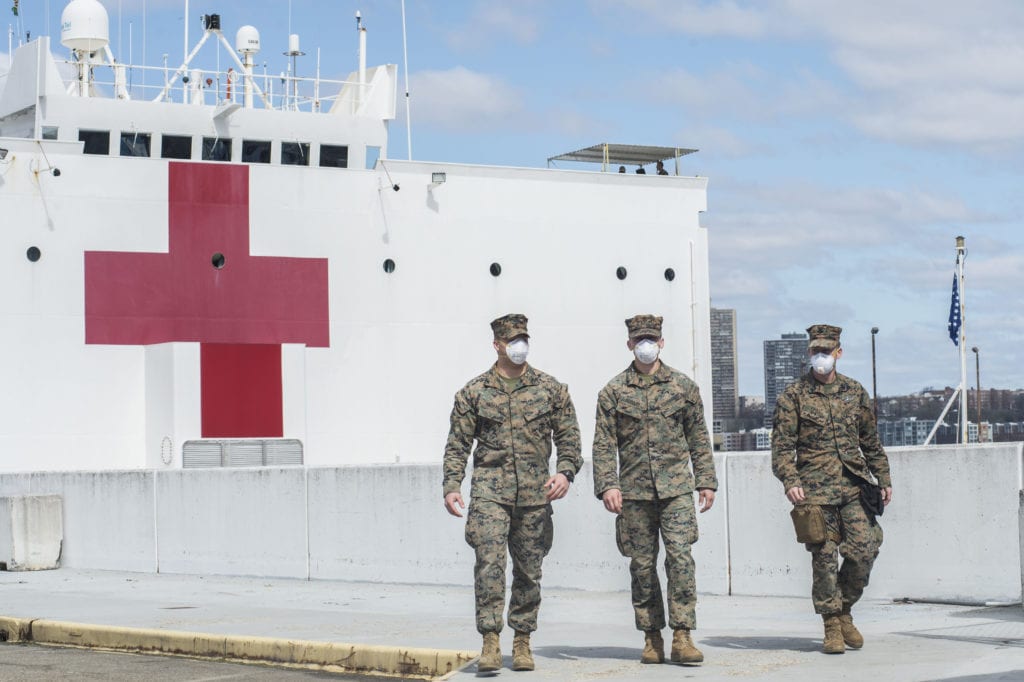
U.S. Marines walk along Pier 90 in New York City as part of a security detachment supporting the Military Sealift Command hospital ship USNS Comfort. U.S. Navy/Mass Communication Specialist 2nd Class Adelola Tinubu

ARLINGTON, Va. — The governor of New York, the state hardest hit by the COVID-19 pandemic, wants the hospital ship USNS Comfort to switch missions and accept patients with the novel coronavirus ahead of an anticipated spike in infections and deaths.

At his daily news conference April 6 in Albany, N.Y., broadcast by numerous news outlets, Cuomo said he would call on President Trump to direct the 1,000-bed Medical Treatment Facility on board the USNS Comfort to start treating COVID-19 patients. Trump later granted Cuomo’s request. A crew member on the hospital ship later tested positive for the virus, several media outlets reported.

See: Navy Deploys Medical Personnel to New Orleans, Dallas

See: Coast Guard Oversees Disembarkation of Cruise Passengers

The Comfort and the USNS Mercy, which was sent to help another overburdened medical system in Los Angeles, were designated as referral hospitals for non-COVID 19 patients, to allow local health professionals and hospitals to focus their attention and equipment, like intensive care units and ventilators, on COVID-19 patients.

However, the Comfort, docked in the Hudson River, has seen only a handful of non-COVID patients. Noting mandatory stay-at-home orders in the state, which have reduced auto accidents, crime and other activities that might require a trip to the hospital in ordinary times. “We don’t need the Comfort for non-COVID,” Cuomo said, “we need it for COVID.”

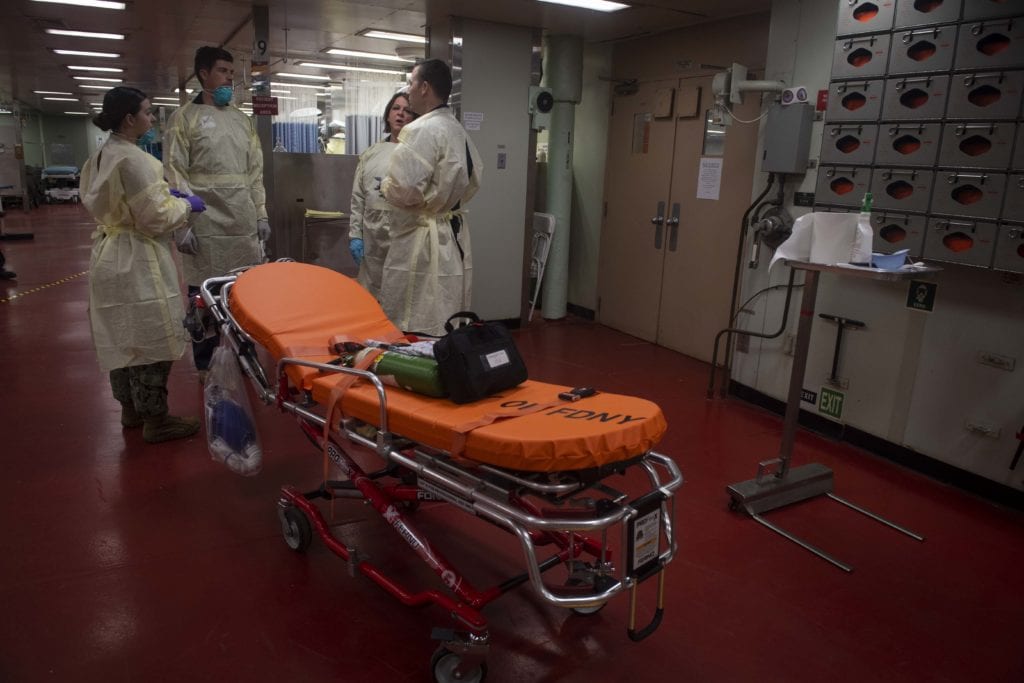
The patient transport team prepares to receive a patient aboard the hospital ship USNS Comfort while the ship is moored in New York. U.S. Navy/Mass Communication Specialist 2nd Class Sara Eshleman

President Trump raised the issue April 5 at a coronavirus task force briefing at the White House. While the ship’s mission wasn’t supposed to be for virus treatment “at all,” Trump said, “It looks like more and more we’ll be using it for that.”

New York State has been the epicenter of the COVID-19 outbreak in the United States with 130,689 cases and 4,758 deaths. The 800-foot-long Comfort, a converted oil supertanker, can provide a range of services such as general surgeries, critical care and ward care for adults. The ship wasn’t accepting obstetrics or pediatric cases, for which it had no specialists or equipment. Walk-in patients weren’t permitted, and ambulances couldn’t take patients directly to the Comfort. Patients first had to be transported to a city hospital for evaluation, including testing for COVID-19 before they could be transported to the ship.

Pentagon officials announced April 3 that screening for care on the USNS Comfort was being modified and will occur pier-side to reduce the backlog at some of the nearby New York hospitals. The screening effort for the Comfort no longer would require a negative test, but each patient still will be screened by temperature and a short questionnaire. The Pentagon also announced that the 2,500-bed non-COVID facility set up in New York’s Javits Convention Center would start taking COVID-19 positive patients.

Capt. Patrick Amersbach, the USNS Comfort’s medical commander, told reporters in a teleconference April 2 that if the mission changed, all the Comfort’s beds would have to be reconfigured to keep those with the virus far apart from those not infected.

“We understand that introducing COVID-19 positive patients into the FMS environments elevates the risk of transmission to other patients and our medical providers. This decision was risk-informed and made to ensure that DoD can continue to provide these local communities the type of medical care they most need. Force health protection is a top priority and our medical professionals will have the required personal protective equipment needed for this mission,” the Defense Department announcement said.

The shipboard coronavirus relief operation in both New York and Los Angeles is led by the Federal Emergency Management Agency in coordination with U.S. Northern Command, Military Sealift Command and the U.S. Navy.


Navy Awards $200 Million Contract to Upgrade USS Boxer

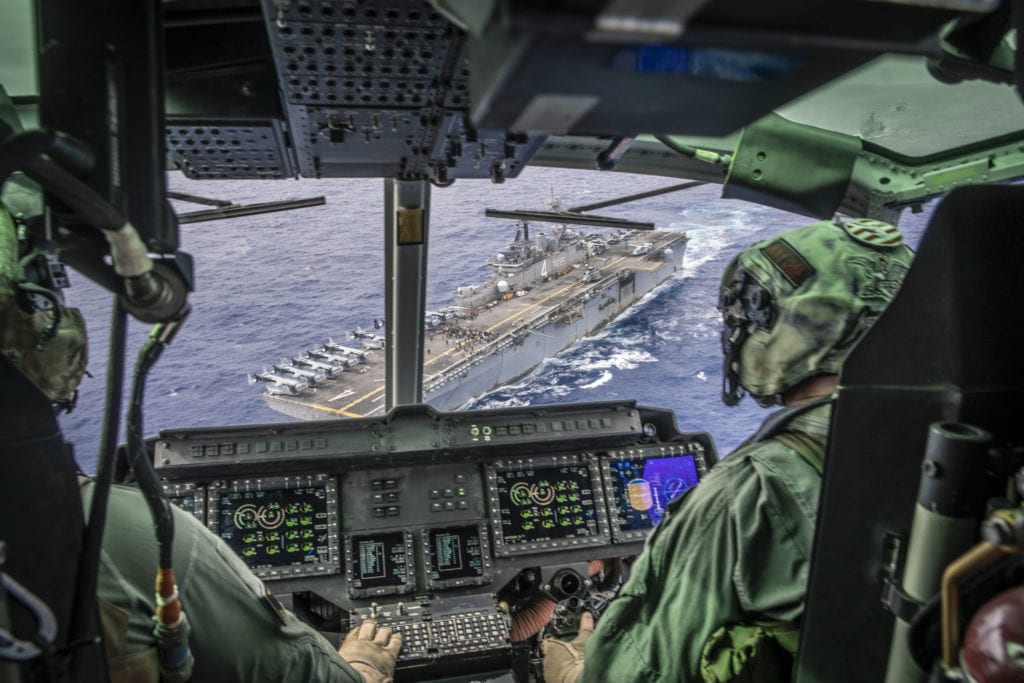
U.S. Marine Corps UH-1Y Venom pilots with Marine Medium Tiltrotor Squadron 163 (Reinforced), 11th Marine Expeditionary Unit, demonstrate an unguided missile attack run at the amphibious assault ship USS Boxer during an air power demonstration. U.S. Marine Corps/Sgt. Adam Dublinske

SAN DIEGO — BAE Systems has received a $200 million contract from the U.S. Navy to drydock and perform nearly 18 months of maintenance and modernization work aboard the amphibious assault ship USS Boxer, according to a company release. 

The drydocking of the USS Boxer will be the first time the company’s San Diego shipyard will use its 950-foot-long Pride of California drydock to service a large-deck warship. The shipyard is nearing completion of another major milestone for the drydock: the first simultaneous docking of two guided-missile destroyers on the West Coast. 

BAE’s San Diego shipyard will begin working aboard the 843-foot-long USS Boxer in June. Under the awarded contract, BAE will upgrade the ship to support and operate joint strike fighters on-board; perform hull, tank and mechanical work; and make other shipboard improvements. The shipyard is expected to complete its work aboard the 25-year-old ship in December 2021. The contract includes options that, if exercised, would bring the cumulative value to $207.5 million. 

Last October, BAE Systems simultaneously docked the USS Stethem and USS Decatur. The guided-missile destroyers are scheduled to be refloated together from the Pride of California drydock later this spring. The Pride of California, the largest drydock in California, can lift more than 55,000 tons. 


Wicker Praises HII Contract for Amphibious Transport Dock Ship

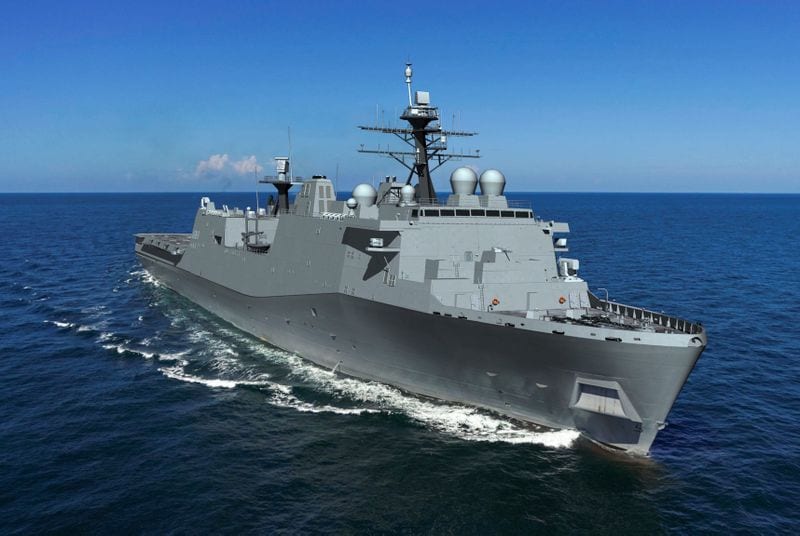
An artist’s rendering of an amphibious transport dock ship. Huntington Ingalls Industries

ARLINGTON, Va. — The earlier-than-expected April 3 award to Huntington Ingalls Industries’ shipbuilding division of a $1.5 billion contract modification for the procurement of the detail design and construction of amphibious transport dock ship LPD 31 was praised by a U.S. senator as a move to shore up shipbuilding.  

Sen. Roger Wicker (R-Miss.), a senior member of the Senate Armed Services Committee, commended the decision to award the shipbuilding contract for LPD 31, which he said “was announced earlier than expected and intended to help the Mississippi shipbuilder mitigate the destabilizing effects of the coronavirus outbreak on its workforce,” according to a release from the senator. 

“This is great news for the dedicated men and women of Ingalls Shipbuilding and the many other suppliers who rely upon a stable rate of construction at the shipyard,” Wicker said. “The talented tradespeople in Pascagoula have been continuing the fight to get our Navy the ships it needs, even in the midst of the great uncertainty brought on by the coronavirus epidemic.” 

LPD 31 will be the 15th in the San Antonio class and the second Flight II LPD, according to an April 3 release from Huntington Ingalls. 

“In building this 15th LPD, Ingalls experienced shipbuilders will continue this hot production line of great amphibious warships for our Navy/Marine Corps team,” Ingalls Shipbuilding President Brian Cuccias said in the release. 

Wicker worked with the other members of the Senate Armed Services Committee to authorize procurement of LPD 31 and provide incremental funding authority to the Navy in the fiscal 2019 and 2020 National Defense Authorization Acts, his release said. Both actions gave the Navy the flexibility to expedite the ship’s purchase.  

The San Antonio class is a major part of the Navy’s 21st century amphibious assault force. The 684-foot-long, 105-foot-wide ships are used to embark and land Marines, their equipment and supplies ashore via air cushion or conventional landing craft and amphibious assault vehicles, augmented by helicopters or vertical takeoff and landing aircraft such as the MV-22 Osprey.


Coast Guard, Air Force, FEMA Deliver Medical Supplies to American Samoa

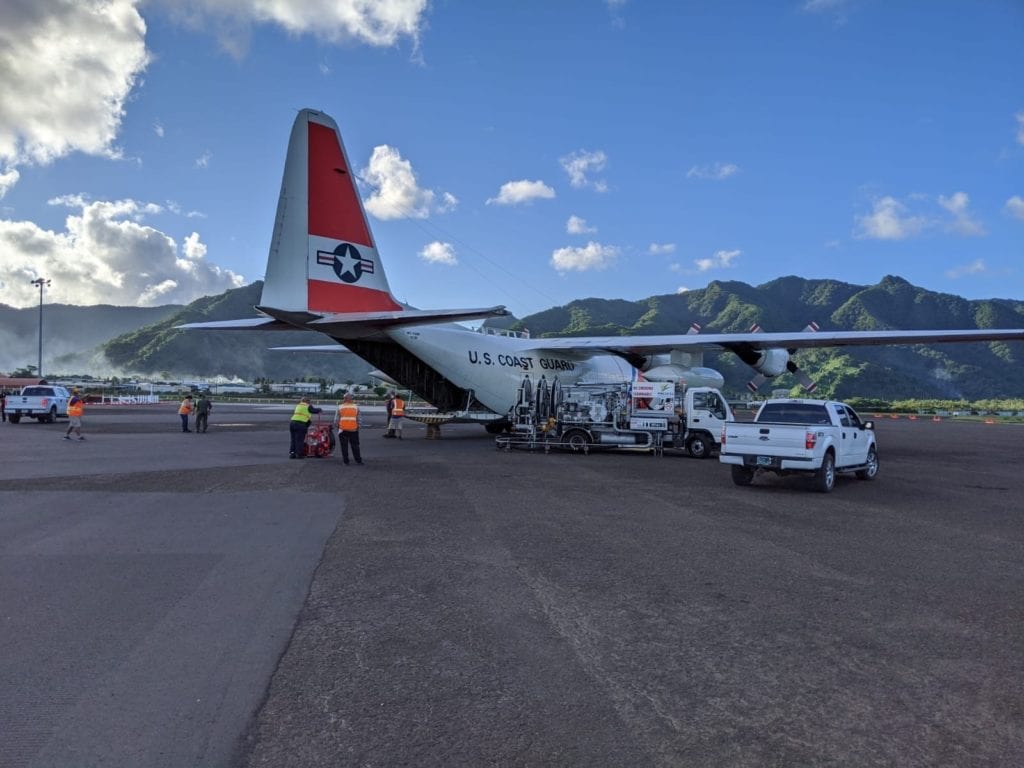
A U.S. Coast Guard HC-130 Hercules airplane crew on April 1 brought various medical and other supplies to American Samoa, including personal protective equipment. U.S. Coast Guard/Lt. Cmdr. Karl Savacool

HONOLULU — The U.S. Coast Guard and Air Force worked together with the Federal Emergency Management Agency to ensure the April 1 delivery of a shipment of personal protective equipment (PPE) to medical responders in American Samoa and the strategic deepwater Port of Pago Pago, according to a Coast Guard release. 

“FEMA notified the Coast Guard of the need March 27, and we worked collectively for a whole of government response to expedite the timely delivery,” said Capt. Craig O’Brien, chief of response for the Coast Guard’s 14th District.

See: Coast Guard Oversees Disembarkation of Cruise Passengers 

The pallet of supplies arrived safely to the main airport in Tafuna on the island of Tutuila aboard a Coast Guard HC-130 Hercules airplane from Air Station Barbers Point, Oahu, on April 1, after earlier movement from the Strategic National Stockpile by the Air Force aboard a C-17 Globemaster airplane to Hickam Air Field, also on Oahu. 

The services continue to support the CDC, state and local health officials for matters involving the pandemic and remains ready to respond to emergency needs throughout the region. Similar deliveries may take place soon to assist other regional partners. 


Coast Guard Oversees Disembarkation of Port Everglades Cruise Passengers; 31 Medically Evacuated

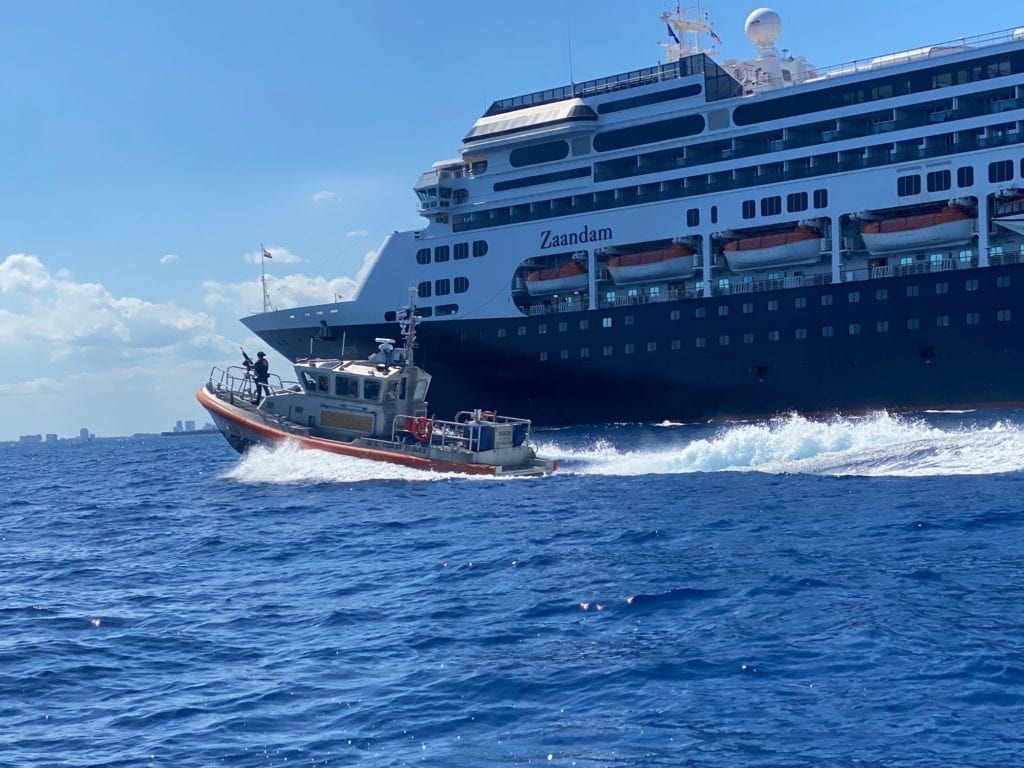
A Coast Guard Station Fort Lauderdale boat crew escorts the cruise ship Zaandam to Port Everglades on April 2. The Coast Guard has been assisting in escorting cruise ships and cruise ship tenders in and out of the Ports of Miami and Everglades. U.S. Coast Guard

WASHINGTON — The U.S. Coast Guard on April 2 helped oversee the offloading of more than 1,200 passengers from the cruise ships Zaandam and Rotterdam in Port Everglades, Florida, according to a Coast Guard Headquarters release. 

This combined with one remaining disembarkation being coordinated represents the processing of more than 120 vessels in the last three weeks to remove 250,000 passengers from cruise ships due to the COVID-19 pandemic.

See: Coast Guard, Air Force, FEMA Deliver Medical Supplies to American Samoa

The Coast Guard, under guidance from the U.S. Centers for Disease Control and Prevention and working with Department of Homeland Security partners Customs and Border Protection and the Transportation Security Administration as well as state and local entities facilitated the safe landing, screening, quarantine and repatriation of these passengers. Many were brought to safe harbor in the U.S. when international ports refused entry. 

“We commend the decision by the cruise industry to cease operations. However, pausing a global tourist industry does not happen instantaneously or easily.”

Vice Admiral Dan Abel, Coast Guard deputy commandant for Operations

Most of the cruise line industry announced a voluntarily suspension of operations from U.S. ports of call on March 13, and the CDC issued a “no sail” order on March 14 to all cruise ships that had not voluntarily suspended operations. 

“We commend the decision by the cruise industry to cease operations. However, pausing a global tourist industry does not happen instantaneously or easily,” said Vice Admiral Dan Abel, Coast Guard deputy commandant for operations.  

The drawdown of passenger operations is a major milestone, but it does not eliminate U.S. government concerns for cruise ships and their crews. 

Today, there are 114 cruise ships, carrying 93,000 crew members, either in or near U.S. ports and waters. This includes 73 cruise ships, with 52,000 crew members, moored or anchored in U.S. ports and anchorages. Another 41 cruise ships, with 41,000 crew members, are underway and still in vicinity of the United States.