Boeing Extends Temporary Suspension of Puget Sound Production Operations
SEATTLE — Boeing is extending the temporary suspension of production operations at all Puget Sound area and Moses Lake sites until further notice, the company said in a release.
These actions are being taken in light of the company’s continuing focus on the health and safety of employees, current assessment of the spread of COVID-19 in Washington state, the reliability of the supply chain and additional recommendations from government health authorities.
During the suspension, the company will continue to implement additional health and safety measures at its facilities to protect employees. These measures include new visual cues to encourage physical distancing, more frequent and thorough cleaning of work and common areas and staggering shift times to reduce the flow of employees arriving and departing work, among many other improvements.
“The health and safety of our employees, their families and our communities is our shared priority,” Boeing’s commercial airplanes President and CEO Stan Deal said.
The volunteers who have been supporting essential site and services work should continue to report to their assigned shifts. Puget Sound area and Moses Lake employees who can work from home should continue to do so.
As the suspension of operations continues, Boeing will monitor government guidance and actions on COVID-19 and their impact on company operations. Boeing sites that remain open are being monitored and assessed daily.
Boeing assembles P-8A maritime patrol aircraft at Renton, Washington.
Attack Submarine USS Delaware Joins Fleet
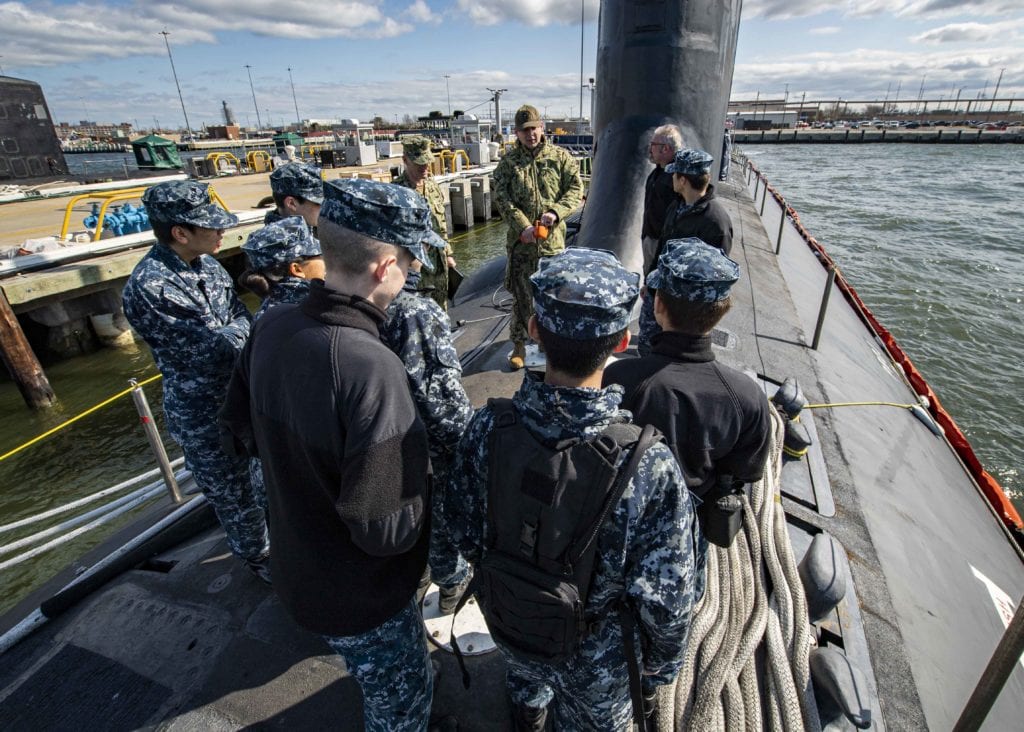
Sonar Technician (Submarine) 1st Class Ryun Lewis (center) gives a tour of the Delaware last month to U.S. Naval Sea Cadets with the sub moored pier side at Naval Station Norfolk as the Virginia-class boat prepared for its April 4 commissioning. U.S. Navy/Mass Communication Specialist 2nd Class Cameron Stoner
WASHINGTON — The U.S. Navy commissioned USS Delaware, the 18th Virginia-class attack submarine, on April 4, according to a Navy release.
Although the traditional commissioning ceremony was canceled due to restrictions on large gatherings brought on by the COVID-19 pandemic, the Navy commissioned USS Delaware administratively and transitioned the ship to normal operations. Meanwhile, the Navy is looking at an opportunity to commemorate the special event with the ship’s sponsor, crew and commissioning committee.
“This Virginia-class fast-attack submarine will continue the proud naval legacy of the state of Delaware and the ships that have borne her name,” acting Navy Secretary Thomas B. Modly said in the release.
Vice Adm. Daryl Caudle, commander of Navy Submarine Forces, said he is pleased to welcome the ship to the sub fleet and contribute to Navy undersea warfighting capability.
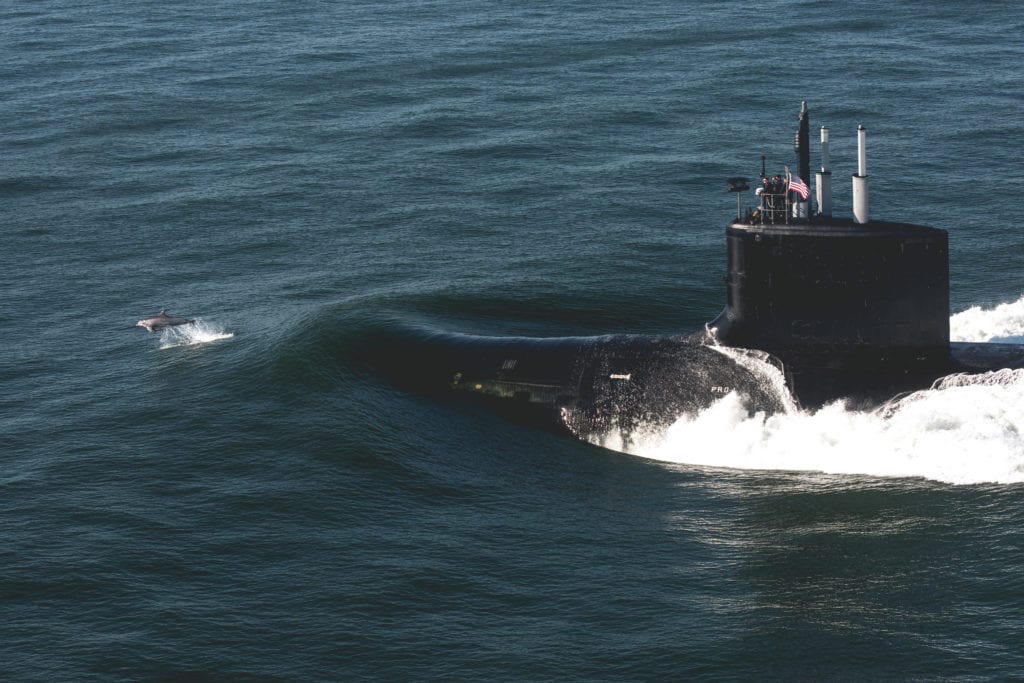
The Virginia-class attack submarine USS Delaware transits the Atlantic Ocean after departing Huntington Ingalls Industries Newport News Shipbuilding division during sea trials last August. U.S. Navy via Ashley Cowan of HII
“The U.S. Navy values the support of all those who contributed to today’s momentous milestone and will look for a future opportunity to commemorate this special event,” Caudle said. “The sailors of USS Delaware hail from every corner of the nation and from every walk of life. This crew, and the crews who follow, will rise to every challenge with unmatched bravery and perseverance to ensure the U.S. Submarine Force remains the best in the world.”
The ship’s sponsor, Jill Biden, spouse of former Vice President Joe Biden, a Democratic candidate for president, offered congratulations to everyone who played a role in delivering USS Delaware to service.
“I know this submarine and her crew of courageous sailors will carry the steadfast strength of my home state wherever they go,” she said. “The sailors who fill this ship are the very best of the Navy, and as you embark on your many journeys, please know that you and those whom you love are in my thoughts.”
Delaware’s commanding officer, Cmdr. Matthew Horton, said the commissioning marks the culmination of six years of hard work by the men and women who constructed the submarine and are preparing it to become a warship. He thanked the crew and their families, Jill Biden, the USS Delaware Commissioning Committee and the Navy League of Hampton Roads for their work and support.
“As we do our part to maintain the nation’s undersea supremacy well into the future, today marks a milestone for the Sailors who serve aboard USS Delaware. Whether they have been here for her initial manning three years ago, or have just reported, they all are strong, capable submariners ready to sail the nation’s newest warship into harm’s way,” Horton said.
This is the first time in nearly 100 years the name “Delaware” has been used for a U.S. Navy vessel. It is the seventh Navy ship, and first sub, to bear the name of the state. The boat is 377 feet long, has a 34-foot beam and will be able to dive to depths greater than 800 feet and operate at speeds in excess of 25 knots submerged. It will operate for more than 30 years without ever refueling. Its keel was laid on April 30, 2016, and was christened during a ceremony on Oct. 20, 2018. It is the final Block III Virginia-class sub before Block IV deliveries begin.
Fortem Ships New AI-Enabled DroneHunter F700
PLEASANT GROVE, Utah — Fortem Technologies Inc. announced the shipment of the new AI-enabled F700 DroneHunter unmanned aerial system.
“In a world where jamming drones and drone swarms from the ground is no longer effective, the F700 stands alone as a safe, effective deterrent against the rising number of careless and criminal drones,” the release said.
The F700 is being used by the Defense Department and other international government agencies and has seen nearly 400 test runs.
The company said the “ultimate advancements of the F700 are its new flexible undercarriage, which offers interchangeable countermeasures for single, multiple or swarm-based threats and its new lightweight carbon fiber frame, enabling greater athleticism and speed.”
The F700 can carry multiple types of anti-drone countermeasures and deploy them in real-time, based on the dynamic threat that is detected miles beyond the protected area. The undercarriage features pogo pins and payload snaps that are integrated with artificial intelligence-enabled firing and flight software, according to the company.
“The F700 offers significant payload capacity to handle situations over civilians where zero collateral damage is a requirement,” the release said. “AI decisions are now made in real-time to select the appropriate effectors for the detected threat.”
“We have advanced the DroneHunter F700 so that it can deliver any ordinance necessary to stop drones and to protect stadiums, refineries, campuses and entire metro regions,” Fortem CEO Timothy Bean said in the release. “It is the premier AI-enabled interceptor drone in the world.”
Fortem is developing several DroneHunter mitigation types, including directed energy.
Bollinger Delivers 38th Fast-Response Cutter, Harold Miller, to Coast Guard
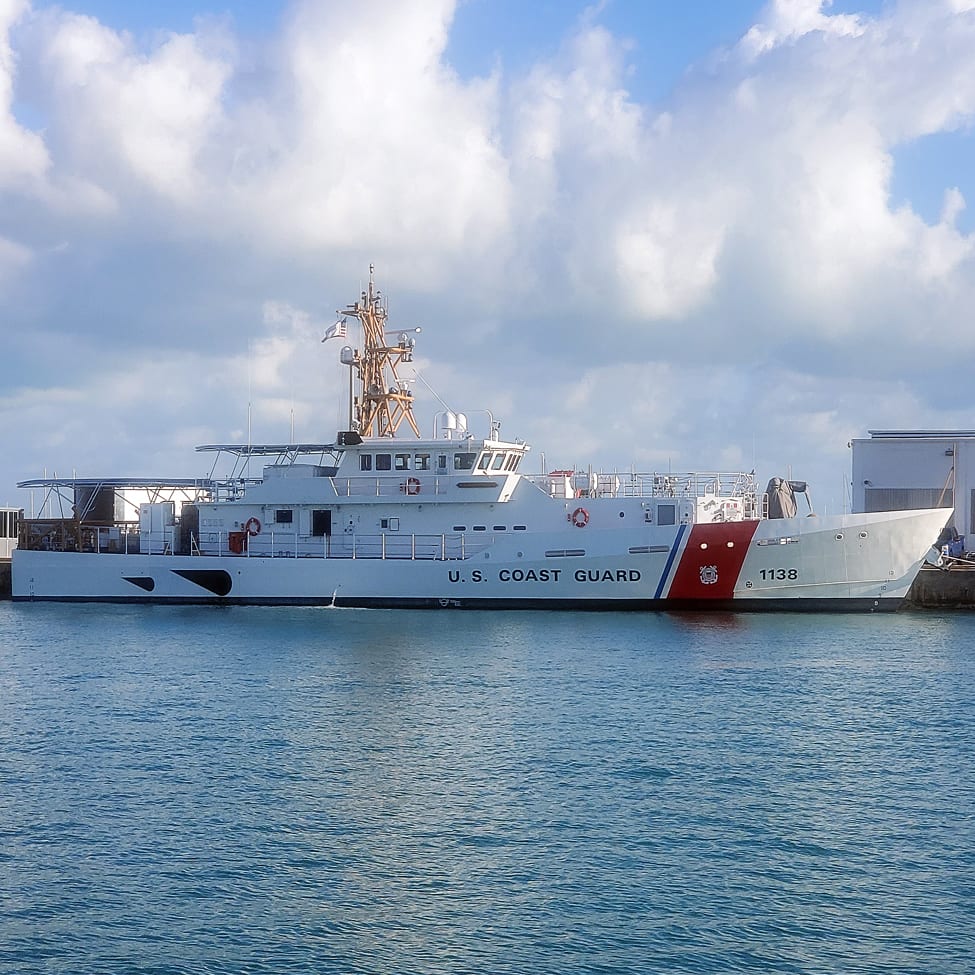
The fast-response cutter Harold Miller, delivered to the U.S. Coast Guard in Key West, Florida, on April 2. Bollinger Shipyards
LOCKPORT, La. — Bollinger Shipyards delivered the fast-response cutter (FRC) Harold Miller to the U.S. Coast Guard in Key West, Florida, on April 2, the company said in a release.
The cutter is the 161st vessel Bollinger has delivered to the U.S. Coast Guard over a 35-year period and the 38th FRC delivered on the current program. The Harold Miller is the third of three FRCs to be home-ported in Galveston, Texas.
“We are very proud to announce our latest FRC delivery, especially given the unprecedented times and challenges which we’re facing as a nation,” said Ben Bordelon, Bollinger’s president and CEO.
“For this reason, I want to commend the resilience and dedication of the 600-plus men and women who, despite the threat of global pandemic, continued to work safely and efficiently to build and deliver an exceptional, high-performance cutter to strengthen U.S. national security at a time when our nation needs us most.”
“While providing the United States Coast Guard with an extremely capable and affordable asset, the Bollinger FRC program also provides tremendous benefits to the state of Louisiana, not only through highly skilled and well-paying jobs, but also through its direct and indirect spending, resulting in millions of dollars of economic benefits to the state,” said Rep. Steve Scalise (R-La.).
Each FRC is named for an enlisted Coast Guard hero who distinguished themselves in the line of duty. Harold Miller, a boatswain’s mate second class, piloted the first wave of landing craft on Tulagi Island in the Pacific Theater during World War II and made a landing against a Japanese force on Guadalcanal Island. Miller was awarded a Silver Star by Adm. Chester Nimitz for his heroic combat actions.
The FRC is an operational game-changer, according to senior Coast Guard officials. The class is consistently being considered and utilized for a broader mission within the Coast Guard and other branches of our armed services due to the success of the platform and the FRC’s expanded operational reach and capabilities, including the ability to transform and adapt to the mission.
FRCs have conducted operations as far as the Marshall Islands — a 4,400-nautical-mile trip from their homeport. Measuring 154 feet, FRCs have a flank speed of 28 knots, state-of-the-art command, control, communications, computers, intelligence, surveillance and reconnaissance suite, and stern launch and recovery ramp for a 26-foot, over-the-horizon interceptor cutter boat.
Former Commander of Theodore Roosevelt to Replace Ousted Skipper
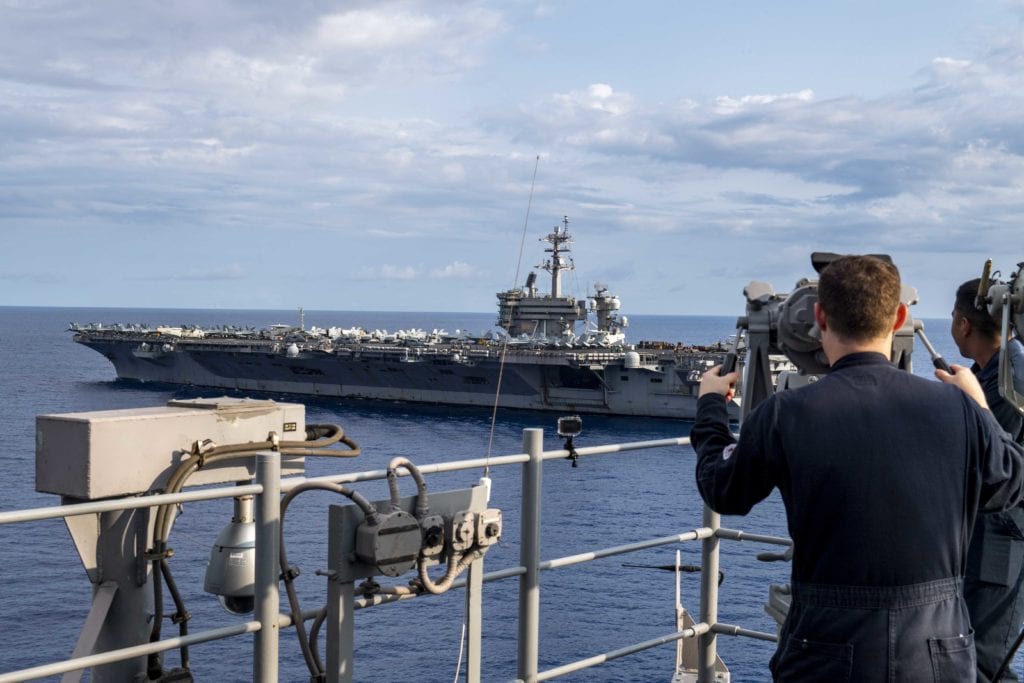
Sailors aboard the amphibious assault ship USS America watch the aircraft carrier USS Theodore Roosevelt get underway in formation in the Philippine Sea. U.S. Navy/Mass Communication Specialist Seaman Jomark A. Almazan
ARLINGTON, Va. — The most recent former commander of the USS Theodore Roosevelt will replace the aircraft carrier’s ousted skipper, Capt. Brett Crozier, who was dismissed April 2 after his plea to the U.S. Navy for more help dealing with a shipboard coronavirus outbreak went public.
Rear Adm. Select Carlos Sardiello, who commanded the Teddy Roosevelt from July 2017 until last November, will replace the man who took over from him just five months ago — as soon as Sardiello can reach Guam, where the carrier is docked.
Until that time, Capt. Dan Keeler, the carrier’s executive officer, is in command. Several videos posted on social media on April 3 show large crowds of Theodore Roosevelt personnel cheering for Crozier as he departs down the carrier’s gangway alone. Thousands of the TR’s 4,900 personnel have been offloaded, isolated and tested on Guam to counter the spread of the novel coronavirus, COVID-19.
Rear Adm. Select Carlos Sardiello, captain of the Theodore Roosevelt from July 2017 until last November, will assume command of the aircraft carrier again following the ouster of Capt. Brett Crozier. U.S. Navy/Mass Communication Specialist 3rd Class Becca Winberry
Sardiello “is extremely well-acquainted with the ship, many members of its crew and the operations and capabilities of the ship itself,” acting Navy Secretary Thomas Modly told an April 2 press briefing where he announced Crozier’s removal. Sardiello “is the best person in the Navy right now to take command under these circumstances,” Modly said.
A few days after three of the TR’s sailors tested positive for COVID-19 and were evacuated by air, the carrier made a scheduled port visit at Guam, where the number testing positive grew to more than 100. Most of those Sailors have minor or no symptoms and none have been hospitalized.
In a four-page March 30 letter to Navy leadership, Crozier said that the TR had inadequate space to isolate or quarantine Sailors in keeping with guidance from the U.S. Centers for Disease Control and Prevention and the Navy. “The spread of the disease is ongoing and accelerating,” Crozier wrote. He called for disembarking all but a token force of about 10% of the crew until all could be tested for infection, isolated for the required 14 days and the ship sanitized. The letter was leaked to the San Francisco Chronicle, which published it on March 31.
At a Pentagon press briefing the following day, Modly said he was “disappointed” to hear of Crozier’s remarks but avoided saying whether the captain would be fired for going outside normal channels to draw attention to his ship’s plight. “We need a lot of transparency in this situation, and we need that information to flow up through the chain of command,” Modly said.
However, at the April 2 briefing, also attended by Chief of Naval Operations Adm. Mike Gilday, Modly said he was ordering Crozier removed from his command because he had “lost confidence in [Crozier’s] ability to lead” the Roosevelt during the virus outbreak. Before Crozier’s letter was published, Navy leadership had been in touch with the captain, Modly said. Crozier said he wanted his crew evacuated from the carrier faster but did not relay “the various levels of alarm that I, along with the rest of the world, learned from his letter when it was published,” Modly said.
Crozier “had allowed the complexity of his challenge with the COVID breakout on the ship to overwhelm his ability to act professionally, when acting professionally was what was needed most.”
Acting Navy Secretary Thomas Modly
Nor had Crozier discussed the situation with his immediate superior, the carrier strike group’s commander, Rear Adm. Stuart Baker, who was on board the TR “right down the passageway from him,” Modly said. The secretary also complained that Crozier had not encrypted the letter, which was sent over nonsecure, unclassified e-mail outside the chain of command that raised questions about the operational capabilities and security of the aircraft carrier.
After discussions in person and by teleconference with Gilday, the commanders of the U.S. Pacific Fleet, the 7th Fleet, Navy Surgeon General Rear Adm. Bruce Gillingham and others, Modly said he concluded Crozier “had allowed the complexity of his challenge with the COVID breakout on the ship to overwhelm his ability to act professionally, when acting professionally was what was needed most.”
Moldy said Gilday has directed Vice Chief of Naval Operations Adm. Robert Burke to investigate the circumstances and climate of the entire Pacific Fleet “to help determine what may have contributed to this breakdown in the chain of command.”
Navy Orders Materials for Harpoon Missiles for Six Allies and Partners
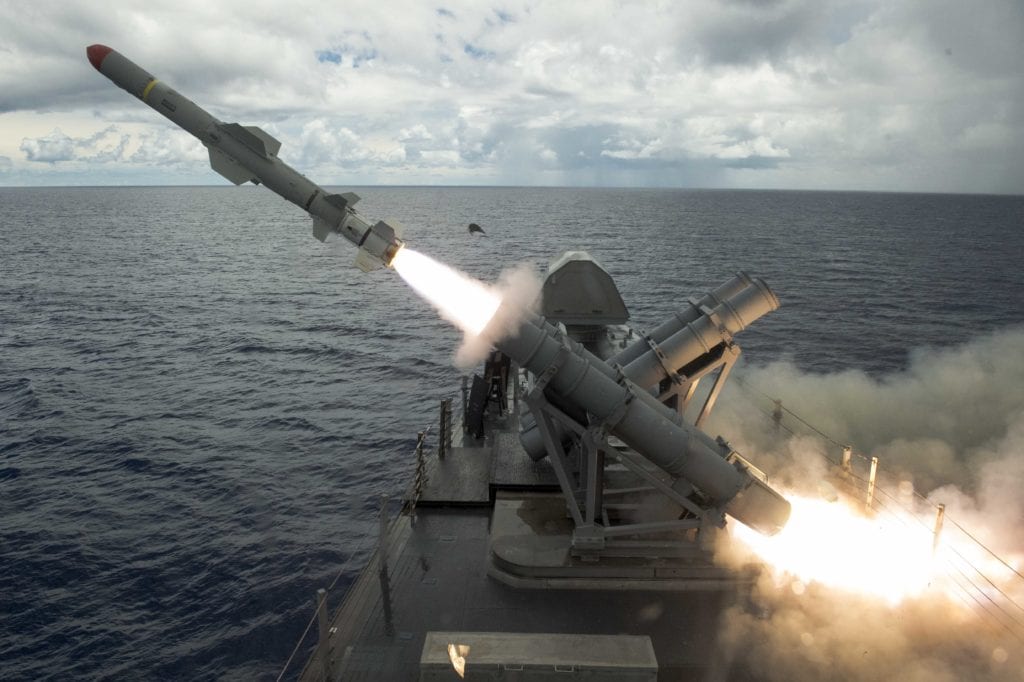
A Harpoon missile launches from the missile deck of the littoral combat ship USS Coronado off the coast of Guam. U.S. Navy/Mass Communication Specialist 2nd Class Kaleb R. Staples
ARLINGTON, Va. — The U.S. Navy has ordered materials for AGM/RGM-84 Harpoon anti-ship cruise missiles for six allied and partner nations, the Defense Department said in an April 2 release.
Naval Air Systems Command awarded Boeing a $73.2 million contract modification to provide additional long-lead material funding for full-rate production Lot 91 of the Harpoon missile under the foreign military sales program. Work is expected to be complete by December 2023.
When produced, the missiles will be delivered to the governments of Saudi Arabia, Qatar, Thailand, South Korea, Brazil and Japan.
The Harpoon missile family is deployed by the armed forces of 31 nations.
Navy Orders Four New LCU 1700 Utility Landing Craft from Swiftships
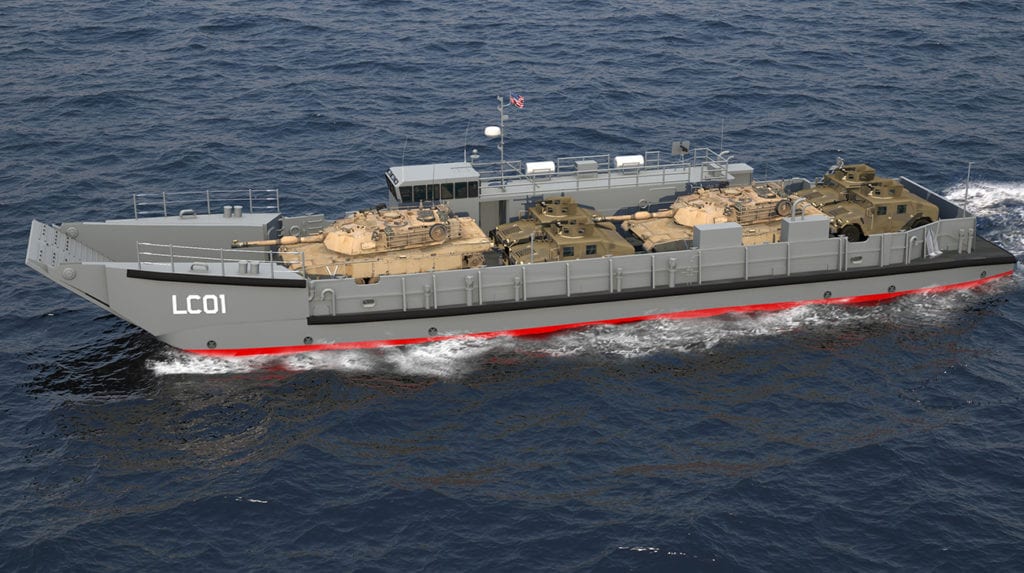
A Swiftships Landing Craft Utility 1700. Swiftships
ARLINGTON, Va. — The U.S. Navy has ordered four more of its new utility landing craft (LCU) for its amphibious warfare forces.
Naval Sea Systems Command awarded Swiftships of Morgan City, Louisiana, a $50.1 million modification to a previously-awarded contract “to exercise an option for the construction of four Landing Craft Utility (LCU) transportation boats (1703 through 1706),” the Defense Department said in an April 2 announcement. Delivery is expected by October 2022. The funds will come from the fiscal 2020 budget.
In February 2019, the Navy ordered LCU 1701 and 1702 under a $26.7 million contract modification. The craft will follow the prototype of the LCU 1700 class. Delivery is expected by May 2021.
“The LCU 1700 class will recapitalize the LCU 1610 capabilities and have a design life of 30 years,” the contract announcement said. “LCU 1700 craft will be a highly reliable and fuel-efficient heavy-lift platform whose capability will be complementary to the faster air cushion landing craft, which have a significantly shorter range, smaller payload capacity, no habitability and operating hour limitations.”
The Navy’s amphibious warfare ships equipped with well decks routinely deploy with LCUs embarked. The Navy plans to procure a total of 32 LCU 1700 craft.
Navy Orders Two E-2D Advanced Hawkeye Aircraft
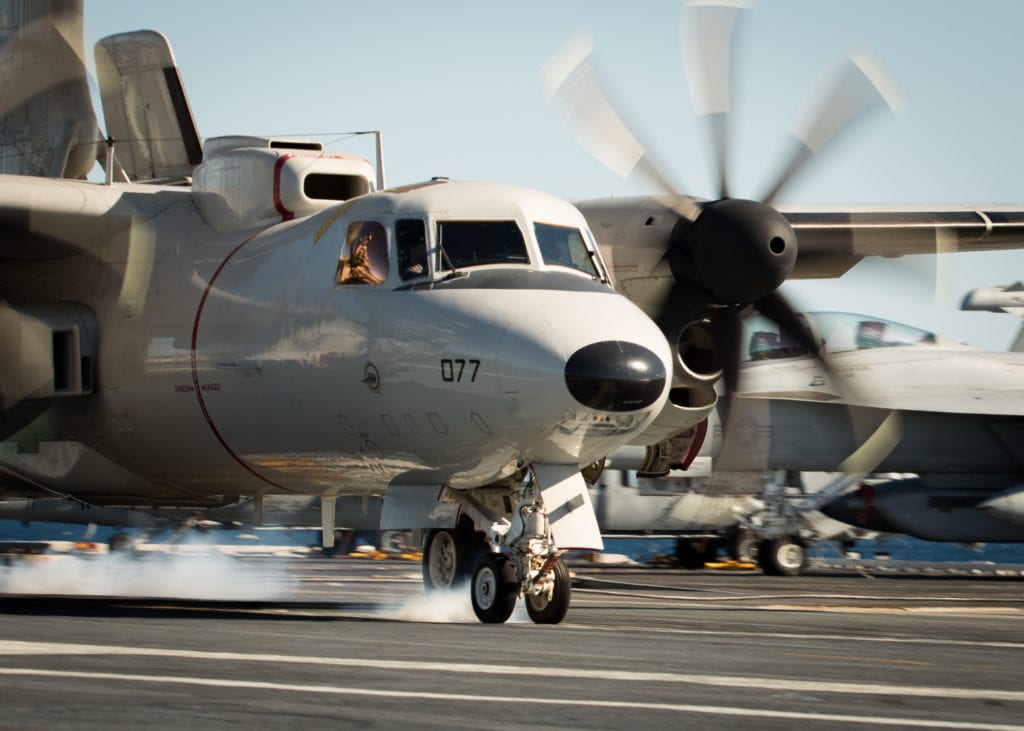
A E-2D Hawkeye lands on the flight deck of the aircraft carrier USS Gerald R. Ford. U.S. Navy/Mass Communication Specialist 3rd Class Ryan Carter
ARLINGTON, Va. — The U.S. Navy has ordered two more E-2D Advanced Hawkeye battle management aircraft, the Defense Department said in a contract announcement.
Naval Air Systems Command awarded Northrop Grumman Aeronautics Systems of Melbourne, Florida, a $404 million contract modification to the previously awarded, fixed-price-incentive-firm-target contract, the department said in an April 1 release.
One of the E-2Ds is being procured as part of fiscal 2019’s full-rate production (FRP) Lot 8 while the second as part of fiscal 2020’s FRP Lot 9.
This modification exercises contract options for nonrecurring engineering and software support activities. Work is expected to be complete by March 2025, the release said.
The Navy expects to procure a total of 86 E-2Ds. Japan has received four E-2Ds of and has ordered an additional nine. The E-2Ds are replacing E-2C Hawkeye aircraft in both the U.S. Navy and the Japanese Air Self-Defense Force.
Boeing Awarded Navy Contract Modification for Additional MQ-25 UAVs
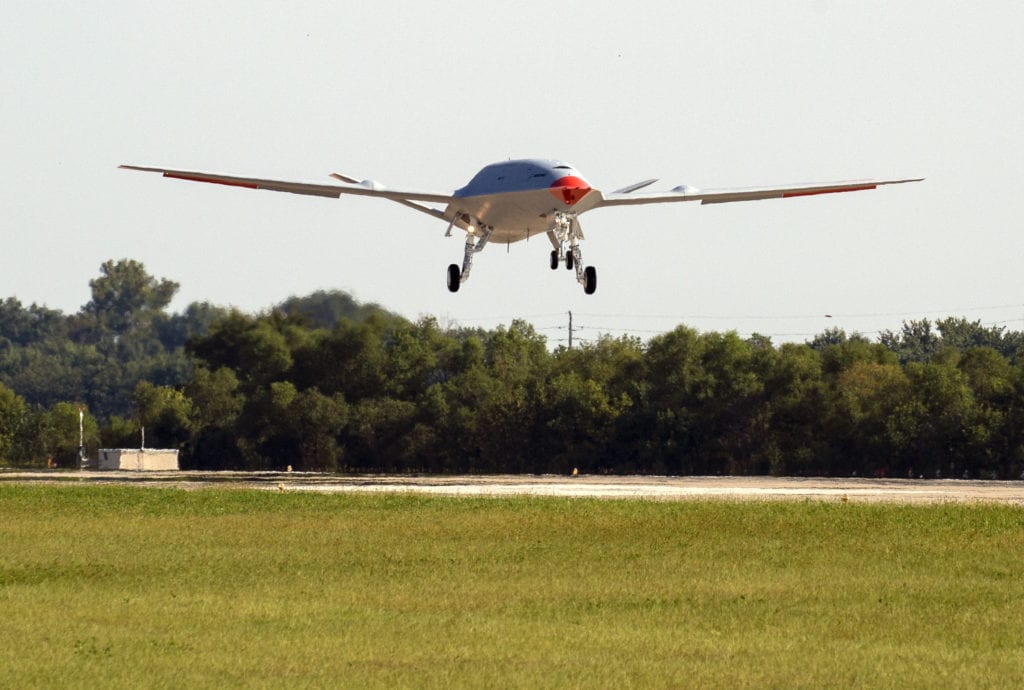
The MQ-25 unmanned carrier-based test aircraft comes in for landing after its first flight in September at MidAmerica Airport in Mascoutah, Illinois. The Boeing-owned test asset, known as T1, flew two hours to validate the aircraft’s basic flight functions and operations. U.S. Navy via Boeing
ST. LOUIS — The U.S. Navy has awarded Boeing a contract modification for three additional MQ-25 unmanned aerial refueling aircraft, bringing the total number of aircraft Boeing is manufacturing to seven, the company said in a release.
“We’re honored to have the Navy’s confidence in our system design and performance that is evident from this additional order,” said Dave Bujold, Boeing’s MQ-25 program director.
“This order establishes uninterrupted production of the first MQ-25 aircraft and lines up with the Navy’s MQ-25 test and training plans for fleet introduction. The MQ-25 program is vital in ensuring the Navy can deliver a critical unmanned aerial refueling capability to the carrier air wing.”
This $84.7 million modification exercises options for three MQ-25 system demonstration test articles and was an option identified in the original $805 million contract for four aircraft awarded in August 2018.
Early flight testing of Boeing’s MQ-25 test asset, T1, is contributing to program progress. The company recently concluded the first round of flight testing for T1, resulting in nearly 30 hours in the air at various speeds and altitudes.
The aircraft is undergoing a planned modification that includes installation of an aerial refueling store (ARS) under the left wing. Flight testing with the ARS will resume later this year.
Chao, Buzby Conference With Maritime Industry Leaders Over COVID-19
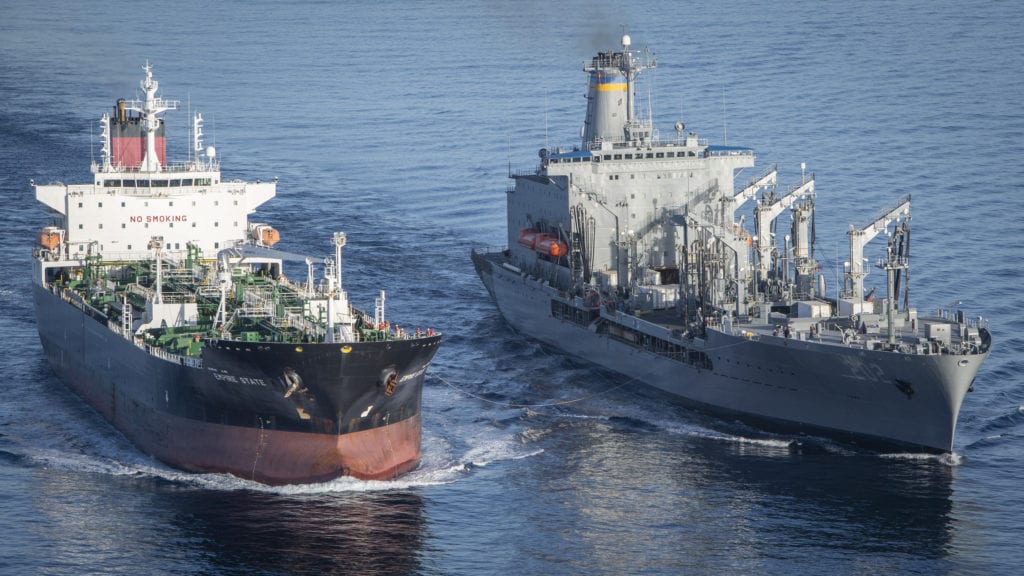
The Henry J. Kaiser-class underway replenishment oiler USNS Yukon prepares to conduct a loading with the commercial tanker MT Empire State. U.S. Navy/Mass Communication Specialist 1st Class Patrick W. Menah Jr.
WASHINGTON — Transportation Secretary Elaine L. Chao and Maritime Administrator Mark H. Buzby held a teleconference with maritime industry leaders on April 2 to discuss the effects of the COVID-19 outbreak on the industry, according to an April 2 MARAD release.
Chao and Buzby discussed the crisis with chief executive officers, presidents and other senior officials of the industry.
“During the call, Secretary Chao voiced her support for the maritime industry and the challenges they face at this time,” the release said.
Did you know there are about 70 civilian mariners aboard the USNS Comfort supporting the Navy doctors, nurses, and other health care professionals. Andrew Chen, chief mate, helps guide the ship from the bridge as it arrives in New York City. pic.twitter.com/ED4Qu2IBJP
— DOT Maritime Administration (@DOTMARAD) April 2, 2020
“Secretary Chao and Administrator Buzby briefed maritime industry partners on departmental activities concerning COVID-19 and provided industry leaders the opportunity to share their insights, questions and concerns with the secretary, [Department of Transportation], MARAD and other government interagency Partners. Topics discussed included the overall status of maritime industry operations, including personnel [staff/contractors], any disruptions, and [the outbreak’s] impact on the cargo movement in the U.S. and overseas.”