Bollinger Delivers 38th Fast-Response Cutter, Harold Miller, to Coast Guard
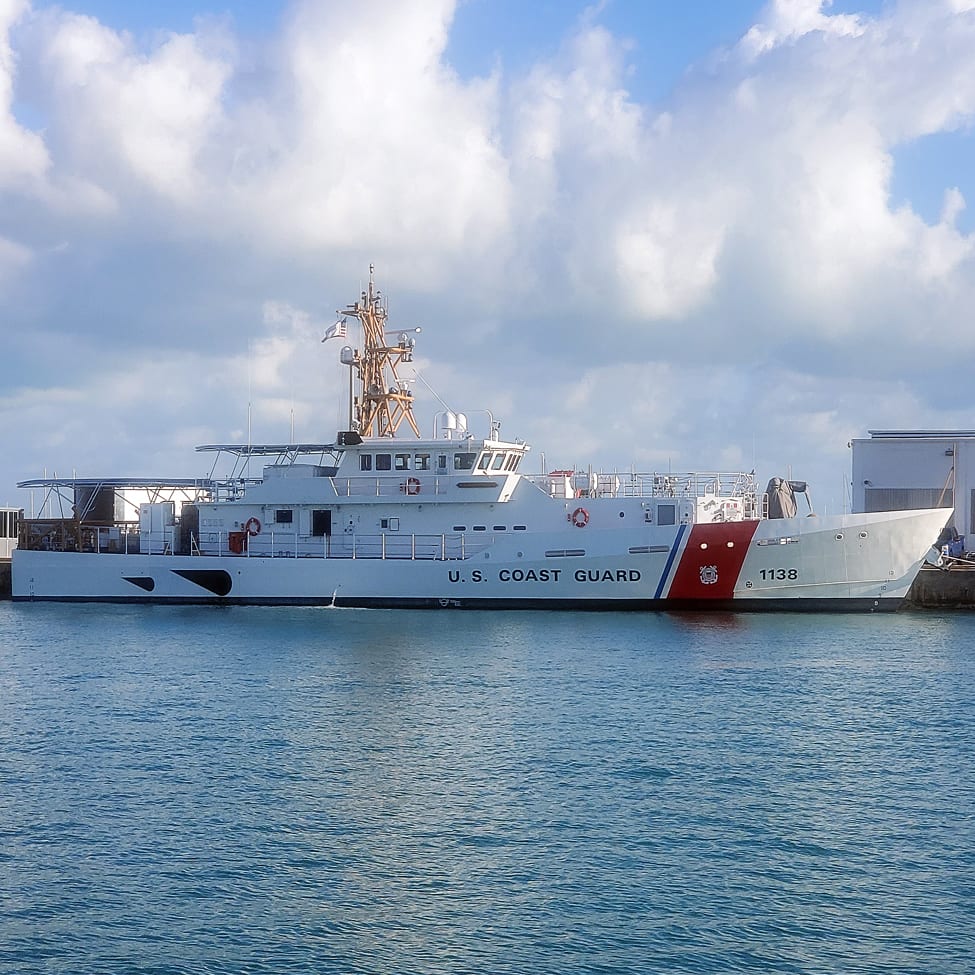
The fast-response cutter Harold Miller, delivered to the U.S. Coast Guard in Key West, Florida, on April 2. Bollinger Shipyards
LOCKPORT, La. — Bollinger Shipyards delivered the fast-response cutter (FRC) Harold Miller to the U.S. Coast Guard in Key West, Florida, on April 2, the company said in a release.
The cutter is the 161st vessel Bollinger has delivered to the U.S. Coast Guard over a 35-year period and the 38th FRC delivered on the current program. The Harold Miller is the third of three FRCs to be home-ported in Galveston, Texas.
“We are very proud to announce our latest FRC delivery, especially given the unprecedented times and challenges which we’re facing as a nation,” said Ben Bordelon, Bollinger’s president and CEO.
“For this reason, I want to commend the resilience and dedication of the 600-plus men and women who, despite the threat of global pandemic, continued to work safely and efficiently to build and deliver an exceptional, high-performance cutter to strengthen U.S. national security at a time when our nation needs us most.”
“While providing the United States Coast Guard with an extremely capable and affordable asset, the Bollinger FRC program also provides tremendous benefits to the state of Louisiana, not only through highly skilled and well-paying jobs, but also through its direct and indirect spending, resulting in millions of dollars of economic benefits to the state,” said Rep. Steve Scalise (R-La.).
Each FRC is named for an enlisted Coast Guard hero who distinguished themselves in the line of duty. Harold Miller, a boatswain’s mate second class, piloted the first wave of landing craft on Tulagi Island in the Pacific Theater during World War II and made a landing against a Japanese force on Guadalcanal Island. Miller was awarded a Silver Star by Adm. Chester Nimitz for his heroic combat actions.
The FRC is an operational game-changer, according to senior Coast Guard officials. The class is consistently being considered and utilized for a broader mission within the Coast Guard and other branches of our armed services due to the success of the platform and the FRC’s expanded operational reach and capabilities, including the ability to transform and adapt to the mission.
FRCs have conducted operations as far as the Marshall Islands — a 4,400-nautical-mile trip from their homeport. Measuring 154 feet, FRCs have a flank speed of 28 knots, state-of-the-art command, control, communications, computers, intelligence, surveillance and reconnaissance suite, and stern launch and recovery ramp for a 26-foot, over-the-horizon interceptor cutter boat.
Former Commander of Theodore Roosevelt to Replace Ousted Skipper
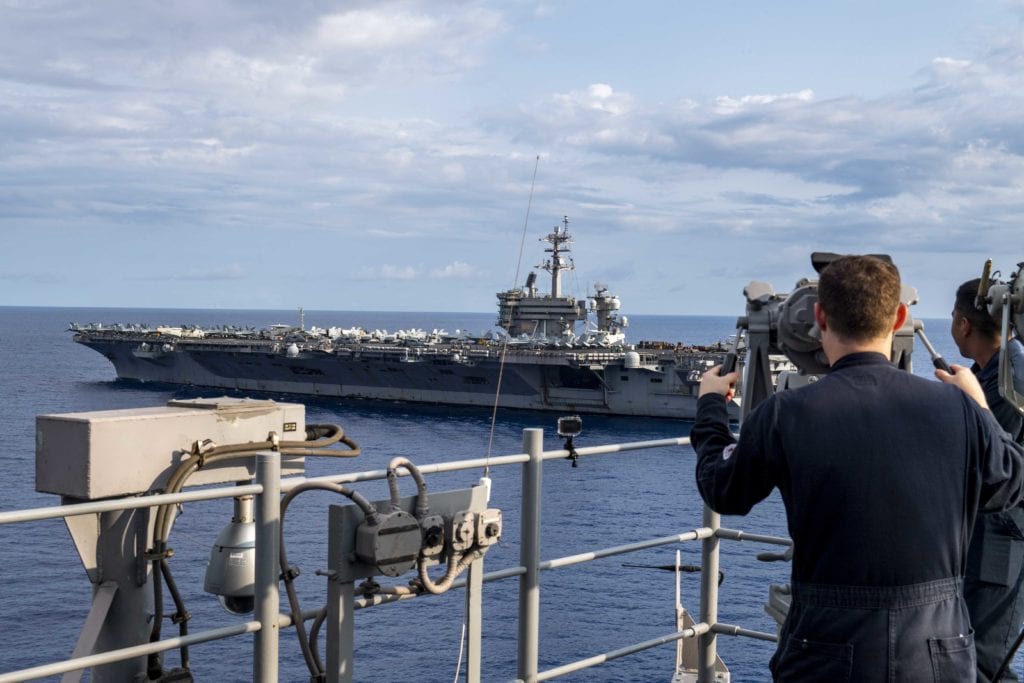
Sailors aboard the amphibious assault ship USS America watch the aircraft carrier USS Theodore Roosevelt get underway in formation in the Philippine Sea. U.S. Navy/Mass Communication Specialist Seaman Jomark A. Almazan
ARLINGTON, Va. — The most recent former commander of the USS Theodore Roosevelt will replace the aircraft carrier’s ousted skipper, Capt. Brett Crozier, who was dismissed April 2 after his plea to the U.S. Navy for more help dealing with a shipboard coronavirus outbreak went public.
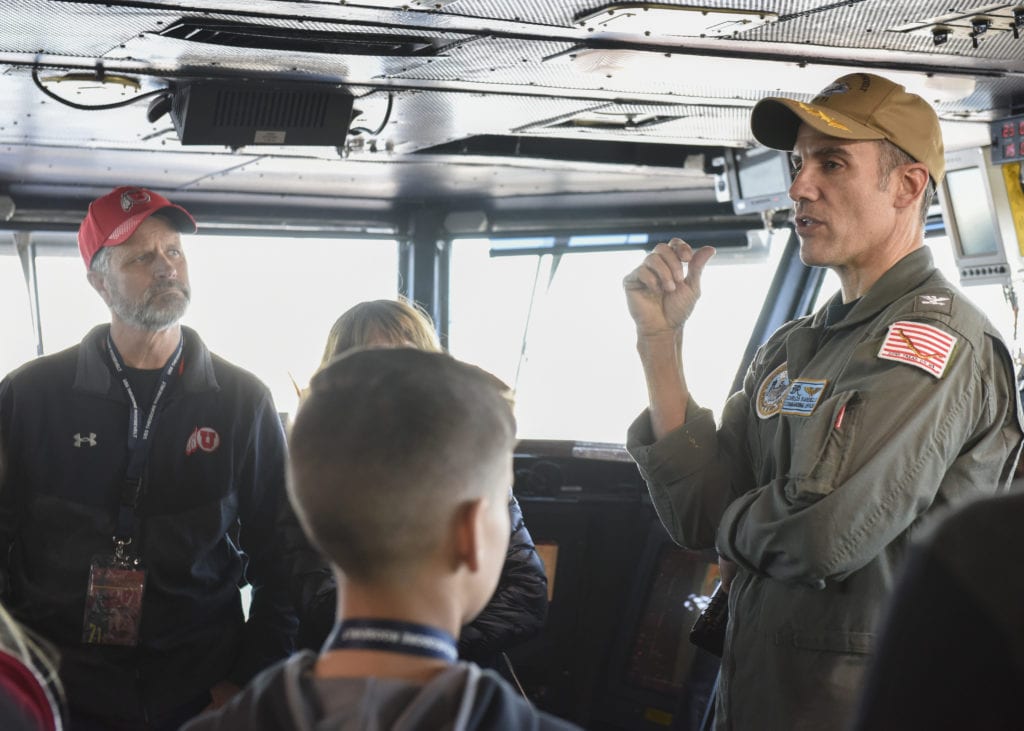
Rear Adm. Select Carlos Sardiello, who commanded the Teddy Roosevelt from July 2017 until last November, will replace the man who took over from him just five months ago — as soon as Sardiello can reach Guam, where the carrier is docked.
Until that time, Capt. Dan Keeler, the carrier’s executive officer, is in command. Several videos posted on social media on April 3 show large crowds of Theodore Roosevelt personnel cheering for Crozier as he departs down the carrier’s gangway alone. Thousands of the TR’s 4,900 personnel have been offloaded, isolated and tested on Guam to counter the spread of the novel coronavirus, COVID-19.
Rear Adm. Select Carlos Sardiello, captain of the Theodore Roosevelt from July 2017 until last November, will assume command of the aircraft carrier again following the ouster of Capt. Brett Crozier. U.S. Navy/Mass Communication Specialist 3rd Class Becca Winberry
Sardiello “is extremely well-acquainted with the ship, many members of its crew and the operations and capabilities of the ship itself,” acting Navy Secretary Thomas Modly told an April 2 press briefing where he announced Crozier’s removal. Sardiello “is the best person in the Navy right now to take command under these circumstances,” Modly said.
A few days after three of the TR’s sailors tested positive for COVID-19 and were evacuated by air, the carrier made a scheduled port visit at Guam, where the number testing positive grew to more than 100. Most of those Sailors have minor or no symptoms and none have been hospitalized.
In a four-page March 30 letter to Navy leadership, Crozier said that the TR had inadequate space to isolate or quarantine Sailors in keeping with guidance from the U.S. Centers for Disease Control and Prevention and the Navy. “The spread of the disease is ongoing and accelerating,” Crozier wrote. He called for disembarking all but a token force of about 10% of the crew until all could be tested for infection, isolated for the required 14 days and the ship sanitized. The letter was leaked to the San Francisco Chronicle, which published it on March 31.
At a Pentagon press briefing the following day, Modly said he was “disappointed” to hear of Crozier’s remarks but avoided saying whether the captain would be fired for going outside normal channels to draw attention to his ship’s plight. “We need a lot of transparency in this situation, and we need that information to flow up through the chain of command,” Modly said.
However, at the April 2 briefing, also attended by Chief of Naval Operations Adm. Mike Gilday, Modly said he was ordering Crozier removed from his command because he had “lost confidence in [Crozier’s] ability to lead” the Roosevelt during the virus outbreak. Before Crozier’s letter was published, Navy leadership had been in touch with the captain, Modly said. Crozier said he wanted his crew evacuated from the carrier faster but did not relay “the various levels of alarm that I, along with the rest of the world, learned from his letter when it was published,” Modly said.
Crozier “had allowed the complexity of his challenge with the COVID breakout on the ship to overwhelm his ability to act professionally, when acting professionally was what was needed most.”
Acting Navy Secretary Thomas Modly
Nor had Crozier discussed the situation with his immediate superior, the carrier strike group’s commander, Rear Adm. Stuart Baker, who was on board the TR “right down the passageway from him,” Modly said. The secretary also complained that Crozier had not encrypted the letter, which was sent over nonsecure, unclassified e-mail outside the chain of command that raised questions about the operational capabilities and security of the aircraft carrier.
After discussions in person and by teleconference with Gilday, the commanders of the U.S. Pacific Fleet, the 7th Fleet, Navy Surgeon General Rear Adm. Bruce Gillingham and others, Modly said he concluded Crozier “had allowed the complexity of his challenge with the COVID breakout on the ship to overwhelm his ability to act professionally, when acting professionally was what was needed most.”
Moldy said Gilday has directed Vice Chief of Naval Operations Adm. Robert Burke to investigate the circumstances and climate of the entire Pacific Fleet “to help determine what may have contributed to this breakdown in the chain of command.”
Navy Orders Materials for Harpoon Missiles for Six Allies and Partners
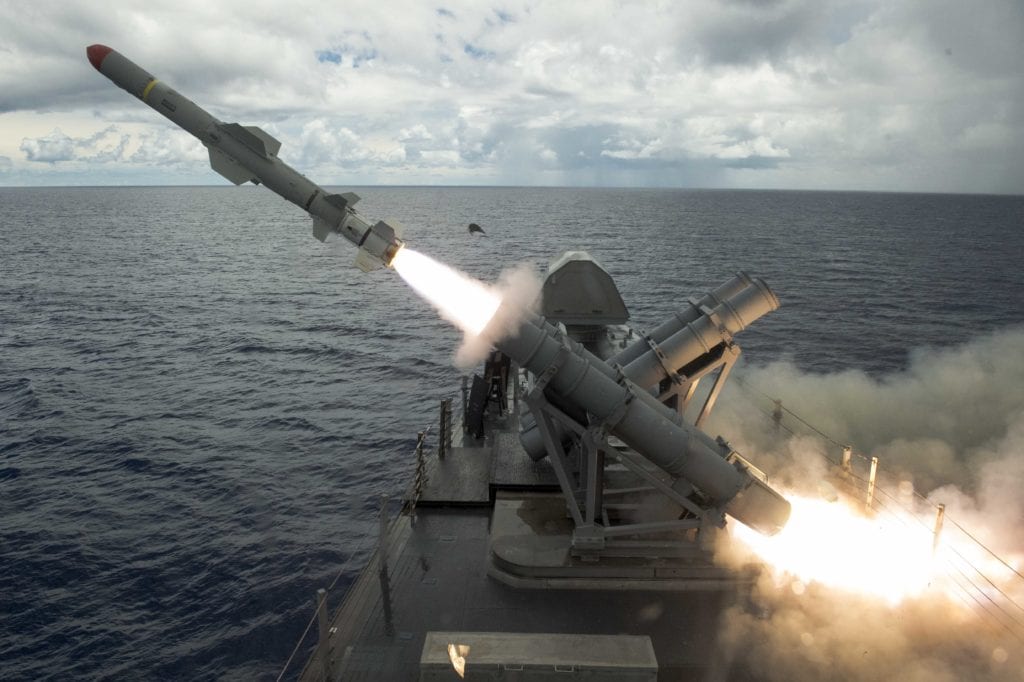
A Harpoon missile launches from the missile deck of the littoral combat ship USS Coronado off the coast of Guam. U.S. Navy/Mass Communication Specialist 2nd Class Kaleb R. Staples
ARLINGTON, Va. — The U.S. Navy has ordered materials for AGM/RGM-84 Harpoon anti-ship cruise missiles for six allied and partner nations, the Defense Department said in an April 2 release.
Naval Air Systems Command awarded Boeing a $73.2 million contract modification to provide additional long-lead material funding for full-rate production Lot 91 of the Harpoon missile under the foreign military sales program. Work is expected to be complete by December 2023.
When produced, the missiles will be delivered to the governments of Saudi Arabia, Qatar, Thailand, South Korea, Brazil and Japan.
The Harpoon missile family is deployed by the armed forces of 31 nations.
Navy Orders Four New LCU 1700 Utility Landing Craft from Swiftships
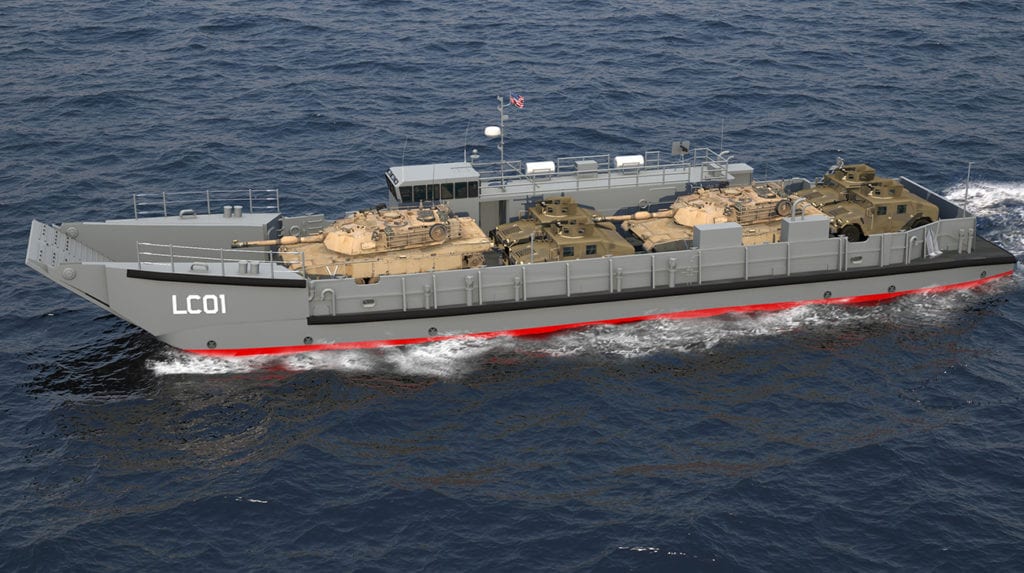
A Swiftships Landing Craft Utility 1700. Swiftships
ARLINGTON, Va. — The U.S. Navy has ordered four more of its new utility landing craft (LCU) for its amphibious warfare forces.
Naval Sea Systems Command awarded Swiftships of Morgan City, Louisiana, a $50.1 million modification to a previously-awarded contract “to exercise an option for the construction of four Landing Craft Utility (LCU) transportation boats (1703 through 1706),” the Defense Department said in an April 2 announcement. Delivery is expected by October 2022. The funds will come from the fiscal 2020 budget.
In February 2019, the Navy ordered LCU 1701 and 1702 under a $26.7 million contract modification. The craft will follow the prototype of the LCU 1700 class. Delivery is expected by May 2021.
“The LCU 1700 class will recapitalize the LCU 1610 capabilities and have a design life of 30 years,” the contract announcement said. “LCU 1700 craft will be a highly reliable and fuel-efficient heavy-lift platform whose capability will be complementary to the faster air cushion landing craft, which have a significantly shorter range, smaller payload capacity, no habitability and operating hour limitations.”
The Navy’s amphibious warfare ships equipped with well decks routinely deploy with LCUs embarked. The Navy plans to procure a total of 32 LCU 1700 craft.
Navy Orders Two E-2D Advanced Hawkeye Aircraft
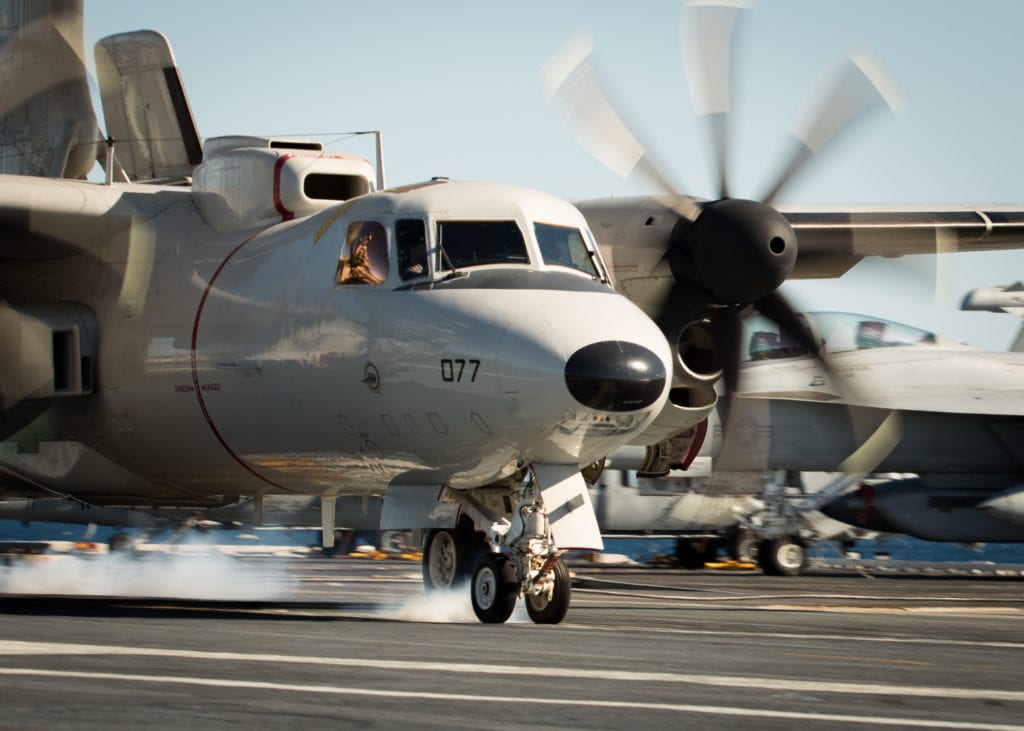
A E-2D Hawkeye lands on the flight deck of the aircraft carrier USS Gerald R. Ford. U.S. Navy/Mass Communication Specialist 3rd Class Ryan Carter
ARLINGTON, Va. — The U.S. Navy has ordered two more E-2D Advanced Hawkeye battle management aircraft, the Defense Department said in a contract announcement.
Naval Air Systems Command awarded Northrop Grumman Aeronautics Systems of Melbourne, Florida, a $404 million contract modification to the previously awarded, fixed-price-incentive-firm-target contract, the department said in an April 1 release.
One of the E-2Ds is being procured as part of fiscal 2019’s full-rate production (FRP) Lot 8 while the second as part of fiscal 2020’s FRP Lot 9.
This modification exercises contract options for nonrecurring engineering and software support activities. Work is expected to be complete by March 2025, the release said.
The Navy expects to procure a total of 86 E-2Ds. Japan has received four E-2Ds of and has ordered an additional nine. The E-2Ds are replacing E-2C Hawkeye aircraft in both the U.S. Navy and the Japanese Air Self-Defense Force.
Boeing Awarded Navy Contract Modification for Additional MQ-25 UAVs
The MQ-25 unmanned carrier-based test aircraft comes in for landing after its first flight in September at MidAmerica Airport in Mascoutah, Illinois. The Boeing-owned test asset, known as T1, flew two hours to validate the aircraft’s basic flight functions and operations. U.S. Navy via Boeing
ST. LOUIS — The U.S. Navy has awarded Boeing a contract modification for three additional MQ-25 unmanned aerial refueling aircraft, bringing the total number of aircraft Boeing is manufacturing to seven, the company said in a release.
“We’re honored to have the Navy’s confidence in our system design and performance that is evident from this additional order,” said Dave Bujold, Boeing’s MQ-25 program director.
“This order establishes uninterrupted production of the first MQ-25 aircraft and lines up with the Navy’s MQ-25 test and training plans for fleet introduction. The MQ-25 program is vital in ensuring the Navy can deliver a critical unmanned aerial refueling capability to the carrier air wing.”
This $84.7 million modification exercises options for three MQ-25 system demonstration test articles and was an option identified in the original $805 million contract for four aircraft awarded in August 2018.
Early flight testing of Boeing’s MQ-25 test asset, T1, is contributing to program progress. The company recently concluded the first round of flight testing for T1, resulting in nearly 30 hours in the air at various speeds and altitudes.
The aircraft is undergoing a planned modification that includes installation of an aerial refueling store (ARS) under the left wing. Flight testing with the ARS will resume later this year.
Chao, Buzby Conference With Maritime Industry Leaders Over COVID-19
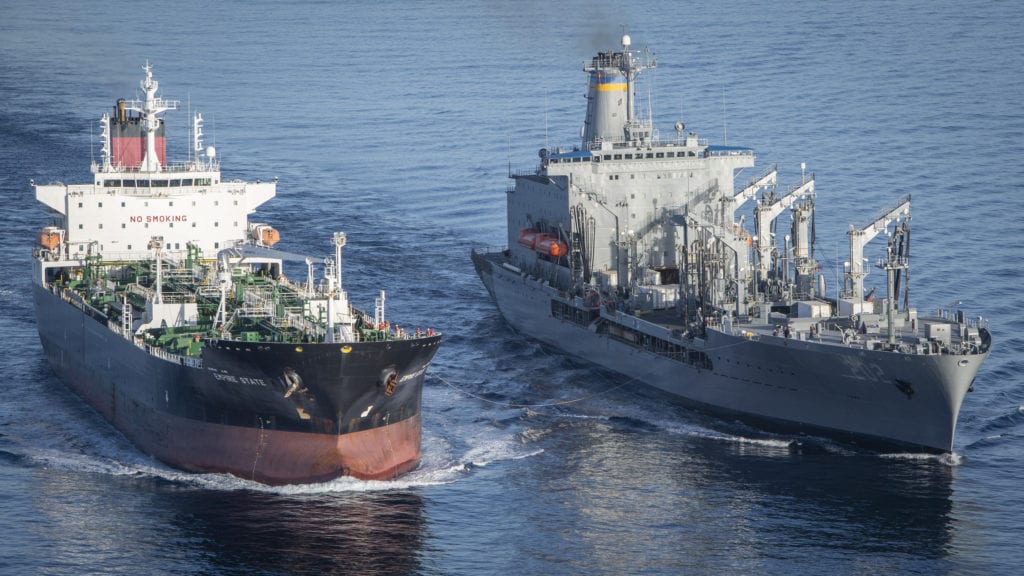
The Henry J. Kaiser-class underway replenishment oiler USNS Yukon prepares to conduct a loading with the commercial tanker MT Empire State. U.S. Navy/Mass Communication Specialist 1st Class Patrick W. Menah Jr.
WASHINGTON — Transportation Secretary Elaine L. Chao and Maritime Administrator Mark H. Buzby held a teleconference with maritime industry leaders on April 2 to discuss the effects of the COVID-19 outbreak on the industry, according to an April 2 MARAD release.
Chao and Buzby discussed the crisis with chief executive officers, presidents and other senior officials of the industry.
“During the call, Secretary Chao voiced her support for the maritime industry and the challenges they face at this time,” the release said.
Did you know there are about 70 civilian mariners aboard the USNS Comfort supporting the Navy doctors, nurses, and other health care professionals. Andrew Chen, chief mate, helps guide the ship from the bridge as it arrives in New York City. pic.twitter.com/ED4Qu2IBJP
— DOT Maritime Administration (@DOTMARAD) April 2, 2020
“Secretary Chao and Administrator Buzby briefed maritime industry partners on departmental activities concerning COVID-19 and provided industry leaders the opportunity to share their insights, questions and concerns with the secretary, [Department of Transportation], MARAD and other government interagency Partners. Topics discussed included the overall status of maritime industry operations, including personnel [staff/contractors], any disruptions, and [the outbreak’s] impact on the cargo movement in the U.S. and overseas.”
Captain of COVID-19-Plagued Aircraft Carrier Relieved of Command
Capt. Brett Crozier addresses the crew for the first time as commanding officer of the aircraft carrier USS Theodore Roosevelt during a change-of-command ceremony in November on the ship’s flight deck. U.S. Navy/Mass Communication Specialist 3rd Class Sean Lynch
ARLINGTON, Va. — The commander of the aircraft carrier USS Theodore Roosevelt — whose letter to U.S. Navy brass about leadership’s slow response to a coronavirus outbreak that endangered his crew was leaked to a San Francisco newspaper — has been relieved of his post.
Acting Navy Secretary Thomas Modly announced April 2 that the carrier’s commander, Capt. Brett Crozier, was being relieved of command of the ship, now docked in Guam, where nearly 100 Sailors tested positive for the novel coronavirus, COVID-19.
In a hastily called press briefing, Modly said Crozier was not fired in retaliation for his letter but because the secretary had lost confidence in his leadership. Crozier “had allowed the complexity of his challenge with the [COVID-19] breakout on the ship to overwhelm his ability to act professionally, when acting professionally was what was needed.”
On March 30, in a four-page letter to Navy leadership, Crozier said that his ship had inadequate space to isolate or quarantine Sailors in keeping with guidance from the U.S. Centers for Disease Control and the Navy.
Crozier “had allowed the complexity of his challenge with the [COVID-19] breakout on the ship to overwhelm his ability to act professionally, when acting professionally was what was needed.”
Acting Navy Secretary Thomas Modly
“The spread of the disease is ongoing and accelerating,” Crozier wrote. He called for disembarking all but a token force of about 10% of the crew from the ship until all could be tested for the infection, isolated for the required 14 days and the ship adequately cleaned.
The letter was leaked to the San Francisco Chronicle, which published it two days later. The Chronicle article, which gained wide attention, included Crozier’s position that: “We are not at war. Sailors do not need to die. If we do not act now, we are failing to properly take care of our most trusted asset — our Sailors.”
Reaction to Crozier’s April 2 dismissal was swift from at least some leaders on Capitol Hill, where Democrats on the House Armed Services Committee — including its chairman, Rep. Adam Smith (D-Wash.) — decried the move. “While Captain Crozier clearly went outside the chain of command,” the congressmen wrote in a statement, his dismissal “is a destabilizing move that will likely put our service members at greater risk and jeopardize our fleet’s readiness.”
Hospital Corpsman 2nd Class Michael Lusk takes a swab sample for COVID-19 testing aboard the aircraft carrier USS Theodore Roosevelt on April 1 with the ship docket in Guam. U.S. Navy/Mass Communication Specialist 3rd Class Dartañon D. De La Garza
At an April 1 press briefing at the Pentagon, Modly declined to say whether Crozier would be fired for going outside channels to draw attention to his ship’s plight. Chief of Naval Operations Adm. Mike Gilday also declined to comment on the fate of Crozier’s command of the Theodore Roosevelt.
Modly noted that Crozier stayed within Navy channels by sending his letter up the chain of command and added that the special medical team which deployed to the Roosevelt echoed some of the captain’s concerns.
“Let me emphasize that this is exactly what we want from our officers and our medical teams. We need a lot of transparency in this situation and we need that information to flow up through the chain of command,” Modly said at the briefing.
New York, L.A. Hospital Ships See Few Patients But Brace for Expected Wave
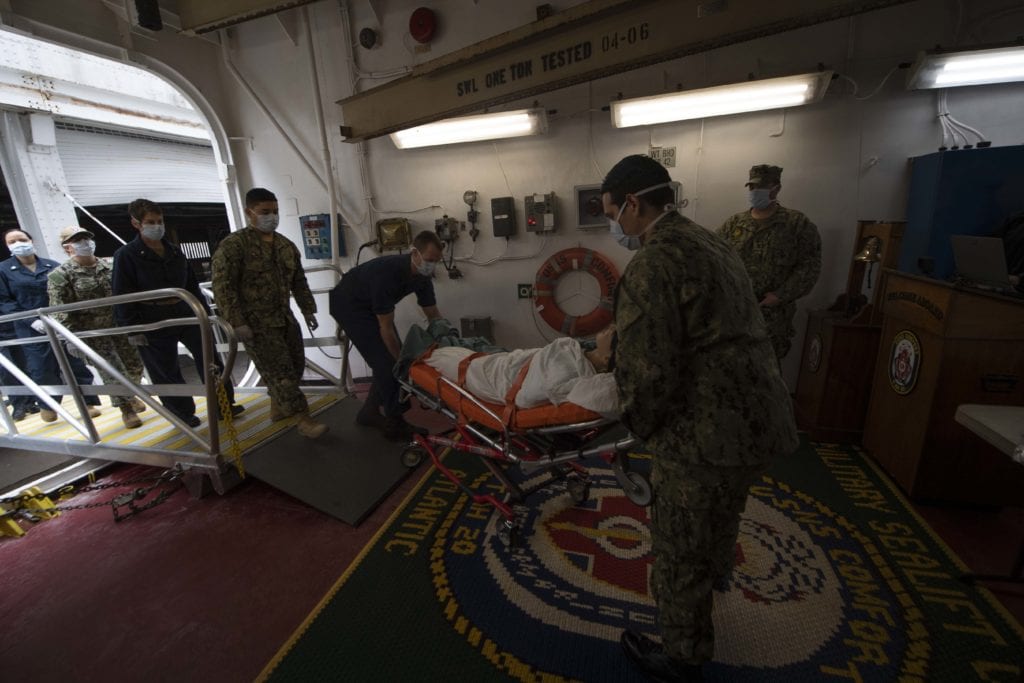
Sailors practice patient transfer from the pier onto the hospital ship USNS Comfort as they prepare to admit patients in New York in support of the nation’s COVID-19 response efforts. U.S. Navy/Mass Communication Specialist 2nd Class Sara Eshleman
ARLINGTON, Va. — Both commanders of medical operations on the two Military Sealift Command hospital ships sent to ease the load of non-coronavirus cases at hard-pressed local hospitals in Los Angeles and New York City said their staffs have treated only a handful of patients so far.
Capt. John Rotruck, commander of the Medical Treatment Facility USNS Mercy in Los Angeles, and Capt. Patrick Amersbach, the Medical Treatment Facility USNS Comfort commander in New York, told an April 2 Pentagon press conference by phone that their vessels were rushed to both cities to be in place before hospitals were overwhelmed by COVID-19 patients so, as Rotruck said, “when capacity demand really increases, we’ll be ready.”
The Mercy, based in San Diego, reached L.A. on March 27 and received its first patient March 29. Since then, 15 patients have been transferred from local hospitals to the hospital ship. Five have been discharged and 10 others are still being treated on board.
That effective throughput showed the hospital ships could act as “a relief valve for local hospitals,” Rotruck said. Otherwise, if the ships filled up “we would be of little use to the local hospitals.” The Norfolk, Virginia-based Comfort set sail six days ahead of original plan on March 28 and reached New York two days later. Comfort staff have treated 30 people since April 1.
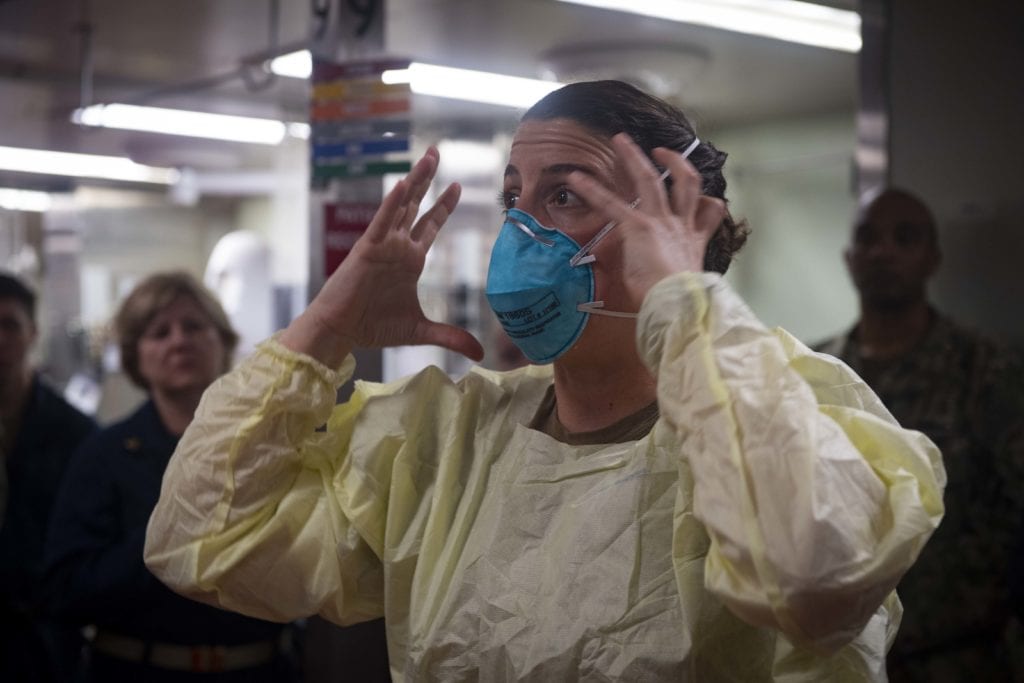
Lt. Cmdr. Nevin Yazici demonstrates how to properly fit an N95 respiratory protective device aboard the Comfort in New York. U.S. Navy/Mass Communication Specialist 2nd Class Sara Eshleman
“We were brought into New York City as quickly as possible,” Amersbach said, to “accept COVID-19-free patients to take pressure off local health systems before the wave hit.”
Both huge vessels can provide a full spectrum of services, including general surgeries, critical care and ward care for adults. That will allow local health care professionals to focus on treating COVID-19 patients and for shore-based hospitals to use their intensive care units and ventilators for threating those patients. Neither ship is accepting obstetrics or pediatric patients, which the captains said would require more specialists and equipment than the ships have for their primary mission.
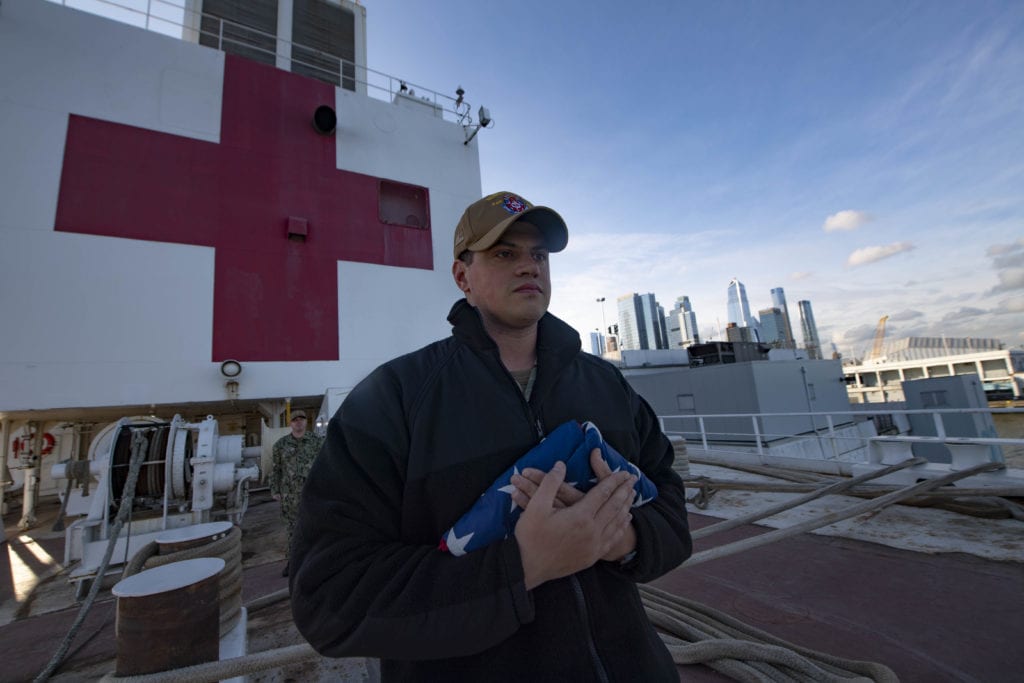
Aviation Boatswain’s Mate 2nd Class Justin Cosgrove participates in morning colors aboard the Comfort while the ship is moored in New York City in support of the nation’s COVID-19 response efforts. U.S. Navy/Mass Communication Specialist 2nd Class Sara Eshleman
Rotruck said the cases doctors on the Mercy have treated ranged from traumatic accident injuries to gastrointestinal, heart and lung issues. In both cities, all patients are referred by local hospitals to a central command center for disposition and are screened and tested for COVID-19 before they can come aboard the ships.
Medical staff on the ships, who include Navy reservists as well as active-duty personnel, were screened for COVID-19 before they came on board and any new staff will have to self-isolate in New York or Los Angeles for 14 days before boarding either ship.
If higher authorities changed the ships’ mission to treat COVID-19 patients, Rotruck speculated that Mercy would have to “transfer all the non-COVID-19 patients off the ship and become a 100% COVID operation.” Amersbach said if the mission changed, all the Comfort’s beds would have to be reconfigured to keep those with the virus far apart from those not infected.
Rotruck said the apparent deliberate derailment of a railroad locomotive near the port area where the Mercy is berthed did not affect the ship’s staff, patients or services. “It happened well outside of our fence line,” said Rotruck, adding that the Navy and Defense Department will adjust force protection procedures if there are additional security concerns.
In New York City, were supplies of personal protection equipment (PPE) for local medical staff are running critically low, Amersbach said the Comfort hasn’t received any requests for supplies or equipment from hospitals, adding that such requests would be forwarded to the Federal Emergency Management Agency. “We currently have enough PPE, equipment and stores on board,” he said, “at least for the next couple of weeks, depending on how many patients we get aboard the ship.”
The two hospital ships aren’t the only Navy Department responses to the medical needs of the civilian population, acting Navy Secretary Thomas Modly told a press briefing on April 1.
Scalable, modular, rapidly erectable shelters, known as Expeditionary Medical Facilities, were sent to temporary medical stations at convention centers in Dallas and New Orleans. Marine Corps Systems Command and the Naval Information Warfare Center, Pacific, were designing 3-D parts to assist the University of California-San Diego convert ventilators to handle multiple patients, Modly said.
Navy Picks HII to Provide Logistics Support for Surface Ships, Subs
NEWPORT NEWS, Va. — Huntington Ingalls Industries’ Technical Solutions division was selected by the U.S. Navy to provide integrated logistics support (ILS) for the hull, mechanical and electrical (HM&E) systems and equipment installed on surface ships and submarines, the company announced in an April 1 release.
The indefinite delivery, indefinite quantity (IDIQ) contract has a potential value of $41 million over five years, if all options are exercised.
“We take great pride in providing our customers around the globe with multiple logistics products and services to help them achieve their missions,” said Brad Mason, president of Technical Solutions’ Fleet Support business unit. “ILS development, maintenance and deployment to the warfighter is a critical part of how HII sustains our nation’s fleet.”
The IDIQ contract was awarded by the Naval Surface Warfare Center, Philadelphia Division, which is responsible for all ILS work related to the HM&E systems and equipment installed on Navy surface ships and submarines. Under the direction of the Life Cycle Logistics & Readiness Division, HII will execute services related to technical, process and programmatic support for integrated logistics and technical documentation.