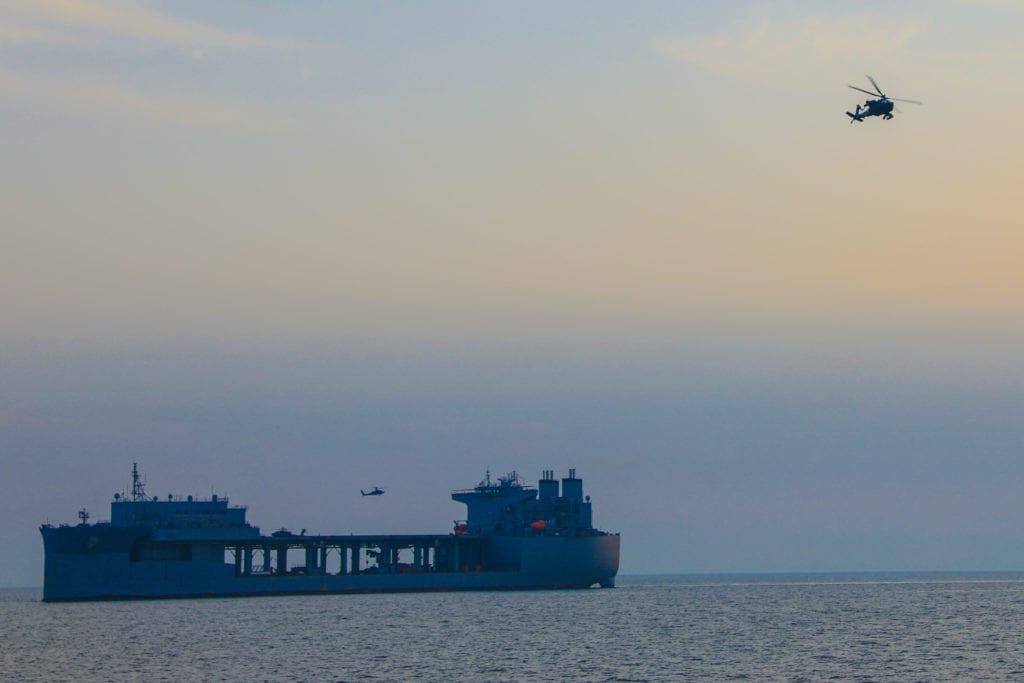
Navy Surface Forces, Army Attack Helicopters Conduct Ops in Arabian Gulf
AH-64 Apache helicopters operate with the expeditionary sea base USS Lewis B. Puller during a joint naval and air integration operation on March 27. U.S. Army/Spc. Cody Rich
PERSIAN GULF — U.S. Navy expeditionary landing base ship USS Lewis B. Puller has been conducting joint naval and air integration operations with U.S. Army AH-64E Apache attack helicopters assigned to Army Central Command’s Task Force Saber throughout March, according to U.S. Naval Forces Central Command (USNAVCENT) public affairs.
The operations, which are designed to enhance the capabilities of U.S. forces to respond to surface threats, have involved Puller performing as a landing base platform for the Apaches, while Cyclone class Patrol Coastal ships select simulated targets for them to engage. The guided-missile destroyer USS Paul Hamilton also participated in the joint operations.
“The integration of U.S. Army air weapons teams with other joint fires into the maritime environment greatly enhances our ability to expand reconnaissance and attack capability,” said Capt. Peter Mirisola, commander of Destroyer Squadron (DESRON) 50/Commander, Combined Task Force (CTF) 55. “The Apaches, in coordination with our surface ships, allow us to hold an adversary at high risk at extended ranges. Combined with other joint fires, these aircraft significantly increase the precision lethality of our joint maritime forces.”
Similar integration operations with Special Operations assets were conducted in the Arabian Gulf between U.S. naval forces and MH-6M Little Bird helicopters during Operation Earnest Will from 1987 to 1988.
More recently, USNAVCENT surface forces also conducted joint naval and air integration operations with AC-130W Stinger II gunships, assigned to U.S. Special Operations Command Central, on March 8 and March 9.
“Working with USARCENT forces represents another key capability in our ongoing integration of naval and air assets across our joint and coalition force to ensure maritime superiority,” said Vice Adm. Jim Malloy, commander of USNAVCENT/U.S. 5th Fleet. “This kind of cross-domain integration allows us to maintain highly lethal and effective defensive capabilities, regardless of what platforms are operating in theater.”
DESRON 50/CTF 55 conducts maritime security operations in support of regional security and stability. Its responsibilities include planning and executing a robust regional engagement program with coalition forces from regional partners and allied navies who operate and deploy to the Arabian Gulf.
The U.S. 5th Fleet area of operations encompasses about 2.5 million square miles of water area and includes the Arabian Gulf, Arabian Sea, Gulf of Oman, Red Sea and parts of the Indian Ocean. The expanse is comprised of 20 countries and includes three critical choke points at the Strait of Hormuz, the Suez Canal and the Bab el-Mandeb Strait at the southern tip of Yemen.
New NOAA Program to Support, Expand Agency’s Use of Unmanned Systems
SILVER SPRING, Md. — The National Oceanic and Atmospheric Administration is establishing a new Unmanned Systems Operations Program to support the rapidly expanding use of these systems across the agency, according to a NOAA release.
The new program will promote the safe, efficient and economical operation of unmanned systems (UxS) that NOAA uses to collect high-quality environmental data for the agency’s science, products and services.
“Unmanned airborne and maritime systems are transforming how we conduct earth science at NOAA,” said retired Navy Rear Adm. Timothy Gallaudet, NOAA’s deputy administrator. “Our new unmanned systems operations program will help us dramatically increase the application and use of these technologies in every NOAA mission area.”
Unmanned systems are sensor-equipped vehicles that operate autonomously or are remotely piloted. NOAA uses them for seafloor and habitat mapping, ocean exploration, marine mammal and fishery stock assessments, emergency response and at-sea observations that improve forecasting of extreme events, such as harmful algal blooms and hypoxia.
While the use of UxS is not new to NOAA — agency scientists have been experimenting with and using unmanned systems for decades — the recent increase in the availability of highly capable UxS has brought a corresponding increase in their innovative use as a force multiplier for many NOAA programs. NOAA’s use of small unmanned aircraft for science missions has increased more than tenfold since 2012.
The Unmanned Systems Operations Program is being established within NOAA’s Office of Marine and Aviation Operations (OMAO), which operates, manages and maintains the agency’s fleet of ships and aircraft and oversees NOAA’s diving and small boat safety programs. Its services will include training, cybersecurity, acquisition and other expert support to ensure safe, cost-effective operations across the agency.
“With the creation of this new program, we will be better positioned to transition these technologies into operational platforms that will gather critical environmental data every American relies upon,” said Rear Adm. Michael J. Silah, director of the NOAA Commissioned Officer Corps and OMAO.
The new program will be housed at two locations. The NOAA Aircraft Operations Center in Lakeland, Florida, will continue to support the agency’s unmanned aircraft activities. A new facility being built by the Mississippi State Port Authority in partnership with the University of Southern Mississippi in Gulfport, Mississippi, will support unmanned maritime systems.
NOAA received $12.7 million from Congress in fiscal year 2020 to improve and expand UxS operations across the agency, including the creation of the new program — a key goal of NOAA’s recently released Unmanned Systems Strategy. The program will also help meet the objectives of the Commercial Engagement Through Ocean Technology Act of 2018, which requires NOAA to coordinate research, assess and acquire unmanned marine systems with the U.S. Navy, other federal agencies, industry and academia.
NOAA is partnering with the Navy this year to evaluate new UxS technologies for ocean science applications through the Advanced Naval Technology Exercise (ANTX) program. Now in its fifth year, ANTX enables scientists and engineers to participate in the testing and assessment of experimental technologies that can support missions of both agencies. During the exercise, dozens of new systems are tested and demonstrated to help inform government and private sector investment decisions.
NOAA is also exploring the use of artificial intelligence in combination with UxS to collect and analyze large volumes of scientific data. NOAA recently released the NOAA Artificial Intelligence Strategy in conjunction with the Unmanned Systems Strategy.
Geurts: Ship Construction Ongoing, Repairs Continuing Amid COVID-19 Outbreak
Earl Cobbs of Newport News, Virginia, grinds a bulkhead in the hangar bay aboard the aircraft carrier USS John C. Stennis in Norfolk during the carrier’s refueling and complex overhaul. U.S. Navy/Mass Communication Specialist 3rd Class Joshua L. Leonard
ARLINGTON, Va. — The U.S. Navy is continuing to build and repair ships amid the COVID-19 pandemic but also is looking ahead to position itself to accelerate as the nation recovers from the pandemic, the service’s top acquisition official said.
The repair yards are “continuing to get the work done,” James F. Geurts, assistant secretary of the Navy for research, development and acquisition, said during an April 1 teleconference with media.
“We’ll see some challenges,” Geurts said, but noted that his office is focused on “one or two steps down the road” and on “how to accelerate out of recovery” to maintain the readiness of the fleet.
He said that 95% to 98% of the Navy’s acquisition work force is teleworking and that he “was not seeing a drop-off in performance.”
The assistant secretary reiterated his focus on three lines of operation:
The health of the defense industrial work force, including the government work force and its industrial partners such as prime contractors, subcontractors, small suppliers and individuals.
Ensuring the health of the industrial base.
Ensuring warfighting readiness of the Navy and U.S. Marine Corps.
“We haven’t slowed down,” he said, and that the work force “is continuing to press hard.”
Geurts said he continues to see some tightening in the supply chain and that his workforce in continually reassessing measures to work out the challenges. He lately is focusing attention on the transportation and distribution networks to monitor potential disruptions in the supply chain.
Geurts has been pressing to get contracts issued earlier than normal to assure the shipbuilders and repair yards and their suppliers that “work is coming.”
He pointed out that awarding contracts two months early has the advantage of getting planning and work started early; “creating some resiliency” as challenges arise; and making possible an acceleration of the post-pandemic recovery.
He said that contracts awarded recently included those for two Navajo-class towing, salvage and rescue ships; 18 P-8A maritime patrol aircraft, the AIM-9X Sidewinder air-to-air missile, berthing barges and patrol boats, and that contracts were imminent for a Block II San Antonio-class amphibious transport dock ship and for the new class of utility landing craft.
He also said he has yet to see the impact of the pandemic on the next-generation frigate program.
Geurts also pointed to the upcoming April commissionings of the Virginia-class attack submarines Delaware and Vermont and the upcoming combat systems completion of the guided-missile cruiser USS Zumwalt as evidence that the Navy’s acquisition of ships is not slowing down.
Cutter Stratton Departs for Eastern Pacific Counter-Narcotic Patrol
The crew of the U.S. Coast Guard Cutter Stratton lines the rails of the flight deck as the cutter moors last November following a 162-day patrol in the western Pacific Ocean. The crew left again March 28 on a months-long deployment to the eastern Pacific. U.S. Coast Guard/Petty Officer 1st Class Matthew S. Masaschi
ALAMEDA, Calif. — The crew of the U.S. Coast Guard Cutter Stratton got underway from Coast Guard Island on March 28 for a months-long deployment to the eastern Pacific Ocean, where the crew will patrol international waters off Central and South America to intercept and deter drug-trafficking efforts.
The cutter is currently conducting training and an at-sea health evaluation to ensure the crew is COVID-19-free and fully ready for operations.
“Times of crisis are when the nation counts on the U.S. Coast Guard and other military services to perform,” said Capt. Bob Little, Stratton’s commanding officer. “Cutter Stratton is capable of a wide range of homeland and national-security missions that are vital during a national emergency. Our crew understands the importance of sustaining these missions now, more than ever. It’s never easy to leave your families behind, and this deployment is no exception. Our families will be carrying a particularly large burden while we are away, but their resilience is at the center of our ability to provide maritime security for the nation.”
In fiscal year 2019, the Coast Guard conducted 236 separate drug events, detained 611 suspected smugglers and removed more than 458,000 pounds of cocaine worth more than $6.1 billion.
One in five global drug-related deaths occur in the United States, and drugs have since 2000 cost the U.S. $193 billion in crime, health, safety and lost productivity annually. The drug trade also funds cartels’ illegal activities in their home countries, spreading corruption and instability throughout the region.
The Stratton will be deployed in support of Campaign Martillo, The U.S.’s whole-of-government effort to combat drug trafficking and transnational organized crime, which includes efforts of 16 U.S. agency partners, including the Coast Guard, the U.S. Navy, Customs and Border Protection, FBI, DEA, HSI, and U.S Attorneys in California, Florida and Puerto Rico, New York, Texas, Alabama and Ohio.
Campaign Martillo also includes the participation of 21 nations who work together to counter cartels and illicit trafficking traveling via air or waters of the Western Hemisphere.
The campaign is led by Joint Interagency Task Force South, a component of U.S. Southern Command, which oversees the detection and monitoring of illicit traffickers traveling via air and seas and supports U.S. and multi-national law enforcement agencies with interdictions.
The actual U.S.-led at-sea law enforcement boardings are conducted by trained Coast Guard members under the tactical control of the Coast Guard’s 11th District, which is headquartered in Alameda.
“It is critically important the Coast Guard continues our lifesaving work during this national emergency,” said Vice Adm. Linda Fagan, commander, Pacific Area.
“Our missions ensure the safety of Americans and the security of our maritime borders, and they enable the safe flow of commerce into U.S. ports. In this challenging COVID-19 environment, we have armed our members, like the crew of the Coast Guard Cutter Stratton, with the necessary training and equipment to prevent exposure to the virus, and we made sure their families back home are supported.”
Raytheon, MDA Sign $2 Billion Standard Missile-3 Contract
TUCSON, Ariz. — Raytheon Co. will produce and deliver SM-3 Block IB interceptors under a $2.1 billion, multiyear U.S. Missile Defense Agency contract, the company said in a release. The deal is the first multiyear contract for the SM-3 program and covers fiscal years 2019–2023.
SM-3 is the only ballistic missile interceptor that can be launched on land and at sea. It is deployed worldwide and has achieved more than 30 exo-atmospheric intercepts against ballistic missile targets.
“This procurement deal is a win-win for government and industry,” said Mitch Stevison, Raytheon Strategic and Naval Systems’ vice president. “Efficiencies gained from this contract will allow us to reduce costs, continue to improve the SM-3 and deliver an important capability to our military.”
The Block IB variant achieved full-rate production in 2017. The company has delivered more than 400 SM-3 rounds over the lifetime of the program.
Navy Regional Maintenance Centers Continuing Work Amid COVID-19 Crisis
A docking team from the Japan Regional Maintenance Center (RMC) collaborates with port operations workers to close a caisson. The RMCs are continuing to maintain Navy ships amid the COVID-19 pandemic, the sea service says. U.S. Navy/Ryo Isobe
WASHINGTON — In the middle of the COVID-19 pandemic, the U.S. Navy’s Regional Maintenance Centers (RMCs) are continuing to maintain the Navy’s ships, even in countries where the pandemic is especially severe, the Navy said.
“Our priority is the protection of our workforce, [and] our commanders have the flexibility to respond to conditions in their areas to effectively carry out their missions while meeting the critical needs of their people,” said Colleen O’Rourke, spokeswoman for Naval Sea Systems Command, in response to a query from Seapower. “Our RMCs continue to maintain the readiness of our fleet.”
The Navy has RMC activities in two countries hardest hit by the virus, at Rota, Spain, and Naples, Italy.
“We are committed to taking every measure possible to protect the health of our force,” O’Rourke said. “We remain in close coordination with host nation authorities, U.S. Embassy and public-health authorities to ensure the well-being of our personnel and local population.”
Marine Recruiting Command Transitions to Digital, Telephonic Prospecting
QUANTICO, Va. — Amid the national emergency caused by the COVID-19 outbreak, Marine Corps Recruiting Command (MCRC) is taking steps to protect recruiters and applicants, their families and their communities by limiting face-to-face interactions with the public, the command said in a release.
Effective immediately, MCRC will temporarily transition to prospecting entirely via digital and telephonic means, and Marine recruiters will no longer meet with new applicants in person.
“The preservation of our recruiting force, applicants, poolees and their families is the highest priority for the Marine Corps Recruiting Command during this national emergency,” said Maj. Gen. James W. Bierman, commanding general of MCRC. “With that in mind, we will immediately transition to prospecting exclusively via digital and telephonic means, and no longer initiate in-person interviews. We remain committed to recruiting the highly-qualified men and women our nation needs for its Marine Corps.”
“Because recruiting is an activity of vital importance to our nation and Corps, we will continue our efforts to ship young men and women to our recruit depots and officer candidate school as conditions permit,” Bierman said. “At the same time, it is recognized this imperative is not the only consideration. Our efforts will prioritize protecting our Marines and families.”
Local recruiting offices will continue to be staffed, but at reduced manpower levels commensurate with social distancing guidelines recommended by the Centers for Disease Control and Prevention.
Leaders at every level have full discretion to carefully appraise the personal and geographic risk factors unique to each situation and then move to curtail or modify activities when necessary. Travel is limited to mission-essential requirements, and no more than two individuals will travel in a vehicle.
Any member of the recruiting staff who has family members in a high-risk category as it pertains to COVID-19 will work remotely from their home.
Boeing Receives $1.5 Billion P-8A Poseidon Contract from U.S. Navy
Aviation Ordnanceman Airman Michael Perna taxis and directs a P-8A Poseidon aircraft. U.S. Navy/Mass Communication Specialist 2nd Class Juan Sua
ARLINGTON, Va. — The U.S. Navy has awarded Boeing a $1.5 billion production contract for the next 18 P-8A Poseidon aircraft, the company announced in a release. The contract includes eight aircraft for the U.S. Navy, six aircraft for the Republic of Korea Navy and four aircraft for the Royal New Zealand Air Force.
The Republic of Korea Navy and Royal New Zealand Air Force acquired the aircraft through the foreign military sales process and will receive the same P-8A Poseidon variant designed and produced for the U.S. Navy. The Royal New Zealand Air Force is expected to begin receiving aircraft in 2022 and the Republic of Korea Navy is expected to begin receiving aircraft in 2023.
The P-8 is a long-range multimission maritime patrol aircraft capable of broad-area, maritime and littoral operations. A military derivative of the Boeing 737 next-generation airplane, the P-8 combines superior performance and reliability with an advanced mission system that ensures maximum interoperability in the battle space.
The P-8 is militarized with maritime weapons, a modern open mission system architecture and commercial-like support for affordability. The aircraft is modified to include a bomb bay and pylons for weapons. It has two weapons stations on each wing and can carry 129 sonobuoys. The aircraft is also fitted with an in-flight refueling system.
With more than 254,000 flight hours to date, the P-8A Poseidon and P-8I variants patrol the globe performing anti-submarine and anti-surface warfare, intelligence, surveillance and reconnaissance, humanitarian and search-and-rescue missions.
Getting and Staying Tough: With Elements Borrowed from SEALs, a Navy Pilot Program Aims to Teach Sailors How to Perform Under Extreme Stress
Sailors assigned to the Blue crew of the Ohio-class ballistic missile submarine USS Maryland observe sea and anchor detail upon returning to the boat’s homeport at Naval Submarine Base Kings Bay, Georgia. The Maryland is serving as a testbed for the Warrior Toughness program. U.S. Navy/Lt. Katherine Diener
The U.S. Navy wants Sailors to toughen up.
That’s not to suggest Sailors lack in the toughness department. But working in today’s Navy can be stressful, and Sailors need the tools to handle the burden. Soon they may get them — thanks to a program in its pilot stage, Warrior Toughness.
The 3-year-old program — confined to the crews of some Ohio-class ballistic missile submarines, principally the USS Maryland — could one day be used all across the sea service.
Check out the digital edition of the April Seapower magazine here.
Rear Adm. Michael D. Bernacchi, commander of Submarine Group 10, told Seapower that the program is a new approach to making sure Sailors are prepared for stressful jobs.
“What we were looking to do was to arm Sailors with additional tools to allow them to deal with stress so that they could perform better in stressful situations — both chronic and acute stress,” he said.
In creating the program, Bernacchi took lessons from the Navy SEALs, who are famous for their ability to adapt and even thrive in the most stressful situations imaginable.
“We wanted to adapt that to the general Sailor to give them more tools, whether that be standing the midwatch or dealing with a fire or whatever the case may be, you could respond well in any stressful situation and recall information,” he said.
Back to the Basics of Mind, Body, Soul
Bernacchi said there was nothing “new or magical” about the Warrior Toughness Program — it’s just about getting back to the basics of the mind, body, and soul and recognizing that they are all integral to the success of individuals.
“It’s about training your mind, understanding why it does the things that it does, making sure you’re in physical shape, understanding Navy core values — it’s a lot of different things, and we took a lot of it from the SEALs,” he said.
“What we were looking to do was to arm Sailors with additional tools to allow them to deal with stress so that they could perform better in stressful situations — both chronic and acute stress.”
Rear Adm. Michael D. Bernacchi, commander, Submarine Group 10
Right now, the program is just being tested on submarines, where Sailors have to deal with a lot of chronic stress just from living in that environment. However, Bernacchi envisions developing a fleet version that could be used in individual units.
When it was first rolled out at Navy Recruit Training Command, some Sailors were a little bit hesitant to embrace the new way of approaching training, but eventually most were on board, he said.
“When we started it at boot camp, most people didn’t want to do it,” he said. “I remember it getting called ‘recruit yoga’ and all kinds of other things. But you saw a huge increase in the performance of divisions, and then people wanted it. That’s the same thing we’ve seen here [aboard submarines].”
But what does the Warrior Toughness program look like from a Sailor’s point of view? Master Chief Matthew Glisson, Sub Group 10’s engineering department master chief (EDMC) and the Warrior Toughness lead, said there are many components. “There are psychology and a mindfulness techniques,” he said. “We’ve got a breathing technique called ‘recalibrate’ … where one learns to focus. The other benefit is that it lowers the heart rate.”
Capt. Seth Burton, commanding officer of the USS Florida, observes his crew’s performance during “angles and dangles” operation in the Mediterranean Sea. The Warrior Toughness program is being tested on submarines, where Sailors must deal with a lot of chronic stress just to live in cramped environments. U.S. Navy/Mass Communication Specialist 3rd Class Drew Verbis
Another technique practiced in Warrior Toughness is the “body scan” — where a Sailor tenses as many muscles in their body as possible to find out where the tension is located. Then there’s “mental rehearsal,” where a Sailor envisions, in as much detail as possible, a stressful scenario and then rehearses what their immediate actions would be and where they can draw on certain tools to cope with and perform in that situation.
Four Pilot Programs on Four Subs — Then Off to Study the Data
Four pilot programs on four submarines will be up and running by the end of 2020, including the one that started on the USS Maryland last October. The next pilot will launch in April, and then another a month after. Once Warrior Toughness gathers enough data from the first three, the program will determine which sub should get the fourth pilot. After the fourth, the program will examine the data, see what has been and what has not been successful, and then potentially create a larger program from it.
The program’s exists because the Navy recognized that it hadn’t ever focused on the issue of stress, Bernacchi said. “We have never in the Navy sat down and taught you, ‘Hey, this is how you physically deal with stress,'” he said. “No one’s ever taught me how to meditate before. No one’s ever taught me, ‘Hey, this is how chemistry in your brain works.’ I’ve never had a psychologist sit there and explain to me that this is the chemical reaction when fear strikes, and this is how you counter it.”
“In the training cycle we just came out of, we found a lot of uses in the strategic and tactical warfare simulator training environment, and we were able to apply stress-management and mindfulness exercises.”
Cmdr. Michael Paisant, commanding officer, USS Maryland Gold crew
Cmdr. Michael Paisant, commanding officer of the USS Maryland Gold crew, said the crew has already just about reached the “run” phase of “crawl-walk-run” with this program.
“We’re still trying to figure out — specifically on board — how we’re going to apply it,” he said. “In the training cycle we just came out of, we found a lot of uses in the strategic and tactical warfare simulator training environment, and we were able to apply stress management and mindfulness exercises.”
For example, during a portion of the training that involved piloting the submarine into ports, Sailors underwent breathing and mindfulness exercises as well as a visualization exercise as they went through each stage of the navigation process. The crew is also looking at ways to apply Warrior Toughness in a maintenance environment and not just operationally.
Paisant acknowledged that some of the crew was skeptical of the program at first, but since it began he says there’s been a lot of buy-in.
Sailors assigned to the Gold crew of Ohio-class ballistic-missile submarine USS Maryland attend Warrior Toughness introductory training in the Trident Training Facility at Naval Submarine Base Kings Bay, Georgia, last November. The Maryland Gold crew was the first to implement Warrior Toughness into their training. U.S. Navy/Mass Communication Specialist 1st Class Ashley Berumen
“They initially may have thought it would be another thing added to their plate, which it is not,” he said. “It’s focused on the individual Sailor, and on being a better spouse, a better leader. I think they’ve seen the benefits of it, and I’ve had a lot of folks say, ‘Hey, I do this all the time now. I do this in my personal life.’ I think my crew has really embraced it.”
Bernacchi hopes to see the program continue to evolve and eventually make all Sailors ready to protect the nation while dealing with any kind of stress — even the worst trauma imaginable. “When we take a missile hit to a carrier and lose 1,300 Sailors, are we going to be able to take a knee, gather ourselves, and then turn around and deliver the blow to kill the enemy who did that?” he said. “The answer is, we have to. But I don’t want to wait. Throughout our history we’ve shown we can do that, but it takes time to adapt. It takes time to get over the shock.
“The next battle, because of the speed of weaponry and everything else, we may not have that time,” he added. “So, I need to have Sailors who are ready to fight from the very second it goes off. And that’s what this is about.”
Q&A With CNO Adm. Mike Gilday
Chief of Naval Operations Adm. Mike Gilday visits with Sailors aboard USS Kearsarge in August during his first ship visit following the CNO change-of-office ceremony. U.S. Navy/Chief Mass Communication Specialist 2nd Class Nick Brown
Since August, Adm. Mike Gilday has
led the world’s most powerful navy as the 32nd chief of naval operations. The son
of a Sailor and a native of Lowell, Massachusetts, he is a surface warfare
officer who graduated from the U.S. Naval Academy and holds master’s degrees
from the Harvard Kennedy School and the National War College.
At sea, he deployed with USS Chandler
(DDG 996), USS Princeton (CG 59) and USS Gettysburg (CG 64). He commanded
destroyers USS Higgins (DDG 76) and USS Benfold (DDG 65) and subsequently
commanded Destroyer Squadron 7, serving as sea combat commander for the Ronald
Reagan Carrier Strike Group.
As a flag officer, he served as commander, Carrier Strike Group 8, embarked aboard the USS Dwight D. Eisenhower (CVN 69), and as commander, U.S. Fleet Cyber Command and U.S 10th Fleet.
Check out the digital edition of the April Seapower magazine here.
His staff assignments include the
Bureau of Naval Personnel, staff of the CNO and staff of the vice CNO. Joint
assignments include executive assistant to the chairman of the Joint Chiefs of
Staff and naval aide to the president.
As a flag officer, he served in joint
positions as director of operations for NATO’s Joint Force Command Lisbon; as
chief of staff for Naval Striking and Support Forces NATO; director of
operations, J3, for U.S. Cyber Command; and as director of operations, J3, for
the Joint Staff. He recently served as director, Joint Staff.
Gilday answered questions from Senior
Editor Richard R. Burgess in writing.
Why the renewed
emphasis on mastering fleet-level warfare?
GILDAY: The nature of
war at sea today is changing. Maritime operations stretch from the seabed to
space and across the electromagnetic spectrum. Long-range missiles that fly at
supersonic and hypersonic speed have decreased the amount of time a commander
has to make decisions, and the emergence of cyber and space as warfighting
domains have created a much more complex operating environment for our Sailors.
To meet these challenges, our fleets must
be the operational center of warfare. Fleet commanders must own the physical
and virtual battlespace they are responsible for and drive the fight, if
required to do so.
“We fight and win as a team, and we are better when we integrate more closely with the Marine Corps. We will build capability with our most natural partner, tying more closely with them at all levels.”
However, to be able to fight as a fleet,
we must exercise as a fleet. We have made great investments in our maritime
operational centers [MOCs], which gives fleet commanders the ability to do just
that. We need to exercise — and the only way to do that is with iron out there
at scale.
Upcoming fleet exercises, like Large
Scale Exercise 2020, will leverage operational concepts like Distributed
Maritime Operations, Expeditionary Advanced Base Operations and Littoral Operations
in a Contested Environment. Combined with war-gaming, future exercises will
serve as the key opportunity for experimentation and the development and
testing of alternative concepts. These exercises and experiments will inform
doctrine and tactics, and future fleet headquarters requirements, capacity and
size, and investments in future platforms and capabilities.
Going forward, we must leverage experience from combatant command, joint and other service exercises to better prepare the Navy to integrate, support and lead the joint force in a future fight.
Gilday delivers remarks Feb. 7 during a full honors ceremony for Vice Adm. Michael Noonan, chief of the Royal Australian Navy, at the Navy Yard in Washington, D.C. U.S. Navy/Mass Communication Specialist 1st Class Raymond D. Diaz III
The Optimized Fleet Readiness Plan and Dynamic Force Employment, in theory, would seem to be in tension. How should the Navy ensure a sustainable personnel tempo while keeping adversaries off balance?
GILDAY: People are our most important resource, and the Navy cannot succeed without its Sailors — they are our asymmetric advantage.
While we strive to have a predictable model for our Sailors and their families, it’s important to remember that sometimes the world gets a vote, which may require us to respond at a moment’s notice — and differently than we planned.
In which aspects do you see integration with the U.S. Marine Corps as having the greatest potential for improving naval power?
GILDAY: We fight and win as a team, and we are better when we integrate more closely with the Marine Corps. We will build capability with our most natural partner, tying more closely with them at all levels.
Together, we will build Navy-Marine Corps integration by aligning concepts, capabilities, programming, planning, budgeting and operations to provide integrated American naval power to the Joint Force. Opportunities for increased integration include our cyberspace operations, war-game and exercise programs, development of the Naval Tactical Grid, and potential Dynamic Force Employment options.
Alongside the United States Marine Corps, our Navy is the bedrock of integrated American naval power.
Gilday visits with Sailors assigned to Helicopter Maritime Strike Squadron 40 during his first visit as CNO to Naval Air Station Jacksonville and Naval Station Mayport, Florida, on Sept. 17. U.S. Navy/Chief Mass Communication Specialist Nick Brown
Where
do you see the best application of unmanned systems for naval warfare?
GILDAY: Unmanned is an
important part of the future. It must be a central component of our future
battle force to support the way we want to fight in a distributed way. Going
forward, I believe there will be a requirement for seaborne-launched vehicles
to deliver effects downrange, likely using a mix of manned and unmanned assets.
Ultimately, we must leverage technology to expand our reach, lethality and
warfighter awareness in undersea, surface and air domains. We must continue to
experiment more with unmanned, and we need to do it with greater speed.
Based on your experience, what does the Navy need to do to be prepared for war in the cyber domain?
GILDAY: Cybersecurity is commanders’ business. Commanders need to own it. Commanders must understand the status of their networks and systems and the potential operational risk they are assuming if readiness has degraded.
Going forward, we need to invest in training and retaining the best and brightest, and in cyber infrastructure; treat the network ([Navy-Marine Corps Intranet], ONE-NET, afloat networks) like the warfighting platform it is, giving priority to ensure it is secure and defended; defend forward — disrupt threats before they reach our networks; develop cyber-resiliency (think shipboard damage control) — identify, protect, detect, react and restore the network; integrate MOC to MOC, across the fleets and interagency, in every major exercise and operation; [and] partner with other services, interagency, industry, allies and partner nations.
“We must ensure the fleet’s readiness today so we can deliver credible ready forces tomorrow. This includes the prioritization of force design and the delivery of naval forces capable of imposing lethal power to any adversary and aggressive pursuit of increased lethality and modernization across the Navy.”
What have you learned the most about your role so far as a member of the Joint Chiefs?
GILDAY: My role as a Joint Chief is one that I take extremely seriously, and it is important that I provide the president, secretary of defense and chairman of the Joint Chiefs the best military advice I can. That is why I spend a lot of time studying and thinking about near-peer competitors, potential adversaries and our future force.
What are the main priorities of the Navy’s 2021 budget?
GILDAY: The Navy’s first acquisition priority is recapitalizing our strategic nuclear deterrent. We will continue to drive affordability, technology development and engineering integration efforts to support Columbia’s [ballistic-missile submarine] fleet introduction on time or earlier, maintain mastery of the undersea domain and sustain a formidable forward presence through our aircraft carrier fleet.
We must ensure the fleet’s readiness today so we can deliver credible ready forces tomorrow. This includes the prioritization of force design and the delivery of naval forces capable of imposing lethal power to any adversary and aggressive pursuit of increased lethality and modernization across the Navy.
Gilday visits with Sailors on Sept. 17 at the Littoral Combat Ship Operational Trainer Facility at Naval Station Mayport, Florida. U.S. Navy/Chief Mass Communication Specialist Nick Brown
How do you explain the lower shipbuilding budget and the early ship retirements given the need for a larger fleet?
GILDAY: The fiscal 2021 budget supports implementation of the National Defense Strategy, which remains our guidepost and drives our decision-making. While we are committed to building the largest Navy we can, the capacity reductions in the recent budget submissions were made with the service’s priorities of strategic deterrence, readiness, lethality and modernization in mind. We remain focused on maximizing the naval power of our ships, aircraft, unmanned vehicles, weapons and systems we have today in our fleet.
Our balanced approach in our budget submission provides a Navy ready to fight today while committing to the training, maintenance and modernization to provide a Navy ready to fight tomorrow. Naval power is critical to implementing the National Defense Strategy. But naval power is not just a function of fleet size: It is a combination of the readiness, lethality and capacity of that fleet.
Our
No. 1 priority is the Columbia-class ballistic-missile submarine. This request
also heavily invests in readiness accounts, such as ship and aircraft depot
maintenance and modernization, manpower, live virtual constructive training,
steaming days, and flying hours. It invests in new systems to make our fleet
more lethal, including increasing our weapons inventory, bolstering the range
and speed of those weapons, exploring directed energy weapons, and
incorporating new technologies such as hypersonics. This request grows our
fleet in size, generating sustainable, capable capacity.
The
configurations in some older platforms require a significant amount of
modernization, and we believe that the significant investment necessary for modernization
necessary to ensure platforms can operate in contested environments is better
utilized in other programs.
Looking to the next 10 years, how can the Navy best balance the funding needs between current readiness and new acquisition
GILDAY: Mission No. 1 for every Sailor — active and Reserve, civilian and uniform — is the operational readiness of the fleet.
We
must ensure the fleet’s readiness so we can deliver credible ready forces. This
includes the prioritization of force design and the delivery of naval forces
capable of imposing lethal power to any
adversary. That must be balanced with an aggressive pursuit of increased
lethality and modernization across the Navy, against the constraints of our
budget topline.
Going forward, we will continue to
prioritize investments using the National Defense Strategy as our
guidepost.
With the nuclear deterrent as the Navy’s No. 1 priority, what concerns do you have about the Columbia SSBN being on track to deploy on time?
GILDAY: Lead-ship construction for Columbia began in 2020 and the Navy continues to identify opportunities to drive schedule and cost margin. While the construction schedule is aggressive, it is achievable. The Navy is actively overseeing shipbuilders as they manage the submarine and aircraft carrier industrial base suppliers to minimize risk and incorporate recent lessons learned.
Why is the Navy asking for more Sailors
for the fleet?
GILDAY: To operate effectively as a force, we
need to properly man our ships, submarines and aviation squadrons, and this
budget request supports that effort with a 2% increase in active-duty Sailors (plus
7,300 from fiscal 2020 to 2021). Recruiting, developing and retaining a
high-quality military and civilian workforce is essential for our warfighting
success.
How is the budget strengthening the nation’s sealift capability?
GILDAY: We have a three-prong approach to strengthening our sealift capability, which includes the procurement of commercial vessels with 20 to 25 years of life remaining at a cost of $30 million, as opposed to acquiring new vessels at a cost of $300 million, $400 million or $500 million. Additionally, the Navy is conducting at service life extension [SLE] on existing sealift ships, which includes six service life extensions, put in place last year. The Navy intends to increase SLEs from six to 10 in 2021.