RTX, Anduril Complete Successful Test of Advanced Solid Rocket Motor
Recent test demonstrates collaborative innovation in rocket motor development
ARLINGTON, Va. (October 7, 2025) — Raytheon, an RTX (NYSE: RTX) business, and Anduril have successfully conducted a static fire test of an advanced solid rocket motor under a contract with the Air Force Research Laboratory Munitions Directorate.
In response to the increasing global demand for munitions, Raytheon has been working with domestic and international partners to enhance U.S.-based rocket motor manufacturing capacity.
“This test demonstrates more than just a technical achievement,” said Colin Whelan, president of Advanced Technology at Raytheon. “It’s about building a more robust and adaptable supply base for solid rocket motors that can rapidly respond to emerging national security needs.”
By partnering with Anduril, Raytheon is expanding the defense technology ecosystem and addressing critical limitations in the rocket motor supply base. This collaboration exemplifies the company’s composable weapons strategy, which aims to create more flexible and adaptable missile systems through strategic partnerships.
“Designing and firing a Highly Loaded Grain rocket motor is one of the most technically demanding tasks in the solid rocket motor industry,” said LTG (ret.) Neil Thurgood, Senior Vice President, Anduril Industries. “Achieving this result highlights the strength of Anduril’s engineering team and demonstrates our ability to deliver high-performance propulsion solutions in a domain long defined by a small set of providers.”
Marines Bid Farewell to the Assault Amphibious Vehicle
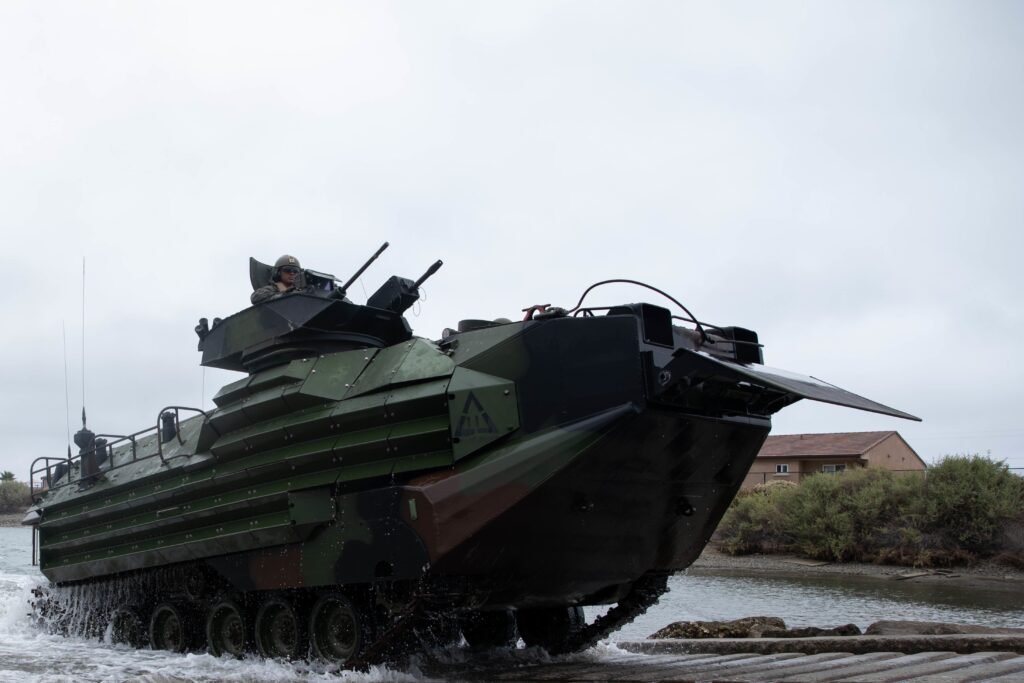
CAMP PENDLETON, Calif. (June 29, 2021) U.S. Marines with 3d Assault Amphibian Battalion, 1st Marine Division, emerge from the water in an AAV-P7/A1 amphibious assault vehicle (AAV) during water operations training at Marine Corps Base Camp Pendleton, California, June 29, 2021.(U.S. Marine Corps photo by Sgt. Jamin M. Powell)
MARINE CORPS BASE QUANTICO, Va. – The Assault Amphibious Vehicle was officially decommissioned during an AAV Sundown Ceremony at the Assault Amphibian School at Camp Pendelton, California, Sept. 26.
The ceremony honored both the vehicle’s 53 years of service to the Marine Corps and the Marines and Sailors who served with it, while marking the transition to the Corps’ next amphibious platform, the Amphibious Combat Vehicle. Col. Lynn W. Berendsen, commanding officer of the Assault Amphibian School, delivered remarks paying tribute to those who operated and maintained the AAV throughout its service.
The AAV replaced the Landing Vehicle, Tracked, which entered combat in August 1942 during the Solomon Islands Campaign. The LVT was the first vehicle capable of moving Marines from ship to shore and continue inland under fire. It proved decisive in battles like Tarawa, Inchon and later in during the Vietnam War where the following generations of amphibious vehicles carried Marines across beaches, rivers and flooded terrain.
The AAV was introduced in 1972, originally designated as the Landing Vehicle, Tracked, Personnel-7, featuring a water-jet propulsion system and a stern ramp that sped up ship-to-shore movement. Service life extension programs during the 1980s upgraded the vehicles with new engines, transmissions and weapon stations, after which it was redesignated the AAV-7A1. Over the decades, AAVs received additional upgrades to meet operational demands.
“The AAV-P7 has been many things, a ship to shore connector, an armored fighting vehicle, a troop carrier, a logistics platform and even sometimes a live boat,” said Berendsen. “Most importantly it was in a place where Marines made their mark in combat in service and in sacrifice.”
From Grenada and Somalia to the Persian Gulf and Iraq, the AAV carried Marines throughout combat, supported humanitarian missions, and amphibious landings. During its service, it transported personnel, delivered supplies, and provided protected mobility in both littoral and inland environments. Its legacy is not only in its capabilities but also in the countless Marines who operated it and relied on it to accomplish their missions.
“The AAV gave Marines both mobility and armored protection allowing them to close with the enemy and seize objectives at speed,” said Berendsen. “In the desert, just as in the Pacific beaches decades earlier, showed it was more than a connector, it was a fighting vehicle at the heart of the Marine Air Ground Task Force.”
The ACV, successor to the AAV, is an eight-wheeled armored personnel carrier built for expeditionary operations. With multiple variants for personnel transport, command and control, recovery, and fire support, the ACV integrates seamlessly with naval shipping and amphibious connectors. The introduction of the ACV supports the Marine Corps’ modernization efforts aligning with Force Design, advancing a lighter, faster, and more resilient force capable of operating in contested environments and contributing to joint and naval operations.
The final pass of three AAVs drove across the parade deck marked the close of a historic chapter and the Marine Corps’ continued evolution toward modern, expeditionary amphibious operations.
Former PEO, Ships, Joins Hanwha Defense USA as President of U.S. Shipbuilding
ARLINGTON, Va., Oct. 6, 2025 – Retired U.S. Navy Rear Admiral and former Program Executive Officer, Ships Tom Anderson has joined Hanwha Defense USA as President of U.S. Shipbuilding.
Anderson served in the U.S. Navy for 34 years, including leadership roles as PEO, Ships and acting Commander, Naval Sea Systems Command (NAVSEA), where he was responsible for acquiring, maintaining and modernizing the U.S. Navy’s ships.
Over the course of his career, he served in a variety of industrial, fleet, program office and headquarters assignments in ship design and construction, maintenance, budgeting and requirements for the Navy’s ships, submarines and systems.
Anderson will be responsible for the execution of Hanwha’s U.S. shipbuilding programs and shipyard operations, including developing the company’s strategy for future shipbuilding programs as well as building the company’s shipbuilding infrastructure and associated workforce to accommodate future growth.
“Tom has had a distinguished and impactful naval career, and we are delighted to bring his deep industry expertise, creative thinking, and demonstrated leadership to Hanwha,” said Mike Smith, President and CEO of Hanwha Defense USA. “This is a pivotal time for the Navy and U.S. shipbuilding writ large. Tom brings a wealth of experience and unique perspectives that will accelerate the delivery of novel solutions to our customers’ most elusive industrial base challenges.”
“Hanwha’s global defense strategy is focused on our evolution into a multi-domestic company that brings leading technology, deeper partnerships and sovereign capacity to each of the markets we serve,” said Michael Coulter, Hanwha Global Defense President and CEO. “I am excited to welcome Tom to our team as we continue to invest in capacity in the United States.”
Last December, Hanwha—a global conglomerate with a world-class shipbuilding arm—acquired the Philly Shipyard for $100 million. With the acquisition, Hanwha is focused on revitalizing the Hanwha Philly Shipyard as part of its wider goal of increasing U.S. maritime capacity and the U.S. maritime industrial base.
Drawing on its decades of shipbuilding expertise and know-how, Hanwha is making significant investments in expanding its Philadelphia shipyard’s capabilities with technological advancements, workforce training and smart systems, creating significantly more shipbuilding capacity and thousands of new skilled manufacturing jobs in the U.S.
REMUS 620 Conducts First Torpedo Tube Recovery and Swimout
Joint Team Hits Key Milestone in Submarine-Launched UUV Ops
NEWPORT NEWS, Va., Oct. 06, 2025 (GLOBE NEWSWIRE) — A joint team from HII (NYSE: HII), Woods Hole Oceanographic Institution (WHOI), and the U.S. Navy’s Naval Undersea Warfare Center Division Newport (NUWC Division Newport) has successfully completed the first recovery of a second-generation REMUS 620 into a Virginia-class submarine torpedo tube and shutterway test fixture at Seneca Lake, New York.
This milestone, achieved less than seven months after integrating WHOI’s Yellow Moray torpedo tube launch and recovery (TTL&R) technology into the next-generation REMUS 620 medium unmanned undersea vehicle (UUV), marks a major step forward in the U.S. Navy Submarine Force’s efforts to launch and recover autonomous undersea vehicles from submarine torpedo tubes.
An in-water test by the joint team confirmed the ability of REMUS 620 to conduct complex autonomous navigational and communication protocols in safely docking with the shock and fire enclosure capsule (SAFECAP) loaded into a submerged Virginia-class submarine fixture. The REMUS 620 also successfully demonstrated reverse swimout launch and safe separation during this test period.
“This successful docking validates the research and development investments and efforts of HII; specifically the REMUS 620 engineers working in close cooperation with our WHOI teammates. We leveraged WHOI’s previous three years of TTL&R work, lessons learned, and expertise to greatly accelerate our progress in successfully getting to this important milestone,” said Duane Fotheringham, president of the Unmanned Systems group in HII’s Mission Technologies division.
Carl Hartsfield, director and senior program manager at Oceanographic Systems Lab (OSL) of the Woods Hole Oceanographic Institution, stated: “Despite a highly compressed schedule, our teams rapidly conducted testing runs, quickly evaluated the data, and made substantive adjustments to the vehicle. This is a real testament to the teamwork and professionalism between our three organizations. The REMUS 620 team’s thorough preparation working hand in hand with our technical experts at the OSL in advance was clear during all phases of the successful testing. We were also extremely impressed with the Seneca Lake NUWC support provided throughout the test schedule.”
Blue Water Autonomy Appoints Senior Leaders from Defense and Tech to Advisory Board
Former Navy and Pentagon leaders join to support scale-up, autonomy roadmap, and strategic positioning.
Release From Blue Water Autonomy
BOSTON – Oct. 6, 2025 – Blue Water Autonomy, the Boston-based technology and shipbuilding company designing and producing highly adaptable unmanned ships for the U.S. Navy, today announced the formation of its Advisory Board. Blue Water Autonomy’s founding Advisory Board members include:
RADM (ret.) Tom Anderson, former Program Executive Officer, Ships (PEO Ships)
Stephen Rodriguez, Chairman of Blue Forge Alliance & dual-use investor
Michael Stewart, former Director, Navy Disruptive Capabilities Office and Unmanned Task Force
VADM (ret.) Roy Kitchener, former Commander, Naval Surface Forces Pacific
Together, these leaders bring decades of experience in shipbuilding, naval operations, autonomy, and innovation policy, and have scaled defense technologies from government and the private sector.
“As we enter the next phase of growth, this advisory board brings the expertise and leadership we need to scale fast – and to do it right,” said Rylan Hamilton, CEO and co-founder of Blue Water Autonomy. “We’re thrilled to welcome such a distinguished group who’ve spent their careers solving the exact problems we’re tackling today: how to accelerate naval capability, integrate new technologies responsibly, and strengthen the industrial base. Each of these leaders brings a firsthand understanding of Navy acquisition priorities and operational needs.”
This announcement follows a string of recent company milestones, including a $50 million Series A investment led by Google Ventures, securing a shipyard partnership with Conrad Shipyards to begin vessel construction, a new Washington D.C. office, and recent executive hires.
Deep Naval Experience and Technical Vision
Rear Adm. Anderson most recently served as the Navy’s Program Executive Officer for Ships, where he oversaw the acquisition and delivery of surface combatants, amphibious ships, logistics support vessels, and more. His leadership at NAVSEA included multiple roles in design, maintenance, and modernization across 30+ ship programs.
Stephen Rodriguez is a leading voice in dual-use technology adoption and national security investment. He is currently Chairman of Blue Forge Alliance, a key Navy partner focused on maritime industrial base revitalization. He also chairs Booz Allen Hamilton’s Defense Technology Board and works with dual-use startups through One Defense, a strategic advisory he founded. An Operating Partner at DCVC focused on defense investing, he is a Board Advisor or Director to 15 companies including several in the maritime industrial base.
Michael Stewart brings a unique mix of operational, policy, and business experience to Blue Water. As Director of the Navy’s Disruptive Capabilities Office, he led efforts to rapidly field emerging technologies to operational commanders. He previously served as Executive Director of the Unmanned Task Force and has held senior roles at the Office of the Secretary of Defense, The Boeing Company, and NATO.
With 39 years of dedicated service, Vice Adm. Roy Kitchener deployed and served around the world. He commanded destroyers, a cruiser, and an expeditionary strike group. His last assignment on active duty was as commander, Naval Surface Forces/Naval Surface Force U.S. Pacific Fleet – “the SWO Boss”.
“Blue Water Autonomy is revolutionizing naval operations by tackling the toughest hull, mechanical, and electrical (HM&E) autonomy challenges. These challenges have hindered delivering long endurance, long range, cutting-edge USVs that enhance the U.S. Navy’s mission readiness and operational reach,” said Michael Stewart, former Director of the Navy’s Disruptive Capabilities Office. “The company’s innovative approach and strategic partnerships position them as a game-changer in maritime technology.”
“We are at an inflection point where the future of naval dominance will not be measured solely by the tonnage of our manned fleet, but by our ability to field a resilient, distributed, and software-defined force,” said Rodriguez from Washington D.C. “Long-range unmanned surface vessels represent the vanguard of this new maritime paradigm. They are not merely assets; they are a critical test of our entire defense industrial ecosystem. If we fail to create the agile acquisition pathways and collaborative bridges between our traditional shipbuilders and the autonomous systems trailblazers, we risk building a hollow navy – possessing the hardware of the 21st century but lacking the software-driven adaptability and scalable industrial base required to win a future conflict.”
Advancing Autonomy with Urgency
Blue Water Autonomy was founded in 2024 by robotics engineers and Navy veterans to accelerate the deployment of autonomous surface ships for operational use – not just R&D demos. The company’s platform is designed for modular multi-mission operations, rapid production at U.S.-based shipyards, and months-long autonomy at sea.
The new advisory board reflects Blue Water’s commitment to combining startup speed with real-world accountability, Navy mission alignment, and credibility in front of government stakeholders.
Secretary Phelan Welcomes Under Secretary of the Navy Hung Cao
Release From SECNAV Public Affairs, Oct. 3, 2025
Today, Secretary of the Navy John C. Phelan announced a wide-ranging cross departmental portfolio for the Under Secretary of the Navy (UNSECNAV) that unifies the Department’s most consequential levers for rebuilding warrior ethos and quality of service.
Secretary Phelan also congratulated Under Secretary of the Navy Hung Cao on his swearing-in by Secretary of War Pete Hegseth and warmly welcomed him back to the Department of the Navy.
“It is my pleasure to welcome Hung Cao to my Navy team; I look forward to having this experienced patriot lead on the highest priorities of the Secretary of War.” Secretary Phelan added, “I want to recognize with sincere gratitude, Dr. Brett Seidle, who over the past year has served as Acting Assistant Secretary of the Navy for Research, Development and Acquisition and has performed the duties of the Under Secretary of the Navy. His steady leadership in these roles has been vital to our Navy and our nation. Dr. Seidle has informed me of his intention to retire after twenty-five years of federal service following a smooth transition to Under Secretary Cao. The Department thanks him for his distinguished service and extends its best wishes for his future endeavors.”
As Secretary of War Hegseth told Flag and General Officers at Marine Corps Base Quantico earlier this week: “…at the War Department first and foremost we must restore a ruthless, dispassionate and common sense application of standards…Standards must be uniform, gender neutral and high. If not, they’re not standards. They’re just suggestions, suggestions that get our sons and daughters killed.”
“That is why I am putting my Under Secretary on the field to tackle the issues that affect the daily lives of Sailors and Marines,” said Secretary Phelan. “From his years in uniform and his record of leadership, he will cut through bureaucracy, drive real solutions and keep our people first.”
“Readiness starts at home and shows up on target,” Secretary Phelan said. “The Under Secretary’s new remit puts one quarterback and one playbook on the field to execute my gameplan for upgrading how we recruit, train, equip and take care of our people, so the Fleet stays the world’s premier, most lethal maritime force.”
“This is about speed, standards and service,” Phelan added. “When Sailors and Marines know their families are supported, housing is right, chow is quality and systems work the first time, morale rises, performance sharpens and the force delivers.”
Under the Secretary’s direction and consistent with governing statutes and the Department of the Navy priorities, the UNSECNAV will lead and synchronize the following lines of effort across the Department of the Navy:
Quality of Service: The UNSECNAV will drive rapid inspections and upgrades of family housing, recreational, healthcare and educational facilities on Navy and Marine Corps installations; tighten oversight of public-private ventures and modernize nutrition both ashore and afloat to align fueling the force with warfighter readiness.
Digital and Business Systems: As Chief Management Officer, the UNSECNAV will partner with the Department of the Navy Chief Information Officer to modernize unclassified Information Technology systems and critical Defense Business Systems. Cut downtime. Simplify processes. Get Sailors, Marines, civilians and families the tools they need fast.
Audit: The UNSECNAV will supervise the Auditor General and accelerate the Navy and Marine Corps to clean audit opinions, strengthening trust, transparency, speed of resourcing and accountability across the enterprise.
Recruiting: The UNSECNAV will visit, assess and raise Navy and Marine Corps recruiting standards, management and organization to meet and exceed end-strength. He will capitalize on the surge of Americans motivated to serve by President Trump’s call to revitalize strength and pride in our armed forces. In line with Secretary Hegseth’s charge, standards will be high, uniform and non-negotiable. They will not be suggestions. They will be the foundation of combat power.
Reserve Reform: The UNSECNAV coordinating with Assistant Secretary of the Navy for Manpower and Reserve Affairs, Chief of Naval Reserve and Deputy Commandant for Manpower and Reserve Affairs, will implement my plan for reserve reform that is already underway and produce actionable changes that integrate Reserve components as ready, lethal teammates with the active force maximizing the skills of Sailors and Marines and ensuring that reform translates into real capability.
Wellness & Suicide Prevention: The UNSECNAV will spearhead efforts across the Department to reduce mental health incidents and strengthen the performance of our force, serving as the primary representative to interagency and Department of War bodies on prevention, response and personnel readiness.
PCS, Families and Education Options: The UNSECNAV will represent the Department on the Permanent Change of Station Joint Task Force to streamline PCS orders, review on-base education and support homeschooling options so families can choose what works best for them.
Personnel Policy: The UNSECNAV will coordinate implementation of policies for service members impacted by the rescinded COVID-19 vaccine mandate and update
physical fitness standards, with a particular focus on combat units, so standards are clear, fair and combat-credible.
Guam as a Power-Projection Platform: As the Senior Defense Official for Guam, the UNSECNAV will review and assess island infrastructure and clear barriers, including energy and material challenges, so Guam delivers as a frontline power-projection platform for Indo-Pacific operations.
Standards and Warfighter Ethos: The UNSECNAV will implement Departmental direction on the elimination of divisive concepts and eradication of DEI initiatives within the Department of the Navy to keep time, talent and dollars on warfighting outcomes.
The UNSECNAV portfolio ties quality of service to combat power by design so we turn everyday friction points into force multipliers that show up on time and on target. We will fix faster, cut red tape and deliver better outcomes for families and commands. Minutes saved are minutes gained in the fight.”
“Our mission to defend the American homeland and put America first, starts in the homes of Sailors and Marines who stand the watch every day,” he continued. “When the basics work the first time, ships sail more, aircraft fly further, crews rearm and recover faster, lethality rises, risk falls and American sea power wins.”
“One Team, One Mission, One Vision is the way we operate, the way we win, the way we lead,” Secretary Phelan said. “With this move I am giving my Under Secretary the responsibility and the tools to fix what slows us down and to fuel what makes us unbeatable.”
Navy SEAL Museum Opens Showcase Location in Downtown San Diego
The museum lets visitors gain a better understanding of the lives and missions of Navy SEALs. Photo credit: Navy SEAL Museum San Diego.
SAN DIEGO— Seeking to inspire service and personal excellence among all visitors, the Navy SEAL Museum San Diego is opening its doors, unlocking exclusive access and insight into the world and ethos of U.S. Navy SEALs and their predecessors.
Positioned near San Diego’s waterfront at 1001 Kettner Blvd., the museum’s collection of interactive exhibits, state-of-the-art galleries, and firsthand docent accounts brings the story of Naval Special Warfare to life.
“The Navy SEAL Museum San Diego is a world-class tribute to the courage, perseverance, and dedication of these unparalleled special operators,” said Brian Drechsler, executive director of the Navy SEAL Museum San Diego, a retired U.S. Navy Captain and former Navy SEAL. “It is our honor to share this legacy, and inspire future generations to lead with integrity, serve with purpose and rise to life’s challenges.”
Building on the legacy of the existing location that opened in Fort Pierce, Florida in 1985, the Navy SEAL Museum selected San Diego for its expansion west. Central to SEAL training and home to Naval Special Warfare Command, San Diego is a heritage city for SEALs as an indelible part of their storied history. The opening of the Navy SEAL Museum’s showcase location downtown will serve as a launchpad for a larger San Diego venue in the future, for which the search is actively underway.
With an innovative blend of technology, personal narrative and historical context, the museum provides exclusive insights into the evolution, missions and mindset of the Navy SEALs. Visitors can experience an up-close look at Operation Neptune Spear, the Navy SEAL mission to neutralize Osama bin Laden, through a 3D animation narrated by retired U.S. Navy Four-Star Admiral William McRaven that walks viewers through the operation’s major steps from planning to execution.
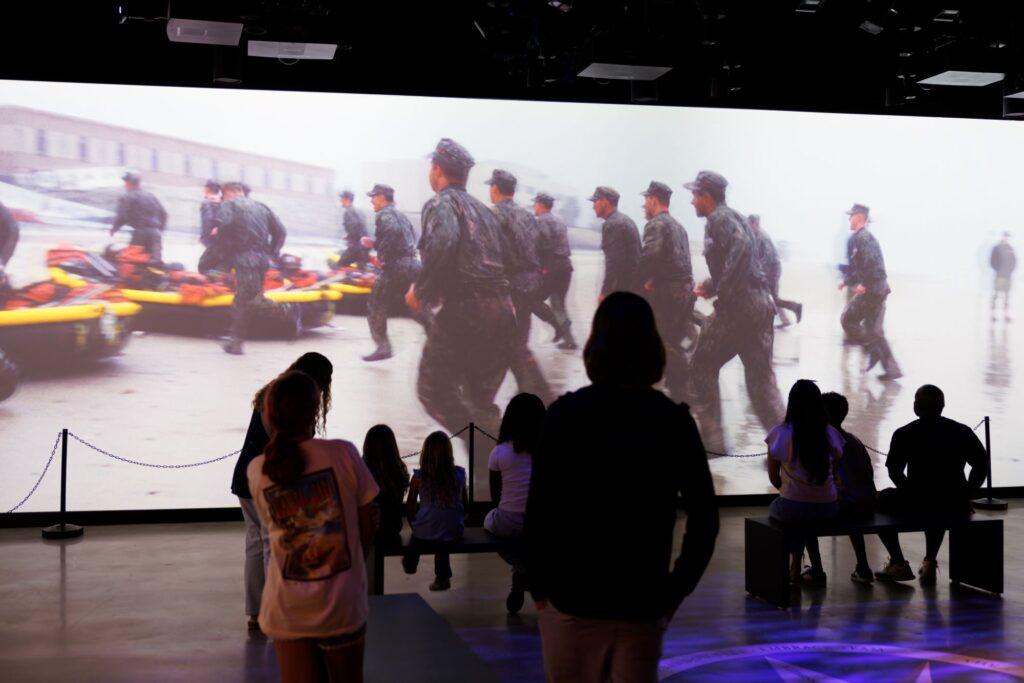
Other exhibits include a SEAL delivery vehicle suspended above a hands-on gameplay opportunity to operate the covert submersible; a 270-degree immersive theater bringing guests into the life and service of Navy SEALs through documentary style personal accounts; artifacts and rich storytelling that bring the 80-year evolution and adaptations of Naval Special Warfare to life; and a Memorial Wall, where the fallen are never forgotten and their stories continue to inspire.
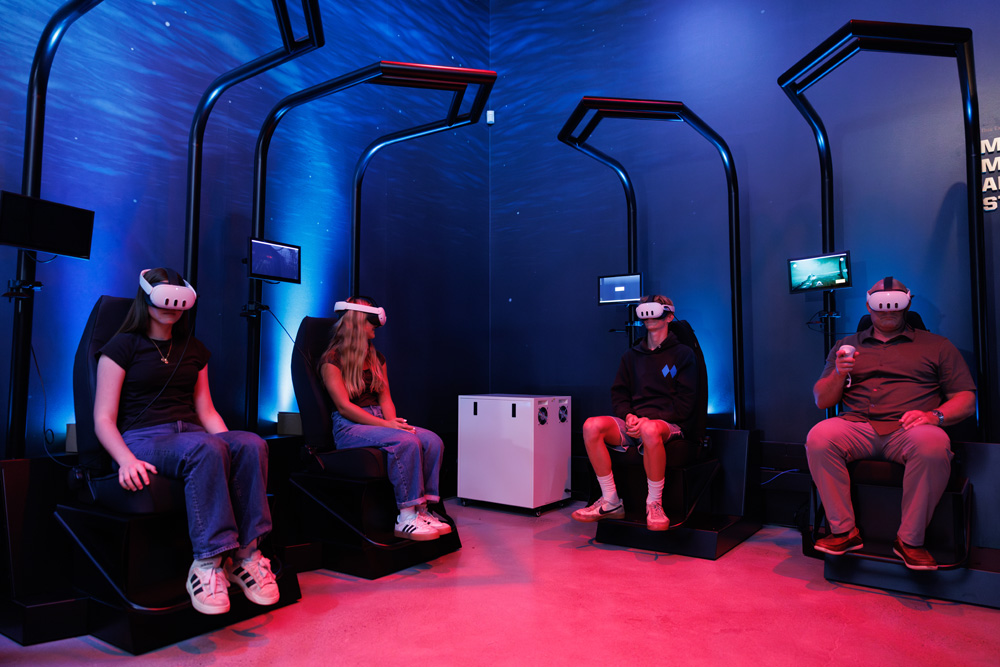
The museum includes an immersive, 3D experience. Photo credit: Navy SEAL Museum San Diego.
Visitors can also immerse themselves in the Navy SEAL Xperience, a virtual reality mission, which uses advanced VR technology to take visitors on a pulse-pounding, first-person journey into a high-stakes hostage rescue mission.
Beyond the exhibits and attractions, the docents, mostly comprised of retired and veteran SEALs and Special Warfare Combat Crewman, make each visit a deeply personal and intimate experience. By revealing untold stories and lived values of the Navy SEALs through the voices of those who have lived the legacy — docents shine a light on the resilience, sacrifice and spirit that define the Naval Special Warfare operators.
Following in the footsteps of the flagship museum in Fort Pierce, the San Diego location will extend the museum’s inspirational mission far beyond its physical space through strategic community partnerships and proven programs that will instill hope, resilience and service-minded leadership by leveraging the Navy SEALs Ethos.
Visitors can experience these real stories, missions and heroes beginning Oct. 4, 2025. Advanced bookings are encouraged, as the museum operates on a time-entry basis. Advance ticket prices are $20 for adults, with free admission for reserve and active-duty military (with ID). Visit NavySEALMuseumSD.org for details.
Navy Concludes Helicopter Aviator Training in TH-57 SeaRanger
PENSACOLA, Fla. (Feb. 23, 2017) Two U.S. Navy TH-57C Sea Ranger helicopters conduct a formation training flight over Pensacola Beach, Fla. (U.S. Navy photo by Ensign Antonio More)
By Richard R. Burgess, Senior Editor
ARLINGTON, Va. — The. U.S. Navy has retired the Bell TH-57 Sea Ranger helicopter from training naval aviators after 57 years of training Navy, Marine Corps, Coast Guard, and foreign naval aviators to fly helicopters.
The last Sea Ranger in Training Air Wing Five, TH-57C Bureau Number 162668, side number E-106, based at Naval Air Station (NAS) Whiting Field, Florida, made its last flight on Sept. 19, 2025, and was delivered to the National Naval Aviation Museum at NAS Pensacola, Florida. The helicopter was presented that day to museum director Sterling Gillum by the pilot, Commander James Gelsinon.
Another of the wing’s TH-57Cs was delivered to the USS Lexington Museum in Corpus Christi, Texas.
The TH-57 in its three versions — A, B, and C — provided flight training over the years to student rotary wing aviators by Training Air Wing Five’s Helicopter Training Squadrons HT-8, HT-18, and HT-28. The Navy procured a total of 40 TH-57As, 51 TH-57Bs, and 89 TH-57Cs.
The TH-57 is not quite gone, however, being used at NAS Patuxent River, Maryland, by an air test and evaluation squadron, HX-21.
“HX-21 still flies TH-57 for readiness flights, not testing,” said Connie Briggs, a spokeswoman for the Naval Air Systems Command. “Right now, there are no immediate plans to retire the aircraft.”
The TH-57 has been succeeded by the TH-73A Thrasher for training naval helicopter pilots at Whiting Field. The Thrasher is built by AgustaWestland Philadelphia, a Leonardo company.
HII Names Roger Kelly as Vice President of Contracts and Pricing at Newport News Shipbuilding
From HII
NEWPORT NEWS, Va., Oct. 02, 2025 (GLOBE NEWSWIRE) — HII (NYSE: HII) announced today that Roger Kelly has been promoted to vice president of contracts and pricing at its Newport News Shipbuilding division. Kelly succeeds Matt Mulherin Jr., who has been appointed vice president of supply chain and strategic sourcing at NNS.
Kelly will have overall responsibility for contracts, pricing, and export/import licensing and compliance for NNS. He will report to Don Godwin, NNS vice president of business management and chief financial officer.
“I am confident Roger has the leadership, business and technical expertise required to lead impactful contract negotiations on behalf of our team,” Godwin said. “I know he will continue to build upon Matt’s strong leadership of the contracts organization.”
Starting his career with the company in 1999 as a nuclear engineer, Kelly supported the Virginia-class submarine program. Since then, he has held positions of increasing responsibility across business management, most recently serving as director of contracts and pricing, overseeing all new construction contracts at the shipyard.
Kelly holds a bachelor’s degree in civil engineering and an MBA, both from Old Dominion University.
MIB, Electric Boat, Lincoln Electric Advance Additive Manufacturing for Submarine Building
From Lincoln Electric
WASHINGTON & CLEVELAND, Sept. 30, 2025 — The U.S. Navy’s Maritime Industrial Base (MIB) Program, General Dynamics Electric Boat, and Lincoln Electric today announced an investment to accelerate the integration of additive manufacturing (AM), also known as 3D printing, into the construction of nuclear-powered submarines.
America must deliver one Columbia-class ballistic missile submarine and two Virginia-class attack submarines each year by 2028, while sustaining the current fleet. Meeting this demand requires innovative methods to increase throughput, reduce bottlenecks, and strengthen supply chains. Additive manufacturing provides critical solutions to these challenges.
Matt Sermon, executive director of the Maritime Industrial Base Program, noted, “The MIB Program is charged with strengthening and expanding the shipbuilding and repair capacity our nation needs for deterrence and warfighting. By investing in additive manufacturing at scale, we are helping ensure our industrial base has the tools, technologies, and resilience required to meet the Navy’s mission.”
Through MIB Program funding, General Dynamics Electric Boat will source critical components from Lincoln Electric’s new large-scale metal additive manufacturing capability, anchored by four state-of-the-art SculptPrint™ machines. This represents Lincoln Electric’s largest government-funded AM capital investment to date, located at its advanced Additive Solutions facility in Cleveland.
“Material availability continues to drive construction delays across the submarine enterprise,” said Ken Jeanos, vice president of supply chain, materials and logistics for General Dynamics Electric Boat. “3D-printed parts have the potential to accelerate construction and delivery of submarines to the U.S. Navy by cutting lead times for critical components.”
“This Maritime Industrial Base investment is a pivotal step to further unlock AM capabilities, enabling the defense industry to address complex supply chain challenges with innovative, efficient solutions,” added Jeanos. “This partnership expands the use of AM and other innovative technologies that Electric Boat’s engineering and procurement teams have been working on for several years.”
Steven B. Hedlund, chairman and CEO of Lincoln Electric, underscored the partnership’s impact: “This investment strengthens our partnership with Electric Boat and solidifies Lincoln Electric’s commitment to delivering transformative solutions for the defense industrial base.”