Admiral Caudle Confirmed as Chief of Naval Operations 

ARLINGTON, Va. — Admiral Daryl Caudle was confirmed July 31 by the U.S. Senate as the 34th chief of naval operations (CNO). Caudle was serving as commander, U.S. Fleet Forces Command when he was nominated by the president. 

Adm. Daryl Caudle is a native of Winston-Salem, North Carolina and a 1985 graduate of North Carolina State University (magna cum laude) with a degree in chemical engineering. He was then commissioned after attending Officer Candidate School in Newport, Rhode Island. Caudle holds advanced degrees from the Naval Postgraduate School, Master of Science (distinction) in Physics; from Old Dominion University, and Master of Science in Engineering Management. He also attended the School of Advanced Studies, University of Phoenix, where he obtained a Doctor of Management in Organizational Leadership with a specialization in Information Systems and Technology. 

His doctoral dissertation research was conducted on military decision making uncertainty regarding the use of force in cyberspace. He is also a licensed professional engineer. 

He assumed command of U.S. Fleet Forces Command; U.S. Naval Forces Northern Command; U.S. Naval Forces Strategic Command; and U.S. Strategic Command Joint Force Maritime Component Commander on December 7, 2021. 

Prior to this assignment, he served as commander, Submarine Forces; commander, Submarine Force Atlantic; commander, Task Force (CTF) 114, CTF 88, and CTF 46; and commander, Allied Submarine Command. 

His other flag assignments include deputy chief for security cooperation, Office of the Defense Representative, Pakistan; deputy commander, Joint Functional Component Command-Global Strike; deputy commander, U.S. 6th Fleet; director of operations U.S. Naval Forces Europe-Africa; commander, Submarine Group Eight; commander, Submarine Force, U.S. Pacific Fleet; and vice director for Strategy, Plans, and Policy on the Joint Staff (J-5) in Washington, D.C. 

His early sea tours included assignments as division officer, USS George Washington Carver (SSBN 656G); engineer, USS Stonewall Jackson (SSN 634B); engineer, USS Sand Lance (SSN 660); and executive officer of USS Montpelier (SSN 765). 

Caudle’s first command assignment was as commanding officer of USS Jefferson City (SSN 759). As deputy commander, Submarine Squadron 11, he served as commanding officer of USS Topeka (SSN 754) and USS Helena (SSN 725) due to emergent losses of the normally assigned commanding officers. He also commanded Submarine Squadron 3. 

His tours ashore include assignments as assistant force nuclear power officer, Commander Submarine Force, U.S. Atlantic Fleet; officer-in-charge of Moored Training Ship (MTS 635); deputy commander of Submarine Squadron 11; assistant deputy director for information and cyberspace policy on the Joint Staff (J-5) in Washington, D.C.; and as chief of staff Commander Submarine Force, U.S. Pacific Fleet. 

His personal decorations include the Navy Distinguished Service Medal, Defense Superior Service Medal (four awards), Legion of Merit (four Awards), Meritorious Service Medal (Three Awards), Navy and Marine Corps Commendation Medal (five Awards), and the Navy and Marine Corps Achievement Medal (four Awards). 


Vice Admiral Dougherty Takes Command of NAVAIR 

From Naval Air Systems Command, Aug 1, 2025  

NAS PATUXENT RIVER, Md. — Vice Adm. John “Doc” Dougherty, IV assumed command of the Naval Air Systems Command Aug. 1. Dougherty relieved Vice Adm. Carl Chebi, who retired after 38 years of distinguished naval service.  

Under Chebi’s leadership, NAVAIR achieved and sustained the highest readiness levels in the history of naval aviation, identified over $3 billion in savings to reinvest in naval aviation priorities, and delivered capabilities that are changing the way the naval aviation trains and fights.   

“I’m incredibly proud of the NAVAIR team’s dedication to delivering the capabilities the fleet needs, when they need them,” said Chebi. “I have full confidence Doc will lead this exceptional workforce to deliver next-level capabilities and readiness for our warfighters.”  

Dougherty brings a powerful combination of acquisition and technical experience to his new role, having served as commander of the Naval Air Warfare Center Aircraft Division and NAVAIR Chief Engineer.   

In his first message to the workforce, Dougherty outlined NAVAIR’s “playbook” for delivering readiness and capability–emphasizing a “fleet first” approach to advancing operational readiness and effectiveness, prioritizing speed, executing with precision, tracking performance and owning results and building trust to align efforts and enable data-informed decisions at the lowest levels.    

A Harrisburg, Pennsylvania native, Dougherty graduated from United States Naval Academy in 1995 and holds both a Master of Business Administration and Master of Systems Engineering from the Naval Postgraduate School. Dougherty’s extensive background includes operational tours flying the F/A-18C Hornet with over 1,200 flight hours and 300 carrier landings, followed by senior acquisition roles managing critical programs including Precision Strike Weapons, F-35 Joint Strike Fighter, and the Navy’s Next Generation Air Dominance Program.  

“It’s a privilege to lead this talented team as we continue advancing naval aviation capabilities and readiness,” Dougherty said. “Our success is measured by the fleet’s success, and that mindset will continue to drive our priorities moving forward.” 


U.S. Coast Guard Cutter Stratton Returns Home Following 134-day Western Pacific Patrol 

U.S. Coast Guard Cutter Stratton (WMSL 752) transits the San Francisco Bay after crossing under the Bay Bridge during the ship’s return to its Alameda, California, July 30, 2025. National security cutters are 418-feet long, 54-feet wide, and can hold a crew of up to 170. (U.S. Coast Guard photo by Petty Officer 3rd Class Austin Wiley)

From U.S. Coast Guard Oceania District, July 31, 2025

ALAMEDA, Calif. — The U.S. Coast Guard Cutter Stratton (WMSL 752) and crew returned to their Base Alameda home port, Wednesday, following a 134-day patrol in the Indo-Pacific. 
 
Stratton’s crew engaged in professional exchanges, cultural events, and joint exercises with Japan, Republic of Korea and the Philippines, including at-sea search-and-rescue and interdiction exercises. 
 
Expanded U.S. Coast Guard presence in the Indo-Pacific facilitates professional exchanges that strengthen our mutual capacity and interoperability with allies and partners, creating opportunities to expand maritime domain awareness in support of a secure and prosperous Indo-Pacific through unrestricted access to the maritime commons. 
 
In Puerta Princesa, Philippines, Stratton conducted joint operations with the U.S. Coast Guard Maritime Security Response Team West and Philippine Coast Guard (PCG) Special Operations Forces and hosted the U.S. Ambassador to the Philippines, MaryKay Carlson, and PCG Commandant Adm. Ronnie Gil Gavan. 
 
In Busan, Republic of Korea, Stratton participated in a search and rescue (SAR) tabletop exercise with ten countries for international mission collaboration. Stratton also conducted a trilateral partner nation engagement with the PCG and Japan Coast Guard in Kagoshima, Japan, during which the crew led ship’s tours, tabletop discussions and an at-sea SAR exercise, marking the first time the PCG operated with the U.S. Coast Guard outside their Exclusive Economic Zone. 
 
While anchored in Koror, Palau, Stratton hosted the President of Palau and U.S. Ambassador to Palau, Joel Ehrendreich. The event highlighted the importance of the U.S partnership as Stratton was the first in its class to visit Palau. 
 
Supporting a White House initiative for the Quadrilateral Security Dialogue, Stratton hosted six observers from India Coast Guard, Japan Coast Guard, and Australian Border Force, for the first-ever Quad at-sea ship observer mission to improve interoperability in the Indo-Pacific. 
 
The U.S. Coast Guard navigates with our Quad partners to leverage and network respective maritime security capabilities toward cooperation on key maritime issues of mutual concern and significant value to Indo-Pacific stability. 
 
Additionally, Stratton’s crew embarked three law enforcement officers from the Republic of the Marshall Islands (RMI) Sea Patrol, who provided a combined presence and conducted two successful maritime law enforcement boardings of commercial fishing vessels operating in the RMI EEZ. While no violations were initially reported from the boarding, potential issues with the catch emerged later and constituted further inspection from RMI. 
 
Stratton’s deployment contributed to regional cooperation and enhanced global maritime governance through integrated deterrence and strengthened partnerships. 
 
“The crew is excited to return home after a long but incredibly important deployment,” says Capt. Dorothy Hernaez, Stratton’s commanding officer. “Stratton and her crew showcased that the U.S. Coast Guard is a global Coast Guard. Through presence and partner engagement in the Indo-Pacific, Stratton advanced regional stability that in turn provides for homeland security, peace, and prosperity.” 
 
Hernaez assumed command of the Stratton during a change of command ceremony held in Honolulu on July 22, as the cutter transited toward its home port. 
 
Commissioned in 2012, Stratton is one of ten Legend-class national security cutters and one of four homeported in Alameda. National security cutters are 418-feet long, 54-feet wide, and have a 4,600 long-ton displacement. They have a top speed of 28 knots, a range of 12,000 nautical miles, and can hold a crew of up to 170. National security cutters routinely conduct operations throughout the Pacific, where their unmatched combination of range, speed, and ability to operate in extreme weather provides the mission flexibility necessary to conduct vital strategic missions. 
 
The namesake of U.S. Coast Guard Cutter Stratton is Capt. Dorothy Stratton, who led the service’s all-female reserve force during World War II. Dorothy Stratton was the first female commissioned officer in the Coast Guard and commanded more than 10,000 personnel. The ship’s motto is “We Can’t Afford Not To.” 


Historic TH-57 Helicopter Landing Aboard USS Lexington Marks End of an Era

A TH-57C Sea Ranger and a TH-73A Thrasher attached to Helicopter Training Squadron (HT) 28 land on the flight deck of decommissioned aircraft carrier USS Lexington (CV 16), Museum on the Bay, in Corpus Christi, Texas, July 30, 2025. This landing commemorates the legacy of the TH-57 training helicopter while showcasing the future of naval aviation with the TH-73. (U.S. Navy photo by Morgan Galvin)

From Morgan Galvinof the Chief of Naval Air Training   

CORPUS CHRISTI, Texas, July 30, 2025 

Helicopter Squadron 28 (HT-28) conducted a landing of a TH-57C Sea Ranger helicopter aboard decommissioned aircraft carrier USS Lexington (CV 16) Museum on the Bay, July 30, 2025. The landing honored the legacy of the TH-57C and celebrated the Navy’s transition to the TH-73A Thrasher, the next-generation training helicopter poised to advance the future of rotary-wing aviation. 
 
Based out of Naval Air Station Whiting Field in Milton, Florida, HT-28 is one of the Navy’s advanced helicopter training squadrons, responsible for training hundreds of student naval aviators each year in rotary-wing flight operations. The squadron’s expertise and dedication ensure that naval helicopter pilots are equipped to meet the rigorous demands of operational fleet service around the world. 
 
While in service, the TH-57C trained more than 30,000 naval aviators and will continue to serve as a living tribute to decades of naval aviation excellence aboard USS Lexington Museum. 
 
“The successful landing and transfer of the TH-57C to the USS Lexington Museum honor a remarkable legacy of naval aviation training, especially here in South Texas,” said Rear Adm. Rich Brophy, Chief of Naval Air Training. “The Sea Ranger has prepared generations of pilots for the fleet, and we are proud to preserve its history for future aviators and visitors. At the same time, we welcome the enhanced capabilities the TH-73A brings to our training community.” 
 
The USS Lexington now proudly houses the TH-57C, where it will inspire and educate the public on the history and evolution of naval rotary-wing aviation. 
 
As the Navy celebrates its 250th anniversary this year, this historic event symbolizes the service’s continued commitment to honoring its past while embracing innovation to train tomorrow’s warfighters.


Navy Demonstrates Multi-Day Solar UAS Flight

NAVAL AIR WARFARE CENTER AIRCRAFT DIVISION, Patuxent River, Md. – The Navy, in partnership with Skydweller Aero, recently achieved continuous solar-powered unmanned flight during a nonstop three-day test from Stennis, Mississippi. Led by the Naval Air Warfare Center Aircraft Division (NAWCAD), the test of Skydweller UAS marks a significant advancement in both long-endurance solar-powered UAS technology and its potential to enhance maritime intelligence, surveillance, and reconnaissance (ISR). 

Release From NAVAL AIR WARFARE CENTER AIRCRAFT DIVISION

NAS PATUXENT RIVER, Md. — The Navy, in partnership with Skydweller Aero, recently achieved continuous solar-powered unmanned flight during a nonstop three-day test from Stennis, Mississippi. 
 
Led by the Naval Air Warfare Center Aircraft Division (NAWCAD), the test of Skydweller UAS marks a significant advancement in both long-endurance solar-powered UAS technology and its potential to enhance maritime intelligence, surveillance, and reconnaissance (ISR). 
 
“This demonstration is a prime example of how NAWCAD partners with industry to deliver what the fleet needs,” said NAWCAD Commander Rear Adm. Todd Evans. “It also reflects the technical depth of our workforce and our ability to translate ideas into capability.” 
 
The 73-hour flight proved Skydweller’s ability to maintain continuous solar-powered operation and demonstrated the feasibility of achieving a positive energy balance to power the aircraft during extended flights. It also validated the system’s communication links, autonomous real-time decision making and ability to adapt to turbulent weather. 
 
“Integrating Skydweller into the Navy’s ISR architecture creates a layered and resilient network that maximizes the capabilities of all our assets,” says NAWCAD’s Special Purpose UAS lead Bill Macchione. “This collaborative approach ensures we have the right platform for the right mission, optimizing our resources and enhancing our overall maritime domain awareness.” 
 
Skydweller’s strength lies in its ability to provide continuous, wide-area surveillance over extended periods, enabling more advanced systems to focus on missions that require such specialized capabilities as rapid response and advanced sensor packages. 
 
NAWCAD began experimentation with Skydweller’s solar-powered UAS capabilities in 2020 to address U.S. Southern Command (SOUTHCOM) operational challenges, including drug trafficking and border security. This technology provides continuous surveillance over vast areas, enabling the U.S. and its allies to enhance maritime security and disrupt illicit activities. NAWCAD will conduct further testing with Skydweller later this summer in the SOUTHCOM area of responsibility. 
 
NAWCAD’s military, civilian, and contract personnel operate test ranges, laboratories, and aircraft in support of test, evaluation, research, development, and sustainment for all Navy and Marine Corps aviation platforms. Based in Patuxent River, Maryland, NAWCAD also has major sites in St. Inigoes, Maryland; Lakehurst, New Jersey; and Orlando, Florida. 


Marine Rotational Force-Darwin Demonstrates Rapid Response 

From HQMC Communications Directorate, July 30, 2025 

WASHINGTON, D.C. — U.S. Marines postured around the globe serve as America’s rapid crisis response force, ready to meet the Nation’s needs at a moment’s notice. On July 26 Marine Corps readiness was on display, when U.S. Marine Medium Tiltrotor Squadron 363, operating under Marine Rotational Force–Darwin, deployed four MV-22B Ospreys more than 1,950 nautical miles from Darwin, Australia, to Clark Air Base, Philippines. 

Within 24 hours of notification, Marines planned, organized and were in the air headed to their assigned objective, demonstrating the agility and speed of the Marine Air-Ground Task Force. Two U.S. Air Force KC-46 Pegasus aircraft from the 6th Air Refueling Squadron enabled the long-range movement by offloading 59,100 pounds of fuel midair. The MV-22B’s unique ability to bridge the gap between rotary-wing and fixed-wing capabilities allows the Joint Force to move personnel and supplies quickly across vast distances and diverse terrains, which is essential to crisis response. 

This mission underscores the value proposition of a forward deployed Marine Corps in support of our Nation’s interests. Marine Rotational Force–Darwin rapidly transitioned from Exercise Talisman Sabre 26 to real-world crisis operations, integrating joint-enabled capabilities to ensure that when the Nation calls, Marines answer without hesitation. 


U.S. Navy Seeks Industry Feedback for Modular Attack Surface Craft Program

By Program Executive Office Unmanned and Small Combatants Public Affairs, July 31, 2025 

WASHINGTON, D.C. — The U.S. Navy released a solicitation seeking industry input in support of the Modular Attack Surface Craft (MASC) program, July 28. The solicitation, open until August 11, invites industry partners to submit white papers or slide decks outlining their capabilities and proposed solutions for the MASC program. 

The program will utilize an innovative acquisition approach – leveraging Other Transaction Agreements, a flexible and streamlined acquisition tool – to emphasize rapid deployment and cost-effectiveness through commercial off-the-shelf technology and incremental development phases. Utilizing existing commercial designs and production capabilities will enable the Navy to rapidly deploy a formidable and cost-effective USV force. 

“The MASC program represents a significant step forward in the Navy’s pursuit of a robust and adaptable unmanned surface fleet,” said Capt. Matthew Lewis, program manager of the Unmanned Maritime Systems program office. “This innovative approach to acquisition, coupled with a modular design philosophy, will provide the fleet with cost-effective and highly capable platforms to address the challenges of the 21st-century maritime environment.” 

MASC combines essential capabilities from the Navy’s Medium and Large Unmanned Surface Vessel (USV) programs, merging them into a flexible, modular platform designed for multi-mission operations. This will enhance the Navy’s distributed lethality and battlespace awareness through embarked warfighting capabilities including anti-surface warfare, strike warfare and information operations in addition to future embarked mission areas. 

“By uniting advanced modular design with rapid, cost-effective acquisition strategies, MASC will transform our surface fleet’s capabilities—enabling distributed lethality and enhanced battlespace awareness across multiple mission domains,” said Melissa Kirkendall, acting Program Executive Officer, Unmanned and Small Combatants (PEO USC). “We encourage industry partners to engage with this transformative initiative and collaborate with us to shape the future of unmanned maritime operations.” 

The development of MASC answers the call to adapt to evolving geopolitical and technological challenges. MASC will bolster the Navy’s ability to operate in contested environments, ensuring a more distributed and resilient force posture and significantly enhancing the Navy’s combat effectiveness. 

PEO USC designs, develops, builds, maintains, and modernizes the Navy’s unmanned maritime systems; mine warfare systems; special warfare systems; expeditionary warfare systems; small boats/craft; and small surface combatants. 


Saronic Unveils Echelon: A Unified Platform for Autonomous Surface Vessels

Release From Saronic 

Austin, Texas, July 30, 2025 — Saronic Technologies today unveiled Echelon, a unified platform that enables advanced mission planning, high-fidelity simulation, and real-time command-and-control (C2) for its growing fleet of Autonomous Surface Vessels (ASVs). Built to enable scalable, distributed operations, Echelon allows a single operator to plan, simulate, and execute complex missions across multiple autonomous assets—using a single interface. 

As maritime environments become increasingly contested and operationally complex, both defense and commercial users require intuitive solutions to deploy, manage, and dynamically task autonomous systems at scale. Success in these domains hinges on advanced mission planning, scalable C2, and the ability to operate reliably with or without continuous connectivity. Echelon aims to deliver on this need by combining mission planning, simulation, and execution capabilities into one system, accelerating deployment timelines and reducing cognitive load for operators. 

With Echelon, operators are provided with an intuitive interface for rapidly designing and testing missions in a high-fidelity simulation environment. Enabled by Saronic’s deep instrumentation across the hardware and software stack, this simulation layer delivers full visibility into vessel autonomy, providing insight into the vessel’s performance capabilities prior to deployment. Once validated in simulation, the mission is easily deployed to the designated ASV(s). Mission observation and real-time control are available as needed, though Saronic ASVs are uniquely capable of operating independently without persistent communications, a critical requirement for denied or degraded environments. 

During operation, Echelon prioritizes the safety, reliability, and effective control of Saronic ASVs. The platform combines ultra-low-latency video streaming with intelligent, autonomy-aware alerts generated from the vessels’ onboard sensors and mission telemetry. By surfacing only the most relevant data, from subsystem telemetry to autonomy behaviors, Echelon helps operators stay focused, informed, and ready to make high-impact decisions in real-time.  

“Echelon is aligned with Saronic’s core belief that a vertically integrated system across both software and hardware will best enable our end users to achieve their mission objectives,” said Vibhav Altekar, Co-Founder and CTO at Saronic. “While our vessels remain compatible with third-party C2 systems, Echelon was purpose-built to unlock the full potential of Saronic’s autonomy stack and deliver an intuitive mission-ready capability to our customers.”   

Saronic continues to push the boundaries of distributed autonomy with Echelon. The unified platform represents a critical step forward in Saronic’s mission to enable one-to-many operations, where a single operator can command and control a heterogeneous fleet of ASVs—reliably, safely, and at scale. 


Navy and Marine Corps Commence Large Scale Exercise 2025 

From U.S. Fleet Forces Command, July 30, 2025 

NORFOLK, Va. – Sailors and Marines from across 22 time zones, six component commands, and seven U.S. numbered Fleets are now participating in Large Scale Exercise (LSE) 2025, as the Navy and Marine Corps officially kick off one of their largest global training events, July 30. 
 
LSE 2025 is a global, all-domain warfighting exercise designed to simulate complex, real-world threats—from the piers of U.S. naval bases to ships at sea and headquarters around the globe—creating a realistic environment that mirrors strategic competitor challenges. 
 
Using state-of-the-art technology, exercise planners have built real-time, dynamic scenarios that stress-test Navy and Marine Corps systems, processes, and decision-making—without physically wearing down our ships, aircraft, and equipment. While the scenarios are virtual, the lessons learned are very real, testing readiness, flexibility, and resilience in ways never before imagined. 
 
Building upon insights from previous exercises, LSE 2025 enables Sailors and Marines to plan, execute, and evaluate advanced warfighting concepts, ensuring future readiness when facing a thinking, capable adversary. 
 
For the first time, LSE will include U.S. allies and partners—including Canada, Japan, and NATO—expanding the exercise’s reach and enhancing coalition integration. This level of international coordination strengthens interoperability, trust, and joint effectiveness across the maritime force, ensuring we can respond to future challenges with unity and precision. 
 
“This isn’t just about scale—it’s about integration, synchronization, and rehearsal for the full spectrum of conflict,” said Vice Adm. John Gumbleton, deputy commander, U.S. Fleet Forces Command. “LSE 2025 will test our ability to globally coordinate Maritime Operations Centers, execute contested logistics, and mobilize our Reserve forces. Large Scale Exercise 2025 is how we prepare to fight and win—anywhere, anytime.” 
 
LSE 2025 is the only exercise where all 10 Fleet Maritime Operations Centers (MOCs) will operate simultaneously. While many exercises focus on a single fleet or region, LSE 2025 raises the bar—requiring coordinated action across the globe and providing critical experience at the operational level of war. 
 
“This exercise provides an incredible opportunity to hone command and control across the most lethal amphibious task forces in the world, ensuring sea lanes remain open and global commerce flows freely, maintaining peace and stability worldwide,” said Lt. Gen. Bobbi Shea, commander, Marine Forces Command. “LSE offers a glimpse into the future of warfare, pushing the boundaries of what’s possible and ensuring that our Navy-Marine Corps team remains the most advanced, agile, and effective fighting force in the world.” 
 
Large Scale Exercise 2025 represents a pivotal opportunity to test and refine the Navy and Marine Corps’ ability to operate in a globally contested environment. By integrating advanced warfighting concepts, allied capabilities, and real-time operational coordination, LSE 2025 reinforces the maritime services’ commitment to maintaining strategic advantage, deterring aggression, and ensuring security and stability across the world’s oceans. 
 
USFFC is responsible for manning, training, equipping and employing more than 125 ships, 1,000 aircraft, and 103,000 active-duty service members and government employees, and providing combat-ready forces forward to numbered fleets and combatant commanders around the globe in support of U.S. national interests. 


Coast Guard Offloads More than $74M in Illicit Drugs Interdicted in Eastern Pacific 

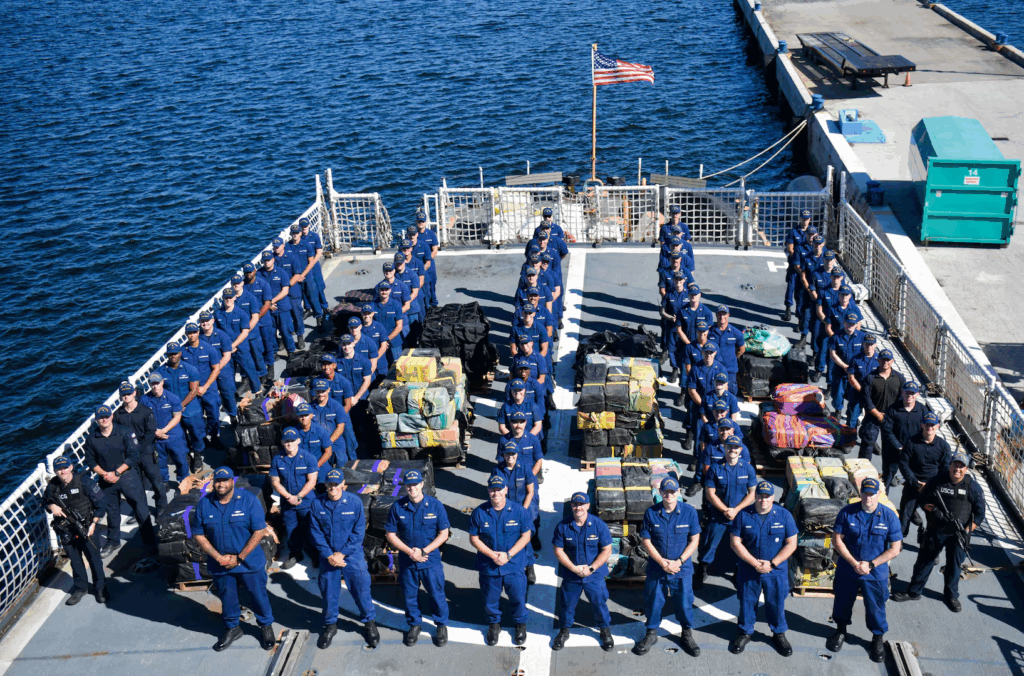
The crew of the Coast Guard Cutter Tahoma standing at parade rest on the flight deck at Port Everglades, Florida, July 29, 2025. The seized contraband was the result of an interdiction on June 24, 2025, approximately 120 miles northwest of Ecuador. (U.S. Coast Guard photo by Petty Officer 3rd Class Nicholas Strasburg)

From U.S. Coast Guard Southeast District, July 29, 2025 

MIAMI – U.S. Coast Guard Cutter Tahoma’s crew offloaded approximately 9,970 pounds of cocaine worth $73.7 million, Tuesday, at Port Everglades. 

The seized contraband was the result of an interdiction on June 24, 2025, approximately 120 miles northwest of Ecuador by the crew of the Tahoma. 

“I couldn’t be more impressed with the determination and teamwork displayed by this crew. They executed this interdiction with precision and professionalism,” said Cmdr. Nolan Cuevas, commanding officer of the Cutter Tahoma. “Behind every successful deployment is a dedicated team of logistics and support personnel. Their tireless efforts ensured we had the resources and maintenance support to operate. Our collective actions reaffirm the Coast Guard’s unwavering commitment to protecting our nation’s borders and the safety of our citizens.”  

The following assets and crews were involved in the interdiction operations:   

  • U.S. Coast Guard Cutter Tahoma (WMEC 908)  

  • U.S. Coast Guard Pacific Area Tactical Law Enforcement Team  

  • U.S. Coast Guard Maritime Safety & Security Team Houston  

Detecting and interdicting illicit drug traffickers on the high seas involves significant coordination. Joint Interagency Task Force-South conducts the detection and monitoring of aerial and maritime transit of illegal drugs. Once an interdiction becomes imminent, the law enforcement phase of the operation begins, and control of the operation shifts to the U.S. Coast Guard for the interdiction and apprehension phases. Interdictions in the Eastern Pacific Ocean are performed by members of the U.S. Coast Guard under the authority and control of the Southwest Coast Guard District, headquartered in Alameda, California.   

Tahoma is a 270-foot Famous-class medium endurance cutter homeported in Newport, Rhode Island, under U.S. Coast Guard Atlantic Area Command.