Cydome Unveils Cyber‑Incident Reporting Tool as the U.S. Maritime Sector Faces Law Enforcement 

A new tool provides immediate compliance support as maritime operators become federally required to report cyber incidents under U.S. law 

From Cydome, July 28, 2025 

Tel Aviv, July 28, 2025 – With Federal maritime cybersecurity reporting rules that entered enforcement on July 16, U.S.-bound maritime operators are now federally required to report cyber incidents, marking a turning point for shipowners, operators, and offshore stakeholders. In response, Cydome, a leading provider of class‑endorsed maritime cybersecurity solutions, has launched a free reporting tool to simplify compliance. By simply registering, operators take an immediate first step toward meeting the Coast Guard’s cyber‑reporting expectations. 

Cydome data shows that roughly every three days, a shipping company faces a cyber threat, yet many still struggle to operationalise existing guidance. The new U.S. regulation, applying to vessels, facilities, terminals, and outer continental shelf (OCS) facilities, mandates not only incident reporting, but also cybersecurity staffing, procedures, and governance. Incident reporting is just one pillar of the revamped Federal Law. 

Many of the incidents now deemed reportable are everyday glitches, such as GPS spoofing or jamming, short VSAT dropouts, partial software updates that require a system restart, or an unauthorized USB stick being plugged into a bridge computer; a sustained loss or degradation of communications (e.g., satellite, VHF, or navigation‑data links), or a series of mistyped passwords that lock an account, can also trigger a mandatory report. Taken together, these otherwise routine events can generate dozens of mandatory reports during a single voyage. Non‑compliance is costly: the Coast Guard may impose substantial civil fines, suspend a vessel’s certificate, detain the ship in port, or issue Captain of the Port orders that require anchorage, tug escort, or a full halt to cargo operations until the vulnerability is remedied. 

Cydome’s digital platform provides a step-by-step incident workflow, complete with built-in U.S. Coast Guard templates that are pre-filled and auto-routed for seamless submission. The tool enables internal escalation, from IT to CISO to senior management, as well as formal reporting to regulators, helping companies stay compliant efficiently, automatically, and securely. It is built to accommodate both large organizations with dedicated IT or cyber teams and companies with more limited in-house capabilities. It is designed for the operational realities of multi-class fleets, where vessels may fall under different standards and reporting chains. 

“This tool puts operators back in control,” said Nir Ayalon, CEO and Founder of Cydome. “We designed it to be simple enough for maritime companies, yet powerful enough to deliver a full audit trail for inspectors. With enforcement now real, the sector needs a no-obstacle solution, and we’re proud to deliver exactly that.” 

While the U.S. Coast Guard has been tasked to begin enforcing the new cyber-reporting legislation, Cydome turns the cyber-incident ensuring process into a few clicks. The platform mirrors the Coast Guard’s forms, auto-fills every required field, timestamps supporting evidence, and routes each report from shipboard IT through the CISO and senior management directly to the National Response Center (NRC). In moments, crews can file an inspector‑ready record for navigation, propulsion, ballast, and other critical IT or OT systems, long before an audit team arrives.  
 
With U.S. enforcement already underway, compliance urgency is high. At the same time, the EU’s NIS2 directive has taken effect and will soon be actively enforced. Cydome’s class‑endorsed, independent platform gives European operators the same streamlined reporting workflow, automated escalation paths, and regulator‑ready templates that U.S. users already rely on. By design, the tool adapts seamlessly to multiple regulators, classification societies, and standards, giving mixed fleets a single, simple route to full compliance on both sides of the Atlantic. 

“Policy alone won’t keep ships safe; crews need a clear, repeatable way to act,” said Dr. Gary Kessler, former cyber official at the U.S. Coast Guard and a leading voice in maritime cybersecurity. “By translating every Coast Guard requirement into a straightforward process, Cydome delivers that clarity, and because the solution is class‑endorsed, the same disciplined approach works across multi-class fleets and the new European rules as well.” 

About Cydome 
Cydome is a class-certified cybersecurity pioneer, purpose-built for maritime and critical infrastructure. Trusted by all major classification societies for its independence, Cydome’s ISO-certified platform secures IT, OT, and onboard communications, automates vulnerability management, and simplifies compliance with US Coast Guard, NIS2, and global regulations. With seamless onboard deployment and centralized control, Cydome empowers operators to detect, respond to, and protect against cyber threats, ensuring vessels remain secure and compliant. 


Lockheed Martin Delivers 250th MK 48 Torpedo Guidance and Control Section 

Bethesda, Md. July 28, 2025 – Lockheed Martin has reached a landmark achievement with the delivery of the 250th MK 48 Guidance and Control (G&C) Section, a critical component of the MK 48 ADCAP torpedo, a powerful and reliable weapon that has been the cornerstone of the US Navy’s and Allies’ submarine arsenal. The Guidance and Control Sections are designed to detect and track threats in real-time, ensuring pinpoint accuracy and lethality in the most high-pressure situations. 

The MK 48 Guidance and Control Section, leverages advanced capabilities to engage and eliminate fast-moving, evasive and deep-diving threats with precision. Its advanced processing and algorithms enable a flexible response in complex engagements, allowing the system to adapt in a dynamic undersea environment. This makes the MK 48 Heavyweight Torpedo an indispensable asset in the heat of the battle where split-second decisions mean the difference between success and failure. 

“Reaching the production of the 250th MK 48 Guidance and Control Section marks a major milestone in our mission to deliver new torpedoes to the fleet. It’s a fitting achievement that this comes as the US Navy celebrates its 250th birthday this year – a powerful reminder of our enduring commitment to those who serve”, stated Tom Warner, Lockheed Martin, RMS Vice President of Undersea Warfare. 

The production of 250 Guidance and Control Sections is a testament to Lockheed Martin’s unrelenting pursuit of excellence and its commitment to supporting the US Navy’s mission. This achievement demonstrates Lockheed Martin’s ability to aggressively revitalize a once-dormant technology, while maintaining the highest standards of quality and performance. As the US Navy continues to evolve and face new challenges, Lockheed Martin remains steadfast in its commitment to providing the advanced technologies and capabilities necessary to maintain its edge in the maritime domain. 


Beechcraft M-346N Unveiled as Solution for US Navy Undergraduate Jet Training System 

Introducing the Beechcraft M-346N for the future of Naval aviation 

From Textron Aviation Defense, July 28, 2025 

Textron Aviation Defense LLC, a Textron Inc. (NYSE: TXT) company, today announced its offering of the Beechcraft M-346N jet as a “ready-now” solution from an iconic American company for the U.S. Navy Undergraduate Jet Training System (UJTS) program. The U.S. Navy has released several Requests for Information related to an upcoming Request for Proposals for a new aircraft for the UJTS program. 

Textron Aviation Defense and Leonardo have entered into a teaming agreement to work together to meet the Navy’s requirements for its new jet trainer. The Beechcraft M-346N is part of a proven integrated training system based on the original M-346 aircraft developed by Leonardo. More than 100 Leonardo M-346 aircraft are already meeting the demanding student pilot training needs for 4th and 5th generation air forces worldwide, including at Italy’s globally renowned International Flight Training School (IFTS). 

“With our heritage deeply rooted in the strength and reliability of American manufacturing, the Beechcraft M-346N joins a proud lineup of aircraft built on 95 years of aviation excellence. The aircraft can be the cornerstone for the Navy’s future of undergraduate jet training, combining operationally-proven performance with cutting-edge technologies.” Said Travis Tyler, president and CEO, Textron Aviation Defense 

About the Beechcraft M-346N 
The Beechcraft M-346N — a twin-engine, tandem-seat aircraft with fully digital flight controls and avionics — is equipped with a fly-by-wire flight control system with quadruple redundancy, a cutting-edge human-machine interface with Head-Up Display and Large Area Display in each cockpit, hands on throttle and stick (HOTAS) controls and innovative safety features such as the Automatic Ground Collision Avoidance System (Auto-GCAS). 

Fitted with two Honeywell F124-GA-200 turbofan engines, the M-346N delivers an inherently high level of safety along with impressive performance, including a maximum cruise speed of more than 590 knots and a service ceiling of 45,000 ft. 

The aircraft’s advanced aerodynamic design enables exceptional maneuverability and energy management, while the elevated rear cockpit gives instructors excellent visibility in all phases of flight. The result is a trainer that effectively bridges basic instruction and the high-performance world of carrier-based fighter operations. 

Advanced integrated training: A complete ecosystem 
The comprehensive M-346N integrated training ecosystem, which has been validated and continuously improved through the global operational experience of the M-346 integrated training system, is poised to provide the Navy with a complete solution that enhances student readiness and operational effectiveness while reducing training costs and risks. 

The Beechcraft M-346N leverages the operationally-proven Embedded Training System avionics suite for basic to advanced tactical training emulating sensors, weapons and Computer Generated Forces. This enables students to interact in real-time through a Live-Virtual-Constructive (LVC) training architecture that links aircraft in flight (Live), simulators (Virtual) and computer-generated friendly and adversary forces (Constructive). The innovative system also features adaptive training powered by Artificial Intelligence which continuously analyzes student pilot performance data to personalize learning paths, automate evaluations and tailor instruction to individual strengths and areas for improvement 

Together with its full spectrum of high-fidelity ground-based training devices — comprising simulators, computer training devices, mission planning / management tools and a carrier-based LVC environment — the Beechcraft M-346N offers a complete solution for training the next generation of Navy and Marine Corps aviators. 


Bollinger to Lead Partnership with Allies to Deliver U.S. Coast Guard’s Arctic Security Cutter

Partnership comprises world’s premier icebreaker shipbuilders: Bollinger Shipyards, Rauma Shipyards, Seaspan Shipyards and Aker Arctic 

Plan delivers fastest schedule, lowest risk, cost certainty, and a full transition to American shipyards 

MPI design exceeds all requirements and is production ready, allowing for delivery of the first vessel within 36 months of award.

From Bollinger Shipyards, July 29, 2025 

July 29, 2025 — Lockport, La. — Bollinger Shipyards (Bollinger), Rauma Shipyards (Rauma), Seaspan Shipyards (Seaspan) and Aker Arctic (Aker) today announced the formation of a strategic partnership to deliver the lowest-risk, fastest delivery solution of best-in-class Arctic Security Cutters (ASC) to the U.S. Coast Guard. This strategic partnership represents a deliberate effort to strengthen the U.S. industrial base, expand America’s shipbuilding capacity, and equip American workers with the skills to lead in a new era of strategic competition through the transfer of knowledge, technology, and design expertise needed to build the next generation of icebreakers right here in the United States. 

Together, the four companies represent the world’s premier icebreaker shipbuilding companies. Bollinger is the largest privately-owned shipbuilder in the United States, is currently building the first heavy icebreaker in the United States in 50 years and has built and delivered nearly 200 high-performance vessels to the U.S. Coast Guard in a 40-year period. Rauma is Finland’s legendary ice-class shipyard. Seaspan Shipyards is the Canadian subsidiary of U.S. based Washington Companies and the leading icebreaker design and build shipyard currently delivering on the largest order book of ice capable vessels in the world. Aker Arctic, is a respected authority in icebreaking technology and design, having developed the majority of icebreaker designs currently in operation today. 

Fastest Path to Delivery 

The strategic partnership leverages the trilateral ICE Pact framework between the United States, Canada and Finland to answer President Trump’s call to rapidly grow a modernized U.S. icebreaking fleet, with delivery of the first vessel within 36 months of award, and ensures the ASC program is anchored in American shipbuilding and transitions quickly to full U.S. production, consistent with President Trump’s ‘America First’ priority. 

“In line with President Trump’s directive to grow and modernize America’s icebreaking fleet, Bollinger is proud to lead this partnership with a focus on speed, quality, certainty and results,” said Ben Bordelon, President and CEO of Bollinger Shipyards. “Speculative designs can derail programs, delay delivery and devastate shipyards. The Seaspan-Aker MPI design is the most mature, construction-ready design available, and we’re bringing proven capability, hard-earned lessons, and unmatched U.S. capacity to get it built. With Bollinger’s access to more than 4,000 skilled workers and over 30 facilities across the country, no one is better positioned to move fast and deliver the Arctic Security Cutter.” 

Finnish Industrial Strength for Arctic Operations 

This strategic collaboration presents a unique opportunity to apply our proven capabilities in support of the U.S. Coast Guard’s Arctic mission,” said Mika Nieminen, President and CEO of Rauma Shipyards. “We are fully prepared to begin construction immediately, leveraging a mature design and deep experience in building technically complex vessels for operation in severe winter conditions. With a fully operational production line and world-class facilities, we bring reliability and results—not projections. Beyond construction, Rauma provides added value through crew training, bridge simulator programs, and ice trials to support successful commissioning and elevate the technological and operational capabilities. Together with our partners, we offer a clear and executable path to strengthening America’s presence in the Arctic.” 

Purpose-Built Design. Mission-Ready Capability. 

The Seaspan-Aker Multi-Purpose Icebreaker (MPI) design is the optimal design to meet U.S. Coast Guard requirements as it exceeds all ASC requirements and supports all eleven statutory missions. With the ability to break four feet of ice, travel 12,000 nautical miles, and operate for over 60 days, the design is purpose-built to support the evolving mission needs of the U.S. Coast Guard in the harshest conditions. Additionally, its shared multi-mission design with the Canadian Coast Guard fleet will create the largest class of icebreaking capability in the world, optimizing interoperability and maintenance support. 

 “We are proud to collaborate with Bollinger, Rauma and Aker Arctic to share our expertise in icebreaker design and engineering with the United States — a historically and close partner with Canada in securing the Arctic,” said John McCarthy, CEO of Seaspan Shipyards. “Together, we’ve assembled the world’s foremost experts in icebreaking construction to deliver a low-risk, mission-ready solution that fully meets the U.S. Coast Guard’s requirements. Together, through the ICE Pact, we’re strengthening Arctic security and advancing the long-term capabilities of our nations’ shipbuilding industries.”  

Notably, all other proposed designs will require significant investment and corresponding ramp-up time creating a large risk for schedule, cost and delivery delay. 

“We are proud to be part of this collaboration in the development of the USCG’s Arctic Security Cutter icebreakers,” said Mika Hovilainen, CEO Aker Arctic Technology Inc. “This partnership highlights our commitment to advancing maritime security and innovation in the Arctic region. The vessel we are offering has been developed for the Canadian Coast Guard and includes specialized capabilities that are essential for fulfilling the Coast Guard’s missions. Together, we will leverage our expertise to build state-of-the-art icebreakers that meet the highest standards of mission capability and reliability.” 

The trilateral U.S.-Canada-Finland shipbuilding partnership is a direct embodiment of the ICE PACT initiative, reinforcing the commitment of all three nations to enhance Arctic security and shipbuilding expertise. This team stands uniquely aligned with national priorities to restore American maritime strength, not just through capability, but through speed and proven performance. 


Bollinger Begins Contract Negotiations for Construction of USCG Fast Response Cutters 

Historic $25 billion investment in USCG includes $1 billion for additional FRCs 

From Bollinger Shipyards, July 28, 2025 

LOCKPORT, La., July 28, 2025 — Bollinger Shipyards (“Bollinger”) announced today it has begun contract negotiations with the U.S. Coast Guard for the construction of at least 10 additional Fast Response Cutters (FRCs), supported by the historic $25 billion investment included in the recently enacted One Big Beautiful Bill, the largest single commitment of funding in the history of the Coast Guard. This investment in the continuation of the FRC program will support the 650 skilled men and women that build these cutters in Lockport and the thousands of employees from our 950-plus suppliers hailing from 37 states. 

“This moment reinforces what we’ve known all along: when you invest in American workers, you get results,” said Ben Bordelon, President and CEO of Bollinger Shipyards. “Our incredible workforce has delivered over 180 cutters, including 60 FRCs, in our more than 40-year partnership with the Coast Guard — many of those vessels delivered on time, on budget and with zero production discrepancies. That kind of performance doesn’t happen by accident. It’s the result of dedication, precision and pride in the mission.” 

Included in the recently enacted One Big Beautiful Bill was a historic $25 billion investment to strengthen every facet of the Coast Guard and support Force Design 2028, the comprehensive effort to modernize the Service. The now law includes $1 billion for the acquisition of additional FRCs.  

“This historic investment marks a new era for the Coast Guard,” said Coast Guard Acting Commandant Adm. Kevin Lunday on the enactment of the One Big Beautiful Bill. “It reflects the strong support of the American people and empowers us to restore our Service and prepare for the challenges of today and tomorrow.” 

To date, Bollinger has delivered 60 FRCs and is under contract to build a total of 67 FRCs, with the final vessel scheduled for delivery in 2027. This critical $1 billion investment will allow the total to increase to at least 77 vessels, and ensure the continuation of the program for another 3 years beyond the current contract.  

With FRC 67 currently under construction, the production line should have begun to wind down this year. However, in a bold demonstration of confidence in the workforce and respect for the American taxpayer, Bordelon authorized the company to go “at-risk” earlier this year. The company spent millions to protect workforce continuity and maintain production momentum. Bollinger began procuring long-lead materials and sustained full payroll to keep future costs low and efficiencies high, enabling the government to stretch its investment further and secure at least 10 new cutters under the $1 billion investment. 

“For nearly 80 years, Bollinger has set the gold standard in American shipbuilding, delivering some of the most advanced vessels in the world for the U.S. Government and commercial maritime sector, all right here in South Louisiana,” said Louisiana Governor Jeff Landry. “This isn’t just a win for our economy, it’s a win for Louisiana, our workers, and our role in defending America’s strength. I applaud President Trump for his leadership and for signing this Big Beautiful Bill that supports American shipbuilding. I’d also like to thank Speaker Johnson, Leader Scalise, and the entire delegation for their work.” 

The FRC program has had a total economic impact of over $2 billion since its inception in material spending and directly supports more than 650 jobs in Southeast Louisiana. The program has indirectly created 1,690 new jobs from operations and capital investment and has an annual economic impact on GDP of $202 million, according to the most recent data from the U.S. Maritime Administration (MARAD) on the economic importance of the U.S. Shipbuilding and Repair Industry. Bollinger sources over 271,000 different items for the FRC consisting of 282 million components and parts from 965 suppliers in 37 states. 

The FRC is one of many U.S. Government shipbuilding programs that Bollinger is proud to support. In addition to the construction of the FRC, Bollinger is currently building the Polar Security Cutter (PSC) for the U.S. Coast Guard, the Towing, Salvage and Rescue Ship (T-ATS), the Auxiliary Personnel Lighter (APL), the newest oceanographic survey ship (T-AGS 67) and the Mine Countermeasures Unmanned Surface Vessels (MCM USV) for the U.S. Navy. Bollinger is also building three Regional Class Research Vessels (RCRV) for the National Science Foundation through Oregon State University. Bollinger also supports the nuclear-powered ballistic missile submarine program by building various auxiliary vessels for General Dynamics-Electric Boat. 


USS Iwo Jima Becomes First Amphibious Ship Outfitted with USO Afloat Recharge Centers

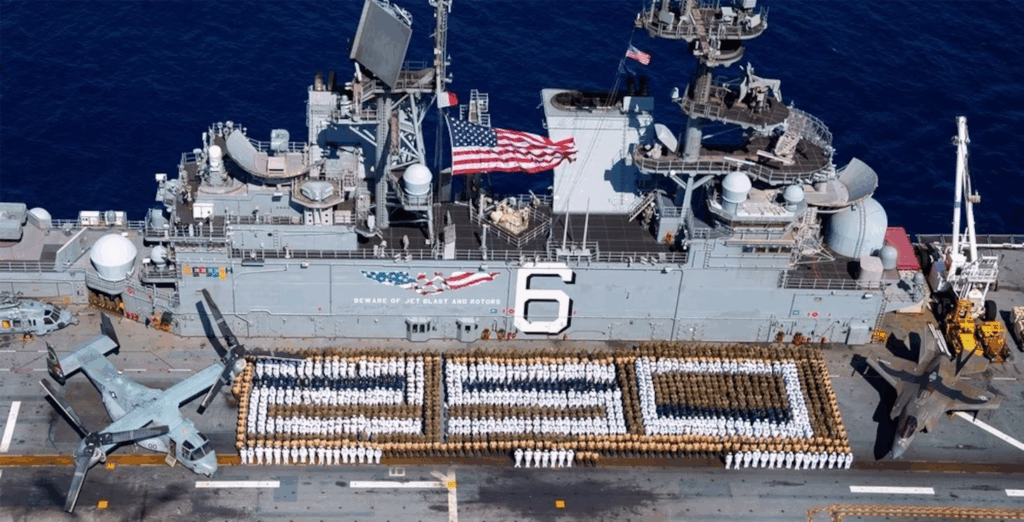
NORFOLK (July 28, 2025) Sailors assigned to the Wasp-class amphibious assault ship USS Iwo Jima (LHD 7) and United Service Organization (USO) staff take a group photo during a ribbon cutting ceremony. The event acknowledges the grand opening of the first USO afloat recharge centers on an amphibious assault ship. (U.S. Navy photo by MC1Erickson B. Magno) 

From Petty Officer 1st Class Erickson Magno, July 29, 2025 

NORFOLK, Va.—The Wasp-class amphibious assault ship USS Iwo Jima (LHD 7) and United Service Organizations (USO) held a ribbon cutting ceremony onboard, officially opening the first ship-based USO centers on an amphibious assault ship, July 28. 

The afloat centers include many of the same amenities as a land-based center, such as comfortable seating, TVs, video and board games, and snacks. Equipping the ship with these centers creates a home away from home for Sailors and embarked Marines while on deployment. 

“Onboard Iwo Jima, we have 2,200 Sailors and Marines—warfighters who are being prepared and are ready to support our nation’s business when we deploy,” said Capt. Kathryn Wijnaldum, executive officer of Iwo Jima. “Our intent for its [centers] use is that they will provide an opportunity to support the warfighter—to help them reset, recharge, and de-stress—so that they can resume their duties that enable us to accomplish our mission and get the job done when our nation calls upon us.” 

These new ship-based centers gives the Sailors of Iwo Jima and their embarked Marine teammates from the 22nd Marine Expeditionary Unit (Special Operations Capable)—America’s premier warfighters—an alternative way to recharge and build a close-knit community with one another while serving in high-stress operational environments. 

“Thank you for the extreme cooperation of the ship and for the patience to deal with us here now on our very first gator,” said Jeff Hill, the USO’s Expeditionary Region Vice President. “To be able to serve Marines and Sailors wherever the world takes you, USO is going to be with you wherever you may go—that’s our objective.” 
 
Iwo Jima is the first amphibious assault ship to have ship-based centers, and the USO has ship-based centers on 10 aircraft carriers and five destroyers. 
 
For more than 80 years, the USO has served the men and women of the U.S. military and their families throughout their time in uniform—from shore-based assignments and continuing that tradition at sea. With multiple ships now carrying a USO presence, the organization is charting a course toward an extraordinary era of support to service members at sea. 
 
Iwo Jima is moored at Naval Station Norfolk following its return from a 4-week underway for Composite Training Unit Exercise (COMPTUEX). COMPTUEX was the final certifying event in the pre-deployment workup cycle for the ship’s company. 
 
Iwo Jima is the flagship of the Iwo Jima Amphibious Ready Group (ARG) which is capable of conducting global missions to accomplish U.S. strategic goals, deter adversaries, and ensure unimpeded commerce by keeping the high seas open and free in accordance with international law. Embarked aboard ARG shipping is the 22nd MEU (SOC) and provides a forward-deployed, flexible sea-based Marine Air Ground Task Force (MAGTF) capable of conducting amphibious operations—to include enabling the introduction of follow-on forces and designated special operations to meet Combatant Commander’s requirements. 


BlackSky Wins Next Phase of U.S. Navy Optical Inter-Satellite Link Research Contract

Contract furthers the design, development and evaluation of compatibility with Space Development Agency transport layer in support of tactical ISR missions 

From BlackSky, July 29, 2025 

HERNDON, Va. (July 28, 2025) — BlackSky Technology Inc. (NYSE: BKSY) won the next phase of a competitive U.S. Navy research contract to further develop optical inter-satellite link (OISL) terminal applications for its Gen-3 constellation. The OISL terminals are expected to increase the speed at which very high-resolution imagery and other high-volume space-based data travel directly between satellites before downlinking to ground stations. 

“This important award directly supports BlackSky’s ability to deliver timely, high-impact intelligence that drive decisions all the way to the tactical edges of the frontline,” said Brian O’Toole, BlackSky CEO. “High-speed inter-satellite communication links are a critical innovation that makes BlackSky’s commercial remote sensing services a robust and viable option for fleet-wide tactical ISR operations.” 

Under the development agreement, BlackSky will explore hardware and software design adaptations, novel operating concepts for commercial transport network nodes and establish new protocols for data movement. Future Gen-3 satellites will be equipped with optical inter-satellite link terminals compatible with both the Space Development Agency’s Transport Layer and commercial transport networks. 

“Extending our Gen-3 capabilities with optical intersatellite link terminals will give customers reliable access to real-time earth imaging capabilities across the full range of warfighting scenarios. Enhanced Gen-3 satellites are expected to deliver data to end users 10 times faster than current systems, with data volumes five times greater than existing capabilities,” said O’Toole. 

Laser-based OISLs create high-bandwidth, direct communication lines between satellites, reducing the time it takes to transmit and process data. In addition to reduced latency and decision making, OISLs can provide a more secure and resilient data transmission path, making them less susceptible to interference and jamming. 


USNS Comfort Arrives in Limón, Costa Rica for CP25

LIMÓN, Costa Rica (July 24, 2025) The Mercy-class hospital ship USNS Comfort (T-AH 20) arrives in Limón, Costa Rica during Continuing Promise 2025, July 24, 2025. Continuing Promise 2025 is the 16th iteration of the U.S. 4th Fleet/U.S. Naval Forces Southern Command-led mission since 2007, which aims to foster goodwill, strengthen existing partnerships with partner nations, and form new partnerships between host nations, non-federal entities, and international organizations. (U.S. Navy photo by MC2 Deven Fernandez) 

By U.S. Naval Forces Southern Command / U.S. 4th Fleet Public Affairs – Continuing Promise Detachment, July 24, 2025 

LIMÓN, Costa Rica  –  The Mercy-class hospital ship USNS Comfort (T-AH 20) arrived in Limón, Costa Rica, July 24, 2025, for the fifth mission stop of Continuing Promise 2025 (CP25). 

“The Continuing Promise team is excited to be here in Costa Rica and ready to bring medical aid and participate in subject matter expert exchanges and community building events alongside our Costa Rican counterparts,” said Capt. Ryan Kendall, commodore, Destroyer Squadron 40 and CP25 mission commander. “Our combined team is stronger together and we look forward to continuing to strengthen our relationships and friendships over the next week.” 

This visit marks the sixth CP mission stop to Costa Rica since its inception in 2007, and the third visit aboard Comfort in support of CP. 

“The arrival of USNS Comfort marks the beginning of the Continuing Promise 2025 mission, a mission that embodies the best of our shared values,” said Michael Flores, Chargé D’Affaires, U.S. Mission to Costa Rica. “It is a testament to the strong friendship built upon our partnership.” 

While in Costa Rica, the team will provide comprehensive medical services—including adult, pediatric, dental, optometry, and women’s health care, and perform surgeries aboard Comfort. Service members will also conduct humanitarian assistance and disaster relief training, and medical exchanges with Costa Rican professionals to strengthen maritime partnerships and enhance joint disaster response capabilities. 

“Continuing Promise 2025 has been a rewarding experience to be able to work with people from so many different countries,” said Lt. Cmdr. Laura Riebel, a physical therapist assigned to Comfort. “As a physical therapist, we have been able to help with conditions that we don’t see often and provide relief to numerous patients so far.” 

Additionally, U.S. Army veterinarians assigned to 248th Medical Detachment Veterinary Support Services will perform spay and neuter surgeries, while Seabees from Naval Mobile Construction Battalion 11 will repair two Costa Rican schools and the U.S. Fleet Forces Band “Uncharted Waters” will host performances at multiple local schools. 

“I left Costa Rica six years ago,” said Hospital Corpsman 2nd Class Veronica Hernandez Araya, assigned to Comfort. “I am grateful that I am here, grateful for this opportunity to be a part of this mission to Costa Rica.” 

Sailors from Comfort will also support the Costa Rican community through outreach events, including paint restorations and sporting activities such as basketball, cricket, and kickball. 

Lastly, for some service members, this mission represents more than professional duty—it has deeply personal connections. 

“I am excited to see my little brother, it has been a year since the last time that I saw him,” said Mass Communication Specialist 2nd Class Deven Fernandez, assigned to Comfort. “It’s an uplifting feeling when we get to help people that are close to your family and have a similar background.” 

CP25 marks the 16th mission to the region since 2007 and the eighth aboard Comfort. The mission will foster goodwill, strengthen existing partnerships with partner nations, and encourage the establishment of new partnerships among countries, non-federal entities, and international organizations. 

U.S. Naval Forces Southern Command/U.S. 4th Fleet supports U.S. Southern Command’s joint and combined military operations by employing maritime forces in cooperative maritime security operations to maintain access, enhance interoperability, and build enduring partnerships in order to enhance regional security and promote peace, stability and prosperity in the Caribbean, Central and South American region. 


U.S. Coast Guard responds to Chinese Research Vessel off Alaska 

A Coast Guard C-130J Hercules aircrew from Coast Guard Air Station Kodiak detects and responds to the China-flagged research ship Xue Long 2 on the U.S. Extended Continental Shelf (ECS) in the U.S. Arctic, approximately 290 NM north of Utqiagvik, Alaska, July 25, 2025. The C-130J aircraft was operating under Coast Guard Arctic District’s Operation Frontier Sentinel, which is designed to meet presence with presence in response to adversary activity in or near Alaskan waters. (U.S. Coast Guard photo courtesy of Air Station Kodiak)

From U.S. Coast Guard Arctic District, July 26, 2025 

JUNEAU, Alaska — The U.S. Coast Guard detected and responded to the China-flagged research ship Xue Long 2 on the U.S. Extended Continental Shelf (ECS) in the U.S. Arctic, approximately 290 NM north of Utqiagvik, Alaska, Friday. 

A Coast Guard C-130J Hercules fixed wing aircraft from Air Station Kodiak responded to the Xue Long 2, an icebreaker operated by the Polar Research Institute of China and 130 NM inside the ECS boundary. 

The U.S. has exclusive rights to conserve and manage the living and non-living resources of its ECS. 

“The U.S. Coast Guard, alongside partners and other agencies, vigilantly monitors and responds to foreign government vessel activity in and near U.S. waters to secure territorial integrity and defend sovereign interests against malign state activity,” said Rear Adm. Bob Little, Commander of the U.S. Coast Guard Arctic District. 

The C-130J aircraft was operating under Coast Guard Arctic District’s Operation Frontier Sentinel, which is designed to meet presence with presence in response to adversary activity in or near Alaskan waters. 


USS Mitscher Departs Naval Station Norfolk for Scheduled Deployment 

The Arleigh Burke-class guided-missile destroyer USS Mitscher (DDG 57) departs Naval Station Norfolk, July 25, for a regularly scheduled deployment as part of the Gerald R. Ford Carrier Strike Group (GRFCSG). The GRFCSG is deployed to the U.S. European Command area of responsibility to underpin American security and economic prosperity, deter adversaries, and project power on a global scale through sustained operations at sea. (U.S. Navy photo by Mass Communication Specialist 1st Class Clay M. Whaley)

From Commander, U.S. 2nd Fleet, July 28, 2025 

NORFOLK, Va. – Arleigh Burke-class guided-missile destroyer USS Mitscher (DDG 57), assigned to Destroyer Squadron Two (DESRON-2), departed Naval Station Norfolk for a regularly scheduled deployment to the U.S. European Command area of responsibility, July 25, 2025. 

Equipped with the Aegis combat system, Mitscher provides multi-mission offensive and defensive capabilities to conduct anti-air, anti-submarine and anti-surface warfare. 

“Our Sailors have trained hard and are well-prepared to go over the horizon in support of our nation’s tasking,” said Cmdr. Stephen Prugh, commanding officer of Mitscher. “Our Sailors are ready to use their knowledge and expertise in support of U.S. security, whether steaming independently or as a part of the Gerald R. Ford Carrier Strike Group.” 

USS Gerald R. Ford (CVN 78), the strike group’s flagship, as well as multiple destroyers from DESRON-2 and USS Winston S. Churchill (DDG 81), departed Naval Station Norfolk for deployment to the U.S. European Command area of operations on June 24, 2025. In addition to Mitscher, DESRON-2 includes USS Mahan (DDG 72), USS Bainbridge (DDG 96) and USS Forrest Sherman (DDG 98). 

“Mitscher is another combat-ready warship DESRON-2 brings to Fleet and Component Commanders for force employment,” said Capt. Mark Lawrence, commodore of DESRON-2. “Our forces are steadfast in their support of economic prosperity, national security and national defense, in the Atlantic Ocean and all around the globe.” 

The Gerald R. Ford Carrier Strike Group provides combatant commanders and civilian leaders with increased capacity to support U.S. security, deter adversaries and project power globally through sustained operations at sea. 

U.S. 2nd Fleet, reestablished in 2018 in response to the changing global security environment, develops and employs maritime ready forces to fight across multiple domains in the Atlantic and Arctic in order to ensure access, deter aggression and defend U.S., allied, and partner interests. 

For more U.S. 2nd Fleet news and photos, visit facebook.com/US2ndFleet, https://www.c2f.usff.navy.mil/, X – @US2ndFleet, and https://www.linkedin.com/company/commander-u-s-2nd-fleet.