U.S. Coast Guard Cutter Resolute Returns Home, Offloads Approximately $93.2 Million Worth of Drugs in St. Petersburg

The crew of USCGC Resolute (WMEC 620) pose for a group photo during a drug offload at Coast Guard Sector St. Petersburg, July 17, 2025. Resolute deployed in support of Joint Interagency Task Force-South (JIATF-South), an interagency and international task force that conducts counter-illicit trafficking and security cooperation operations in the Caribbean Sea and Atlantic and Pacific Oceans. (U.S. Coast Guard photo by Petty Officer 1st Class Riley Perkofski) 

From Public Affairs Detachment Tampa Bay

ST. PETERSBURG, Fla. – The crew of U.S. Coast Guard Cutter Resolute offloaded nearly 12,600 pounds of cocaine, worth an estimated $93.2 million, in their homeport of St. Petersburg, Thursday, following a 59-day patrol in the Eastern Pacific.  

Resolute deployed in support of Joint Interagency Task Force-South (JIATF-South), a U.S. Department of Defense command that leverages the capabilities of U.S. Intelligence and Law Enforcement agencies, Allies and Partner Nations to detect, monitor, and support interdiction of illicit narcotics movements in the air and maritime domains throughout the Western hemisphere. During their patrol, Resolute’s crew worked to detect, deter, and intercept smuggling of illegal narcotics into the United States.   

Resolute spent several weeks as the only U.S. Coast Guard cutter in the Eastern Pacific, playing a critical role in maintaining maritime domain awareness and operational coverage across a vast area, spanning over 1,000,000 square miles. Halfway through patrol, Resolute was joined by the cutters Escanaba, Tahoma, and Hamilton, providing broad, coordinated coverage across the major drug-smuggling vectors running from Ecuador towards the United States.   

The crew expertly completed a total of six vessel interdictions, including a sailing vessel, one fishing vessel, and four go-fast style speedboats. Although several of the boats were determined to not be carrying illicit contraband at the time of interdiction, they provided excellent opportunities to hone Resolute’s tracking and interception capabilities, often done in coordination with Maritime Patrol Aircraft (MPA) support from the sky. One notable case saw Resolute launching their primary interceptor, an Over-the-Horizon Cutter Boat (OTH), from nearly 70 nautical miles away to successfully intercept a high-speed go-fast vessel transiting south of the Galapagos.   

During this time, Resolute’s law enforcement team successfully interdicted a suspicious vessel and seized nearly 5,000 pounds of cocaine concealed within the vessel’s cabin. Less than two weeks later, Resolute coordinated with an MPA and launched their OTH to pursue a go-fast vessel transiting in heavy seas. While in pursuit, the OTH experienced a critical structural failure, rendering the asset inoperable. Resolute was able to safely recover the disabled OTH, launched their second interceptor, and worked with the MPA to force the go-fast to jettison their load of contraband, over 3,700 pounds of cocaine. Less than 24 hours after that pursuit, Resolute interdicted yet another go-fast style vessel carrying over 3,900 pounds of cocaine. Together, these three successful seizures prevented over $93.2 million in illicit narcotics from reaching American streets.   

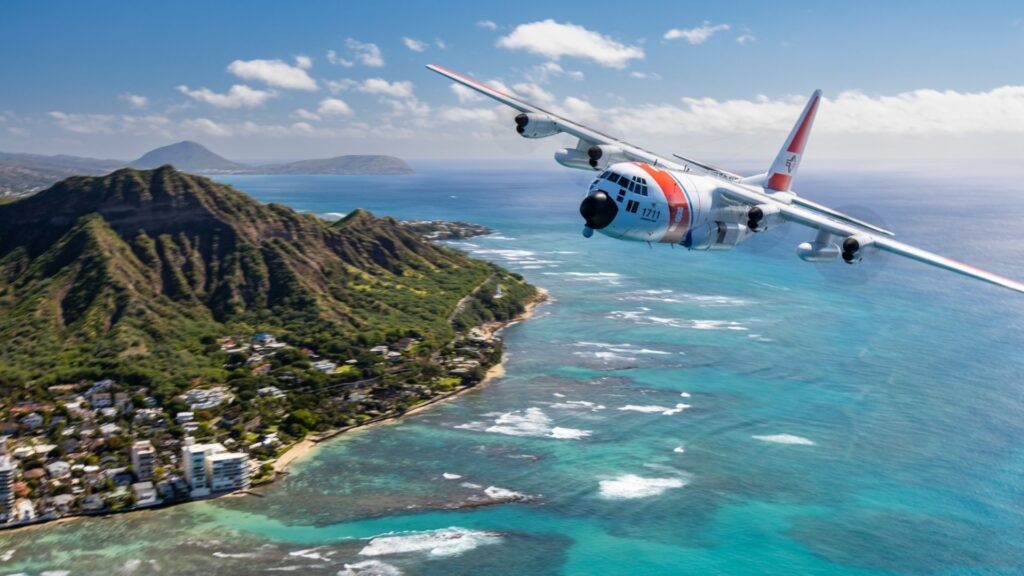
The OTH casualty significantly reduced Resolute’s interdiction capability and required a rapid solution in a logistically challenging area of operations. Demonstrating remarkable interagency cooperation and logistical agility, the crew of Resolute worked with JIATF-S, the Coast Guard’s Surface Forces Logistics Center (SFLC), and U.S. Coast Guard Air Station Elizabeth City, to swiftly coordinate the replacement of the OTH. The replacement boat was airlifted to Panama City, Panama, aboard a U.S. Coast Guard HC-130J Super Hercules aircraft. Demanding precise timing and expert execution, the undertaking powerfully underscored the Coast Guard’s dedication to maintaining a persistent and effective presence in its counter-narcotics mission. With the replacement OTH safely cradled aboard the cutter, Team Resolute was able to resume and successfully complete their patrol in the Eastern Pacific drug smuggling vectors.  

“Yet again, the crew impressed me with their ability to achieve significant operational success and protect American interests while fighting every day to maintain a nearly 60-year-old ship in a challenging maritime environment,” said Cmdr. Ian Starr, Resolute’s commanding officer.  

Resolute is a 210-foot, Reliance-class medium-endurance cutter. The cutter’s primary missions are counter drug operations, migrant interdiction, and search and rescue in support of U.S. Coast Guard operations throughout the Western Hemisphere. For information on how to join the U.S. Coast Guard, visit GoCoastGuard.com to learn about active duty, reserve, officer, and enlisted opportunities. Information on how to apply to the U.S. Coast Guard Academy can be found here.  

These interdictions relate to Organized Crime Drug Enforcement Task Forces’ (OCDETF), Strike Force Initiatives and designated investigations. OCDETF identifies, disrupts, and dismantles the highest-level criminal organizations that threaten the United States using a prosecutor-led, intelligence-driven, multi-agency approach. Additional information about the OCDETF program can be found at https://www.justice.gov/OCDETF.   

For information on how to join the U.S. Coast Guard, visit GoCoastGuard.com to learn about active duty, reserve, officer, and enlisted opportunities. Information on how to apply to the U.S. Coast Guard Academy can be found here.    

For breaking news, follow Coast Guard District 7 on X (formerly Twitter). For more information, follow us on Facebook, Instagram, and also follow Coast Guard Atlantic Area on Facebook, Instagram and X.    

-USCG-   


Coast Guard Cutter Reliance Returns Home to Florida After 60-day Patrol

 Coast Guard Cutter Reliance (WMEC 615) small boat crew conducts operations in the Gulf of America, July 15, 2025. Reliance’s crew completed a 60-day maritime border security patrol to deter illegal migration, fishing, and smuggling in the region. (U.S. Coast Guard photo by Ensign Jack Steel)

From U.S. Coast Guard Atlantic Area

PENSACOLA, Fla. — The crew of the Coast Guard Cutter Reliance (WMEC 615) returned to their home port in Pensacola, Friday, following a 60-day maritime border security patrol in the Gulf of America. 

Reliance’s crew deployed to the Coast Guard Heartland District’s area of responsibility in support of maritime safety, security and environmental protection, where crew members conducted extensive operations along the U.S. – Mexico maritime border to protect American sovereignty and territorial integrity. While at sea, the crew worked to deter illegal migration, fishing and smuggling while increasing awareness of all maritime activity in the region. 

During the patrol, Reliance’s crew visited Galveston, Texas, near where the cutter was constructed in 1964. While in Galveston, the crew hosted free public tours over Independence Day weekend, welcoming over 800 members of the public on board for an up-close look at life aboard a Coast Guard cutter while providing informational materials to prospective recruits. 

Additionally, Reliance’s crew was honored to receive a visit from Master Chief Petty Officer Michael Koch, command master chief, Coast Guard Heartland District, who recognized Reliance’s very own Petty Officer 1st Class Cody Scott, a storekeeper on board, as the Heartland District 2024 Enlisted Person of the Year. 

“I am incredibly proud and impressed by the Reliance crew’s professionalism, resilience and skill, which they demonstrated throughout this patrol,” said Cmdr. Kevin Robinson, commanding officer of Reliance. “Their unwavering dedication to protecting our nation’s marine resources and deterring illegal activity at our maritime border reflects the very best of the Coast Guard. Their efforts not only safeguarded American lives and livelihoods but reinforced the Coast Guard’s commitment to mission excellence in maritime safety and security.” 

Reliance is a 210-foot, Reliance-class medium-endurance cutter with a crew of 77. The cutter’s primary missions include counter-narcotics and alien interdiction, enforcement of living marine resource laws, and search and rescue throughout the Western Hemisphere. 

For information on how to join the U.S. Coast Guard, visit GoCoastGuard.com to learn about active duty, reserve, officer and enlisted opportunities. Information on how to apply to the U.S. Coast Guard Academy can be found here.   

For more, follow us on Facebook, Instagram and X.   


U.S. Coast Guard, USS Sampson Conduct Drug Interdiction in Eastern Pacific 

PACIFIC OCEAN (July 10, 2025) Service members aboard the Arleigh Burke-class guided-missile destroyer USS Sampson (DDG 102) haul seized contraband to a secured space in the Pacific Watch mission, July 10, 2025. (U.S. Navy photo by MCSN Maliq Martin) 

Release From U.S. Pacific Fleet

PACIFIC OCEAN  –  The U.S. Coast Guard, in coordination with the U.S. Navy destroyer USS Sampson (DDG 102), interdicted two suspected drug smugglers, and seized approximately 3,439 pounds of cocaine in international waters of the Eastern Pacific Ocean July 10. 
 
While on routine patrol, the Sampson detected a go-fast vessel approximately 380 miles southwest of Acapulco, Mexico. The vessel displayed no indication of nationality and was operating in a known drug trafficking corridor. Its appearance and behavior aligned with known maritime smuggling trends, raising further suspicion. 
 
Tactical control of the Sampson was transferred from U.S. Third Fleet to Coast Guard Southwest District for interdiction and apprehension authority. When the U.S. Navy MH-60R Sea Hawk helicopter, assigned to the “Scorpions” of Helicopter Maritime Strike Squadron (HSM) 49, launched from the Sampson and signaled its presence, the suspects aboard began jettisoning packages into the ocean. After warning shots were ineffective, the helicopter crew employed disabling fire, successfully stopping the vessel. 
 
The Sampson launched two boarding teams, which recovered several of the jettisoned packages and took positive control of the suspect vessel. Coast Guard law enforcement personnel conducted a boarding and determined the vessel to be without nationality, granting authority for a full law enforcement boarding. 
 
The two suspected drug smugglers were taken into custody, and field tests confirmed the presence of cocaine aboard the go-fast. 
 
Due to the vessel’s lack of tow points, absence of navigation lights, and poor seaworthiness, the Coast Guard deemed it a hazard to navigation and authorized the sinking of the vessel. 
 
Tactical control of the USS Sampson has since been returned to U.S. Third Fleet for continued operations. 
 
The Coast Guard routinely partners with U.S. Navy and interagency assets to counter transnational criminal organizations operating in the maritime domain. 
 
Sampson is employed under U.S. Northern Command’s maritime homeland defense authorities with a Coast Guard Law Enforcement Detachment embarked to enable maritime interdiction missions to prevent the flow of illegal drugs and other illegal activity. U.S. Northern Command is working together with the Department of Homeland Security to provide additional military forces and capabilities at the southern border. 


SECDEF Announces Flag and General Officer Nominations 

Release From the U.S. Department of Defense

Secretary of Defense Pete Hegseth announced today that the president has made the following nominations: 

Marine Corps Lt. Gen. Michael J. Borgschulte for reappointment to the grade of lieutenant general, with assignment as superintendent, U.S. Naval Academy, Annapolis, Maryland. Borgschulte is currently serving as deputy commandant, Manpower and Reserve Affairs, Quantico, Virginia. 

Marine Corps Maj. Gen. Christian F. Wortman for appointment to the grade of lieutenant general, with assignment as commanding general, I Marine Expeditionary Force, Camp Pendleton, California.  Wortman is currently serving as the commanding general, 3d Marine Division, Okinawa, Japan. 

Navy Vice. Adm. Yvette M. Davids for reappointment to the grade of vice admiral, with assignment as deputy chief of Naval Operations for Operations, Plans, Strategy, and Warfighting Development, N3/N5/N7, Office of the Chief of Naval Operations, Pentagon, Washington, D.C.  Davids is currently serving as superintendent, U.S. Naval Academy, Annapolis, Maryland.  

Navy Rear Adm. Jeffrey J. Czerewko for appointment to the grade of vice admiral, with assignment as deputy chief of Naval Operations for Personnel, Manpower, and Training, N1, Office of the Chief of Naval Operations and Chief of Naval Personnel, Arlington, Virginia. Czerewko most recently served as commander, Naval Education and Training Command, Pensacola, Florida. 

Navy Rear Adm. John E. Dougherty IV for appointment to the grade of vice admiral, with assignment as commander, Naval Air Systems Command, Patuxent River, Maryland.  Dougherty is currently serving as commander, Naval Air Warfare Center, Aircraft Division/ chief engineer, Naval Air Systems Command, Patuxent River, Maryland. 

Navy Rear Adm. (lower half) Michael S. Sciretta for appointment to the grade of rear admiral.  Sciretta is currently serving as director, Maritime Operations, U.S. Fleet Forces Command, Norfolk, Virginia. 

Space Force Lt. Gen. Shawn N. Bratton for appointment to the grade of general, with assignment as vice chief of space operations, U.S. Space Force, Pentagon, Washington, D.C.  Bratton is currently serving as deputy chief of Space Operations for Strategy, Plans, Programs, and Requirements, Pentagon, Washington, D.C. 


USS Santa Fe and JMSDF Submarine Conduct Bilateral Exercise 

PACIFIC OCEAN (July 12, 2025) – The Los Angeles-class fast-attack submarine USS Santa Fe (SSN 763) and a Japan Maritime Self-Defense Force (JMSDF) submarine steam alongside one another during Submarine Exercise (SUBEX) 25-1, in the Pacific Ocean, July 12, 2025. (Photo courtesy of JMSDF.) 

By MC2 Daniel Providakes 

YOKOSUKA, Japan  –  The Los Angeles-class fast-attack submarine USS Santa Fe (SSN 763) and a Japan Maritime Self-Defense Force (JMSDF) submarine conducted Submarine Exercise 25-1 (SUBEX) in the Pacific Ocean, July 12, 2025. 
 
This bilateral exercise portrayed the interoperability and cooperation between the U.S. Navy and JMSDF, showcasing Santa Fe and the JMSDF submarine’s capability to work together while underway in the Indo-Pacific. 
 
“We enjoy a strong bond with our dear partners and friends in the Japanese Submarine Force,” said Rear Adm. Lincoln Reifsteck, commander, Submarine Group 7 (CSG 7). “This submarine exercise is just one of dozens of operations our combined forces are planning or executing day in and day out. We take every opportunity to enhance the integration of our undersea forces, reaffirming our commitment to a shared vision of peace and prosperity for our allies and partners in the Indo-Pacific region.” 
 
SUBEX 25-1 was a two-day exercise conducted in the vicinity of Yokosuka between the U.S. Navy and JMSDF, in order to make significant advancements in the joint submarine capabilities and operations. Exercises like this bolster the U.S. and JMSDF momentum in critical undersea warfare and mutual defense. 
 
Both submarine forces continue to work together and progress every day to seamlessly interoperate with each other. This dedication to mutual understanding and shared values of peace and security in the Indo-Pacific reflects the steadfast bonds between the two silent services. 
 
Santa Fe, homeported in San Diego, California, and assigned to Submarine Squadron 11, is conducting routine operations in the U.S. 7th Fleet area of operations. 
 
CSG 7 directs forward-deployed, combat capable forces across the full spectrum of undersea warfare throughout the Western Pacific, Indian Ocean, and Arabian Sea. 
 
U.S. 7th Fleet is the U.S. Navy’s largest forward-deployed numbered fleet, and routinely interacts and operates with allies and partners in preserving a secure and prosperous Indo-Pacific region. 
 
For more news from Commander, Submarine Group 7, visit www.csp.navy.mil/csg7/ 


Scientific Systems Introduces VENOM Autonomous Small USV 

From Scientific Systems  

VENOM Is Cost-Effective, Quickly Built With Rapidly Scalable Manufacturing, And Designed To Meet The U.S. Navy’s Need For sUSV Interceptors 

BURLINGTON, Mass., July 15, 2025 – Scientific Systems, an industry leader in developing AI-powered autonomy for defense applications announced today the debut of its Vehicle for Expeditionary Naval Over-the-Horizon Missions (VENOM) small Unmanned Surface Vehicle (sUSV.) Designed to address the Navy’s operational need for sUSV interceptors, VENOM has effectively demonstrated its seakeeping performance and autonomy behaviors during sea trials and is available now for procurement by the Department of Defense and other government agencies.  

VENOM is a multi-mission, 9-meter-long unmanned surface vehicle, featuring a rugged High-Density Polyethylene (HDPE) hull and a 300HP outboard diesel engine. The sUSV delivers over 35 knots of sprint speed, a greater than 500-nautical-mile range at 24 knots in moderate sea state, and a loiter capability of 130 hours, surpassing the expected requirements of the Navy.  VENOM has demonstrated the ability to autonomously transit through contested water space, avoiding static and moving obstacles, loiter in an assigned operating area while monitoring for maritime surface threats, and then sprinting to interdict a noncooperative, maneuvering vessel, making it ideal for missions including force protection (kinetic and non-kinetic), persistent ISR, contested logistics, and maritime patrols & security. 

As an innovative, non-traditional autonomy software company, Scientific Systems joined forces with best-in-class teammates Tideman Marine and Sea Machines to deliver this software-centric unmanned surface vehicle.  With manufacturing readiness secured, the team is prepared to rapidly scale delivery of this affordable, unmanned surface vehicle to meet anticipated Department of Defense needs. 

“Scientific Systems was honored to work with partners to successfully test and qualify our production-ready, low-cost, autonomous VENOM interceptor that can travel hundreds of miles though contested water space,” said Scientific Systems Chief Executive Officer Kunal Mehra. “The fact that Scientific Systems is leading a team of partners for this vehicle underscores the reality that the future of warfare is software driven. We are proud to continue to develop the type of cutting-edge autonomous solutions the U.S Navy needs to confront a new generation of threats at sea.”  

VENOM features a hull made from high-density polyethylene (HDPE), providing exceptional durability and strong resistance to hull fouling. Partner Tideman Marine is the world leader in welded HDPE vessel construction in terms of total number of boats, total number of contracts, and pedigree of success. 

Designed to meet future demands, VENOM is architected to enable mission-level collaboration amongst large numbers of autonomous vessels – a key enabler of the Navy’s vision for large scale USV operations. 

Further information about the VENOM unmanned surface vehicle is available on the Scientific Systems website


Integer Technologies, University of Southern Mississippi Announce $25M Defense Contract 

From Integer Technologies, July 16, 2025  

Partnership will advance Navy’s decision-making tech for autonomous seabed warfare 

Gulfport, Miss. — July 16, 2025 — Integer Technologies and the University of Southern Mississippi announce the Office of Naval Research has awarded their team a $25 million ceiling contract, with a fully funded initial base period of $4.3 million. The applied research contract supports the development of novel software to help the U.S. Navy maintain maritime dominance and increase its seabed warfare capabilities. 

The program, titled Intelligent Autonomous Systems for Seabed Warfare, will enhance underwater missions and data collection for unmanned vessels by improving their decision-making capabilities at the edge. This will allow unmanned vessels to adapt more effectively to changing environmental conditions and improve their ability to identify objects on the seafloor. 

This program will develop innovative technology for unmanned underwater systems that can autonomously make sense of large, high-dimensional data sets in real-time. This technology augments the Navy’s ability to conduct unattended missions with unmanned and autonomous platforms. 

Increasing the independence, flexibility, and intelligence of these platforms provides the U.S. fleet with the reliable autonomous operations needed to achieve their mission and national security goals. 

Integer and USM will work together to develop a full solution that includes edge-deployed software tools that can assess environmental, platform, and mission data to make decisions about how to best collect and process complex datasets. They will develop predictive tools that leverage advances in artificial intelligence and machine learning (AI/ML) that can enable unmanned platforms to adapt their missions in real-time. 

The program combines USM’s strengths in ocean engineering and oceanography with Integer’s expertise in creating predictive software models for unmanned platforms that combine data, physics, and AI to deliver decision advantage in uncertain environments. 

As part of this program, Integer has established an office at USM’s Roger F. Wicker Center for Ocean Enterprise Facility (Wicker Center) in Gulfport, Miss. This location allows for close collaboration between USM’s and Integer’s engineers and scientists, and convenient access for in-water testing in the Gulf of America. 

“This is an ideal moment for this research on software for ocean sensing and seabed warfare. USM’s oceanography expertise will combine with Integer’s predictive technology to help us explore and master the ocean floor, earth’s last frontier. These unmanned, subsurface vessels will boost the United States’ edge in undersea warfare and support the bustling blue economy along Mississippi’s coast,” said U.S. Senator Roger Wicker, the Chairman of the Senate Armed Services Committee. 

“The Navy’s investment in cutting-edge seabed warfare technology in Mississippi reflects well on the critical role our state continues to play in advancing our national security,” U.S. Senator Cindy Hyde-Smith said. “The partnership between Integer Technologies and the University of Southern Mississippi will not only strengthen the Navy’s capabilities, but also bring high-skill jobs and research opportunities to the Gulf Coast. I’m proud to support initiatives that position Mississippi as a leader in defense innovation and that create opportunities for our students, engineers, and scientists.” 

“Integer’s presence in Gulfport will be the epicenter of our work to deploy and test AI-driven software on maritime unmanned systems,” said Duke Hartman, Chief Executive Officer & Cofounder at Integer. “We are grateful to Senators Wicker and Hyde-Smith, USM, and all those in the South Mississippi community who supported this investment in the state. The beautiful Wicker Center offers direct ocean access where our team of Gulfport-based engineers will work alongside USM’s ocean scientists to make unmanned systems more intelligent and effective for our military and commercial customers.” 

“This award demonstrates The University of Southern Mississippi’s reputation as a leader in ocean research and blue economy innovation,” said Kelly Lucas, Ph.D., Vice President for Research at Southern Miss. “By establishing operations at the Roger F. Wicker Center for Ocean Enterprise, Integer Technologies is bringing high-skill jobs to the Gulf Coast and creating a technology ecosystem that will attract additional partners and investments. This program exemplifies how university-industry partnerships can drive both scientific advancement and economic development in Mississippi.” 


Pentagon to Increase Low-Cost Drone Production in U.S. 

July 16, 2025 | By David Vergun, DoD News  

The Defense Department, with help from industry, will ramp up production and fielding of drones to maintain battlefield superiority.  

Today at the Pentagon, 18 American-made drone prototypes were on display.  

Defense Secretary Pete Hegseth, who toured the displays, said the drones that are manufactured using off-the-shelf components for rapid production are examples of disruptive thinking.  

Emil Michael, undersecretary of defense for research and engineering, said the prototypes on display went from concept to development in just an average of 18 months, a process that normally takes up to six years.  

The department will continue to rapidly innovate and scale up production of drones and other systems using cost, resilience, firepower and range as driving factors, which are areas DOD wants to improve upon, Michael said.  

Hegseth said in a July 10, 2025, memorandum that he’s rescinding restrictive policies that hindered drone production.  

“Drones are the biggest battlefield innovation in a generation, accounting for most of this year’s casualties in Ukraine. Our adversaries collectively produce millions of cheap drones each year,” he said, noting the U.S. military is lacking needed quantities of lethal small drones.  

The secretary said there are three goals:  

  • Prioritizing the purchase of American-made drones and parts with help from industry’s private capital;  

  • Arming combat units with low-cost drones made by America’s world-leading engineers and artificial intelligence experts; and  

  • Training with drones in realistic battlefield scenarios, led by leaders who are not risk averse.  

President Donald J. Trump signed a June 6, 2025, executive order to speed up U.S. drone production using the latest innovative industry technologies.  

The president said he supports reducing regulatory uncertainty and streamlining approval and certification processes for safe and secure drone production.  

Also, the Federal Aviation Administration and DOD will coordinate to streamline the approval processes to expand access to airspace for conducting drone training, Trump said.  


Blue Water Autonomy Opens Office in DC, Hires Leader From DARPA’s NOMARS 

BOSTON, July 17, 2025 /PRNewswire/ — Blue Water Autonomy, Inc., the technology company building autonomous ships for the U.S. Navy, today announced the opening of a Washington, D.C. office and the hiring of Ryan Maatta, a principal engineer with broad and recent experience delivering the most advanced autonomous ships. 

“The establishment of Blue Water Autonomy’s Washington, D.C. office is a natural next step for us,” said CEO Rylan Hamilton. “This third location supports our growing company and increases our workforce options while improving Blue Water’s accessibility for our Navy customer.” 

The expanded footprint in the capital comes as Blue Water Autonomy’s unmanned ship segment shows increased urgency and attention. The latest defense budget authorization includes $2.1B in Medium Unmanned Surface Vessel funding, and the U.S. Navy recently held a Future Unmanned Surface Vessel industry day to outline its plans for new vessel development. 

Blue Water Autonomy also announced the addition of Ryan Maatta to its growing team. Ryan brings decades of marine engineering and operations experience, and most recently held a senior technical leadership on USX-1 Defiant – the vessel built for DARPA’s No Manning Required Ship (NOMARS) Program. 

“We’re a team of hands-on builders, and his multiple shipboard tours as chief engineer makes him a great addition to the team,” said CTO Scott N. Miller. Miller, who has taken 100+ commercial products to market, including iRobot’s Roomba, leads Blue Water Autonomy’s growing technology team, many of them veterans of Boston’s robotics hub. Maatta’s arrival comes just weeks after Blue Water welcomed COO Tim Glinatsis, formerly of General Dynamics NASSCO and Bath Iron Works. 


USS Toledo Arrives at Joint Base Pearl Harbor-Hickam

JOINT BASE PEARL HARBOR-HICKAM, Hawaii (July 12, 2025) – Los Angeles-class fast-attack submarine USS Toledo (SSN 769) arrives at Joint Base Pearl Harbor-Hickam during its change of homeport, July 12, 2025. (U.S. Navy photo by Mass Communication Specialist 1st Class Scott Barnes) 

From MC1 Scott Barnes of Commander, Submarine Force, U.S. Pacific Fleet, July 12, 2025 

The Los Angeles-class fast-attack submarine USS Toledo (SSN 769) arrived at its new homeport of Joint Base Pearl Harbor-Hickam, from its previous homeport of Portsmouth, Virginia, July 12, 2025. The Toledo joined Submarine Squadron 7 as their fourth Los Angeles-class fast-attack submarine. 

“Our crew is excited to finally arrive in Pearl Harbor after completing an important maintenance period in Hampton Roads,” said Cmdr. Dustin Kraemer, commanding officer of the Toledo. “Our crew looks forward to the new chapter for Toledo and the opportunities while operating throughout the Indo-Pacific.” 
 

The Toledo returned to the fleet April 19, 2025, following successful completion of its engineered overhaul at Norfolk Naval Shipyard. The maintenance period included refurbishment and modernization to extend the submarine’s operational life in support of operations throughout the Indo-Pacific. 
 
Rear Adm. Chris Cavanaugh, commander, Submarine Force, U.S. Pacific Fleet, welcomed the Toledo to Pearl Harbor, stating, “The Toledo team has demonstrated professionalism and commitment in completing their extended maintenance and getting the ship back to sea. Toledo joins the Pacific Submarine Force as a tested and capable submarine for years to come.” 
 
Capt. Corey Poorman, commander, Submarine Squadron 7, met the Toledo pierside upon arrival to welcome the crew to the island. “The Squadron 7 Ohana enthusiastically welcomes the crew and families of the Toledo with Hawaii’s enriched culture and spirit of aloha,” said Poorman. “Our team looks forward to continuing the training and certification of Toledo’s crew in defense of our nation and its allies and partners.” 
 
Commissioned on Feb. 24, 1995, the Toledo was named for the city of Toledo, Ohio. The submarine has a crew of approximately 12 officers and 98 enlisted Sailors. The Toledo’s ability to support a multitude of missions, to include anti-submarine warfare, anti-surface ship warfare, intelligence, surveillance and reconnaissance, and strike warfare, makes Toledo one of the most capable submarines in the world. 
 
Submarine Squadron 7 is responsible for providing training, material, and personnel readiness support to two Virginia-class submarines and four Los Angeles-class submarines. 
 
The U.S. Pacific Fleet Submarine Force provides strategic deterrence, anti-submarine warfare, anti-surface warfare, precision land strike, intelligence, surveillance, reconnaissance, and early warning, and special warfare capabilities around the globe.