One Day Before Departure, Phelan Touted Need for New Budget, New Business Practices, New Battleship
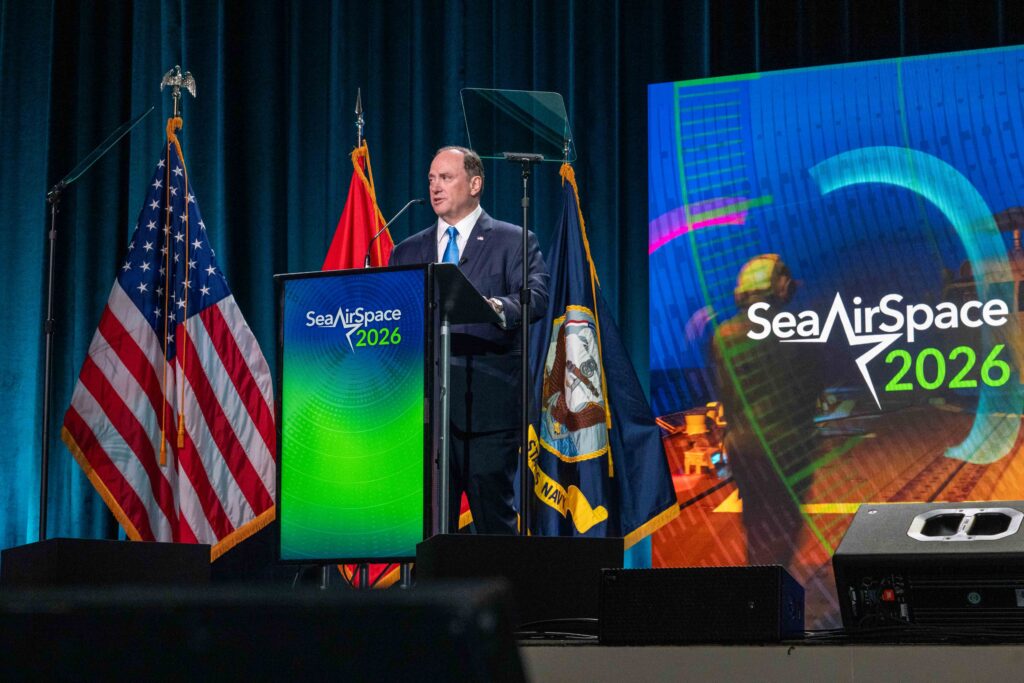
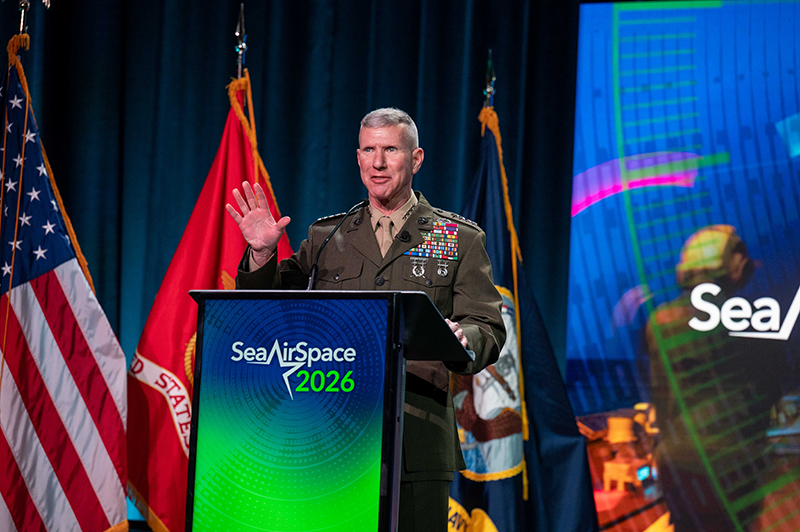
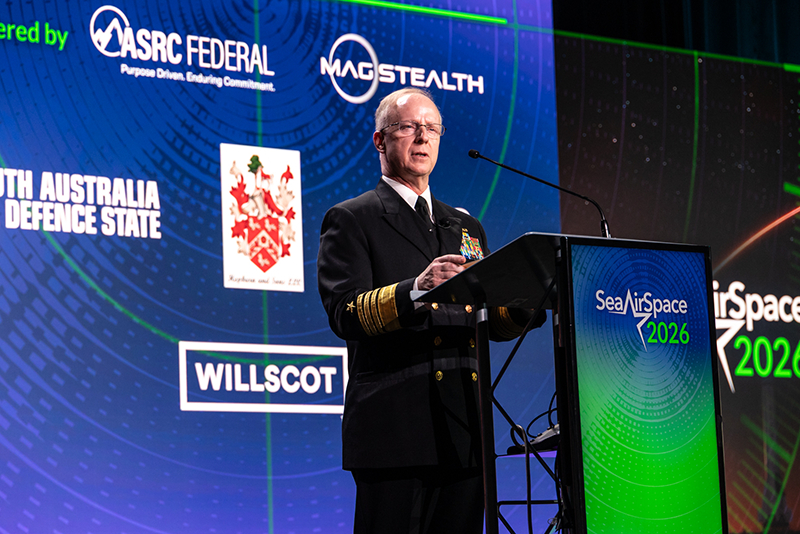
Then-Secretary of the Navy John Phelan delivers a keynote address just hours before unexpectedly departing the job. Photo credit: Laura Hatcher.

Editor’s note: This story appeared April 21 in Seapower’s Show Daily at Sea-Air-Space. On April 22, Pentagon Spokesman Sean Parnell announced on X that John Phelan was leaving the administration; other media reports said he had been forced out. Undersecretary of the Navy Hung Cao is now acting secretary of the Navy. This article is about his keynote speech at Sea-Air-Space.

On the day the Pentagon released a $1.5 trillion fiscal 2027 defense budget, Navy Secretary John Phelan addressed Sea-Air-Space and said the Department of the Navy needs a budget, not a series of continuing resolutions from Congress.

Phelan also defended the controversial planned Trump-class battleship, saying it brings a needed capability and would anchor the new “high-low” Golden Fleet concept outlined the day before by Chief of Naval Operations Admiral Daryl Caudle, speaking from the same stage.

Phelan also echoed Caudle in saying doing business with the Navy must change, which is why the service recently announced a new portfolio acquisition executive (PAE) structure, appointing five senior leaders to act as single accountable officials for key domains to accelerate capability delivery and keep a lid on costs.

Phelan said he will soon testify on the budget on Capitol Hill and will tell lawmakers a continuing resolution — a budget carrying forward current levels of spending — “would have extremely negative consequences for the DoN. It’s like running a business and not being able to charge what your competitors do,” he said. “Continuing resolutions impose constrained short-term funding conditions that force legacy program tradeoffs and impact our ability to innovate and therefore our readiness over time.”

The Golden Fleet initiative “is about delivering the fleet of the future through three mutually reinforcing pillars. One, to maintain and enhance maritime dominance. Two, revitalize the maritime industrial base and three, change how the Department of the Navy does business,” Phelan said.

The initiative includes the proposed Trump-class battleship, or BBG(X), certain to be a target of some in Congress.

“I know the question many of you and the pundits are asking, why battleships, and why now? The answer is straightforward and grounded in the realities of high-end conflict in shaping the next large surface combatant,” he said.

Phelan said he has discussed the issue with top admirals and commanders and said they don’t want to have to choose between air defense, anti-ship warfare, anti-submarine warfare or long-range strikes.

“Battleship strike groups will offer commanders more options than what exists in today’s fleet,” he said. The ships would be “built to fight and stay in the fight by sustaining fires, maintaining pressure and outlasting any adversary … these are not capabilities you can fully distribute across smaller systems alone.”

Phelan said he has heard the critiques of the proposed battleship, that it would be too vulnerable, too expensive, too big. “We’ve heard that before about carriers and about submarines and yet when it matters most, those are the platforms that combatant commanders call for.”

However, he said the battleship would be just a “small part” of the Golden Fleet and would operate as part of a distributed network that would include smaller ships, crewed and uncrewed.

“This is not about replacing the fleet … the strategic reality is that manned platforms combined with unmanned systems, acting interchangeably, is the most powerful winning combination.”

Reviews from Carriers to Barracks

In a roundtable interview with reporters after the keynote speech, Phelan said the Navy is studying all aspects of how it does business, from planning the battleship to building barracks for Sailors more efficiently.

Phelan said the Navy is reviewing CVN 82 and 83, the next Ford-class carriers “to review the costs, the designs, the systems, to make sure that they make sense and they have all the systems and requirements that we want going forward,” a study he said should wrap up next month.

“I think one of the things we have to do a better job of in the Navy is kind of what I call total cost of ownership. So, what does it really cost to sustain and maintain these things? … To be honest, we’re reviewing every program, so the carrier’s just one of them.

“We’re doing the same thing in maintenance. We’re doing the same thing on infrastructure. We’re doing the same thing on milcon [military construction]. I’m still trying to understand why barracks cost, you know, on average more than $1,500 a foot, right? That’s insane.”

The budget proposal aims to improve the military industrial base to, among other things, improve submarine production rates. Phelan said that will be a challenge bigger than improving the production rate of surface ships.

“The submarines [are] a challenge because it’s one of the most complicated things I have seen, having been in there and looking at it, and I’ve been to a lot of places, including SpaceX, etc. This thing’s an underwater space station in effect, if you really look at it, particularly the Columbia.”

Phelan said he has walked a lot of shipyards and “I see a lot of machinery from the 1960s and I see 1980s practices. For example, when a welder runs out of materials, they’re not right next to ’em. They’re sometimes in another building a mile away. Bathrooms are not in the same building. These are things that slow down time on the deck plate.”

Phelan also said the Navy is looking at having some of its ships built by foreign partners, an idea President Trump has raised as a possibility.

“We are going to study that and take a hard look at it,” he said. It might make sense for foreign shipyards to build support ships, or to build modules for combatant ships. The United States will be looking at ships that are rapidly producible and could “hit the fleet fast, so that would tend to lead you more to the Koreas, Japans of the world,” he said. “I guess I would say everything’s on the table. We just need to look at it, understand it, understand the implications be
OMB’s Vought: Industry Must Share Blame for Shipbuilding Woes

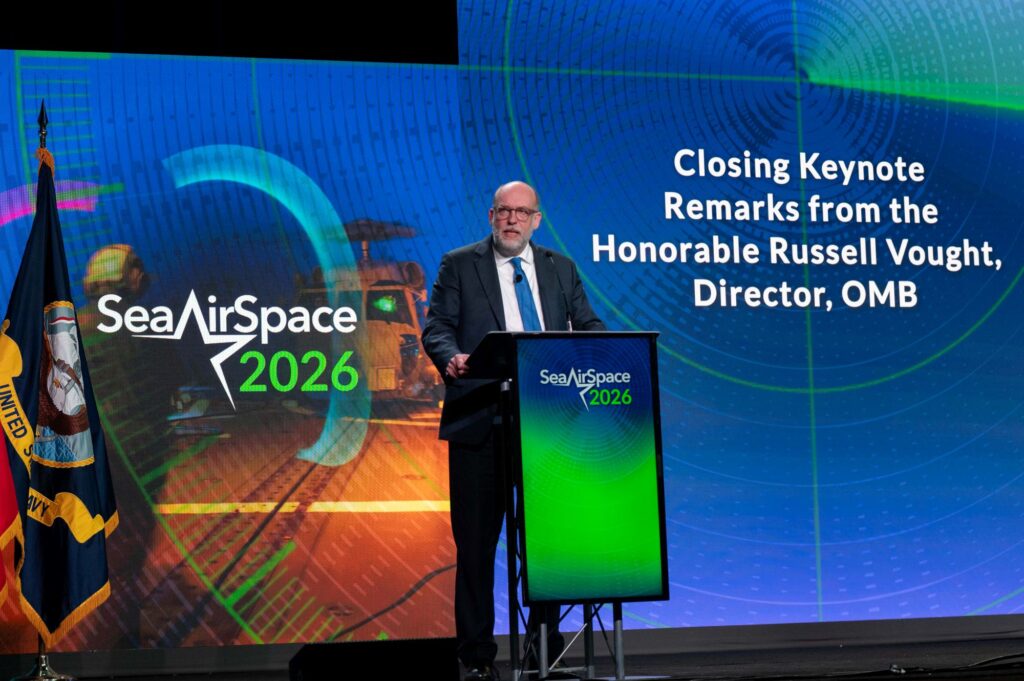
OMB Director Russell Vought discusses shipbuilding investment in the closing keynote of Sea-Air-Space. Photo credit: Laura Hatcher

The shipbuilding industry must share the blame for delays in shipbuilding and the Trump administration is willing to look beyond the traditional industry if it can’t produce products on time and within budget, OMB Director Russell Vought said at the closing keynote of Sea-Air-Space 2026.

Vought — who also served in his role in the first Trump administration — said, “during the first term, I came to believe that we had a demand signal problem. My view was that we, the government, we the customer, had failed to deliver a consistent demand signal to industry over successive appropriation cycles, and it was because of this inconsistency that production rates could not be more ambitious. I no longer believe that, because if you look back over the last administration, Congress provided sustained resources for shipbuilding but productivity went down, not up.”

Vought said the problem has been a long time coming and has two major sources.

“First was the now legendary ‘last supper’ meeting in which Bill Clinton’s secretary and deputy secretary of defense convened the CEOs of America’s largest defense companies and told them essentially to merge or die,” Vought said. “This decision, based on an end-of-history mindset, represents a strategic mistake of staggering proportions that it resulted in 105 large defense firm being reduced down to essentially seven major primes, with a resultant loss in capacity and competition.”

The second major influence that exerted what Vought called a major negative impact on the operations of large defense firms in the 1990s was the transition from “founder engineers” in the C suite, “men who understood the founding culture of their organizations,” with executives who were “heavily influenced by the philosophies coming out of consulting firms that placed an absolute priority upon ownership, interest in stock prices and dividends to the detriment of both the customer, which is to say the government, and the workforce.”

The latter reason is why President Trump signed an order prohibiting companies from paying dividends or conducting stock buybacks “until such time as they are able to provide a superior product on time and on budget.”

The administration is also willing to look overseas and to non-traditional shipbuilding yards for ships, Vought said, citing an agreement with Finland for 11 new icebreakers that would include four built in Finland and the rest built in U.S. shipyards after they modernize their facilities.

“This overall effort will not only produce ships for our Coast Guard but also result in American shipyards with more heavy industrial capacity into the future. These icebreakers will help to put the heavy back into America’s heavy industry, but they will also result in shipyards that can compete for other programs to include surface combatants into the future,” Vought said.

The new defense budget includes sizable investments for buying new ships — 18 battle force ships and 16 support ships for the Navy, more for the Coast Guard and Army and other agencies — but Vought warned traditional shipbuilders to step up or they may be procured elsewhere.

“Most of these ships can be built to commercial standards in a number of our nation’s shipyards that are not already tasked and behind schedule with Navy contracts,” Vought said.  “Some of these ships need to be bought in large numbers and could attract direct foreign investment that will meet the president’s goal of both adding capacity and competition to the U.S. shipbuilding sector.

“To be clear, we need more ships and we need them right now. We hope this year’s budget on top of the 82 ships we already received in [fiscal] ‘26 in the one Big Beautiful Bill convey that sense of urgency on the part of President Trump and his administration. If we cannot get the ships we need from traditional sources at cost and on time, we will get them from other shipyards.”


Coast Guard Poised to Meet Great Expectations

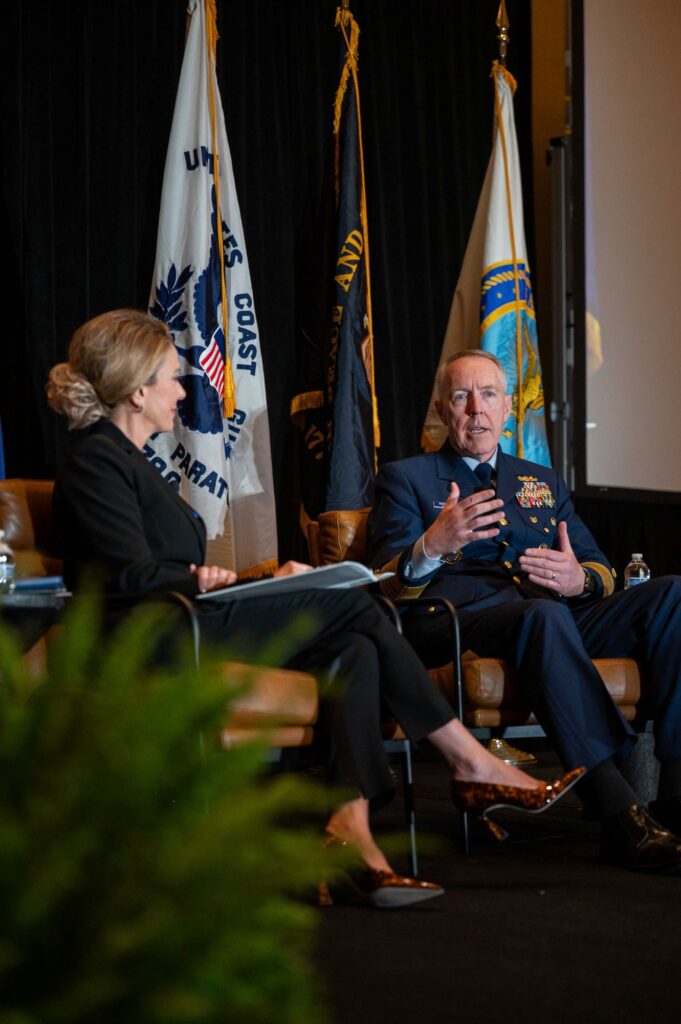
U.S. Coast Guard Commandant Admiral Kevin E. Lunday addresses the service’s successes and challenges at Sea-Air-Space. Photo credit: Laura Hatcher

The U.S. Coast Guard is quickly allocating an unprecedented $24.6 billion funding infusion provided to the Department of Homeland Security agency in last year’s budget reconciliation bill. At the same time, the armed services branch is shuttered, caught in the political crossfire over the actions of another DHS entity, Immigration and Customs Enforcement.

In describing this bizarre situation to a Sea-Air-Space 2026 audience on April 22, the 28th Coast Guard Commandant, Admiral Kevin E. Lunday, looked to Charles Dickens, who opens “A Tale of Two Cities” with the famous lines, “it was the best of times, it was the worst of times. …”

“We want to get those worst of times out of here,” he said in a conversation with ABC News correspondent Kyra Phillips on the closing day of the conference. Lunday urged Congress to fund the Coast Guard to “ensure our readiness but pay our people.”

Citing an emergency authority, the White House directed DHS to cut checks to personnel across the agency, including affected members of the Coast Guard, a temporary solution that most agree is not a substitute for annual appropriations.

Promise Amid the Peril

Despite the funding stoppage, Lunday said it’s still an “amazing time for our service.”

That’s in part thanks to the nearly $25 billion from the reconciliation bill, which is funding long-deferred shipbuilding and modernization efforts at the agency, which Lunday has led since Jan. 15, 2026.

Lunday said the Coast Guard relies on an aging fleet — including 50-year-old cutters — to conduct much of its work. For instance, this year these stalwart vessels freed frozen shipping lanes in the New England, New York and Great Lakes regions so ships could deliver essential cargo like home heating oil and other goods.

“Keeping commerce moving is a constant, constant effort,” he said. “In fact, it’s one of the most important, but maybe one of the things that is not aways seen.”

These operations have continued amid a decades-long downward spiral in readiness, Lunday said. He said the Coast Guard requires about $20 billion in annual funding but has in recent years received just under $13 billion per year.

To reverse that trajectory, Lunday’s team knew they needed to get the new cash out the door quickly. To do this, the service created an acquisition “super highway” to accelerate the shipbuilding acquisitions process.

The Coast Guard has already obligated $9 billion of the new money, with three new heavy icebreakers and 11 new Arctic security cutters set to roll off the U.S. shipyards starting in 2028.

“No one is moving that fast,” Lunday said.

Topline Annual Appropriations

However, it’s critical that Congress also support the president’s fiscal 2027 budget request of $15.6 billion to build on the one-time cash injection from the reconciliation bill, he said. The plus-up in yearly funding is necessary for homeports, hangars, facilities and other infrastructure to support the roughly 100 new assets funded through the bill, he said.

That includes funding to train, hire and support the families of roughly 1,300 additional personnel needed to crew the new vessels.

“And the ’27 budget request goes a long way to do that,” he said. “But we’re going to need to continue to see that topline growth, not only in the operating funds but continued investments in capital assets to be able to meet the demands of the American people.”

The Coast Guard is currently comprised of about 41,000 active-duty military and 8,700 civilian employees, 6,200 reservists and 26,000 auxiliary volunteers.

Compared to its size, Lunday said the Coast Guard delivers “unprecedented value” to the nation, saving lives, protecting the maritime borders, keeping trade routes safe and free, and providing disaster assistance worldwide. Some of these operations in 2025 involved:

  • Saving 5,220 people and assisting more than 19,000 through search-and-rescue missions.
  • Diverting a four-person crew far inland to help respond to the July 4 Central Texas floods, which ultimately killed 135 people.
  • Deploying USCG cutters Storis, Healy and Waesche to protect U.S. sovereignty in the Arctic by chasing off five Chinese research vessels that traversed U.S. waters.
  • Ensuring the safe maritime passage of $1.8 billion tons of cargo, a 13% annual increase.
  • Seizing a record-breaking 511,000 pounds of cocaine trafficked to the United States by cartels.

As the 236-year-old service begins its promising next chapter, Lunday said he hopes the funding lapse can end so he can refer to a different Dickens’ tome: “Great Expectations.”


Caudle: ‘Era of Platform-Centric Thinking is Over’ 

CNO Caudle met with reporters the morning of his luncheon keynote address. 
 

By Brett Davis, Editor-in-Chief 

Ongoing operations against Iran are the “early expression of the Golden Fleet design” the Navy is pursuing, which will require a new way of doing business with the defense industry, Chief of Naval Operations Admiral Daryl Caudle said at the opening luncheon at Sea-Air-Space 2026 on Monday, April 20. 

The Golden Fleet Initiative “integrates a high-low mix of crewed and uncrewed platforms,” including uncrewed surface and underwater vehicles, into “tailored force packages” for combatant commanders, he said. 

All of these will be “enabled by advanced manufacturing, artificial intelligence, directed energy and containerized capabilities,” he said, “because the era of platform-centric thinking is over.” 

The low side would be attritable uncrewed systems that could be built and deployed rapidly, and the high side would be the main battle force, including submarines, destroyers and the new battleship, which would begin design work under the new Pentagon budget. 

“It creates a continuous engine that can produce, adapt and employ combat power faster than any adversary, levering the hedge strategy in order to optimize our Navy,” Caudle said. 

His message to the industry officials in the room was simple: “Build systems that integrate. Build systems that scale. Build systems that sustain in contact. And build them fast.” 

To that end, Caudle said he has introduced the Fleet Introduction Operating System, or FIOS.  

“Under FIOS, when the Navy receives a new capability, subsequent updates and upgrades should be as seamless as updating an app on your phone,” he said. “That means common interface standards. It means modularity. Open architecture. Virtualization with digital twins. Familiar look and feel. Modern training content that matches the style of what we are doing … FIOS is how we end the era where the fleet is the integration lab. If a capability shows up, it’s ready to fight, day one.” 

Sailor Concerns  

Earlier in the day, Caudle met with reporters to discuss his priorities and to push back on recent news reports about poor Sailor food during Operation Epic Fury. 

“Nutrition for Sailors has been one of my top priorities,” he said, as he wants to treat Sailors “like world-class athletes.” 

He said at least some of the photos sent to media reports appear to have been taken on shore facilities, not at sea, and all ships in the operation had at least 10 days’ worth of food, and most had more than 30. 

“But in no way, shape or form has there been a time, at least in this deployment, where they’ve not meant the nutritional requirements” of Sailors, Caudle said. 

Sailors occasionally might grumble about individual meals but otherwise he had heard no food complaints until the story broke. 

The food is just part of the Navy’s push to better the lives of its service members, which Caudle said will be reflected in the pending defense budget request. 

The Navy tries to get a quick jump on unsafe living conditions if there is a “tactical” issue, he said, but a recent unhealthy leak situation at the Red Hill facility in Hawaii led to a pilot program where responses to public works issues have been moved from Naval Facilities Command, a systems command, to a local captain and region commander to align solving those issues with the base command. 

“public work divisions is not only base operations stuff … but it’s also tied into NAVFAC, so it’s not that easy just to split that out, so we had to figure out how to do that, so we’re working that with the mid-South region now down in Norfolk and Hampton Roads.” 

The Navy has been pushing to improve unaccompanied housing for Sailors. “When the budget rolls out, that the administration and secretary of the Navy are certainly behind funding barracks and getting more and better quality situations there … you’re going to see that in the budget and you’re going to see that as a high priority for us,” he said. 


Lockheed Martin to Integrate PAC-3 MSE Into Aegis Combat System

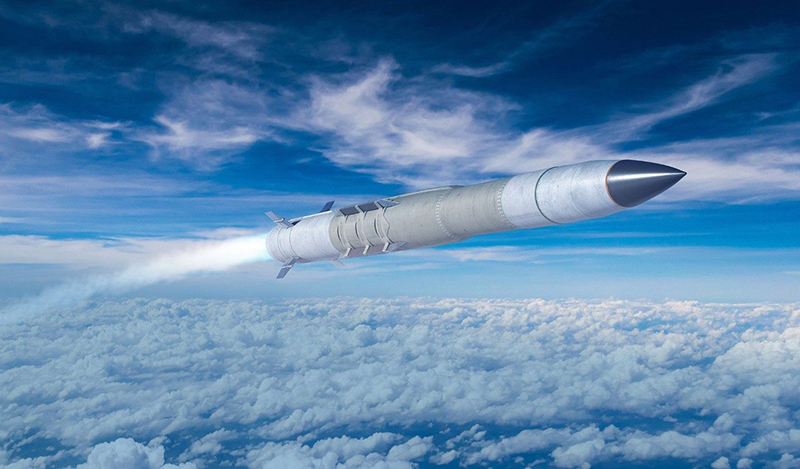
An artist’s rendering of a PAC-3 MSE in flight. Credit: Lockheed Martin 

The U.S. government announced a contract with Lockheed Martin (Booth 901) for the development, integration and testing of PAC-3 Missile Segment Enhancement (MSE) into the Aegis Combat System for the first time. 

This move places the U.S. Navy among the ranks of PAC-3 MSE users around the world, including the U.S. Army and 16 partner nations, giving Navy warships “a razor-sharp defense that helps keep America’s freedom of the seas unchallenged,” the company announced Tuesday. 

PAC-3 MSE is a key integrated air and missile defense capability for the U.S. and its allies. The U.S. government awarded Lockheed Martin a multi-million contract to continue munitions acceleration efforts and deliver a record number of PAC-3 MSE interceptors in 2026. This new contract builds on the framework agreement Lockheed Martin signed with the U.S. Department of Defense to rapidly accelerate the production and delivery of PAC-3 MSE. 

“By integrating PAC‑3 MSE’s capabilities into Aegis, the Navy is taking a decisive step forward in defending America’s fleet and our global interests against the most advanced threats,” Jason Reynolds, vice president and general manager of Lockheed Martin IAMD, said in a press release. “Lockheed Martin is driving the innovation behind this effort — bringing together advanced, combat‑proven systems in new ways to accelerate capability and deliver a decisive advantage in maritime defense.”  

Before receiving government funding, Lockheed Martin said it made internal investments to integrate the system with Aegis and the MK41 Vertical Launching System. 

“This integration further expands the capability of Aegis to engage missile threats at multiple layers, enabling a more comprehensive and effective defense against evolving threats, ensuring the warfighter has the strategic advantage,” Chandra Marshall, vice president of Lockheed Martin Multi-Domain Combat Solutions, said in the release. 

PAC-3 MSE hit-to-kill technology that delivers exponentially more kinetic energy on the target than can be achieved with blast fragmentation mechanisms, the company said. PAC-3 MSE is combat proven against ballistic and cruise missiles as well as hypersonic and airborne threats.   


Greenroom Robotics Wants to Put its Brains on Your Boat

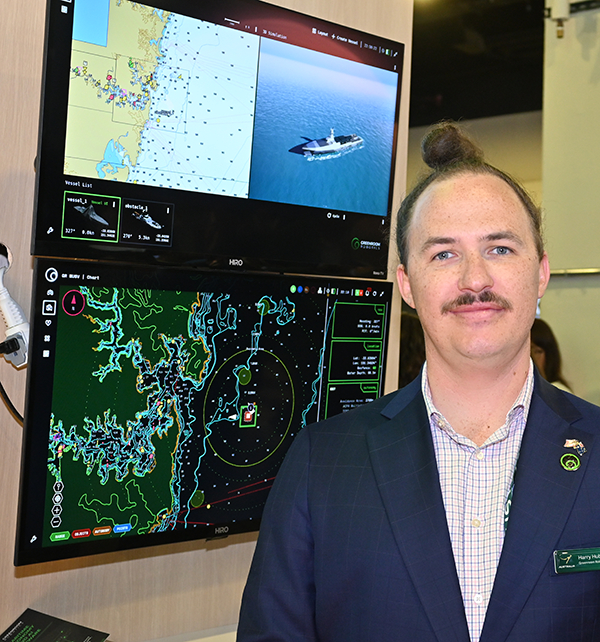
Harry Hubbert, COO for the relatively new Australian company Greenroom Robotics. Credit: Brett Davis 

By Brett Davis, Editior-in-Chief 

New small- and medium-sized uncrewed surface vessels are emerging from the waves everywhere at Sea-Air-Space, and one small Australian company is marketing its software to operate them. 

“We are a pure software company,” said Harry Hubbert, chief operating officer for Greenroom Robotics (Booth 1537 in the Australian pavilion), formed in 2017 when its founders met at the Australian Maritime College in Launceston, Tasmania, and bonded over a passion for ocean adventures and maritime robotics (the company’s name is a surfing term referring to the inside of a barrel produced by a wave). 

The company has four products: GAMA, a navigation and control system; Lookout +, an AI-powered optical radar that’s fully passive and can be used in contested environments, according to James Griffin, sales engineer at Greenroom; MIS-SIM, a mission simulator for training and planning; and MAROPS, a digitized mission management system. The products can work alone or together. 

The company’s software has been used on a retrofitted Aermidale-class patrol boat with Austal in Australia; a high-speed, agile uncrewed surface vessel from Subsea Craft in Australia, the United States and the United Kingdom; a EGS Survey USV in Australia and about 30 other vessels around the world, Hubbert said. 

“You can come to us with a boat that’s 25 or 30 years old, and we can make it into a fully autonomous boat,” Griffin said, or companies can bake the software into new USVs being developed. 

There are many USVs on display at the show this year and Greenroom Robotics has been talking to them, and the Navy push with the new Medium USV program and others is helping, Hubbert said. 

“The United States is a really big focus for us, given the scale of the operation over here but also the clear need,” Hubbert said. “The U.S. government’s been great at actually defining that they want this and this is what they want to do, and we happen to meet a lot of their requirements, so it’s been a good opportunity for us here.” 

The AUKUS agreement between the U.S., U.K. and Australia has eased the regulatory burden, “cracked the door open and allowed us to get moving a little bit faster,” Hubbert said, but the self-funded company is also setting up a shop in the U.S. and hiring Americans to help navigate the defense market. 


Commandant Gives an Update on Marines Future

Marine Corps Commandant Gen. Eric Smith discusses the 250th anniversary of the U.S. Marine Corps. (Credit: Laura Hatcher)

By Vicky Uhland, Seapower Correspondent 

Marines don’t win wars; they win battles, said General Eric Smith, commandant of the U.S. Marine Corps, during the Tuesday afternoon session “250 Years Strong — Building the Marine Corps of Tomorrow.” 

“If you’re looking for a chain-mail fist, you’re looking at the U.S. Army,” he said. “If you’re looking to get popped in the nose, you’re looking at the Marine Corps.” 

Smith outlined how the Marines are evolving with the changing character of war. The amphibious ready group remains the crown jewel of the expeditionary force, he said, and is currently deploying a three-ship Marine expeditionary unit — one from the East Coast, one from the West Coast and one from Japan. “We could use 5.5 MEUs, but we are committed to an unwavering goal of a 3.0 MEU presence,” he said.   

Smith said the Marines are also optimizing maintenance schedules to get more out of ships, are targeting investments in service-life extensions and are moving forward with procurement of new, more capable ships.  

“Our current investment of 31 amphibious ships is not adequate,” he said, noting that the 2027 defense budget is a significant down payment on a generational investment in ships, but more money is needed.  

Another area of emphasis is littoral mobility, mainly in the Indo-Pacific, which Smith called the world’s most challenging environment due to scale and size.  

Smith said the Marines are also bolstering their logistics network.  

“For decades, we operated with uncontested logistics, but the days of being three steps away from an MRE” or other supplies are over, he said. “As the maritime environment becomes less permissive, the global positioning network comes in.”  

Smith said another challenge that “worries me greatly right now” is sufficient magazine depth, which can give commanders freedom of action and reduce operational risk. 

Smith also highlighted current areas of achievement, including a clean financial audit for the third year in a row, the only service agency to do so. Barracks 2030 is delivering modern, safe and comfortable living conditions for Marines, and the Marine Corps Total Fitness program is helping make warriors physically, mentally, spiritually and socially resilient, he said.  

Smith also answered some audience questions, including:  

What can industry do to improve Marine resilience? 

“Keep on budget. Don’t sell me what I don’t need. Give me what I’m asking for at a price I can afford,” Smith said. 

What in-house innovations are impressing you? 

The Drone Dominance task force in Quantico is doing an amazing job with drone technology, Smith said. “We’re still too expensive and haven’t learned all the lessons of Ukraine, but we’re getting faster and faster.”    


A Panoply of USVs Graces the Gaylord Pier

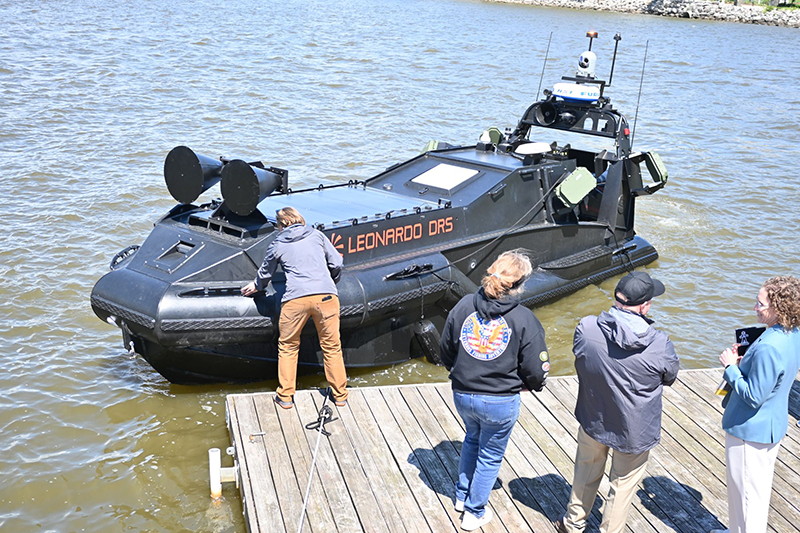
Leonardo DRS displayed its counter-UAS at sea system. (Credit: Brett Davis)

By Brett Davis, Editor-in-Chief 

In his keynote speech on Monday, Chief of Naval Operations Admiral Daryl Caudle said the future Golden Fleet will include a mix of main battle force ships and attritable, rapidly manufactured uncrewed systems. 

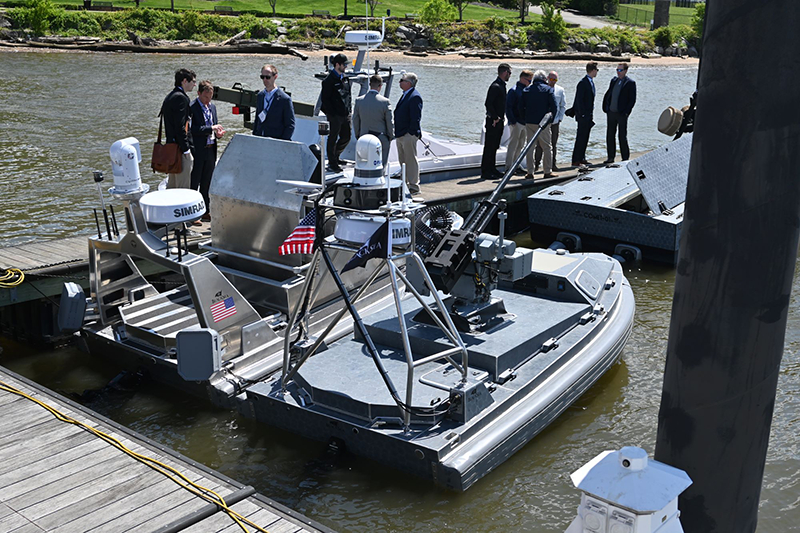
To get started on his shopping Caudle would only need to take a short walk to the Gaylord Pier, where 10 exhibitors featured a variety of small to medium boats, many of them autonomous and uncrewed. 

One was Leonardo DRS, which showcased its counter-UAS at sea system, which features a Ring counter-UAS system from partner Regulus mounted on a Sea Machines Stormrunner USV. 

As presented at Sea-Air-Space, the system uses a GPS spoofer to defeat UAS, including small ones that can be detected up to about a kilometer away, according to Jason Beaty, Leonardo DRS’ program director for unmanned systems. 

Further down the pier, California-based Navier made its show debut with two of its vessels, which can operate autonomously or with a crew. The company says its N30 Quanta-D system’s retractable hydrofoil design, based on the commercial N30 hydrofoil platform, enables superior speed, range and performance for the autonomous vessel. 

The company has systems already deployed with the U.S. Navy, said Navier founder and CEO Sampriti Bhattacharyya, although she could not discuss specifics. 

The N30 Quanta-D has a 2,000 nautical mile range, could be built quickly by a variety of shipyards and is cheap to operate, she said. 

“This boat costs 50 percent less to operate, or much less [than comparable vehicles],” she said. “You think of hundreds of these boats over 10 years, or even five years, or three years, the operational cost savings adds up massively. So, everybody is thinking attritable, but even beyond attritable, these are definitely low cost to build but the operational cost is also super, super low.” 

Another company on the pier is Michigan-based Ghostworks, which has a family of carbon fiber systems in use by Special Operations Forces and commercial users, said Britt Ward, the company’s chief naval architect. 

The company was formed four years ago and marked its third appearance at Sea-Air-Space, Ward said. Ghostworks’ MUT 3.5-meter composite USV, its smallest, aimed at attritable and intelligence, surveillance and reconnaissance missions, and Magic, an eight-meter foil-assisted catamaran which can carry electronic equipment, nonlethal payloads and autonomous controls. 

Further down the pier is BlackSea Technologies, which is displaying two small new USVs, Chaser and Comet. 

BlackSea Technologies unveiled two small new USVs, Chaser (above) and Comet. (Credit: Brett Davis (above), BlackSea Technologies (below))

“Chaser and Comet reflect our focus on giving operators scalable, mission ready platforms that can adapt quickly to evolving threats and mission demands,” BlackSea President Bob Pudney said in a press release. “We are proud to launch them alongside a group of industry partners whose technology helps make these vessels possible.” 

Chaser is a small USV designed to expand payload capacity, range and mission flexibility while maintaining rapid deployability and ease of use (meeting the Navy requirement to fit in a 20’ shipping container).  

Comet is BlackSea’s larger, high speed combat ready platform, designed to bridge the gap between small tactical USVs and larger unmanned combat craft. The 13.1 meter vessel can exceed 45 knots, carry a 10,000 pound payload including fuel, and support advanced payloads for missions including counter UAS, mine countermeasures, surface warfare, antisubmarine warfare, electronic warfare, maritime domain awareness and high value unit escort.   

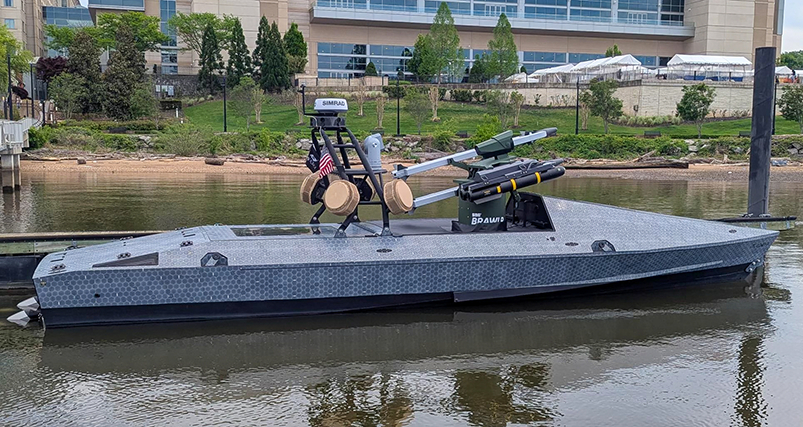
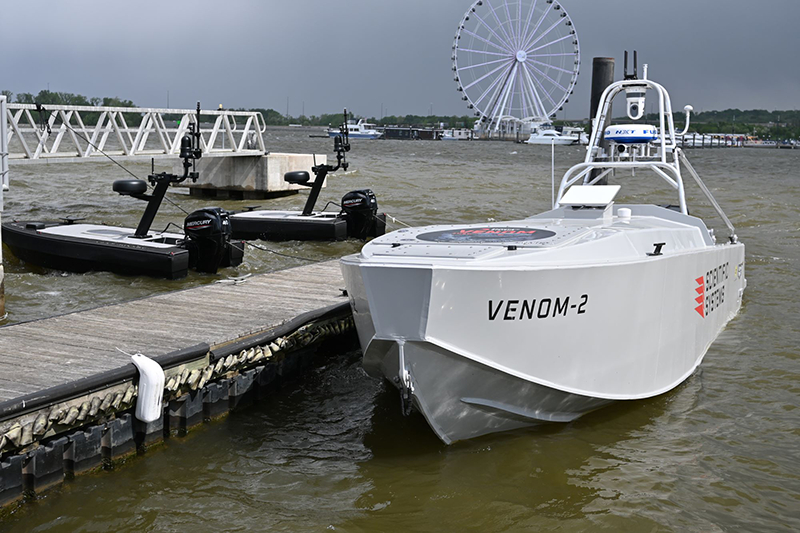
Other companies displaying on the pier include Scientific Systems with its Vehicle for Expeditionary Naval Over-the-Horizon Missions (VENOM), announced last year; Martec with its Mantas T38 Devil Ray autonomous USV, which has been used in various military exercises; Textron Systems with its Tsunami USV, which the company says is ready for mission-ready autonomy and is based on a commercial hull; Saronic with its Corsair USV, which debuted last year at Sea-Air-Space; HavocAI, whose software-defined hardware approach powers military and commercial autonomous systems; Maritime Robotics, which builds small “sea drones;” and Zodiac Milpro, one of the rare boats on the pier intended to carry people. 

Scientific Systems showcased its Vehicle for Expeditionary Naval Over-the-Horizon Missions (VENOM), announced last year. (Credit: Brett Davis)


White House Commitment to Shipbuilding Sparks Industry Optimism

From left, Amber Stein, Kari Wilkinson, Ben Bordelon and George Whittier speak at the panel on Navy and Coast Guard shipbuilding. Credit: Brett Davis

By Erika Fitzpatrick, Seapower Correspondent 

The White House’s commitment to multiyear investments in new Navy ships, including the recently announced fiscal 2027 request of $65.8 billion for the Golden Fleet Initiative, is spurring changes in the shipbuilding industrial base, industry leaders said April 21 at Sea-Air-Space 2026.  

The Pentagon’s $1.5 trillion budget request would provide the Navy with more than $377 billion, a 24% increase over fiscal 2026 levels. Industry players, including George Whittier, CEO of Wisconsin-based Fairbanks Morse Defense (Booth 1337), a U.S. Navy warship service and component provider and supplier, welcomed the budget details, also released Tuesday. 

“Critically, the Pentagon said it would request multiyear authorities from Congress for long-running programs,” Whittier said in a statement. “Much of the nation’s strategic manufacturing capacity and technical expertise is in our maritime supplier base. This is exactly the kind of certainty the shipbuilding industrial base needs to thrive.” 

Although shipbuilding manufacturers and suppliers now have confidence that pledged investments in sea power have a better chance to happen, Congress decides appropriations for the coming fiscal year, which begins Oct. 1, 2026. 

Nevertheless, the budget visibility is helping manufacturers prepare for the massive workload in the pipeline, said Kari Wilkinson, executive vice president and president of Newport News Shipbuilding at HII (Booth 923).  

“We have built submarine and carriers for many years, and we know we can do this,” she said. “We expect our customers to be demanding. 

“It’s fundamentally about people,” Wilkinson said, including hiring, training and equipping personnel to fulfill orders. That requires changing the narrative that shipbuilding careers are unstable and distributing the workload to suppliers. 

“It is a different landscape today than it has been, but that isn’t daunting,” she said. “This is a team sport.” 

The administration’s emphasis on schedule — rapid delivery — is pushing shipbuilding to ramp up planning and workforce development, concurred Ben Bordelon, president and CEO at Louisiana-based Bollinger Shipyards.  

Bollinger supports shipbuilding for the Navy and U.S. Coast Guard, which also received a cash infusion from Congress that’s led to a boom in icebreaker and cutter shipbuilding.  

With these investments, the industry can now say to its talent pipeline that shipbuilding is sustained, profitable work. “We’re selling a career versus a job,” Bordelon said.


Senior Leaders Forecast the Future of Maritime Dominance

From left to right: Retired Admiral James Foggo, Vice Admiral Rob Gaucher, retired Captain William Toti and Admiral Karl Thomas discussed their visions of the future of U.S. maritime dominance during the fifth annual CMS breakfast on Tuesday. (Credit: Laura Hatcher)

By Vicky Uhland, Seapower Correspondent 

The U.S. Department of Defense is at an inflection point in maritime dominance through acquisition reform, said panelists at Tuesday morning’s fifth annual breakfast hosted by the Navy League’s Center for Maritime Strategy. 

The Department of War is not just a moniker, “it represents a sea change in the way we go about business,” said U.S. Navy retired Captain William Toti, senior advisor to the deputy secretary of war. “We are mobilizing our industrial base in a way that’s never been done probably since World War II. We need everybody in industry to pull along as we go down this lane.” 

Toti said when he joined the Department of Defense a year ago, he conducted a review and found war preparation was not taken seriously, critical munitions programs had been terminated and 100% of other critical programs were late and over budget.  

“There was complacency all over the department and a loss of military dominance,” he said. “It was a department that lost its way; it was focused on the wrong things” and a reboot was necessary.  

Vice Admiral Rob Gaucher, direct reporting portfolio manager (DPRM) submarines and program acquisition executive (PAE) undersea, said DRPM handles submarine building and the PAE structure maintains existing submarines.  

For submarine building, the first priority is a “forward-looking supply-chain view to find bottlenecks,” he said. On the PAE side, he’s building out scorecards to measure five specific types of maintenance.  

Panelists answered a series of questions about the future of maritime dominance from audience members and the session moderator, retired Navy Admiral James Foggo, dean of the Center for Maritime Strategy. Questions included:  

There are going to be three carrier strike groups coming home from the Gulf; how do you get them repaired? 

Admiral Karl Thomas, commander of U.S. Fleet Forces Command, said the biggest problem is capacity issues in the shipyard. The main levers include prioritizing maintenance continuum and “ensuring that shipyard workers are turning wrenches,” he said. 

“Longer deployments mean more maintenance,” Thomas said. Maintenance of the USS Gerald R. Ford (CVN 78), which had a major fire on board in March, will exceed 10 months, he said, noting the Navy plans to hire 3,000 more shipyard workers a year to deal with those chores.  

What challenges have you learned from Virginia-class submarine procurement maintenance, and how are we postured to overcome those challenges for Columbia and SSN(X)? 

Thomas said the gap from “the kill chain from thinking I can manufacture something to when I actually get the ability to get the part” takes more than a year. “We as the Navy have not made it clear to industry” about the manufacturing requirements. This was a huge problem for the Virginia class, he said, and the Navy is leaning into advanced technology to do things quicker.  

What is your metric for deciding if industry is supporting the Navy, and what does industry support look like to you? 

“Accept the new paradigm [Deputy] Secretary [Steve] Feinberg has put in place. Don’t push back. This is how it’s going to be,” Toti said. “It’s OK to think outside the box but not OK to go to Congress. Congress is fully on board; nobody is pushing back on this.”  

What advice would you give at this point in your careers that would make a difference to a junior Sailor or junior officer? 

“The thing that kept me in the Navy to this point is the camaraderie,” Thomas said.  

Toti said he’s been “so blessed to have three lucrative careers, and none of them was planned. Enjoy what you’re doing now and don’t worry about the future.”  

“There are going to be plenty of bad deals out there, but there are incredibly good deals and things you get to do,” Gaucher said, recommending that young Sailors and officers “take a minute to remember the importance of what you do and what the Navy offers as a career.”