U.S. Coast Guard Receives Historic Investment to Rebuild Under President Trump’s One Big Beautiful Bill

Release From U.S. Coast Guard Headquarters, July 4, 2025 

WASHINGTON – The U.S. Coast Guard welcomed the nearly $25 billion investment included in the One Big Beautiful Bill Act Friday — marking the largest single commitment of funding in Service history.   

This investment strengthens every facet of Coast Guard operations and supports the Service’s role as the Nation’s leading drug interdiction and maritime border security force.   

This funding will allow the Coast Guard to procure an estimated 17 new icebreakers, 21 new cutters, over 40 helicopters and six C-130J aircraft while modernizing shore infrastructure and maritime surveillance systems. The package also strengthens the Coast Guard’s ability to counter drug and human trafficking, conduct search and rescue, enhance navigational safety and enable maritime trade.  

“This historic investment marks a new era for the Coast Guard,” said Coast Guard Acting Commandant Adm. Kevin Lunday. “It reflects the strong support of the American people and empowers us to restore our Service and prepare for the challenges of today and tomorrow. With this level of support, and the dedication of our Coast Guard men and women, there’s nothing we can’t accomplish. We are deeply grateful for this opportunity to build a stronger Coast Guard for the Nation.”  

Investment highlights include:  

  • $4.4 billion for shore infrastructure, training facilities and homeports  

  • $4.3 billion for Polar Security Cutters, extending U.S. reach in the Arctic  

  • $4.3 billion for nine new Offshore Patrol Cutters  

  • $3.5 billion for three Arctic Security Cutters  

  • $2.3 billion for more than 40 MH-60 helicopters  

  • $2.2 billion for depot level maintenance to sustain readiness  

  • $1.1 billion for six new HC-130J aircraft and simulators  

  • $1 billion for Fast Response Cutters  

  • $816 million for light and medium Icebreaking Cutters  

  • $266 million for long-range unmanned aircraft systems  

  • $170 million for maritime domain awareness, including next-generation sensors   

  • $162 million for three Waterways Commerce Cutters  

These investments support Force Design 2028 — the Secretary’s comprehensive effort to modernize operations and capabilities to ensure the Coast Guard remains the finest maritime fighting force ready to protect and defend the nation for decades to come.   

The Coast Guard extends its appreciation for the leadership of the Administration, including President Trump and Secretary Noem, and leaders in Congress for recognizing the strategic importance of a ready, modern and resilient Coast Guard.  


Coast Guard Renames Geographic Operational Districts 

From U.S. Coast Guard Headquarters Public Affairs, July 3, 2025 

WASHINGTON — The U.S. Coast Guard announced Thursday the renaming of its operational districts from numerical to geographic designations, a key initiative under Force Design 2028 (FD2028). 

This strategic change, directed by Secretary of Homeland Security Kristi Noem on May 21, 2025, aims to indicate more accurately the regions they serve and represent. Renaming operational districts revises a numbered system established during World War II, when the Coast Guard operated as part of the Navy to ensure alignment between the services. In the 80 years since the Coast Guard separated from the Navy, the Service has maintained the numbered districts. However, the Navy stopped using numbered districts over 25 years ago. 

Updating operational districts to regional names will more clearly align districts with their areas of responsibility, facilitate collaboration with interagency partners, and ensure the American public and maritime stakeholders can easily find and understand the districts in which they live, recreate and operate. This change is a direct action within FD2028’s organization campaign, which is focused on adapting the Coast Guard’s structure to remain effective and responsive. 

The new geographic names, approved by the Department of Homeland Security, are as follows: 

District 1: USCG Northeast District 
District 5: USCG East District 
District 7: USCG Southeast District 
District 8: USCG Heartland District 
District 9: USCG Great Lakes District 
District 11: USCG Southwest District 
District 13: USCG Northwest District 
District 14: USCG Oceania District 
District 17: USCG Arctic District 

“This renaming is more than just a change in labels; it’s a critical step in our journey to become a more agile, capable, and responsive fighting force,” said Acting Commandant Kevin E. Lunday. “Under Force Design 2028, we are driving fundamental changes to speed decision-making, improve strategic alignment, and ultimately best serve the American people for decades to come. This initiative underscores our commitment to ensuring that change is lasting and has an enduring impact on the Service and the Nation.” 

This change will not impact operations or change existing geographical district boundaries. To memorialize the updated names for operational districts, the Coast Guard is undertaking the process of formally changing district names in the Code of Federal Regulations. Through this process, the Coast Guard will continue to communicate with stakeholders and provide updated resources and information as appropriate. 

For more information, please contact Coast Guard Media Relations at [email protected]

Read more about the Coast Guard’s transformation through FD2028 here: USCG Force Design 2028


Mobile Diving and Salvage Unit 2 Disestablished; Explosive Ordnance Disposal Mobile Unit 10 Established 

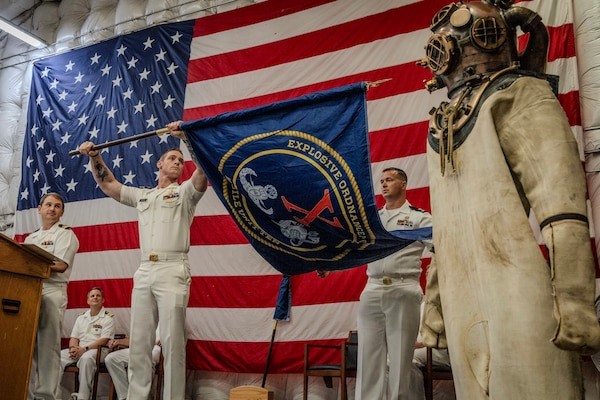
VIRGINIA BEACH, Va. — Cmdr. Garret Pankow, commanding officer of Mobile Diving and Salvage Unit (MDSU) 2, changes command with Cmdr. Jonathon Maurus, as he assumes command of Explosive Ordnance Disposal Mobile Unit (EODMU) 10 during a ceremony at Joint Expeditionary Base Little Creek-Fort Story, July 3, 2025. During the ceremony MDSU-2 was disestablished and EODMU-10 established, combining their warfighting capabilities. EODMU-10 is a subordinate command of Explosive Ordnace Disposal Group 2 and operates as part of Navy Expeditionary Combat Force providing skilled, capable, and combat-ready deployable Navy EOD and Navy Diver forces around the globe to support a range of operations. (U.S. Navy photo by Mass Communication Specialist 2nd Class Jackson Adkins) 

From Lt.j.g. Martin Carey, July 3, 2025 

VIRGINIA BEACH, Va. – The U.S. Navy marked the end of an era and the beginning of a new chapter during a ceremony July 3, as Mobile Diving and Salvage Unit (MDSU) 2 was formally disestablished and Explosive Ordnance Disposal Mobile Unit (EOD) 10 was established aboard Joint Expeditionary Base Little Creek-Fort Story. 

The ceremony, attended by families, shipmates, and distinguished guests, celebrated the legacy of MDSU-2 – a unit synonymous with diving, salvage, and undersea response excellence – and welcomed the future of integrated expeditionary operations under EODMU-10. 

Established in 1982, MDSU-2 was a cornerstone of U.S. Navy diving and salvage capability. Over the decades, its Sailors supported numerous historic and high-profile operations, including the 1986 recovery of Space Shuttle Challenger, the salvage of TWA Flight 800 in 1996 and Swiss Air Flight 111 in 1998, and the recovery of Space Shuttle Columbia in 2003. 

Divers and EOD technicians from MDSU-2 also played critical roles in complex salvage operations around the globe, including the 1994 Eritrea Africa ship salvage, the 1999 USS Cole (DDG 67) recovery, and the multi-year recovery project of USS Monitor, a Civil War ironclad warship. The unit supported humanitarian assistance responses for Hurricane Katrina and Hurricane Sandy and led pioneering efforts in Arctic diving during Operation Nanook in 2010. 

Commander Garrett Pankow took to the podium to deliver his final message as the commanding officer of MDSU-2. 

“Today is bittersweet,” said Pankow. “We’re not only executing a time-honored transfer of command but also retiring a combat salvage unit with a legacy that spans the globe, and establishing a new EOD mobile unit. For half a century, MDSU-2 Salvors have operated with character and competency – from the Arctic Circle to the depths of the Red Sea.” He continued, “It has been the honor of my career to be the skipper of MDSU-2. The spirit and capability of MDSU-2 carries forward into EODMU-10, and all East Coast EOD mobile units, as we combine EOD and Salvage warriors at EOD mobile units; ready to support the fleet, anytime, anywhere.” 

Commander Jonathon Maurus, from Dearborn, MI, will be the first commanding officer of EODMU-10. 

“I am extremely honored and humbled to take the helm from Commander Pankow during this historic transition – while we close the chapter on MDSU-2, we carry forward its proud legacy as we stand up EOD Mobile Unit-10, ready to meet the Navy’s evolving mission with the same tenacity and excellence.” 

Rear Adm. Brad Andros, Commander, Navy Expeditionary Combat Command, served as the ceremony’s guest speaker and stressed the significance of the redesign of the mobile diving and salvage force. 

“The transition from MDSU-2 to EOD Mobile Unit-10 is not a loss – it is a consolidation of excellence,” said Andros. “This force redesign brings the full spectrum of EOD and MDSU capabilities under one commander, one unified command – bringing together our teams, our chief’s mess, our wardrooms. Our expeditionary forces must be ready for a future fight. We can no longer look at our niche capabilities as we did 10 or 20 years ago…our Navy Expeditionary Combat Forces will be needed for our full repertoire, full capability and full capacity.” 

The establishment of EODMU-10 reflects a greater NECC effort to ensure readiness for the future fight and a deliberate approach to build a more sustainable and agile force. The unit will continue to leverage diving and salvage expertise while aligning under the broader Explosive Ordnance Disposal Group 2 enterprise. 

As a critical component of the Navy Expeditionary Combat Force, Navy EOD forces clear explosive hazards to provide access to denied areas; they employ advanced tactics and technologies to exploit and secure the undersea domain for freedom of maneuver; they build and foster relationships with a constellation of capable and trusted partners; and they protect the homeland and our American way of life. 

For more information, visit https://www.necc.usff.navy.mil/eod/ 


U.S., ROK Navies Conduct CONSOL Training 

CHINHAE, South Korea—Republic of Korea’s Cheonji-class fast combat support ship ROKS Daecheong (AOE-58) connects its fuel line to Military Sealift Command’s commercial charter oiler MT Allied Pacific during conducted a simulated consolidated cargo replenishment at sea (CONSOL), at Chinhae, June 19, 2025. CONSOL capability is when a specially outfitted MSC-controlled tanker conducts underway refueling operations, transferring fuel and/or cargo to combat logistics-force ships at sea. (Courtesy photo) 

by Grady T. Fontana, July 2, 2025 

CHINHAE, South Korea – Military Sealift Command’s (MSC) commercial charter oiler MT Allied Pacific conducted a simulated consolidated cargo replenishment at sea (CONSOL), at Chinhae, June 16-19, 2025. 
 
CONSOL capability is when a specially outfitted MSC-controlled tanker conducts underway refueling operations, transferring fuel and/or cargo to combat logistics-force (CLF) ships at sea. 

Typically, CLF ships are required to return to shore to a Defense Fuel Support Point to resupply. A CONSOL eliminates those round-trips to a supply point, thereby, reducing cost and increasing time at sea to support the fleet. 
 
“Returning to shore, or to a supply depot, requires ships to leave the operation areas, and travel to wherever the fuel terminal is, which requires time,” said U.S. Navy Senior Chief Boatswain’s Mate Andrew Werner, MSC Far East. “The sole advantage to a CLF taking fuel from a tanker vice a terminal, is that the tanker can move to the geographic location, where it is needed.” 
 
In this case, Allied Pacific connected with Republic of Korea’s Cheonji-class fast combat support ship ROKS Daecheong (AOE-58). The ability of an ROK tanker to CONSOL allows them to also carry fuel out to the fleet, and provide underway replenishment of fuel, fleet cargo, and stores to customer ships at sea, thereby increasing capacity in the Indo-Pacific region. 
 
“The ROK Navy was very interested in how the U.S. Navy conducts CONSOL events with a civilian tanker,” said Werner. “So we demonstrated how we do CONSOL events and the steps on preparing their underway replenishment stations.” 
 
Allied Pacific is one of a few commercial oil tankers that has been chartered and outfitted to pump fuel to CLFs at sea, which allows the CLF ships to stay closer to the fleet, and allies and partner nations. 

“The U.S. and ROK have a strong strategic alliance,” said Capt. David L. Reyes, Commodore of MSC Far East. “Interoperable refueling capabilities enhance this partnership by enabling joint operations, training exercises, and real-world missions. This cooperation reinforces mutual defense commitments and helps promote regional stability.” 
 
The four-day event began at port on board Commander, Fleet Activities Chinhae, and both crews participated in safety briefings, discussions and cross-deck training on day one. 
 
Days two and three involved pier side training: deploying, retrieving and re-deploying the fuel lines between the two ships while at port. 
Day four, both ships got underway and connected at sea, as planned, offering a successful proof-of-concept. 
 
“CONSULs between ROK and U.S Navy fleet replenishment oilers are not new,” said Werner. “However, the ability for ROK vessels to connect with an MSC-chartered commercial oiler is a capability that the ROK Navy is very interested in. This increases operational reach and endurance of both naval forces.” 
 
MSC Far East supports the U.S. 7th Fleet and ensures approximately 50 ships in the Indo-Pacific Region are manned, trained, and equipped to deliver essential supplies, fuel, cargo, and equipment to warfighters, both at sea and on shore. U.S. 7th Fleet is the U.S. Navy’s largest forward-deployed numbered fleet and routinely interacts and operates with allies and partners in preserving a free and open Indo-Pacific region. 


Coast Guard offloads more than $20 million in illicit drugs interdicted in Caribbean Sea 

From Coast Guard 7th District, July 2, 2025 

MIAMI – U.S. Coast Guard Cutter Northland’s crew offloaded approximately 2,220 pounds of cocaine and 3,320 pounds of marijuana worth an estimated $20.1 million, Wednesday, at Coast Guard Base Miami Beach.   

The seized contraband was the result of four interdictions in the Caribbean Sea by the crews of HMCS William Hall and HNLMS Friesland with embarked Coast Guard law enforcement detachments.   

“Stopping harmful and illicit narcotics from reaching our shores and entering our communities is a team effort,” said Cmdr. Brian Gismervik, Coast Guard Cutter Northland’s commanding officer. “In the dynamic maritime environment, it takes the combined efforts of our joint force DoD, DHS, and international partners to combat transnational criminal organizations.”  

The following assets and crews were involved in the interdiction operations:   

  • Royal Canadian Navy ship HMCS William Hall  

  • Royal Netherlands Navy ship HNLMS Friesland  

  • U.S. Navy ship USS Cole 

  • U.S. Coast Guard Tactical Law Enforcement Team South, LEDET 404  

  • U.S. Coast Guard Tactical Law Enforcement Team Pacific, LEDET 103  

  • Helicopter Interdiction Tactical Squadron Jacksonville  

  • Seventh Coast Guard District staff  

Detecting and interdicting illicit drug traffickers on the high seas involves significant interagency and international coordination. Joint Interagency Task Force-South, in Key West, conducts the detection and monitoring of aerial and maritime transit of illegal drugs. Once an interdiction becomes imminent, the law enforcement phase of the operation begins, and control of the operation shifts to the U.S. Coast Guard for the interdiction and apprehension phases. Interdictions in the Caribbean Sea are performed by members of the U.S. Coast Guard under the authority and control of the Seventh Coast Guard District, headquartered in Miami.  

USCGC Northland is a 270-foot Reliance-class medium endurance cutter homeported in Portsmouth under U.S. Coast Guard Atlantic Area Command.   

For breaking news, follow us on X (formerly Twitter). For additional information, find us on Facebook and follow us on Instagram.   

Make a difference on land, at sea or in the air with the Coast Guard. Visit GoCoastGuard.com to learn more about active duty and reserve, officer and enlisted opportunities. Information on how to apply to the U.S. Coast Guard Academy can be found here.  


Fincantieri Marine Group Appoints George Moutafis as CEO 

From Fincantieri 

Fincantieri Marine Group (FMG), the U.S. subsidiary of Fincantieri – one of the world’s largest shipbuilding groups and a global leader in the construction of highly complex vessels – announces the appointment of George A. Moutafis as Chief Executive Officer, effective July 1, 2025. 

The leadership transition of the US company of the Group led by Chief Executive Officer and General Manager Pierroberto Folgiero comes at a pivotal moment for the U.S. shipbuilding industry, as the new U.S. administration places renewed strategic emphasis on strengthening domestic naval capabilities. In this context, Fincantieri reinforces its long-term commitment to the United States by appointing a seasoned U.S. executive with deep expertise in defense, naval manufacturing, and international industrial transformation. 

George Moutafis brings over 25 years of executive experience across strategic planning, program management, and industrial restructuring, with a distinguished track record in both the public and private sectors. His background includes leadership roles in major defense and manufacturing organizations, most recently as Chief Operating Officer and General Manager of Beretta USA Corp. He also previously held leadership roles within FMG, contributing to innovation and program execution in support of U.S. Navy platforms. His background in defense and naval manufacturing, combined with his international perspective, and his proven ability to drive operational and financial management, aligns with the Group’s strategic direction in response to shifting priorities in the broader U.S. institutional and industrial context. 

Fincantieri has been present in the United States for over 15 years, with a solid industrial footprint that includes four shipyards and a workforce of approximately 3,000 people. Over this period, the Group has invested more than $800 million in its U.S. shipbuilding operations, of which over half was specifically allocated to upgrading and expanding the Marinette yard in Wisconsin. This strategic presence underscores the Group’s enduring commitment to supporting the U.S. Navy and contributing to the country’s industrial base.  


HII Launches Virginia-class Submarine Arkansas at Newport News Shipbuilding 

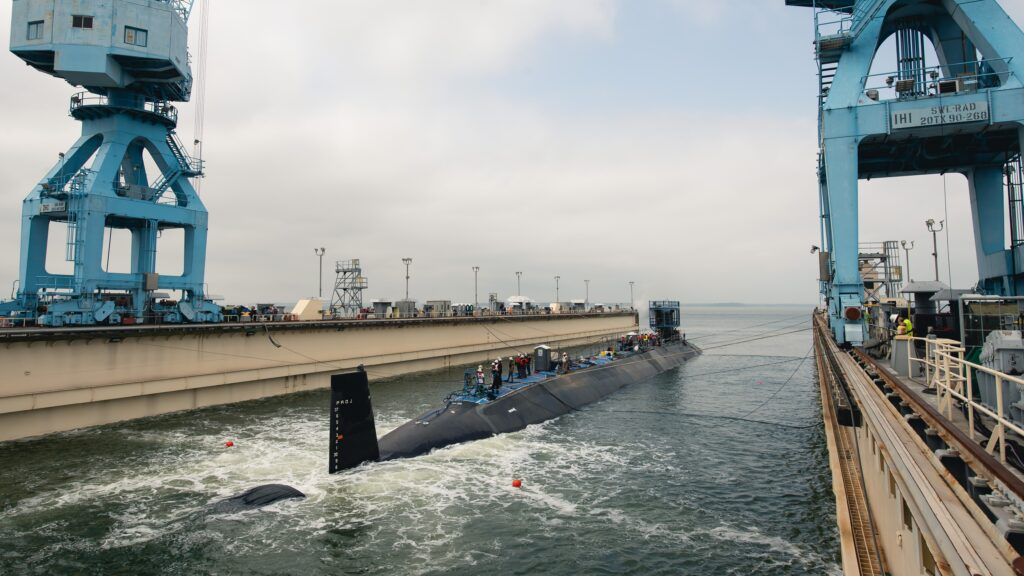
NEWPORT NEWS, Va., July 2, 2025 (GLOBE NEWSWIRE) — HII (NYSE: HII) announced today that Virginia-class submarine Arkansas (SSN 800) was recently launched into the James River at the company’s Newport News Shipbuilding (NNS) division. 

Shipbuilders transferred the submarine from a construction facility to the floating dry dock, where it was launched and moved by tugboats to a submarine pier at the shipyard for final outfitting, testing and crew certification. 

“We are committed to increasing submarine construction cadence and throughput for the U.S. Navy,” said Bryan Caccavale, NNS vice president of Navy programs. “Nuclear-powered submarines are critical to our national security and we’re proud to see Arkansas in the water.” 

The ship’s sponsors are the six women of the historic group known as the Little Rock Nine, the first African American students to attend all-white Central High School in Little Rock, Arkansas, during desegregation. 

Arkansas is the 27th Virginia-class submarine and will be the 13th delivered by NNS. The advanced capabilities of Virginia-class submarines increase firepower, maneuverability and stealth. 

Photos accompanying this release are available at: http://hii.com/news/hii-launches-virginia-class-submarine-arkansas-ssn-800-at-newport-news-shipbuilding/


GD Electric Boat Awarded $1.85B Contract Modification for Sub Long-Lead Material

From General Dynamics Electric Boat 

GROTON, Conn. (July 2, 2025) — Electric Boat, a business unit of General Dynamics, announced today that it was awarded a $1.85 billion contract modification to a previously awarded contract supporting submarine production. This modification is for long lead time material and preliminary construction efforts for submarine production, as detailed in the June 26 U.S. Department of Defense contract award announcement


“This contract modification allows for the acquisition of critical material and components for Virginia-class submarines that require substantial lead time to manufacture and deliver. It sends a continued demand signal, supporting supplier investment in the capacity and materials needed to achieve our required production volume,” said Mark Rayha, president of General Dynamics Electric Boat. “Consistent funding and support such as this contract modification is essential for the shipyards to achieve the high-rate production of submarines the Navy needs.” 


General Dynamics Electric Boat designs, builds, repairs and modernizes nuclear submarines for the U.S. Navy. Headquartered in Groton, Connecticut, it employs more than 24,000 people. More information about General Dynamics Electric Boat is available at www.gdeb.com


Continuing Promise 2025 Mission Update: Ecuador 

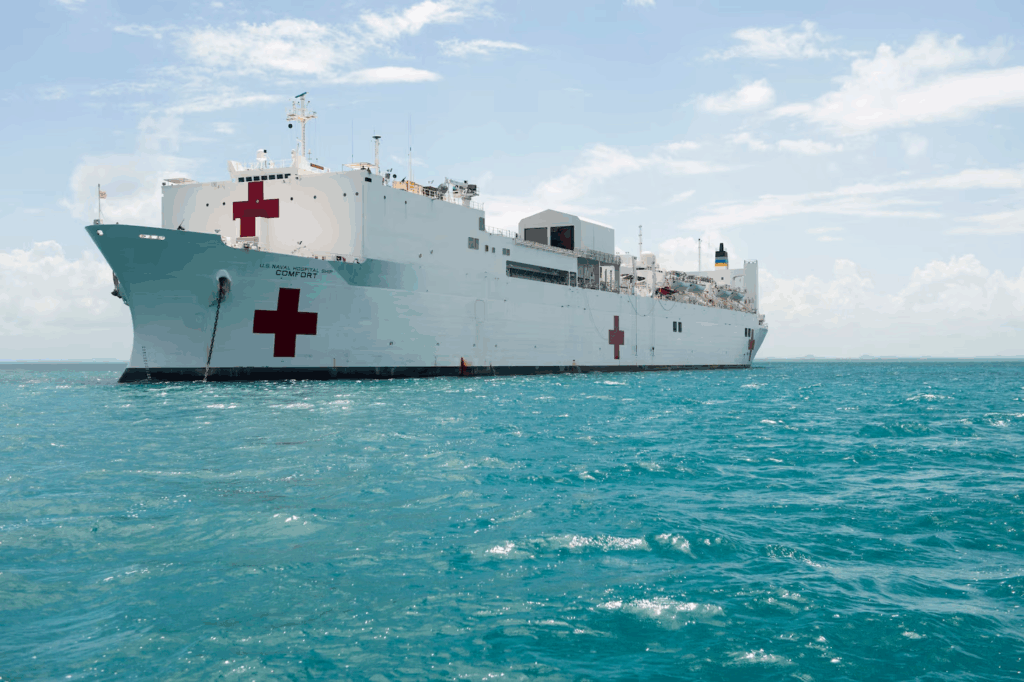
The Military Sealift Command hospital ship USNS Comfort (T-AH 20) sit at anchor during Continuing Promise 2015. Continuing Promise is a U.S. Southern Command-sponsored and U.S. Naval Forces Southern Command/U.S. 4th Fleet-conducted deployment to conduct civil-military operations including humanitarian-civil assistance, subject matter expert exchanges, medical, dental, veterinary and engineering support and disaster response to partner nations and to show U.S. support and commitment to Central and South America and the Caribbean. (U.S. Navy photo by Mass Communication Specialist 1st Class Gary Johnson/Released)

by U.S. Naval Forces Southern Command / U.S. 4th Fleet Public Affairs, July 1, 2025 

MAYPORT, Fla. – The USNS Comfort (T-AH 20) is now scheduled to conduct its Continuing Promise 2025 mission stop in Manta, Ecuador from July 4-10, instead of the previously planned July 12-19. 
 
Adjusting the mission dates allows the USNS Comfort to maintain readiness to support U.S. Navy global operations while delivering important humanitarian assistance. The U.S. Navy is committed to working with Ecuador to promote public health, security, and prosperity. 
 
The United States values its partnership with Ecuador, a nation with which we share a history, strong democratic values, and enduring security and economic ties. The U.S. remains committed to longstanding cooperation with the Ecuadorian people and government and regrets any inconvenience this change causes. 
 
U.S. Naval Forces Southern Command/U.S. Fourth Fleet, as U.S. Southern Command’s maritime component commander, remains committed to strengthening regional partnerships, fostering solidarity, and cultivating lasting friendships. 


USCGC Vigorous Returns Home After 51-Day Counter-Migration Patrol in Windward Passage 

From U.S. Coast Guard Atlantic Area, July 1, 2025 

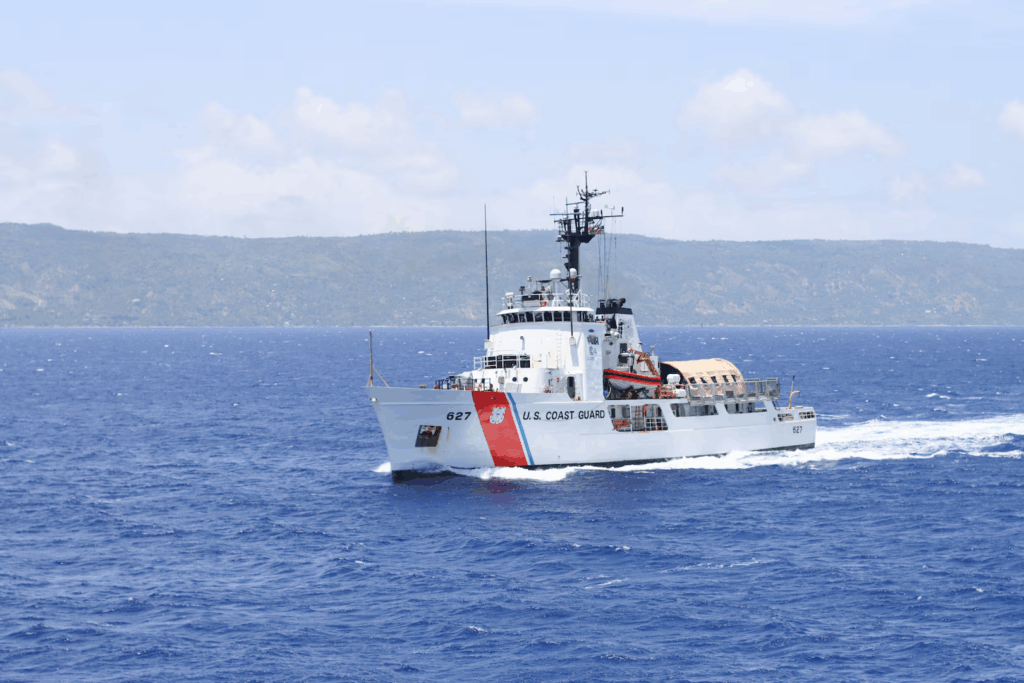
PORTSMOUTH, Va. — The crew of Coast Guard Cutter Vigorous (WMEC 627) returned to their home port in Portsmouth, Tuesday, following a 51-day patrol in the Windward Passage.  

Vigorous deployed in support of Operation Vigilant Sentry to advance the primary missions of safety of life at sea and deterrence of illegal alien ventures in known transit zones. Vigorous’ crew conducted maritime safety and security missions while protecting America’s maritime borders from unlawful entry.   

Vigorous conducted several consent-based interview boardings in the Canal de la Tortue, Haiti, a key transit zone between Haiti and points north. Vigorous also patrolled for Coast Guard Sector Key West and Sector Miami, which are crucial to deterring illegal activities and maintaining maritime domain awareness. Working with Department of Defense and Department of Homeland Security entities, Vigorous contributed to the disposition of 17 suspected smugglers and nearly 1,400 pounds of cocaine with an estimated street value of $10 million.  

Vigorous also honed its tactical proficiency through advanced boat tactics training alongside Coast Guard Cutter Campbell (WMEC 909). The crews conducted pursuit training, enhancing their interoperability and response capabilities in high-speed maneuvering situations. Additionally, they completed a towing exercise, further strengthening their collaborative efforts in maritime assistance and rescue operations.  

In a demonstration of international partnership, the Vigorous worked with the Department of State to deliver critical boat supplies to the Haitian Coast Guard, bolstering their capabilities and strengthening maritime security cooperation in the region.  

“The crew performed exceptionally well throughout this demanding patrol,” said Cmdr. Charles Bare, commanding officer of Vigorous. “Their dedication and professionalism enabled us to achieve significant operational successes, contributing directly to regional stability and interagency and international partnerships.”    

DHS Operation Vigilant Sentry is a DHS-led operation comprised of federal, state and local partners responsible for preventing and responding to maritime migration. OVS, previously known as Homeland Security Task Force – Southeast, was established in 2003 and is comprised of more than 50 federal, state, and local agencies.   

Vigorous is a 210-foot, Reliance-class medium-endurance cutter homeported in Portsmouth, Virginia. Its missions include search and rescue, maritime law enforcement, marine environmental protection, and homeland security operations in the Atlantic Ocean. The cutter falls under the command of U.S. Coast Guard Atlantic Area, which is based in Portsmouth, Viginia.   

For more information on how to join the U.S. Coast Guard, visit GoCoastGuard.com to learn about active duty, reserve, officer and enlisted opportunities. Information on how to apply to the U.S. Coast Guard Academy can be found here.