AV’S Switchblade 300 Selected for U.S. Marine Corps’ Organic Precision Fires-Light Program
The Switchblade 300 Block 20 system is battle-proven and production-ready to support Marine Infantry. AeroVironment
ARLINGTON, Virginia –AeroVironment was selected by the U.S. Marine Corps for the first phase of the Organic Precision Fires-Light (OPF-L) program of record. AV’s Switchblade 300 Block 20 loitering munition system (LMS) will provide the Marine Corps with organic, anti-armor/anti-personnel, precision fires capability at the tactical level. AV was awarded an initial order of $8.9M on a contract with a maximum potential value of $249M.
AV’s Switchblade 300 Block 20 supports the OPF-L program’s request for an individually operated, man-portable loitering munition with a lightweight, precision-guided capability against beyond- line-of-sight adversaries. Switchblade 300 will ensure that Marines are properly equipped and sustained with a lethal, reliable, organic capability for rapid target engagement while minimizing collateral damage and exposure to threat weapon systems.
“AV offers a battle-proven and production-ready system to support OPF-L to meet the Marine Corps’ requirements,” said AV’s Senior Vice President of LMS, Brett Hush. “Our mature and trusted manufacturing capability combined with world-class training and support will ensure Marine Infantry is adequately prepared for the fight.”
AV’s Switchblade 300 has been deployed in support of urgent operational needs to combat theaters since 2012. Switchblade 300 Block 20 is the next generation of the system that capitalizes on over a decade of user assessments, combat deployments, and lessons learned from the conflict in Ukraine, including operating in contested environment operations.
The Switchblade Block 20 system significantly expands on the currently fielded Switchblade 300 capabilities, including armor penetrating capability through an Explosively Formed Penetrator (EFP) warhead, increased target attack angle, and significantly greater battery life, flight endurance, and radio link range.
“With over 6,000 Switchblade loitering missiles tested, produced, and fielded, AV is in a unique position to offer revolutionary organic precision fire capabilities to the USMC, leveraging the proven reliability, producibility and supportability of current Switchblade programs,” continued Hush.
VMUT-2 begins assembly of the first 2nd MAW MQ-9A Reaper
U.S. Marines with Marine Unmanned Aerial Vehicle Training Squadron (VMUT) 2 conduct familiarization training with an MQ-9A Reaper unmanned aircraft at Marine Corps Air Station Cherry Point, North Carolina, April 11, 2024. (U.S. Marine Corps photo by Lance Cpl. Orlanys Diaz Figueroa)
MARINE CORPS AIR STATION CHERRY POINT, N.C. – Marine Unmanned Aerial Vehicle Training Squadron (VMUT) 2, 2nd Marine Aircraft Wing (MAW), began the assembly of 2nd MAW’s first MQ-9A Reaper, April 10, as part of the U.S. Marine Corps’ continued transition from the legacy RQ-21A Blackjack in accordance with Force Design initiatives.
“The delivery and build of VMUT-2’s first MQ-9A aircraft is yet another successful milestone in the transition of VMUT-2 to become the MQ-9A Fleet Replacement Squadron, responsible for the world-class training of the Marine Corps’ MQ-9A pilots and sensor operators,” said Lt. Col. Michael Donlin, commanding officer of VMUT-2.
Many of the parts for the aircraft were delivered to VMUT-2, known as the “Night owls,” aboard Marine Corps Air Station (MCAS) Cherry Point, North Carolina, from General Atomics in March, making 2nd MAW the third and final MAW to receive the aircraft. Marine Unmanned Aerial Vehicle Squadron (VMU) 1, 3rd MAW, procured the first MQ-9A Reaper for the Marine Corps in August 2021, and VMU-3, 1st MAW, was the first VMU to achieve initial operational capability with the MQ-9A platform in August 2023.
The MQ-9A Extended Range Marine Air-Ground Task Force (MAGTF) Unmanned Expeditionary (MUX) Medium-Altitude, High-Endurance (MALE) aircraft is a medium-altitude, long-endurance Block 5 remotely piloted aircraft, enabling future Marine Corps, naval, and joint force operating concepts by providing multisensor surveillance and reconnaissance; data gateway and relay capabilities through an aerial layer; and enabling or conducting the detection and engagement of targets during expeditionary, joint, and combined operations. The aircraft will provide intelligence, surveillance, reconnaissance and targeting as well as performing additional missions such as: maritime domain awareness, airborne network extension, airborne early warning, and electronic support.
With a range of more than 1,600 miles and the ability to operate for more than 20 hours, the unmanned aircraft is designed to provide intelligence, surveillance and reconnaissance in support of 2nd MAW and wider Marine Expeditionary Force missions. This extended range is possible through the Marine Corps’ addition of external fuel tanks to the aircraft that are capable of holding 1,300 pounds of fuel.
These capabilities will allow the MQ-9A Reaper to support future Marine Corps operating concepts, such as distributed maritime operations, littoral operations in a contested environment, and expeditionary advanced base operations as part of Force Design initiatives. The capabilities that the MQ-9A Reaper will provide represent an enhancement to 2nd MAW’s intelligence, surveillance, and reconnaissance, and data and communications network capabilities. The arrival and assembly of this aircraft represents a milestone in 2nd MAW unmanned aircraft systems’ support for future operating concepts and represents an additional milestone in VMUT-2’s continued transition from the RQ-21A Blackjack platform that served as 2nd MAW’s primary unmanned aircraft system until July 2023.
“Our ability to rapidly and safely build these aircraft sets the stage for flight operations in the near future and is a testament to the hard work of the ‘Night owl’ maintenance department and the program office over the last ten months,” said Donlin. “‘Night owls’ don’t quit.”
VMM-268 Marines Prepare for Marine Rotational Force Darwin
Marine Corps Base Hawaii
April 16, 2024
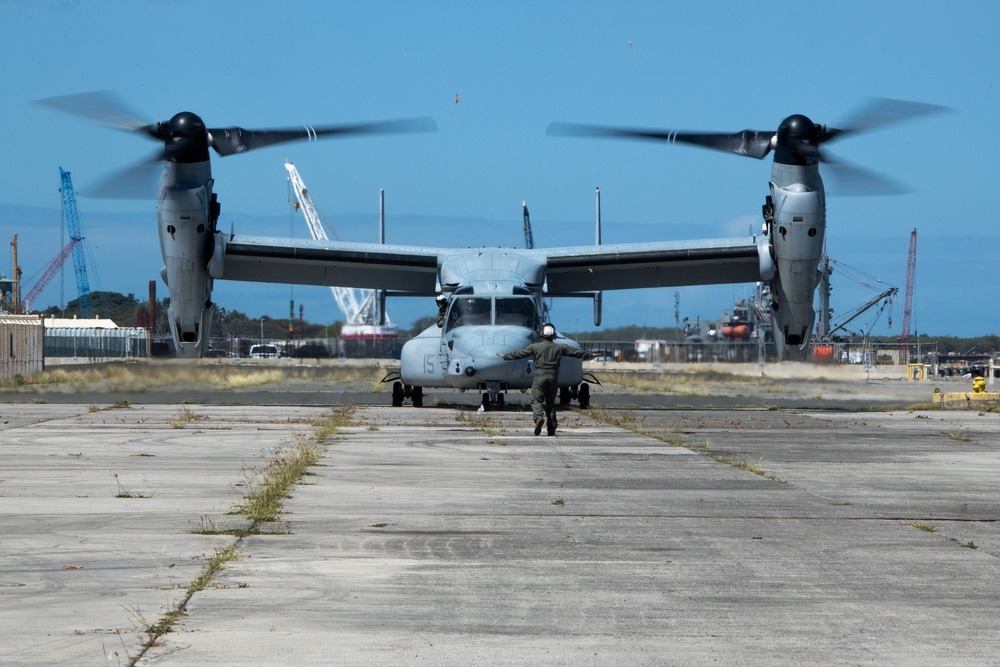
A U.S. Marine with Medium Tiltrotor Squadron (VMM) 268, Marine Aircraft Group 24, 1st Marine Aircraft Wing, guides an MV-22B Osprey in preparation for Marine Rotational Force Darwin (MRF-D) at Joint Base Pearl Harbor-Hickam, Hawaii, April 16, 2024. MRF-D is a deployment held in Australia that enhances capabilities and readiness of both the United States Marine Corps and the Australian Defense Force and continues to help strengthen the alliance between the two nations. VMM-268 will serve as the Aviation Combat Element for the upcoming iteration of MRF-D. (U.S. Marine Corps photo by Lance Cpl. Tania Guerrero)
BAE Receives Additional Contracts for Amphibious Combat Vehicles
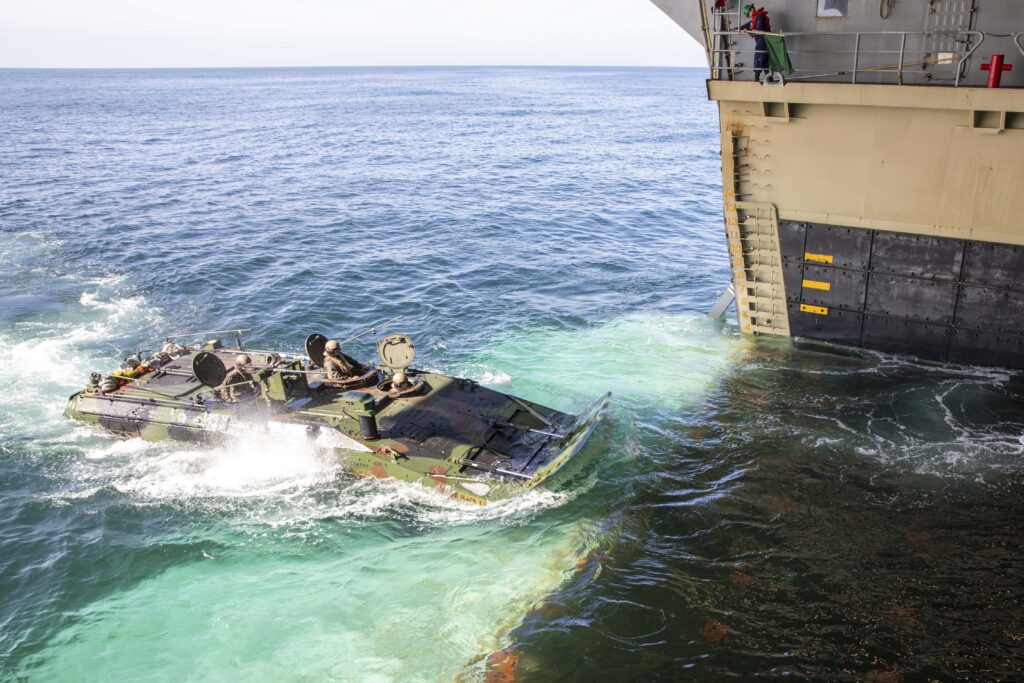
An Amphibious Combat Vehicle (ACV) with the 3d Assault Amphibian Battalion, 1st Marine Division, enters the well deck of amphibious assault ship USS Makin Island (LHD 8) during waterborne training in the Pacific Ocean. U.S. Navy | Mass Communication Specialist Seaman Kendra Helmbrecht
BAE Systems has been awarded an additional $25 million firm-fixed-price modification to a previously awarded $181 million contract by the U.S. Marine Corps for more Amphibious Combat Vehicles (ACVs) under the Marine Corps’ fourth order for full-rate production (FRP).
Total cumulative face value of the contract is $2.7 billion. In addition to vehicle production, the award covers the procurement of ACV Personnel (ACV-P) variants, fielding and sustainment costs, and support and test equipment.
Vehicles produced under this contract will fulfill the Marine Corps’ fleet requirements for ACV-Ps, providing them full operational amphibious capability to execute operations around the world.
“This contract award allows us to continue to deliver this critical capability to the Marine Corps to enable warfighters to complete ship-to-shore missions and other expeditionary requirements,” said Garrett Lacaillade, vice president of amphibious vehicles for BAE Systems. “We continue to work hand-in-hand with our strategic partner Iveco Defense Vehicles and the Marine Corps to ensure that ACVs are ready for current and future deployments.”
ACV-P is the first in a family of four variants to be manufactured and delivered to the Marine Corps. Additional variants include the ACV Command and Control (ACV-C) variant which is currently in production; the ACV 30mm Cannon (ACV-30) variant which production ready test vehicles were delivered for testing earlier this year; and an ACV Recovery (ACV-R) variant which recently completed the design and development phase.
The ACV 8×8 platform provides true open-ocean amphibious capability, land mobility, payload, and growth potential to accommodate future variant growth and technology integration to meet the Marine Corps’ ever-evolving operational needs.
ACV production and support is taking place at BAE Systems locations in Stafford, Virginia; San Jose, California; Sterling Heights, Michigan; Aiken, South Carolina; and, York, Pennsylvania. Deliveries are anticipated to begin in late 2025.
VMFA-542 achieves full operational capability as U.S. Marine Corps’ first F-35 operational squadron on the East Coast
From Communication Strategy and Operations Office,
2nd Marine Aircraft Wing
Apr. 5, 2024
MARINE CORPS AIR STATION CHERRY POINT, N.C. – Marine Fighter Attack Squadron (VMFA) 542, 2nd Marine Aircraft Wing (MAW), achieved full operational capability, Wednesday, as the U.S. Marine Corps’ first East Coast F-35 Lightning II Joint Strike Fighter squadron in the Fleet Marine Force.
Full operational capability means that VMFA-542 is ready for full operations and completed its transition from a legacy tactical-aircraft platform to the F-35B Lightning II. The squadron is now capable and eligible to deploy globally in support of planned or contingency operations. As 2nd MAW’s first operational fifth-generation fighter-attack squadron, they can fulfill their mission essential tasks (METs) in support of the Marine Air-Ground Task Force (MAGTF). These METs include close-air support, strike, strike coordination and reconnaissance, offensive anti-air warfare, suppression of enemy air defenses, electronic attack, electronic support, and active air defense.
“Achieving full operational capability is a testament to the exceptional hard work and professionalism from the Marines of VMFA-542,” said Lt. Col. Brian Hansell, commanding officer of VMFA-542. “This milestone marks the addition of a battle-ready aviation squadron with unmatched combat lethality and survivability to the Marine Expeditionary Force. We are ready and able to conduct missions globally in support of the MAGTF as we continue to prepare for the next challenge.”
The F-35 is a fifth-generation fighter jet with advanced stealth, agility and maneuverability, sensor and information fusion, and provides the pilot with real-time access to battlespace information. It is designed to meet an advanced threat while improving lethality, survivability, and supportability. The F-35B Lightning II is the short-takeoff and vertical-landing F-35 variant. This capability allows the aircraft to operate from amphibious assault ships and expeditionary airstrips less than 2,000 feet long.
VMFA-542 began its transition to the F-35B Lightning II in December 2022 and received its first F-35B on May 31, 2023. The squadron then achieved initial operational capability, Feb. 5, before receiving its 10th aircraft, March 25, and achieving full operational capability, April 3.
The squadron also recently participated in Exercise Nordic Response 24 in Norway, which was a two-week exercise with NATO allies and partners demonstrating military prowess across land, maritime, and aviation domains against challenging arctic and mountainous conditions. During the exercise, VMFA-542 conducted a distributed-aviation-operations event at Kallax Air Base in Lulea, Sweden, March 13, marking the first time a U.S. F-35 Lightning II aircraft landed in Sweden, the first time any F-35 operated at Kallax Air Base, and one of the first training events conducted by Sweden as a NATO member.
VMFA-542 is a subordinate unit of 2nd MAW, the aviation combat element of II Marine Expeditionary Force.
Metal Shark Set to Debut Autonomous, Amphibious, Semi-Submersible “Prowler” Military Interceptor and “Frenzy” Micro-USV
JEANERETTE, La. – April 4th, 2024: Louisiana-based boat builder Metal Shark has announced the debut of “Prowler,” a versatile military craft combining multiple unique technologies to meet the current and near future warfighting requirements of the US military and its allies. The company is also debuting “Frenzy,” a high-performance, low-cost, amphibious micro-USV with a payload carrying capacity of up to 14 lbs.
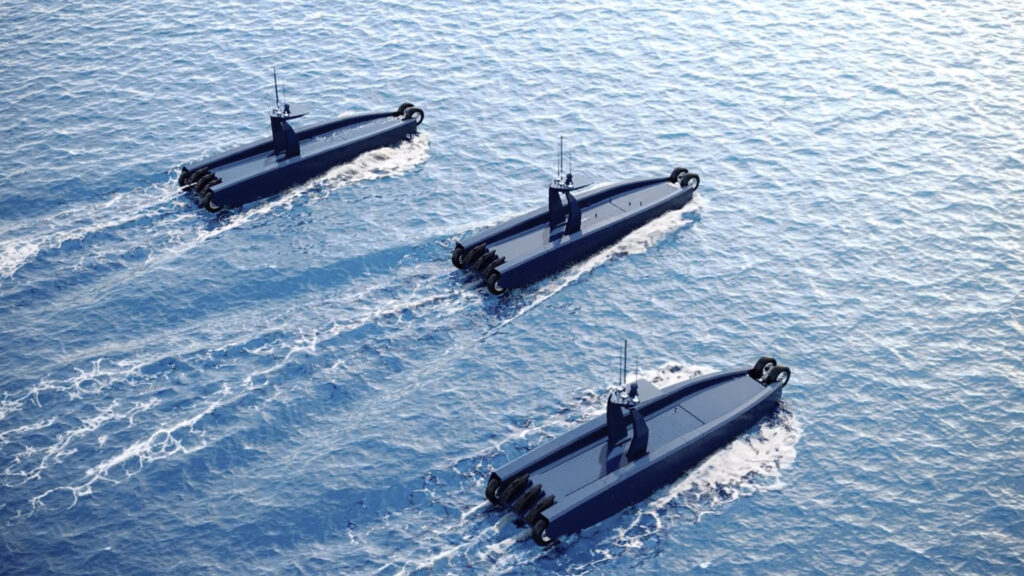
Merging autonomous, amphibious, and semi-submersible capabilities with the performance and seakeeping characteristics of a slender deep-vee monohull surface craft, Prowler has been designed to address operational challenges identified by the United States Navy and Marine Corps, two key Metal Shark clients.
“Prowler represents the sum total of everything we’ve learned while building 400-plus autonomous and remote operated vessels for our military customers over the past decade,” said Metal Shark CEO Chris Allard. “Every aspect of Prowler’s intended operation draws from proven technology. Prowler delivers massive increases in lethality and versatility, merging multiple capabilities into a compact, flexible, lower-cost platform ready for volume production.”
Fully amphibious and capable of autonomous or remote operation on land or at sea, Prowler offers drastically simplified launch and recovery compared to traditional vessels. Prowler is capable of self-launch and self-recovery at boat ramps, without a prime mover or trailer, or from the well deck of an amphibious ship, with no need for cumbersome cradles or dollies. Prowler’s low-speed crawl enables autonomous or remote operation on land, allowing vessels to be staged and maneuvered with minimal effort.
Prowler operates on land via a proprietary electric-drive system developed by Metal Shark, which uses low-pressure, high-traction tires mated to dedicated motors for propulsion and steering. Hydraulic rams raise and lower front and rear wheels for operation on land or at sea. Rear wheels are equipped with OTR-certified tires and marine brakes, and Prowler features DOT-compliant lighting. This allows Prowler to be transported over the road behind a conventional prime mover with no trailer, greatly simplifying logistics for operators.
Propelled by a 300-horsepower Volvo Penta D6 Aquamatic inboard diesel engine and stern drive, the 30-foot, welded-aluminum Prowler operates as a typical surface vessel while underway, with a deep-vee planing hull delivering a 35-knot sprint speed and 500 nautical mile range.
Designed for extended loitering in a semi-submerged state, Prowler’s large integrated ballast tanks flood when the vessel is static. In loitering mode, Prowler’s decks are near the waterline, with only the vessel’s arch-style communications mast visible above the water. Semi-submersion reduces Prowler’s operational profile while also improving stability for sensors, surveillance and weapons systems.
Prowler’s mast carries an array of communications equipment and a situational awareness ensemble for autonomous or remote operation, and can be equipped with port and starboard launch tubes for the deployment of loitering smart drones or other weapons. The mast also serves as the air intake for Prowler’s diesel engine. A lithium-ion battery or optional generator power pack supports station keeping, surveillance, guidance, and communications systems during extended loitering periods of up to a week.
The lift from Prowler’s planing hull design allows the vessel to quickly climb to the surface from its submerged state to resume normal operation once the surveillance mission concludes.
Prowler is equipped with a computer networked system able to support a multitude of UMAA-compliant command and control, autonomy, targeting, and AI software packages. Prowler’s system architecture provides the forward flexibility to accommodate third party software and/or hardware upgrades to support collaborative intercept capability or other technologies as they may be required.
Prowler’s computer system, along with propulsion, mechanical, and electrical systems are contained within a single removable module to allow for expedited onsite servicing, repair, upgrade, or replacement with no need to transport the vessel.
Prowler can simultaneously carry multiple payloads, with 1,000 lbs. of total payload carrying capacity. In addition to the aforementioned smart loitering drones, Prowler can carry up to twelve “Frenzy” amphibious micro USVs, which are carried on deck and self-launched on their own wheels via Prowler’s stern ramp. Designed and built by Metal Shark, the Frenzy features electric waterjet propulsion, carries a payload of up to 14 lbs., and, like Prowler, can loiter in a semi-submerged state.
“I’ve been toying with the notion of this little gizmo ever since we began designing the Long Range Unmanned Surface Vessel (LRUSV) for the Marine Corps,” said Mr. Allard, speaking of the Frenzy micro USV. “There’s a huge need for attritable USVs in a compact form factor, and very few sources. Frenzy will serve this demand, and putting Frenzy onboard Prowler makes perfect sense. Pairing an over-the-horizon capable USV with micro-USVs delivers a one-two punch capability, keeping the key asset safe while allowing the attritable drones to do their job, all while being watched from the sky.”
Prowler and Frenzy will make their public debut April 8th through 10th at Sea-Air-Space 2024 in National Harbor, Maryland, before returning to Metal Shark’s Louisiana facilities for further testing and development.
“We challenged the men and women of Metal Shark to dream big and to think outside the box to bring Prowler and Frenzy to life in an accelerated timeframe, and I am blown away by their talent, energy, and dedication to this project,” said Mr. Allard. “I look forward to showing off the ingenuity and hard work of our people next week at Sea-Air-Space.”
Kratos Demonstrates XQ-58A Electronic Warfare Capabilities for Marine Corps
From Kratos Defense, April 2, 2024
SAN DIEGO, April 02, 2024 (GLOBE NEWSWIRE) – Kratos Defense & Security Solutions, Inc. (NASDAQ:KTOS), a leading National Security Solutions provider, announced that Kratos Unmanned Systems Division has successfully demonstrated the ability of the XQ-58A to fly in concert with two F-35 aircraft and the ability to deliver an integrated electronic attack (EA) capability on the XQ-58A Valkyrie aircraft during a live flight test event at Eglin Air Force Base, Florida. The demonstration completes the first phase of the United States Marine Corps’ Penetrating Affordable Autonomous Collaborative Killer – Portfolio (PAACK-P) program. Flight test support was provided by the 40th Flight Test Squadron, 96th Test Wing. All flight test objectives were successfully met.
The demonstration follows the award of a $22.9M “Phase 2” contract modification on December 4, 2023 for additional engineering development and flight test demonstrations, and marks a significant milestone in the PAACK-P program as the Headquarters Marine Corps Aviation Cunningham Group and Advanced Development Team, Marine Corps Warfighting Lab, the Office of the Undersecretary of Defense for Research and Engineering (OUSD(R&E)), the Naval Air Systems Command (NAVAIR), and Naval Air Warfare Center Aircraft Division (NAWCAD) AIRWorks continue to inform MQ-58B requirements for the Marine Air-Ground Task Force (MAGTF) Unmanned Aerial System (UAS) Expeditionary (MUX) Tactical Aircraft (TACAIR) for use in a Suppression of Enemy Air Defense (SEAD) role.
The XQ-58A’s advanced EA payload autonomously detected, identified, and geolocated multiple tactically relevant targets of interest, transmitted emitter target track coordinates to collaborative assets, and successfully presented non-kinetic electronic attack effects against multiple emitters. Flying since 2019, the Kratos XQ-58A Valkyrie is a high-performance, runway-independent tactical UAV capable of long-range flights at high-subsonic speeds. The Valkyrie can serve as a loyal wingman, conduct single UAS operations, or operate in swarms. Combining affordability, survivability, long-range, high-subsonic speeds, maneuverability, and ability to carry flexible mission kit configurations and mix of lethal weapons from its internal bomb bay and wing stations, the XQ-58A provides unmatched operational flexibility at an affordable price for multiple Department of Defense customers.
“MUX TACAIR promises to increase the lethality and survivability of our current crewed platforms,” said Lt. Col. Bradley Buick, Cunningham Group Capabilities, Research, and Integration Officer. “These platforms are the future of air warfare.”
Steve Fendley, president of Kratos Unmanned Systems Division, said, “We’re very excited about the mission capability demonstrated during the flight and the incredible effectiveness per cost that this enables; not to mention the elimination of risk to a human pilot, and elimination of risk to expensive manned platforms. We’re proud to be pioneering these technologies with our integrated autonomous aircraft systems that truly validate the DoD’s goal of achieving effective, survivable, affordable mass. We are humbled to support the vision and drive of our Marine’s customer who has charted the course for these critical 21st century capabilities and proud to be working as a collective team with Kratos high performance uncrewed jets, Northrop Grumman’s leading technology EW systems, and the Marine Corps.”
2nd Marine Aircraft Wing Marines receive last AV-8B Harrier pilot designations
2nd Lt. John W. Graham, 2nd Marine Aircraft Wing Public Affairs, 1 Apr 2024
MARINE CORPS AIR STATION CHERRY POINT, N.C. — The AV-8B Harrier II Fleet Replacement Detachment (FRD), Marine Aircraft Group (MAG) 14, 2nd Marine Aircraft Wing (MAW), graduated the final two pilots to receive the 7509 Military Occupational Specialty (MOS) at Marine Corps Air Station (MCAS) Cherry Point, North Carolina, Friday.
Capt. Joshua Corbett and Capt. Sven Jorgensen completed their final training flight at the FRD in order to receive the 7509 MOS, which is reserved for AV-8B Harrier II qualified pilots. The flight, a low-altitude close air support training sortie, represents the culmination of the Marines’ training at the FRD.
“The significance of the last replacement pilot training flight in the Harrier community is that it is the beginning of the end for us as a community.” said Corbett. “The Harrier, more than many aircraft than I have come across, elicits an emotional response. For members of the public, members of the aviation community, members of the Marine community, and especially members of the Harrier pilot community, it’s bittersweet. All good things have to come to an end, and it’s our turn soon, but not yet.”
The Harrier is a vertical/short takeoff and landing (VSTOL) tactical attack aircraft. The first AV-8B Harrier II arrived at MCAS Cherry Point in January 1984. In their 40-year presence in the eastern North Carolina region, 2nd MAW Harriers, and the 7509s that pilot them, have supported numerous operations across the globe, including Operation Desert Storm, Operation Allied Force in 1999 in the former Yugoslavia, Operation Enduring Freedom, and Operation Iraqi Freedom. Corbett’s and Jorgensen’s designation represents 2nd MAW’s continued operational transition from legacy fixed-wing tactical aircraft, such as the Harrier.
As the Harrier transitions out of the Fleet Marine Force, its role is being filled by the F-35B Lightning II. Marine Attack Squadron (VMA) 223 will be the last Harrier squadron in the Marine Corps and is set to continue operating the platform through September 2026. Until then, the platform will continue to call MCAS Cherry Point home and execute deployed operations as part of Marine Expeditionary Units.
“I am incredibly proud of the legacy of the AV-8B, both within Marine Aviation and here in eastern North Carolina.” said Lt. Col. Nathaniel Smith, the Commanding Officer of VMA-223. “Our platform is part of the fabric of eastern North Carolina, as countless Marines, sailors, and civilians have contributed to our success for decades. It is exciting to see our last two students graduate from the FRD and hit the fleet. Our team of pilots, maintainers, and supporting staff have done outstanding work in supporting both the FRD and VMA missions here at VMA-223, and I look forward to us continuing to support 2nd MAW and the MAGTF at home and overseas.”
Both pilots will report to VMA-223 after completing the FRD syllabus.
First AH-1Z to Receive SIEPU Upgrade Arrives at Bell Amarillo Assembly Center
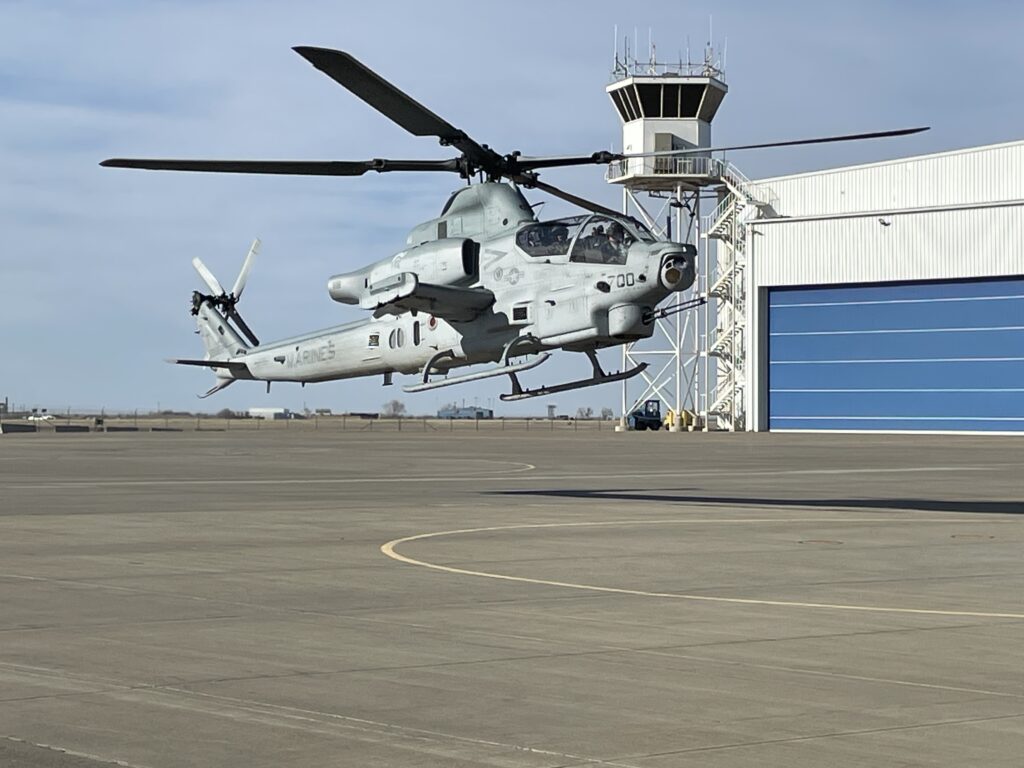
The Bell AH-1Z arrives at the assembly center for the SIEUP modification. Bell Textron
AMARILLO, Texas — The first Bell AH-1Z set to receive the Structural Improvement Electrical Power Upgrade (SIEPU) modification to be provided by Bell Textron Inc. under a contract with the U.S. Marine Corps has arrived at Bell’s Amarillo Assembly Center.
SIEPU modifications optimize the aircraft to improve mission capabilities, aircrew safety and interoperability by increasing the electrical power capacity on the aircraft and supporting the integration of additional cabin capabilities. SIEPU marks the start of the next chapter in the life of domestic H-1 helicopters, following the completion of the U.S. Marine Corps Program of Record in November 2022.
“The Bell AH-1Z Viper and UH-1Y Venom provide the backbone of attack and utility aviation support in the various battlespaces in which they are used, so SIEPU comes at an important time for the future strategic implementation of this platform,” said Mike Deslatte, Bell H-1 senior vice president and program director. “SIEPU will be immediately beneficial for today’s operations, and also sets the H-1 up to quickly support future operational needs, some that may not even be conceived of yet.”
With SIEPU, H-1s will be able to upgrade to current weapons systems with next-generation capabilities, including kinetic long-range munitions and air launched effects as well as new non-kinetic capabilities. These upgrades greatly extend reach and range while simultaneously enhancing standoff distance.
While the H-1s have already demonstrated their capability to counter enemy unmanned aerial systems, SIEPU will also allow for there to be enough on-board power capacity for future weapons that are yet to be implemented.
“We are confident that SIEPU will help the Marine Corps expand mission essential tasks with more mission flexibility,” said Danielle Markham, SIEPU program manager. “The important thing is to make sure the H-1 is in a position to take advantage of those opportunities as they become available.”
Prior to arriving at the Bell Amarillo Assembly Center, the AH-1Z and UH-1Y completed datalink capabilities testing with the Marine Corps modifications at Camp Pendleton and testing with VMX-1 in Yuma. Bell plans to continue supporting the AH-1Z Viper and UH-1Y Venom through the 2040s in alignment with the Marine Corps Aviation Plan.
First of its Kind Deployment of Marine Cyber Forces to the INDO-PACOM Theater
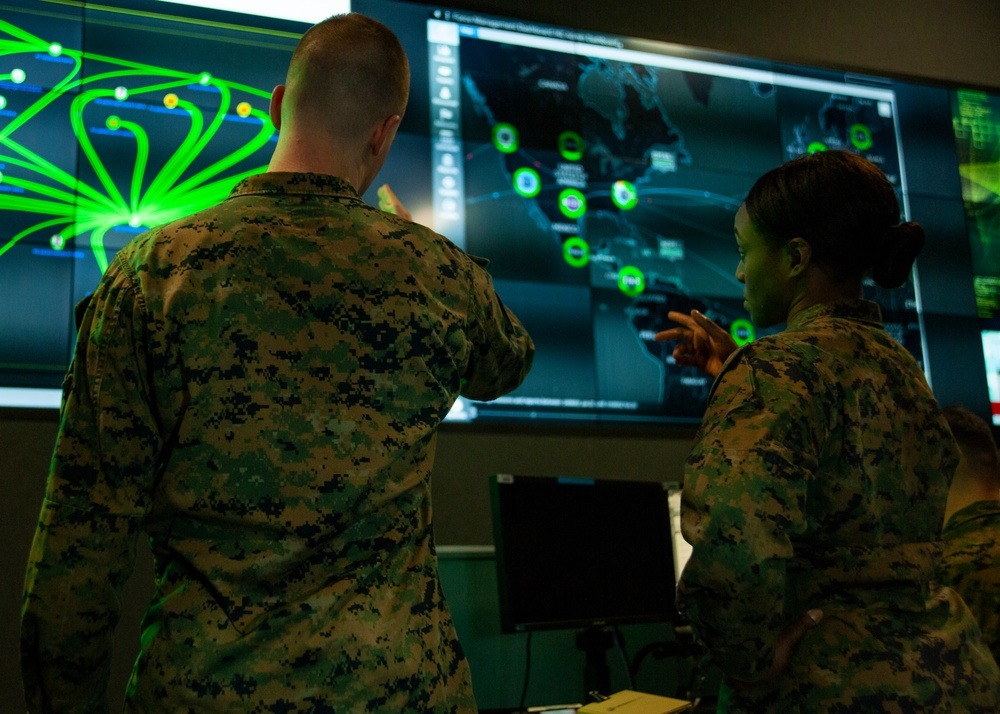
OKINAWA, Japan — Marines assigned to U.S. Marine Corps Forces Cyber Command deployed to Okinawa, Japan as part of the inaugural iteration of a new cyber rotational force concept.
The cyber rotational force concept brings experts in defensive cyber operations to assist tactical and operational units stationed with geographic combatant commands.
“Cyber defense is crucial, and as our capabilities continually mature, it is important that we support the warfighters and units tasked with ensuring our competitive edge throughout the globe,” said Marine Corps Maj. Gen. Ryan P. Heritage, the commander of MARFORCYBER. “Ensuring we have the skills and resources to maintain resilient, reliable networks to support rapid decision making at every level is at the heart of what we do. This is just another step in realizing that goal.”
The team, made up of defensive cyber operations professionals assigned to MARFORCYBER, will join with defensive cyber operations Marines assigned to III Marine Expeditionary Force.
Their mission will be to harden Marine Corps and joint networks in order to better enable the maneuver of units throughout the Western Pacific, knowing that critical infrastructure, networks and systems are effectively monitored and secured.
The forward deployment of cyber forces to operational theaters such as the INDO-PACIFIC, is one way MARFORCYBER is assisting units’ operational and tactical network resiliency in challenging environments.
“Protecting critical networks located inside the weapons engagement zone of several regional adversaries is essential to our ability to physically and virtually maneuver,” said Lt. Gen. William M. Jurney, commander, U.S. Marine Corps Forces, Pacific. “We are excited to work with MARFORCYBER on the cyber rotational force concept and, look forward to the resilience and flexibility their experts can provide our force.”
While the cyber rotational force’s immediate mission is to harden the networks units in the Western Pacific rely upon to complete their mission, it is also a chance to refine the tactics that will be needed in future conflicts against sophisticated adversaries.
“As the threat to our critical cyber infrastructure evolves, it is essential that the Marine Corps be able to defend our forward deployed networks,” Jurney said. “This will be crucial to the Marine Corps’ development of the expeditionary advance basing and stand-in force concepts.”