MV-22B Ospreys Begin Reintegration with 15th Marine Expeditionary Unit
Story by Capt. Brian Tuthill, 15th Marine Expeditionary Unit   

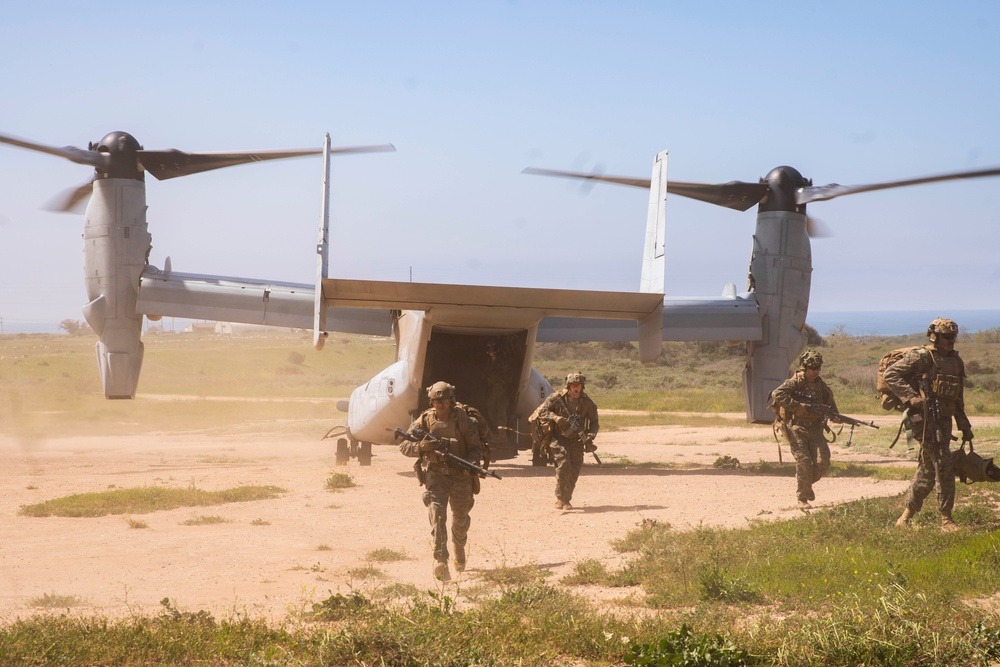
MARINE CORPS BASE CAMP PENDLETON, Calif. – The 15th Marine Expeditionary Unit began MV-22B Osprey reintegration training March 21, transporting a platoon of Marines across Camp Pendleton to regain proficiencies in foundational skills for pilots and infantry Marines. 
 
The training was conducted at two sites and involved a section of MV-22B Ospreys from Marine Medium Tiltrotor Squadron 165 (Reinforced), part of the aviation combat element of the 15th MEU, and Marines with Bravo Company, Battalion Landing Team 1/5, the 15th MEU’s ground combat element. 
 
Bravo Company is BLT 1/5’s airborne assault company for the 15th MEU. 
 
“This type of reintegration training is an important step in returning our pilots and enlisted aircrew to full proficiency and readiness to support the 15th MEU,” said Lt. Col. Drew Bossart, the commanding officer of VMM-165 (Rein.). “We continue to follow the Marine Corps’ deliberate, three-phased approach as our pilots regain basic flight currency, rebuild our instructor cadre, and achieve proficiencies. I am fully confident in our aircraft and that our pilots and aircrews will soon achieve a high state of operational readiness.” 
 
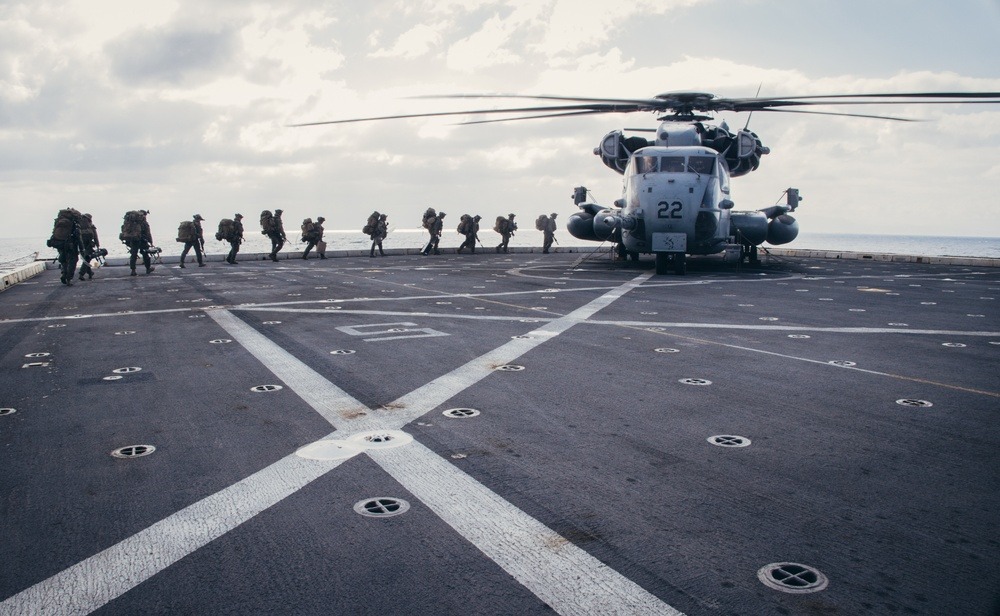
Pilots first landed Ospreys at Camp Pendleton’s helicopter outlying landing field, or HOLF, in the San Mateo area. The HOLF has a section that matches the flight deck dimensions of a U.S. Navy amphibious assault ship, which allows pilots to simulate landing on a ship. The pilots exited their aircraft to meet with leaders from Bravo Company on the ground and provided instructions to the Marines waiting to board the aircraft. Bravo Company Marines then conducted multiple boarding and disembarking drills at the HOLF in the same manner they did previously during at-sea training aboard USS Boxer (LHD 4). 
 
Following the landing zone drills in San Mateo, VMM-165 (Rein.) pilots transported Bravo Company Marines to a confined area landing site in the Las Flores area. The CAL site is a landing zone that that requires pilots to maneuver around obstacles such as trees, powerlines, or buildings to land. These types of landings prepare pilots and crew chiefs for unpredictable terrain and situations they may encounter in an expeditionary environment. Bravo Company Marines exited the aircraft and established security to simulate how they would insert and extract at a landing zone during a mission before reembarking the aircraft. 
 
Following the training at the CAL site, Bravo Company’s Marines were flown back to San Mateo for their final landing and the Ospreys returned to their squadron headquarters at Marine Corps Air Station Miramar. 
 
“MV-22s are the cornerstone of the 15th MEU’s Marine Air-Ground Task Force, providing us unrivaled flexibility for expeditionary operations across the spectrum of military operations and movement from ship to shore,” said Col. Sean Dynan, the commanding officer of the 15th MEU. “VMM-165’s pilots and aircrews have the full support of the 15th MEU as they take a measured approach to progress through all requirements carefully and deliberately.” 
 
VMM-165 (Rein.) and the 15th MEU will continue to conduct progressive training events over the coming weeks, both ashore and at sea. 
 
MV-22B Ospreys are multi-engine, dual-piloted, self-deployable, medium lift, vertical takeoff and landing (VTOL) tiltrotor aircraft designed for combat assault support, combat service support, and special operations missions worldwide. Ospreys have the ability to carry 24 Marines and Sailors twice as fast and five times farther than previous helicopters, flying at 240 knots and up to 200 nautical miles. 


Bataan ARG, 26th MEU(Soc) Return From 8-month Deployment

By Chief Mass Communication Specialist Eva-Marie Ramsaran, Amphibious Squadron 8 Public Affairs 

21 March 2024 

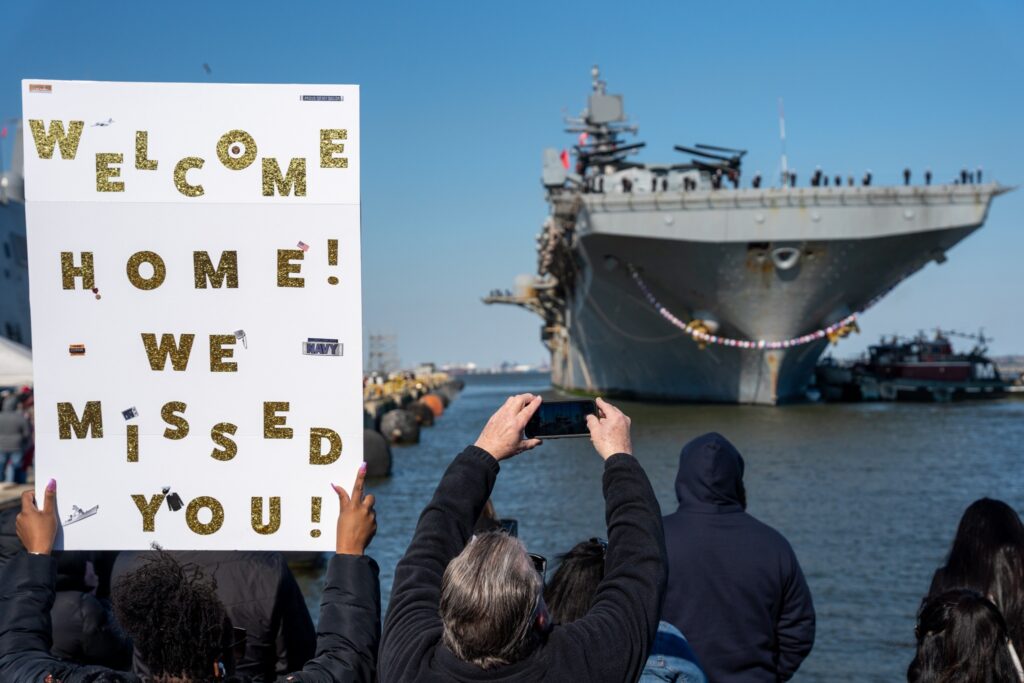
NORFOLK, Virginia — More than 4,000 Sailors and Marines assigned to the Bataan Amphibious Ready Group (ARG) and embarked 26th Marine Expeditionary Unit (Special Operations Capable) (MEU(SOC)) returned to Hampton Roads following an eight and a half-month deployment to the U.S. 2nd, 5th and 6th Fleet areas of operations, March 21. 

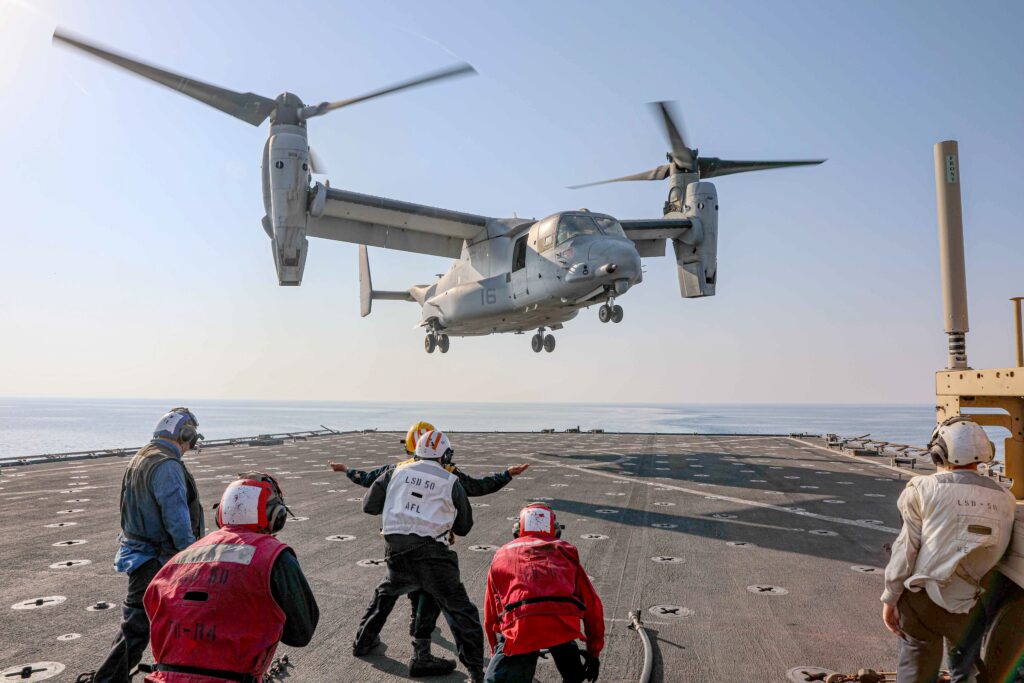
Two of the ARG ships, the Wasp-class amphibious assault ship USS Bataan (LHD 5) and Harpers Ferry-class dock landing ship USS Carter Hall (LSD 50), returned to Naval Station Norfolk and Joint Expeditionary Base Little Creek in Virginia. 

“It is great to be home,” said Amphibious Squadron (CPR) 8 Commodore, Capt. Martin Robertson. “I’m proud of the Sailors and Marines of the Bataan Amphibious Ready Group who return home today knowing that for eight and a half months, they were the nation’s rapid response force.” 

The San Antonio-class amphibious transport dock ship USS Mesa Verde (LPD 19) is expected to return to Naval Station Norfolk, Virginia, in the coming days. Most of the Marines assigned to the 26th MEU(SOC) departed the ARG ships and returned to Camp Lejeune, North Carolina earlier this week. 

While in the U.S. 5th and 6th Fleet areas of operations, the Bataan ARG and 26th MEU(SOC) team supported a wide range of interoperability opportunities and exercises across the North Atlantic, Eastern Mediterranean, Baltic region, Red Sea and Arabian Gulf, increasing combat readiness and crisis response capabilities while strengthening relationships with both Allies and partners. 

“These young men and women were called into action from the start to help stop the spread of wildfires in Southern Europe, to deter Iran from seizing U.S.-flagged merchant vessels in the Middle East, and they reacted swiftly at the onset of the crisis in the Bab-El Mandeb to ensure merchant shipping access to the Red Sea,” Robertson said. “Your sons and daughters stood ready to assist American citizens in countries impacted by the Israel-Hamas conflict, and their efforts directly prevented the conflict from expanding to other nations in the region. Simultaneously, we operated close to Russia in the high north and Baltic regions, reinforcing America’s commitment to the NATO alliance, emphasizing the importance of regional peace and security. Thank you to our families and friends. Your love and support made all our successes possible.” 

In July 2023, following the wildfires in Greece, the Bataan ARG disaggregated, with Mesa Verde remaining in the U.S. 6th Fleet area of operations supporting Allies and partners through various bilateral exercises and operations across the theater. Mesa Verde and the embarked Marines visited Greece, Ireland, Latvia, Norway, Spain and the United Kingdom. Additionally, Secretary of the Navy Carlos Del Toro visited Mesa Verde while the ship was in Dublin, Ireland, for the U.S. Naval Academy versus University of Notre Dame football game, Aug. 26, 2023. 

Bataan and Carter Hall transited the Suez Canal and operated in the U.S. 5th Fleet area of operations for more than four months, ensuring the free flow of navigation and regional stability. Following the outbreak of conflict between Israel and Hamas, both ships participated in Operation Prosperity Guardian in the Red Sea to deter further escalation and protect open sea lanes. 

“It’s been a challenging deployment, but we have accomplished a lot, and I am extremely proud of the hard work and resilience of every member of the Bataan team,” said Capt. Paul Burkhart, Bataan’s commanding officer. “Throughout the past eight months, we have really shown what it means to be ‘Bataan tough.’ We were able to showcase our amphibious capabilities throughout three Navy fleets, deter aggression through our presence and were able to create and share countless memories that will last a lifetime.” 

Notable visitors to the Bataan and Carter Hall included commanders and staff of U.S. Naval Forces Europe-Africa, U.S. 6th Fleet, U.S 5th Fleet, U.S. Central Command, Task Force 61/2, Task Force 51/5, French, Italian and Turkish navies, along with distinguished guests from the Kingdom of Bahrain, Cyprus, Egypt, Jordan, Kuwait, Oman, Kingdom of Saudi Arabia, United Arab Emirates and U.K. 

The ARG/MEU presence overseas supported strategic interests and contributed to regional security and stability and reassured U.S. commitment to multiple regions. The blue-green team provided operational flexibility to combatant commanders by providing a versatile contingency response force using sea, air, land and logistical assets. The versatility inherent to the amphibious force allowed for flexible and mission-tailored forces, while representing our nation’s strength, capability and resolve to partners and Allies and deterring potential adversaries. 

“History has proven the necessity of having forward-deployed Marines, embarked aboard amphibious ships. Over the past eight months, the Marines and Sailors of the 26th MEU(SOC) have showcased the value, utility and unique all-domain operational capabilities you only find in a marine expeditionary unit,” said Col. Dennis Sampson, commanding officer of the 26th MEU(SOC). “When coupled together, the ARG and the MEU(SOC) form a flexible naval expeditionary force capable of reassuring our Allies and partners of our commitment to maritime security and capable of dominating within the littorals against any adversary in any clime or place.” 

The Bataan ARG is comprised of the Bataan, Mesa Verde, and Carter Hall. Embarked commands include CPR 8, Fleet Surgical Team 8, Tactical Air Control Squadron 21, Helicopter Sea Combat Squadron 26, Assault Craft Unit 4, Beach Master Unit 2 and the 26th MEU(SOC). 

The 26th MEU(SOC) consists of the Command Element; Aviation Combat Element, Marine Medium Tiltrotor Squadron 162 (Reinforced); Ground Combat Element, Battalion Landing Team 1/6; and Logistics Combat Element, Combat Logistics Battalion 22. 


USMC Conducts First F-35 Landing in Sweden During Exercise Nordic Response

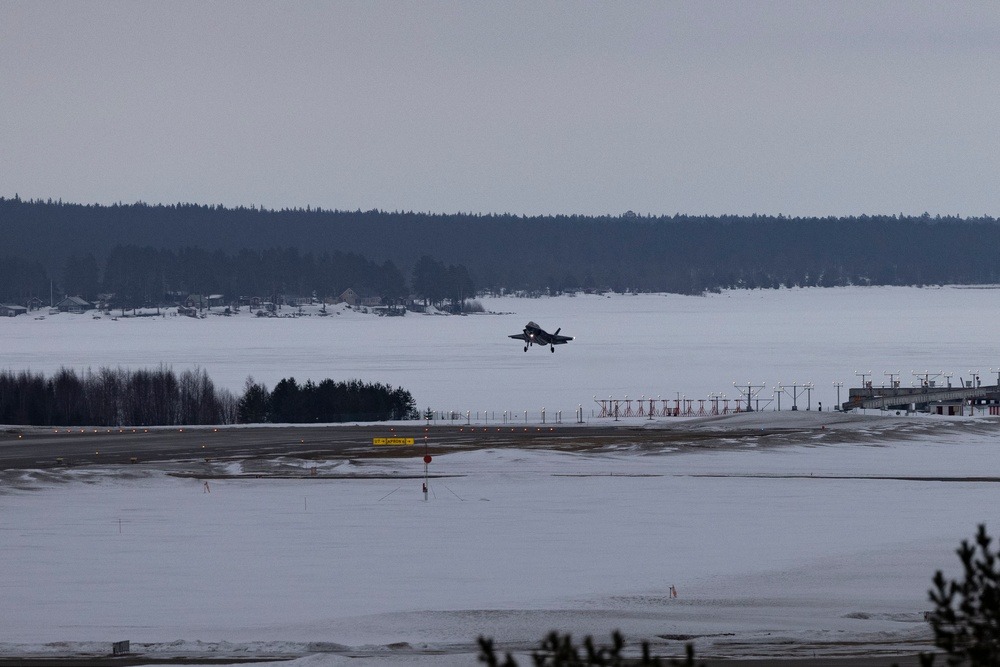
A U.S. Marine Corps pilot lands an F-35B Lightning II jet with Marine Fighter Attack Squadron (VMFA) 542, 2nd Marine Aircraft Wing (MAW), at Lulea, Sweden, March 13, 2024. (U.S. Marine Corps photo by Lance Cpl. Orlanys Diaz Figueroa)

Captain Jacob Sugg USMC, Exercise Nordic Response Media Information Center  

15 Mar 2024 

LULEA, Sweden–Four U.S. Marine Corps F-35B Lightning II Joint Strike Fighters with Marine Fighter Attack Squadron 542, 2nd Marine Aircraft Wing, and a KC-130J Super Hercules with Marine Aerial Refueler Transport Squadron 252, 2nd MAW, conducted distributed aviation operations during Exercise Nordic Response 24 at Kallax Air Base in Lulea, Sweden, March 13, 2024. 

Exercise Nordic Response, formerly known as Cold Response, is a NATO training event conducted every two years to promote military competency in arctic environments and to foster interoperability between the Marine Corps and allied nations. 

The event marked the first time a U.S. F-35 Lightning II jet aircraft landed in Sweden, the first time any F-35 operated at Kallax Air Base, and one of the first training events conducted by Sweden as a NATO member. 

“We’re thrilled to welcome the first American F-35 landing here at Kallax air force base, and it’s an F-35B from the U.S. Marine Corps,” said Swedish Brig. Gen. Tommy Petersson, deputy commander of the Swedish Air Force. “For the U.S. Marine Corps of course, it’s a part of the agile combat employment portion in the framework of the exercise we’re conducting together right now, Nordic Response 24.” 

The preplanned event provided an opportunity for U.S. Marine Corps aviation platforms to use a Swedish air base and host-nation support to conduct aviation-delivered ground refueling from a U.S. KC-130J Super Hercules to U.S. F-35B JSF aircraft. 

“Of course, this is of vital interest for Sweden as a new ally in NATO to further develop our ability for host-nation support, for instance for American assets,” said Petersson. 

Distributed aviation operations is a method of generating aviation combat power through the coordinated employment of aviation squadrons, command-and-control agencies, aviation logistics, and aviation ground-support units disaggregated across the battlefield that challenges adversary targeting efforts. The 2nd MAW concept of DAO distributes command and control of aviation forces across echelons of command, pushing authorities to the lowest levels, while keeping forces moving between airfields and air sites. It also integrates and builds interdependencies between the 2nd MAW and its allies and partners. 

“This is an opportunity to work with our Swedish partners to exercise distributed aviation operations,” said U.S. Maj. Gen. Scott Benedict, commanding general of 2nd MAW. “We were able to launch our aircraft into a NATO training strike package, recover them back here in Sweden, refuel them via expeditionary means out of a KC-130, and get them back in the air for another sortie. This is our means to be able to operate in an environment where we are protected because of our mobility.” 

Both VMFA-542 and VMGR-252 deployed from their home base of Marine Corps Air Station Cherry Point, North Carolina. VMFA-542 is the first East Coast operational F-35 squadron for the U.S. Marine Corps. Exercise Nordic Response 24 was VMFA-542’s first overseas exercise as an F-35B Lightning II jet squadron and since achieving initial operational capability on Feb. 5, 2024. 

During the exercise, VMFA-542 employed its fifth-generation assets in a near-peer adversary training exercise while advancing and sustaining the squadron in core mission-essential tasks of anti-air warfare, active air defense, suppression-of-enemy air defense, and strike capabilities while progressing the squadron toward full operational capability. The squadron integrated with NATO allies across Northern Europe and with United Kingdom and Norwegian F-35 aircraft, showcasing the breadth and diversity of the Joint Strike Fighter program. 

Throughout the exercise, VMGR-252 employed its KC-130J Super Hercules aircraft to support Marine Air-Ground Task Force objectives such as providing transportation of cargo, combat-assault transport, aerial refueling, and aviation-delivered ground refueling to both U.S. and allied aircraft. They conducted aviation operations from expeditionary shore-based sites and cold-weather conditions to achieve training objectives and increase aircrew and loadmaster proficiencies. 

Exercise Nordic Response 24 was a two-week exercise that brought together NATO allies and partners for a comprehensive demonstration of military prowess across land, maritime, and aviation domains. Against the backdrop of challenging arctic and mountainous conditions, participating military forces engaged in realistic force-on-force scenarios, showcasing their capabilities in both offensive and defensive operations. 

“Our allies and partners have been living in this region for a long time, and they’ve developed similar capabilities themselves,” said Benedict. “As we partner with allies, it enables us to exercise what to do better and to learn from their experience operating here. We’re always better working together; opportunities to enable our concepts and operations alongside partners, while learning, gets the best of both worlds.” 

Exercise Nordic Response 24 is a continuation of the record-breaking NATO exercise Steadfast Defender. 

B-roll, imagery, and news stories of II MEF Marines participating in Exercise Nordic Response 24 can be found hyperlinked on the Exercise Nordic Response DVIDS page


Rite-Solutions Awarded $60 Million NUWC Division Newport IT Services Contract

MIDDLETOWN, R.I. (March 18, 2024) — Rite-Solutions was recently awarded a $60.7 million, five-year contract to support NUWC’s Activity Chief Information Officer (ACIO)/Information Technology (IT) division, which is responsible for strategic planning, operations, maintenance, and compliance of the center’s IT systems and infrastructure. 

The company will provide IT services in several areas including software engineering, system administration, cybersecurity, client support services/help desk, Navy Marine Corps Intranet (NMCI) support, IT governance and application portfolio management support, and more. 

“Cybersecurity touches every one of these areas,” notes Rocky Reeves, Rite-Solutions Sr Vice President and Director of IT Services. Over one-half of the personnel supporting this contract must meet the Navy’s strict Cybersecurity Workforce requirements. “This was a major reason Rite-Solutions won the contract. Many of our employees have degrees in cybersecurity or computer science as well as security and operating system certifications.”  

“We are honored that NUWC chose to renew the contract with us,” says Rite-Solutions co-founder Joe Marino. “While we are rapidly expanding into new technologies that give the Navy an Information Advantage, IT services and security remain a critical component of what we offer.” 

The company is the prime contractor on the project and will work with subcontractors including SAIC, McLaughlin Research Corporation, Mikel, and others.  

Rite-Solutions will support NUWC headquarters in Newport, R.I. as well as NUWC locations in Connecticut, Virginia, Florida, and the Bahamas.


SECNAV Announces General, Flag Officer Nominations

March 18, 2024 

Secretary of Defense Lloyd J. Austin III announced today that the president has made the following nomination: 

Marine Corps Lt. Gen. James F. Glynn for appointment to the grade of lieutenant general, with assignment as commander, U.S. Marine Corps Forces Pacific; and commanding general, Fleet Marine Forces Pacific. Glynn is currently serving as the deputy commandant for Manpower and Reserve Affairs, Quantico, Virginia. 

Navy Rear Adm. (lower half) Joseph B. Hornbuckle for appointment to the grade of rear admiral. Hornbuckle is currently serving as commander, Fleet Readiness Centers, Naval Air Systems Command, Patuxent River, Maryland.


Austin Nominated for Deputy Commandant for CD&I

ARLINGTON, Va.—Secretary of Defense Lloyd J. Austin III announced March 14 that the president has made the following nomination: 

Marine Corps Maj. Gen. Eric E. Austin for appointment to the grade of lieutenant general, with assignment as deputy commandant for Combat Development and Integration, Headquarters, U.S. Marine Corps; and commanding general, Marine Corps Combat Development Command.  Austin is currently serving as the commanding general, 1st Marine Aircraft Wing, Camp Foster, Okinawa, Japan. 


BATARG and 26th MEU(SOC) Returns Home From 8-month Deployment

CAMP LEJEUNE, NC, UNITED STATES 

12.03.2024 

Story by Capt. Angelica White 

26th Marine Expeditionary Unit (Special Operations Capable)    

Marines and Sailors assigned to the 26th Marine Expeditionary Unit (Special Operations Capable) will return home in several waves beginning Mar. 16, 2024 after successfully completing an extended eight-month deployment embarked aboard the amphibious warships of the Bataan Amphibious Ready Group (BATARG) in U.S. Naval Forces Europe and Africa/6th Fleet and U.S. Naval Forces Central Command/5th Fleet areas of operations. 
 
The BATARG is comprised of the Wasp-class amphibious assault ship USS Bataan (LHD 5), the San Antonio-class amphibious transport dock ship USS Mesa Verde (LPD 19), and the Harpers Ferry class dock landing ship USS Carter Hall (LSD 50). 
 
Upon leaving the east coast of North Carolina for deployment in July 2023, the Secretary of Defense directed the BATARG and 26th MEU(SOC) to support operations in the U.S. Central Command (USCENTCOM) in response to attempts by Iran to threaten the free flow of commerce in the Arabian Gulf and Strait of Hormuz. The 26th MEU(SOC) took deliberate actions to task-organize an element aboard the USS Mesa Verde with the appropriate staff depth and operational capabilities to execute operations and activities in support of U.S. European Command (USEUCOM) theater security objectives, while the majority of the 26th MEU(SOC) Marine Air-Ground Task Force, embarked aboard USS Bataan and USS Carter Hall, was postured in USCENTCOM to deter Iranian malign activity and increase maritime security in the waters surrounding the Strait of Hormuz. 
 
The 26th Marine Expeditionary Unit’s deployment marked the first time the U.S. Marine Corps and II Marine Expeditionary Force were able to certify and employ a special operations capable Marine Expeditionary Unit in over two decades. This historical milestone demonstrated the Marine Corps’ commitment to joint naval integration and partnering with forward-deployed special operations forces in support of crisis response and Fleet campaigning priorities, reinforced throughout the 26th MEU(SOC)’s voyage with the BATARG. 
 
Throughout the deployment, the 26th MEU(SOC) executed distributed operations spanning across the Tri-Geographic Combatant Command to include USEUCOM, USAFRICOM, and USCENTCOM, contributing to increased maritime security and regional stability, while also participating in activities with Allies and partners to enhance mil-to-mil relationships, showcase interoperability, and sustain high operational readiness. 
 
In the High North, the Marines and Sailors of the 26th MEU(SOC), embarked aboard USS Mesa Verde participated in bilateral exercises with elements of the Norwegian Brigade North and Italian partners to exchange tactics, techniques, and procedures in the coastal regions and littorals. 
 
While operating in the Baltics, the 26th MEU(SOC) participated in Exercise Northern Coasts, a German, multi-national naval exercises series in the Baltic region, aimed at delivering realistic, live training for a broad range of amphibious operations. The 26th MEU(SOC)’s participation in Exercise Northern Coasts marked the first time U.S. Marine Corps forces participated in this large-scale NATO-exercise. 
 
Concurrently, in USCENTCOM, the Marines and Sailors of the 26th MEU(SOC), embarked aboard USS Bataan and USS Carter Hall participated in a series of bilateral exercises with the Kuwaiti Marine Corps, Bahrain Royal Marines, and the Bahrain Royal Air Force. Additionally, the BATARG and 26th MEU(SOC) supported Operation Inherent Resolve and Operation Prosperity Guardian. Moreover, the 26th MEU(SOC) showcased an ability to integrate and partner with other forward-deployed Special Operations Forces within the littorals as a part of the MEU/SOF-I3 continuum and efforts to increase maritime security and stability while deterring any potential malign actors. 
 
When the terrorist attacks against Israel on 7 Oct. dynamically changed the security environment across the region, the 26th MEU(SOC) rapidly transitioned from participating in a readiness and sustainment training exercise in Kuwait to posturing to rapidly respond to emergent operational requirements and to safeguard U.S. national interests within the Red Sea. 
 
The Marines and Sailors of the 26th MEU(SOC), embarked aboard the three ships of the aggregated BATARG in the Mediterranean Sea, remained postured in the Eastern Mediterranean Sea from Dec. 28 to Mar. 1 as the immediate response force with the operational capabilities needed to provide leaders across the Geographic Combatant Command with options in USEUCOM and USCENTCOM. The 26th MEU(SOC) also conducted several enhanced interoperability training sustainment exercises with NATO Allies and partners in the Mediterranean Sea. 
 
Through rapid planning, coordination, and execution, the BATARG and 26th MEU(SOC) team successfully completed multinational training events with Naval Striking and Support Forces NATO (STRIKFORNATO), the United Kingdom, Türkiye, and NATO Maritime Group Two at the end of February prior to transiting towards the United States. 
 
“History has proven the necessity of having forward-deployed Marines, embarked aboard amphibious ships. Over the past eight months, the Marines and Sailors of the 26th MEU(SOC) have showcased the value, utility, and unique all-domain operational capabilities you only find in a Marine Expeditionary Unit,” said Col. Dennis Sampson, Commanding Officer of the 26th MEU(SOC). “When coupled together, the ARG and the MEU(SOC) form a flexible naval expeditionary force capable of reassuring our Allies and partners of our commitment to maritime security and capable of dominating within the littorals against any adversary in any clime or place.” 
 
From the High North of Norway, to the Baltics, to the Mediterranean, Horn of Africa, to the Middle East, the BATARG and the 26th MEU(SOC) successfully completed over 15 bilateral activities with over 30 NATO Allied and partner countries in Plymouth, United Kingdom; Narvik and Setermoen, Norway; Riga, Latvia; Dublin, Ireland; Cartagena, Spain; Athens, Chania, Volos, and Lidochorro, Greece; Dubai and Abu Dhabi, United Arab Emirates; Manama, Bahrain; Saudi Arabia; Yemen; Kuwait; Lanarca, Cyprus. In addition to bilateral exercises, the BATARG and 26th MEU(SOC) engaged with multiple representatives from embassies, ministries of defense, and local government, military, and civilian officials to strengthen relationships with NATO Allies and partners through in-person key leader engagements and subject matter expert exchanges, including ship tours, ceremonies and receptions, and community service projects during each port visit. 
 
“Throughout our time in the U.S. 5th and U.S. 6th Fleet regions, the Sailors and Marines of the BATARG and 26th MEU(SOC) showcased the unique capabilities that we bring as a response force to our Allies and partners,” said Capt. Martin Robertson, Amphibious Squadron 8 Commodore. “Our presence in the Eastern Mediterranean was exactly what our Nation needed: an integrated Navy and Marine Corps force ready to respond when called upon.” 
 
The 26th MEU(SOC) serves as one of the United States’ premier crisis response forces capable of conducting amphibious operations, crisis response, and limited contingency operations, to include enabling the introduction of follow-on forces and designated special operations, in support of theater requirements of the Geographic Combatant Commander. The 26th MEU(SOC) serves as a premier stand-in force with the unique all-domain operational capabilities necessary to compete and win within the littorals and within the weapons engagement zones of an adversary in any clime or place. 
 
“I am very proud of the steadfast professionalism of every Marine and Sailor assigned to the 26th MEU(SOC) and the BATARG. They have made a difference and highlighted the relevance of the ARG and MEU to our national security interests across the Tri-COCOM region,” Sampson said. “More so, I am truly grateful for the steadfast support from our 26th MEU(SOC) families and friends. I know they are proud of their Marine or Sailor and I know they are ready for our homecoming in a couple of weeks.” 
 
The BATARG and 26th MEU(SOC) presence in the U.S. 6th Fleet and U.S. 5th Fleet areas of operation supported strategic objectives and contributed to regional security and stability, reassuring the United States commitment to Allies and partners in the High North, Baltics, Mediterranean, and Middle East. Coupled with the BATARG, the 26th MEU(SOC) showcased the value, utility, and operational flexibility a forward-deployed ARG-MEU provides Geographic Combatant Commanders. 
 
From responding to contingencies to enhancing bilateral relations with key Allies and partners, the constant theme of the 26th MEU(SOC) was being ‘Ready, Relevant, and Capable’ of aggregating other joint, coalition, or special operations forces and deploying with limited notice in support of crises, expeditionary operations on land or from the sea, or other emergent operational requirements. 


Navy Awards Bell Textron Contract for 12 AH-1Z Helicopters for Nigeria

KOREA STRAIT (March 29, 2023) An AH-1Z Viper helicopter takes off from the amphibious assault ship USS Makin Island (LHD 8), March 29, 2023. (U.S. Marine Corps photo by Gunnery Sgt. Chad J. Pulliam) 

By Richard R. Burgess, Senior Editor 

ARLINGTON, Va. — The government of Nigeria is slated to receive 12 AH-1Z Viper helicopter gunships, becoming the third foreign customer for the Viper. 

In a March 12 contract announcement, the Naval Air Systems Command awarded to Bell Textron of Fort Worth, Texas, a $455 million “firm-fixed-price, undefinitized contract for the production and delivery of 12 AH-1Z helicopters for the government of Nigeria, as well as provides associated engineering, program management and logistics support, and non-recurring engineering for obsolescence.” 

Deliveries to the Nigerian government are expected to be complete by July 2028. 

Bell built 189 AH-1Zs for the U.S. Marine Corps and 12 for Bahrain, and is building four for the Czech Republic, along with eight UH-1Y Venom utility helicopters. The Czech Republic also is receiving free of charge six AH-1Zs and two UH-1Ys that formerly were part of the U.S. Marine Corps’ inventory.


Marine Corps Returns MV-22 to Flight Status

HEADQUARTERS MARINE CORPS – The Marine Corps returned its MV-22s to flight on March 8, following Naval Air Systems Command’s (NAVAIR) announcement that deemed the aircraft safe to fly. 

In a release announcing the flight clearance, Naval Air Systems Command said, “This decision follows a meticulous and data-driven approach prioritizing the safety of our aircrew.” 

The Nov. 29, 2023, crash of an Air Force CV-22 off the coast of Japan remains under investigation. The tragic mishap is what precipitated the temporary grounding of all services’ V-22s. The grounding provided time for a thorough review of the mishap and formulation of risk mitigation controls to assist with safely returning the V-22 to flight operations. 

The Marine Corps, after a thorough review of all available engineering data and with revisions to the flight manual in place, is now enacting a deliberate plan to return all 17 MV-22 squadrons to full capability. Close coordination among key senior leaders across all three services, the Marine Corps, Air Force, Navy and the Safety Investigation Board (SIB) has been paramount in formulating the comprehensive review and return to flight plan, and this collaboration will continue. 

The Marine Corps’ three-phased approach begins with a focus on regaining basic flight currency, rebuilding units instructor cadres, and achieving proficiency in Core and Basic skill training for pilots and aircrew. After that, squadrons will follow well-established training and readiness manuals to gain proficiency in basic and advanced mission sets, demonstrating their ability to conduct the core missions of an MV-22 Squadron.  Finally, squadrons will conduct specific pre-deployment training for their next assigned mission, executing the advanced, all-weather tactics that distinguish our MV-22 squadrons among other aviation capabilities and units.  The second and third phases of this plan will vary in length, and some units will extend into the late Spring or early Summer of 2024 before they return to operational capability.  

“The Marine Corps has confidence in the Osprey and we are laser focused on the safety and mission readiness of our pilots and aircrew,” said Lt. Gen. Bradford J. Gering, Deputy Commandant for Marine Corps Aviation.  “Our people have been and will always be our top priority. The Air Force CV-22 mishap is a tragedy, and we honor the legacy of those eight fallen service members by diligently and deliberately applying what we have learned from that day as we return to flight operations. We have worked extensively on plans and timelines that support a deliberate, methodical, and safe return to flight. We are flying the Osprey again because our airworthiness authority cleared it for flight, because we trust our well-established operational risk management procedures, and most of all because we trust our professional pilots, aircrew and maintainers to safely get this combat-proven aircraft back into the fight.” 

Since mid-January, Marines in Africa have been flying the MV-22 safely, under a very specific operationally necessary banner. Those missions, in support of U.S. Africa Command priorities, have been conducted safely and demonstrate the range, speed, and maneuverability the MV-22 provides the combatant commander. 


Lawmakers Stand Firm for 31 Amphibious Ship ‘Floor’

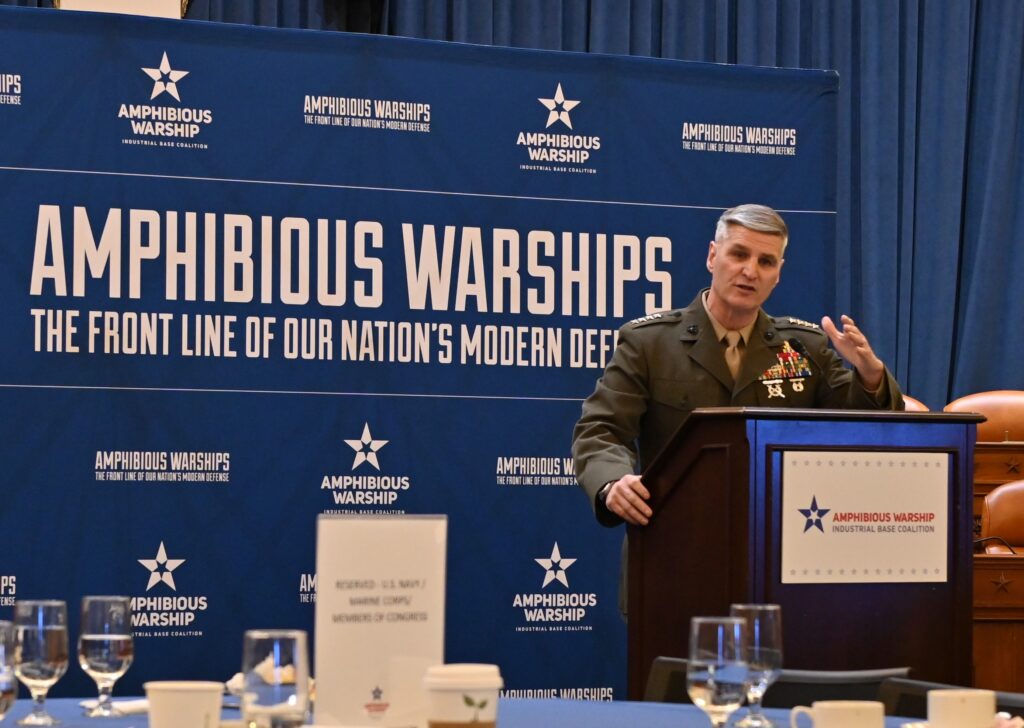
Gen. Mahoney speaks to members of the Amphibious Warship Industrial Base Coalition. Brett Davis

WASHINGTON ꟷ The U.S. Marine Corps needs a minimum of 31 amphibious ships and Congress is prepared to force the issue if the Pentagon balks, lawmakers from the House and Senate told members of the Amphibious Warship Industrial Base Coalition on March 7.

“Until they [the Marine Corps] can walk on water, we better be building more ships,” said Rep. Rob Wittman (R-Virginia).

He and other lawmakers from both parties said amphibious ships are critical for projecting both hard and soft power around the world.

Sen. Dan Sullivan (R-Alaska) said a floor of 31 amphibious ships is written into defense authorization, but a previous Navy budget projection “never once” hit that 31 number. He said Chief of Naval Operations Admiral Lisa Franchetti has assured him the new one will.

“We’re going to make them build what the Marine Corps needs,” Sullivan said.

Sen. Roger Wicker (R-Missisippi) said, “this is the most dangerous national security climate we’ve had in decades. Thirty-one amphibs. Three hundred and fifty-five ships. Do the right thing.”

Sen. Tammy Baldwin (D-Wisconsin) said maintaining an adequate amphibious fleet is “an issue of national security for all of us.”

General Chris Mahoney, the assistant commandant of the U.S. Marine Corps, also addressed the group and noted how easy it is for adversaries to interfere with international shipping, citing the attacks by Houthi rebels in the Red Sea.

“I’m going to remain in lockstep with the CNO when she says, ‘I need more players on the field,’” Mahoney said. “We need to keep the [production] lines hot, multiple lines.”