BAE Systems Delivers First Production-Ready ACV Command Variant to U.S. Marine Corps
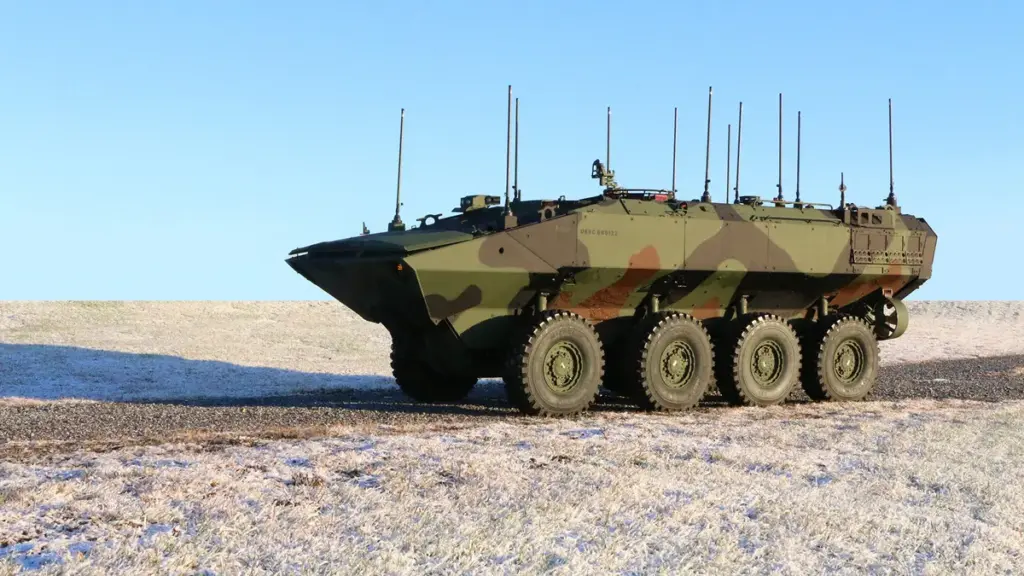
BAE Systems’ ACV-C variant. BAE Systems

STAFFORD, Va. — BAE Systems delivered the first Amphibious Combat Vehicle Command and Control (ACV-C) variant under the full-rate production contract to the U.S. Marine Corps.

The ACV-C will provide Marines with a mobile command center which enables situational awareness and operations planning in the battlespace. 

ACV-C provides true open-ocean and ship-to-objective amphibious capability, land mobility, survivability and ample growth capacity and flexibility to incorporate and adapt future technologies. Through previous studies with the Marine Corps, BAE Systems has proven that the ACV is truly customizable and has the built-in growth capacity to integrate future mission critical technologies, including new battle management capabilities, advanced communications, multi-domain targeting management, beyond-line-of-sight sensors, and manned-unmanned teaming (MUM-T) with autonomous and unmanned systems.

“We are thrilled to deliver this critical capability into the hands of Marines in the field,” said Garrett Lacaillade, vice president of the amphibious vehicles product line for BAE Systems. “As the Marines begin to familiarize themselves with the new ACV-C, BAE Systems and our strategic partner Iveco Defence Vehicles remain ready to fulfill any of the Corps’ critical amphibious warfighting needs to ensure the Fleet Marine Force is mission ready.”

The Marine Corps and BAE Systems entered full-rate production on the ACV program with a contract award in December 2020. Currently, two of the four ACV variants are in production today at BAE Systems facility in York, Pennsylvania: the ACV Personnel variant (ACV-P), which provides transport for 13 combat-loaded Marines and three crew, and the new ACV-C variant. Production Representative Test Vehicles are currently in production for ACV 30mm (ACV-30). ACV-30 is armed with a 30mm Remote Turret System that provides the lethality and protection Marines need while leaving ample room for troop capacity and payload.

The fourth variant on contract, the ACV Recovery variant (ACV-R) recently completed phase one of the design process. BAE Systems will deliver production representative test vehicles in 2025. ACV-R will provide direct field support, maintenance, and recovery to the ACV family of vehicles.

ACV production and support is taking place at BAE Systems locations in Stafford, Virginia; San Jose, California; Sterling Heights, Michigan; Aiken, South Carolina; and York, Pennsylvania.


New Air Defense System Advances Corps’ Air Dominance

U.S. Marines with Marine Corps Systems Command fire a Stinger Missile from a Marine Air Defense Integrated System (MADIS) at Yuma Proving Ground, Arizona, Dec. 13. U.S. Marine Corps | Virginia Guffey

YUMA PROVING GROUND, Arizona – The Marine Corps is one step closer to defeating unmanned aircraft systems. In December, Program Executive Officer Land Systems successfully tested the Marine Air Defense Integrated System, or MADIS, low-rate initial production model, hitting several launched drones during a live-fire test at the Yuma Proving Ground in Arizona.

The live-fire test subjected MADIS to actual battlefield scenarios, where it detected, tracked, identified, and defeated unmanned aerial threats. “MADIS can complete the entire kill chain, and we witness that during this event,” said Col. Andrew Konicki, program manager for Ground Based Air Defense. “It is a linchpin for mission success and our ability to neutralize airborne threats…which in turn, increases our lethality.”

MADIS is a short-range, surface-to-air system that enables Low Altitude Air Defense Battalions to deter and neutralize unmanned aircraft systems and fixed wing/rotary wing aircraft. Mounted aboard two Joint Light Tactical Vehicles, the system is a complementary pair. MADIS includes multiple disparate systems, including radar systems, surface-to-air missiles, and command and control elements. In layman’s terms, one detects, and the other attacks.

Drones continue to be a threat, especially with the emergence of easily accessible, commercial off-the-shelf products. MADIS uses real-time communication and coordination to destroy or neutralize low-altitude aerial threats in defense of the Marine Air Ground Task Force.

“The importance of countering UAS threats cannot be overstated,” said Konicki. “We see it all over the news. MADIS is the key. We’re excited to get this out to Marines.”

During the test, MADIS successfully tracked and hit multiple targets using the Stinger missiles and 30mm cannon. Information passed through the Common Aviation Command and Control System to the “fighting pair” of vehicles, executing the engagements while continuing to track other UAS targets.

“We’ve taken multiple disparate commercial off-the-shelf and government off-the-shelf technologies and put them together,” said Konicki. “This is a capability the Marine Corps has never had, and it was a challenge for the acquisition community. This test event shows we met that challenge.”

The program office has additional live-fire testing planned for new equipment training, system verification testing, and initial operational test and evaluation in FY24, prior to the start of fielding, said Maj. Craig Warner, product manager for Future Weapons Systems. The 3rd Littoral Anti-Air Battalion will be the first battalion in the Marine Corps to receive the MADIS.


Marine Corps Awards Leidos Contract for Air Defense Radar 

Leidos demonstrated the Marine Expeditionary Long-Range Persistent Surveillance (MELPS) prototype at last year’s Project Convergence 2022 in the San Diego area. Photo: Leidos

Release from Leidos 

***** 

Leidos demonstrated the Marine Expeditionary Long-Range Persistent Surveillance (MELPS) prototype at last year’s Project Convergence 2022 in the San Diego area. Photo: Leidos 

Huntsville, Ala. (Nov. 27, 2023) – Leidos, a Fortune 500 science and technology company, announced it was recently awarded a new $32 million contract by the Marine Corps System Command (MARCORSYSCOM) through the Consortium Management Group (CMG). The defense radar systems development contract calls for four Medium Range Air Defense Radar (MRADR) prototype systems within a two-year span. The company’s Dynetics team will be leading the development of the required sensors. 

“This win represents a significant transition for the Leidos team,” said Larry Barisciano, the weapons technology operations manager for Leidos’ Dynetics Group. “Our successful R&D process has created a path for this opportunity to become a true program of record. We’re excited to begin developing, producing and deploying these sensors for our nation’s Marines.” 

Leidos’ Dynetics Group previously developed the Marine Expeditionary Long Range Persistent Sensor (MELPS) assets through the Office of Naval Research Multi-domain Radar in Contested Environments (MuDRaCE) program, which was managed by Leidos’ Innovation Center (LInC). Those sensors provide a 360-degree field of view that combines digitized antennas and receivers with sophisticated signal processing techniques to provide a persistent, high-quality air picture with no detectable electromagnetic footprint. 

Work on the new systems will be based off expertise from previous sensor development programs as well as feedback from live demonstrations. 

Work will primarily be performed in Huntsville, Alabama, with some labor conducted in Arlington, Virginia. The current delivery date is scheduled for 2025. 


SECDEF Announces Nominations for Marine Corps Reserve Generals

***** 

ARLINGTON, Va. — Secretary of Defense Lloyd J. Austin III announced Dec. 15, 2023, that the president has made the following nominations: 

Marine Corps Reserve Brig. Gen. Douglas K. Clark for appointment to the grade of major general.  Clark is currently serving as commanding general, 4th Marine Division, U.S. Marine Forces Reserve, New Orleans, Louisiana. 

Marine Corps Reserve Brig. Gen. Sean N. Day for appointment to the grade of major general.  Day is currently serving as mobilization assistant to the deputy commander, U.S. Space Command, Colorado Springs, Colorado. 

Marine Corps Reserve Col. Thomas M. Armas for appointment to the grade of brigadier general.  Armas is currently serving as deputy director, Reserve Affairs, Reserve Affairs Division, Manpower & Reserve Affairs, Headquarters Marine Corps, Quantico, Virginia. 

Marine Corps Reserve Col Daniel B. Taylor for appointment to the grade of brigadier general.  Taylor is currently serving as liaison officer to the commander, Third Fleet, I Marine Expeditionary Force, Camp Pendleton, California. 

Marine Corps Reserve Col. Patrick F. Tiernan for appointment to the grade of brigadier general.  Tiernan is currently serving as assistant wing commander, 4th Marine Aircraft Wing, U.S. Marine Forces Reserve, New Orleans, Louisiana. 

Marine Corps Col. William T. Wilburn Jr. for appointment to the grade of brigadier general.  Wilburn is currently serving as director of Plans and Strategy, Joint Task Force – ARES, Marine Corps Forces Cyberspace Command, Fort Meade, Maryland. 


U.S. 3rd Fleet Hosts RIMPAC Mid-Planning Conference 

Release from U.S. 3rd Fleet Public Affairs 

***** 

Dec. 6, 2023 

KANEOHE BAY, Hawaii   –  Commander, U.S. 3rd Fleet unveiled the new Rim of the Pacific 2024 logo at the kick-off of the middle planning conference for the exercise at Marine Corps Base Hawaii Dec. 5, 2023. 
 
More than 800 personnel from representing nations participating in RIMPAC 2024 were in attendance to view the official logo before it was displayed to the public. 
 
Of the 47 highly competitive entries from around the world, the final design was a combination of two separate submissions – one from Lt. Tristan Robertson of the Royal Canadian Navy and one from Lt. Emily Paiz of the U.S Navy. 
 
“The logo for RIMPAC represents the progress that has been made since the inception of the first exercise back in 1971,” said U.S. 3rd Fleet Deputy Commander Capt. Richard Meyer. “The design reflects the development of new and longstanding relationships while also highlighting the versatility in training that is a direct result of having a joint exercise of this scale.” 
 
The RIMPAC 2024 theme “Partners: Integrated and Prepared” was the inspiration behind the creation of the logo. The creators wanted the logo to convey that RIMPAC is not just an exercise designed to bring multiple nations together, but also an event that allows its participants the opportunity to develop the relationships and partnerships required to meet the needs of each nation’s training and interoperability objectives. 
 
“There has been tremendous growth with partnerships among nations,” said RIMPAC coordinator Royal Australian Navy Lt. Cmdr. Timothy Gill. “We continue to have more nations who want to join, want to train with us, and also want to train with all nations as a unit. We are all focused on the same goal of maritime safety and security.” 
 
Unlike the previous RIMPAC, the entire exercise will solely take place in and around the Hawaiian Islands. To commemorate that, the backdrop of the logo features a tropical landscape. At the center of the logo is a trident that is representative of both U.S. 3rd Fleet and the joint warfighting capabilities of land, air and sea. 
 
The logo was revealed at beginning of the mid-planning conference for RIMPAC 2024, a biennial event that allows participants from all partner nations to conduct detailed exercise planning, synchronize all aspects of the exercise, including harbor, force integration and tactical phases, and review draft schedules of events. 
 
“I anticipate that this RIMPAC will be more dynamic than previous iterations, and will provide increased opportunities for all participating nations to work together as an integrated and interchangeable force,” said Meyer. “While its focus on the maritime remains, the scale and scope of RIMPAC has grown and evolved over the years into a true multi-domain exercise. We see particular growth in the air and land domains. In keeping with the updated RIMPAC theme, vision and objective, RIMPAC 2024 will mark a notable advancement in the history of the exercise.” 
 
The world’s largest international maritime exercise, RIMPAC provides a unique training opportunity while fostering and sustaining cooperative relationships among participants critical to ensuring the safety of sea lanes and security on the world’s oceans. 
 
RIMPAC 2024 is the 29th exercise in the series that began in 1971 and was held annually until 1974, when it became a biennial exercise due to its increasing scale. The founding nations were Australia, Canada and the United States. 


USMC Orders More Amphibious Combat Vehicles from BAE

Dec. 7, 2023

BAE Systems has been awarded a $211 million firm-fixed-price modification to a previously awarded contract by the U.S. Marine Corps for more Amphibious Combat Vehicles (ACVs) under the Marine Corps’ fourth order for full-rate production (FRP). In addition to vehicle production, the award covers procurement of 40 FRP ACV Personnel (ACV-P) variants, fielding and support costs, and support and test equipment.

The world’s most capable amphibious vehicle, the ACV 8×8 platform provides true open-ocean amphibious capability, land mobility, survivability, payload, and growth potential to accommodate the ever-evolving operational needs of the Marine Corps.

“With this contract and alongside our strategic partner, Iveco Defence Vehicles, we are able to continue to offer the Marine Corps predictability, stability, and continuity with production and the supply chain to deliver ACVs on time and on budget,” said Garrett Lacaillade, vice president of amphibious vehicles for BAE Systems. “With more than 200 ACVs delivered to date, this program, which began full-rate production in December 2020, has matured to deliver this critical capability so that Marines can fulfill their missions around the world.”

ACV-P is the first of a family of four variants to be manufactured and delivered to the Marine Corps. Additional variants include the ACV Command and Control (ACV-C) variant which is currently in production; the ACV 30mm Cannon (ACV-30) variant which BAE Systems is currently under contract to produce multiple production representative vehicles; and the ACV Recovery (ACV-R) variant which is currently in design and development.

ACV production and support is taking place at BAE Systems locations in Stafford, Virginia; San Jose, California; Sterling Heights, Michigan; Aiken, South Carolina; and, York, Pennsylvania. Deliveries are anticipated to begin in April 2025.


ELBIT AMERICA WINS $500 MILLION CONTRACT TO CONTINUE SUPPLYING NIGHT VISION TO U.S. MARINES

The Squad Binocular Night Vision Goggle is lightweight, provides critical advantages on the modern battlefield 

FORT WORTH, TEXAS – DEC. 7, 2023 – Elbit America received a five-year Indefinite Delivery/Indefinite Quantity (ID/IQ) contract from the United States Marine Corps (USMC) to continue producing the Squad Binocular Night Vision Goggle (SBNVG). The competitive contract is worth up to $500 million, with an initial delivery order for nearly $127 million. The goggles will be produced in Roanoke, Virginia. The company has delivered more than 15,000 SBNVG systems to the USMC since 2019.  

The SBNVG has proven to be a game-changer in modern warfare, as it is lightweight without compromising capability. The goggles currently provide image intensification, with an enhanced clip-on thermal imager. The set-up allows Marines to operate at night, or in dark buildings and tunnels where one’s situational awareness is challenged.  

The SBNVG is a helmet-mounted system that provides Marines with increased depth perception, enhanced clarity through high-performance white phosphor image intensifier tubes, a thermal-imaging capability, and more. These features, along with extra-long run times, provide Marines an added edge on the battlefield. 

“No matter the light conditions or environment, Marines are tapped for challenging missions. Equipped with Elbit America’s Squad Binocular Night Vision Goggles, Marines can quickly understand their surroundings and act,” said Erik Fox, Vice President of Warfighter Systems at Elbit America.  

“Elbit America is proud of our long history supplying Marines with night vision and electro-optic innovations,” said Raanan Horowitz, the company’s president and CEO. “We continue to refine our portfolio, offering solutions that enable the networked Warfighter of the future with sophisticated decision aids and display systems that work in all operational environments.”  

More details about Elbit America Night Vision are available at  https://www.elbitamerica.com/night-vision


GA-ASI AND USMC COMPLETE FIRST MQ-9A WTI TRAINING CLASS

Release rom GA-ASI 

***** 

MAWTS-1 Graduates Will Be Employed as MQ-9A Experts  

SAN DIEGO – 30 November 2023 – General Atomics Aeronautical Systems, Inc. (GA-ASI) and the U.S. Marine Corps (USMC) teamed up to conduct flight training for Marines that was completed on Oct. 29, 2023. The seven-week course on the operation of MQ-9A Block 5 Unmanned Aircraft System was given to Marine Aviation Weapons and Tactics Squadron One (MAWTS-1) at Marine Corps Air Station Yuma, Arizona. The students participated in Weapons and Tactics Instructor (WTI) Course 1-24, which is a comprehensive course designed for selected pilots and enlisted aircrew that incorporates Marine Corps planning along with implementation of advanced air and ground tactics.  

WTI, recognized as an advanced, graduate-level program, provided standardized, advanced tactical training, and played a crucial role in developing and employing aviation weapons and tactics both over land and in maritime environments. The Marines were trained using a GA-ASI-supplied MQ-9A, and the graduates of WTI will now go on to be the experts in MQ-9A Block 5 employment in their squadrons.  

The training is a critical part of the Marine Air-Ground Task Force (MAGTF) Unmanned Expeditionary (MUX) Medium-Altitude, High-Endurance (MALE) program meeting Full Operational Capability (FOC). GA-ASI is a committed partner in helping the USMC meet this critical program milestone.  

“We congratulate the new graduates of WTI and Semper Fi,” said GA-ASI Vice President of DoD Strategic Development Patrick Shortsleeve. “GA-ASI is proud to support the training of the MAWTS-1 aircrews in the use and utility of the MQ-9A platform.” 

Renowned for its fault-tolerant flight control system and triple-redundant avionics system architecture, the MQ-9A UAS embodies the industry’s highest standards of reliability and performance, surpassing those of many manned aircraft.  

GA-ASI has delivered nine MQ-9A UAS to the USMC so far. Four of these MQ-9A aircraft are actively engaged in operational missions, playing a vital role in supporting mission-critical Marine Corps objectives. The USMC awaits delivery of 11 additional aircraft, which will fulfill their goal of three squadrons by 2025. 


Vipers and Heavy Haulers Return Home from Indo-Pacific Deployment

***** 

MARINE CORPS AIR STATION MIRAMAR, UNITED STATES 

11.27.2023 

By Maj. Natalie Batcheler, 3rd Marine Aircraft Wing   

MARINE CORPS AIR STATION MIRAMAR, Calif. – The Marines and Sailors of Marine Light Attack Helicopter Squadron (HMLA) 169, and Marine Heavy Helicopter Squadron (HMH) 462, 3rd Marine Aircraft Wing, returned from deployments in support of the Unit Deployment Program and 31st Marine Expeditionary Unit, to their home stations of Marine Corps Air Station Camp Pendleton and MCAS Miramar, California, respectively, earlier this month. 
 
The HMLA-169 “Vipers” and HMH-462 “Heavy Haulers” demonstrated adaptability and versatility by task-organizing their squadrons into elements for two different deployments each. 
 
The Heavy Haulers also attached the remaining third of their squadron to Marine Medium Tiltrotor Squadron (VMM) 163, yielding a reinforced assault support squadron, which supported a bilateral exercise and relief efforts in the Philippines this summer. 
 
UDP enhances the United States’ forward presence and provides a consistent and rapid response capability. The program aims to maintain combat readiness, deter aggression, and strengthen alliances and partnerships in the Indo-Pacific region. UDP reinforces the Marine Corps’ ability to rapidly maneuver to key maritime terrain, establish resilient air command and control, and generate aviation combat power from distributed locations. 
 
The 31st MEU is the Marine Corps’ only permanently forward-deployed MEU, and is the nation’s expeditionary force in readiness in the Indo-Pacific region. 
 
The Vipers’ UH-1Y Venom and AH-1Z Viper aircraft, and the Heavy Haulers’ CH-53E Super Stallions operated across the Indo-Pacific, demonstrating the operational reach of Marine aviation. 
 
They participated in exercises including Marine Aviation Support Activity, Talisman Sabre, Fuji Viper, Super Garuda Shield, and Korean Marine Exchange Program, and conducted training in Okinawa including a variety of flight operations and qualifications; maritime integration; and joint and Marine Air-Ground Task Force integration. 
 
“The Vipers executed an aggressive campaign that emphasized distributed operations across the Indo-Pacific theater,” said Lt. Col. Thomas Duff, commanding officer of HMLA-169. “We utilized strategic airlift, amphibious shipping, and self-deploying detachments to support five bilateral exercises and enhance interoperability with our partners in the region.” 
 
The Vipers and Heavy Haulers played a key role in fostering relationships with allies and partners in the region, demonstrating a forward presence in the Indo-Pacific, and enhancing capabilities for mission sets across the range of military operations. 
 
“Mobility is an identified challenge in the Western Pacific, specifically in the First Island Chain, that is crucial for the United States to promote regional stability and strengthen alliances with partner nations while in Great Power Competition,” said Lt. Col. Jonathan Bryant, commanding officer of HMH-462. “Over the past seven months, the Marines and Sailors of HMH-462 met this challenge head-on by continuously demonstrating the Marine Corps’ ability to conduct long range assault support and heavy lift operations for III MEF as the Stand-In-Force in INDOPACOM.” 
 
Marines and assets from 3rd MAW, the largest wing in the Marine Corps, are constantly forward-deployed in support of operations and training around the globe. Ready to fight tonight and win, 3rd MAW is poised to respond when called upon. 


PACIFIC MARINES, KIRIBATI AND U.S. EMBASSY SUVA COMMEMORATE 80TH ANNIVERSARY OF THE BATTLE OF TARAWA 

***** 

Nov. 21, 2023 

TARAWA, Kiribati – Pacific Marines, alongside the Government of the Republic of Kiribati and U.S. Embassy, Suva, co-hosted the 80th Annual Commemoration of the Battle of Tarawa at the Betio Sports Complex, Tarawa Atoll, Kiribati, on Nov. 22, 2023.  

Ceremony participants included U.S. Ambassador to the Republic of Fiji, Kiribati, Tonga, Nauru, and Tuvalu Marie Damour; His Excellency, Taneti Maamau, President of the Republic of Kiribati; and Col. Matthew Brannen, Deputy Director for Operations, Defense POW/MIA Accounting Agency. 

“Kiribati and the United States share an enduring commitment to freedom, democracy, rule of law, human rights, and regional peace and stability in the Blue Pacific. With today’s ceremony, we commemorate standing side by side in World War II to secure our collective freedom, as we continue to work together to promote security and prosperity,” said Ambassador Damour.  

Marines from 2nd Battalion, 2nd Marines also participated in the ceremony, highlighting 2nd Marine Division’s historical role as one of the first units ashore during the capture of Betio in 1943.  

The Battle of Tarawa was a pivotal engagement in the Pacific Theater during World War II. The actions that took place during the preparation and execution of the Battle of Tarawa led to significant innovations in amphibious warfare, including improvements to landing craft and intelligence-gathering procedures, marking it as a crucial turning point in momentum of the island-hopping campaign.  

A portion of the ceremony honored the repatriation of unidentified remains discovered on Tarawa. Following the ceremony, the remains will be transported back to DPAA facilities in Hawaii for possible identification.  

“As we commemorate the 80th anniversary of the Battle of Tarawa in Kiribati, we stand united in honoring the sacrifices of those who endured the harsh realities of combat and those who gave the last full measure of devotion to our Nation,” said Col. Brannen. “The opportunity underscores our unwavering commitment to fulfilling the Nation’s promise that no one is left behind. In the face of history, we renew our dedication to the mission of the DPAA, ensuring closure for families and preserving the legacy of those who bravely served. This moment reminds us that our duty to the fallen is timeless, and we press forward in the relentless pursuit of the fullest possible accounting for our missing heroes.”  

The ceremony served as a reminder of our history with Allies and partners across the Pacific, as well the Marine Corps’ enduring commitment to the region as ‘Soldiers of the Sea.’ 

U.S. Marine Corps Forces, Pacific is the largest operational command in the Marine Corps and the Nation’s expeditionary force-in-readiness in the Indo-Pacific. Pacific Marines serve alongside the joint force and like-minded Allies and partners to preserve and maintain a free and open Indo-Pacific region.