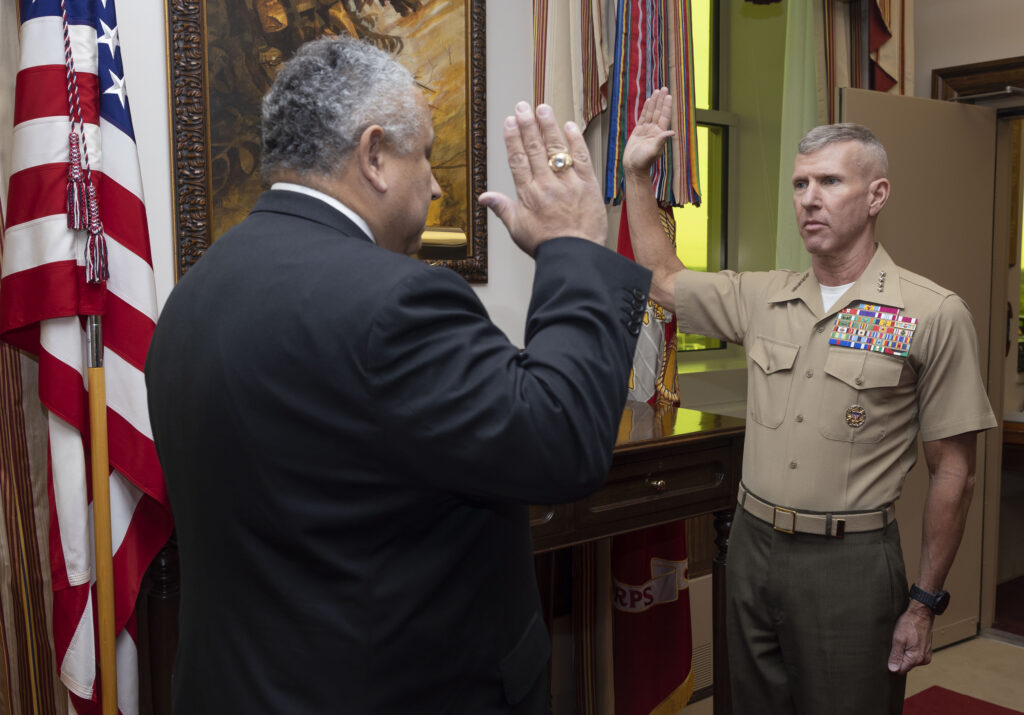
WASHINGTON, D.C. — General Eric M. Smith was sworn-in as the 39th Commandant of the Marine Corps by the Secretary of the Navy, the Honorable Carlos Del Toro, Sept 22, 2023, at the Pentagon, Headquarters Marine Corps said in a release.
General Smith, who was also the 36th Assistant Commandant of the Marine Corps, had been performing the duties of the Commandant since July 10, 2023.
“I am grateful the Senate took action to allow the Marine Corps to have a confirmed Commandant, and I am humbled to have the opportunity to continue to serve Marines,” Gen. Smith said. “I remain mindful that dozens of junior Marine officers, families, and their units remain in an unstable position as they wait for confirmation. I look forward to the day when all Marines and their families enjoy the stability they deserve.”
Unmanned Surface Vessel Division One Makes Its First Port Visit in Yokosuka, Japan
The unmanned surface vessel Ranger transits the Pacific Ocean during Integrated Battle Problem (IBP) 23.2, Sep. 7, 2023. IBP 23.2 is a Pacific Fleet exercise to test, develop and evaluate the integration of unmanned platforms into fleet operations to create warfighting advantages. (U.S. Navy photo by Mass Communication Specialist 2nd Class Jesse Monford)
YOKOSUKA, Japan – The unmanned surface vessels (USVs) Ranger and Mariner from Unmanned Surface Vessel Division ONE (USVDIV-1) arrived at Fleet Activities Yokosuka on Sept. 18 as part of a scheduled port visit during Integrated Battle Problem (IBP) 23.2.
IBP 23.2 launched this August and is the third multi-domain unmanned capabilities exercise under U.S. Pacific Fleet’s Experimentation Plan following IBP 23.1 earlier this year. The event will focus on testing and developing capabilities and concepts for medium and large USVs to advanced manned-unmanned teaming in the Indo-Pacific.
“Unmanned and autonomous technologies are key to growing our distributed maritime operations framework.” said Rear Adm. Blake L. Converse, deputy commander of U.S. Pacific Fleet, who visited the USVs last month on Joint Base Pearl Harbor-Hickam. “By proliferating our presence in the Pacific and increasing the fleet’s situational awareness and lethality, we give ourselves more options to make better decisions at all levels of leadership.”
Before arriving in Yokosuka, USVDIV-1 also participated in the Navy and Marine Corps’ Large Scale Exercise 2023.During the exercise, USVs have integrated with Carrier Strike Group One to expand its maritime domain awareness in support of the Nimitz-class aircraft carrier USS Carl Vinson (CVN-70).
“Through the integration of unmanned platforms in our operations, we continue to forge a culture of learning and innovation within our Navy and with joint partners to deliver warfighting advantage.” said Rear Adm. Carlos Sardiello, commander, Carrier Strike Group 1. “Testing and integrating emerging technologies in a demanding, real-world operational environment is vital to providing feedback that informs our progress in this domain.”
The exercise allows USVDIV-1, the command in tactical control of the exercise, to work closely with type commanders to develop concepts of operations for unmanned platforms.
“Our approach is focused on integrating, exercising, and refining tactics, techniques, and procedures for immediate application into real world operations with the fleet.” said Cmdr. Jeremiah Daley, commanding officer of USVDIV-1.
“Since standing up USVDIV-1 as a pre-commissioning unit in 2021, we continue to turn fleet feedback from exercises into adapting technology and requirement generation in order to provide realistic and impactful capabilities that future USV programs of record will bring to the Navy.”
The port visit marks the first time any U.S. Navy USV has visited Japan as IBP 23.2 is the first exercise to employ USVs in the 7th Fleet area of responsibility. Following the visit, IBP 23.2 will continue to test, develop and evaluate the integration of unmanned platforms into fleet operations alongside partners and allies to create warfighting advantages and ensure regional security and stability in the Indo-Pacific.
Koa Moana Marines Host Puma Training for Palau Maritime Law Enforcement
U.S. Marines with Task Force Koa Moana 23 concluded the Task Force Koa Moana RQ-20B Puma Training Course with a graduation ceremony at the Palau Joint Operations Center, Bureau of Maritime Security and Fish & Wildlife Protection, Koror, Palau, Sept. 14, 2023.
The three-week Marine-led course taught 11 Palauan Maritime Law Enforcement Officers how to use the RQ-20B Puma drone, which is an unmanned aircraft system used for surveillance and intelligence gathering.
“Originally, we were going to just teach them how to fly the Puma,” said Staff Sgt. Alex Lane, a native of Rockford, Illinois and the course supervisor. “But, we turned it into a train-the-trainer; we train the Palauans and then they teach their fellow Palauans how to accurately operate the drone during their operations at sea and also here in their homeland of Palau.”
According to Lane, the students learned how to deal with maintenance issues as well as how to fly, launch and land the Puma.
“They were five-day instructional weeks, where we would be doing one to two days of classroom work,” said Lane. “The third day would be us flying it at the pier on land, and then the following two days would be us flying it off the boat. We would take it about a mile out and they are able to practice while the boats are moving, so they can get used to how they would normally use it in a maritime domain.”
The Palauan Maritime Law Enforcement Officers have had RQ-20B Pumas for approximately two years, but within the first year, they lost a majority of their operators to other job capacities and have not had anyone trained to fly them recently.
“We came out here and they had operators who had no knowledge and no experience,” said Lane. “Within just five days, they were full-fledged operators. The next week they were teaching us as the instructors to see where their knowledge was at. Then the next week, they were teaching their fellow Palauans. For individuals who had no knowledge of how to fly a drone, they picked it up so fast. I was extremely impressed with them.”
The goal of the course is to enable the officers to use the Puma system on every single operation that they will embark on.
“They will be using it for search and rescue operations and as a deterrent for suspicious vessels,” said Lane. “They can fly it near them and it will be like ‘hey, this is Palau, you can’t come into our water.’ It is also the same for illegal, unregulated or unreported fishing. It will be a better reconnaissance and surveillance asset for them. They will be able to see these wrong doings and be able to get a clear picture of it and more information to relay to the nation of Palau. It makes everyone’s job easier.”
According to the Marine instructors, the students picked up on the skills quickly and were able to proficiently conduct operations.
“I think it went extremely well; we learned so much about these new technologies that we didn’t have and I think it will be very useful for us to use and utilize during our trips and for surveillance,” said Monique Hideo, a Police Officer 2 at the Palau Division of Maritime Security. “The Marines have so much knowledge about drones. It was a great experience to learn under people who really know their stuff. The Marines were amazing at making us feel confident. I would say if they weren’t there to teach us, we would be less likely to be confident behind the controller.”
During the training, the students would be designated as a mission operator or as a vehicle operator and would have practical application exercises.
“I would say the best part was actually having the drones in the air,” said Hideo. “You could just imagine all the good things it could do when an emergency actually happens, because all of these features would be so helpful.”
JB Charleston, MCAS Beaufort search-and-recovery team locates F-35B debris field
JOINT BASE CHARLESTON, S.C. – Personnel from Joint Base Charleston and Marine Corps Air Station Beaufort, in close coordination with local authorities, have located a debris field in Williamsburg County.
The debris was discovered two hours northeast of Joint Base Charleston.
Teams from Joint Base Charleston, Marine Corps Air Station Beaufort, the 2nd Marine Aircraft Wing out of MCAS Cherry Point, Navy Region Southeast, the FAA, the Civil Air Patrol, as well as local, county, and state law enforcement across South Carolina have been working together to locate the U.S. Marine Corps F-35B.
Members of the community should avoid the area as the recovery team secures the debris field.
JB Charleston transferred the incident command to the U.S. Marine Corps on the evening on Sept. 19, as they began the recovery process.
The mishap is currently under investigation, and we are unable to provide additional details to preserve the integrity of the investigative process.
We would like to thank all of our mission partners, as well as local, county, and state authorities, for their dedication and support throughout the search and as we transition to the recovery phase.
F-35B Loss is the Fourth for the Marine Corps
*****
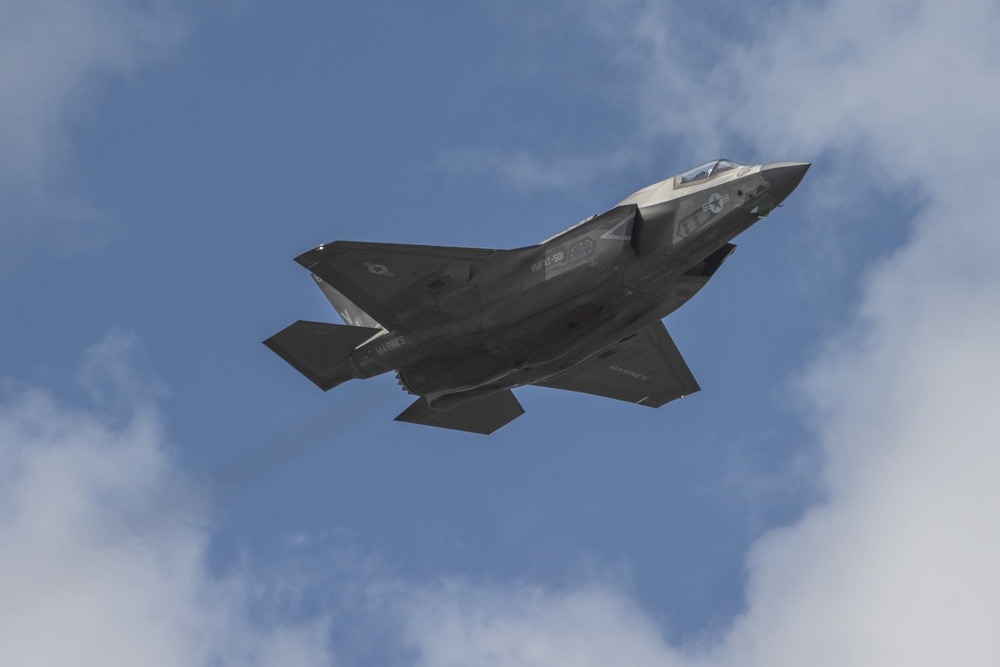
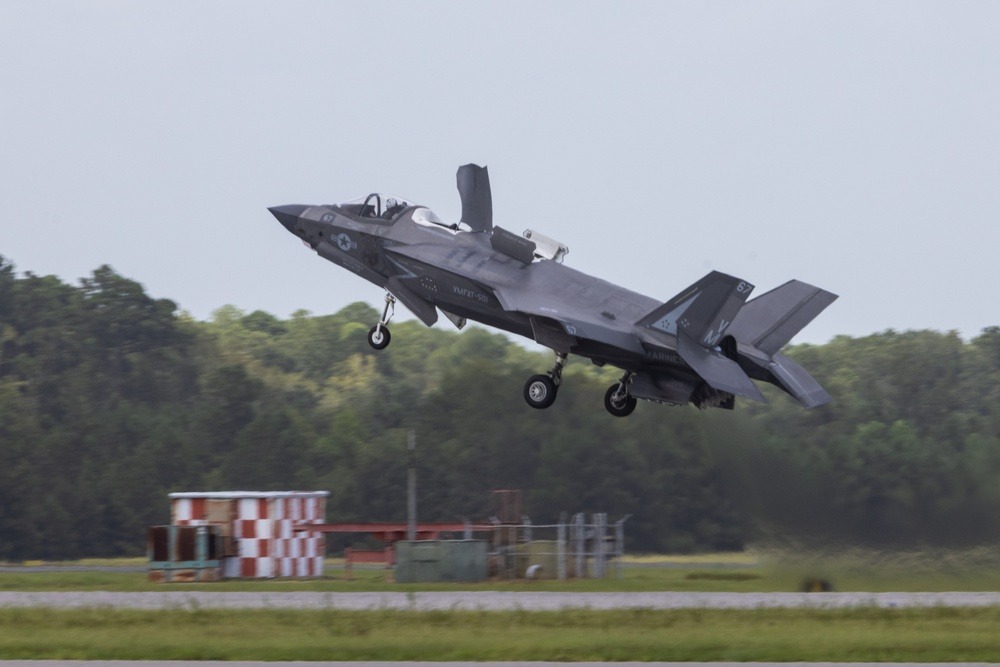
ARLINGTON, Va. — The pilot of a Marine Corps F-35B Lightning II strike fighter ejected safely near Charleston, South Carolina, on September 17, but search-and-recovery efforts for the aircraft are ongoing, a Marine Corps official said.
“The search-and-recovery efforts for the aircraft are ongoing, and we are thankful to the agencies assisting in this effort,” said Major Kevin Stephensen, a Marine Corps spokesperson in the Communication Directorate of Headquarters, Marine Corps, in a Sept. 18 update. “The mishap is currently under investigation. The Department of the Navy has a well-defined process for investigating aircraft mishaps. We are unable to provide additional details to preserve the integrity of the investigatory process.”
The pilot and aircraft were assigned to Marine Fighter Attack Training Squadron 501 (VMFAT-501) at Marine Corps Air Station Beaufort, South Carolina. The squadron is the East Coast fleet replacement squadron for the F-35B pilots and maintenance personnel.
The loss of the F-35B is the third for VMFAT-501. On Oct. 16, 2016, one of its F-35Bs caught fire and landed safely, but the aircraft was a write-off. On Sept. 2, 2018, the squadron lost an aircraft because of an engine failure.
On Sept. 29, 2020, an F-35B from another squadron collided with a KC-130J and crashed in southern California.
Another F-35B crashed on Dec. 15, 2022, at Naval Air Station-Joint Reservation Base Fort Worth, Texas, but the aircraft had not yet been delivered to the Marine Corps and was flown at the time by an Air Force pilot.
1st LAAD Battalion Reactivates in Hawaii
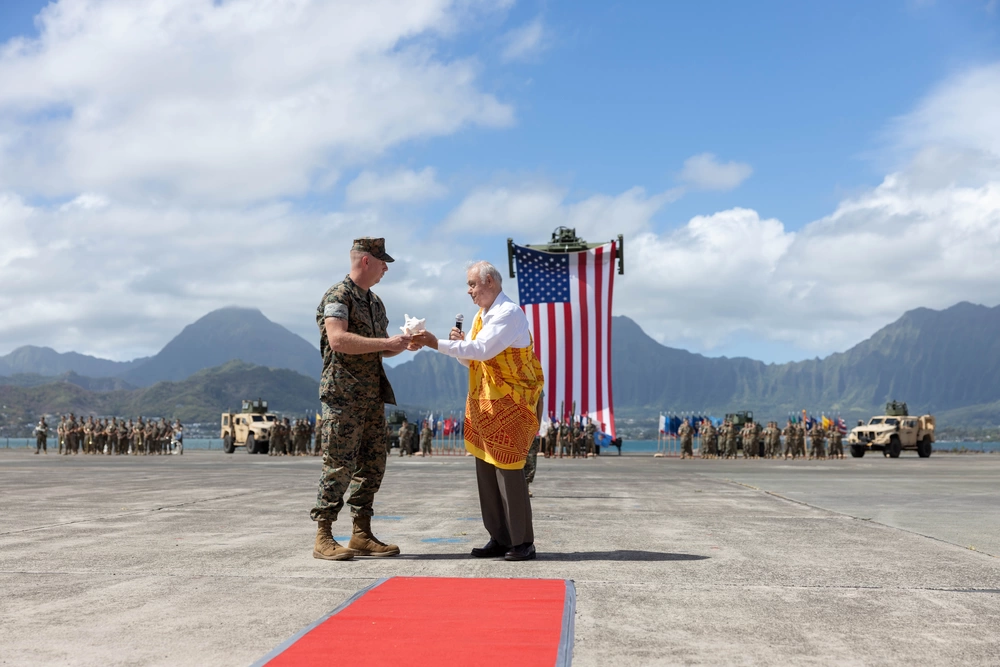
Photo By Lance Cpl. Clayton Baker | U.S. Marine Corps Lt. Col. Heath Phillips, commanding officer, 1st Low Altitude Air Defense (LAAD) Battalion, Marine Air Control Group 18, 1st Marine Aircraft Wing, receives a gift during a reactivation and designation ceremony at Marine Corps Air Station Kaneohe Bay, Hawaii, Aug. 31, 2023. Originally activated in July 1982 in Okinawa, Japan, the unit underwent two redesignations before folding its’ colors in Sept. 2007. The reactivation of 1st LAAD Battalion demonstrates forward progression toward force modernization in the INDOPACIFIC region. The primary mission of 1st LAAD Battalion is to deliver close-in, low-altitude, surface-to-air weapon capabilities. (U.S. Marine Corps photo by Lance Cpl. Clayton Baker)
MCAS KANEOHE BAY, Hawaii – Today, Headquarters and Service (H&S) Battery, 1st Low Altitude Air Defense (LAAD) Battalion, Marine Air Control Group 18, 1st Marine Aircraft Wing, reinstated their unit colors during a reactivation and designation ceremony.
Originating as 1st Forward Area Air Defense (FAAD) Battery, initially established on July 1, 1982, in Okinawa, Japan, 1st LAAD Battalion previously underwent two redesignations. The first occurred in October 1986, when 1st FAAD battery was redesignated as the 1st LAAD Battalion. The second took place in May 1993, when the battalion’s size was reduced, leading to its designation as 1st Stinger Battery. 1st Stinger Battery was officially deactivated in Okinawa on Sept. 28, 2007.
Today’s reactivation of 1st LAAD Battalion at Marine Corps Base Hawaii demonstrates progress toward force modernization with a significant increase in III Marine Expeditionary Force (III MEF), joint, and combined force capabilities. Originally designed to counter fixed wing and rotary wing enemy aircraft, the LAAD community now employs mobile, scalable air defense capabilities to counter not only manned aviation threats but also unmanned. This reactivation provides III MEF organic ground-based air defense assets against enemy aircraft and unmanned aerial systems (UAS) which enables their employment within the Indo-Pacific region without depleting resources from I or II MEF.
The primary mission of 1st LAAD Battalion is to deliver close-in, low-altitude, surface-to-air weapon capabilities. When task-organized, the battalion also provides command and control forces for ground security in defense of the Marine Air-Ground Task Force (MAGTF) commander’s designated critical areas. “1st LAAD Battalion will provide a much-needed capability to III MEF in the defense of maneuver units, forward operating areas and command and control nodes. This capability will enable Marines to fight and win under contested airspace,” said Lt. Col. Heath A. Phillips, the commanding officer of 1st LAAD Battalion.
Marine Corps Base Hawaii will primarily serve as a strategic hub for 1st LAAD Battalion. “We are honored to homebase in Hawaii,” Phillips added, “We will grow here; we will train here; but make no mistake about it, our work is west.”
The battalion is taking a phased activation approach, slated to culminate in 2028, beginning with the H&S Battery today. H&S Battery will establish the foundation for onboarding future capabilities and subsequent battery activations. Alpha Battery is anticipated to activate in August 2024.
1st LAAD Battalion looks forward to employing emerging capabilities in the Indo-Pacific in support of service, joint, allied, and partner forces. For more information about 1st LAAD Battalion please contact 1st Marine Aircraft Wing Communication Strategy and Operations, https://www.1stmaw.marines.mil/Subordinate-Units/Marine-Aircraft-Group-24/
Marine Corps Looking at Stealthy Autonomous Vessels for Logistics
*****
ARLINGTON, Va.—The U.S. Marine Corps is exploring a concept to enhance its ability to supply its forces its forces inside a contested environment: low-profile vessels used by drug-running cartels.
The Corps, however, is looking at autonomous low-profile vessels (LPVs), said Lieutenant General Karsten Heckl, deputy commandant for Combat Development and Integration, speaking Sept. 6 at the Defense News Conference in Arlington, who advocated the use of autonomous unmanned systems wherever possible.
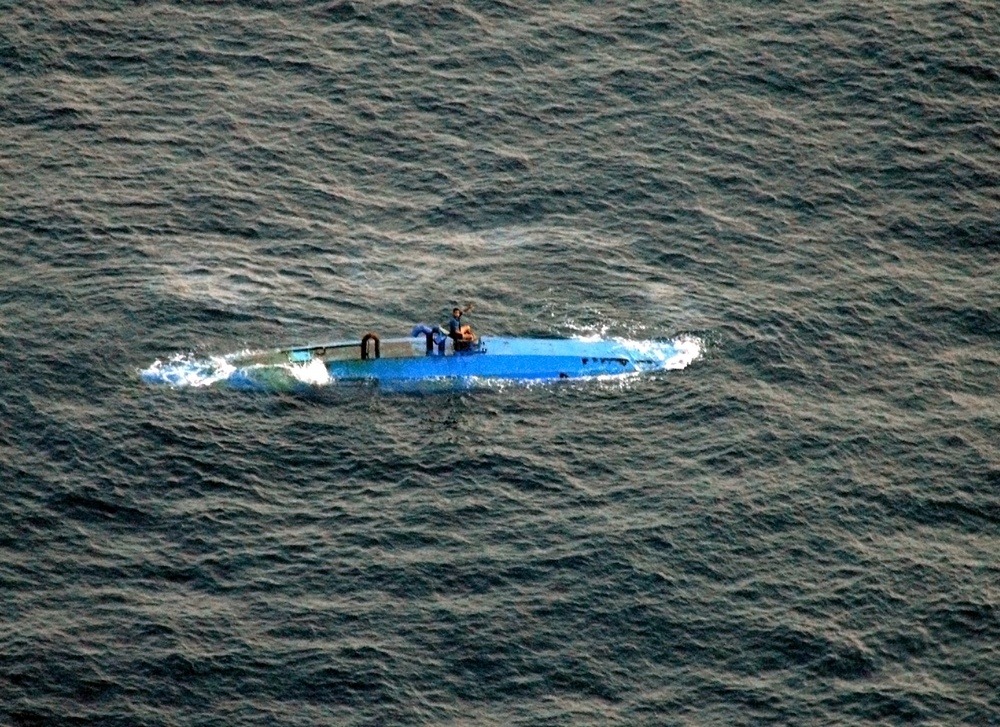
Drug runners have built and used manned LPVs frequently over the last two decade to carry loads of illegal drugs from Latin America to the United States. The LPVs, called semisubmersibles, are fabricated in secret locations and, with a small crew, carry their payload along the transit lanes, trying to avoid visual and radar detection with their very low profiles.
“We just copy the drug lords down south running drugs,” Heckl said. “They are hard to find, so now we figure, hey, it works, right?
The Marine Corps has recently focused on logistics in a contested environment as part of its Force Design 2030 to address the challenge of supplying its forces inside the enemy’s weapons engagement zone — inside the first island chain off China, for example.
Heckl addressed the concept pairing it with uncrewed autonomy, noting the lower cost of unmanned systems without having to accommodate humans and the supplies and safety systems needed to sustain them.
The required scale of autonomous LPVs is so far undetermined, but Heckl pointed to the success of an unmanned expeditionary fast ship (T-EPF) in autonomous operations. Austal built the Miliary Sealift Command’s 13th T-EPF, USNS Apalachicola — a fast catamaran logistics ship–with autonomous control systems to demonstrate the potential of autonomous operations of a ship of its size.
“T-EPF 13 went out and did 1,500 nautical miles completely autonomously,” Heckl said. “They had human beings on board as back-ups, but what an amazing capability, a ship that can go 45 knots in Sea State 3 that can operate autonomously. Autonomous—from a logistics perspective—absolutely.
“I want autonomous everything, if we can get there,” he said.
U.S. Navy, Marine Corps Establish New Maritime Fires Executive Agent
WASHINGTON — Deputy Chief of Naval Operations for Operations, Plans and Strategy Vice Adm. Gene Black, and Acting Marine Corps Deputy Commandant for Plans, Policies and Operations Maj. Gen. Roger Turner jointly announced the designation of a new executive agent (EA) for maritime fires, May 16, 2023.
The new maritime fires EA will be a single entity to oversee maritime fires, and will improve the planning, coordination, execution and assessment of all-domain fires by the Navy and Marine Corps. In Department of Defense vernacular, “fires” are defined as “the use of weapon systems or other actions to create specific lethal or nonlethal effects on a target.”
“This designation demonstrates a significant step forward in naval service integration, increasing maritime force readiness and lethality,” said Black. “This initiative will drive improvements and efficiencies to Navy and Marine Corps doctrine, organization, and training. It will enable us to deliver maritime fires with precision and timeliness in every domain, when required.”
Echoing Black, Turner added how a centralized EA facilitates U.S. Navy and Marine Corps integration.
“This is naval integration in action. Maritime fires integration is absolutely something we have to get right and this is a great step forward for our services,” said Turner. “This designation is going to enable us to better leverage the full force of the Navy and Marine Corps team.”
Commander, Pacific Fleet (PACFLT) has been selected to fill the role as EA. In that capacity, PACFLT is making a plan and identifying resources to support several lines of effort, including development of doctrine and policy, the maritime fires training continuum, and a campaign of learning through experimentation, war-games and exercises.
An executive agent (EA) is a designation for a role with substantial responsibility to execute a noteworthy task or the function is particularly sensitive or complex. EAs are tasked to provide defined levels of support for either operational or administrative missions.
DEPOT TACKLES SUPPLY CHAIN ISSUES WITH ADVANCED MANUFACTURING
Release from U.S. Marine Corps Logistics Command
*****
MARINE CORPS LOGISTICS BASE ALBANY, GA – The Marine Corps Advanced Manufacturing Center of Excellence (AM COE) recently helped the Navy solve a supply chain issue for the USS Kentucky.
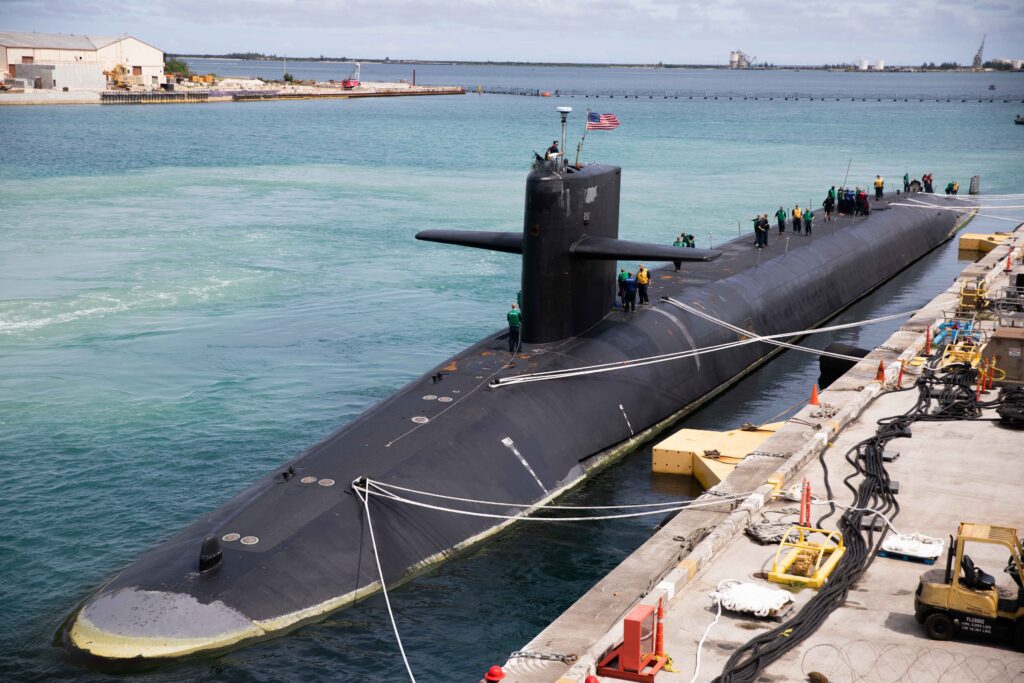
The Kentucky, an Ohio-class ballistic submarine (SSBN), needed a specifically designed cover for a ventilation system, and a long lead supply chain and the complex geometry of the part meant that a creative solution was needed.
In December, Naval Sea Systems Command’s Trident Refit Facility Bangor (TRFB), which is responsible for repairing, incrementally overhauling and modernizing the Pacific Fleet SSBNs during refits, contacted the Marine Depot Maintenance Command (MDMC). The AM COE, part of the Marine Corps Maintenace Command, leverages AM technology to increase depot production and bolster supply operations and expeditionary capabilities for the Fleet Marine Force.
When TRFB reached out to the MDMC’s Advanced Manufacturing team for a solution, they answered the call. The Marine Corps AM COE reengineered the provided drawings to meet 3D printer specifications and MDMC’s Production Plant in Barstow, California, 3D printed the aluminum using an EOS 400-1 Machine.
This is the first additively manufactured metallic component produced to solve a supply chain issue on Ohio-Class submarines.
“We appreciate the tremendous work of the Marine Corps Advanced Manufacturing Center,” said CAPT Mike Eberlein, commanding officer, TRFB. “Having access to AM greatly increases our efficiency and this is just one of many examples of multiple commands working together to solve problems for the benefit of our warfighters.”
The Marine Corps AM COE continually explores ways to expand partnerships and welcomes inquiries from organizations across the U.S. Marine Corps, Department of Defense, industry and academia.
Naval Surface Force, U.S. Pacific Fleet, Public Affairs
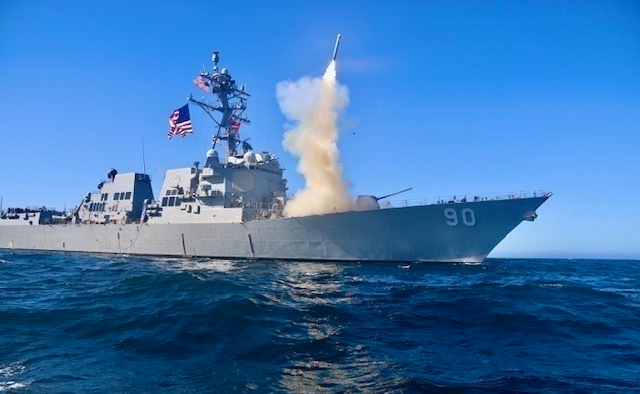
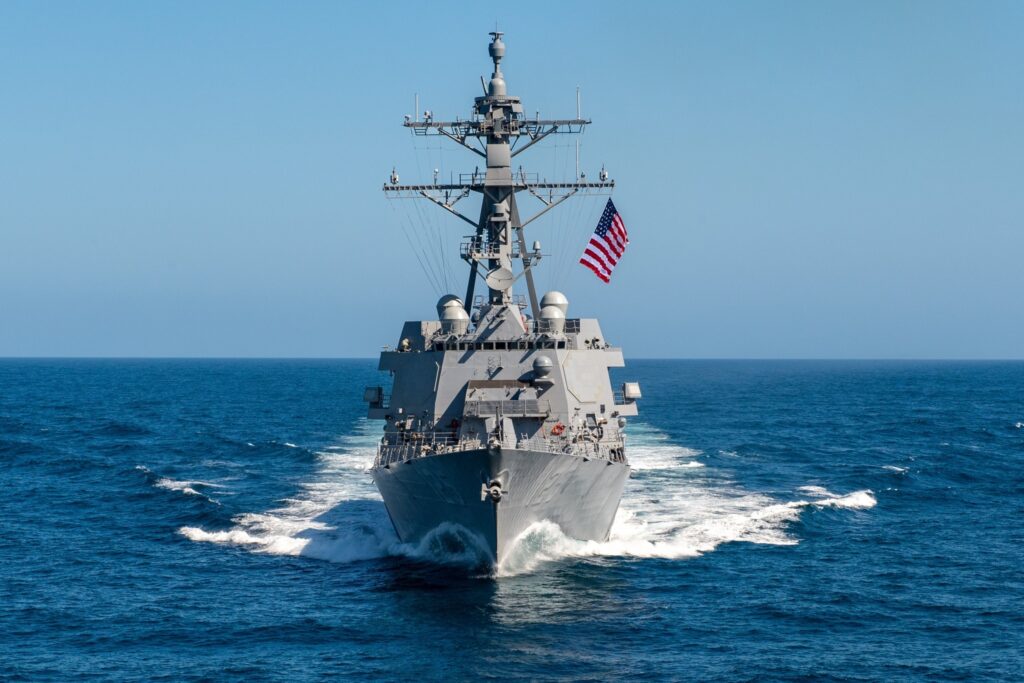
The future USS Jack H. Lucas (DDG 125) will join the active fleet on October 7, with a commissioning ceremony in Tampa, Florida. DDG 125 will be the Navy’s first Flight III destroyer with notable technological upgrades. The Flight III upgrades are centered on the AN/SPY-6(V)1 Air and Missile Defense Radar and incorporates upgrades to the electrical power and cooling capacity.
Guided-missile destroyers provide multi-mission offensive and defensive capabilities. Destroyers can operate independently or as part of carrier strike groups, surface action groups, and expeditionary strike groups. They are capable of conducting anti-air warfare (AAW), anti-submarine warfare (ASW), and anti-surface warfare (ASuW).
The ship’s name was selected on Sept. 17, 2016 by then Secretary of the Navy Ray Mabus to serve as a constant reminder to the immense impact actions taken by any one Sailor or Marine can truly have.
DDG 125 is named for Pfc. Jack Lucas, who served in the U.S. Marines during World War II, earning the Medal of Honor for his heroism at Iwo Jima, when he was just 17 years old. He is the youngest Marine, and the youngest serviceman in World War II, to be awarded the United States’ highest military decoration for valor. In 1961, he returned to military service as a captain in the U.S. Army and trained younger troops headed for Vietnam. Lucas passed away on June 5, 2008 in Hattiesburg, Mississippi.
Ruby Lucas, widow of the ship’s namesake, and philanthropist Cathy Reynolds are the ship’s sponsors.
This will be the first Naval warship to bear the name Jack H. Lucas.
Following commissioning, USS Jack H. Lucas will transit to its homeport of San Diego.