3,000 Sailors and Marines Arrive in Middle East aboard USS Bataan, USS Carter Hall
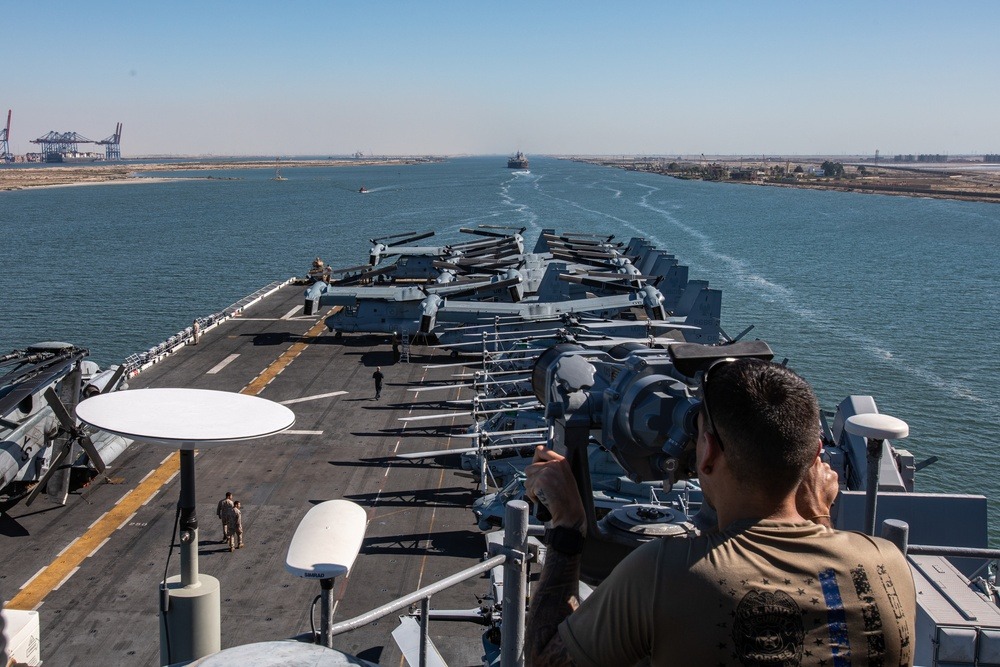
A U.S. Navy sailor from USS Bataan (LHD 5) stands watch as the amphibious assault ship transits the Suez Canal with the 26th Marine Expeditionary Unit (MEU), Aug. 6, 2023.
From U.S. Naval Forces Central Command Public Affairs
MANAMA, Bahrain – More than 3,000 U.S. Sailors and Marines of the Bataan Amphibious Ready Group (ARG) and 26th Marine Expeditionary Unit (MEU) arrived in the Middle East, Aug. 6, as part of a pre-announced Department of Defense deployment.
Amphibious assault ship USS Bataan (LHD 50) and dock landing ship USS Carter Hall (LSD 50) entered the Red Sea after transiting from the Mediterranean Sea through the Suez Canal. Bataan ARG/26th MEU units bring to the region additional aviation and naval assets, as well as more U.S. Marines and Sailors, providing greater flexibility and maritime capability to U.S. 5th Fleet.
An amphibious assault ship can carry more than two dozen rotary-wing and fixed-wing aircraft, including MV-22 Osprey tilt-rotor aircraft and AV-8B Harrier attack jets in addition to several amphibious landing craft. A dock landing ship also supports operations for various rotary-wing aircraft, tactical vehicles and amphibious landing craft.
The Bataan ARG departed Norfolk, Virginia on July 10 with Amphibious Squadron 8, Fleet Surgical Team 8, Tactical Air Control Squadron 21, Helicopter Sea Combat Squadron 26, Assault Craft Unit 4, Beach Master Unit 2 and the 26th MEU.
The 26th MEU, based in Camp Lejeune, North Carolina, is capable of conducting amphibious missions, crisis response and limited contingency operations to include enabling the introduction of follow-on forces and designated special operations.
The U.S. 5th Fleet area of operations encompasses approximately 2.5 million square miles of water space and includes the Arabian Gulf, Gulf of Oman, Red Sea, parts of the Indian Ocean and three critical choke points at the Strait of Hormuz, Suez Canal and Strait of Bab al-Mandeb.
Naming of the Marine Corps Wargaming and Analysis Center
Release from Marine Corps Combat Development Command
*****
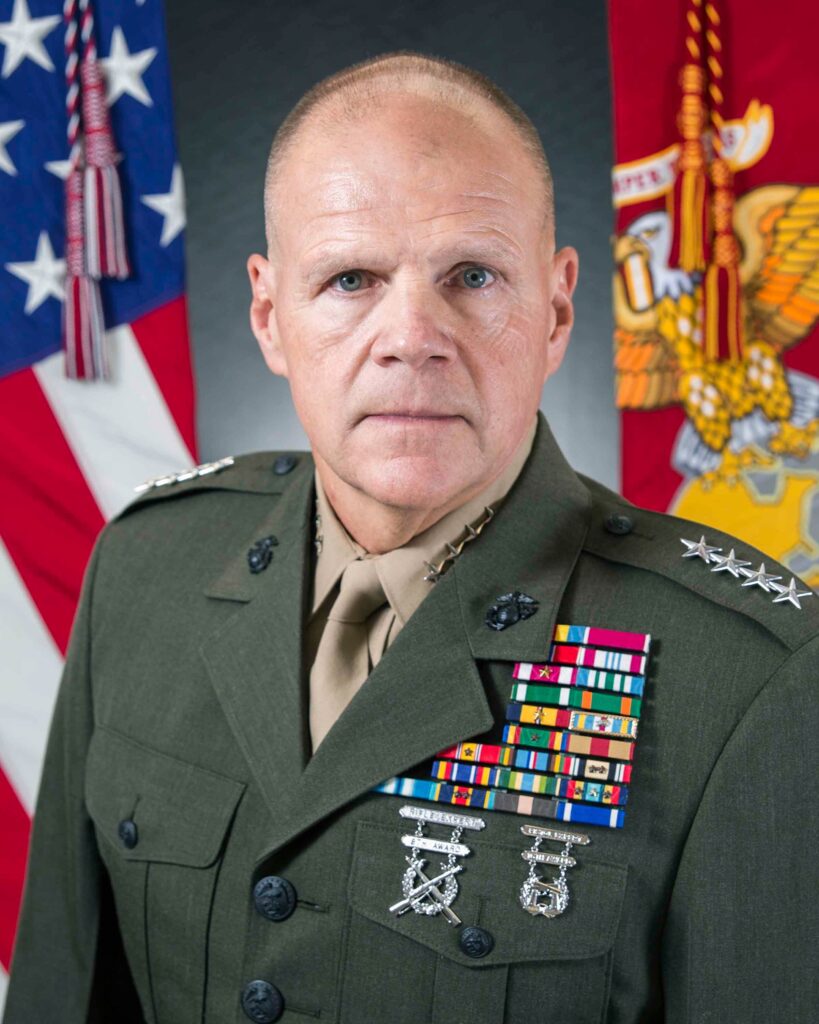
MARINE CORPS BASE QUANTICO, VA— The Marine Corps Wargaming and Analysis Center will be named after Gen. Robert B. Neller, 37th Commandant of the Marine Corps and will be called the “General Robert B. Neller Center for Wargaming and Analysis.” The short name will be the Neller Center.
The Neller Center is currently under construction with initial operating capability planned during 2025. It’s located in the National Capitol Region, on the Marine Corps University campus on Marine Corps Base Quantico. It encompasses 100,446 gross square feet and will be a one-of-a-kind facility, operated and maintained by the Marine Corps Warfighting Laboratory.
In 2017, then-Commandant of the Marine Corps Gen. Robert Neller directed the establishment of a world-class facility for Marines to wargame repeatedly in a secure, centralized location and enhance the Marine Corps’ ability to make analytically informed decisions.
The Marine Corps, the other services, and departments will facilitate modernization at the Neller Center and seek to realize his vision to achieve service and joint objectives and future strategic demands.
The Center will provide next-generation technologies to facilitate wargaming and analysis across multiple levels of classification, with a host of coalition and joint partners, and will eventually allow for geography agnostic wargame participation across the globe.
The increased capability and capacity facilitated by the Neller Center will be integral to the combat development process within the Combat Development and Integration enterprise. These capabilities will help ensure the decisions required to equip and train our future warfighters are based upon the most accurate, threat-informed, and timely recommendations.
President Biden Signs Legislation to Mint 250th Anniversary Commemorative Coin to Honor the Marine Corps
Release from Marine Corps Heritage Foundation
*****
Proceeds from coin sales will support the programs of the National Museum of the Marine Corps and the Marine Corps Heritage Center
Triangle, Va. – The Marine Corps Heritage Foundation (MCHF) is proud to announce the successful passage of the 250th Anniversary of the United States Marine Corps Commemorative Coin Act. The legislation, signed by the President on July 26, instructs the U.S. Mint to issue over 1 million coins to commemorate 250 years of Marine Corps history, and raise funds to support future educational, historical, and cultural programs. The commemorative coin minting becomes part of the upcoming, national celebration of the Marine Corps’ 250th anniversary in 2025.
“We are grateful to the President and Congress, especially Representatives Moulton, Bergman, Gallego, and Pence, and Senators Blumenthal, Sullivan, Rick Scott, Rounds, Young, Shaheen, Warner, Heinrich, and Duckworth for their leadership and rallying their colleagues for the passage and signing of this bill. It enables us to further support and expand programs that educate all Americans about the rich history of the Marine Corps,” said Major General James W. Lukeman, USMC (Ret), President and CEO of the Marine Corps Heritage Foundation. “Through the minting of these coins, all Americans will be able to honor Marines for their 250 years of unwavering dedication to duty, service and sacrifice for the United States.”
By purchasing these coins in 2025, Americans will honor the legacy of the Marine Corps and celebrate 250 years of the Marine Corps while also contributing to the preservation and dissemination of Marine Corps history for generations to come.
The signed legislation authorizes the Department of Treasury to mint 50,000 five-dollar coins, 400,000 one-dollar coins, and 750,000 half-dollar coins.
ACV Transition Training Unit Certifies First Marines
CAMP Pendleton, Calif. — A Marine Corps-established Amphibious Combat Vehicle Transition Training Unit at the Assault Amphibian School graduated 29 Marines Tuesday, July 25, after completing the new Operational Certification (OPCERT) course at Marine Corps Base Camp Pendleton, California. This course brought the total of trained and certified Marine Amphibious Combat Vehicle operators to 59 with the inclusion of graduates from a successful pilot course last month.
Additionally, a total of 19 Marines has since graduated from the TTU’s new Maintainers Certification (MAINTCERT) course between the pilot and first official course.
The OPCERT and MAINTCERT courses, piloted in May and June 2023 respectively, were approved as rigorous and standardized programs that ensure Marines possess the technical knowledge, skills, and proficiency required to safely operate, maintain, and employ the ACV. The proficiency evaluation and validation standards developed by the TTU will be sustained on an enduring basis through entry-level ACV operator, maintainer, and unit leader training and advanced training for Marines as they progress through their career.
“This is an important milestone in the development of our assault amphibian Marines and the transition to this key platform,” said Brig. Gen. Farrell Sullivan, commanding general, Training Command. “U.S. Marines are the nation’s premier naval expeditionary force, and retaining this forcible entry capability is a key component of providing options to our nation’s leaders. I’m proud to see Amphib Assault Marines successfully contributing to our combat capability and leading their community through this milestone.”
Marine Corps visits Potential Site of Future Medium Range Intercept Capability Missile Facility
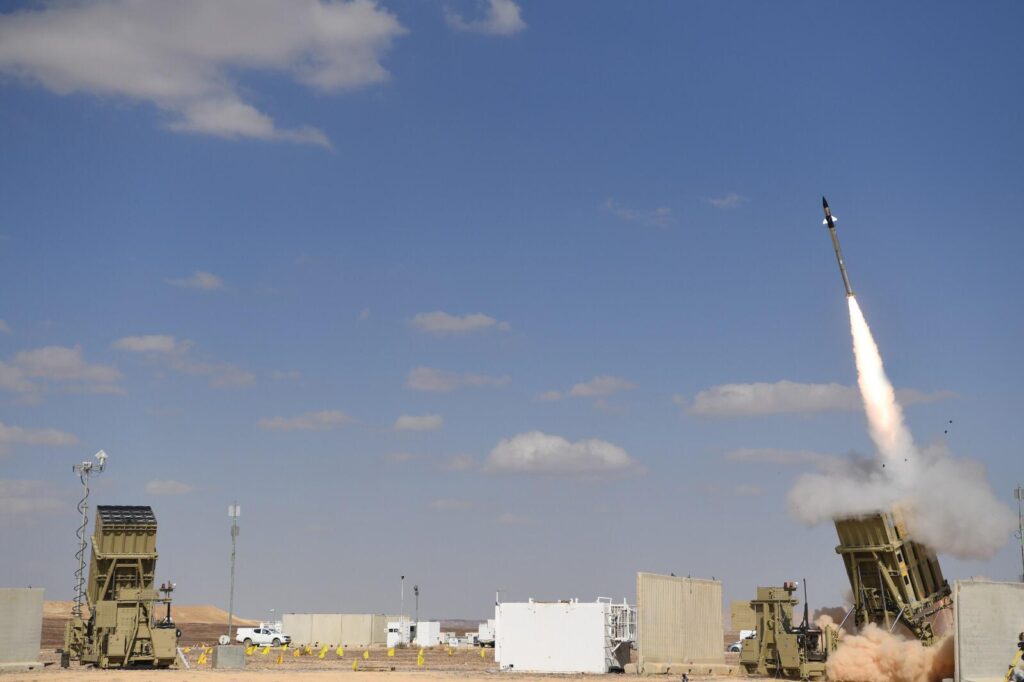
U.S. Marines at the White Sands facility in New Mexico test a new prototype system for Medium Range Intercept Capability using TAMIR IRON DOME interceptors. Spokesperson Department at the Israeli Ministry of Defense
Release from Program Executive Office Land Systems
*****
July 26, 2023
By PEO Land Systems
Camden, Arkansas — The Program Executive Officer Land Systems, Ground Based Air Defense Program Manager recently visited Camden, Arkansas, to discuss the possibility of producing the Iron Dome Tamir missile and future Americanized version known as Sky Hunter for the Medium Range Intercept Capability program. The discussions, held July 19, included representation from Raytheon, Rafael and Raytheon Rafael Systems better known as R2S. During the discussions, R2S detailed the concept of the production facility and provided a tour of the potential site.
“This will be a great thing for the Medium Range Intercept Capability program and for the USMC, if this occurs,” said PM GBAD Don Kelley. The production of the Tamir/Sky Hunter within the United States not only will provide American built Sky Hunters, but a possible second source of Tamir missiles for the Israeli Missile Defense Organization.
Since 2018, the Marine Corps GBAD Program Office has been developing MRIC to counter cruise missile threats. The system includes the Common Aviation Command-and-Control System and a mini–Battle Management Control system for the Tamir missile, along with the AN/TPS-80 Ground/Air Task Oriented Radar.
MRIC completed a series of successful live-fire tests in September 2022. The Milestone Decision Authority met in December 2022 and provided authorization to conduct the certification process, with the first platoon made ready to deploy in fiscal year 2025.
A follow on decision by the Marine Corps would potentially procure up to three batteries between fiscal 2025 – 2027.
Leidos announces strategic collaboration agreement with Microsoft
Companies pledge collaboration aimed at expediting the development of advanced cloud technology.
(RESTON, Va.) July 31, 2023 – Leidos (NYSE:LDOS), a FORTUNE® 500 science and technology leader, today announced it has entered into a strategic collaboration agreement with Microsoft aimed at leveraging each company’s unique strengths in the market to accelerate artificial intelligence (AI) transformation for new and existing customers in the public sector. A near-term priority for co-development is in the area of generative AI solutions to support organizational efficiency, enhanced productivity and cross domain applications.
“Leidos is continuously exploring opportunities to accelerate solving our customers’ hardest problems,” said Steve Hull, Executive Vice President, Enterprise and Cyber Solutions Operation, Leidos. “This agreement will help enable co-innovation utilizing the latest cloud and AI technologies.”
Leidos recently completed a successful migration of 20 critical support applications from an on-premise data center to Microsoft’s Azure Government cloud environment in support of the U.S. Navy. This migration was part of Leidos’ ongoing support of the Department of the Navy’s Next Generation Enterprise Network (NGEN) Service Management, Integration, and Transport (SMIT) program, enabling the Navy to monitor, maintain, and secure the Navy and Marine Corps Intranet (NMCI) with increased efficiency and collaboration without compromising security.
“Our collaboration with Leidos will help accelerate adoption of cloud-driven solutions to improve our customers’ operations,” said Angela Heise, Corporate Vice President, Worldwide Public Sector, Microsoft. “Leidos’ expertise in national security operations coupled with Microsoft’s advanced cloud, cyber, and AI technologies will enable our two organizations to develop innovative solutions to address a wide range of complex challenges faced by public sector organizations around the world.”
Leidos and Microsoft are committed to building a partner ecosystem that can identify customer challenges and work together responsibly and efficiently to solve them.
Romania Seeks Former Marine Corps Assault Amphibious Vehicles
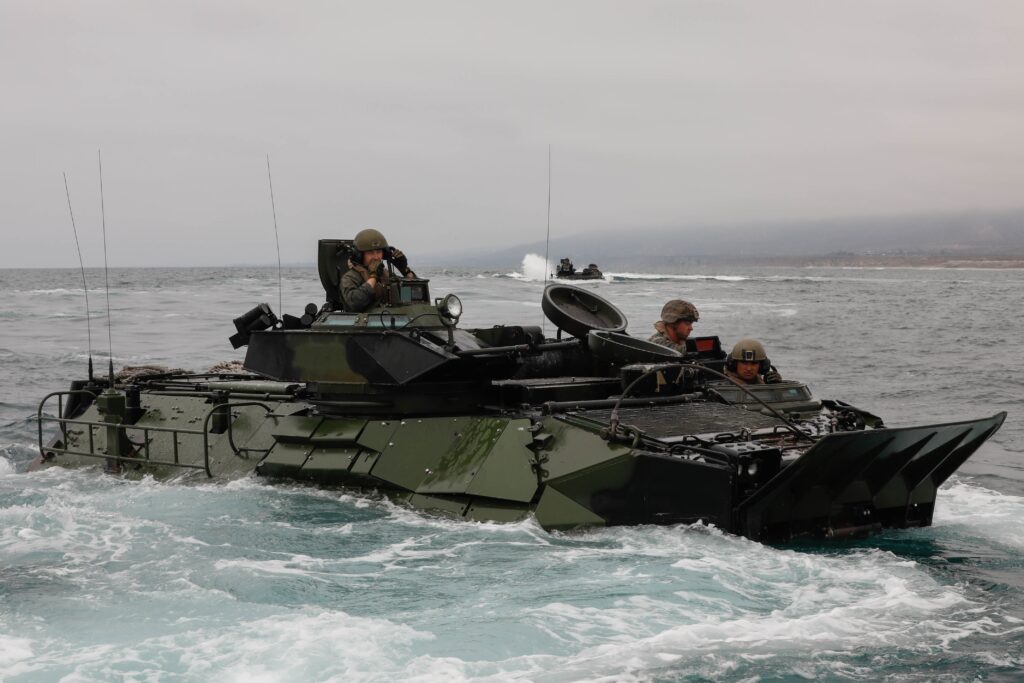
CAMP PENDLETON, Calif. (June 30, 2021) U.S. Marines with Co. A, 1st Battalion, 5th Marines, 1st Marine Division (1st MARDIV), and Co. B, 3d Assault Amphibian Battalion, 1st MARDIV, prepare to evacuate a P7/A1 assault amphibious vehicle (AAV) during a surf qualification at Marine Corps Base Camp Pendleton, California, June 30, 2021.
Romania Seeks Former Marine Corps Assault Amphibious Vehicles
By Richard R. Burgess, Senior Editor
ARLINGTON, Va. —The U.S. State Department has approved a possible sale of AAV7 assault amphibious vehicles to the Government of Romania, the Defense Security Cooperation Agency (DSCA) said in a July 2 release.
Romania has requested the sale of 21 AAV-7s, including 16 AAVP-A1 personnel carrier versions, three AAVC-7A1 command vehicles, and two AAVR-7A1 recovery versions. The sale also would include armament, thermal sights, spare parts, manuals, data package, engineering support, ad other support. The total cost of the sale would be an estimated $120.5 million.
The AAV-7 family of vehicles, built by BAE Systems, is being replaced in the U.S. Marine Corps by the Amphibious Combat Vehicle (ACV) family, also built by BAE Systems. The AAV-7 entered Marine Corps service in 1972.
A contract to deliver the vehicles and support to Romania in the event the sale is finalized has not yet been identified.
Romania, a member of NATO that borders the Black Sea, has increasingly joined in military ties and exercises with the United States.
U.S. Department of Transportation Announces First Ships Enrolled in the Tanker Security Program
Creation of the program meets an urgent DOD need and grows the U.S.-flagged fleet
WASHINGTON – Today, the U.S. Department of Transportation’s Maritime Administration (MARAD) announced that nine ships have been enrolled in the Tanker Security Program (TSP). TSP establishes a fleet of active, commercially viable, militarily useful, privately owned product tank vessels of the United States that will meet national defense and other security requirements and maintain a United States presence in international commercial shipping.
The TSP will strengthen the U.S. supply chain and improve the movement of liquid fuel products while creating good-paying jobs. The TSP will also support American-owned, American-flagged, and American-crewed commercial product tankers operating in international commercial shipping. The program will ensure the Department of Defense (DoD) has assured access to critically needed product tankers capable of loading, transporting, and storing on-station bulk petroleum refined products to support national economic security.
“Today we are announcing the first ships to join the Tanker Security Program, which will help strengthen both our supply chains and our national security by delivering fuel to our armed forces around the world while creating hundreds of good jobs for American mariners,” saidU.S. Transportation Secretary Pete Buttigieg.
“The TSP accomplishes two key maritime sealift objectives: it grows our U.S.-flagged fleet and it significantly expands our ability to deliver vital fuel supplies to support military missions across the globe,” said Maritime Administrator Ann Phillips. “Implementation of the TSP is a significant milestone for MARAD and the U.S. maritime industry.”
The companies selected for enrollment are Overseas Shipholding Group, Inc. (three tank vessels); Crowley-Stena Marine Solutions, LLC. (three tank vessels); and Seabulk Tankers, Inc. (three tank vessels).
All of the companies have signed operating agreements. Of the enrolled vessels, four are under U.S. flag and are now operating in the program, and five are working with the assistance of the U.S. Coast Guard to expedite reflagging to U.S. registry to begin operating under TSP agreements. Each tank vessel enrolled will receive a maximum $6 million per year payment, prorated on a monthly basis for qualified service as participants in the program. The vessels will operate in U.S. foreign commerce and be available for use by the United States during times of war or national emergency.
MARAD published a solicitation in the Federal Register on July 25, 2023, seeking applications for enrollment in TSP from qualified companies. The program is authorized for up to ten tankers and MARAD seeks to fill the remaining operating agreement with a qualified vessel. MARAD published notices in the Federal Register seeking applications for enrollment from qualified participants. To qualify for the program, proposed vessels have to qualify as Medium Range product tankers between 30,000-60,000 deadweight tons with fuel carrying capacity of 230,000 barrels or more, be less than 10 years of age, and available to commit to an emergency preparedness agreement for the duration of the program’s authorization. All vessel operators selected for the TSP are required to be enrolled in MARAD’s sexual assault and sexual harassment prevention and response policy program Every Mariner Builds A Respectful Culture (EMBARC).
GE Marine to Supply LM2500 Gas Turbine Engines in New Lightweight Composite Enclosure for Turkish I-Class MILGEM
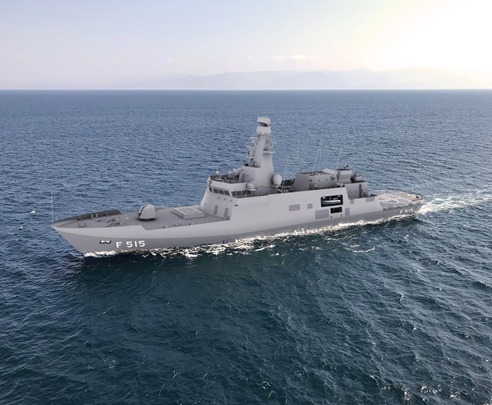
İstif-Class Frigate Project, Photo courtesy of STM
July 25, 2023, Evendale, OH – GE Marine signed an agreement with TAIS OG-STM İş Ortaklığı in Istanbul, Türkiye, to provide the LM2500 marine gas turbine engine in a new lightweight composite enclosure for the İstif-Class frigates, numbers 6, 7, and 8 in the Turkish MILGEM Project. The lightweight enclosure debuted on the U.S. Navy’s USS Santa Barbara in April. Türkiye’s Navy converted from the steel engine enclosure for the redesigned frigates to benefit from the many features of the one-piece composite enclosure.
Between the Barbaros, Gabya, and İstif class frigates and the ADA class Corvettes, 31 LM2500 marine gas turbine engines currently power 18 Turkish ships. Under this project, the private shipyards of Türkiye will build a frigate class surface combatant for the first time. The ships will be built at Anadolu, Sedef, and Sefine shipyards in 36 months. GE will support this expedited timeline. The new I-Class Frigate will be 10 meters longer than previous models to account for the increased capabilities in weapons systems. One LM2500 will provide 22 MW of power to propel each new MILGEM frigate.
This engine selection builds on the April 2023 announcement of GE Marine’s newest collaboration in Türkiye with TEI (TUSAS Engine Industries, Inc.) as an in-country service provider for the maintenance, repair, and overhaul of GE’s LM2500 marine gas turbines. “We want GE Marine’s strong relationships in Türkiye, along with the new engine selection on the I-Class MILGEM, to demonstrate our commitment to supporting Türkiye’s naval programs, including domestic sustainment of naval capabilities,” said Mark Musheno, Vice President of Sales and Marketing for GE Marine.
GE’s new state-of-the-art composite gas turbine enclosure replaces its steel predecessor. It provides a safer engine room environment, improved access for sailors, and a significant weight reduction for ship designers. Other benefits include:
Reduced engine room noise: 60% (4dBA) less noise than steel enclosure
Cooler engine room temperatures: Enclosure wall temperatures are 25oF to 50oF degrees cooler, approximately 50% less heat is rejected into the engine room.
Superior operational and life cycle benefits: The composite walls are constructed from a single corrosion-resistant piece.
Significant weight reduction: The walls and roof assembly are 2,500 kg (5,500 lbs) lighter, which is a 50% weight reduction, allowing ship designers more flexibility for increased payload, fuel, or systems.
Better access to the engine: Improved crew access to inlet plenum and a lightweight main door for easy handling.
Ease of engine removal/reinstallation: The gas turbines can be removed and reinstalled through the intake path.
The LM2500 is renowned for its reliability onboard 638 naval ships and is the gas turbine of choice for 40 navies worldwide due to its superior performance on diverse military applications, from patrol boats, corvettes, and frigates to destroyers and aircraft carriers. As the new lightweight composite enclosure debut demonstrates, GE Marine offers a wide range of products backed by continual infusion of new technologies to meet ever-changing customer needs.
Marine Infantry Packs a Logistics Punch on Australian Beach
Marine Infantry Packs a Logistics Punch on Australian Beach
July 27, 2023 | By David Vergun , DOD News
Several hundred U.S. Marine Corps infantrymen of the 31st Marine Expeditionary Unit landed yesterday on the beach at Midge Point in Queensland, Australia.
With them were trucks, spare parts, mechanics, fuel, communications gear and everything else needed to support the infantry in a fight as part of Exercise Talisman Sabre 2023 — the U.S.-Australia exercise that included a dozen other partner nations.
During the first decades of the 21st century, Marines and other forces in Iraq and Afghanistan relied on massive logistics sites, known as “iron mountains,” for beans, bullets, bandages and everything else needed to conduct operations, said Marine Corps Lt. Col. Matt Verdin, commander of Combat Logistics Battalion, 3rd Battalion, 1st Marine Regiment, based at Camp Pendleton, California.
Not anymore, he said.
When Marines came ashore in Navy landing craft air cushions, or LCACs as they are better known, they took with them all the supplies and other materiel needed to push inland against entrenched enemy forces in the exercise scenario, he said.
It’s getting back to the roots of what the Marine Corps does best, he said: sustaining themselves in austere, contested environments and moving quickly to secure objectives without waiting for the logistics tail to catch up to the fighters.
Exercises like Talisman Sabre bolster rapid crisis response capability that has been a Marine Corps hallmark for centuries, he said.
This year marks the 10th iteration of Talisman Sabre, a biennial exercise designed to advance a free and open Indo-Pacific by strengthening partnerships and interoperability among key allies. The spelling of the name — sabre vs. saber — reflects which country is leading the exercise: Talisman Sabre when Australia leads and Talisman Saber when the U.S. leads.
Marines who landed yesterday had sailed from Okinawa, Japan, aboard the amphibious transport dock ships USS Green Bay and USS New Orleans. Accompanying those vessels was the amphibious assault carrier USS America, the lead ship of the America Amphibious Ready Group.
Landing with the Marines were detachments from the Japan Ground Self Defense Force’s Amphibious Rapid Deployment Brigade and a German naval infantry from the Bundeswehr Sea Battalion.
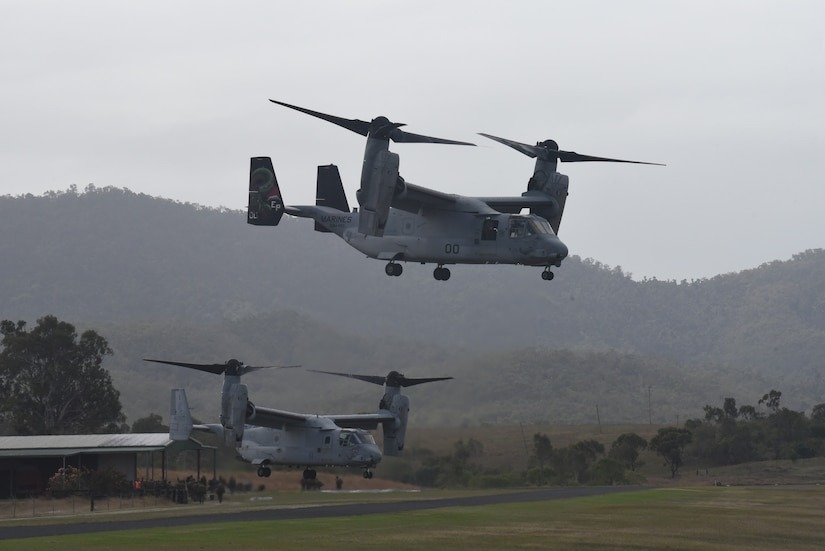
Later in the day, Marines from the USS America landed further inland from Midge Point, arriving aboard V-22 Osprey aircraft. Those aircraft can land vertically like helicopters, but they fly much faster. Others landed in CH-53 helicopters. Upon landing, they all encountered an opposition force made up of Marines dressed in desert camouflage uniforms to identify them as “enemy.”
The V-22s were protected overhead by Cobra attack helicopters.
The America Amphibious Ready Group made a port visit last month to Brisbane, Australia, just to the south of where the landings took place.
The United Kingdom is also participating in Talisman Sabre. The U.S., U.K. and Australia comprise what’s known as AUKUS, which is a trilateral security pact formed in 2021.
“All of this is yet another reminder that our unbreakable alliance is capable of great things. It has, indeed, endured for generations, and it remains vital to regional peace and security,” Secretary of Defense Lloyd J. Austin III said of AUKUS earlier this year during a visit by Australian Deputy Prime Minister Richard Marles, who also serves as his country’s defense minister.
At that meeting, Austin said: “We also pledged to find new ways to work closely with Japan as we pursue a common vision of a free and open Indo-Pacific, as a region where all countries can chart their own course and all states respect international rules and norms and where all disputes are resolved peacefully.”
Austin met with British Defense Secretary Ben Wallace just weeks earlier.