DAVIDSON, N.C. – March 23, 2023 –Curtiss-Wright Corporation, (NYSE: CW) today announced that it has been awarded a follow-on contract by the United States Marine Corps (USMC) to provide small form factor network router and switch modules to support communications modernization with highly portable expeditionary network communications technology. Under the contract, Curtiss-Wright will provide a Modular Open Systems Approach (MOSA) deployed baseband system for the Marine Corps Wideband Satellite-Expeditionary (MCWS-X) program.
“As a leading supplier of tactical battlefield communications solutions, we are very proud to provide the Marine Corps with our proven field-deployable network communications technology to support the MCWS-X program,” said Lynn M. Bamford, Chair and CEO of Curtiss-Wright Corporation. “This contract further strengthens the long and successful relationship we have with the USMC and highlights Curtiss-Wright’s ability to enhance interoperability and improve cost efficiencies with electronics systems that adhere to the DoD’s mandate for solutions based on the Modular Open Systems Approach.”
Curtiss-Wright is performing the work within its Defense Solutions division in the Defense Electronics segment. The products covered by this agreement will be shipped to the USMC from the Curtiss-Wright Defense Solutions facility in Portland, Oregon.
The Marine Corps has officially updated its logistics doctrine with the publication of Marine Corps Doctrinal Publication 4, Logistics, March 21, 2023. This publication provides Marines a conceptual framework for understanding how logistics is an essential aspect of every military operation.
This publication is a revision of the 1997 version by the same name. It places the time-tested, combat-proven principles outlined in the previous version in an updated warfighting context. This updated publication draws on the increasing importance of information and data, and highlights the global challenges associated with sustaining an expeditionary force.
“Marine Corps Doctrinal Publication 4, Logistics represents a significant update to our logistics doctrine,” said Lt. Gen. Edward Banta, Deputy Commandant for Installations and Logistics. “It provides a common framework for all Marines involved in logistics operations and will help ensure that we are able to sustain our operations in the most effective and efficient manner possible.”
The future fight requires Marines to operate when logistics is contested, thereby requiring the force to innovate and leverage new technologies for comparative advantages against potential adversaries. Both strategic- and operational-level logistics is critical and requires a fundamental understanding of logistics limitations and opportunities in the information age.
Marine Corps Doctrinal Publication 4, Logistics is available online at MARADMIN 146/23.
Providing global logistics to sustain the force and provide humanitarian aid over air, land and sea is a capability the Defense Department enjoys, unmatched by any other nation, said Air Force Gen. Jacqueline D. Van Ovost, commander, U.S. Transportation Command, who spoke yesterday at a McAleese-sponsored event in Washington, D.C.
“Mission success depends on the nation’s capacity and capability to transport and supply its forces,” she said.
In response to Russia’s invasion of Ukraine, Transcom has delivered large quantities of munitions and weaponry to Ukraine from the U.S., allies and partners, she said.
“The entire enterprise proudly continues to enable Ukraine’s national defense, and that in turn delivers success for our allies and partners,” she said.
Despite the significant demands of the European theater, Transcom continues to execute its global mission in support of joint and combined exercises with geographic combatant commands, she said.
Global power projection relies on accessible basing and overflights overseas, she said, requiring diplomatic alignment with allies and partners.
Within the United States, mobilization and logistical movement depends on a good network of highways, railways and pipelines, she said.
“The combination of our organic logistics and commercial capabilities must continue to present a credible deterrent for delivering,” she added.
Achieving this requires proactive effort, she said. “In 10 years, more than 50% of the U.S. government’s sealift ships will reach the end of service life. For this reason, Transcom supports the Navy’s strategy to recapitalize the fleet by acquiring used sealift vessels on the commercial market, and to provide the secretary of defense discretionary authority to purchase new ships.”
Joint force global projection also relies on air refueling as the backbone of rapid global mobility, she said. To meet this requirement, Transcom supports modernization of the tanker fleet, along with upgrades to existing aircraft.
Transcom is also embracing secure artificial intelligence and machine learning tools to accelerate decision making in the transportation space, she said.
Van Ovost noted that the Indo-Pacific region is the most challenging theater, with vast ocean distances to be crossed and a scarcity of logistics hubs.
Secretary of Defense Lloyd J. Austin III announced today that the president has made the following nominations:
Marine Corps Lt. Gen. James W. Bierman, Jr., for reappointment to the grade of lieutenant general with assignment as deputy commandant for plans, policies, and operations, Headquarters, United States Marine Corps, Washington, D.C. Bierman is currently serving as commanding general, III Marine Expeditionary Force, Okinawa, Japan.
Marine Commandant is Bullish on Flight II LPD Capabilities
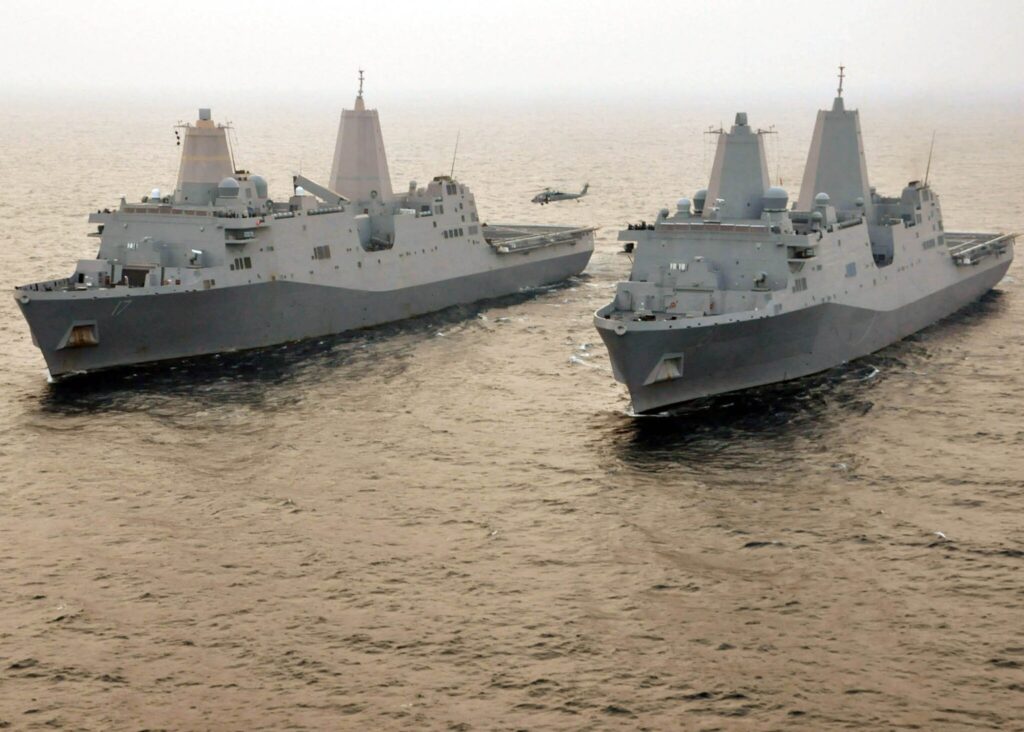
The Flight I amphibious transport dock ships USS San Antonio (LPD 17) and USS New York (LPD 21) in 2011 off the coast of Virginia. They are being succeeded by the Flight II LPD. U.S. NAVY / Mass Communication Specialist 1st Class Edwin F. Bryan
*********
WASHINGTON — The Marine Corps commandant praised the Flight II version of the San Antonio-class amphibious platform dock ship (LPD) and re-iterated his position that 31 large and medium amphibious warships is the minimum needed to enable amphibious power projection for the Marine Corps.
“The Flight II program is a huge success,” said General David H. Berger, speaking in a conversation with Defense One reporter Caitlin Kennedy during the March 16 Defense One State of the Marine Corps webcast. “To us, the Flight II is exactly what we need to replace the LSD.”
The Flight II LPD is designed to replace the old Whidbey Island-class dock landing ships (LSDs). With the Navy’s 2023 budget, the Navy had planned to retire four LSDs, but Congress refused to consent and prohibited the Navy from decommissioning them. In the 2024 budget proposal, the Navy is requesting to retire three of the LSDs.
However, the Navy is planning to gap procurement of the Flight II ships for at least five years in the 2024 Future Years Defense Plan while it evaluates the requirements of the Navy and Marine Corps and the construction costs of the ships.
“The decommissioning of the older ones [LSDs] and a strategic pause [in LPD Flight II procurement] causes a dilemma,” Berger said.
The Navy in 2014 decided to use the Flight I LPD hull as the basis for the Flight II design as a cost-saving measure. Berger said the cost of as Flight II ship was $1.62 billion, compared to $2 billion for a Flight I ship.
The commandant also said that the number large and medium amphibious warships needed was nothing less than 31, noting that if the number drops below 31, the nation will lack the Marine presence to respond to crises. He pointed to lack of an amphibious ready group and associated Marine Expeditionary Unit in the Mediterranean Sea to respond to the need disaster relief following the recent earthquake in Türkiye.
“If the net number of amphibious ships starts to drop … and you don’t have the amphibious ships that you need — we have the Marines, the Navy has the Sailors — the limiting factor here is the number of ships,” he said. “If that happens, you can’t respond in the timeline, you can’t respond when the need is urgent. This is the underpinning of our national strategy … the ability to support allies and partners and deter something from happening. You need to be forward to do that.”
Berger also re-iterated his support for Chief of Naval Operations Admiral Michael Gilday’s number one priority of readiness. The commandant said the funds for ship maintenance the Navy proposed in the 2024 budget, “were absolutely a step in the right direction.”
AUSTIN, Texas – The Marine Corps established the Marine Corps Software Factory (MCSWF) to create a world-class Marine-led software development capability today, March 10, 2023.
The future operating environment will require Marines to scope and implement software-based solutions at the edges of the battlefield without connectivity or assistance from centralized or contracted support.
The MCSWF enhances Marine Corps modernization efforts by empowering Marines to develop applications for commanders at the speed of relevance.
“Our Marines have an amazing capacity for understanding complex technologies. We must empower our Marines to use that technological know-how to create a more lethal force,” stated Gen. David H. Berger, 38th Commandant of the Marine Corps. “The Marine Corps is fielding more complex systems and platforms right now, and we must invest in our Marines’ and Civilian Marines’ capacity to advance in parallel.”
The MCSWF will leverage recent endeavors in talent management, partnerships with industry, and innovations in cloud technology. The MCSWF will work closely with Manpower and Reserve Affairs (M&RA) to ensure ease of career implications for program participants and to ensure software factory outcomes are optimized across the modernization enterprise.
As the Marine Corps’ Chief Information Officer, Lt. Gen. Matthew Glavy, Deputy Commandant for Information (DC I), will serve as the executive sponsor for the MCSWF.
“The Marine Corps Software Factory is about outcomes, creating advantage for Marines at the tactical edge, today”, stated Glavy. “The MCSWF will provide viable capabilities to enhance mission readiness through the power of information.”
MCSWF is a three-year pilot to demonstrate a scalable, Marine-led software development capability. The three-year pilot will evaluate the demand from the fleet to better understand overall requirements.
March 25, 2021, MARADMIN 164/21 was released via Information, Command, Control, Communications, and Computers (IC4) division soliciting participation in the inaugural Marine Corps Micro-Application Development Innovation Challenge. The Innovation Challenge yielded promising results and proved that given the right resources, talented Marines across the MOS spectrum can design and deliver software capabilities from the tactical to strategic levels. Subsequent micro-application innovation challenges consistently revealed untapped technical talent and a demand signal for organically developed software solutions within the Marine Corps.
The initial MCSWF cohort was sourced from the Communications Occupational Field. Future candidates will be solicited across the service from any MOS.
Marines selected to attend the MCSWF will undergo a three-year program consisting of three phases: a technical accelerator, one-to-one pairing enablement, and employment utilization. For the first three months, Marines will attend a technical accelerator to establish a baseline skillset. Then, Marines will work one-to-one with technical experts from industry while solving real Marine problem sets.
Marines who successfully complete the enablement phase will receive the 0673 Necessary MOS (Application Developer). Marines will spend the final 24 months in a utilization tour building Marine Corps software solutions while continuing to advance their skillsets.
The MCSWF is co-located with the Army Software Factory (ASWF) in Austin, Texas. The MCSWF has established a formal agreement with the ASWF showcasing the first collaborative software development effort in the DoD. Partnering with ASWF will accelerate Marine Corps software development modernization efforts at a significantly reduced cost.
The software factory is for Marines, powered by Marines. If anyone on the Marine Corps team is interested in joining the factory or has an idea of how a software solution can better the Corps they are encouraged to reach out directly to the factory via email at [email protected]
To learn more about the MCSWF or how to get involved the following link to the MCSWF website is provided: https://www.hqmc.marines.mil/mcswf
BAE Systems receives $256 million full-rate production contract from U.S. Marine Corps for additional Amphibious Combat Vehicles
FALLS CHURCH, Va. – March 6, 2023 – The U.S. Marine Corps (USMC) has awarded BAE Systems a $256.8 million contract for additional Amphibious Combat Vehicles (ACVs) under a third order for full-rate production (FRP). This award covers production, fielding, and support costs for the ACV Personnel (ACV-P) variant and the Command variant (ACV-C). The contract exercises existing contract options, which include $145.3 million for more than 25 ACV-P vehicles, and $111.5 million for more than 15 ACV-C vehicles.
The ACV is an 8×8 platform that provides true open-ocean amphibious capability, land mobility, survivability, payload, and growth potential to accommodate the evolving operational needs of the USMC. The Marine Corps approved full rate production on the ACV-P vehicle in 2021, and the vehicle is currently being fielded to Marine Corps Fleet Marine Force units. The ACV-C variant, which will provide multiple workstations for Marines to maintain and manage situational awareness in the battle space, is also in full-rate production and will begin fielding later this year.
“The ACV is an extremely versatile platform that continues our commitment to equip the Marines with the vehicle to meet their expeditionary needs,” said Garrett Lacaillade, vice president of amphibious programs at BAE Systems. “Today, with our strategic partner Iveco Defence Vehicles, we are delivering this critical capability to the Marines. Together, we are working to introduce new and future capabilities into the ACV family of vehicles.”
BAE Systems is also under contract for two other ACV mission role variants: ACV-R; and ACV-30. The ACV Recovery (ACV-R) variant will replace the legacy Assault Amphibious Vehicle recovery variant (AAVR7A1), and will provide direct field support, maintenance, and recovery to the ACV family of vehicles. The ACV-30 mounts a stabilized, medium caliber Remote Turret System manufactured by KONGSBERG that provides the lethality and protection the Marines need while leaving ample room for troop capacity and payload.
The company has also received task instructions from the USMC to complete a study of incorporating Advanced Reconnaissance Vehicle Command, Control, Communication and Computers/Unmanned Aerial Systems mission payload onto an ACV variant. The ACV C4/UAS variant was delivered to the Marine Corps in January of 2023 for testing.
ACV production and support is taking place at BAE Systems locations in: Stafford, Virginia; San Jose, California; Sterling Heights, Michigan; Aiken, South Carolina; and, York, Pennsylvania.
Marine Corps releases Talent Management Update
Release from Headquarters, U.S. Marine Corps 6 March 2023
*****
MARINE CORPS BASE QUANTICO, VA – The U.S. Marine Corps released the Talent Management Update which details the progress made since the release of Talent Management 2030. The release of TM2030 marked the Marine Corps’ initial step to transition from an industrial-era model of personnel management to a 21st century talent management system that better harnesses each Marine’s unique talents to improve our readiness and extend our advantage over competitors.
Marine Corps talent management efforts that recruit, develop, and retain the right Marines are critical to the success of the modern Marine Corps operational concepts, as described in Force Design 2030.
To date, the Marine Corps enacted the following talent management initiatives:
Commandant’s Retention Program. The CRP provided pre-approved reenlistments for top-performing Marines along with priority access to duty station and assignment options. This effort resulted in a 72% increase of first-term reenlistment submissions by top-performing Marines, with the average reenlistment approval accomplished in 24 to 48 hours – a fraction of the average reenlistment approval time.
Staff Non-Commissioned Officer (SNCO) Promotion Board Realignment. Staff non-commissioned officer promotion boards were realigned, effective for the fiscal year 2024 boards, to more effectively sequence the assignments and reenlistment processes, while reducing billet gaps throughout the Marine Corps, and decrease reenlistment processing time.
Recruiting Station Commanding Officer Selection Board (RSCO). Commissioned officers eligible for recruiting station command consideration were offered two opportunities to increase career flexibility: volunteer and request removal. This change allowed officers to volunteer for command, including those not scheduled for consideration; and to request removal from consideration for one year, without penalty, to complete a deployment, personal or professional obligation.
Special Duty Assignment (SDA) Volunteer Incentives. The Special Duty Assignment Volunteer Incentives provided Active and Reserve Component Marines who volunteer for Special Duty Assignment to receive their preferred duty station. This incentive resulted in an increase of volunteers by 62%, minimizing disruption to Marines, families, and Fleet Marine Force units, while also reducing SDA school attrition.
MarineView 360-Degree Leadership Review. The Marine Corps launched the MarineView360 Leadership Review pilot, a program designed to assess Marines by polling their supervisors, peers, and subordinates to identify strengths and areas of improvement for emerging future leaders. The MarineView360 pilot began with sitting commanders and will expand to all commanders and senior enlisted leaders in the future.
Officer Promotion Opt-Out. The Officer Promotion Opt-Out initiative allows certain Active and Reserve Component in-zone officer populations to opt-out of consideration for promotion once, without penalty, to pursue unconventional career experiences or formal education, to increase the flexibility in career paths for officers. The potential for offering this same flexibility to enlisted Marines is being explored.
Digital Boardroom 2.0 (DBR 2.0). The Digital Boardroom 2.0 increases the functionality and accuracy of information presented to board members, safeguards data, and improves this critical talent management process. The Enlisted Career Retention and Reserve Aviation Boards were successfully executed using the DBR 2.0. As DBR 2.0 use is expanded, the Marine Corps will assess outcomes, cost and time savings, and professional depth and breadth of board members to benchmark with our legacy process.
Separate Competitive Promotion Categories. To meet the demands of the future, the Marine Corps must retain the highest quality officers with the necessary skill sets at all ranks. We are conducting detailed analysis on options to reorganize the unrestricted officer population into separate competitive categories to better meet the Marine Corps’ need for the diverse expertise and experience at all ranks by competing for promotion with peers having similar skill sets, training, and education. We intend to conduct a pilot program during the 2025 field grade officer promotion boards.
Career Intermission Program (CIP). The Career Intermission Program allows Marines to temporarily pause active duty service and later resume their careers without penalty to enable career flexibility and encourage retention of experienced, talented Marines. CIP payback was reduced by half to just one month of obligated active service for each month of intermission. Analysis will be completed to ensure the program is balanced with the need to sustain our professional fighting force and prevent loss of skill and familiarization.
Future talent management initiatives and developments are nested within the following four mutually supporting lines of effort:
LOE 1: Rebalance recruiting and retention to accelerate the shift from our legacy, high turnover “recruit and replace” personnel model toward one characterized by a greater emphasis on investment in, and retention of, our most capable Marines.
LOE 2: Optimize the employment of talent to maximize our warfighting capabilities by increasing the effectiveness and transparency of the assignments process to better utilize and retain our most talented Marines.
LOE 3: Multiple pathways to career success through career initiatives that account for evolving interests and personal development over the course of a Marine Corps career.
LOE 4: Modernize talent management digital tools and data systems to synthesize personnel information and requirements across the force via a transparent, commander-focused, collaborative system to better align the individual abilities, skills, and aspirations of our Marines to our warfighting requirements.
Reorienting and reconfiguring our human resources enterprise into a talent management system is a work in progress, but one that is well underway. The actions we have taken, and those we will take, ensure we will remain the Nation’s premier expeditionary force-in-readiness within the rapidly evolving world we face.
AMPHIBIOUS CONSTRUCTION BATTALION TWO (ACB2) HOLDS DECOMMISSIONING CEREMONY AFTER NEARLY 80 YEARS SERVICE TO THE NAVY AND MARINE CORPS
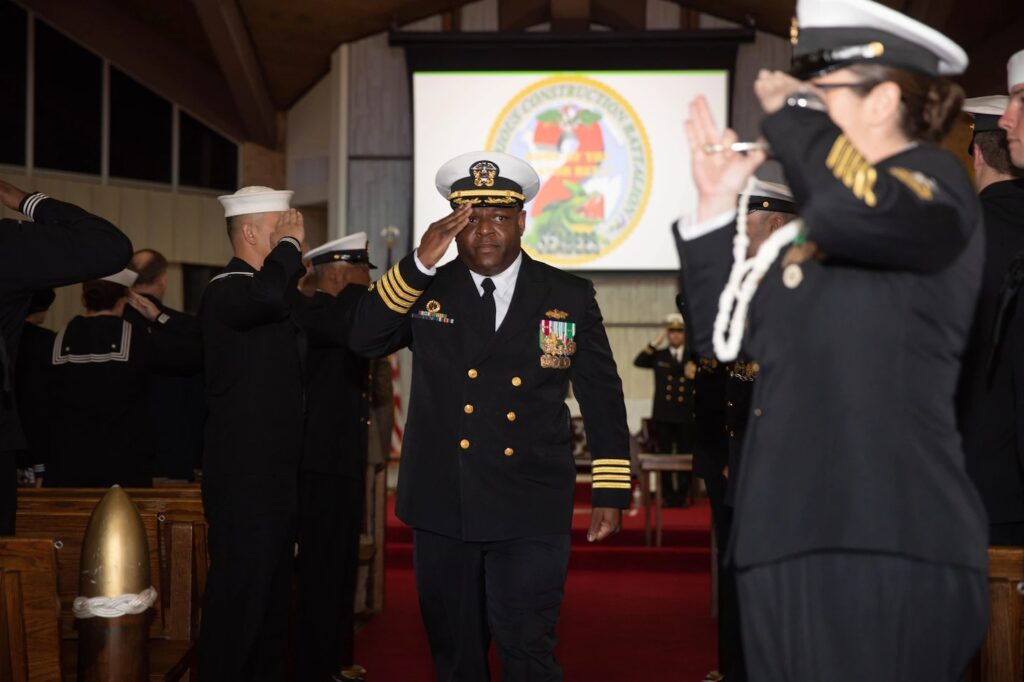
Amphibious Construction Battalion TWO (ACB2) Commanding Officer, Capt. Atiim Senthill, salutes as he passes through sideboys to close out the ACB2 decommissioning ceremony, March 2, 2023.
JOINT EXPEDITIONARY BASE LITTLE CREEK-FORT STORY, Va. – On March 2, Amphibious Construction Battalion TWO (ACB2) held a decommissioning ceremony at the Joint Expeditionary Base Little Creek (JEBLC) chapel after nearly 80 years of service to the Navy and Marine Corps team and our nation.
ACB2 Commanding Officer, Capt. Atiim Senthill, presided over a ceremony that included several previous commanding officers, family, prior command members, and the crew, dressed in blues. Established as the 105th Naval Construction Battalion on July 14, 1943 and re-designated ACB2 in 1950, throughout its run the non-kinetic unit allowed combat units to maintain a forward sustained presence through ship-to-shore logistics in support of Maritime Prepositioning Forces as well as Joint Logistics Over the Shore (JLOTS) operations. On July 18, a CNO message ordering its deactivation marked the beginning of the end for ACB2. Operating on a $2.5 million disestablishment budget, within eight months all command assets had to be inventoried and reapportioned across the fleet. It was an emotionally-taxing job that inspired Senthill to praise the hard work of the crew. “These Sailors worked tirelessly and delivered,” he said. “All assets arrived at their destination early and under budget.”
Despite the look of a final nail being driven into the command’s coffin, the doors at ACB2 will remain open a few more weeks before officially shutting down March 31. Some Sailors will make the trip across country to begin new, yet familiar chapters at ACB1. Other ACB2 Sailors will remain nearby. Wherever they go, they will remain part of a proud heritage. With a history that began in the middle of U.S. involvement in World War II, ACB2 participated in the 1958 Lebanon crisis, the 1983 American citizen rescue in Grenada, Operation Desert Shield and Desert Storm, the TWA Flight 800 disaster recovery, and Operation Iraqi Freedom as well as the 2017 cleanup efforts for Hurricane Maria. This broad scope of missions demonstrates capabilities spanning a wide variety of missions and environments.
Rear Adm. Dean VanderLey, Commander of Naval Facilities Engineering Systems Command and guest speaker, emphasized this to the ACB2 Sailors in attendance. “While this has the appearance of a funeral, it should be a celebration of life,” VanderLey said. “You helped accomplish so much and are part of an incredible legacy.”
HII Hosts Congressional Delegation and USMC Officers at Ingalls Shipbuilding
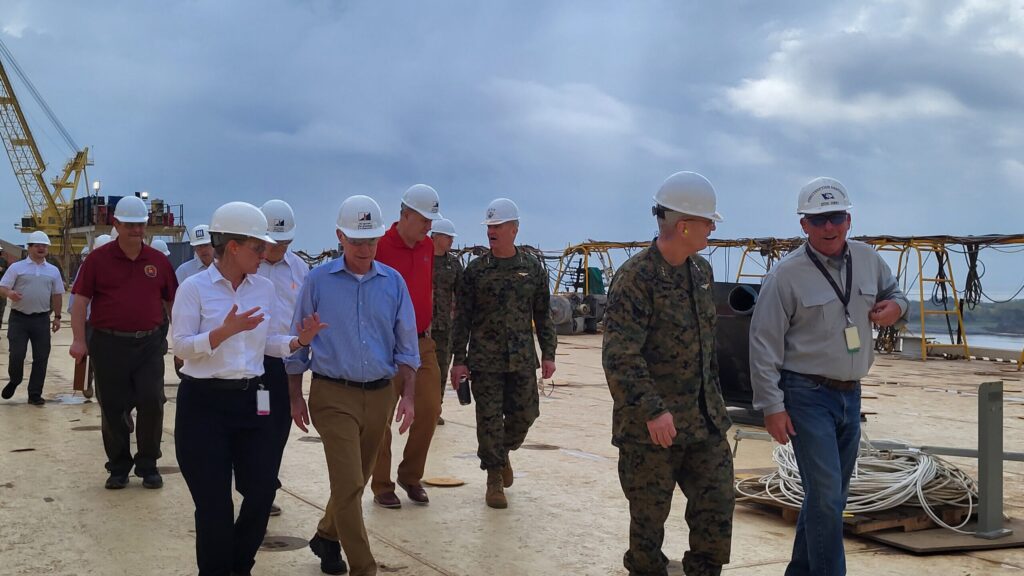
PASCAGOULA, Miss., March 02, 2023 (GLOBE NEWSWIRE) — HII’s (NYSE: HII) Ingalls Shipbuilding division hosted U.S. Reps. Trent Kelly, R-Miss.; Joe Courtney, D-Conn.; and Jerry Carl, R-Ala. who were accompanied by U.S. Marine Corps Lt. Gen. Karsten Heckl and Lt. Gen. Christopher Mahoney today for a meeting with Ingalls Shipbuilding leadership and a shipyard tour visit.
“It is always a privilege to host members of the House and our Marine Corps partners,” Ingalls Shipbuilding President Kari Wilkinson said. “We make the best decisions and investments as collaborative partners aligned in our understanding of the opportunities to forward our common mission of providing for our service men and women.”
For 85 years, Ingalls has designed, built and maintained amphibious ships, destroyers, and cutters for the U.S. Navy and the U.S. Coast Guard. During this official visit, the Ingalls Shipbuilding team lead their guests on a shipyard tour including visits aboard amphibious transport dock ship Richard M. McCool Jr. (LPD 29) and large deck amphibious assault ship Bougainville (LHA 8).
“It’s always great to be back at Ingalls Shipbuilding, and I remain impressed with the talent, dedication and teamwork of Ingalls shipbuilders as they construct the next generation of ships for our Navy and Marine Corps,” Kelly said. “Congress has been clear about the requirement for amphibious warships, including the establishment of a minimum 31 amphibious warships in our Navy fleet in last year’s NDAA. I was especially pleased to visit and see construction progress on both LPD 29 and LHA 8 today, and I look forward to working with my colleagues on HASC to provide for the future of amphibious warships in the FY24 National Defense Authorization Act.”
“The work being done by Mississippi’s shipbuilders and engineers at the Ingalls shipyard in Pascagoula is absolutely critical to the mission of our U.S. Navy, and the national security of America and its allies,” Courtney said. ”What I saw at the shipyard should inspire confidence in every American focused on the success of our Marine Corps and Navy — this workforce is sharp, highly skilled and has taken full advantage of the investments Congress made into LPD 32 and LHA9 procurement. Our 2023 NDAA authorized full funding for both programs while also providing advance procurement for the next ships in both classes, all in support of the statutory floor for 31 amphibious ships authorized by the Seapower subcommittee. The volume, pace and capability of what is being built at HII’s Pascagoula shipyard is a huge achievement, and I’m grateful to Chairman Kelly for organizing this opportunity for us to see their impressive workforce in action.”
“It’s an honor to visit and engage industry on how best I can support our Mississippi and Alabama shipbuilders and Marine Corps,” Carl said. “The volume, pace and capability of what is being built at this shipyard is impressive. The workforce should be very proud of building these amphibious ships that are critical to the Navy and Marine Corps who protect our security interests around the globe.”
Ingalls Shipbuilding is the sole builder of the entire San Antonio class of ships and has delivered 12 San Antonio-class ships to the Navy and has three more under construction, including Richard M. McCool, Harrisburg (LPD 30) the first Flight II LPD, and Pittsburgh (LPD 31). The shipyard is also building large-deck amphibious ships for the Navy and Marine Corps, delivering a total of 15 ships, and the production remains online and efficient with the ongoing construction of Bougainville and Fallujah (LHA 9), which started fabrication in December 2022.
“It is great to be able to see the level of construction taking place on amphibious ships currently being built at Ingalls,” Mahoney said. “These amphibious ships are crucial to our national security.”
Heckl echoed the sentiments of Mahoney on the critical need for amphibious ships. “The reality is that the diverse set of missions our amphibs are most likely to execute are very real, occur fairly regularly, and could occur anywhere on the globe,” Heckl said. “The naval force must advocate for a larger Department of the Navy budget. This will enable congressionally authorized multi-ship buys, provide cost savings through industrial base stability, and improve current maintenance and readiness levels.”
HII recently invested nearly $1 billion in infrastructure, facility and toolsets at Ingalls Shipbuilding enabling shipbuilders to improve product flow and process and efficiency, and enhancing product quality. Ingalls is supported by over 1,200 suppliers across 49 states and is the largest manufacturing employer in Mississippi and a major contributor to the economic growth of Alabama.