Increased Maritime Capacity Important Factor for AFRICOM
*****
Arlington, Va. — The United States has an enduring commitment to Africa, said U.S. Marine Corps General Michael Langley, commander of the U.S. Africa Command (AFRICOM) in a March 2 digital press briefing sponsored by the U.S. Department of State. AFRICOM represents a partnership of 53 African nations, all working toward the joint goal of security and stabilization across the continent.
Increased maritime capacity is an important factor in that overall strategy.
Gen. Langley stated that, from a U.S. national security standpoint, Africa is a geopolitical force that will require a strong U.S./Africa relationship today that will serve as an “important foundation” for our shared future. AFRICOM takes a “whole nation” perspective to security challenges in the region, said Langley. This includes a “3D” approach that includes diplomatic efforts from the Department of State, development efforts from the U.S. Agency for International Development (USAID), and defense efforts from the Department of Defense.
The focus on the importance of diplomacy was reiterated throughout the briefing. Langley stated that AFRICOM applauds the efforts of both the Department of State and USAID as U.S. diplomats, and development teams work with leaders in both the Democratic Republic of the Congo (DRC) and Rwanda to address the M23 terrorist crisis — a key example of how collaboration can influence the ultimate goals of stability and security in Africa.
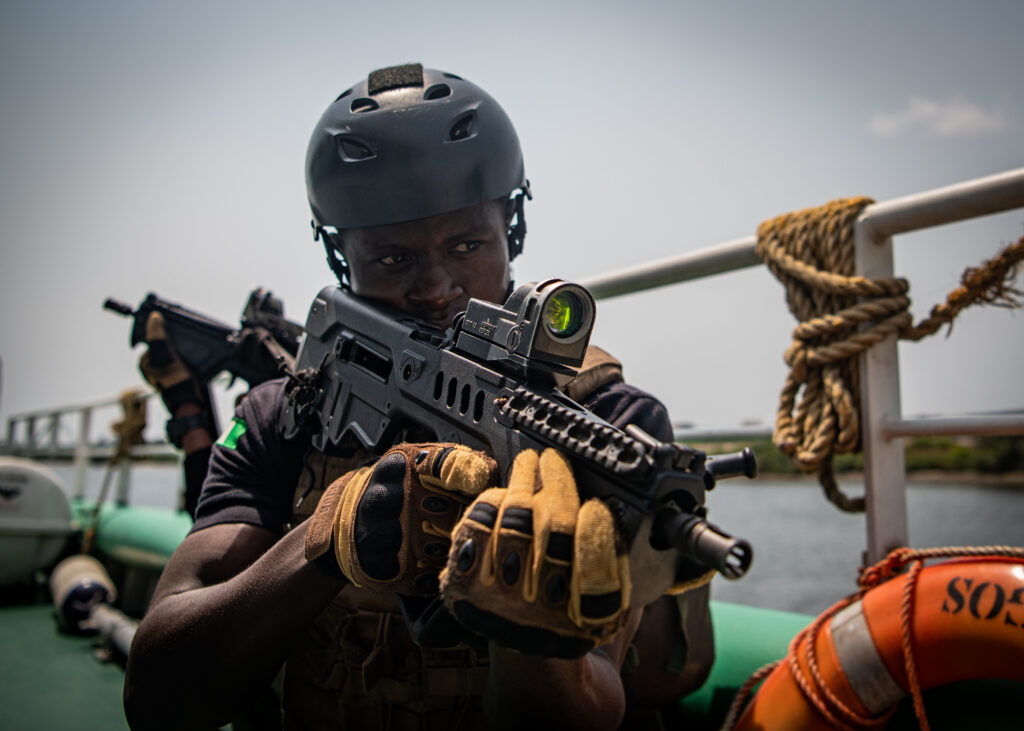
Langley also touched on several joint exercises that address both interoperability and capacity building throughout the continent, such as Cutlass Express, a “U.S. Naval Forces Africa-led, all-domain exercise in East African coastal regions and the West Indian Ocean,” and Obangame Express, the “largest multinational maritime exercise in Western and Central Africa.”
AFRICOM will continue to develop partnerships in coordination and cooperation with African partners to tackle shared challenges such as violent extremist organizations, illegal fishing, piracy, and transnational crime, said Langley. Identifying and building on the capacities of local governments in an important step in the right direction to solve complex problems and prevent terrorist from spreading across the continent, he added.
Joint, Combined Exercise Shows Marine Littoral Regiment Idea is on ”Right Track’
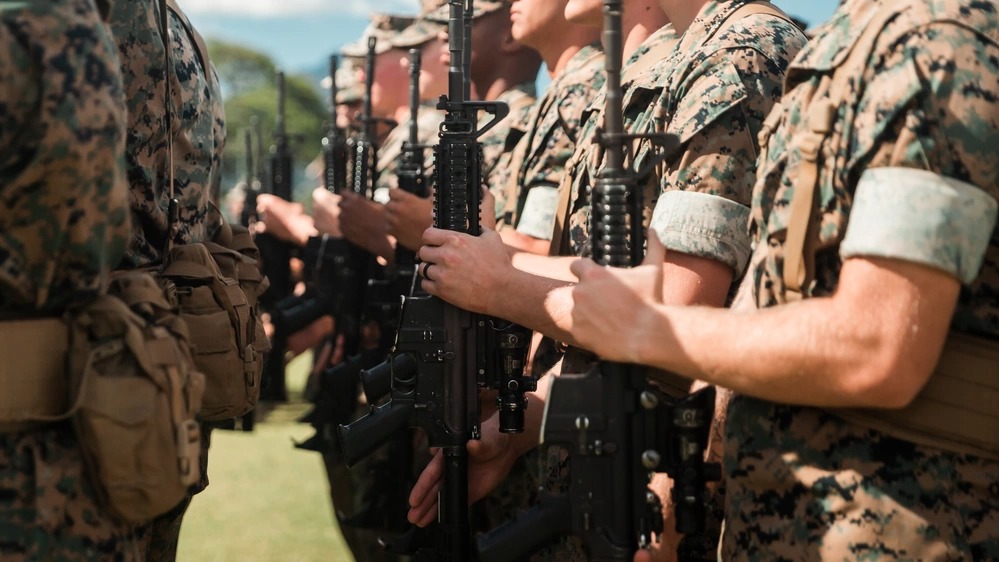
U.S. Marines with 3d Marine Littoral Regiment, 3d Marine Division present arms during the redesignation ceremony of 3d Marines to 3d MLR aboard Marine Corps Base Hawaii, March 3, 2022. The 3d MLR will serve as a key enabler for joint, allied, and partnered forces, will integrate with naval forces, and will enable multi-domain maneuver and fires within contested spaces. The transition of 3d Marines to 3d MLR is in accordance with Force Design 2030 and one of the first major steps to facilitating a shift as the Marine Corps divests in legacy capabilities and builds a force that is optimized for operations envisioned within the Commandant’s Planning Guidance. (U.S. Marine Corps photo by Cpl. Patrick King)
ARLINGTON, Va. — Now that the first Marine Littoral Regiment has been created, U.S. Marine Corps leaders say they’re experimenting to determine how best to equip the pioneering unit as the forward-based eyes and ears of the fleet inside a contested maritime environment.
The 3rd Marine Regiment was redesignated the 3rd Marine Littoral Regiment (MLR) in a March 3, 2022 ceremony at Marine Corps Base Hawaii, where the new regiment will continue to be headquartered. The first of three planned littoral regiments for the Indo-Pacific region, the 3rd MLR is a key part of the Marines’ ambitious force redesign to contend with near-peer militaries like China and Russia.
”We have not only built the organization, now we are equipping it, experimenting and doing the testing and evaluation with those concepts we’ve come up with,” Marine Corps Col. Lance Lewis told the National Defense Industrial Association (NDIA) Expeditionary Warfare Conference Feb. 22. ”We’re definitely on the right track when it comes with MLRs,” added Lewis, the Assistant Vice Chief of Naval Research at the Office of Naval Research (ONR), ”That is how we are going to enable the Stand-In Force.”
The Marines’ evolving Expeditionary Advanced Base Operations concept envisions littoral operations by specialized mobile, low signature units within larger distributed maritime operations areas. Plans call for the MLRs to be organized, trained and equipped to support sea control and sea denial operations as part of a larger naval expeditionary force integrated with the joint force and allied and partnered forces.
Currently the MLRs are divided into three elements: a littoral combat team made up of a one infantry battalion equipped with a ship-killing missile battery, an anti-aircraft battalion, and a combat logistics battalion. All three elements were dispersed over three separate islands in their debut inclusion in RIMPAC 22 , the huge joint multinational maritime exercise in Hawaii. The MLR provided multi-domain awareness to the Combined Task Force, the Combined Force Maritime Component Command, and the Combined Force Air Component Command.
As the “eyes and ears of the fleet,” Lewis said, ”You need not only to restructure, but how do you maneuver those forces around the battlefield so it’s not a standard set of battalions but a different task organization, and then how do you now equip those forces.”
USMC Calls for GPN
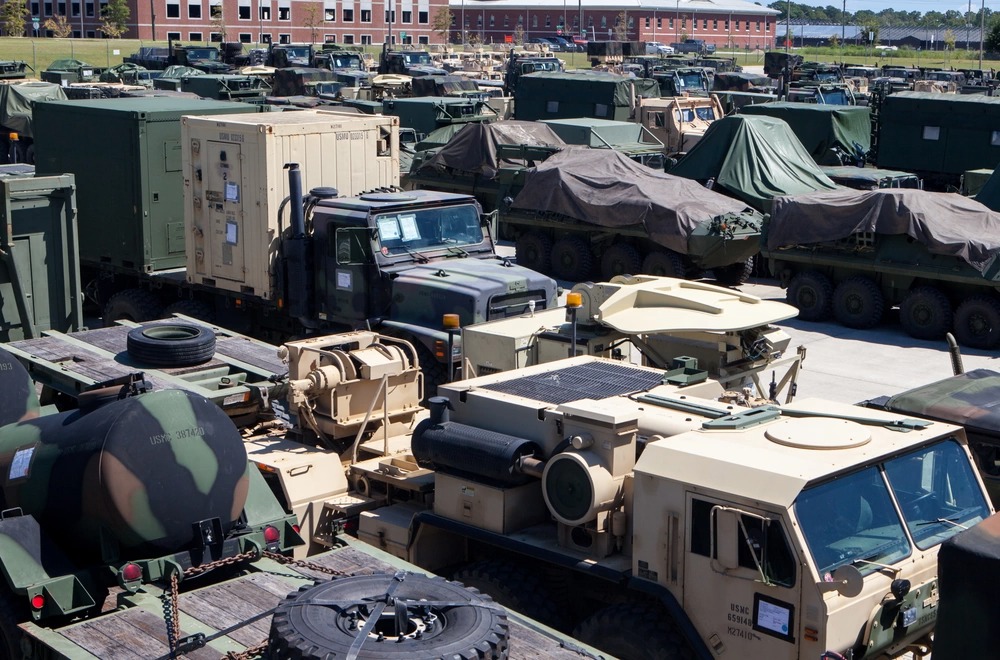
U.S. Marines with Headquarters Company, Headquarters Regiment, 2nd Marine Logistics Group, stage vehicles in support of Exercise Trident Juncture 18 on Camp Lejeune, N.C., Aug.27, 2018.
*****
New Marine Corps Logistics Plan Calls for Pre-Positioned Stocks to be Integrated into a Global Positioning Network
ARLINGTON, Va. — The Marine Corps is refining its logistics concepts in conjunction with the commandant’s Force Design 2030 to provide sustainable logistics in a contested environment. The plan includes integrating its pre-positioned stocks into a Global Positioning Network (GPN), the Corps said in a Feb. 23 press teleconference.
The plan — Installations and Logistics 2030 — was released Feb. 23 by Marine Corps Commandant Gen. David H. Berger, who said in the accompanying release that, “[a]ny student of military history understands the critical nature of logistics and sustainment capabilities. We are focusing on diversifying distribution models, resourcing and improving sustainment capabilities, and ensuring the most resilient installations.”
“One broken link in a supply chain can result in an untethered force,” said Lt. Gen. Edward Banta, deputy commandant for Installations and Logistics. “A web mentality assures sustainment of the force and can absorb disruption.”
Logistics Upgrades Needed
The plan directs myriad studies and experiments to re-vamp the logistical systems and make them more forward and resilient, modify force structure tailored the Stand-In Force operating inside an enemy’s engagement zone, and to and able to take advantage of emerging technologies, including unmanned systems, tele-maintenance, 3D printing, and alternative energy sources.
“Stand-in Forces are small, low signature, mobile, relatively simple-to-maintain-and-sustain forces designed to operate across the competition continuum within a contested area,” the release said. “They are the leading edge of a maritime defense-in-depth in order to intentionally disrupt the plans of a potential or actual adversary.”
“We are changing our global posture with a new Global Positioning Network (GPN) that leverages afloat and ashore capability sets for responsiveness,” Banta said. ”The GPN also matures our relationships with partners and allies for access, basing, and overflight. Within the GPN we will be pushing higher echelons of maintenance further forward, as well as leveraging the already existing global presence of commercial industry partners. An example here is the ability of forklift operator to reach over to a Caterpillar dealer in the region, versus having to order a part from back in the Continental United States.”
The new document says that the current logistics concept “relies on deliberate, multi-modal movement of equipment and supplies across a linear logistics and supply chain, requiring large warehousing and trans-shipment nodes to break down, consolidate, and repackage shipments for delivery to the end user. Our supply chains have been developed for efficiency, not effectiveness. One broken link in the supply chain can result in an untethered force.”
The GPN will be designed to be a supply web instead of a supply line.
“Instead of relying on a singular, vulnerable chain, we must build a more resilient supply web that can adapt to temporary broken links or obstructions,” the new document said. “Improving sustainment will demand global logistics solutions that are non-linear and distributed, have a smaller physical footprint at any one site, and limit the vulnerability of forward forces.”
The Marine Corps maintains prepositioned stocks of weapons, equipment, and supplies on Military Sealift Command ships at Diego Garcia and the Marianas, plus a stock at a facility in Norway. The Corps will be integrating its pre-positioned stocks into the GPN.
In response to a question from Seapower Magazine about the pre-positioned stocks, Col, Michael Mulvey, Futures branch head for Logistics Vision and Strategy said, “[We] are looking at an integrated global positioning network now. So that’s, that’s a combination of both afloat and ashore platforms that enables campaigning. So that’s steady state operations that Marines will do from day to day. And by having that forward position [with] the equipment and capabilities inside the first island chain and in the Indo Pacific, we can transition much more efficiently from campaigning to a conflict scenario if we need that.”
“The logistical challenge in front of us is massive. But the risks of not implementing change are clear – the Naval Expeditionary Force becomes unnecessarily vulnerable, particularly while operating in forward and distributed formations,” Berger said in the new document. “Transforming our current installations and logistics related capabilities, capacity, and resiliency to support the future force more effectively, while reducing risk to our units, Marines, Sailors, families, and allies and partners is paramount. The time for action is now.”
Secretary of Defense Lloyd J. Austin III announced that the president has made the following nominations:
Marine Corps Col. David R. Everly for appointment to the grade of brigadier general. Everly is currently serving as chief of staff, 2d Marine Expeditionary Force, Camp Lejeune, North Carolina.
Marine Corps Col. Kelvin W. Gallman for appointment to the grade of brigadier general. Gallman is currently serving as senior military advisor to the Secretary of the Navy, Washington, D.C.
Marine Corps Col. Adolfo Garcia Jr., for appointment to the grade of brigadier general. Garcia is currently serving as director, U.S. House of Representatives Congressional Liaison, Office of Legislative Affairs, Headquarters, U.S. Marine Corps, Washington, D.C.
Marine Corps Col. Matthew T. Good for appointment to the grade of brigadier general. Good is currently serving as director, U.S. Senate Congressional Liaison, Office of Legislative Affairs, Headquarters, U.S. Marine Corps, Washington, D.C.
Marine Corps Col. Trevor Hall for appointment to the grade of brigadier general. Hall is currently serving chief of staff, U.S. Marine Corps Forces Command, Norfolk, Virginia.
Marine Corps Col. Richard D. Joyce for appointment to the grade of brigadier general. Joyce is currently serving as commanding officer, Marine Aircraft Group 29, 2d Marine Aircraft Wing, Marine Corps Air Station, New River, North Carolina.
Marine Corps Col. Omar J. Randall for appointment to the grade of brigadier general. Randall is currently serving as director, Logistics Combat Element Integration Division, Combat Development and Integration, Headquarters, U.S. Marine Corps, Quantico, Virginia.
Marine Corps Col. Robert S. Weiler for appointment to the grade of brigadier general. Weiler is currently serving as military secretary to the commandant of the Marine Corps, Headquarters, U.S. Marine Corps, Washington, D.C.
The U.S. Marine Corps awarded Northrop Grumman a production and operations contract for the Next Generation Handheld Targeting System (NGHTS). NGHTS is a laser-based device that provides the Marines with an enhanced capability to identify and designate targets from extended ranges. Credit: Northrop Grumman
APOPKA, Fla. – Feb. 21, 2023 – The U.S. Marine Corps awarded Northrop Grumman Corporation (NYSE: NOC) the initial production and operations contract for the Next Generation Handheld Targeting System (NGHTS). NGHTS is a compact targeting system that provides advanced precision targeting and is capable of operation in GPS-denied environments.
“NGHTS’ advanced technology will significantly enhance warfighters’ ability to safely complete their missions,” said Bob Gough, vice president of navigation, targeting and survivability, Northrop Grumman. “NGHTS is lightweight and combines four systems into one portable device with state-of-the-art imaging, targeting, ranging, designating and networking. This compact, multi-sensor electro-optical/infrared device lightens Marines’ loads and keeps them connected while adding precision and safety to their missions.”
NGHTS performs rapid target acquisition, laser terminal guidance operation and laser spot imaging functions using its advanced range finder and designator. With NGHTS, ground forces have the option to call in a target, transmit the precise location or use laser designation where previously the only option was to call in target coordinates on a field radio. This single, ergonomic handheld product packed with advanced targeting capabilities will enable the Marines to quickly acquire and perform guidance against targets and generate target location data during combat operations.
NGHTS features three sensors: a color day imager, a low-light imager and a thermal imager for creating images in total darkness. It also includes a high-precision GPS receiver and a celestial compass that provides azimuth readings (the angular measurement in a spherical coordinate system) for a target’s heading relative to NGHTS to within fractions of a degree. NGHTS allows for further targeting ranges than current legacy systems.
NGHTS provides superior observation from even the most environmentally and physically onerous locations. During twilight, one of the most challenging times of day to see targets, the streamlined Graphical User Interface (GUI) provides a sharp and clear image. This improved user experience allows the warfighter to conduct accurate target location and laser guidance during combat operations no matter the conditions.
Weighing less than 10 pounds, the unit is extremely durable, and will be tested under extreme conditions of temperature, vibration, salt-fog and altitude. To create efficiencies and prioritize sustainment, Northrop Grumman designed various parts for NGHTS that can be 3D printed in the field rather sending them elsewhere for repair.
Continues production of Foreign Military Sales Aircraft
Fort Worth, Texas (Feb. 20, 2023) – Bell Textron Inc., a Textron Inc. (NYSE: TXT) company, has completed the AH-1Z program of record (POR) for the Kingdom of Bahrain. Bell delivered the final production aircraft to Naval Air Systems Command in December of 2022. The first Bahrain AH-1Zs made their in-country debut during the Bahrain Air Show and six have been delivered in country. The final six helicopters will be prepared for shipment to Bahrain with the Defense Contract Management Agency (DCMA) before being transported to Bahrain in 2023.
“Congratulations to the Kingdom of Bahrain on obtaining the latest generation of the AH-1Zs,” said Mike Deslatte, Bell vice president and H-1 program director. “As a leader in the region, Bahrain’s defensive capabilities will be further bolstered by the advanced technologies of the Viper.”
The completion of the Bahrain AH-1Z program of record comes on the heels of Bell completing the U.S. Marine Corps program of record, signifying two major H-1 production milestones in one year. The AH-1Z Viper is Bell’s newest generation of dedicated attack helicopters manufactured by Bell. The U.S. Marine Corps currently operates the AH-1Z around the world, taking advantage of the minimal logistics requirements for shipboard and expeditionary operations.
“Capabilities are only part of the equation when it comes to modernizing an aircraft fleet,” Deslatte added. “By ensuring the aircraft can operate with minimal logistics support, the Viper enables leaders to react with greater speed and agility to rapidly evolving operations.”
Bell continues to work with Kingdom of Bahrain on post-shipping inspections and re-assembly to guarantee configuration as defined in the FMS case. In addition to manufacturing and delivering the new Vipers, Bell will support the lifecycle of the aircraft to ensure reliability, survivability and lethality on the modern battlefield.
SILVER SPRINGS, Nev. – Feb. 16, 2023 – BAE Systems and Lockheed Martin Skunk Works® conducted a successful test of the Stalker and Indago small uncrewed aerial systems (UAS) on an Amphibious Combat Vehicle Command, Control, Communication and Computers/Uncrewed Aerial Systems (ACV C4/UAS) variant.
Both UAS will provide unprecedented, long-endurance reconnaissance capabilities to support the U.S. Marine Corps’ expeditionary warfare and battle management capabilities aboard the ACV C4/UAS.
“We’re focused on giving Marines an advanced technology solution to meet their reconnaissance requirements,” said Mark Brinkman, program manager for ACV design and development. “That’s why we’re teamed with companies like Lockheed Martin—to provide Marines with the best possible capabilities for their expeditionary needs.”
BAE Systems tested Skunk Works’ Stalker and Indago UAS along with a number of other technology suppliers as part of contractor verification testing, a key event in the ACV C4/UAS program’s lifecycle. Now that contractor verification testing is complete, the Marine Corps will conduct its own series of tests to evaluate if the ACV C4/UAS is a capable and cost-effective Government Off The Shelf (GOTS) solution for the Advanced Reconnaissance Vehicle (ARV) program.
Skunk Works’ Stalker and Indago UAS provide industry-leading endurance, a broad operating envelope, and an open systems architecture to allow them to execute diverse and demanding missions while maintaining a small operational footprint and crew requirement.
“Collaboration with our SOCOM and Marine Corps customers and industry partners has enabled the rapid development of needed capabilities for the warfighter – as exemplified through this partnership with BAE Systems,” said Jacob Johnson, Skunk Works UAS and Attritable Systems director. “By integrating Stalker and Indago on BAE Systems’ ACV platform, we are delivering greater mission flexibility in a small form factor that supports Marine Corps operations.”
BAE Systems’ ACV C4/UAS vehicle is a Mobile Systems Integration Lab (SIL) built to demonstrate the transformational technology Marines need to conduct reconnaissance, surveillance, and acquisition capabilities, including the ability to sense and communicate targets over the horizon using cutting edge C4 systems. Skunk Works’ Stalker and Indago UAS are some of the technology components that the ACV C4/UAS employs to achieve this goal.
Sikorsky Delivers Two More CH-53K® Helicopters To U.S. Marine Corps
Sikorsky delivered two CH-53K Helicopters to the U.S. Marine Corps in December 2022. The heavy lift helicopters will be based at Marine Corps Air Station New River in Jacksonville, North Carolina.
Connecticut factory busy building multi-mission helicopters
STRATFORD, Conn., Feb. 13, 2023 – Sikorsky, a Lockheed Martin company (NYSE: LMT), delivered two CH-53K helicopters to the U.S. Marine Corps in the final quarter of 2022. These CH-53K heavy lift helicopters join the seven already in operation at Marine Corps Air Station (MCAS) New River in Jacksonville, North Carolina.
“Sikorsky’s employees are using advanced technologies to manufacture the CH-53K helicopter, which increases capabilities and survivability to the U.S. Marine Corps,” said Bill Falk, director Sikorsky CH-53K program. “With the CH-53K’s transformative technologies, more is possible for the Marine Corps and our allies when deterring threats in the changing battlefield landscape.”
The CH53K’s heavy-lift capabilities exceed all other U.S. Department of Defense rotary wing platforms and is the only heavy-lift helicopter that will remain in production through 2032 and beyond.
Production Picks Up in 2023
Sikorsky is on track to deliver more multi-mission King Stallion™ helicopters to the U.S. Marine Corps in 2023.
The U.S Navy declared Full Rate Production for the CH-53K program in December 2022; a decision that is expected to increase production to more than 20 helicopters annually in the coming years. The expanded production includes twelve (12) aircraft in various stages of production for the government of Israel.
Sikorsky is procuring long-lead items and critical materials to support ramping CH-53K production to full rate production in its digital factory.
U.S. Marine on CH-53K: “A Level of Safety You Can’t Get Anywhere Else”
The CH-53K is an intelligent aircraft developed to 21st century standards, bringing improved safety and survivability to the warfighter. The CH-53K helicopter will provide many decades of world-wide heavy lift and multi-mission service to the Marine Corps, the Joint Force and our Allies.
A full authority digital fly-by-wire Flight Control System (FCS) is one of many impressive capabilities setting the CH-53K King Stallion™ heavy lift helicopter apart from any other heavy lift aircraft. “Full authority” means the FCS provides all the aircraft motion – not just supplementing the pilot for stability.
A digital fly-by-wire FCS is an electronic flight control system teamed with a digital computer that replaces mechanical control systems in an aircraft. It makes the aircraft easier to handle in degraded visual environments.
For pilots, like Marine Corps Capt. Chris Vanderweerd, the system provides more predictable and stable control responses to improve safety and mission effectiveness.
“We will take up to 30 fully loaded Marines and [are] able to insert them into a zone in a timely and [safe] manner where they don’t have to risk going in via convoy,” said Vanderweerd, who is with Marine Heavy Helicopter Squadron 461. “We can take them airborne and cut the time drastically that they are in enemy engagement zone essentially.”
“The whole fly-by-wire system is awesome,” said Staff Sgt. Dakota Schneider, crew chief with Marine Aviation Weapons and Tactics Squadron (MAWTS) 1, who is supporting the CH-53K at MCAS New River. “It will bring a level of safety that you can’t get anywhere else.”
Based on the recommendation from the V-22 Joint Program Office, the U.S. Marine Corps, U.S. Air Force Special Operations Command and U.S. Navy issued a time limit, via fleet bulletin, on the V-22 Input Quill Assembly, effective Feb. 3, 2023.
The imposed time limit will restrict flight on a subset of V-22s until the Input Quill Assembly is replaced. The Input Quill Assembly is an element of the proprotor gearbox, which houses the aircraft clutch.
This recommendation is based on a progressive increase in Hard Clutch Engagement events and ongoing engineering analysis.
A Hard Clutch Engagement event occurs when the clutch, driven by the engine, releases from the rotor system and suddenly reengages, sending an impulse through the drive train, potentially causing damage.
In order to ensure the continued safety of the aircrew, the services took decisive action to implement the bulletin.
The fleet bulletin identifies aircraft with Input Quill Assemblies above a predetermined flight-hour threshold and the requirement to replace that component. Once replaced, the aircraft will return to flight status.
The services previously implemented in-flight and ground training mitigations. Examples include:
Supplying interim flight guidance to the fleet designed to minimize exposure to a hard clutch engagement, highlighting existing emergency procedures
Modified Hard Clutch Engagement scenarios were added during simulator training
Due to operational security concerns, the specific Input Quill Assembly flight-hour threshold and number of aircraft affected will not be released.
The joint program office is exploring 24 initiatives, such as data mining, laboratory and flight testing and hardware redesign, that fall along 4 lines of effort (analyze, identify, mitigate, eliminate). These efforts provide the information required to inform short-, mid- and long-term solutions. It was a result of these efforts that we identified and implemented the time limit for the Input Quill Assembly. We will use relevant findings to continually improve the safety of the V-22.
Capability Provides Global Coverage That Enables Operations Anywhere in the World
SAN DIEGO – 02 February 2023 – On Dec. 22, 2022, General Atomics Aeronautical Systems, Inc. (GA-ASI) and the Air National Guard (ANG), with joint support from the U.S. Marine Corps (USMC) and U.S. Air Force (USAF), flight tested an MQ-9A remotely piloted aircraft (RPA) equipped with a Low Earth Orbit (LEO) satellite communications (SATCOM) Command and Control system. This groundbreaking capability provides global coverage and connectivity that will enable pole-to-pole operations for GA-ASI’s family of RPA – including models such as the MQ-9B SkyGuardian®/SeaGuardian®, MQ-9A Reaper, and Gray Eagle 25M.
“This is truly game-changing for our platforms,” said GA-ASI President David R. Alexander. “Using LEO SATCOM not only keeps GA-ASI aircraft connected from the North Pole to the South Pole to allow operations in the most austere environments, but it will also provide resilient connectivity that allows operators to pass much more data to and from the aircraft.”
Early testing indicates LEO SATCOM significantly reduces latency and can be used in all phases of flight. For customers across the MQ-9 family of systems, LEO SATCOM should decrease operational costs, and the smaller hardware footprint will ultimately increase flexibility and reduce future payload integration costs.
The MQ-9A flight test was based out of GA-ASI’s Gray Butte Flight Operations Facility near Palmdale, Calif., and followed several weeks of ground testing.