SECDEF Announces Marine Corps General Officer Nominations

ARLINGTON, Va. — Secretary of Defense Lloyd J. Austin III announced on Dec. 6 that the president has made the following nominations: 

Marine Corps Brig. Gen. Marcus B. Annibale for appointment to the grade of major general. Annibale is currently serving as director, Expeditionary Warfare (N95), Naval Operations, Washington, D.C. 

Marine Corps Brig. Gen. Lorna M. Mahlock for appointment to the grade of major general. Mahlock is currently serving as deputy director of Cybersecurity for Combat Support, National Security Agency, Fort Meade, Maryland. 

Marine Corps Brig. Gen. Joseph A. Matos III for appointment to the grade of major general. Matos is currently serving as deputy commanding general, U.S. Marine Forces Cyber; and deputy commander, Joint Task Force-Ares, Joint Force Headquarters-Cyber, Fort Meade, Maryland. 

Marine Corps Brig. Gen. David L. Odom for appointment to the grade of major general. Odom is currently serving as deputy director for Current and Integrated Operations, J-3, Joint Staff, Washington, D.C. 

Marine Corps Brig. Gen. Thomas B. Savage for appointment to the grade of major general. Savage is currently serving as deputy director for Operations, U.S. Africa Command, Stuttgart, Germany. 

Marine Corps Brig. Gen. William H. Swan for appointment to the grade of major general. Swan is currently serving as deputy director for Operations, National Joint Operations/Intelligence Center, Team 3, J-3, Joint Staff, Washington, D.C. 

Marine Corps Brig. Gen. Brian N. Wolford for appointment to the grade of major general. Wolford is currently serving as commander, U.S. Marine Corps Forces Korea, Camp Humphreys, Korea. 

Marine Corps Brig. Gen. Calvert L. Worth Jr. for appointment to the grade of major general. Worth is currently serving as commanding general, 2nd Marine Division, Camp Lejeune, North Carolina.
Marine Corps General: Strategic Overseas Bases Critical to Deterring Adversaries

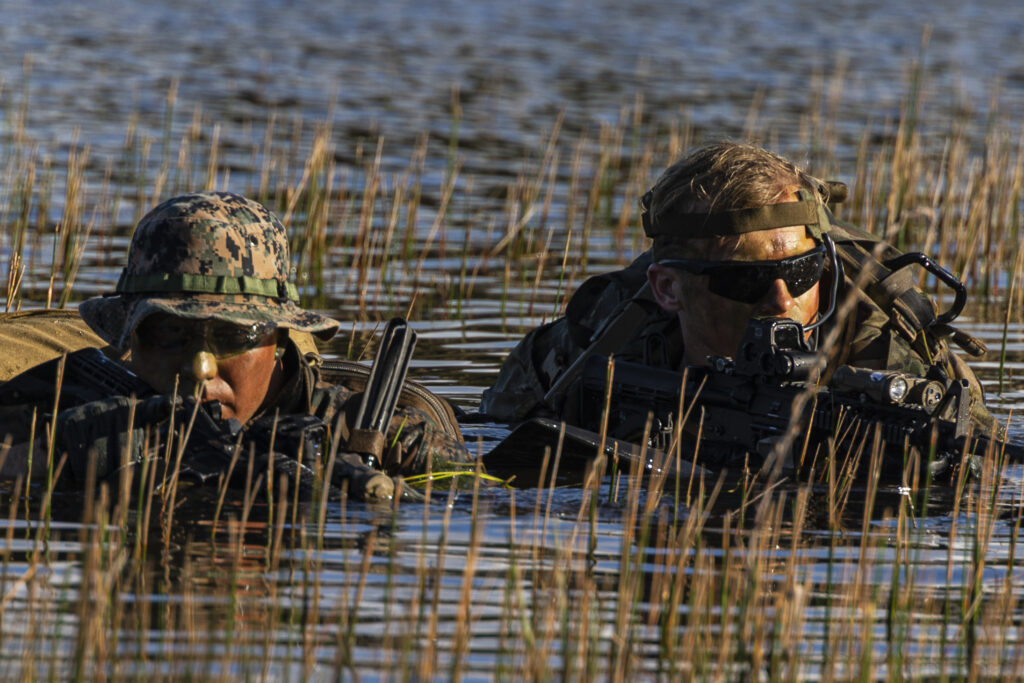
U.S. Marines with the Maritime Raid Force, 31st Marine Expeditionary Unit, tread water during a limited scale raid on Camp Hansen, Okinawa, Japan, Nov. 21, 2022. U.S. MARINE CORPS / Lance Cpl. Manuel Alvarado

WASHINGTON — The commanding general of the U.S. Marine Corps Warfighting Laboratory and Futures Directorate says overseas bases are an underestimated key to deterring competitors from aggression and coercion against friendly nations and allies in the Pacific region. 

The value of strategic basing “deserves more attention in any discussions of deterrence,” Brigadier Gen. Kyle B. Ellison told the U.S. Naval Institute (USNI)’s Defense Forum at the Spy Museum Dec. 6. Overseas bases are “one of the most critical aspects of the deterrence effort, in my opinion,” said Ellison, who is also vice chief of Naval Research in the Office of Naval Research. 

Speakers at the USNI event focused on integrated deterrence, one of three ways cited by the 2022 National Defense Strategy to achieve Defense Department goals that include defending the homeland against the growing multi-domain threat posed by the People’s Republic of China (PRC). Integrated deterrence seeks to bring a whole of government approach across services, government agencies, regions, commands and Ally or partner organizations to thwarting competitors’ aggression.   

The other paths to attaining Defense goals are through campaigning and building enduring advantage. 

“While we modernize our power projection capabilities, we must not lose focus on broadening our stance in the Pacific or hardening our forward installations,” Ellison said. “The value of our overseas bases cannot be overstated and our investment in the resilience of these overseas locations will have a far-reaching impact on our ability deter.” 

Another aspect of integrated deterrence is a stand-in force operating inside a weapons engagement zone, a point that emerged from the Marines’ Force Design 2030 plan. While China has increased the challenges of anti-access/aerial denial over the mainland and created stand-off areas and protective bubbles in the littorals, Ellison said U.S. Allies and partner stand-in forces “will survive in this high threat environment” because they are “nimble, moving often and avoiding enemy intelligence collection efforts.” 

The stand-in force could include, not just Marines, but elements of the Navy, special operations, Allies and partner nations. To support the consistent persistence of the stand-in force, Ellison said the Marines were reducing their sustainment burdens and maximizing maneuverability by “reducing logistics demands across the life cycle of the stand-in forces. This will give them a position of strength and advantage in coordination with Allies and partners.”


Marine Corps Adds Cherry Point Squadron to F-35B Operators

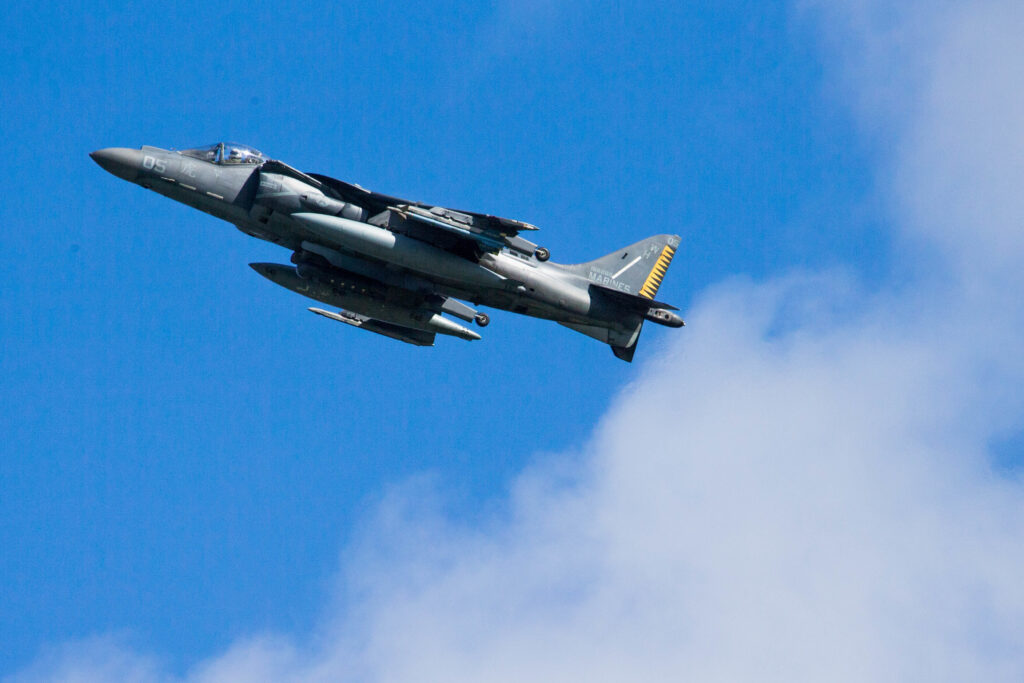
A U.S. Marine Corps AV-8B Harrier assigned to Marine Attack Squadron 542 flies over Bodo, Norway during Fjord Fury, June 6, 2018. U.S. MARINE CORPS / Lance Cpl. Jailine L. Martinez

ARLINGTON, Va. — The Marine Corp is converting another AV-8B Harrier II attack squadron to F-35B Lightning II strike fighters, the first F-3B fleet squadron to be based on the East Coast. 

Marine Attack Squadron 542 (VMA-542) — the Tigers — was re-designated Marine Fighter Attack Squadron 542 (VMFA-542) in ceremonies held at the squadron’s base at Marine Corps Air Station Cherry Point, North Carolina, as it retires its last Harriers in favor of the Lightning II. The squadron is scheduled to be operational with its F-35Bs by next summer. 

VMA-542’s last detachment of Harriers deployed to the Baltic Sea in 2022 on board USS Kearsarge and operated for a period from Estonia in during the Russian invasion of Ukraine. 

With the transition of VMFA-542, the only two AV-8B squadrons, VMA-223 and VMA-231, both based at Cherry Point, will remain flying in the Marine Corps. The last AV-8Bs are scheduled for retirement in fiscal 2027.  

VMA-542 activated in March 1942 during World War as Marine Night Fighter Squadron 542 and flew its F6F-3N Hellcats in combat in the Pacific, including the Battle of Okinawa. In 1948, the squadron was re-designated Marine All-Weather Fighter Squadron 542 and was equipped with F7F-3N/4N Tigercat fighters, which the squadron flew in the Korean War. In 1951, the squadron returned to the United States for transition to the F3D-2 Skyknight jet night fighter. In 1958 the squadron switched to the F4D-1 Skyray fighter.  

In 1963, the squadron was redesignated VMFA-542 as it upgraded to the F-4B Phantom II. From July 15 until January 1970, the Tigers flew combat missions over Southeast Asia during the Vietnam War. The squadron was de-activated on June 30, 1970, but re-activated on Jan. 12, 1972, as the second AV-8A Harrier squadron. In May 1986, the Tigers completed transition to the AV-8B Harrier II. 

With the Harrier II, VMA-542 participated in combat operations such as Operation Desert Shield and Desert Storm in Southwest Asia, Operation Noble Anvil in Kosovo, Operation Iraqi Freedom in Iraq, Operation Enduring Freedom in Afghanistan, Operation Odyssey Dawn in Libya, Operation Odyssey Lightning in Libya, Operation Inherent Resolve in Afghanistan, as well as deployments in support of multiple Marine Expeditionary Units, according to 1st Lt. Hudson Sadler of the 2nd Marine Aircraft Wing.


II MEF Marines Deploy On Board USNS Trenton in the Mediterranean Sea 

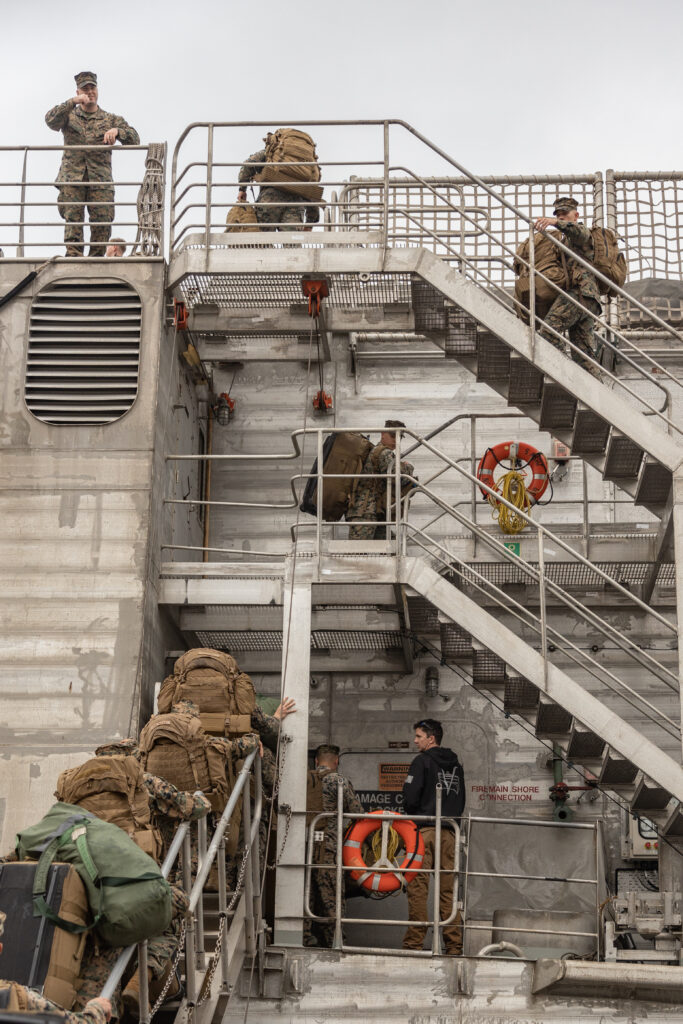
U.S. Marines assigned to II Marine Expeditionary Force board the Spearhead-class expeditionary fast transport USNS Trenton (T-EPF 5) in Koper, Slovenia, Nov. 16, 2022. U.S. MARINE CORPS / Sgt. Scott Jenkins

KOPER, Slovenia — Approximately 50 U.S. Marines from II Marine Expeditionary Force (II MEF), based out of Camp Lejeune, North Carolina, embarked on Military Sealift Command Europe and Africa (MSCEURAF)/Commander Task Force 63 (CTF-63) expeditionary fast transport ship USNS Trenton (T-EPF 5) for a one-month deployment, Nov. 17, said 1st Lt. Jasmine Scott of II MEF. 
 
Their mission exercises II MEF’s ability to rapidly deploy Marines into the European theater aboard an expeditionary fast transport ship. This event is one way II MEF exercises its flexibility and commitment to the European theater, ability to embark on board non-standard platforms, and operate in a maritime environment filled with island chains and choke points. 
 
“This deployment is an example of the many opportunities II MEF Marines have to travel the world, experience different cultures, and train and build camaraderie with fellow service members from our partner nations,” said Maj. Joshua Ramirez. 
 
The majority of the Marine force comes from 8th Engineer Support Battalion, 2d Marine Logistics Group, and 8th Communication Battalion, II MEF Information Group. These two units are deploying combat engineering and communication specialists, respectively. This detachment of Marines will visit several Mediterranean Allies where they will train to improve their unit-level readiness and military-to-military cooperation. 
 
This agile force showcases the dynamic nature of U.S. military presence, while fostering our naval integration and exercise planning capabilities. II MEF deployed forces can scale up in size or composite with other naval, joint or allied forces. 
 
“We are very excited to have the II MEF aboard,” said Trenton’s Officer in Charge Cmdr. Timothy Rustico. “This deployment is a perfect way to demonstrate our ship’s unique transport capabilities and interoperability with the movement of Marines and their equipment.”                    
 
Trenton is on a scheduled deployment in the U.S. Naval Forces Europe-Africa (NAVEUR-NAVAF) area of operations, employed by U.S. Sixth Fleet to defend U.S., allied and partner interests. 


Bell Delivers Marine Corps’ Final AH-1Z Helicopter

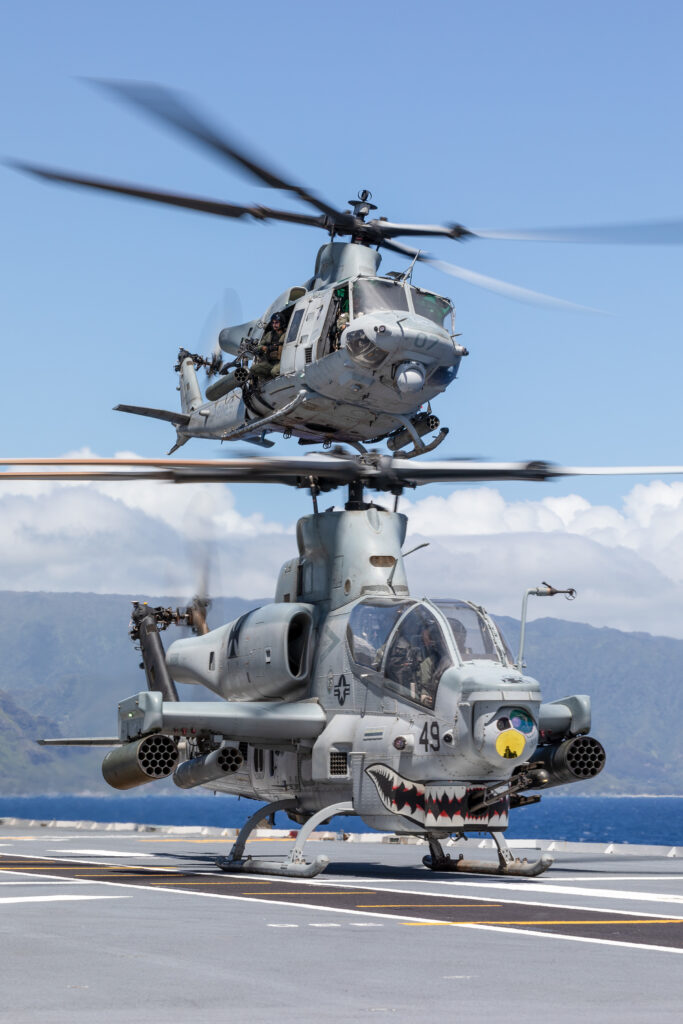
A UH-1Y Venom lifts off from the deck of an amphibious assault ship as an AH-1Z Viper prepares to launch. BELL

AMARILLO, Texas — In a ceremony at the Amarillo Assembly Center, Bell Textron Inc., a Textron Inc. company, celebrated the delivery of the 189th AH-1Z Viper to the U.S. Marine Corps, completing the Program of Record (POR) for the latest version of the storied H-1 platform. Bell completed the UH-1Y POR of 160 aircraft in 2018 bringing the combined Ah-1Z/UH-1Y POR to 349 aircraft.  

“The first production lot of US Marine Corps H-1s was ordered in 1962, and they changed the way Marines fight today,” said Mike Deslatte, Bell H-1 vice president and program director. “Completing the AH-1Z and UH-1Y deliveries to the US Marine Corps adds one more chapter to the legacy of the H-1 platform.” 

Bell has been producing H-1s for the U.S. military since 1959. Bell originally designed the H-1 for the U.S. Army with the iconic “Huey.” In 1966 Bell created the AH-1 Cobra as the first dedicated gunship. In 1970, the Bell UH-1N brought twin engine capabilities to more than 28 countries, and in 1984 the AH-1W provided the U.S. Marine Corps increased attack helicopter capability.  

The current generation AH-1Z Viper and UH-1Y Venom are the most agile, mobile and survivable combination of aircraft used by the Department of Defense. The 85% common platforms are the only two aircraft that share so much commonality, providing the Marines with logistical agility and reduced operating costs. The AH-1Z achieved initial operating capacity in February 2011 and the UH-1Y achieved initial operating capacity in August 2008. The first combined Viper/Venom deployment with a Marine Expeditionary Unit occurred in 2009. 

“H-1s are key to the 2022 Marine Corps Aviation Plan,” said Col. Vasillios Pappas, Light/Attack Helicopters program manager (PMA-276). “With the U.S. program of record now complete, the Marines have the flexibility to manage and deploy the helicopters based on current and future mission requirements as established at the start of the program.” 

The H-1 production line is still active in support of foreign military sales to approved U.S. allies. Bell continues to produce AH-1Z Vipers for the Kingdom of Bahrain and will manufacture eight UH-1Ys and four AH-1Zs for the Czech Republic in 2023. 

Since the first delivery of the AH-1Zs and UH-1Ys to the U.S. Marines, the H-1 mixed fleet has accumulated more than 450,000 flight hours through a full spectrum of military operations. Bell will continue to support the U.S. H-1s with lethality, survivability and reliability upgrades through a long-term modernization plan that helps ensure the aircraft keep an overwhelming tactical advantage for generations. 


Marine Corps Releases ‘Shifting Threats’ Recruiting Advertising Campaign

The U.S. Marine Corps Recruiting Command released its new advertising campaign on YouTube, Oct. 27.

QUANTICO, Virginia — Marine Corps Recruiting Command will release its new advertising campaign, Shifting Threats, via YouTube on Oct. 27. The commercial is scheduled for its television debut, Saturday, Oct. 29, during the Georgia versus Florida college football game. 

This new advertising campaign conveys a single premise: against ever-evolving threats, our nation’s greatest asset is the adaptable skillset of Marines who fight and win. 

Shifting Threats showcases the increasingly complex and chaotic global environment that Marines are currently operating in, characterized by “un” threats: unpredictable, unimaginable, unknown and undeclared.  

“The centerpiece of the Marine Corps isn’t a platform; it’s the individual Marine,” said Lt. Col. Rob Dolan, Director, Marketing and Communication, MCRC. “The concept behind the Shifting Threats campaign is to explain who we are and what we do for the nation while communicating the Marine Corps’ identity to this generation of prospective Marines.” 

On Oct. 27, the Shifting Threats commercial can be viewed at: https://www.youtube.com/user/OurMarines  

Shifting Threats will be amplified through a variety of communication and media platforms to include compelling communication pieces, such as TV/video advertisement (linear and online), digital audio, social media posts and digital assets.  


U.S. Marine Corps successfully tests Rafael’s TAMIR IRON DOME Interceptor

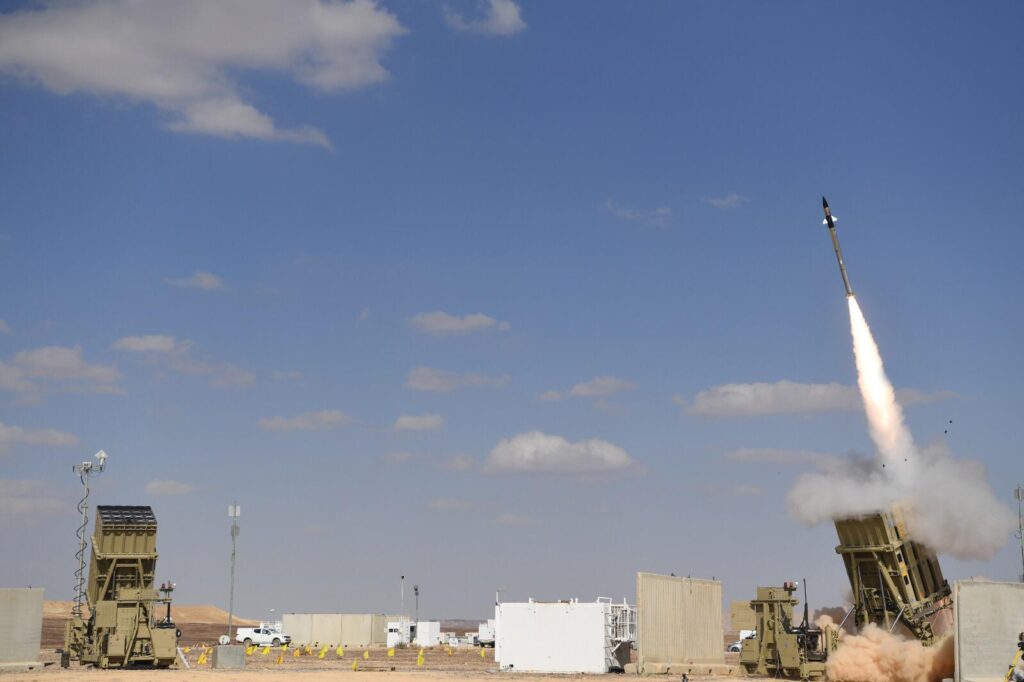
U.S. Marines at the White Sands facility in New Mexico test a new prototype system for Medium Range Intercept Capability using TAMIR IRON DOME interceptors. Spokesperson Department at the Israeli Ministry of Defense

HAIFA, Israel — The U.S. Marine Corps’ latest live fire test of the TAMIR IRON DOME culminates a series of three trials carried out over the past year, and for the third time the system successfully intercepted a wide variety of targets, Rafael said in an Oct. 1 release. In this latest test, the ability to continuously launch TAMIR IRON DOME interceptors from a mobile launcher developed by the Marines was also tested. 

The series of tests were conducted by the Marines at the White Sands facility in New Mexico as part of the development program to test a new prototype system for Medium Range Intercept Capability (MRIC – Medium Range Intercept Capability). 

“The three tests that took place this year proved that the performance of the MRIC system with IRON DOME interceptors is good and provides a dedicated launcher solution for the Marines,” said Don Kelly, project manager in the Air Defense Department (GBAD) of the Marine Corps’ Land Directorate (PEO Land Systems) at the end of the test. 

“Once again, RAFAEL’s systems have proven that they are able to integrate into existing systems and create synergy between systems, providing optimal performance,” said Executive Vice President and Head of the Air and Missile Defense Directorate at RAFAEL Brigadier General (Ret.) Pini Yungman. “RAFAEL’s advanced systems are developed with an “open architecture” allowing seamless integration with other systems.  In the latest test conducted by the Marines, a successful combination of the TAMIR interceptor launched from a new launcher developed under the leadership of the Marines, combined with the Marines’ radar system and the battle management system, which are systems developed by American industries, was demonstrated.” 


T-45 Fleet on Safety Pause 

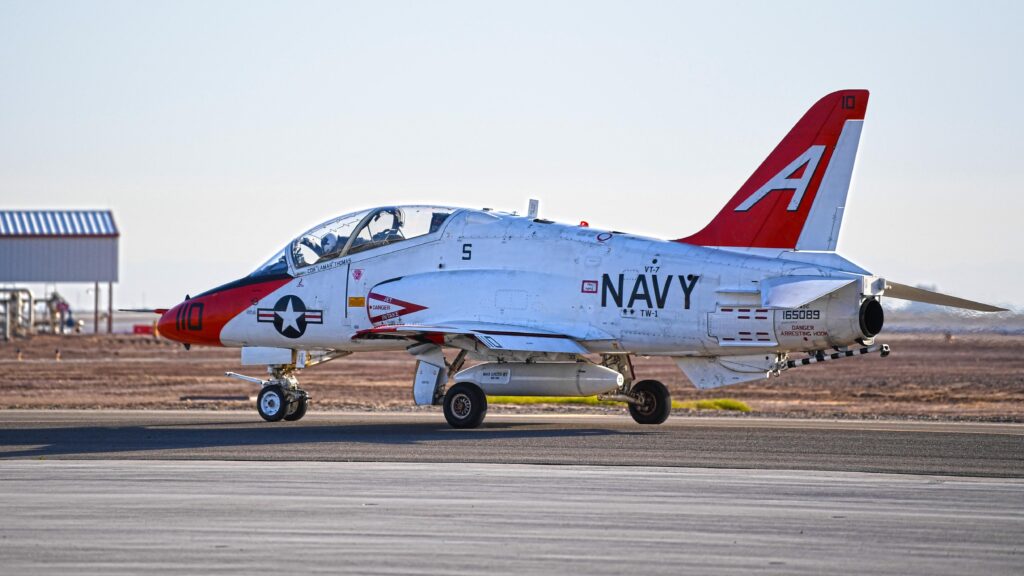
T-45C Goshawk. U.S. NAVY

PATUXENT RIVER, Md. — Chief of Naval Air Training (CNATRA) placed the Navy and Marine Corps’ fleet of T-45Cs on a safety pause Oct. 14 to review an engine blade fault, the Naval Air Systems Command said in an Oct. 18 release. 

“Out of an abundance of caution and concern for the safety of our aviators, CNATRA made the decision to halt all T-45C Goshawk operations following the discovery of an engine blade failure,” said CNATRA Rear Adm. Richard Brophy. “We are working with our partners toward a swift resolution. Safety is at the core of our operations, and we must not expose our pilots or aircraft to unnecessary risk.”   

“The Naval Undergraduate Flight Training Systems Program Office, Naval Air Warfare Center Aircraft Division, Chief of Naval Air Training and Fleet Support Team have been working around the clock with industry partner Rolls Royce to identify the root cause of the recent T-45 engine blade failure,” said Rear Adm. John Lemmon, program executive officer for Tactical Aircraft Programs. “Engineering analysis has been underway and will continue until we can safely return the T-45 fleet to a flying status to support CNATRA’s training.”  


Marine Corps Adjusts Interim Guidance for ACV Waterborne Operations following Training Incident

U.S. Marines assigned to the 3rd Assault Amphibian Battalion, 1st Marine Division, conduct waterborne training with an Amphibious Combat Vehicle (ACV) from shore to loading amphibious transport dock ship USS Anchorage (LPD 23) at Marine Corps Base Camp Pendleton, California, Feb. 12, 2022. U.S. MARINE CORPS / Lance Cpl. Willow Marshall

HEADQUARTERS, U.S. MARINE CORPS — Following a training incident, the Marine Corps has adjusted Amphibious Combat Vehicle (ACV) waterborne operations guidance, ceasing water operations involving surf zone transit to allow for additional testing and evaluation.  

On Oct. 13, 2022, at approximately 7:45 p.m. PST, an Amphibious Combat Vehicle assigned to Assault Amphibian School was conducting normal scheduled training operations when it rolled over in the surf zone after a reported mechanical malfunction near Camp Pendleton, California. Of the three crew members inside the vehicle, none sustained injuries or required medical attention. The incident is currently under investigation.  

“We’re taking a deliberate and methodical approach to fielding this platform,” said Lt. Gen. David H. Furness, deputy commandant for Plans, Policies and Operations. “This adjustment to current guidance ensures our Marines have the ability to safely train and maintain proficiency with the platform while we work to conduct additional testing.”  

Suspension of ACV surf zone transit will remain in effect until additional testing data can be collected and analyzed. In support of this, surf zone operations for Amphibious Vehicle Testing Branch-sponsored testing is authorized. 


Kaman Selected to Build Cargo UAS Prototype for Marine Corps

The Marine Corps’ first two Kaman K-MAX Helicopters arrived at Marine Corps Air Station Yuma, Ariz., Saturday, May 7, 2016. U.S. MARINE CORPS / Pfc. George Melendez

BLOOMFIELD, Conn. — Kaman Air Vehicles, a division of Kaman Corporation, has been selected to build a logistics UAS prototype for the United States Marine Corps, the company said in an Oct. 10 release. Kaman will build a funded military version of its KARGO UAV, a purpose-built autonomous medium-lift logistics vehicle. KARGO UAV carries up to 800 pounds of payload and is designed to operate in austere environments. 

The Marine Corps project is being managed by NAVAIR PMA-263 under the Medium Unmanned Logistics Systems – Air (MULS-A) program. Once the prototype is constructed, KARGO UAV will complete a Field User Capability Assessment conducted in an operationally relevant test environment. 

Kaman began development of its KARGO UAV last year and flew a scaled demonstrator in Fall 2021 to prove out the concept. A full-scale demonstrator is under construction, with first flight scheduled for later this year. Near Earth Autonomy, from Pittsburgh, Pennsylvania, was selected as the autonomy provider on KARGO UAV, and parallel testing is ongoing for the autonomy systems that will be employed on the Marine Corps prototype. 

“We have been tracking the need for expeditionary logistics for some time,” said Carroll Lane, president of Kaman’s Precision Products segment. “And we are thrilled to see our focused R&D efforts to provide an affordable, reliable and maintainable logistics vehicle come into alignment with such an important program as MULS-A.” Lane stressed that KARGO UAV development for the U.S. Marines would remain a priority for the foreseeable future. 

Built with the Marines’ future operating concept in mind, KARGO UAV offers rugged design optimized for expeditionary employment. Compact form-factor of the system fits in a standard CONEX shipping container and is designed to be unloaded and operated by as few as two people.