22nd MEU, Kearsarge ARG Return from Seven-Month Deployment
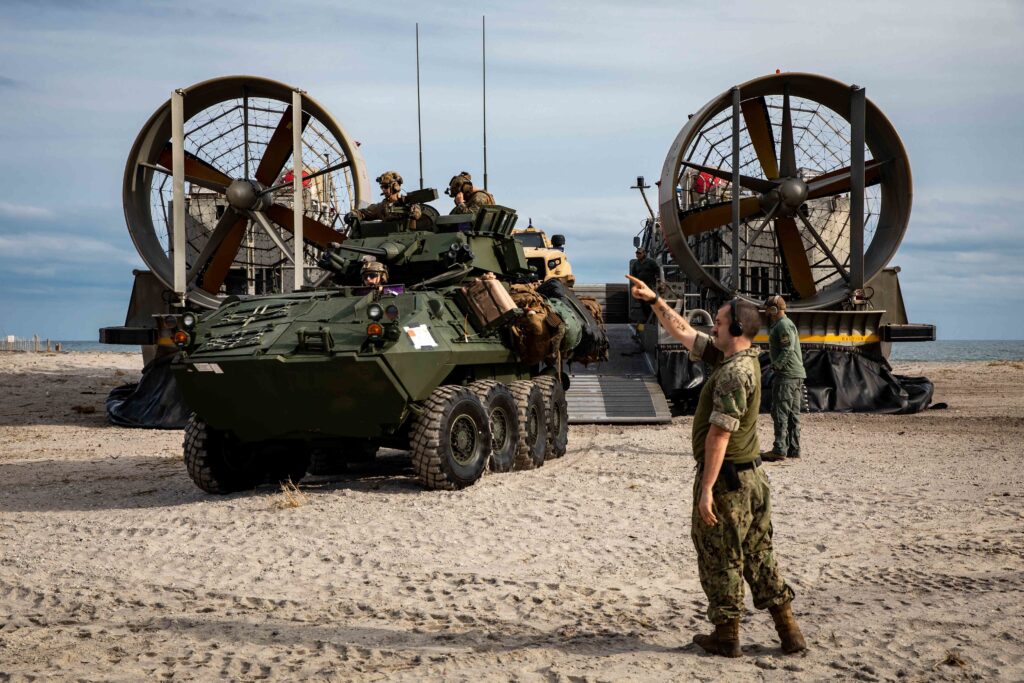
U.S. Navy Construction Mechanic 3rd Class Brandon Baker, assigned to Beach Master Unit (BMU) 2, directs a light armored vehicle, assigned to the 22nd Marine Expeditionary Unit (MEU), off Landing Craft Air Cushion 83, assigned to Assault Craft Unit (ACU) 4, in Morehead City, North Carolina, Oct. 8, 2022. U.S. NAVY / Mass Communication Specialist 1st Class John Bellino

MARINE CORPS BASE CAMP LEJEUNE, N.C. — Sailors and Marines assigned to the 22nd Marine Expeditionary Unit (MEU) returned home to Camp Lejeune, North Carolina, Oct. 9, 2022, after completing a seven-month deployment with the Kearsarge Amphibious Ready Group (ARG) in the U.S. Naval Sixth Fleet area of operations.  The Kearsarge ARG is comprised of the Wasp-class amphibious assault ship USS Kearsarge (LHD 3), the San Antonio-class amphibious transport dock ship USS Arlington (LPD 24) and the Whidbey Island-class dock landing ship USS Gunston Hall (LSD 44). 

The deployment marked the first time an ARG/MEU maintained a six-month presence in the Baltic region in over 20 years. More than 4,000 Marines and Sailors supported a wide range of interoperability training and exercises in 15 countries within U.S. Sixth Fleet; covering the High North/North Atlantic, Central Mediterranean, and Baltic regions promoting stability, increasing interoperability, sustaining combat readiness, and crisis response capabilities while strengthening relationships with both NATO Allies and partners.   

“Our time in the Baltics and the High North was particularly valuable,” said Col. Paul C. Merida, commanding officer, 22nd Marine Expeditionary Unit. “I think all of us in the 22nd MEU came away extremely impressed with the level of military professionalism that our friends in the region possess and the level of enthusiasm for real, integrated defense cooperation was profound wherever we visited. I believe future east coast MEUs will find the High North and the Baltics not only a challenging training environment but a region full of very capable friends and allies.” 

Exercises in the Arctic Region included Northern Viking 2022, a multinational amphibious and maritime exercise alongside Allied nations from France, Germany, Iceland, Norway and the United Kingdom; and a two-week bilateral exercise in northern Norway and the Norwegian Sea, exercising integrated cold weather and live- fire training with the Norwegian Armed Forces.  

In the Central Mediterranean, Marines and Sailors assigned to USS Arlington participated in bilateral exercises such as Alexander the Great 22, a bilateral U.S.-Greece (Hellenic) amphibious training event; EFES 22, a biennial, multinational, combined, joint and live firing exercise with Turkish Armed Forces and U.S. Army’s Explosive Ordnance Disposal (EOD) and medical teams; as well as African Lion 22, an exercise enhancing the U.S. African Command’s partnership and security cooperation with the Tunisian Ministry of Defense.  

While operating in the Baltic region, Kearsarge and Gunston Hall participated in an Estonian-led exercise, Hedgehog (Siil) 22 with Estonian Defense Forces and forces from Task Group 61/2.4 and the NATO-led exercise Neptune Shield. All of these exercises incorporated 18 NATO Allies and partners working together through multiple domains throughout the European continent and waters. In June, Kearsarge and Gunston Hall participated in the joint, annual multinational exercise, Baltic Operations (BALTOPS 22) designed to enhance interoperability, capability and demonstrate cohesion among Allied and partner forces in defending the Baltic Sea region.   

Following BALTOPS22 and AL22, the Kearsarge ARG-MEU conducted scheduled maintenance availability periods in Brest, France, Rijeka, Croatia, and  Copenhagen, Denmark throughout July 2022. The maintenance availability periods, which included mid-deployment voyage repair (MDVR) evolutions, allowed U.S. Navy ships to accomplish necessary and preventative repairs to continue their missions in the region while simultaneously strengthening relationships with host nations.   

Once MDVRs were successfully completed, the Kearsarge ARG-MEU team returned to the Baltic region as a combined force to continue strengthening relationships and partnerships. Through rapid planning, coordination, and execution, the ARG-MEU team successfully completed bilateral training events with Finland, Sweden, and Standing NATO Maritime Group ONE (SNMG 1) during the months of August and September.  

Upon conclusion of operations in the Baltic region, the ARG-MEU successfully completed a cumulative of 29 port visits across the ARG visiting 14 NATO Allied and partner countries including Reykjavik, Iceland; Narvik and Tromsø, Norway; Volos and Alexandropoulos, Greece; Tallinn, Estonia; Helsinki, Finland; Stockholm and Visby, Sweden; Gabés, Tunisia; Kiel, Germany; Brest, France; Rijeka, Croatia; Copenhagen and Kalundborg, Denmark; Riga, Latvia; Klaipeda, Lithuania; and Gdańsk and Gdynia, Poland. During each visit, the ARG-MEU engaged with representatives from embassies, ministries of defense, and local government, military and civilian officials to strengthen relationships with NATO Allies and partners through in-person key leader engagements and exchanges including media availabilities, ship tours, office calls, ceremonies and receptions, and community service projects.  

“After a busy seven-month deployment it’s good to get the 22d MEU team back home to Lejeune,” Col. Paul Merida said. “We believe this was the first East Coast MEU deployment in a long while that was spent entirely in the 6th Fleet area of operations and the Marines did a tremendous job operating from above the Arctic Circle, to the Baltics, to the Mediterranean Sea. All of this was done with the backdrop of the Russia-Ukraine War, which added an additional sense of importance to our work; much of which was done alongside our NATO Allies and other key regional partners. Our families and friends should be proud of the service their Marines rendered and I believe the 22nd MEU has represented II Marine Expeditionary Force and the U.S. Marine Corps accordingly.”       

The 22nd MEU’s mission is to provide the United States with a forward-deployed, amphibious force-in-readiness capable of executing missions across the full spectrum of combat and military operations and consists of four elements – a command element, a ground combat element, Battalion Landing Team (BLT) 2/6, a logistics combat element, Combat Logistics Battalion (CLB) 26, and an aviation combat element, Marine Medium Tiltrotor Squadron (VMM) 263 Reinforced.  

The ARG-MEU’s presence overseas in U.S. Sixth Fleet area of operations supported strategic interests and contributed to regional security and stability and reassured the United States commitment to the High North, Mediterranean, and Baltic regions. The blue-green team provided operational flexibility to combatant commanders by providing a versatile contingency response force using sea, air, land and logistical assets. The versatility inherent to the amphibious force allowed for flexible and mission-tailored forces, while representing our nation’s strength, capability and resolve to partners and allies and deterring potential adversaries. 
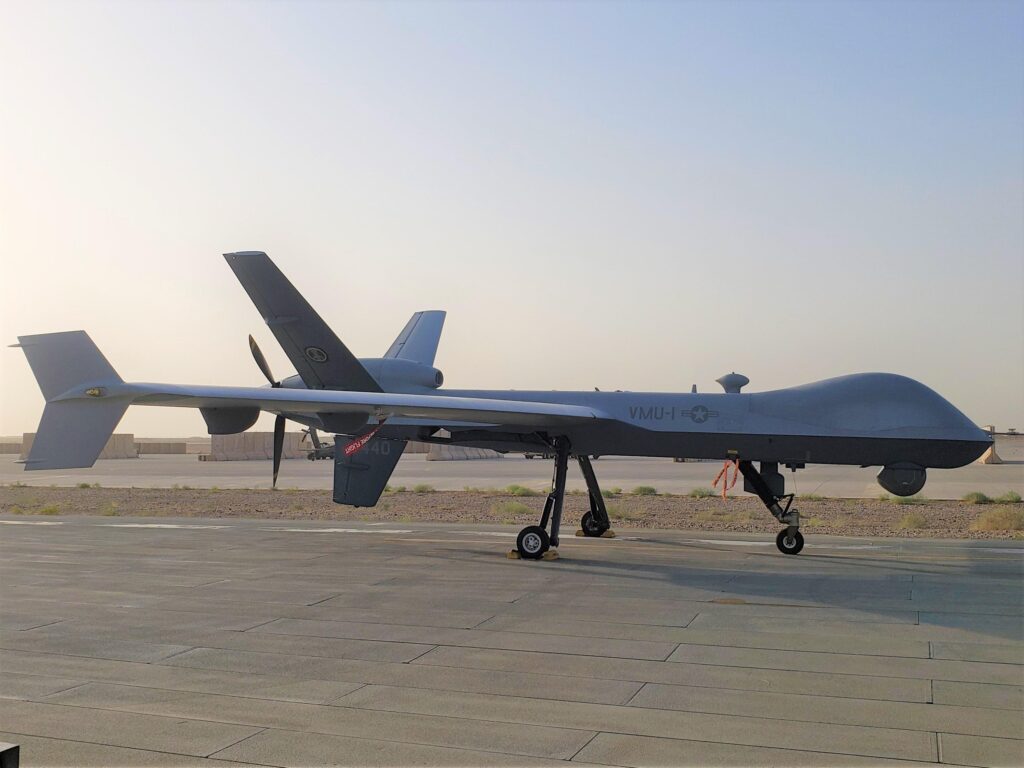


Navy Fast-Tracks Contract for MQ-9 Reaper Advanced Network Pod 

The MQ-9 Reaper provides Marines with a long-range intelligence, surveillance, and reconnaissance capability in support of expeditionary advanced based operations, littoral operations in contested environments, and maritime domain awareness. U.S. MARINE CORPS

PATUXENT RIVER, Md. — The Navy recently awarded an $8.4 million dollar contract to multiple vendors for the Marine Corps’ MQ-9 Reaper Airborne Network Extension Skytower II (STII), the Naval Air Systems said Oct. 3. 

Industry partners Global Air Logistics and Training, Northrop Grumman and L-3Harris will perform work to develop the first phase of STII, a network pod that will add an additional capability to support the MQ-9 Reaper’s operational missions. 

The Multi-Mission Tactical Unmanned Air System program office (PMA-266) awarded the contract under an Other Transaction Agreement/Authority, a contract vehicle used by the government to streamline research and development and prototype development. 

“This OTA allowed the contracts team to tailor the scope of the project and narrow down vendor capabilities by releasing a Statement of Need early on,” said Michelle Dutko, PMA-266’s STII team lead. “The OTA also provided the opportunity for the team to develop the statement of work with vendor input therefore streamlining the normal processing time to contract award.” 

After the first phase of research and development is complete, the Navy and Marine Corps plan to prototype demo on surrogate aircraft and then prototype the system on an MQ-9A aircraft, Dutko said. 

STII is required to execute the intelligence, surveillance, and reconnaissance concept of operations by providing tactically relevant operational communications and data sharing capabilities at the tactical edge. It supports interoperability with existing STI capabilities to include multiple waveforms.  

The Airborne Network Extension will have provisions to complement a collection of onboard sensors and off-board systems, and facilitate the retransmission, cross-banding and translation of data across gateway-connected networks. It will also enhance battlespace awareness and information sharing capabilities amongst the integrated Naval and Joint Force, connecting disparate networks and enabling the execution of mission-critical information exchange requirements. 

The MQ-9 Reaper provides Marines with a long-range ISR capability in support of maritime domain awareness and expeditionary advanced based operations in contested environments. MQ-9s are scheduled to deploy with this new system in 2026. 


Marine Corps ACVs Ok’d for Open-Ocean Waterborne Operations

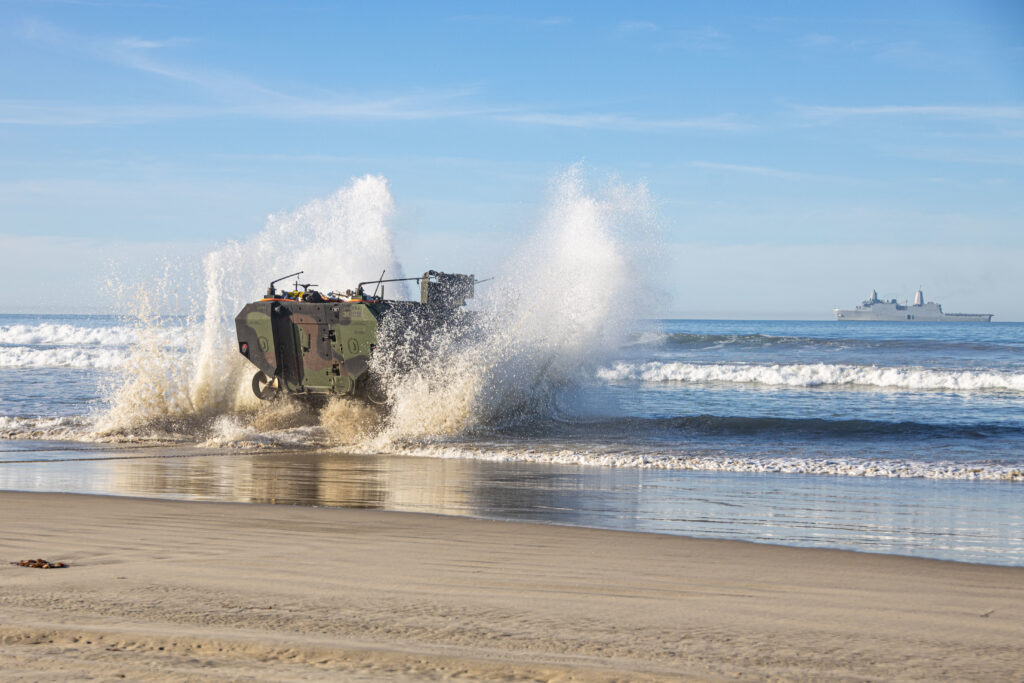
U.S. Marines assigned to the 3rd Assault Amphibian Battalion, 1st Marine Division, conduct waterborne training with an Amphibious Combat Vehicle from shore to loading amphibious transport dock ship USS Anchorage (LPD 23) at Marine Corps Base Camp Pendleton, California, Feb. 12. U.S. MARINE CORPS / Lance Cpl. Willow Marshall

ARLINGTON, Va. — Marine Corps Amphibious Combat Vehicles are authorized to return to open-ocean waterborne operations following the establishment of interim guidance to enhance operational safety when conducting ACV training, Headquarters Marine Corps said Sept. 22.

On July 20, the Marine Corps paused all waterborne ACV operations as a result of a training incident at Marine Corps Base Camp Pendleton, California, two days prior. The service immediately began an internal review to ensure the assault amphibian community’s practices and procedures maintain a capable and ready force without sacrificing the safety of Marines and Sailors.

On July 22, Headquarters Marine Corps authorized ACV water operations in protected waters only, Area 21 and the Del Mar Boat Basin, to sustain crew proficiency and meet entry-level training requirements, but open-ocean and surf restrictions remained until Sept. 22.

“We remain steadfast to the safety of our Marines who conduct amphibious operations, and expect strict adherence to established standards that allows our ACVs to return to waterborne operations,” said Lt. Gen. David J. Furness, deputy commandant for Plans, Policies and Operations. “Our training and discipline allows us to continue sharpening our warfighting abilities to remain the Nation’s premier expeditionary force in readiness.”

The interim maximum surf conditions identified include a significant breaker height of four feet, which allows the ACV to operate safely while maintaining a high-state of readiness for the ACV community. The interim maximum surf conditions are conservative and derive from existing safe operating surf conditions for U.S. Navy and Marine Corps landing craft, and allows the service to better understand surf conditions through ongoing vehicle testing.

Prior to the implementation of the interim guidance, ACV operations remained restricted to protected waters and land operations, to include live-fire training.


Commandant: Long-Range USV Will Be Primarily an ISR Platform That Launches Unmanned Assets

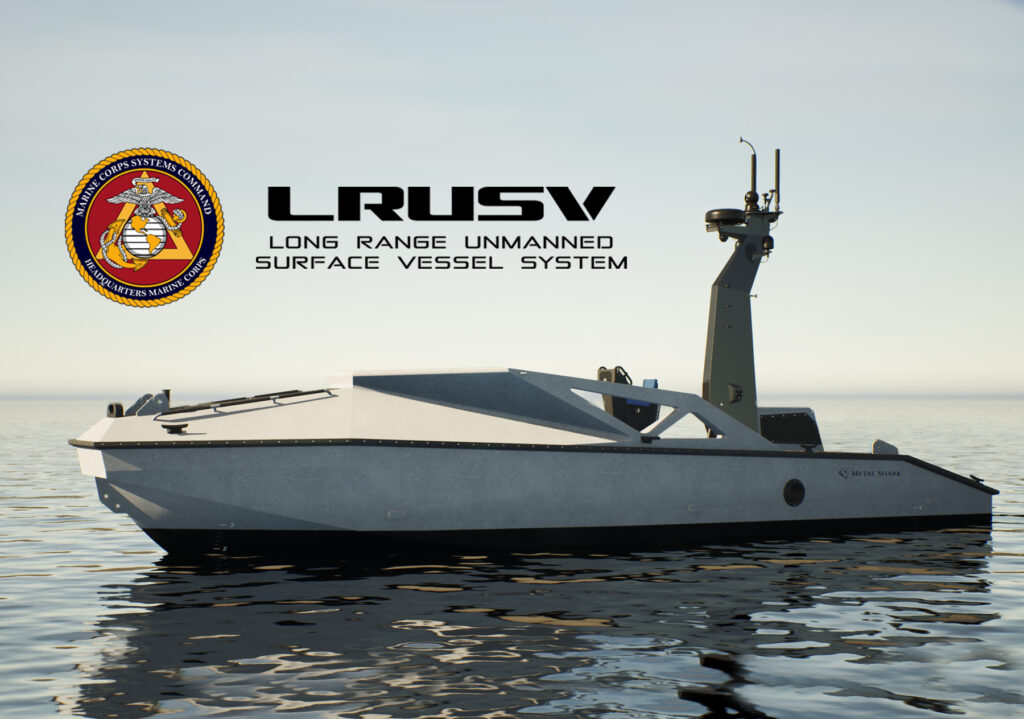
The Long-Range Unmanned Surface Vessel, being developed for the U.S. Marine Corps. METAL SHARK

ARLINGTON, Va. — The Long-Range Unmanned Surface Vessel (LRUSV) under development will primarily serve as an intelligence, surveillance, and reconnaissance platform for the U.S. Marine Corps once it is fielded, Marine Corps Commandant Gen. David H. Berger said Thursday during a virtual event hosted by Defense One.

Berger said the Marines are keenly interested in the distance the platform can cover, as well as its ability to launch other unmanned assets.

“What does it allow us to do that we can’t do right now? One is range across the surface of the water,” he said. “The second is we’re going to use it primarily not as a kinetic platform, but as an unmanned vessel that can launch unmanned collection systems. Now you’re really doubling the reach of where you can collect, where you can inform yourself about what’s happening in front of you.”

He added that the platform can be used on the electromagnetic spectrum to deny adversaries from collecting information against U.S. Navy assets.

“So the long-range unmanned surface vessel, primarily for us we’re looking at it as an ISR platform on the surface of the water that allows us to stretch out, to see what’s in front of us at much greater depth,” Berger said, “and then launch unmanned platforms in the air or on the surface or subsurface even farther. If we had to do that by humans right now, it would be manned vessels, manned aerial platforms, limited by range and the fatigue level, the endurance level, of a human being.

“This allows us to generate a whole lot of tempo and keep a shield, keep a screen out in front of us much more persistently,” he said.

The platform is currently located in the Norfolk, Virginia, area and will soon be transported to Hawaii, Berger said.

Although the LRUSV may be focused on ISR missions, the vessel is likely to get some lethal capabilities as well. Multiple reports indicate the Marines plan to acquire loitering munitions that can be launched from autonomous boats like the LRUSV.


Marine Corps to Gain Three More CH-53K Helicopter Flight Simulators

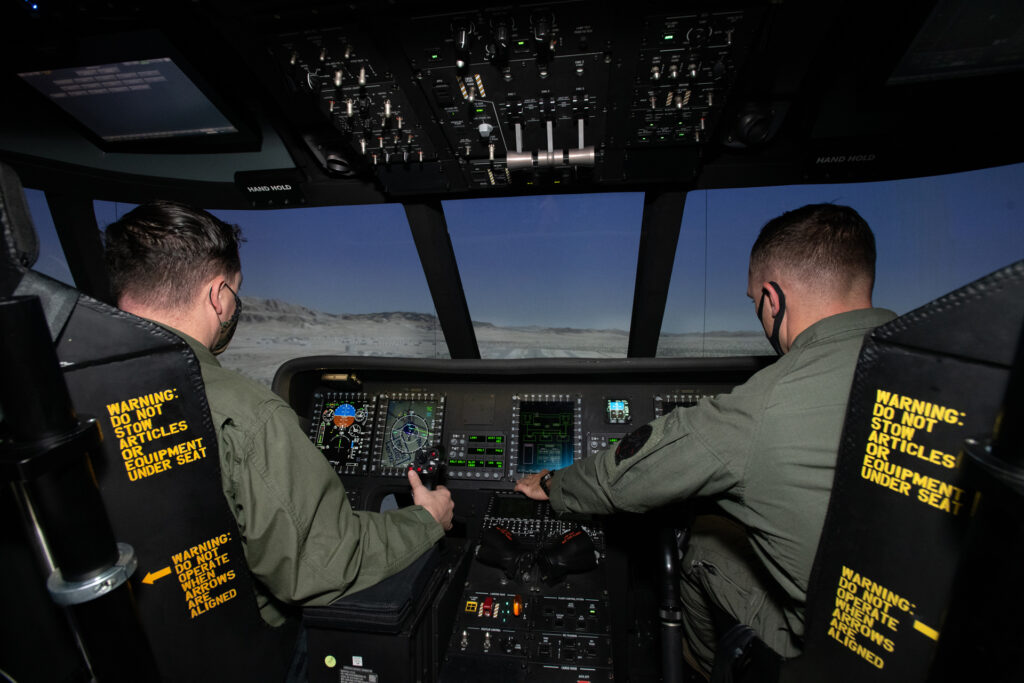
Marine Corps aviators in the CH-53K Containerized Flight Training Device (CFTD) experience a highly immersive virtual environment allowing flight crews to train on the full scope of Marine Corps heavy lift missions, including external lift operations. U.S. MARINE CORPS

ORLANDO, Fla. — The United States Marine Corps will gain additional training opportunities preparing them to operate the Sikorsky CH-53K heavy lift helicopter, Lockheed Martin said in an Aug. 16 release. The aircraft is the most modern and powerful helicopter in Department of Defense inventory capable of moving troops and equipment from ship to shore, and to higher altitude terrain, more quickly and effectively than ever before. 

Lockheed Martin will provide an additional Containerized Flight Training Device (CFTD) to the U.S. Navy with options for three more under the terms of a recent contract award. This follows up on the success of the first training device delivered in 2020 to Marine Corps Air Station (MCAS) New River in Jacksonville, North Carolina. 

“Marine pilots have smoothly transitioned from the training device to the actual CH-53K’s fly-by-wire cockpit and completed missions in the fleet environment – such as air-to-air refueling” said Flash Kinloch, Lockheed Martin, vice president of Training and Simulation Solutions. “Training in this highly immersive virtual environment permits flight crews to train the full scope of tasks that can be performed on the aircraft in a safe, cost effective and realistic manner.” 

Flight crews will train on the full scope of Marine Corps heavy lift missions, including external lift operations, using the full-mission flight simulator that also replicates the various environmental conditions in which the aircraft is likely to fly. Through this new effort, Lockheed Martin is helping the Marine Corps expand proven and critical CH-53K Flight Training with training capability to more Marines. 

The training devices include a full cockpit for the aircraft operated by a pilot and co-pilot, an instructor operating station as well as a brief/debrief room. The newest training devices will include upgrades that improve system performance, increase cost savings, and more closely align to the CH-53K aircraft for increased training realism. 

The Marine Corps achieved Initial Operational Capability (IOC) for the CH-53K in April following a successful test period that resulted in over 3,000 mishap free hours flown in challenging environments and terrain. 

The CH-53K CFTD provided the capability to train mission scenarios which were then completed during Initial Operational Test & Evaluation (IOT&E). They include: 

  • Day and night air-to-air refueling 
  • Air-to-air refueling with 27,000 lb. external load 
  • Sea trials with over 350 landings 
  • Operation in Degraded Visual Environments


Navy Contracts MQ-9 Reapers for Marine Corps, Extending Range for Future Operations

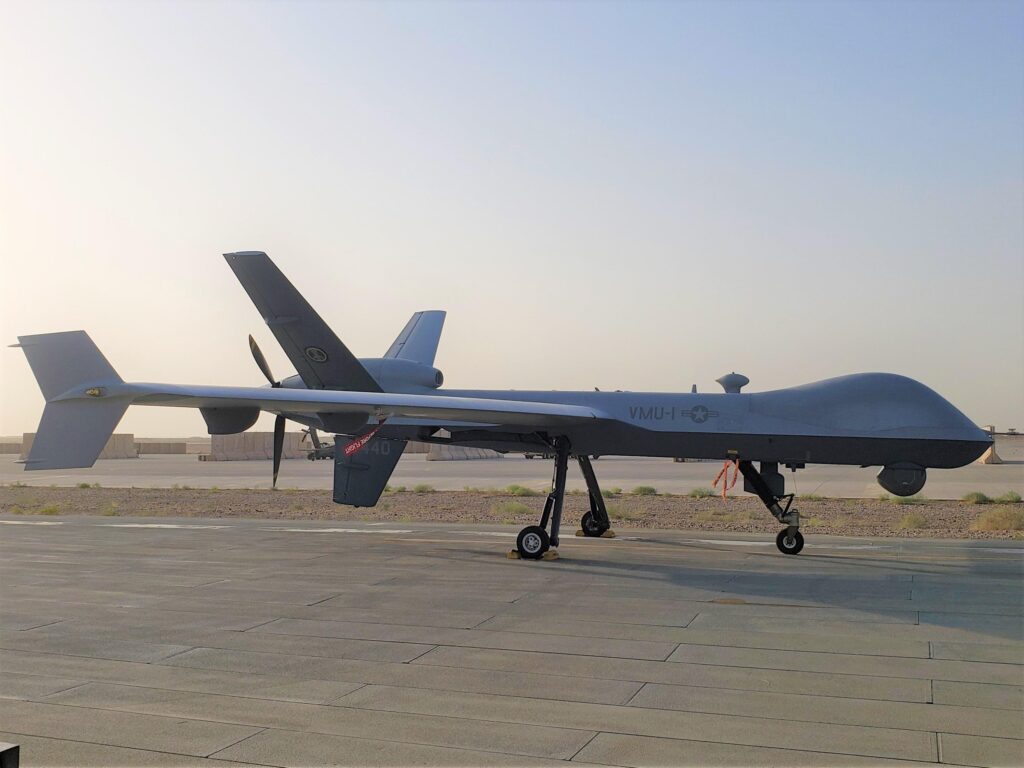
The MQ-9 Reaper provides Marines with a long-range intelligence, surveillance and reconnaissance capability in support of expeditionary advanced based operations, littoral operations in contested environments, and maritime domain awareness. U.S. MARINE CORPS

PATUXENT RIVER, Md. — The U.S. Navy recently awarded a $135.8 million contract to General Atomics Aeronautical Systems Inc. (GA-ASI) for eight MQ-9A Extended Range (ER) Unmanned Aircraft Systems that are scheduled for delivery to the Marine Corps in late 2023, the Naval Air Systems Command said in a release. 

MQ-9A ER will provide a large scale, long-range intelligence, surveillance and reconnaissance capability for the Marine Expeditionary Force. It is designed to extend the aircraft’s endurance to more than 30 hours and equipped with triple redundant avionics architecture. 

As part of the Marine Corps Force Design 2030 efforts, the Marines plan to transition Unmanned Aerial Vehicle Squadron (VMU) 3 located at Kaneohe Bay, Hawaii to MQ-9A operations.  VMU-3 will utilize the MQ-9A ERs to support training for the Marine Littoral Regiment. 

The Multi-Mission Tactical UAS program office (PMA-266), who manages the Marines MQ-9 program, used the Air Force’s Agile Reaper Enterprise Solution (ARES) to award the contract. ARES is a five-year fixed indefinite delivery/indefinite quantity (ID/IQ) contract. 

“Our team has ensured the development and fielding of a new combat capability, critical for the Marine Corps Force Design (FD) 2030 vision, at an exceptional speed,” said Capt. Dennis Monagle, PMA-266 program manager. 

Since the program’s inception in 2018, PMA-266 has leveraged Air Force investments and contracting solutions to procure MQ-9, ultimately accelerating the fielding time.  By tailoring and streamlining the typical acquisition strategy, the MQ-9 program commenced post-Milestone C, eliminating three to five years of traditional acquisition efforts. 

“We closely aligned with the USAF MQ-9 System Program Office (SPO), National Guard Bureau, Marine Corps stakeholders, as well as our vendor teams in order to develop and integrate as quickly as possible,” Monagle said. 

The first two MQ-9 aircraft were delivered in 2019 to Marine Unmanned Air Vehicle Squadron (VMU) 1 and since then have flown over 15,000 operational flight hours. The program continues to develop new, unique payloads and capabilities to meet future requirements for Force Design 2030. These payloads include the Detect and Avoid System (DAAS), a Proliferated Low Earth Orbit (PLEO) satellite system, an airborne network extension payload (Sky Tower), and an electronic warfare payload. 

The MQ-9A and associated payloads will provide the Marines with organic network extension and intelligence, surveillance, reconnaissance, and targeting (ISR-T) in support of expeditionary advanced based operations, littoral operations in contested environments, and maritime domain awareness. 


Marine Corps Awards BAE Systems $88 million Contract for ACV-30 Test Vehicles

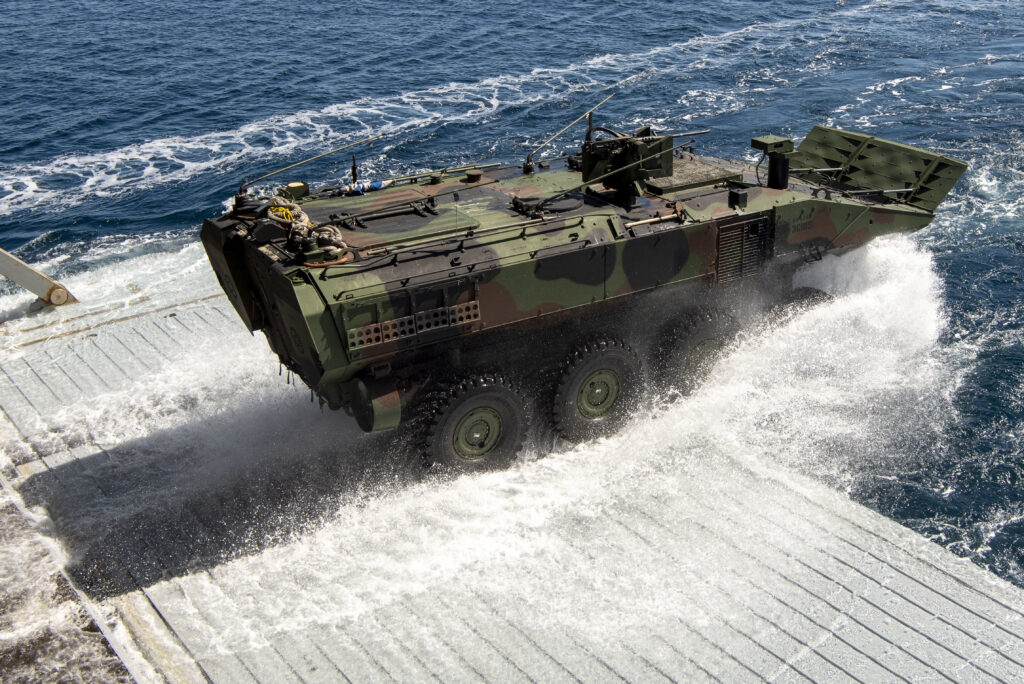
An Amphibious Combat Vehicle (ACV) with the 3rd Assault Amphibian Battalion, 1st Marine Division disembarks the well deck of the amphibious transport dock USS Anchorage (LPD 23) during waterborne training. Anchorage is underway conducting routine operations in U.S. 3rd Fleet. U.S. NAVY / Mass Communication Specialist 2nd Class Hector Carrera

STAFFORD, Va. — The U.S. Marine Corps has awarded BAE Systems an $88 million contract to build multiple ACV-30 Production-Representative Test Vehicles (PRTVs), BAE Systems said in an Aug. 15 release. Once delivered, the PRTVs will undergo a period of testing prior to a full-rate production decision. 

The ACV-30 mounts a stabilized, medium caliber Remote Turret System manufactured by KONGSBERG. The 30mm RT-20 is a remotely controlled and operated weapons system that enhances crew protection. The remote turret eliminates the space requirement of legacy lethality systems. It provides more space to transport troops or mission essential equipment, and reduces weight for better mobility. 

“We are committed to equipping the Marine Corps with the best technology available to provide them with a decisive edge,” said John Swift, vice president of amphibious programs at BAE Systems. “We have carefully chosen proven industry partners who are equally committed to ensuring Marines have the capabilities to dominate on the battlefield.” 

The ACV represents the optimum balance of sea/land mobility and survivability, with future growth potential. The ACV was born out of a combination of BAE Systems’ amphibious vehicles legacy and Iveco Defence Vehicles’ long history of producing more than 30,000 multi-purpose armored vehicles. 

“The unmanned KONGSBERG RT-20 medium caliber turret is designed to meet the current and future needs of the Marine Corps as they move forward in implementing the future operating vision known as Force Design 2030,” said Scott Burk, president of KONGSBERG Protech Systems USA. “The fielding of this vehicle system provides the Marines with a low risk, and operationally proven solution.” 

The ACV-30 is one of four variants in the ACV Family of Vehicles. BAE Systems is under contract for a personnel variant (ACV-P), a command variant (ACV-C), and a recovery variant (ACV-R). 

In addition, BAE Systems has received task instructions from the U.S. Marine Corps to complete a study of incorporating a Command, Control, Communication and Computers/Unmanned Aerial Systems mission payload into an Amphibious Combat Vehicle (ACV) variant. 

ACV production and support is taking place at BAE Systems locations in: Stafford, Virginia; San Jose, California; Sterling Heights, Michigan; Aiken, South Carolina; and York, Pennsylvania. 


Marine Corps’ G/ATOR Demonstrates Advanced Fire-Control Radar Capability 

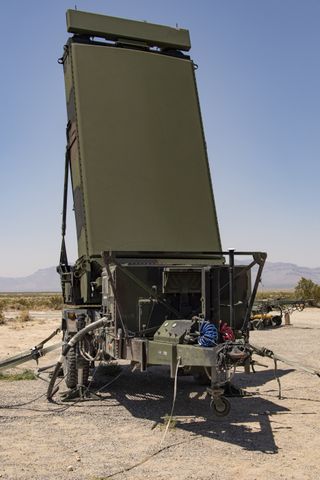
G/ATOR supporting a series of live-fire tests in White Sands Missile Range, New Mexico. Northrop Grumman

BALTIMORE — Northrop Grumman Corporation’s AN/TPS-80 Ground/Air Task Oriented Radar (G/ATOR) multifunction sensor successfully detected and tracked multiple cruise missile threats simultaneously during a recent live-fire test at White Sands Missile Range, New Mexico, the company said in an Aug. 15 release. G/ATOR successfully tracked each target immediately after launch and passed relevant information in real time to intercept numerous cruise missile targets from multiple angles. 

The tests were part of the U.S. Marine Corps’ mid-tier acquisition rapid prototyping effort, known as the Ground Based Air Defense Medium-Range Intercept Capability (GBAD MRIC), a developmental program established to protect high-value areas and assets from airborne threats such as cruise missiles and aircraft. 

“During this test event, the AN/TPS-80 demonstrated a combination of performance capabilities during a realistic representation of an adversary attack,” said Michael Hahn, director, advanced land radar solutions, Northrop Grumman. “G/ATOR is an expeditionary radar and is unrivaled in its ability to simultaneously provide weapons quality tracks on numerous, concurrent airborne targets while maintaining 360-degree surveillance coverage. The software-defined nature of the AN/TPS-80 was critical in rapidly developing and demonstrating this advanced capability in support of challenging threat scenarios to support the Marine Corps.” 

The rapid emplacement and displacement of the AN/TPS-80 means troops can quickly stand up this mission capability in the field, perform the mission, and rapidly move assets to avoid vulnerability of enemy targeting. Unlike traditional sensors, multifunction systems like G/ATOR consolidate multiple capabilities into a single sensor, decreasing the size, weight and power requirements. G/ATOR is one piece of the solution providing the joint forces with an operational picture and deep breadth of data to operate in today’s contested environment, in support of the Marine Corps’ Force Design 2030 strategy. 

The GBAD MRIC program, led by the Marine Corps, integrates existing systems — specifically, G/ATOR and the Common Aviation Command and Control System (CAC2S) — with components of the Israeli Iron Dome System including the Tamir interceptor to provide integrated surveillance and coverage. 


Marines Commemorate 80th Anniversary of the Battle of Guadalcanal 

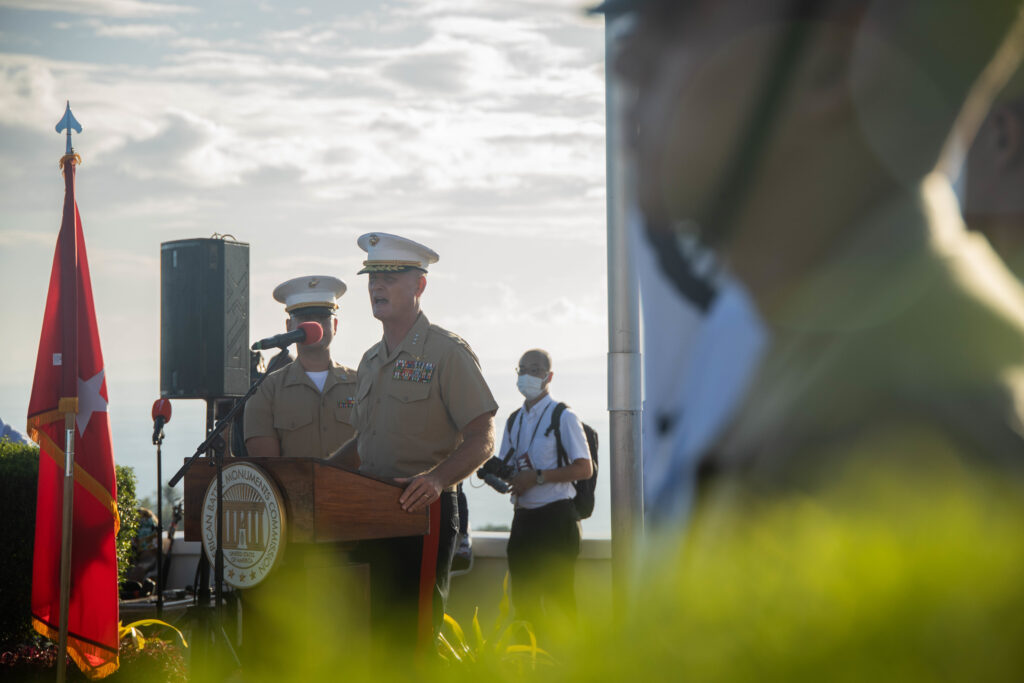
U.S. Marine Corps Lt. Gen. Steven R. Rudder, commander, U.S. Marine Corps Forces, Pacific, makes remarks during the anniversary of the Battle of Guadalcanal at the Guadalcanal American Memorial in the Solomon Islands, Aug. 7, 2022. The ceremony commemorated the 80th anniversary of the battle, and served to honor the fallen and strengthen the U.S. relationship with the Solomon Islands and other Pacific allies and partners. The historic battle was codenamed Operation Watchtower and was the first major offensive and decisive victory for the allied forces in the Pacific theater. U.S. Marine Corps / Cpl. Dillon L. Buck

CAMP H. M. SMITH, Hawaii — Gen. Steven Rudder, commander, U.S. Marine Corps Forces, Pacific (MARFORPAC), traveled to Honiara, Solomon Islands, as part of a U.S. interagency delegation led by Deputy Secretary of State Wendy Sherman from Aug. 7-9, said Chuck Little, of U.S. Marine Corps Forces, Pacific, in a release. The delegation, which also included U.S. Ambassador to Australia Caroline Kennedy and other senior U.S. military officers, participated in several events commemorating the 80th anniversary of the Battle of Guadalcanal, and further strengthened long-standing partnerships between the United States and the nations in attendance: Solomon Islands, Japan, Australia, and New Zealand. 
 
Rudder was joined on the trip by other senior U.S. military officers, including fellow Marines Lt. Gen. Stephen Sklenka, deputy commander, U.S. Indo-Pacific Command; Lt. Gen. George Smith, commanding general, I Marine Expeditionary Force; and Maj. Gen. Benjamin Watson, commanding general, 1st Marine Division. The delegation included U.S. military officers from units that also heroically fought during the battle: Vice Admiral Andrew Tiongson, commander, U.S. Coast Guard Pacific Area; Rear Adm. Jeffrey J. Kilian, commander, Naval Facilities Engineering Systems Command Pacific/director, Fleet Civil Engineer, U.S. Pacific Fleet, U.S. Navy; and Maj. Gen. Joseph Ryan, commanding general, 25th Infantry Division, U.S. Army. 

On Sunday, Aug. 7, the United States hosted a memorial ceremony on Skyline Ridge, the site of the World War II Guadalcanal American Memorial. The hour-long ceremony, which started at 7 a.m., was largely planned and executed by MARFORPAC Marines. The ceremony was the first time a joint service color guard marched on Guadalcanal, carrying the national ensign and flags from each of the 
military services that fought in the battle: the U.S. Marine Corps, U.S. Army, U.S. Navy, and U.S. Coast Guard. A quintet from the 1st Marine Division provided music for the event. 

In his remarks, Rudder highlighted the important impact of the battle. 
 
“So we’re here to remember those sacrifices that were made; it changed the history of the Solomon Islands, and it changed the history of our nation,” Rudder said. “I do not want to pass up the opportunity to show my dear appreciation for the Solomon Islanders. They were instrumental in everything we did and they endured hardships that we can’t imagine.” 
 
“But it makes no sense to remember those sacrifices without looking to the future; and we pledge from Indo-PACOM and the United States Marine Corps, that we will look forward.” 
 
Other speakers at the ceremony included American Battle Monuments Commissioner Mr. Bud Pettigrew and Deputy Secretary of State Mrs. Wendy Sherman. 
 
Sherman, whose Marine father fought and was wounded on Guadalcanal, spoke of the impact of the battle on both the military and Solomon Islanders. “With the benefit of hindsight, it is easy for us gathered here today to recognize the Battle of Guadalcanal as a turning point in the Pacific theater, and indeed in the Second World War. But for the Marines patrolling the dense and humid jungle, who had to be wary of both enemy snipers and crippling disease; for the sailors who fought terrifying night battles in the seas around these islands; for the airmen who engaged in countless dogfights in the skies above, the future was unknown and unknowable. And in many of those places – like here in Solomon Islands – civilians saw their world upended as well, as bombs and mortars fell on their towns and villages, destroying the lives of innocents.” 
 
During the ceremony, Sklenka and Rudder placed a wreath at the base of the monument on behalf of all U.S. service members. 
 
Immediately following the U.S. ceremony, the Solomon Scouts and Coast Watchers (SSCW) Trust hosted a memorial event at the SSCW monument. At this ceremony, during which Ambassador Kennedy spoke, MARFORPAC provided a color guard at the request of the event organizers. Sklenka and Rudder laid a wreath at this ceremony on behalf of all U.S. service members. 

Following the SSCW ceremony, the U.S. delegation traveled to the Point Cruz Yacht Club to attend a ceremony hosted by the U.S. Coast Guard, honoring Medal of Honor recipient Douglas Albert Munro. Afterward, the U.S. delegation traveled to the Japanese War Memorial Peace Park for a ceremony hosted by the Government of Japan. At both ceremonies, Sklenka and Rudder laid a wreath on behalf of all U.S. service members. 

On Monday, Aug. 8, the U.S. delegation attended the fifth and final ceremony, which was hosted by the government of Solomon Islands. The event took place at the Bloody Ridge National Peace Park, which was named after an important battle fought by U.S. Marines in September 1942. 
 
Throughout the seven-month battle for the island, American forces fought side-by-side with Allies from the Solomon Islands, Australia, Britain, New Zealand, the Kingdom of Tonga, and Fiji. The bravery, determination, and commitment of the Allied forces was critical to ensuring the strategic victory that marked a turning point of the war in the Pacific. 
 
In her remarks at the Skyline Ridge ceremony, Deputy Secretary of State Sherman reflected on what came out of the battle for Guadalcanal 80 year ago. “Today – as we have been every day since the war ended – former combatants are united here as partners in peace. We have built schools and clinics together, conducted scientific research together, shared vaccines to combat the pandemic together. We have helped each other recover from natural disasters, protected each other from the impacts of climate change. We have celebrated and mourned and grown together. And above all – forged in the experience of the Second World War and made deeper with each passing year – we have built profound and enduring ties with each other, as one Pacific family.” 


Gen. Langley Assumes Command of U.S. Africa Command

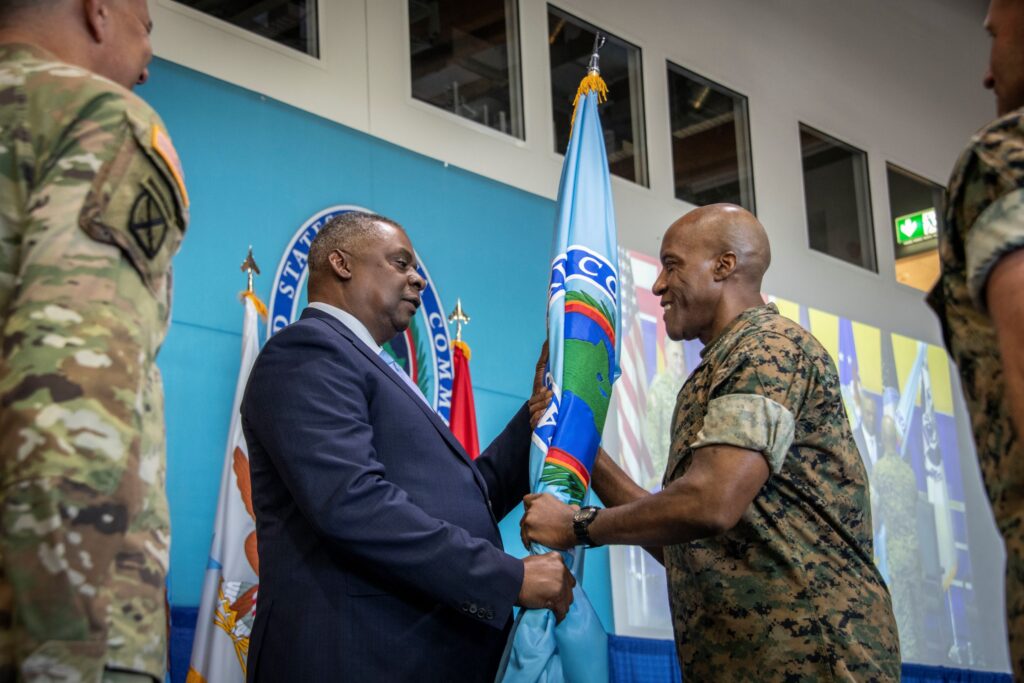
Secretary of Defense Lloyd Austin passes the U.S. Africa Command guidon to Gen. Michael Langley, incoming commander, U.S. Africa Command, during a change of command ceremony in Stuttgart, Germany, on Aug. 9. U.S. AFRICOM / Staff Sgt. Flor Gonzalez

STUTTGART, Germany — U.S. Marine Corps Gen. Michael E. Langley assumed command of U.S. Africa Command in a ceremony at Kelley Barracks, Stuttgart, Germany, Aug. 9, the command said in a release.

“It is truly an honor to stand before you as the new AFRICOM commander,” Langley said at the ceremony. “I look forward to taking on the mantle of leading these talented professionals here at AFRICOM and across our components as we work shoulder-to-shoulder with our allies and partners to advance peace and prosperity for both Africa and the American homeland.”

Langley becomes the sixth U.S. Africa Command commander since the command was established in 2008.

A graduate of the University of Texas at Arlington, Langley was commissioned in 1985 and initially served as an artillery officer. As a general officer, he served as the deputy commanding general for II Marine Expeditionary Force; commanding general for 2d Marine Expeditionary Brigade; commander for Marine Forces Europe and Africa; deputy commanding general for Fleet Marine Force Atlantic; and deputy commander for Marine Forces Command and Marine Forces Northern Command.

Secretary of Defense Lloyd J. Austin III presided over the ceremony, with nearly 400 guests from around the world in attendance.

During his remarks, Austin thanked outgoing commander, U.S. Army Gen. Stephen Townsend, for his dedicated leadership over the past three years as he highlighted the critical work the command is doing in Africa.

“The continent is on the front lines of many of this century’s most pressing threats — from mass migration to food insecurity, from COVID-19 to the climate crisis, from the drumbeat of autocracy to the dangers of terrorism,” he said.

Core to U.S. Africa Command’s mission is to work with allies and partners in a whole-of-government approach where defense supports diplomatic and development efforts to address shared security threats.

“Every day, AFRICOM works alongside our friends as full partners — to strengthen our bonds, to tackle common threats, and to advance a shared vision of an Africa whose people are safe, prosperous, and free to choose their own future,” said Austin.

In other remarks, Chairman of the Joint Chiefs of Staff, U.S. Army Gen. Mark A. Milley, thanked Townsend for his selfless service throughout his career.

“The whole joint force and this nation are proud of your service and thanks you. You have served in peacetime and in combat and through it all you have led with humility, honor, and credibility,” said Milley.

Milley also spoke highly of the incoming commander. Langley “is the right leader at the right time with the right skillset to lead this critical command. He has the unique blend of character, competence, courage, experiences, and knowledge to lead AFRICOM in this challenging time.”

Townsend, who led U.S. Africa Command since July 2019, retires after a U.S. Army career spanning four decades. “The last three years have been an education and Africa is endlessly fascinating. The continent is big, complex, and diverse. America cannot afford to ignore Africa. America’s future security, and I believe prosperity, depends on a more secure and prosperous Africa,” he said.

U.S. Africa Command is one of seven U.S. Department of Defense geographic combatant commands. The command is responsible for all U.S. military operations, exercises, security cooperation, and conducts crisis response on the African continent in order to advance U.S. interests and promote regional security, stability, and prosperity.