Second Iwakuni-Based F-35B Squadron Achieves Full Operational Capability
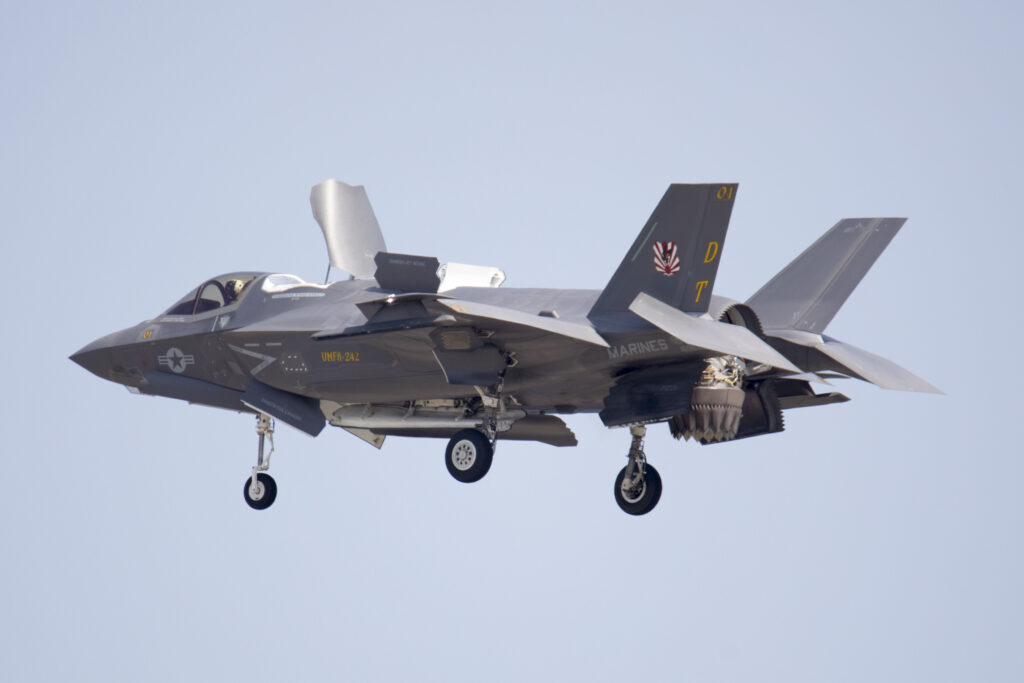
A U.S. Marine Corps F-35B Lightning II aircraft with Marine Fighter Attack Squadron (VMFA) 242 lands at Marine Corps Air Station Iwakuni, Japan, in 2021 during a joint training evolution with Marine Corps, Navy and Air Force assets. U.S. MARINE CORPS / Lance Cpl. Tyler Harmon
IWAKUNI, YAMAGUCHI, Japan — On May 17, Marine Fighter Attack Squadron 242 achieved full operational capability and is now ready to support the full complement of its missions, 1st Marine Aircraft Wing said May 19.
A significant part of this milestone is the establishment of 32 F-35B aircraft permanently forward-based as part of Marine Aircraft Group 12, ready to support a free and open Indo-Pacific. This transition occurred on schedule per the annual Marine Corps’ aviation plan.
The F-35 Lightning II represents the future of Marine Corps tactical aviation and will eventually replace the AV-8B Harrier II and the F/A-18 Hornet in all units across the Marine Corps. On Oct. 16, 2020, VMFA-242, known as the “Bats,” was re-designated as an F-35B squadron and, on Sept. 9, 2021, the squadron attained initial operational capability.
“The FOC milestone is the culmination of well over two years of planning and execution, all while being forward-deployed and in the face of a global pandemic. In my 20-plus years of service, I have never seen a unit come together in a way that our Marines and Sailors have while overcoming many challenges,” said Lt. Col. Michael D. Wyrsch, the commanding officer of VMFA-242. “I am incredibly proud to say that I was a member of this team and I look forward to seeing where the Bats’ lasting culture of excellence will take them.”
MAG-12 received the first forward-based F-35B squadron in January 2017 when VMFA-121 relocated to MCAS Iwakuni. With the addition of VMFA-242, MAG-12 is now the only forward-based unit in the Indo-Pacific with two permanently based F-35B squadrons.
“VMFA-242 has executed a masterful training plan and successfully accomplished the required elements necessary to declare FOC. This declaration provides added capability and capacity, enhances our posture, and ensures that we are able to effectively respond to any tasking,” said Maj. Gen. Brian W. Cavanaugh, the commanding general of 1st Marine Aircraft Wing.
Marine Corps to Neck Down Operational Support Aircraft Types; Increase Indo-Pacific Capabilities
UC-12W U.S. MARINE CORPS
ARLINGTON, Va.—The Marine Corps plans to neck down the number of types of operational support aircraft (OSAs) over the next decade in order to achieve economies with reduced operating costs while increasing capability. The Corps also plans to increase its OSA capabilities in the Indo-Pacific region.
“OSA directly provides an economical and efficient alternative for the movement of personnel and cargo by reducing the burden that small payloads place on large tactical aircraft,” the recently released 2022 Marine Corps Aviation Plan said. “Moving high volumes of small payloads to widely dispersed Marine air-ground task force (MAGTF) elements poses logistical challenges for Marine Corps aviation; OSA relieves this burden. Marine Corps OSA units perform the same airlift missions whether deployed or at their home stations. Unpredictable, short notice movements are not compatible with the United States Transportation Command’s and United States Air Force’s airlift missions or commercial route structures. This flexibility is vital to MAGTF logistics, communications and security in all phases of deployment.”
The Marine Corps operates 27 OSAs and keeps two of those deployed to support Marine Forces Europe/Africa and Marine Forces Central Command. The Corps plans to replace four UC-12F, two UC-12M, and 10 UC-35D aircraft a total of 28 UC-12Ws including eight already on strength. The current program of record for UC-12Ws is 12 aircraft.
“The cost of sustaining UC-35s is increasing and the USMC is looking to replace the UC-35 fleet with UC-12W,” the aviation plan said. “This will require an increase to the program of record of UC-12Ws to 28. Divestment of UC-35s will be based on the procurement and delivery of the UC-12Ws.”
The Marine Corps operates one transport squadron, VMR-1, which flew two C-9B Skytrain II aircraft from Joint Base Andrews-NAF Washington, Maryland, until 2017, when the squadron moved to Naval Air Station-Joint Reserve Base Fort Worth, Texas, to provide crews to share C-40A Clipper transports with Navy Fleet Logistics Support Squadron 59. VMR-1 is receiving two C-40As of its own this fiscal year. The squadron will move to Marine Corps Air Station Kaneohe Bay, Hawaii, by fiscal 2024 to replace the two C-20G Gulfstream IV transports there that support the Indo-Pacific Command.
SECDEF Announces Marine Corps General Nomination
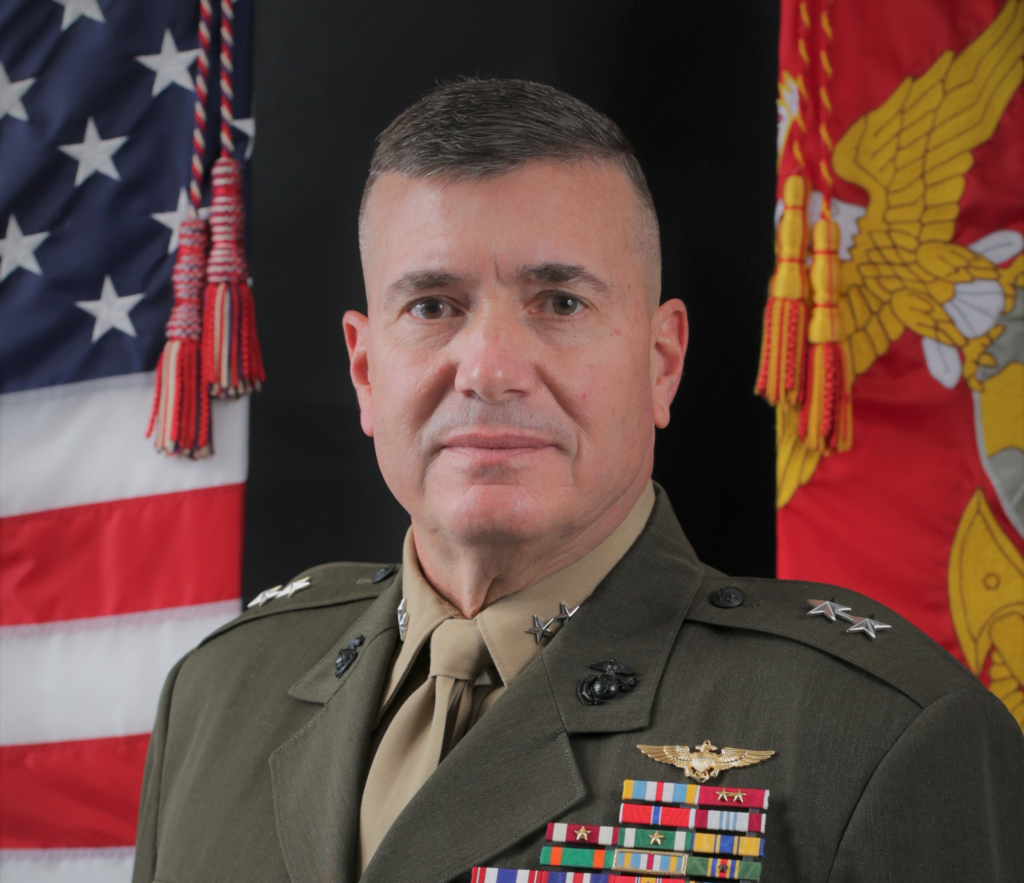
Maj. Gen. Michael S. Cederholm. U.S. MARINE CORPS
ARLINGTON, Va . — Secretary of Defense Lloyd J. Austin III announced May 16 that the president has made the following nomination:
Marine Corps Maj. Gen. Michael S. Cederholm for appointment to the grade of lieutenant general, with assignment as deputy commandant, aviation, Headquarters, U.S. Marine Corps, Washington, D.C. Cederholm is currently serving as commanding general, 2d Marine Aircraft Wing, Cherry Point, North Carolina.
USS Frank E. Petersen Jr. Commissioned in Charleston
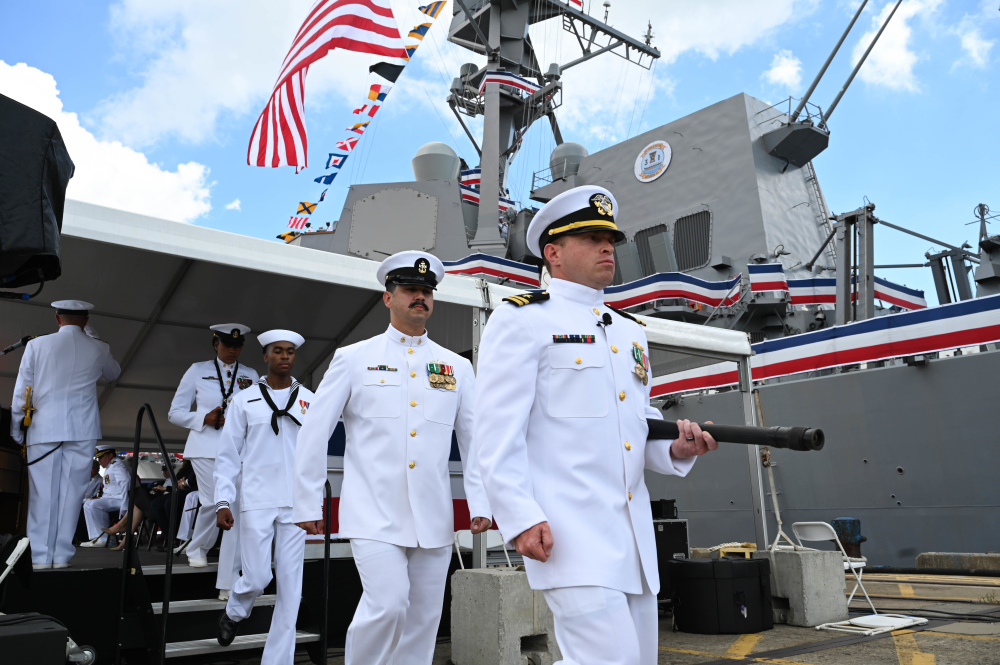
USS Frank E. Petersen Jr. is named after the first black U.S. Marine Corps aviator and the first black Marine to become a three-star general. U.S. NAVY
CHARLESTON, S.C. — The Navy commissioned its newest Arleigh Burke-class destroyer USS Frank E. Petersen Jr. (DDG 121), May 14 in Charleston, South Carolina, said a Navy spokesperson in a May 14 release.
Secretary of the Navy Carlos Del Toro attended the ceremony. He began by thanking the Petersen family for their lifetime of service to the nation. “All of us join you in honoring Lt. Gen. Frank E. Petersen Jr.”
Del Toro also recognized the plankowners bringing the ship to life. “As Secretary of the Navy I contribute all that I can to make sure that you and your families are equipped for the many challenges that lie ahead. That starts with making sure that you have the very best ship that our nation has to offer.”
The principal speaker was Carlos Campbell, naval aviator and former assistant secretary of Commerce for Economic Development, who served alongside Petersen and relayed stories exemplifying the general’s strength and dedication. Recalling Petersen’s ethic, Campbell said, “He received a frag wound, he was treated in the field, and returned to combat.”
Chief of Naval Operations Adm. Mike Gilday also attended the ceremony. “It’s fitting that a name synonymous with service and sacrifice be emblazoned on the steel of this American warship,” said Gilday. “Sailors aboard this mighty warship will deploy wherever, whenever needed, with General Petersen’s fighting spirit and tenacity, for generations to come.”
Gen. David Berger, commandant of the Marine Corps, also attended the ceremony. “General Petersen was a man of many firsts,” said Berger. “There’s a saying that ships take on the characteristics of their namesakes, and if that’s true, then God help any adversary to ever confronts the Frank E. Petersen Jr.”
Gayle Petersen, Lt. Gen. Petersen’s daughter, expressed thanks on behalf of her family and made a special recognition. “We would not be having this ceremony today if not for a gentleman named Robert Adams. When my dad was shot down in Vietnam he was rescued by Robert Adams.” Gayle continued, “I would like to thank all who had a hand in building this ship, from stem to stern.”
Guest speakers for the event included Rep. Nancy Mace, R-South Carolina; John Tecklenberg, mayor of Charleston, South Carolina; and George Nungesser, vice president of Program Management, Ingalls Shipbuilding.
The ship’s sponsors are D’Arcy Ann Neller, wife of former commandant of the Marine Corps, Gen. Robert Neller, and the late Dr. Alicia J. Petersen, Lt. Gen. Petersen’s wife at the time of his passing in 2015. Dr. Petersen passed away in September 2021. Both sponsors participated in the keel laying, mast stepping and christening ceremonies.
D’Arcy Ann Neller thanked the families. “Our service members can’t do what they do without you and your love and support. To the officers and crew: A ship without a crew is like a body without blood. You will all make this ship come alive.”
During the ceremony, USS Frank E. Petersen’s commanding officer Cmdr. Daniel Hancock reported the ship ready. Assisted by Lt. Gen. Petersen’s daughters, Gayle Petersen, Dana Petersen Moore, Lindsay Pulliam and Monique Petersen, Neller gave the traditional order to “Man our ship and bring her to life!”
Lt. Gen. Petersen continues a family legacy of service begun by his great grandfather. Private Archibald (Archie) Charles McKinney enlisted in 1863 and served in the Massachussetts 55th Regiment, Company E during the Civil War. McKinney’s trip home included traveling aboard a steamship, disembarking at the Port of Charleston.
The future USS Frank E. Petersen, Jr. honors Lt. Gen. Frank E. Petersen, Jr. Petersen was the first black U.S. Marine Corps aviator and the first black Marine to become a three-star general. Petersen served two combat tours, Korea in 1953 and Vietnam in 1968. He flew more than 350 combat missions and had more than 4,000 hours in various fighter and attack aircraft. Petersen passed away in Aug. 2015 at the age of 83.
Retiring in 1988 after 38 years of service, Petersen’s awards included the Defense Superior Service Medal, Legion of Merit with Combat “V,” Distinguished Flying Cross; Purple Heart, Meritorious Service Medal, Air Medal, Navy Commendation Medal with Combat “V;” and the Air Force Commendation Medal.
Arleigh Burke-class destroyers are the backbone of the U.S. Navy’s surface fleet. These highly capable, multi-mission ships conduct a variety of operations, from peacetime presence to national security providing a wide range of warfighting capabilities in multi-threat air, surface and subsurface.
SECDEF Announces Flag and General Officer Nominations
ARLINGTON, Va. — Secretary of Defense Lloyd J. Austin III announced on May 11 that the president has made the following nominations:
Marine Corps Maj. Gen. Brian W. Cavanaugh for appointment to the grade of lieutenant general, with assignment as commander, U.S. Marine Corps Forces Command; commanding general, Fleet Marine Force Atlantic; and commander, Marine Corps Forces North, Norfolk, Virginia. Cavanaugh is currently serving as commanding general, 1st Marine Aircraft Wing, Okinawa, Japan.
Navy Rear Adm. Michael E. Boyle for appointment to the grade of vice admiral, and assignment as commander, Third Fleet, San Diego, California. Boyle is currently serving as director, Maritime Operations, U.S. Pacific Fleet, Pearl Harbor, Hawaii.
Navy Rear Adm. Frank M. Bradley for appointment to the grade of vice admiral, and assignment as commander, Joint Special Operations Command; and commander, Joint Special Operations Command Forward, U.S. Special Operations Command, Ft. Bragg, North Carolina. Bradley is currently serving as commander, Special Operations Command Central, MacDill Air Force Base, Florida.
Navy Rear Adm. Richard A. Correll for appointment to the grade of vice admiral, and assignment deputy commander, U.S. Strategic Command, Offutt Air Force Base, Nebraska. Correll is currently serving as director, Strategic Integration, N2/N6T, Office of the Chief of Naval Operations, Washington, D.C.
Navy Capt. Aaron C. Rugh for appointment to the grade of rear admiral (lower half), and assignment as chief prosecutor for military commissions. Rugh is currently serving as division director, Criminal Law Division, Office of the Navy Judge Advocate General, Washington, D.C.
Saab Awarded Contract for Carl-Gustaf Recoilless Rifles for Army, Marine Corps
Carl-Gustaf M4 in artic environment with AFCD from SENOP. Saab
STOCKHOLM — The U.S. Army MAAWS Program Office has awarded Saab a contract for Carl-Gustaf M4 recoilless rifles for the Army and Marine Corps. The Carl-Gustaf rifles are also known as Multi-purpose Anti-Armor Anti-personnel Weapon System (MAAWS) and M3A1 in the U.S. Army. The order will include deliveries of weapons for both the Army and the US Marine Corps. The contract has a total value of USD 16 million and is awarded under a current ID/IQ agreement.
Saab will provide Carl-Gustaf recoilless rifles to continue supporting the ongoing fielding effort in both the Army and the Marine Corps.
“At Saab, we are always striving to support the Infantry with light-weight solutions that make their jobs easier. This order will make Soldiers and Marines more agile thanks to the reduced weight and increased capability compared to the previous version currently in operational use. Additionally, this order will increase interoperability across services, alliances, and partnerships, with so many already fielding the Carl-Gustaf M4,” said Erik Smith, president and CEO of Saab in the United States.
Carl-Gustaf M4 increases tactical flexibility, enabling soldiers to deal with any situation. Built to satisfy future requirements, it is compatible with advanced fire control devices and prepared for specialized ammunition, putting advanced technology at forces’ fingertips. The wide range of ammunition provides extreme tactical flexibility ready for any combat situation, delivering faster engagement, increased hit probability and greater effectiveness.
The Carl-Gustaf system of lightweight weapons, now in its fourth generation. It is in use in more than 40 different countries, including many NATO allies.
Marine Infantry to Become More Commando-Like
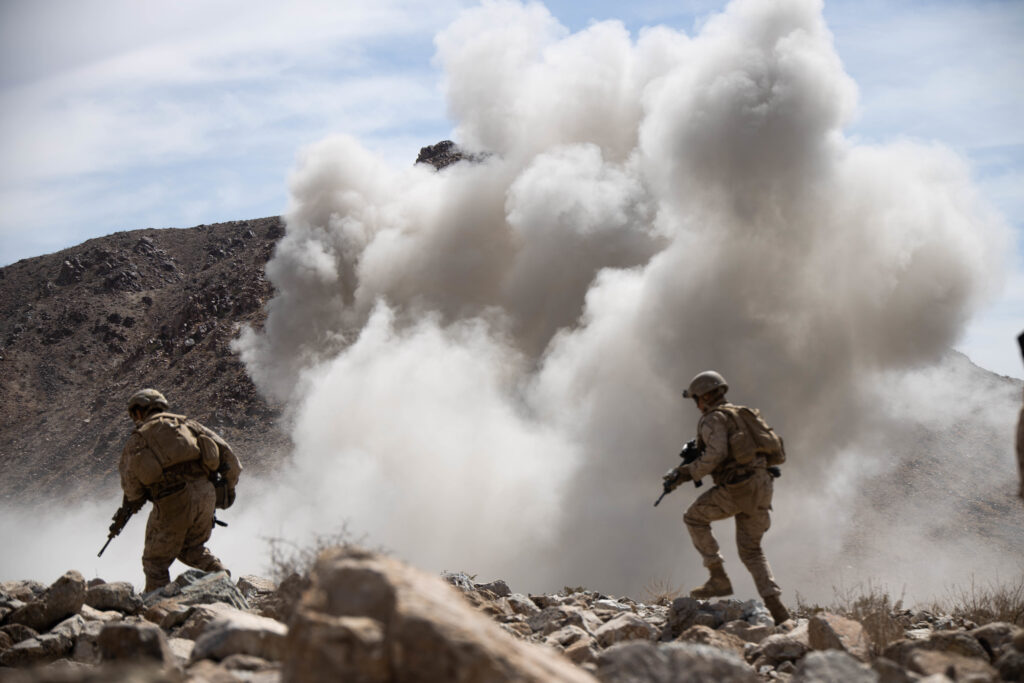
U.S. Marines with India Company, 3d Battalion, 1st Marine Regiment, 1st Marine Division, breach the objective while conducting Range 400 as a part of Integrated Training Exercise (ITX) 3-22 at Marine Corps Air Ground Combat Center Twentynine Palms, Calif., April 10, 2022. ITX is a month-long training evolution comprised of multiple ranges to refine combined arms maneuver in offensive and defensive combat operations. U.S. MARINE CORPS / Lance Cpl. Brayden Daniel
WASHINGTON – A critical element of the Marine Corps’ 2030 force transformation process is a sweeping array of changes in how they train and educate their Marines, from recruiting training, through infantry and advanced skills instruction to the combat exercises among the war-fighting units. The basic thrust of these dramatic changes is to create a more lethal, resilient and innovative force that can adapt to the rapidly changing technological character of war and the actions of any future peer adversary, a panel of the Corps’ top training officers said May 12.
The goal is “to create a generation of Marines who will be able to out wit, out pace and out fight any 21st century adversary,” said Col. Howard Hall, assistant chief of staff of the Marines Training and Education Command (TECOM). But throughout these dramatic transformations, the traditional Marine “rigorous standards will continue to apply” so the future Corps will be “a certain force in an uncertain world,” Hall said.
A major focus of the improved training is on the infantry, with expansion and intensification of the initial and advanced training for both enlisted and officer infantry Marines and higher standards for assignment to what has traditionally been the essential core of the Marines’ warfighting doctrine.
Responding to direction from Marine Corps Commandant Gen. David Berger, “we’re going to make our infantry Marines more like (Army) Rangers, more commando-like,” said Maj. Gen. Julian Alford, commanding general of Training Command. To prepare for that change, Alford said he and his staff visited the 75th Ranger Regiment, who are designed as light-assault raiders, and the British Royal Marines, who are traditionally labeled as “commandos. And to better serve these commando-like infantry units, the Marines will require the Navy hospital corpsmen assigned to those units to go through basic infantry training.
Among the training changes underway, are higher intelligence scores, better swimming capabilities and proven performance on obstacle courses, to qualify for basic infantry training, a four-week extension of that training and the addition of a sergeant or staff sergeant to supervise a 14-Marine element during training, he said. They also are extending the infantry officer training course by four weeks, adding more field training including combined arms instruction, Alford added. And there will be additional training in crew-served and anti-armor weapons.
Although the initial recruit training program will not be extended, it will be modified to include periods in which the recruits are given more opportunity to demonstrate leadership and initiative, and the marksmanship training will shift from the standard shooting at fixed-range targets to more combat-like responding to unexpected targets, said Col. Col. Joseph Jones, Commanding Officer Recruit Training Regiment, Marine Corps Training Depot San Diego.
The recruits also will be given a lot more swimming training to improve water survival skills and their training will be more closely supervised by an officer, Jones said.
But Jones said, “the critical element , the legendary relationship between the drill instructor and the recruits, will remains. It still is as powerful as it’s ever been.”
To support this intensified and redirected training, the Corps is making major expansion and modernization to its combat training infrastructure, with more simulation and constructive capabilities that can tie widely separated personnel into a combat scenario.
The overall factor in these significant changes is the need to change from what Hall called “industrial-age training models, one size fits all,” to produce quantity of bodies to an “information-age” process to prepare for the future “multi-domain, multi-spectral fight.”
Raytheon Flies APG-79(V)4 GaN-AESA Radar in Marine Corps F/A-18
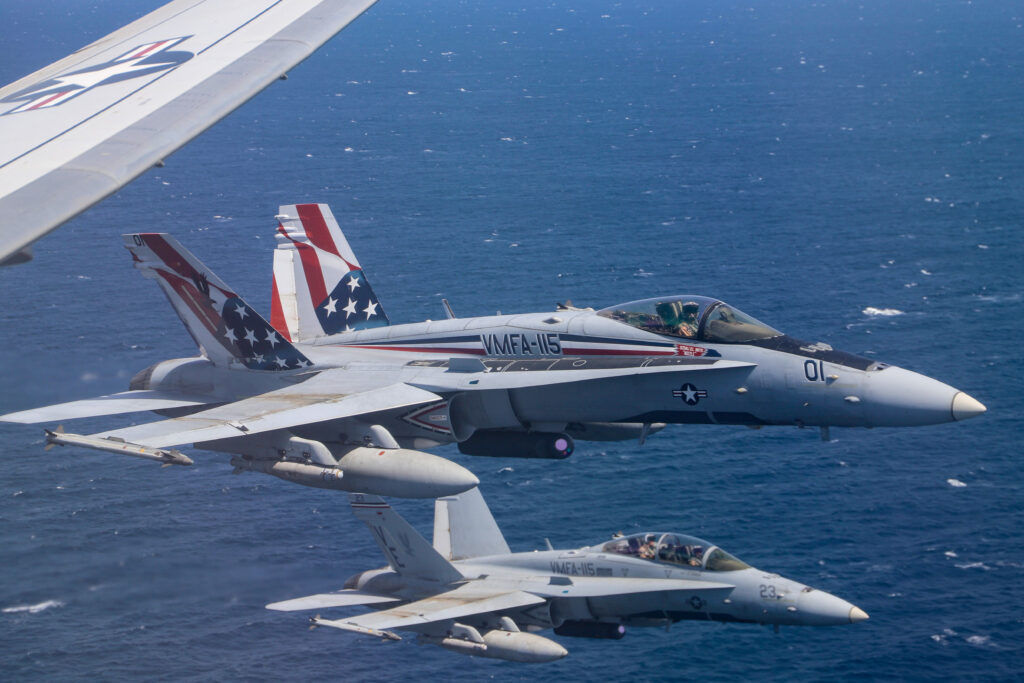
F/A-18C Hornets attached to Marine Fighter Attack Squadron 115 fly in formation during a Bab Al Mandeb transit, Feb. 3, 2022. U.S. NAVY
EL SEGUNDO, Calif. — Raytheon Intelligence & Space’s (RI&S’s) pre-production APG-79(V)4 radar system was successfully flown on a U.S. Marine Corps F/A-18 Hornet earlier this year, at Naval Air Weapons Station in China Lake, California. This is the radar system’s first flight on the aircraft since RI&S delivered the prototype radar in 2021.
The APG-79(V)4 is an APG-79 radar derivative that employs the first airborne GaN-AESA fire-control radar to help pilots detect and track enemy aircraft from greater distances with greater accuracy and meets the power and cooling requirements of legacy aircraft.
“Following successful ground testing and the delivery of the prototype radar, this flight test was critical to observe performance in the air,” said Thomas Shaurette, vice president of F/A-18 & Global Strike Radars for RI&S. “It allowed our partners to see the V4 radar’s enhanced detection and tracking abilities in real-time.”
The U.S. Marine Corps pilot demonstrated the radar’s seamless integration with the legacy Hornet avionics. The APG-79(V)4 radar is common in parts and technology with the legacy AN/APG-79 radar used in the U.S. Navy’s F/A-18 Super Hornet, thus optimizing cost and sustainment. Flight tests will continue to support weapons system integration on the fleet.
The Naval Air Systems Command recently awarded additional contract modifications to equip the Hornet fleet with more radars in 2021, and the total production value for domestic and foreign military sales customers is over $300 million.
Medium Range Interceptor Capability Proves Effective in Marine Corps Test
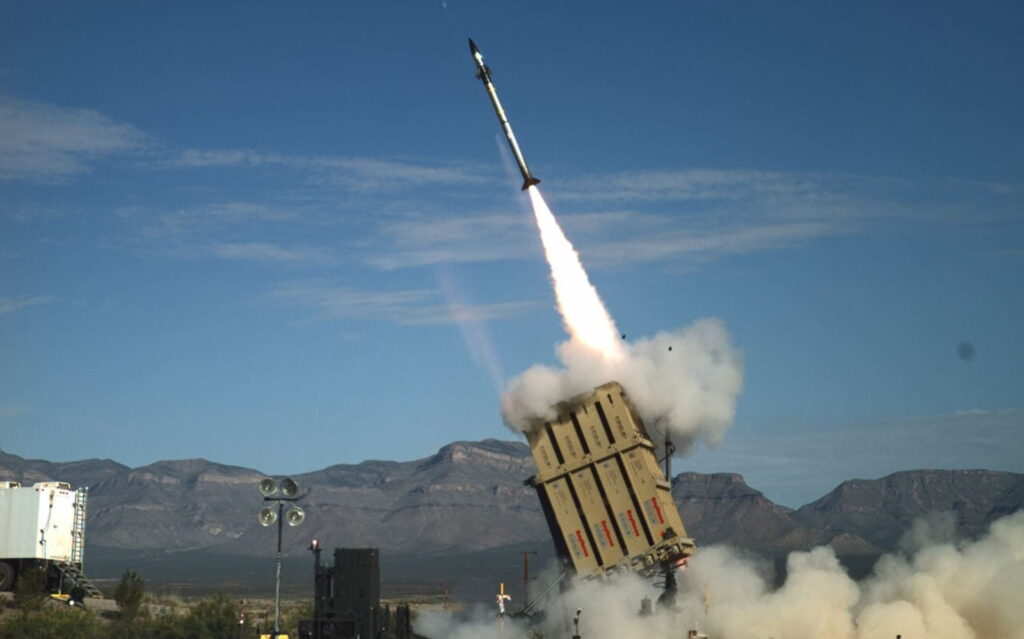
Live fire of the Medium Range Interceptor Capability with the US Marine Corps’ AN/TPS-80 Ground/Air Task Oriented Radar, Common Aviation Command and Control System, and components of the Iron Dome Weapon System, including the Tamir interceptor. U.S. MARINE CORPS
TUCSON, Ariz. — Raytheon Missiles & Defense, a Raytheon Technologies business, and RAFAEL Advanced Defense Systems Ltd., an Israeli-based defense technology company, successfully conducted a live fire of the Medium Range Interceptor Capability (MRIC). During the U.S. Marine Corps event, MRIC engaged targets representative of cruise missile threats, Raytheon said in a May 6 release.
The test examined MRIC’s integration capabilities with the US Marine Corps’ AN/TPS-80 Ground/Air Task Oriented Radar, Common Aviation Command and Control System, and components of the Iron Dome Weapon System, including the Tamir interceptor.
This test is a first in a series designed to prove out the MRIC’s ability to intercept cruise missiles threats. The live fire also stressed the MRIC system to assess its proficiency against high-end threats used by near-peer adversaries.
“This test proved the interoperability of sensors and effectors working together as an integrated air and missile defense capability,” said Tom Laliberty, president of Land Warfare & Air Defense at Raytheon Missiles & Defense. “The demonstration showcased the benefits of integration, extending the capabilities of individual systems into a solution greater than the sum of its parts.”
The Ground Based Air Defense program office at Program Executive Office Land Systems in the U.S. Marine Corps is developing the MRIC prototype in support of a Fleet Marine Forces modernization initiative. According to the U.S. Marine Corps, MRIC is designed is to defeat cruise missile threats and other manned and unmanned aerial threats for fixed and operationally semi-fixed sites.
“We are excited about the success of this live-fire,” said Brig. Gen. (res.) Pini Yungman, executive vice president for Air and Missile Defense of RAFAEL Advanced Defense Systems. “Iron Dome continues to demonstrate its capabilities against more advanced threats, further proving its ability as one of the most premier lower-tier missile air and missile defense systems in the world.”
Raytheon Missiles & Defense and RAFAEL have teamed for more than a decade on Iron Dome, with more than 4,000 operational intercepts and a success rate exceeding 90 percent.
Berger: Holistic Look Needed for Maritime Prepositioning Force
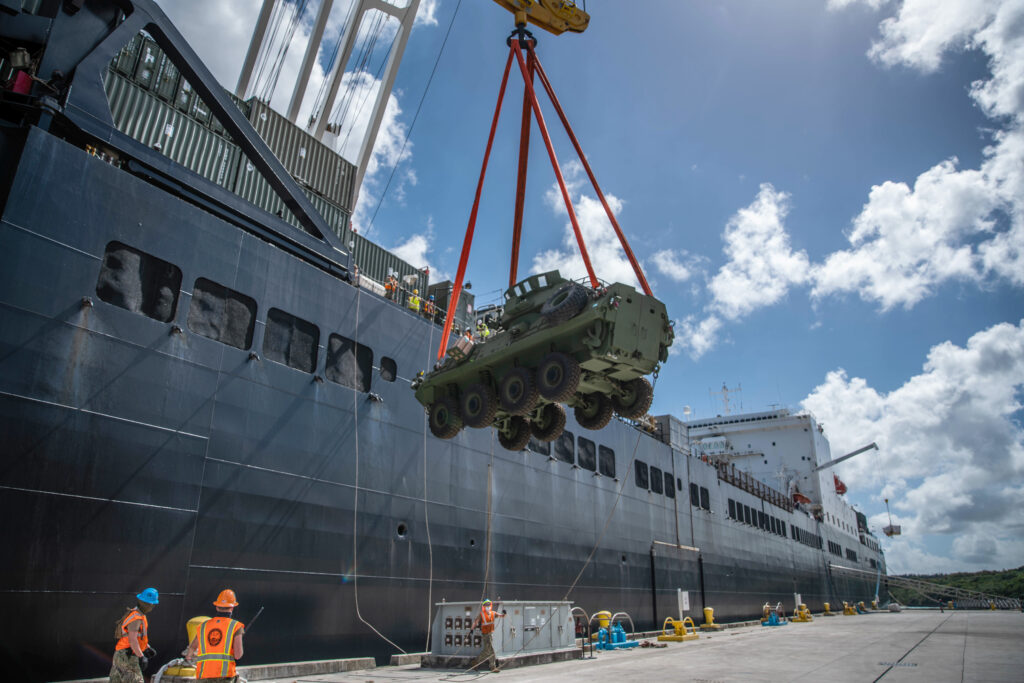
U.S. Marines with Combat Logistics Regiment 3, 3d Marine Logistics Group and Sailors with Navy Cargo Handling Battalion 1 offload a light armored vehicle from the Bob Hope-class vehicle cargo ship USNS Pililaau (T-AKR 304) during Hagåtña Fury 21 at Naval Base Guam, Feb. 21, 2021. U.S. MARINE CORPS / Lance Cpl. Moises Rodriguez
ARLINGTON, Va. — The Marine Corps’ commandant sees a continued need for the Maritime Prepositioning Force in the future as his Force Design 2030 initiative is implemented.
The MPF, managed by the Military Sealift Command, is comprised of two squadrons of ships in full operating status. The squadrons are located at Guam and Diego Garcia. The squadrons carry enough carry enough equipment and supplies to sustain more than 16,000 Marine Expeditionary Brigade and Navy personnel for up to 30 days. The ships can offload equipment at established port facilities or while anchored, using onboard watercraft operated by naval support element forces. The MPS ships complement naval amphibious forces.
Gen. David H. Berger, speaking to reporters May 5 about his update to Force Design 2030, said that “in conjunction with Army prepositioning and the other services’ prepositioning, we’re going to have to take a holistic look at prepositioning in the future. The current framework, like our current posture around the world, is not set optimally for what the National Defense Strategy requires us to do. So, as we adjust global force posture of the joint force — including the Marines — we’re also going to need to adjust maritime prepositioning.
“I won’t speak for the Army, but I would think for the joint force, those adjustments have to be made in conjunction with each other,” Berger said. “There is no possible way you’re going to be able to generate all of the airlift that you need to lift all that we’re going to need anywhere in the globe. Prepositioning cuts the time frame to respond dramatically. We’re going to have to look at MPF and find out how it matches the adjustments we’re going to make with global force posture.”