Marines Prep for ‘Stand-in Force’ Goal of Operating in Enemy Weapon Engagement Zones
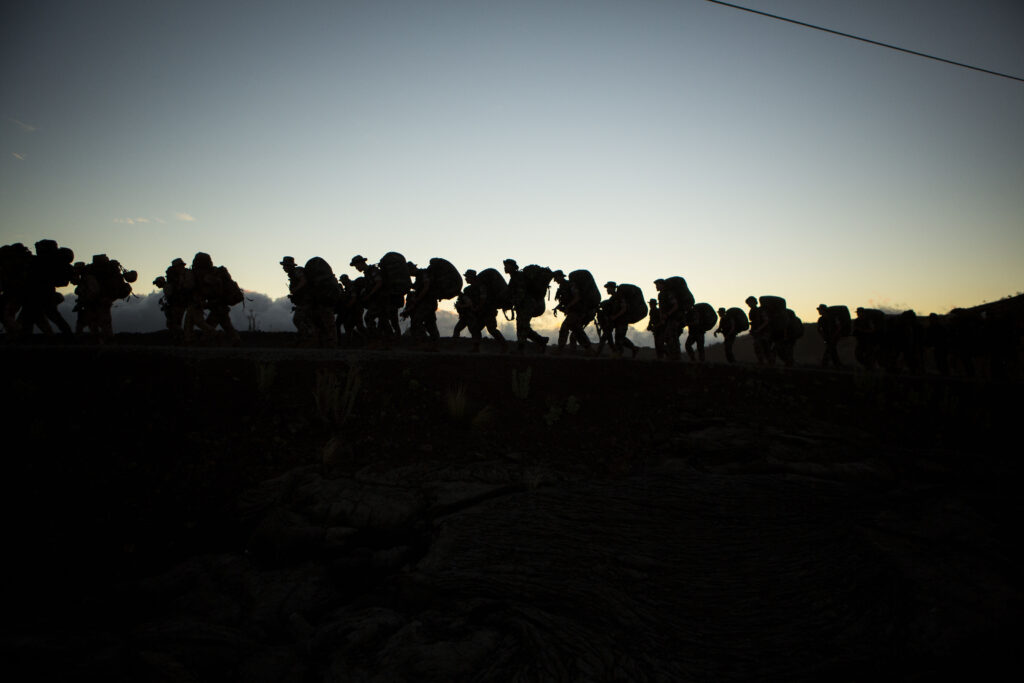
Col. Timothy Brady, commanding officer of the 3rd Marine Littoral Regiment said exercises like the upcoming Rim of the Pacific will play a part in the new regiment gaining full operational status in two years U.S. MARINE CORPS / Lance Cpl. Wesley Timm

WASHINGTON – A key part of the Marine Corps’ ongoing Force Design 2030 is creation of a “stand-in force,” which is intended to be relatively small, highly mobile but lethal units that are to operate well within the enemy’s “weapons engagement zone,” primarily in the Western Pacific. Although this would appear to be a radical, new and potentially dangerous task, a panel of senior Marine officers intensely engaged in the process argued May 11 that the Marines are inherently prepared for this mission and, they emphasized repeatedly, those Marine units would be fighting as part of the U.S. joint force and closely aligned with allies and partners in the Pacific theater.

Force Design 2030 and the concept of the stand-in force is a recognition of the rapidly changing character of war, driven by the fielding of high-tech sensors and precision weapon and the growing involvement of cyberwarfare, said Brig. Gen. Joseph Clearfield, deputy commander of Marine Forces Pacific. “I am so proud that the Marine Corps is out in front on this change,” Clearfield told an audience at the Modern Day Marine exposition at the Walter E. Washington Convention Center.

But Clearfield and his fellow panelists said the Marines traditionally train for the skills needed for the stand-in mission. “We are incredibly well positioned to assume this mission,” Clearfield said.

Col. Timothy Brady, commanding officer of the still-forming 3rd Marine Littoral Regiment, which is to be the first of the units specifically prepared for the stand-in mission, said his regiment “is a small element of MarForPac, part of what will fight inside the enemy’s weapons engagement zone” to set the stage for the joint force.

And Col. Stephen Fiscus, assistant chief of staff for Force Development in MarForPac, who said he is tasked with implementing Force Design, added that “we fight as part of the joint force” and are “already working with our allies and partners.” Clearfield noted that Australia and Japan, America’s closest Pacific allies, are starting to develop similar units.

Brady said his regiment, which was redesignated as the 3rd MLR last year, has its infantry battalion and is to add logistics and air defense battalions as it moves to full operational status in two years. But, he noted, the initial units already have conducted a large-scale exercise with Philippine forces and will engage in even larger tests during the massive Rim of the Pacific Exercise later this year.

While stressing the Marines’ inherent capabilities for the stand-in mission, the three officers acknowledged they need additional capabilities for “persistent stare” sensing and targeting and greater mobility, particularly at sea. Clearfield specifically cited the proposed light amphibious warships, which the Navy’s shipbuilding plan had delayed for at least another year.

Clearfield warned that although the Marines’ force design process is aimed at producing a new organization by 2030, “we may not have that much time,” because of the rapid change in the character of war.

Berger, Del Toro: New Technology Combined With Old Platforms Can Thwart Adversaries

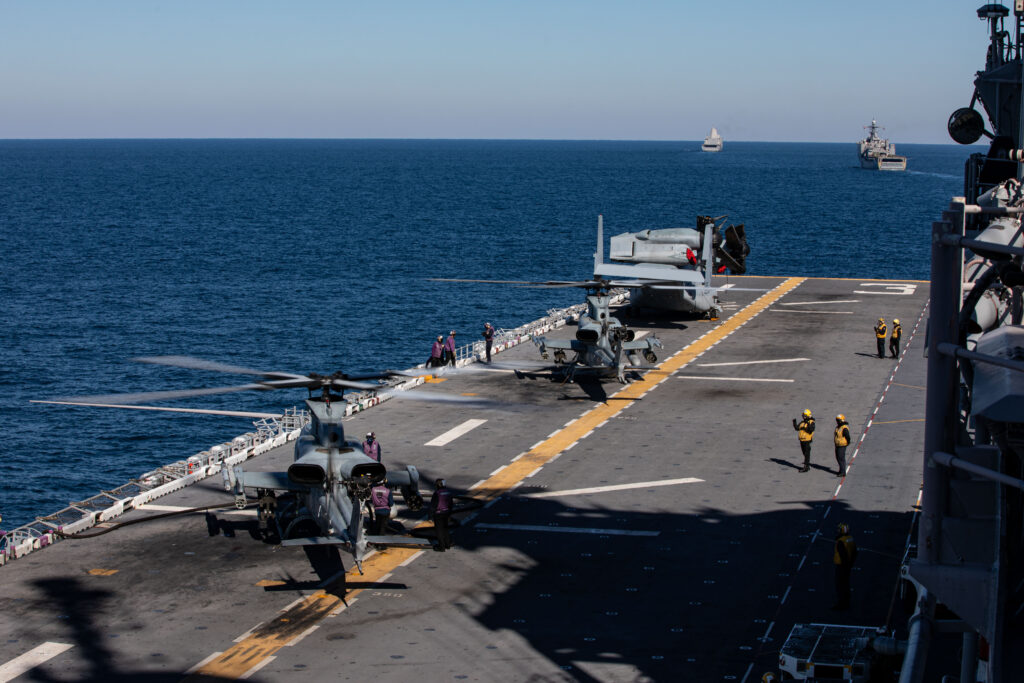
U.S. Navy Sailors refuel UH-1Y Cobras during Composite Training Unit Exercise aboard the USS Kearsarge (LHD 3), Jan. 24, 2022. The 22nd MEU and Amphibious Squadron 6 are underway for COMPTUEX in preparation for an upcoming deployment. COMPTUEX is the last at-sea period in the MEU’s Predeployment Training Program; it aims to test the capabilities of the ARG/MEU and achieve deployment certification. U.S. MARINE CORPS / Sgt. Armando Elizalde

WASHINGTON — U.S. Marine Corps Commandant Gen. David Berger and Secretary of the Navy Secretary Carlos Del Toro are promoting air, surface and undersea unmanned vehicles, and some new uses for old platforms, as a way for the redesigned force to keep adversaries off balance.

Discussing the state of the Marine Corps at the Modern Day Marine exhibition May 10, the two leaders also explained the importance of Berger’s Force Design 2030 plan to prepare the Corps for future challenges from near-peer competitors like China and Russia, and other adversaries in a rapidly changing environment.

“Today’s Marines confront a threat environment characterized by rapid mobility, anti-access/aerial denial systems and cyberwarfare,” Del Toro said, adding that he has “strongly supported Gen. Berger’s Force Design 2030 since his very first day as Navy secretary.

Critics of the force redesign have faulted Berger for shrinking the size of the Corps, eliminating all of its battle tanks and much of its towed artillery, but the 38th commandant has said he is investing in equipment and tech-savvy Marines that will be more effective in a widely distributed, highly mobile and stealthy force using unmanned systems, sensors, and anti-ship and anti-aircraft missiles to dominate the littorals of the Indo-Pacific region and other maritime choke points.

However, he told the Modern Day Marine audience there are existing platforms like amphibious ships, which can be used in innovative ways, especially when paired with unmanned systems. “As more and more uncrewed technology comes to maturity and the cost of production goes down, I think new capabilities are within reach,” Berger said.

“Drone technology over the last 20 years has been transformational on the battlefield,” Del Toro said, “and exactly the kind of technology we need to embrace.”

Berger suggested an Amphibious Ready Group-Marine Expeditionary Unit could launch unmanned undersea vessels from an amphib well deck for antisubmarine warfare, counter reconnaissance, finding minefields and ISR. “No platform, no unit, is capable of a more diverse set of missions across the range of military operations than an ARG-MEU,” he said.

Initial experimentation with the long-range unmanned surface vessel, armed with loitering munitions “has demonstrated the potency of that kind of capability,” Berger said, adding the potential use of UUVs launched from an amphibious well deck is limited “only by your imagination.” On the other hand, a well deck “taxes the imagination of the adversary,” because it conceals what’s on it, Berger said. “If you can’t figure out what’s on the inside, you’re going to spend a whole lot of time trying to do that. It slows down their decision-making. That’s what we want.” Another way to keep an adversary off balance is with drone-delivered loitering munitions. “There’s a psychological impact. You don’t know whether it’s got a camera system or a warhead on it,” Berger said.


Berger: Marines Need More MQ-9 Drones for ‘Organic ISR’

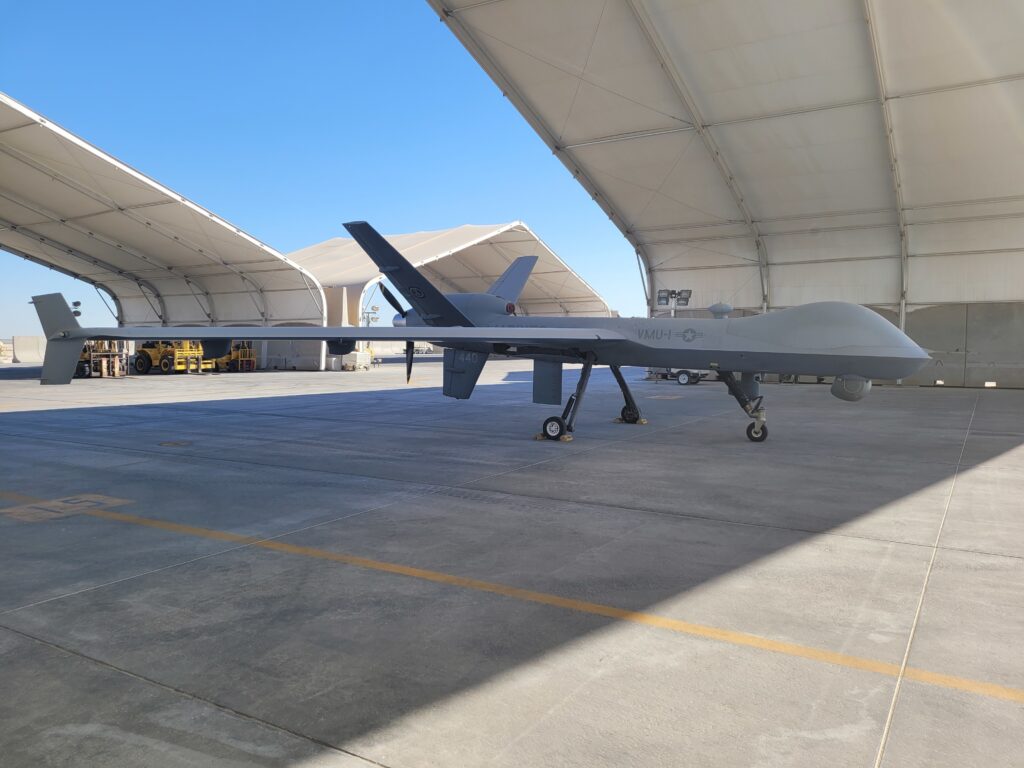
The Marine Corps’ first MQ-9A at an undisclosed location in the Central Command area of responsibility. U.S. Marine Corps

WASHINGTON — The U.S. Marine Corps will expand its fleet of MQ-9 Reaper drones to meet growing intelligence, surveillance and reconnaissance needs, the commandant said May 10.

“We’re going to move from three squadrons right now to perhaps double that,” Gen. David Berger told an audience at the Modern Day Marine exposition. “And the reason why is the need for organic ISR.”

The MQ-9A Block 5 aircraft can stay aloft for more than 26 hours, attain air speeds of 220 knots and can operate to an altitude of 45,000 feet. Manufactured by General Atomics Aeronautical Systems Inc., the Reaper has a 3,850-pound payload capacity that includes 3,000 pounds of external stores. It provides a long-endurance, persistent surveillance capability with full-motion video and synthetic aperture radar.

Berger said that ISR needs were increasingly critical for Marine Corps units, large and small. “So absolutely, we’re going to expand in Group 5, large-scale, big-wing, medium-altitude, long-endurance, uncrewed aircraft. That’s so we can have, for the naval force, persistent organic ISR access from the MEF [Marine Expeditionary Force] level on down to the squad level,” he said.

Over that last year-and-a-half, the Marines have conducted nine force-on-force exercises at the Marine Air Ground Task Force Training Command and Marine Corps Air Ground Combat Center at Twentynine Palms, California, Berger said. All of them showed that “small, distributed lethal teams that can employ organic ISR, loitering munitions, and weapons like the Javelin and Carl Gustav [recoilless rifle] are much more lethal than larger formations that are using traditional force structures and concepts,” backing up the concepts behind his Force Design 2030 plan to retool the way the Corps fights.

The Marines began leasing two Reapers in 2018 under a company owned/company operated agreement, later acquiring them from GA-ASI in 2021 as the first increment of the Marine Air-Ground Task Force unmanned aircraft expeditionary program of record. The Marines procured 16 more of the aircraft to operate in support of distributed maritime operations and expeditionary base operations, particularly in the Indo-Pacific region. 


Marine Panel: Existing Platforms Need Better Employment to Address Global Logistics Challenges

A CH-53K King Stallion helicopter, left, flies over the Chesapeake Bay after successfully connecting with a funnel-shaped drogue towed behind a KC-130J tanker aircraft during aerial refueling wake testing. Lt. Gen. Edward Banta, Deputy Commandant for Installations and Logistics, noted the Marines would need to improve their use of C-130J transports; CH-53K helicopters; and developing unmanned aerial, surface and subsurface systems to address logistics challenges as the threat of a conflict in the Indo-Pacific grows. U.S. NAVY / Erik Hildebrandt

WASHINGTON — The emerging difficult security environment, particularly with the growing threat from China in the Indo-Pacific theater, has placed greater importance on global logistics and created new challenges on how to sustain the deployed forces, a panel of senior Marine officers said May 10.

Improving global logistics in this new operating situation will require better knowledge of “what we have, where we have it and how best to support the Marines” operating across the vast distances of the Pacific, said Lt. Gen. Edward Banta, deputy commandant for Installations and Logistics. Meeting the requirements to sustain the deployed forces also will require reducing their demands for support, including the need for energy and information bandwidth, Banta said at the Modern Day Marine exposition at the Walter E. Washington Convention Center.

Meeting the need to sustain Marine forces in a potentially contested environment will require better employment of existing support platforms, such as the C-130J transports and CH-53K helicopters as well as developing unmanned aerial, surface and subsurface systems, he said.

Maj. Gen. Joseph Shrader, commanding general, Marine Corps Logistics Command, said the new challenges will require “extending the reach” of the U.S. based logistics installations, such as the depots at Barstow, California, and Albany, Georgia. That could include moving some of the depot capabilities to the operational levels, while modernizing the depots by “deciding what we need and getting rid of the rest.”

Schrader and other officer on the panel also stressed the demand to create greater security for the energy and communications requirements for all the Marine installation. To do that, the Corps has experimented with moving some of its installations off the commercial energy grid and will do more of that in the future, they said. They also are making concerted efforts to improve cybersecurity at the domestic installations and overseas bases.

The panel members echoed the statement by Marine Corps Commandant Gen. David Berger that better and more secure logistics was essential to the existence of the “stand-in forces,” which could be relatively small and mobile units operating on islands or isolated land positions within the enemy’s fire engagement zone. Those operations on what are called Expeditionary Advanced Bases, are among the concepts being developed under Berger’s Force 2030 reorganization drive

Brig. Gen. Adam Chalkly, assistant deputy commandant for Installations and Logistics also pointed out that 30 years of uncontested lines of global support is ending and the security of the forward-deployed operational and logistical support installations is no longer ensure, which puts new demands on the entire sustainment system.


BAE Systems Testing ACV for Marine Corps Recon Program

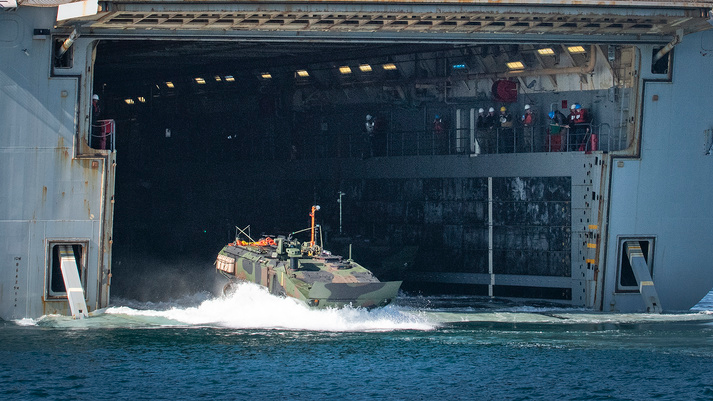
BAE Systems is proposing the Marine Corps use its Amphibious Combat Vehicle for the Advanced Reconnaissance Vehicle program. BAE Systems

WASHINGTON – BAE Systems is offering the Marine Corps an alternative to its proposal to produce a new-start platform for the Advanced Reconnaissance Vehicle program by demonstrating a new version of its Amphibious Combat Vehicle, which is currently operational.

“We like to believe there is an advantage in a proven platform,” that has great land and water mobility and significant survivability, BAE representative Mark Brinkman said May 10. The advantages of adapting the ACV for the recon requirement include a single established parts supply line, a single school house for vehicle drivers and maintenance personnel, and an active production line, he said.

Brinkman discussed the BAE proposal next to a basic ACV that has been modified with an assortment of sensors and defensive systems required for the reconnaissance vehicle, on display at the Modern Day Marine exposition at the Walter E. Washington Convention Center.

The demonstration vehicle had optical and infrared sensors, a small tethered unmanned aerial vehicle, the ability to carry and command and control a larger class-two UAV, and counter-UAV systems. The modified ACV would support a vehicle commander, a driver and five sensor operators, each with a multi-function operating station, Brinkman said.

The Advanced Reconnaissance Vehicle program would replace the existing Light Armor Vehicle, which functions as a scout and troop support platform, but is nearing its end-of-service life. The Marine Corps has given contracts to General Dynamics Land Systems and Textron Systems to develop prototypes for the ARV. But BAE, on its own initiative, will test a modified ACV this summer, provide it for Marine testing and then submit a detailed proposal next year, Brinkman said.

A potential drawback for the BAE proposal is the Marines’ requirement for a vehicle weight limit of 37,000 pounds, set to allow four vehicles to be carried on an LCAC ship-to-shore connector. The BAE ACV weighs about 35 tons – 70,000 pounds.

Brinkman said the ACV’s weight is offset by its “ability to swim” from ship to shore, reducing the need for a connector, like the LCAC. 

But that could minimize the standoff distance for the amphibious shipping as the ACV swims at about 7 knots, compared to the 30-knot water speed of the LCAC.


Oshkosh Displays Vehicles at Modern Day Marine Expo 

The Pratt Miller Defense EMAV can carry a 6,000-pound payload capacity and flat rack and is designed to support most logistics missions. OSHKOSH DEFENSE

OSHKOSH, Wis. — Oshkosh Defense, a wholly-owned subsidiary of Oshkosh Corp., is displaying a Joint Light Tactical Vehicle and trailer and a Pratt Miller Defense Expeditionary Modular Autonomous Vehicle at the Modern Day Marine Expo 2022. The vehicles will be on display at the Walter E. Washington Convention Center in Washington, D.C. from May 10-12, 2022. 

The 4-door Heavy Guns Carrier JLTV will be equipped with the John Cockrill CPWS 2.0 turret and Northrop Grumman 25x137mm M242 Bushmaster chain gun. 

“The modular design of the Oshkosh Defense JLTV, which we’ve built over 16,000, can be adapted to dozens of military missions, from serving as battlefield ambulances to hosting antitank weapons,” said George Mansfield, Vice President and General Manager of Joint Programs for Oshkosh Defense. “The ability to easily integrate weapons that increase the JLTV’s firepower and lethality cost-effectively is yet another example of the vehicle’s flexibility and adaptability for next-generation warfare.” 

The Pratt Miller Defense EMAV on display is a tracked, autonomous vehicle developed for the Marine Corps Warfighting Lab. The EMAV’s hybrid-electric powertrain is capable of silent watch and silent mobility and provides exportable power capability. Furthermore, with a 6,000-pound payload capacity and flat rack, the EMAV is designed to support most logistics missions. 

“Oshkosh Defense’s advanced technology capabilities run the gamut from autonomous vehicles to hybrid-electric powertrains,” said Pat Williams, vice president and general manager of U.S. Army and U.S. Marine Corps Programs for Oshkosh Defense. “We partner with the U.S. Marine Corps and other customers to understand and analyze the challenges they face and explore solutions. This collaboration allows us to apply these next-generation defense technologies and advanced systems to our vehicles in order to meet their evolving mission needs.” 


Marine Corps Force Design Update Adjusts MV-22 Squadron Force Levels 

An MV-22B Osprey assigned to the Aviation Combat Element from Special Purpose Marine Air-Ground Task Force-Crisis Response-Africa 20.2, Marine Forces Europe and Africa, conducts deck landing qualifications aboard the amphibious assault ship USS Bataan (LHD 5), June 28, 2020. U.S. Marine Corps / Cpl. Tanner Seims

ARLINGTON, Va. — The Marine Corps’ Force Design 2030 annual report has announced adjustments in the force levels of its Marine medium tiltrotor (VMM) squadrons that fly the MV-22B Osprey assault transport aircraft.  

“We originally planned to divest three MV-22 medium tiltrotor squadrons from the Active Component, which would have resulted in a total of 14 squadrons of 12 aircraft each,” said the report, released May 9 by Marine Corps Commandant Gen. David H. Berger. “However, detailed analysis demonstrated that 16 squadrons of 10 aircraft each better satisfies joint force requirements and better supports service needs to organize, train and equip. In particular, this force structure simplifies the formation of a Marine Expeditionary Unit’s aviation combat element.” 

“Quite frankly, it was personnel-driven,” said Lt. Gen. Karsten S. Heckl, deputy commandant for combat development and integration, Headquarters, U.S. Marine Corps, and commanding general, Marine Corps Combat Development Command, Marine Corps Base Quantico, Virginia, speaking May 6 to reporters and amplifying the Corps’ reasoning for the change in VMM squadron aircraft complement.  

“There were many external factors to that primary factor of personnel,” Heckl said. “So, there a few levers the commandant can pull on to generate resources. The conclusion that the Headquarters, Marine Corps, staff came to was that manpower was the most appropriate because we were over-sized, we were at an unsustainable number, so that was the logical choice to make.” 

Heckl said the squadron size of 10 MV-22Bs would give the Corps the flexibility to add more F-35B Lightning II strike fighters to the ACE if it so chose. Currently the ACE typically deploys with six F-35B Lightning II strike fighters or AV-8B Harrier II attack aircraft.  

“Right now, the MEUs are going out — and it depends whether it’s 10 or 12 V-22s when the [MEUs] go out [on deployment],” he said. When we start making every deployment with [F-35Bs] and the possibility that the numbers [of F-35Bs] that would go out — those numbers changing — the 10- [V-22s per squadron] makes all the sense in the world. 

“Quite frankly, when you take into the equation the attrition rate, pipeline aircraft, training aircraft, the numbers work out pretty well,” he said.  

The Marine Corps has cut or is cutting four MV-22B squadrons. The stand-up of VMM-212 was canceled in fiscal 2019. VMM-264 and VMM-166 were deactivated in fiscal 2020 and 2021, respectively. VMM-164 will be deactivated in fiscal 2022. The remaining force will include 14 active-component fleet VMM squadrons, one active-component VMMT fleet replacement squadron and two reserve-component VMM squadrons. 

The Force Design annual report also called for an experiment in active-reserve integration of a reserve VMM squadron. The commandant directed the Corps to “perform Active Component/Reserve Component integration proof of concept in 2d MAW [Marine Aircraft Wing] by incorporating VMM-774 into an Active Component Marine Aircraft Group in [fiscal 2023].” 

VMM-774 is based at Naval Station Norfolk, Virginia, also the base of two Navy helicopter mine-countermeasures squadrons that have been combined active-reserve squadrons. 


Marine Corps Plans to Activate Second Adversary Aircraft Squadron in 2023 

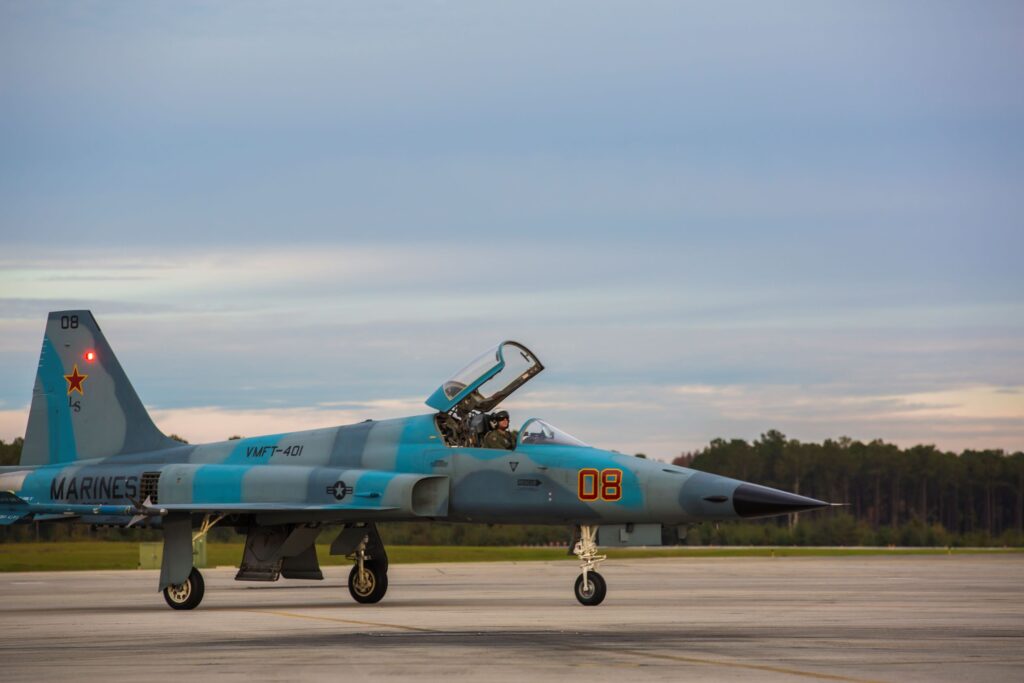
An F-5N Tiger II taxis after landing aboard Marine Corps Air Station Beaufort in South Carolina in 2015 to support Marine Fighter Attack Training Squadron 501 in air-to-air training. U.S. MARINE CORPS AIR STATION BEAUFORT / Sgt. Dengrier Baez

ARLINGTON, Va. — The Marine Corps plans to activate a second adversary aircraft squadron to meet the future aerial combat training needs of its fighter attack squadrons. The second squadron will provide the East Coast with similar training assets as the West Coast.  

According to the 2022 Marine Corps Aviation Plan released this week, Marine Fighter Training Squadron 402 (VMFT-402) will be activated in fiscal 2023 at Marine Corps Air Station Beaufort, South Carolina, scheduled to be safe for flight by the beginning of 2024. 

The Corps has long fielded reserve squadron VMFT-401 at MCAS Yuma, Arizona, which flies Northrop 11 single-seat F-5N and one F-5F Tiger II fighters. The squadron is upgrading to 11 F-5N+ and one F-5F+ aircraft. 

VMFT-402, which also will be a reserve squadron initially, will be equipped with three F-5N+ aircraft but eventually will operate eight F-5N+ and two F-5F+ aircraft.  

To equip the new squadron, the Marine Corps has acquired 11 additional F-5 aircraft from the Swiss air force through the Naval Air Systems Command. The aircraft will be delivered to the Corps over a four-year period beginning in the fourth quarter of 2023.  

The Navy and Marine Corps F-5 fleet is going through upgrades to increase capabilities and extend the service life. The fleet is being upgraded with digital cockpits at a rate of two or three aircraft per year. The Naval Air Systems Command plans to integrate TCTS II Tactical Combat Training System – Increment II (TCTS II) to “allow synthetic adversary injects to decrease the forecasted gap in adversary training.”    

“Serving as a training asset for the entire MAGTF, as well as the joint force, the F-5 has seen adversary requirements grow significantly over the past 13 years,” according to the aviation plan, in large part because of the pilot training requirements of the F-35 fleet replacement squadrons VMFA-501 and VMFA-502. “Annual fleet adversary requirements are expected to also increase for transitioning squadrons from 12,000 air-to-air sorties in [fiscal 2022 to 17,000 sorties per year in order to meet T2.0 requirements in [fiscal 2025].” 

The aviation plan said that “Adversary capacity is the greatest issue in Marine Corps air-to-air training, followed closely by range availability and modernization, and training simulator capabilities. VMFT-401 can source up to 3,300 sorties per year, restrained by aircraft utilization and numbers of F-5s assigned. Combining A/A [air-to-air] requirements for fleet training, FRS [fleet replacement squadron] production and weapon school support, the USMC builds an adversary requirement of nearly 15,000 sorties in 2022. Accordingly, the USMC suffers over an 11,000-sortie capacity gap. Aviation is looking at options to close this gap.” 

The U.S. military uses commercial air services which fly former military jets in the adversary role, but, according to the aviation plan, “commercial air services cannot satisfy all of the adversary requirements. The future lies in multiple solutions that include using the fleet of F-5s efficiently, exploring low-cost training opportunities, incorporating Live, Virtual, Constructive capability, and commercial air services to augment requirements.”      


General: Precise Sensors to Close Kill Chain is a Key Takeaway from Ukraine War

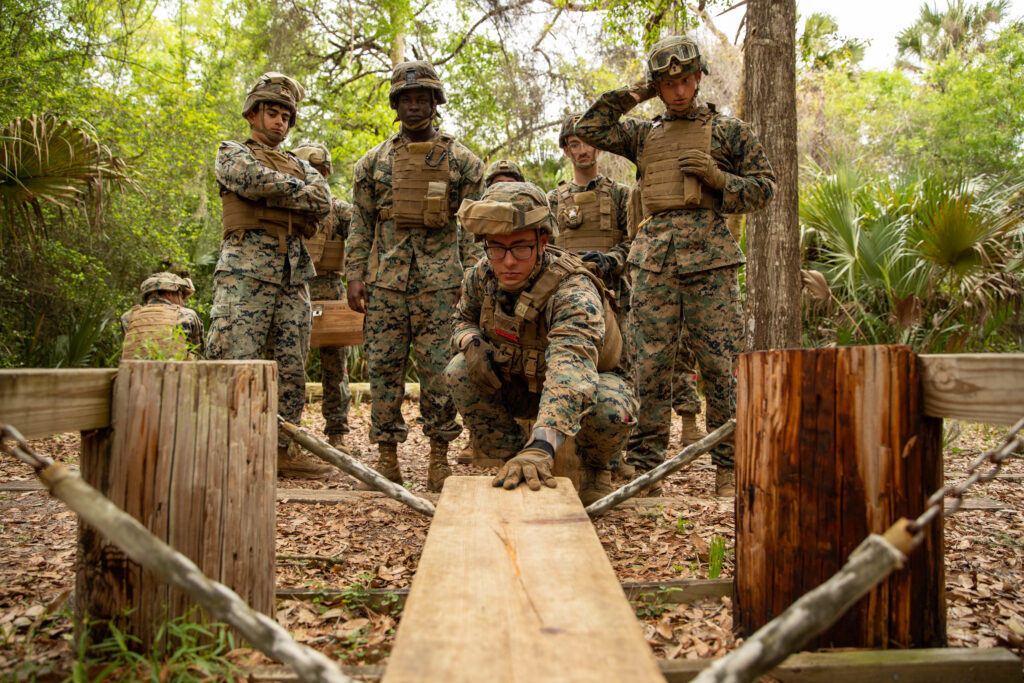
U.S. Marines with Combat Logistics Regiment 37, 3rd Marine Logistics Group, participate in a leadership reaction course during exercise Atlantic Dragon on Camp Blanding, Florida, United States, March 31. U.S. MARINE CORPS / Cpl. Alpha Hernandez

ARLINGTON, Va. — Ukraine’s widespread use of sensor technology to find, target and destroy Russian tanks and command structure is one of the early lessons learned from that conflict, the U.S. Marine Corps’ top requirements officer says.

Discussing the Marines’ Force Design 2030 modernization effort at the Center for Strategic and International Studies on May 4, Lt. Gen. Karsten Heckl, head of Marine Corps Combat Development Command, was asked what strategic and tactical lessons have come out of Russia’s invasion of Ukraine.

“To me, and in conversations with other officers across various services, clearly the ubiquity and proliferation of sensors and the ability to close kill chains accurately, precisely on any target is a major lesson to take away,” said Heckl, who is also deputy commandant for Combat Development and Integration.

While it was too soon to “draw any firm, fast conclusions,” he noted Commandant Gen. David Berger had directed several of his deputies to “make sure we’re harvesting the appropriate lessons from this thing.”

Berger’s Force Design plan seeks to retool the Corps, in size, focus and weaponry to deter a rising China, which the National Defense Strategy identifies as a “pacing challenge” to U.S. interests and the post-1945 world order. Heckl noted that a focus on loitering munitions and organic precision fires, like that seen in Ukraine and the 2020 war between Armenia and Azerbaijan, “is one of the routes Force Design went down early. And we are pursuing that in various forms.”

Logistics is another crucial issue, highlighted by the Russians’ struggle to advance their tank and truck columns.

“The pacing factor in Force Design is logistics in a contested environment,” Heckl said. “As you saw with the Russian invasion of Ukraine, any armor is a massive consumer of fuel. We learned long ago in Iraq and Afghanistan, that fuel trucks on the road immediately became the target.”

While the Marines have disposed of their battle tanks, fuel dependence is still “a significant vulnerability,” for the widely dispersed expeditionary advanced base operations envisioned in Force Design, Heckl said.

“Sustainability, just like [heat] signature management, is first and foremost in every thought, through all our studies, analyses, experiments, exercises, all this campaign of learning. It’s the analytical rigor that underpins every decision the commandant makes on Force Design,” Heckl said.


Marine Corps to Increase KC-130J Force in Pacific to Enhance Mobility of Marine Littoral Regiment 

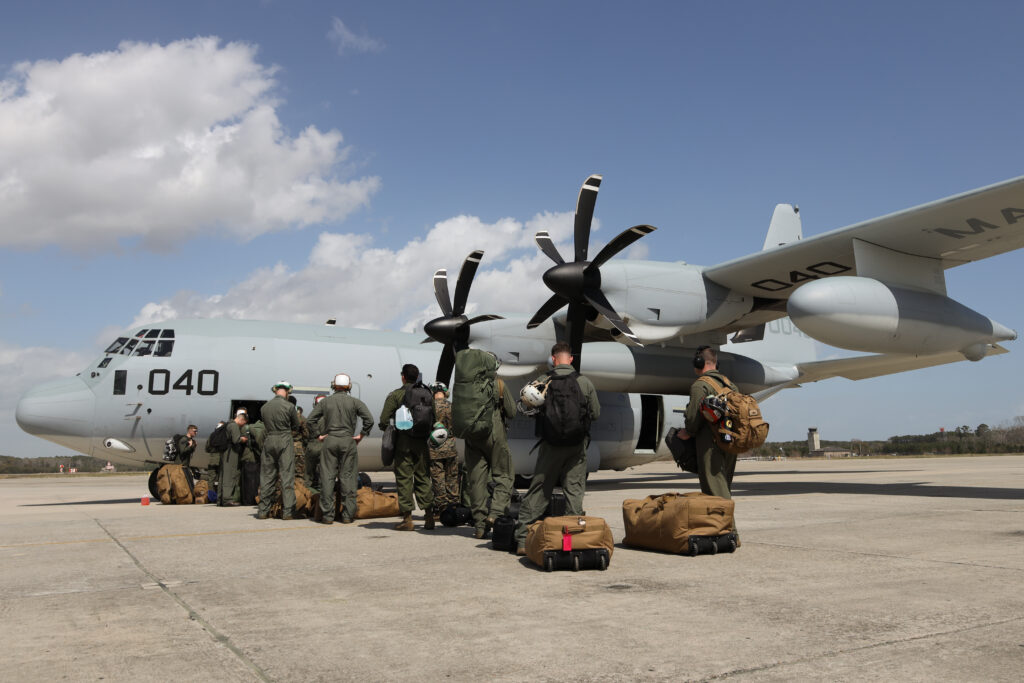
U.S. Marines with Marine All-Weather Fighter Attack Squadron (VMFA(AW)) 533 prepare to board a KC-130J Super Hercules before a flight at Marine Corps Air Station Beaufort, South Carolina, March 7. U.S. MARINE CORPS / Cpl. Lauren Salmon

ARLINGTON, Va. — The Marine Corps plans to activate another KC-130J Super Hercules tanker/transport squadron as part of its aim to provide increased mobility of Marine Corps forces in the Pacific area of responsibility in support of Force Design 2030. 

According to the 2022 Marine Corps Aviation Plan released this week, the Corps plans to activate Marine Aerial Refueler Transport Squadron 153 (VMGR-153) in fiscal 2023. The squadron will be based at Marine Corps Air Station Kaneohe Bay, Hawaii, where two MV-22B Osprey squadrons also are based. 

The additional squadron in Hawaii will enable Marine Forces Pacific to better support aerial refueling, logistics, close air support and multi-sensor imagery reconnaissance in support of expeditionary advance base operations in the Pacific region, particularly for the recently activated 3rd Marine Littoral Regiment, also based in Hawaii. 

VMGR-153 will grow to 17 KC-130J aircraft by fiscal 2026. The East Coast squadron, VMGR-252, based at MCAS Cherry Point, North Carolina, will level out this year at 17 aircraft, and the West Coast squadron, VMGR-352 at MCAS Miramar, California, also will reach a force level of 17 aircraft by the end of fiscal 2022. The squadron based at MCAS Iwakuni, Japan, VMGR-152, will reach a level of 17 aircraft in fiscal 2023.  

The reserve squadron based at Naval Air Station Fort Worth, Texas, VMGR-234, is scheduled to reach a level of 17 aircraft in fiscal 2027. The reserve squadron based at Stewart Air National Guard Base, VMGR-452, has only five KC-130Js and is planned to remain at that level. 

The Marine Corps’ program of record for KC-130Js is 86 aircraft.  

VMGR-252 and VMGR-352 rotate detachments to support the North Africa and East Africa Responses Forces. 

The Marine Corps also plans to sustain the Harvest Hercules Airborne Weapons Kit (Harvest HAWK) program. Ten KC-130J aircraft — five with VMGR-252, four with VMGR-353 and one with test squadron VX-20 — have been modified post-production with the Harvest HAWK to provide the MAGTF a multi-sensor imagery reconnaissance and close air support capability with the MX-20 electro-optical/infra-red imaging system and both wing and door mounted employment of AGM-114P Hellfire and AGM-176 Griffin missiles. A total of six kits are on hand for the 10 fleet aircraft.