Marine Corps Aviation Plan Reduces Number of F-35s in Some Squadrons, Keeps 420 F-35s Total 
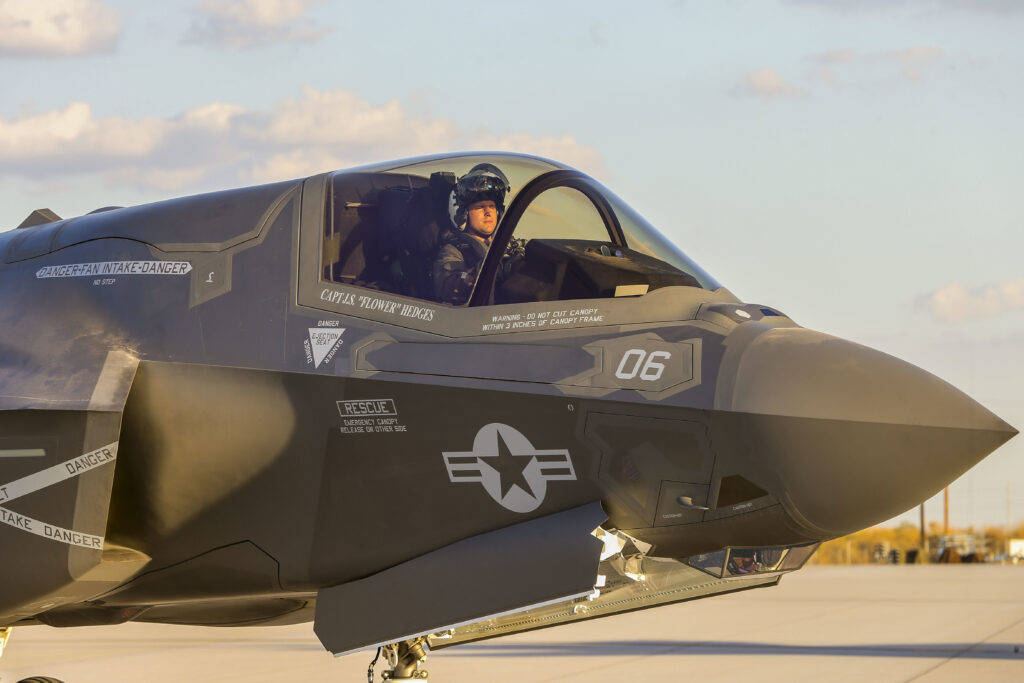
U.S. Marine Corps Maj. Mark Noble, F-35 instructor pilot with Marine Aviation Weapons and Tactics Squadron One, taxis on the runway during a hot load at Marine Corps Air Station Yuma, Arizona, in 2016. U.S. MARINE CORPS / Staff Sgt. Artur Shvartsberg, MAWTS-1 COMCAM

ARLINGTON, Va. — The Marine Corps plans to reduce the number of F-35 Lightning II strike fighters planned for some Marine fighter attack squadrons but is not reducing the program or record of 420 F-35s. 

In the 2022 Marine Corps Aviation Plan released this week, the Corps shows it will reduce the number of F-35Bs in some squadrons from 16 to 10 aircraft. Originally the 16 were going to allow for a six-plane detachment on board an amphibious assault ship in addition to a 10-plane land-based force. In the current plan, all F-35B (and carrier-capable F-35C) squadrons will be equipped with 10 aircraft.  

The plan for F-35 squadrons is in accord with Marine Corps Commandant David H. Berger’s Force Design 2030 plan for restructuring the Marine Corps. 

Lt. Gen. Mark Wise, deputy commandant for Aviation, speaking to reporters May 2 at the Pentagon, said the change in the numbers in the F-35 squadrons “really had to do with what is the optimum way, so starting with the requirement and moving backwards.

“The F-35 is designed to deploy as a division, so 10-airplane [squadrons] were designed to field two divisions with two [aircraft] in backup,” Wise said. “That is the model that we believe is the right direction to go for a Marine expeditionary unit. That way you’re deploying a whole squadron as well. You’re not leaving pieces of it behind. So, you don’t have a command element that’s got to go to one side or go to the other side. With that said, we will continue to learn and evolve and experiment and wargame and do all the things we’ve been doing to make sure that number is right. We have to make sure that the rest of the ACE [Aviation Combat Element] on board the L-class ships, are the numbers are balanced appropriately? Do they all fit? Is all the maintenance able to be done? So, there’s some experimentation to go to make sure we’ve got it perfectly right, but we think we’re off to a pretty good start.” 

Wise said that “overall, our POR [program of record] still remains the same [at 353 F-35Bs and 67 F-35Cs] because if you look at the entirety of the program from start to now, there were certain affordability decisions made early on that had to do with things like our attrition model was truncated in order to meet affordability concerns. So, if you take the attrition model and expand it back to the numbers that we have for those 18 active and two reserve squadrons, your number actually ends up being our POR.”

The Corps intends to upgrade all of its existing F/A-18 Hornet-equipped Marine fighter attack (VMFA) squadrons and convert the remaining AV-8B Harrier II Marine attack (VMA) squadrons to VMFAs. Two more squadrons — one a reserve unit — will be reactivated, while another will be deactivated for about four years and will be reactivated as an F-35C squadron. In all, the plan has the Corps fielding 14 active component and two reserve F-35B squadrons and four active component F-35C squadrons by fiscal 2032. 

The Corps also has two F-35B fleet replacement squadrons, one on each coast. (F-35C training will remain with the Navy’s fleet replacement squadron, VFA-125.) The F/A-18 Hornet fleet replacement squadron, VMFAT-101, will be deactivated in fiscal 2024 and turn its training responsibilities to VMFA-323, a deploying squadron which will maintain a fleet replacement detachment until fiscal 2027.  

Of the Corp’s six remaining active-component Hornet squadrons, five now fly a mix of seven single-seat F/A-18Cs and five two-seat F/A-18Ds. VMFA-323 will retain F/A-18Cs and reserve VMFA-112 will give up its last four F/A-18A++ versions to become an all “C/C+” squadron. 

The four existing Harrier squadrons, all based at Marine Corps Air Station Cherry Point, North Carolina, now fly only the radar-equipped version of the AV-8B. One squadron, VMA-223, also runs a fleet replacement detachment that includes two-seat TAV-8Bs. The Harriers are slated to be phased out in fiscal 2027. 
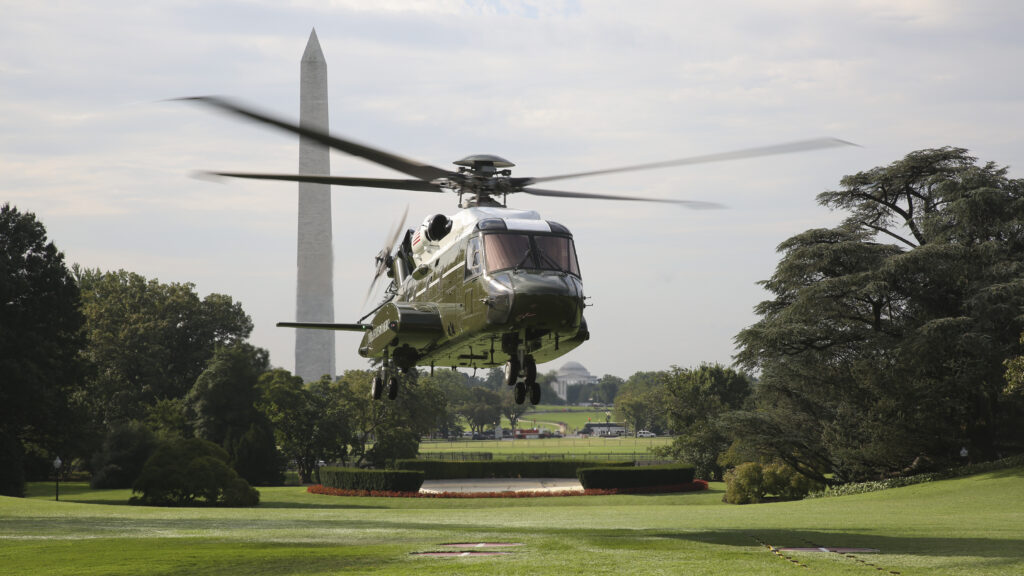


Marine Corps’ New VH-92 Presidential Helicopter Achieves Initial Operational Capability 

Marine Helicopter Squadron One (HMX-1) runs test flights of the new VH-92A over the south lawn of the White House on Sept. 22, 2018. U.S. MARINE CORPS / Sgt. Hunter Helis

ARLINGTON, Va. — The Marine Corps’ VH-92A presidential support helicopter has achieved initial operational capability, according to the Department of the Navy.  

The VH-92A, built by Lockheed Martin, has been going through testing and crew training and achieved IOC on Dec. 28, 2021. No announcement by the program office was made at the time. The IOC was announced in the Navy Department’s budget highlights book for fiscal 2023 which was published in mid-April. 

The VH-92A reaching IOC was confirmed April 26 during a hearing of the Seapower subcommittee of the Senate Armed Services Committee by Frederick Stefany, who is performing the duties of the assistant secretary of the Navy for Research, Development and Acquisition. 

“We achieved IOC of the VH-92 — the presidential helicopter — and we are now starting the commissioning process with the White House to get that helicopter into the White House’s fleet,” Stefany said.  

The presidential helicopter fleet is flown by Marine Helicopter Squadron One (HMX-1). Currently HMX-1 flies the VH-3D Sea King and VH-60N Black Hawk helicopters. 

The fiscal 2023 budget proposal funds the VH-92A program at $45.6 million and “continues developing product improvements for incremental incorporation to the VH-92A capability baseline to include enhancements to Wide Band Line of Sight [WBLOS] communication capability, cockpit upgrades, government furnished equipment, shipboard interoperability, software upgrades and commences developing product improvements for distributed network communications and vehicle performance enhancements.” 

The planned fleet of VH-92As will include 21 operational aircraft and two test aircraft. Full operational capability of the VH-92A is planned for the second quarter of fiscal 2023. 


Marine Corps Deactivates Two Helo Squadrons, One Temporarily 

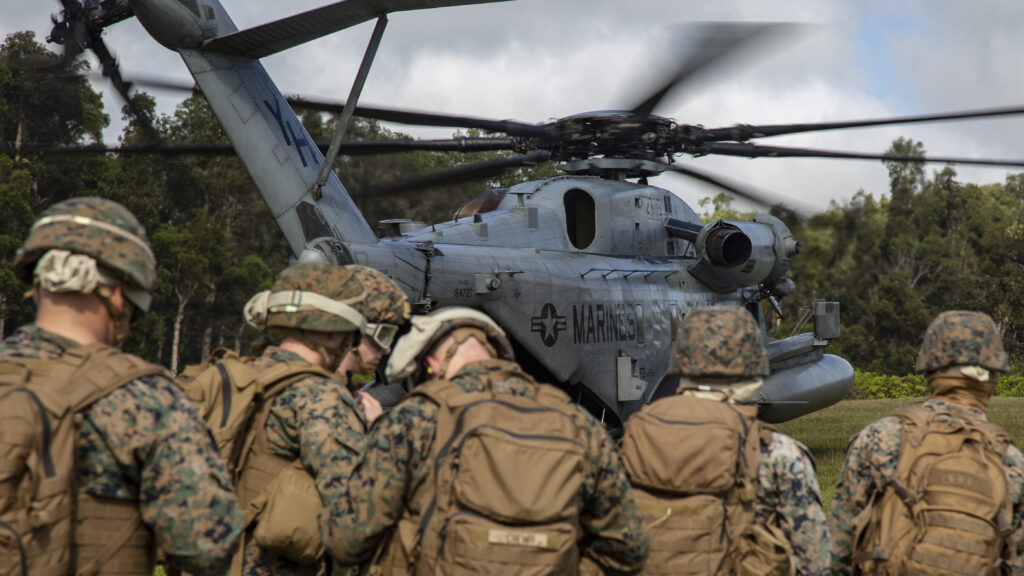
U.S. Marines with 3D Radio Battalion prepare for transport by CH-53E Super Stallion helicopters assigned to HMH-463 at “LZ Kutree,” Hawaii, Dec. 13, 2021. U.S. MARINE CORPS / Cpl. Dalton J. Payne

ARLINGTON, Va. — The U.S. Marine Corps has deactivated two helicopter squadrons in its march toward Force Design 2030, but one of the squadrons will be reactivated later this year, the service said. 

Marine Heavy Helicopter Squadron 463 (HMH-463) — a CH-53E Super Stallion squadron known as Pegasus — was deactivated on April 21 at Marine Corps Air Station Kaneohe Bay, Hawaii. The unit, which had been based in Hawaii since 1971, had been drawing down over the year and transferring its helicopters to other squadrons.  

Marine Light Attack Helicopter Squadron 367 (HMLA-367) — a unit known as Scarface — had operated AH-1Z Viper and UH-1Y Venom helicopters from Kaneohe Bay since 2012. It was deactivated on April 22, also at Kaneohe Bay. 

However, HMLA-367 will be reactivated later this year at Marine Corps Air Station Camp Pendleton, California, where four other HMLA squadrons are stationed with Marine Aircraft Group 39. 

The two squadrons are the second and third to be deactivated as part of Force Design 2030, the Marine Corps concept to build a lighter, more agile force able to operate and survive inside an enemy’s targeting zone. An MV-22B Osprey squadron, Marine Medium Tiltrotor Squadron 166 (VMM-166), was deactivated late last year.  

The Corps still maintains two MV-22B squadrons at Kaneohe Bay — VMM-268 and VMM-363 — with Marine Aircraft Group 24. The service plans to establish a new KC-130J Super Hercules squadron at Kaneohe Bay to support the mobility of Marine forces in the Pacific. 


Marine Corps’ King Stallion Ready to Run 

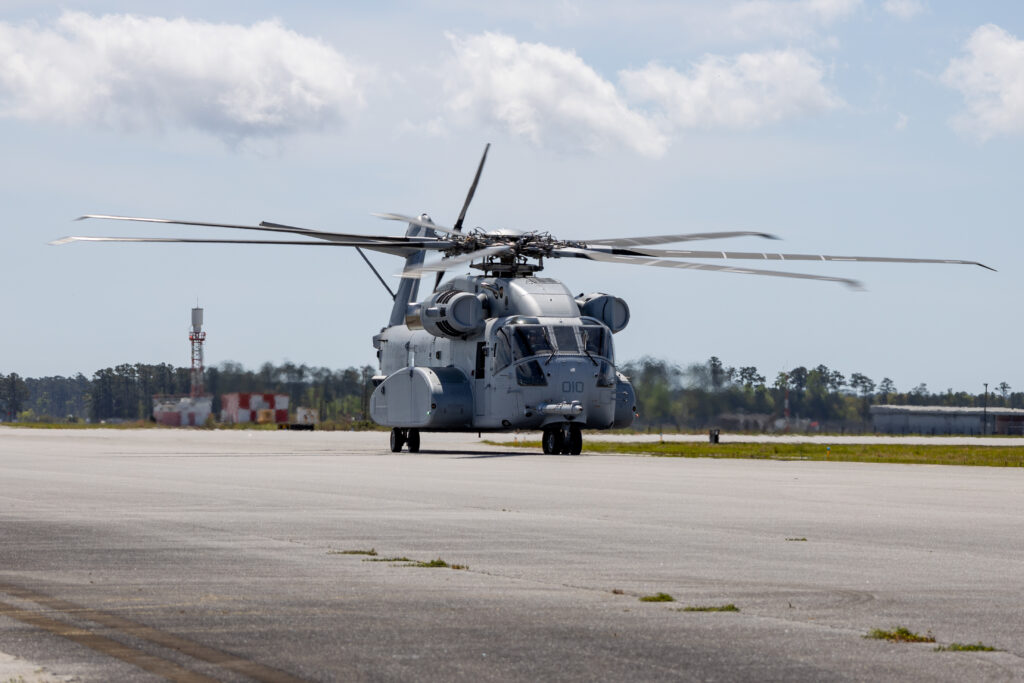
U.S. Marines with Marine Heavy Helicopter Squadron (HMH) 461 taxi in a CH-53K King Stallion after its first operational flight at Marine Corps Air Station New River, North Carolina, April 13. The flight signified the beginning of HMH-461’s modernization from the CH-53E Super Stallion to the CH-53K King Stallion. U.S. MARINE CORPS / Lance Cpl. Elias E. Pimentel III

ARLINGTON, Va. — The Marine Corps’ new CH-53K King Stallion heavy-lift helicopter achieved initial operational capability on April 22, Deputy Commandant for Aviation Lt. Gen. Mark Wise said in an April 25 release.

The first fleet CH-53K squadron, HMH-461, now has at least four CH-53Ks, the minimum number needed to reach IOC and the number needed for a detachment to deploy with a Marine Expeditionary Unit.

“In addition to meeting IOC criteria, the CH-53K successfully completed a thorough initial operational test and evaluation period that resulted in over 3,000 mishap free hours flown in various challenging environments and terrain,” the release said.

“My full confidence in the CH-53K’s ability to execute the heavy lift mission is the result of successful developmental and operational testing conducted by Air Test and Evaluation Squadron (HX) 21 and Marine Operational Test and Evaluation Squadron (VMX) 1,” Wise said in the release.

The first deployment of the CH-53K is set for 2024. The Corps plans to field 5.25 fleet HMH squadrons with CH-53Ks. Col. Jack Perrin, the CH-53K program manager, told reporters earlier this month the “.25” is an extra four aircraft for one of the squadrons, with each of the other four squadrons to be equipped with 16 helicopters. Other CH-53Ks will be assigned to a fleet replacement squadron and test squadrons, while others will be in process through the maintenance pipeline.

The Marine Corps’ seven HMH squadrons equipped with the older CH-53E in recent years have operated with only 12 helicopters instead of 16 because of attrition over the years. One CH-53E squadron was deactivated last week and two more will be deactivated in the course of the commandant’s Force Design 2030 plan.

“The success to date of the CH-53K is a reflection of the hard work and effort by the Marines, Sailors and civilians at VMX-1, H-53 Program Office [PMA-261] and Marine Heavy Helicopter Squadron [HMH] 461, and the support we have received over many years from across the Department of the Navy and our industry partners,” Wise said.

The CH-53K is capable of providing nearly three times the lift capability of the CH-53E.

“The most notable attribute of the King Stallion is its ability to maintain increased performance margins in a degraded aeronautical environment, for example at higher altitudes, hotter climates and carrying up to 27,000 [pounds] out to 110 nautical miles; whereas, the CH-53E would be limited to a 9,628-pound external load in the same environment,” the release said.

“The King Stallion boasts an engine that produces 57% more horsepower with 63% fewer parts relative to its predecessor, which translates to an expanded capability to deliver internal and external cargo loads, providing the commander a mobility and sustainment capability the MAGTF [Marine Air-Ground Task Force] has never had before.”

Supporting the Corps’ Force Design 2030, “the CH-53K will complement connectors that will enable littoral maneuver and provide logistical support to a widely disaggregated naval force.”

The Marine Corps has a requirement for 200 CH-53Ks. Full-rate production is planned for 2023. Full operational capability is scheduled for 2029.


Marine Corps Deploys G/ATOR Radar to Support NATO Air Policing Missions 

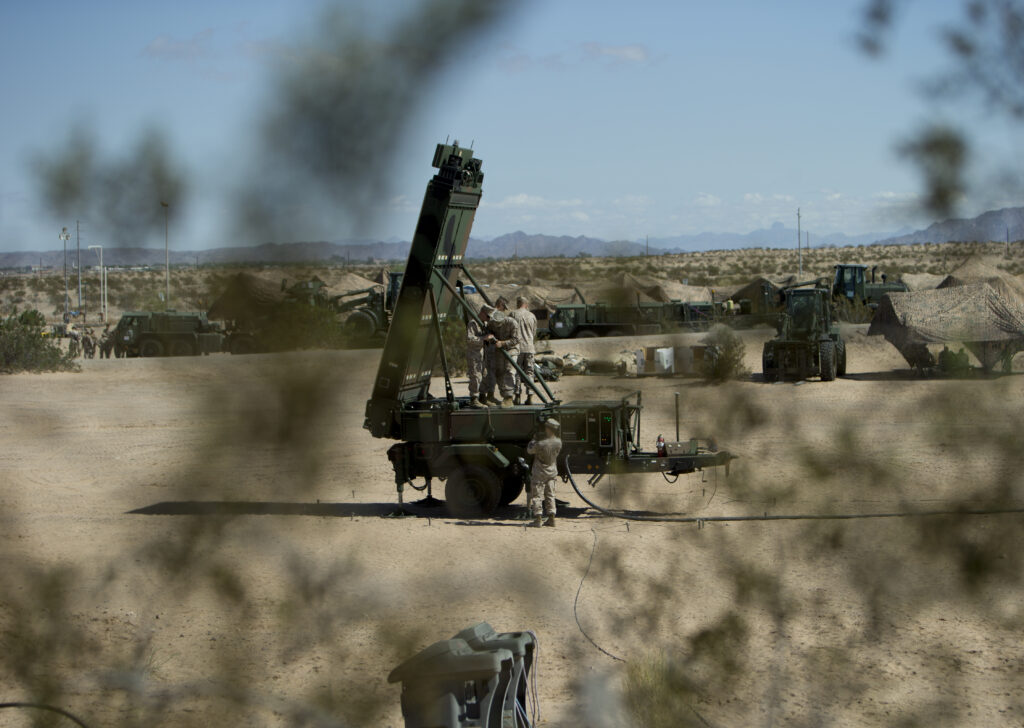
U.S. Marines with the Early Warning Control Crew, radar technicians, install the arms of the Ground/Air Task Oriental Radar (G/ATOR) in 2015 at Cannon Air Defense Complex, Yuma, Arizona. U.S. MARINE CORPS / Cpl. Summer Dowding

RAMSTEIN, Germany — The U.S. Marine Corps has deployed one of its units along with an AN/TPS-80 Ground/Air Task Oriented Radar (G/ATOR) to Lithuania for the first time to support NATO’s enduring air policing mission, NATO’s Allied Air Command Public Affairs Office said April 25. 

This unit provides multi-domain command and control, air defense, air traffic control, radar surveillance and communications support. The G/ATOR allows Marines to conduct air surveillance and air domain awareness in support of NATO operations. 

“This deployment highlights the expeditionary character of our Marines and the command-and-control systems they employ such as the AN/TPS-80 G/ATOR,” said Col. Michael McCarthy, commanding officer of the deployed unit. “With little notice and a light footprint we were able to seamlessly move from training in an arctic, maritime environment to the Baltics; reassuring allies and immediately contributing to USAFE [U.S. Air Forces Europe] and NATO operations.” 

The Marine Corps unit deployed in support of Norwegian led Exercise Cold Response 22 before repositioning to Lithuania. They are a command-and-control unit, which provides multi-domain command and control, air defense, air traffic control, radar surveillance, and communications support. The AN/TPS-80 G/ATOR is the Marine Corps’ newest medium range multi-role radar. The radar builds an airspace picture for controllers through active scanning. 


Marine Corps to Use Leased Ships to Test Light Amphibious Warfare Ship Concept 

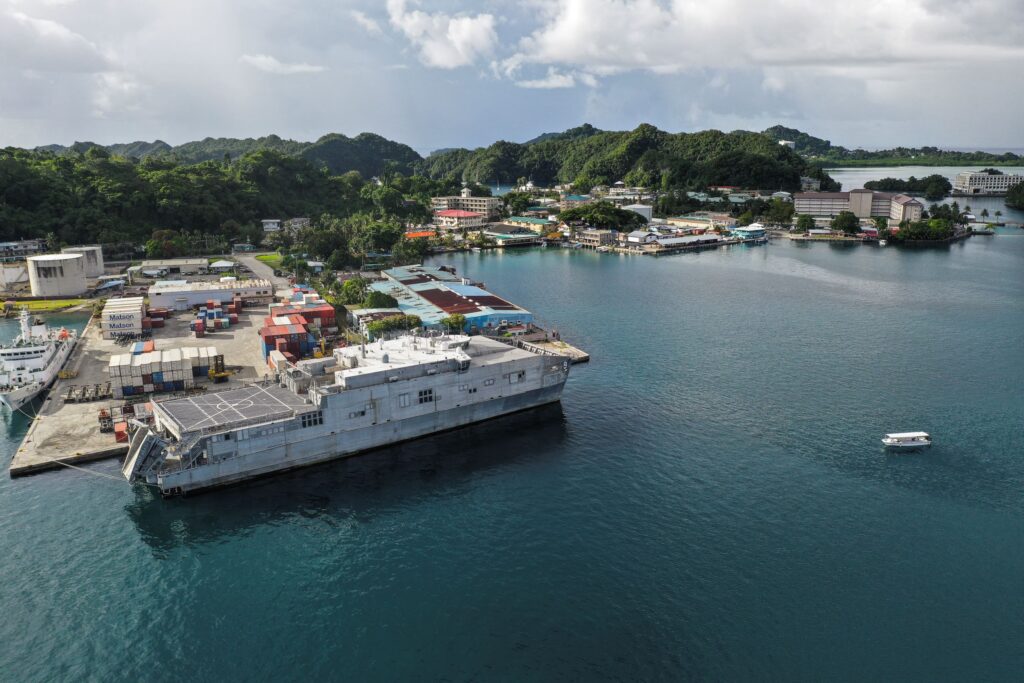
U.S. Military Sealift command’s Spearhead-class expeditionary fast transport ship, City of Bismarck, floats while docked at the Commercial Seaport of Palau in Koror, Republic of Palau, Nov. 5, 2021. Spearhead-class ships may be used to test the concept for a light amphibious warfare ship. U.S. MARINE CORPS / Cpl. Atticus Martinez

ARLINGTON, Va. — The Marine Corps plans to lease two commercial ships over the next two years to experiment with the light amphibious warfare ship concept, also now being classed as the landing ship-medium. 

Brig. Gen. Mark Clingan, assistant deputy commandant for Combat Development and Integration and deputy commanding general of Marine Corps Combat Development Command, speaking April 21 in a webinar of the National Defense Industrial Association, said the Corps was planning to lease a commercial “stern[-ramp] landing vessel” by late summer or early fall [2022]” to use to test the LAW/LSM concept. 

Clingan said a second vessel would be leased in fiscal 2023 for the same purpose. 

The general said the Corps also was looking at using Spearhead-class expeditionary fast ships — which do not have beach landing ramps — and utility landing craft — which do — as part of the concept experimentation. 

The LAW will be designed to carry 75 Marines of a Marine Littoral Regiment and land them on a shore in support of distributed maritime operations and expeditionary base operations. Clingan said the ships would be able to operate within the weapons engagement zone and be less attractive targets for enemy missiles than would a larger amphibious warfare ship.  

Clingan said that with each Marine Littoral Regiment comprised of nine platoons or units of action — one on each light amphibious warfare ship — 27 LAWs would be needed to support the three MLRs. Counting extra MLRs in the maintenance pipeline, the Corps lists 35 LAWs as its probable requirement.  

The Navy plans to procure the light amphibious warfare ship beginning in fiscal 2025. 


Marine Corps May Keep More Tube Artillery, Osprey Squadrons in Force Design 2030 

An MV-22 Osprey aircraft, assigned to Marine Medium Tiltrotor Squadron 166 (Reinforced), departs the flight deck of amphibious assault ship USS Boxer (LHD 4) in 2016. U.S. NAVY / Mass Communication Specialist 2nd Class Jose Jaen

ARLINGTON, Va. — The Marine Corps continues to tweak its Force Design 2030, adjusting the number of tube artillery batteries, the number of MV-22B squadrons, the operation of a Marine Littoral Regiment and the size of an infantry battalion. 

Under Force Design 2030, the Marine Corps is divesting itself of some force structure and weapon systems and building others to reshape the Corps to be more capable of operating inside a threat zone in the current era of great power competition. 

Brig. Gen. Mark Clingan, assistant deputy commandant for Combat Development and Integration and deputy commanding general of Marine Corps Combat Development Command, speaking April 21 in a webinar of the National Defense Industrial Association, said the Corps is looking at retaining more tube artillery batteries, choosing to retain seven batteries instead of five. 

The tube artillery batteries operate M777 155mm howitzers. 

Clingan also said the Corps will continue to field 16 Marine Medium Tilt-rotor Squadrons rather than reduce to 14 squadrons. However, the number of MV-22B Osprey aircraft in each squadron would decrease from 12 to 10 aircraft. One squadron, VMM-166, was deactivated last year. 

He said the Corps’ force design plans “probably weighted too much on the Marine Littoral Regiment and did not really acknowledge that to appropriately be able do the recon/counter-recon fight is going to require the full complement and scope of the Marine Air-Ground Task Force, and so MLRs are singular units but are still going to be very much a part of reaching back and employing the resources of the entire MAGTF. 

Regarding the design of the MLR, Clingan said, “we probably focused too much on lethality without taking enough look or considering specifically the requirement to ‘sense and make sense,’ the mobility and maneuverability and also the need for deception. Now we’re making refinements to that as well. 

“Our initial thoughts were that MLR units would be sourced through UDP [the Unit Deployment Plan] rotation and now we’re opening the aperture and think, maybe, some PCS [permanent change of station] personnel may be more suited to the terms of the units,” he said. 

The Corps has one MLR on strength, the 3rd MLR. Two more MLRs are planned in the future: the 12th and probably the 4th. 

Regarding the size of an infantry battalion, “we initially thought we would be cutting that from about 896 [Marines and Sailors] down to 735,” he said. Noting the need to make the battalions more “robust and capable,” the number of personnel in a battalion “probably need to hover around numbers about 800-835 to have the capabilities it needs.” 


BAE Systems to Study New Amphibious Combat Vehicle Variant  

BAE Systems will study incorporating a C4/UAS payload on the Amphibious Combat Vehicle. BAE SYSTEMS

STAFFORD, Va. — BAE Systems has received task instructions from the U.S. Marine Corps to complete a study of incorporating Advanced Reconnaissance Vehicle-Command, Control, Communication and Computers/Unmanned Aerial Systems mission payload on an Amphibious Combat Vehicle (ACV) variant, the company said April 7.

Pending the results of the phase 1 study, the Marine Corps may pursue modification of an ACV to install the C4/UAS payload. This C4/UAS variant will provide the transformational technology Marines need to observe their surroundings, collect and integrate information, and sense new targets over the horizon. 

The ACV C4/UAS will feature a state-of-the-art battle management system and advanced sensing capabilities. Offering a substantial level of commonality with other ACV variants, BAE Systems will work toward a fully open-architecture approach, allowing for rapid technology refresh and upgrades, including seamless integration of future technologies and capabilities. This has the potential to provide the Marine Corps significant economies of scale in development and life-cycle management costs.   

“BAE Systems is dedicated to offering innovative combat system solutions to meet the multi-domain needs of the U.S. Marine Corps’ modernization efforts,” said John Swift, vice president of amphibious programs at BAE Systems. “Adding the C4/UAS variant to the ACV family of vehicles may offer development and life cycle cost savings. We look forward to continuing our commitment to the Marines’ ability to be unmatched on the battlefield.” 

The ACV is a highly mobile and proven solution capable of conducting rapid ship-to-objective maneuver, delivering enhanced combat power to the Fleet Marine Forces. The ACV was developed with teammate IVECO Defence Vehicles. 

BAE Systems has received two full-rate production contracts since the Marine Corps declared initial operational capability for the ACV family of vehicles program, which includes the ACV personnel variant (ACV-P) and the ACV command variant (ACV-C). The company is currently under contract to design and develop a 30mm cannon variant (ACV-30) and a recovery variant (ACV-R).  

ACV C4/UAS engineering, integration, and fabrication is taking place at BAE Systems locations in Stafford, Virginia.; San Jose, California; Sterling Heights, Michigan; and York, Pennsylvania. 


Corporate Cybersecurity Expert Says Think Like an Attacker to Improve Information Security

“You’ve got to be able to take a punch in this environment,” said Lt. Gen. Matthew Glavy, the Marine Corps Deputy Commandant for Information. LISA NIPP

NATIONAL HARBOR, Md. — The U.S. government, military and private sector need to change the way they perceive cybersecurity and look at it from the attacker’s point of view, the global head of IBM’s X-Force said.

“I think that we will look back at 2022 as a tipping point for information security and the way we work with each other: private sector, public sector. Really, all of these silos which we’ve built up are meaningless for attackers,” Charles Henderson said April 5 during a panel discussion on maritime cybersecurity at Sea-Air-Space 2022.

“They care about their rules, not yours,” he continued. “All too often in information security, whether it’s public sector, private sector or somewhere in between, we tend to think of our own goals and not the goals of the attacker. I think if we’re going to be successful, we need to turn that on its head and start looking at everything through the eyes of an attacker.”

All of the panelists agreed that keeping information secure is essential to maintaining an advantage over adversaries and keeping them from gaining an advantage.

Navy Rear Adm. John Okon, the head of the Warfare Integration Directorate (N2/N6F) in the Office of the Chief of Naval Operations, said “Cybersecurity is really about warfighting. It’s important that we get cybersecurity right, up front, if we’re going to be a lethal, agile and ready force.” To underscore its importance, Okon called cybersecurity “commanders’ business,” but he added that “everyone that puts their fingers on a keyboard has a role in responsibility and accountability for cybersecurity.”

Okon said the Navy Department needed to shift its culture from compliance to readiness. “Expect what you inspect. That’s walking the deck plates every day, looking at your network every day.” Making sure  that the speed from when a vulnerability is identified to a patch is in place comes not in weeks, “but minutes or seconds.”

Lt. Gen. Matthew Glavy, the Marine Corps Deputy Commandant for Information, said the side that is able to maintain the information advantage “has an edge.” That edge could be system overmatch, a good prevailing narrative of “trusted, competent, delivered with trade craft,” or resiliency. “You’ve got to be able to take a punch in this environment,” Glavy said “and the side that can take that punch and either counterpunch or begin anew, creates an edge.”

The Marines are in the final stage of crafting a new information doctrine, Marine Corps Doctrinal Publication 8 Information “all founded on our warfighting construct of maneuver warfare.”

“Protecting your own backyard, you’ve got to have a good defensive perimeter and terrain that you can defend to ensure your capabilities are available where and when you need them. That’s job one for us,” said Rear Adm. Mike Ryan, commander of Coast Guard Cyber. He said the Coast Guard was following the lead of U.S. Cyber Command, generating forces that allow the agency to provide the entire spectrum of capabilities to protect the homeland, ensure mariner safety and secure the $5.4 trillion economic activity that arrives on U.S. shores by maritime commerce.


Assistant Commandant: Marines Must Be Ready to Fight China, Other Adversaries Directly

Sgt. Maj. Troy E. Black speaks during a panel discussion at the Marine Corps Force Design session. SOLARES PHOTOGRAPHY

NATIONAL HARBOR, Md. — The assistant commandant of the Marine Corps said the service must always be prepared for a direct war with China or any other adversaries during a panel discussion at the Navy League’s Sea-Air-Space symposium here on Tuesday.

In initial comments while moderating a panel including three other top service officials on the subject of Marine Corps force design, Gen. Eric Smith said it is not wise to assume the United States won’t go to war with China.

“The pacing threat is China,” Smith said. “People will say, ‘Well, you’re not going to fight China.’ Hey, that’s not for you to say. That’s not for me to say. There’s a plan required to fight the adversaries who may threaten this country — North Korea, China, Russia, violent extremists. We don’t get to say, ‘Hey, we didn’t think that was going to happen, so we didn’t build a plan.’ You always pace off the fastest runner even if you don’t think that’s who you’re going to beat in the final match. You pace off the faster runner and then you pivot to the runners who may not be that fast, and then you’re good.”

Smith said it is vital the Marines continue to be the nation’s naval expeditionary force. “We are still America’s crisis response force,” he said. “We will seize or defend advance naval bases and conduct land campaigns in the furtherance of fleet operations.”

A naval expeditionary force is vital to provide an alternative to deterrence besides nuclear weapons, Smith argued.

“Our part of the joint warfighting concept [is] we deter,” he said. “When you’re talking about a nuclear-armed peer adversary, you don’t want nuclear deterrence to be your only deterrence. … You want to deter forward [and] thwart every nefarious action that’s happening. You want to thwart it from its infancy. You have to be forward deployed from a naval expeditionary force to do that.”