Controversial EABO Concept Has Potential but Will Be Vetted, Speakers Say
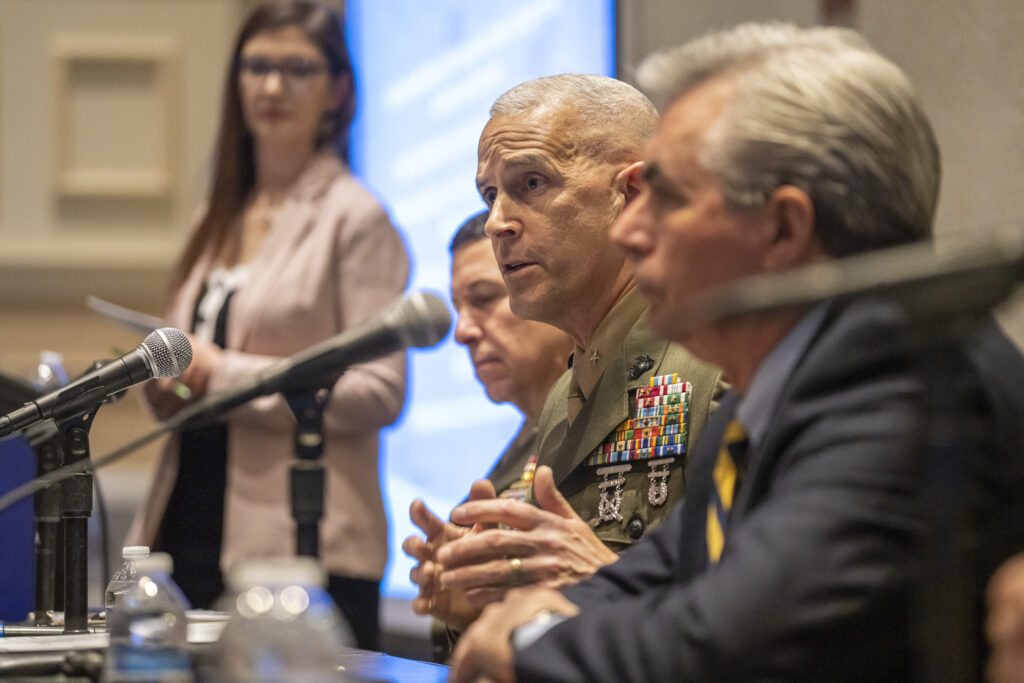
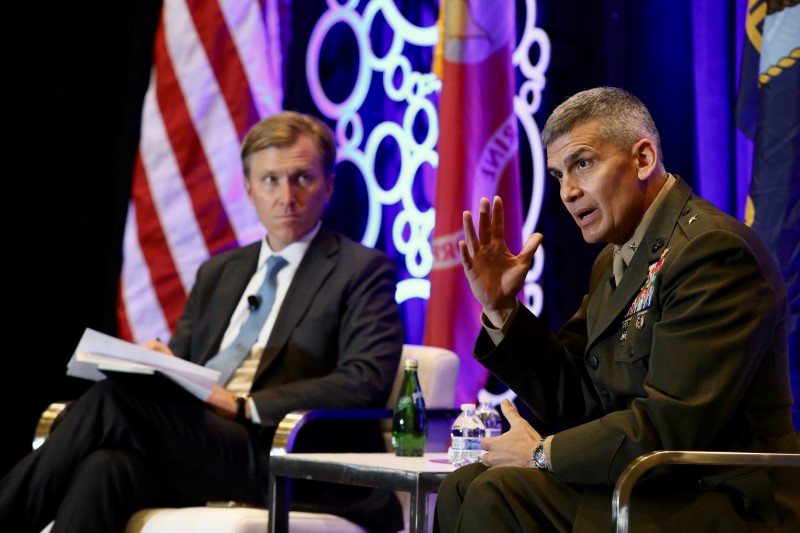
Brig. Gen. David Odom, Director of Expeditionary Warfare, OPNAV N95 addresses questions during the Expeditionary Advanced Base Operations session. SOLARES PHOTOGRAPHY

NATIONAL HARBOR, Md. — The Marine Corps’ concept of deploying small, lightly armed but highly mobile units into isolated locations within an adversary’s weapons engagement zone — called Expeditionary Advanced Base Operations — has the potential of quickly getting forces into a strategically vital area in response to an evolving threat when no other U.S. military assets are available, a senior Marine officer said April 5. 

In addition to being a response to a threat, the concept also could serve as a deterrent by making an adversary stop to think before taking offensive actions, Maj. Gen. Benjamin Watson, Commanding General, Marine Corps Warfighting Laboratory, told an audience at Sea-Air-Space 2022. 

Although the EABO proposal has been controversial, partly because Marine Corps Commandant Gen. David Berger is executing a dramatic restructuring of Marine forces to facilitate it, sharply cutting heavy weapons like tanks and towed artillery, and reducing total end strength. 

But Watson emphasized EABO is “a naval concept,” which was approved by both Berger and Chief of Naval Operations Adm. Michael Gilday, and would directly involve Navy assets, including aircraft carrier battle groups. 

And EABO “is a concept. It’s not proven yet,” and will be tested repeatedly and in increasing detail in the future, Watson said, which was reinforced by other officials on the panel. 

Brig. Gen. David Odom, director Expeditionary Warfare on the Navy staff, echoed both the naval aspects of EABO and the intensity of the experimentation process that lies ahead. Odom cited a number of recent exercises, including Nobile Focus, which involved two Marine expeditionary units, Navy surface action ships and Japanese Self Defense Forces. That exercise and further trials tested one of the critical challenges of the EABO concept — how to support and sustain these isolated units. 

The sustainment and support question must be addressed by substantial “engineering” work, including procuring new amphibious ships and unmanned systems, Odom said. 

The Marines are strongly urging production of a light amphibious warfare ship, which would be much smaller and more nimble than existing amphibs. The new Navy budget proposed delaying starting the LAW program. 

Tim Kao, vice president of data science at the Center for Naval Analysis, noted the challenge of sustainment is created by the development of precision anti-ship missiles and other systems by potential adversaries such as China, which prohibit past supply procedures like those used in Operation Desert Storm. 

And Kao said in considering EABO, “You really have to think through how we contribute to deterrence.” 

Retired Rear Adm. Jamie Barnett, vice president of Global Communications Solutions at Viasat, said his firm’s extensive and growing fleet of communications satellites could help the EABO units by providing the secure connections to keep them from being isolated. 


Russia is Acute Threat, China is Priority Threat, Speakers Say

Brig. Gen. Sean Salene called the United States a “Pacific nation.” LISA NIPP

NATIONAL HARBOR, Md. — The U.S. Defense Department will continue to have a priority focus on China despite the global military community’s recent attention to the war in Ukraine, said Elbridge “Bridge” Colby, a former U.S. deputy assistant secretary of defense for strategy and force development, in a one-on-one April 4 discussion with U.S. Marine Corps Brig. Gen. Sean Salene.

“The China problem remains very grave,” said Colby. “In a lot of respects, this to me is really going to be the core of the defense strategy going forward. We see China continue to be named as the priority challenge. China is the long-term challenge, and the only one that can challenge the United States and our interests in a really sustaining and global way.”  

As he prepared to introduce Salene, Colby posited questions about the concept of integrated deterrence, and asked whether the U.S. will prioritize the Indo-Pacific region and over what time period. Overall, he said the U.S. needs a sustainable Indo-Pacific strategy and must carefully consider the nature of its alliances and partnerships in the region. He said the United States must work to fully understand how to deal, for example, with countries like India, which may have a different perspective on Russia than does the U.S.

“What does it mean that Russia is an acute threat whereas China is the priority threat? How are we going to go about doing that? Or do we need to prioritize at all? Some people are saying maybe we double the defense budget and you get out of prioritization,” Colby said.

Salene, the director of the Strategy and Plans Division, Plans, Policies and Operations at Marine Corps Headquarters, said there are four overarching priorities in the National Defense Strategy, among them “first and foremost” to defend the homeland. Other priorities include deterring a strategic attack against the United States and against its allies and partners; deterring aggression from China, particularly in the Indo-Pacific, and then against the Russia challenge in Europe; and building a resilient joint force and the ecosystem that supports it inside the defense establishment.

Salene said the Indo-Pacific region is critically important to the U.S. and its partners and allies, and the U.S. is committed to helping its allies defend their own sovereignty.

“We are a Pacific nation,” Salene said. “You probably know how much trade goes though there. You probably know the value and the rise of Asia, and what it means to the development of the entire world.”

He said the most important themes going forward involve the key strategic advantages of working with allies and partners, and the “integrated nature at which we would apply all of the elements of our national power,” also known as integrated deterrence. 


Marine Corps’ Black Sheep to Ride the Lightning 

An AV-8B Harrier and an F-35B Lightning II are staged during the change of command and re-designation ceremony for Marine Fighter Attack Squadron 214 aboard Marine Corps Air Station Yuma, Arizona, March, 25. U.S. MARINE CORPS / Sgt. Samuel Ruiz

ARLINGTON, Va. — The Marine Corps’ famous Black Sheep squadron has a new designation as it upgrades to from its AV-8B Harrier II attack jet to its new aircraft, the Lockheed Martin F-35B Lightning II strike fighter. 

Marine Attack Squadron 214 (VMA-214) — the Black Sheep — was re-designated Marine Fighter Attack Squadron 214 (VMFA-214) at Marine Corps Air Station (MCAS) Yuma, Arizona, on March 25, marking the beginning of its transition from the AV-8B to the F-35B.  

VMA-214 was the last AV-8B squadron based at Yuma and based near the West Coast. Three other AV-8B squadrons — VMAs 223, 231, and 542 — remain in service at MCAS Cherry Point, North Carolina. The Harrier is scheduled to serve with the Marine Corps until fiscal 2028. 

Having flown the Harrier since 1989, the Black Sheep routinely deployed six-plane detachments on board amphibious assault ships as part of the Air Combat element of a Marine Expeditionary Unit and flew combat missions in numerous operations. 

The Black Sheep began as Marine Fighter Squadron 214, activated with F4F Wildcat fighters on July 1, 1942, in Hawaii. In August 1943, Maj. Gregory “Pappy” Boyington and Maj. Stan Bailey formed a group of unassigned pilots into a combat squadron with the callsign “Black Sheep” and flew their F4U-1 Corsair fighters to an outstanding record in the Solomon Islands. 

The squadron has built a solid legacy with numerous aircraft types in combat in World War II, the Korean War, the Vietnam War, Somalia, Iraq and Afghanistan and many other crises. For the official history of the Black Sheep, see this link: https://www.3rdmaw.marines.mil/Units/MAG-13/VMA-214/History/ 

“Having previously served in VMA-214 and flown the AV-8B for many years, the Black Sheep and the Harrier hold a special place in my heart,” said Maj. Gen. Bradford J. Gering, the commanding general of 3rd Marine Aircraft Wing, in a Marine Corps release. “As 3rd MAW says a bittersweet farewell to the Harrier, we are excited to increase our number of F-35B squadrons with the re-designation of VMFA-214.” 

“The re-designation of VMA-214 to VMFA-214 is the end of a legacy for the Black Sheep and Marine Aircraft Group-13,” said Lt. Col. Keith Bucklew, the outgoing commander of VMA-214. “This symbolic event finalizes the sundown for Harriers on the West Coast and closes the chapter on 58 years of attack aircraft operations for the Black Sheep. 

“Finishing this mission with a successful 11th Marine Expeditionary Unit deployment is a testament to the viability and performance of the Harrier over the last 33 years and, more importantly, the talent of the Marines who managed them,” Bucklew said. “The AV-8B will be missed in the skies of Yuma, but it is time to transition to the next generation of fighter attack aircraft.” 

“The F-35’s fifth-generation strike fighter capability brings more lethality and flexibility to combatant commanders than any other fighter platform,” said Lt. Col. Christopher Kelly, the commanding officer of VMFA- 214. “The STO/VL capability inherent in the F-35 B variant allows the Marine Corps to operate expeditiously and from remote locations, making the model uniquely qualified at supporting expeditionary advanced base operations.” 


Marine Corps Orders 36 More Amphibious Combat Vehicles 

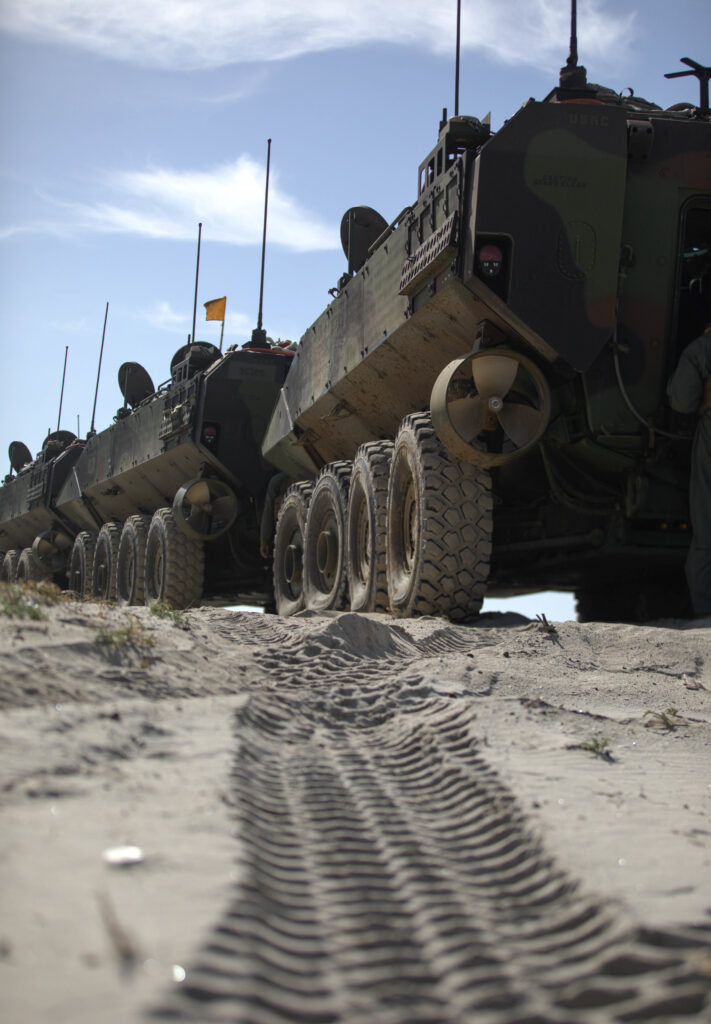
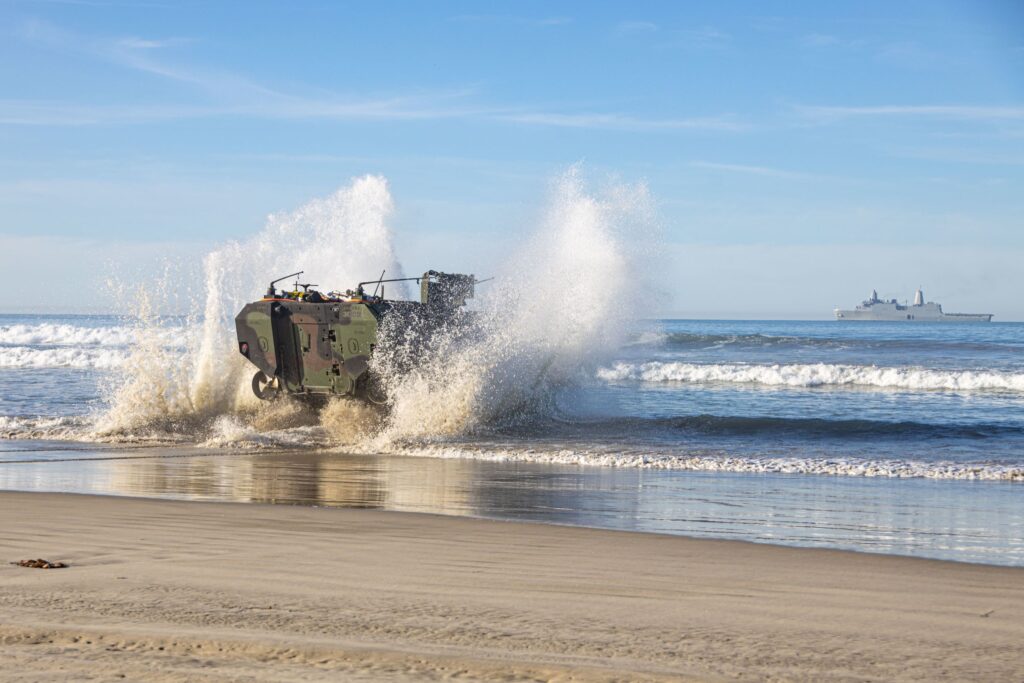
U.S. Marine Corps amphibious combat vehicles with 3d Assault Amphibian Battalion, 1st Marine Division, conduct movement on the shore after a successful training evolution at Marine Corps Base Camp Pendleton, California, March 13. U.S. MARINE CORPS / 2nd Lt. Joshua Estrada

ARLINGTON, Va. — The Marine Corps has ordered 36 more Amphibious Combat Vehicles, the Defense Department announced March 25. 

Marine Corps Systems Command, Quantico, Virginia, awarded BAE Systems Land & Armaments L.P., Sterling Heights, Michigan, a $173.6 million contract modification for a full-rate production lot of ACVs and “associated production, and fielding and support costs.” The deliveries are expected to be completed by March 2024. 

The ACV is an amphibious armored vehicle — with a crew of three Marines — designed to carry 13 Marines in shock-mounted seats from ship to shore in an opposed landing and to carry those Marines inland. Its V-shaped hull is designed to provide blast protection from mines.  

In addition to the personnel carrier versions (ACV-P), BAE Systems has delivered the prototype of the command variant (ACV-C) and is under contract to design and develop the 30mm cannon-armed variant (ACV-30) and the recovery variant (ACV-R). 

The contract raises the number of ACV-Ps ordered so far to more than 250. They are in full-rate production.

The ACV achieved initial operational capability on Nov. 13, 2020. The ACV is replacing the AAV7 family of assault amphibious vehicles that have been in service since the early 1970s. 


Marine Corps Orders Development of Recovery Variant of ACV 

U.S. Marines assigned to the 3rd Assault Amphibian Battalion, 1st Marine Division, conduct waterborne training with an Amphibious Combat Vehicle from shore to loading amphibious transport dock ship USS Anchorage (LPD 23) at Marine Corps Base Camp Pendleton, California, Feb. 12. U.S. MARINE CORPS / Lance Cpl. Willow Marshall

QUANTICO, Va. — The Marine Corps has taken the next step in developing its family of Amphibious Combat Vehicles by beginning development of a maintenance/recovery variant of the ACV. 

The Marine Corps Systems Command awarded BAE Systems Land & Armaments L.P., Sterling Heights, Michigan, a $34.9 million cost-plus-fixed-fee contract modification to procure labor and material for the design and development of the ACV-R maintenance/recovery variant, according to a March 18 Defense Department contract announcement.   

Development of the command-and-control variant, the ACV-C, and the ACV-30 — the latter armed with a 30mm cannon — began in June 2019. The first ACV-C variant was delivered to the Marine Corps in February 2021. 

The basic infantry personnel carrier, the ACV-P, is in full-rate production and is in service with amphibious assault battalions. 

Work on the ACV-R under the contract modification has an expected completion date of October 2023.  


Four Marines Die in MV-22B Crash in Norway 

Four Marines died in a crash during a training flight south of Bodo, Norway, in support of Exercise Cold Response 2022, March 18. All four Marines were assigned to Marine Medium Tiltrotor Squadron 261. U.S. MARINE CORPS

ARLINGTON, Va. — A Marine Corps MV-22B Osprey tilt-rotor transport aircraft crashed in Norway on March 18, killing all four Marine crewmen on board. 

The Osprey, assigned to Marine Medium Tiltrotor Squadron 261 (VMM-261), based at Marine Corps Air Station New River, North Carolina, was on a flight south of Bodo, Norway, when it crashed while supporting NATO’s Exercise Cold Response 2022. 

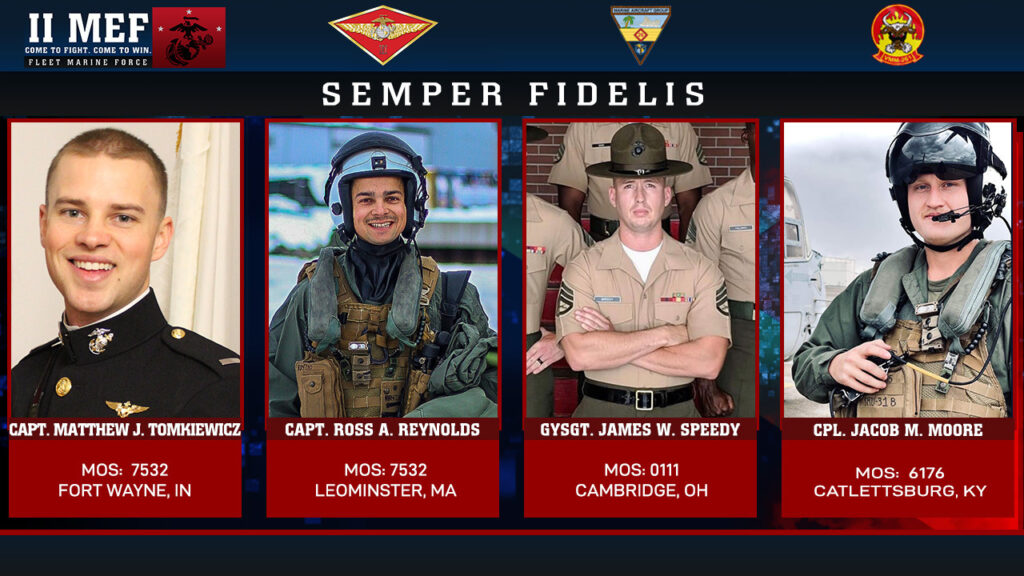
Killed in the crash were Capt. Matthew J. Tomkiewicz of Fort Wayne, Indiana; Capt. Ross A. Reynolds of Leominster, Massachusetts; Gunnery Sgt. James W. Speedy of Cambridge, Ohio; and Cpl. Jacob M. Moore of Catlettsburg, Kentucky, according to a March 21 release from the II Marine Expeditionary Force.   

Norwegian agencies, including the Royal Norwegian Air Force’s 330 Squadron and the Hoved Redning Sentralen civil emergency and response organization led in locating the aircraft’s wreckage and in recovery of the bodies of the victims. 

“The pilots and crew were committed to accomplishing their mission and serving a cause greater than themselves,” said Maj. Gen. Michael Cederholm, commanding general, 2d Marine Aircraft Wing, in a release. “We will continue to execute the mission while keeping these Marines and their service in the forefront of our minds. We will never allow these Marines and their service to go unnoticed or unappreciated. Keep these Marines and their loved ones in your thoughts and prayers.” 

The mishap is under investigation. 


Elements of Kearsarge ARG and 22nd MEU Deploy 

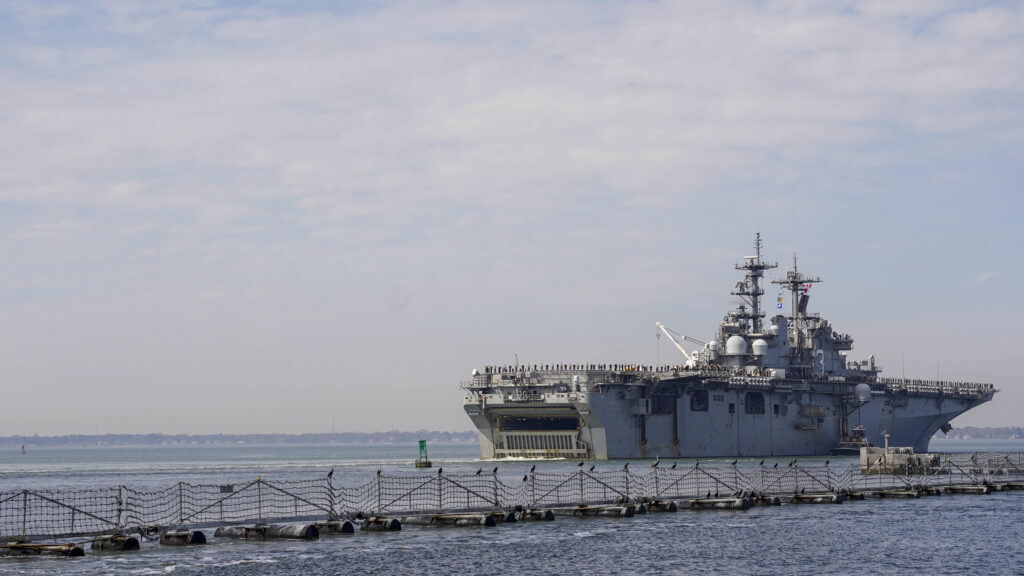
The Wasp-class amphibious assault ship USS Kearsarge (LHD 3) departs Naval Station Norfolk, March 16. Kearsarge Amphibious Readiness Group with embarked 22nd Marine Expeditionary Unit deployed from Naval Station Norfolk and Camp Lejeune, North Carolina, for a regularly scheduled deployment. U.S. NAVY / Mass Communication Specialist 2nd Class Anderson W. Branch

NORFOLK, Va. — Elements of the Kearsarge Amphibious Ready Group with embarked 22nd Marine Expeditionary Unit departed Naval Station Norfolk and Camp Lejeune, North Carolina, for a regularly scheduled deployment on March 16, U.S. 2nd Fleet Public Affairs said in a release. 

The deployment is part of a regular rotation of forces that foster maritime security and increased theater cooperation by providing a forward naval presence with vast, specialized crisis response capabilities. 
 
“After months of rigorous training, the Kearsarge ARG and 22nd MEU are ready to exercise our mission sets across a range of military operations,” said Capt. David Guluzian, commander of Amphibious Squadron 6. “The ARG-MEU team is a fully integrated, multi-mission fighting force ready to respond and decisively engage any situation or challenge during this deployment.” 
 
The ARG consists of the Wasp-class amphibious assault ship and ARG flagship USS Kearsarge (LHD 3), amphibious transport dock ship USS Arlington (LPD 24) and dock landing ship USS Gunston Hall (LSD 44). Gunston Hall is scheduled to depart Joint Expeditionary Base Little Creek later in the month. 
 
Embarked commands with the Kearsarge ARG include commander, Amphibious Squadron 6, Fleet Surgical Team (FST) 2, Tactical Air Control Squadron (TACRON) 22, Helicopter Sea Combat Squadron (HSC) 28, Assault Craft Unit (ACU) 2, Assault Craft Unit (ACU) 4, Naval Beach Group (NBG) 2 and Beach Master Unit (BMU) 2. 
 
The 22nd MEU, commanded by Col. Paul Merida, will serve as a sea-based, expeditionary crisis response force capable of conducting amphibious missions across the full range of military operations. The 22nd MEU includes the command element; the aviation combat element, Marine Medium Tiltrotor Squadron, 263 (Reinforced); the ground combat element, Battalion Landing Team 2/6 (Reinforced); and the logistics combat element, Combat Logistics Battalion 26. 
 
“During the course of a comprehensive six month training program, the Kearsarge Amphibious Ready Group and the 22nd Marine Expeditionary Unit have built a closely integrated and well trained naval expeditionary force,” said Merida. “We stand ready for any mission or challenge that comes our way.” 
 
This deployment follows months of intense training and preparations during various maritime integration exercises. The Kearsarge ARG-MEU team most recently concluded a composite training unit exercise, a series of exercises designed to fully integrate roughly 4,000 Sailors and Marines into one cohesive contingency force while testing the units’ abilities to carry out sustained operations from the sea. During COMPTUEX, the ARG-MEU operated under NATO command and control, which was a first for an ARG-MEU and is typically only practiced among carrier strike groups. Additionally, this exercise marked the first time a U.S. Coast Guard cutter participated in an ARG-MEU exercise by providing valuable interoperability experience between naval and USCG forces. 
 
The Kearsarge ARG-MEU team is manned, trained, and equipped to fulfill amphibious requirements in support of maritime security and stability. Amphibious ready groups and larger amphibious task forces provide military commanders a wide range of flexible capabilities including maritime security operations, expeditionary power projection, strike operations, forward naval presence, crisis response, sea control, deterrence, counter-terrorism, information operations, security cooperation and counter-proliferation, and humanitarian assistance and disaster relief. 


Berger: Ukraine War Demonstrates Vulnerability of Tanks to Missile-Armed Infantry 

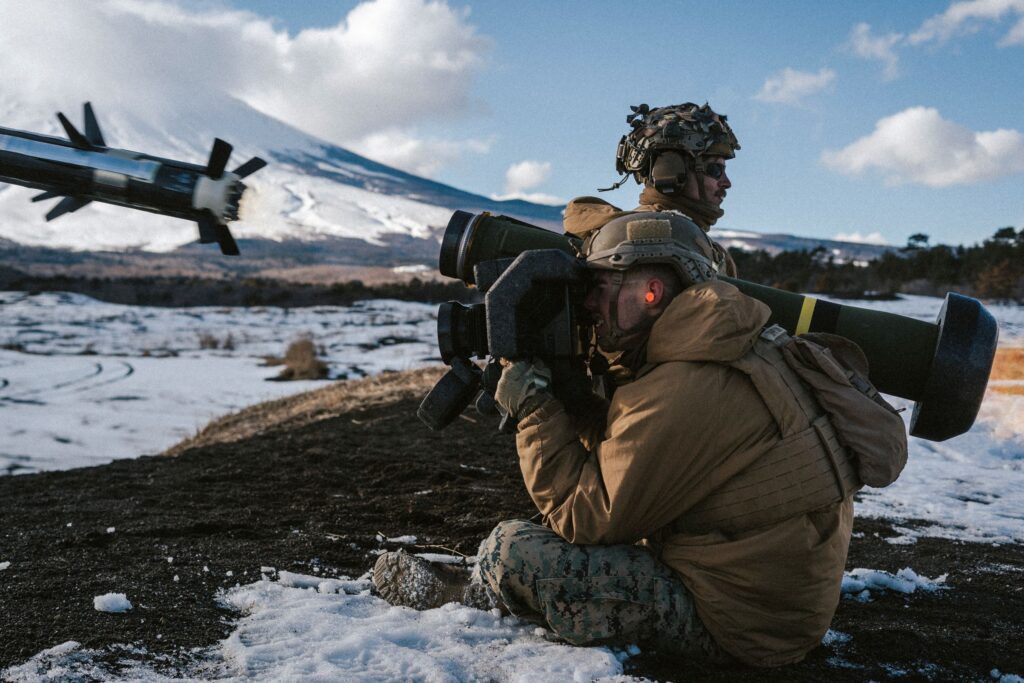
U.S. Marines with 1st Battalion, 3d Marines, 3d Marine Division fire a Javelin shoulder-fired anti-tank missile while conducting squad attacks during Fuji Viper 22.3 at Combined Arms Training Center, Camp Fuji, Japan, Feb. 17. Javelins have proven to be effective against tanks in Ukraine and elsewhere. U.S. MARINE CORPS / Cpl. Juan Carpanzano

WASHINGTON — The success of Ukrainian forces in countering Russian armored vehicle columns with missiles and rockets in the ongoing Russian invasion of Ukraine shows the vulnerability of tanks to missile-armed infantry, the Marine Corps commandant said, and seemed to reinforce his decision to shed tanks from the Corps as part of his Force Design 2030 concept.    

During a live-streamed conversation with Washington Post columnist David Ignatius, Gen. David Berger said the Russian forces seemed to be ineffective in using a combined arms approach in that they were not using “maneuver to bolster your fires or using fires to set up your forces for maneuver. In both cases, one without the other … is very ineffective.” 

Berger also said Ukrainian forces seemed to be effective at causing confusion among Russian forces by stripping away Russian reconnaissance — which he said parenthetically that U.S. Marines “were very, very good at.”  

The commandant also noted Russian forces seemed to have planned for a very short war and lost momentum with poor logistics planning. He said the Ukrainian forces seemed to be able to strike at the Russian “logistics backside.”  

Berger noted that amphibious operations are very complex and the Russian forces seemed to unnecessarily delay their limited amphibious operations. He said amphibious operations remain very much the core mission of the Corps.    

 “Amphibious landings, amphibious assault, forcible entry — things which Marines are known for for 70 years — we’ll continue to do but in a very different way,” Berger said. “Why? Because the character of war is changing. We need to change with it. 

“Instead of tank-on-tank formations, I would say if you look at Armenia and Azerbaijan, Lebanon, or even right now in Ukraine, it’s pretty clear the top-down missile attacks on the top side of heavy armor makes [tanks] pretty vulnerable,” he said.  

The Javelin missiles supplied by the United States to Ukraine have a vertical attack mode. 

“Tanks did tremendous work for us for many years in many different scenarios,” Berger said. “Going forward, they are heavier, too difficult to logistically support, and in some cases too vulnerable to attack from a proliferation of very inexpensive missiles. 

“So, in some cases, we’ve let go of things that were very successful in the past in order to move towards things that we are going to need in the future,” he said. “The aviation/ground/logistics team — that’s the strength of the Marine Corps having it all organic — we are an enabler for the joint force. We’re the first ones on the scene to figure it out. We need the mobility to do that, which means we need amphibious ships, which [are] critical for the nation to have. 

“You need to have the ability — I would say especially today in Ukraine — to have a crisis response force from the sea,” he said. “That means we need to have the number of amphibious ships necessary to global in the pacific or the Mediterranean. For the U.S., that’s 31 amphibious ships we have to have in order to do what the nation needs us to do.” 


Marine Corps and Navy Aviation Fly Together for Manned-Unmanned Teaming

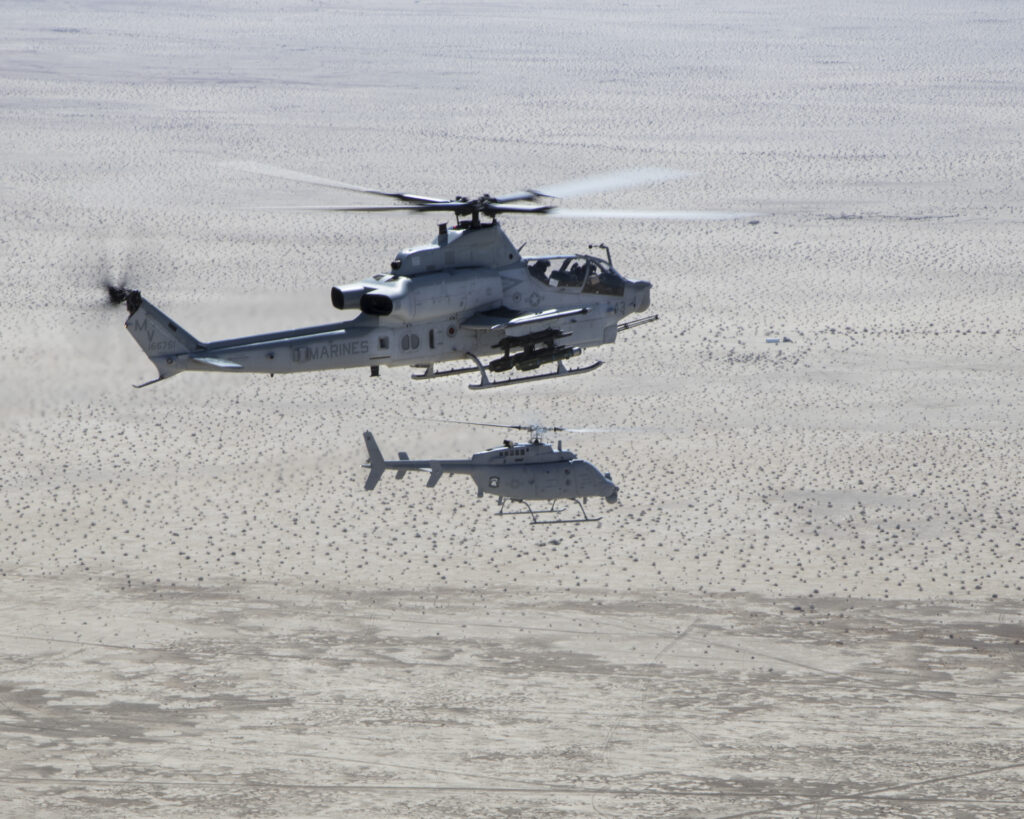
An AH-1Z Viper (top) with Marine Operational and Test Evaluation Squadron 1 (VMX-1), and an MQ-8C Fire Scout unmanned helicopter assigned to Helicopter Sea Combat Squadron 23 (HSC-23), conduct Strike Coordination and Reconnaissance Training near El Centro, California, March 10. U.S. MARINE CORPS / Lance Cpl. Jade Venegas

Washington, D.C. — Marines from Marine Operational Test and Evaluation Squadron One (VMX-1) and Sailors from Helicopter Sea Combat Squadron 23 (HSC-23) teamed to conduct tactics development in integrating manned and unmanned rotary-wing aircraft at Naval Air Facility El Centro, California, on March 10, Headquarters Marine Corps said March 15.

During the exercise, VMX-1’s UH-1Y Venom and AH-1Z Viper helicopters conducted attacks while Marines and Sailors operating in the ground control station assisted with the target detection and strike coordination utilizing a MQ-8C Fire Scout.

“This opportunity promotes greater familiarization and concept development of the manned-unmanned teaming that builds confidence and efficiency throughout the Blue-Green Team,” said VMX-1 Commanding Officer Col. Byron Sullivan. “Our partnership plays an integral part of the commandant and [Chief of Naval Operation]’s vision to embrace the future of warfare and turn it into our advantage on the battlefield.”

The services continue to develop manned-unmanned tactics to better align with the 2018 National Defense Strategy and the Commandant’s Planning Guidance. As the exercise in El Centro progressed, the Navy-Marine Corps team became more proficient in planning, communicating, and coordinating effective fires from manned and unmanned rotary wing aircraft. The proliferation of unmanned rotary wing platforms on U.S. Navy ships makes integration with Marine rotary wing and the MQ-8C a likelihood in the littoral environment.

“Adversaries are going to be placed on the horns of a dilemma as we strengthen our naval expeditionary force in leveraging unmanned systems to complement our rotary wing,” said VMX-1 Science and Technology lead Maj. Ben Henry.

The mission of VMX-1 is to conduct operational test and evaluation of Marine Corps aviation platforms and systems.


NGC Begins Full-Rate Production of Link-16 for the Marine Corps H-1 Fleet 

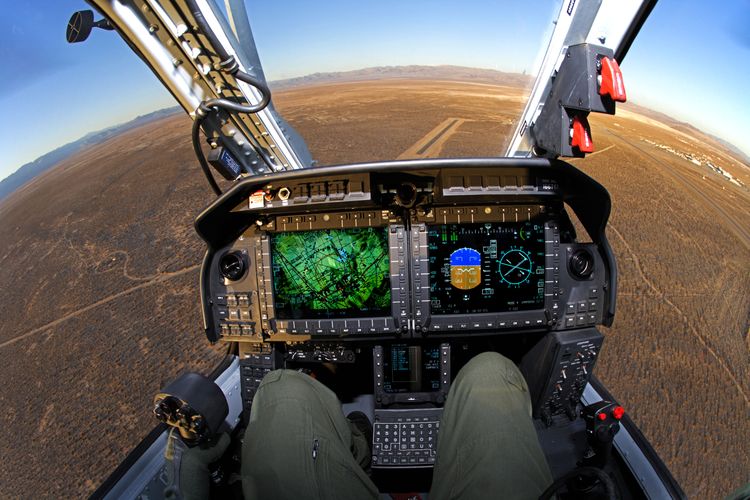
Link-16 will give the AH-1Z and UH-1Y the ability to share data and communications securely with other aircraft and users of military networks. NORTHROP GRUMMAN

WOODLAND HILLS, Calif. — Northrop Grumman has been awarded a $65 million contract by the U.S. Navy to execute the full-rate production of Link-16 for the U.S. Marine Corps AH-1Z and UH-1Y aircraft, which will involve the integration of data link hardware across the fleet, the company said March 9. 

“As lead technology integrator for H-1 Avionics, we are expanding our long-standing partnership with the Marine Corps to modernize electronic systems across the fleet through an open systems architecture approach,” said Lindsay McEwen, vice president, navigation, targeting and survivability at Northrop Grumman. “Link-16 full-rate production is the starting point.” 

Link-16 is a secure data link that allows H-1 crews to share data and communications with other aircraft and users on military networks. This capability is a critical mission enabler as the Department of Defense moves to joint all-domain command and control. 

The company said the processes, capabilities and open architecture developed for the H-1 fleet are directly applicable to other platforms and could be used in future aircraft development programs such as Naval Air Command’s Vertical Take Off and Landing Family of Systems, MUX and others.