Marine Corps Joint Air-to-Ground Missile achieves Initial Operational Capability
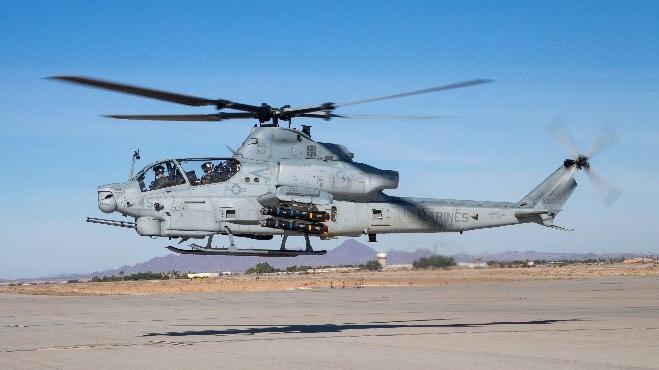
Marines pilot an AH-1Z Viper during a joint air-to-ground missile operational test at Marine Corps Air Station Yuma, Arizona, Dec. 6, 2021. U.S. MARINE CORPS / Cpl. Gabrielle Sanders
NAVAL AIR STATION PATUXENT RIVER, Md. — The U.S. Marine Corps declared initial operating capability for the AGM-179A Joint Air-to-Ground Missile on the AH-1Z Viper effective 1 March 2022, the Naval Air Systems Command said March 4.
JAGM, a joint program with the Army, is a precision-guided missile that combines semi-active laser guidance and millimeter-wave radar. It is an air-to-surface precision-guided munition used on joint rotary-wing, unmanned aircraft systems, and fixed-wing platforms to destroy high-value, stationary and moving, land and maritime targets.
“IOC marks a major milestone for the JAGM program and significant increase in capability for the AH-1Z,” said Cmdr. J. Reid Adams, deputy program manager for precision-guided missiles. “This accomplishment is a true testament of the tireless efforts made by so many across DoD and our industry partners to support the warfighter.”
The JAGM program successfully completed a thorough initial operational test and evaluation period with a recommendation to field the missile. AH-1Z pilots tested JAGM off the coast of Florida in November 2021 and conducted land-based testing in Arizona in December 2021.
IOC was achieved with missiles, training, and support equipment delivered to Marine Light Attack Helicopter Squadron 267 to support an upcoming deployment with the 13th Marine Expeditionary Unit.
“Incorporating systems such as JAGM on the AH-1Z is essential in keeping the platform at the forefront of warfighting capabilities,” said Col. Vasilios Pappas, USMC H-1 light/attack helicopter program manager.
JAGM provides improved lethality, operational flexibility, and a reduced logistics footprint to the H-1 platform. It is part of an effort to upgrade the AH-1Z and UH-1Y aircraft in alignment with the Commandant’s vision of force modernization to maintain a competitive edge against potential adversaries.
Marine Crew Ejects from F/A-18D Before Crash on Plantation
An F/A-18D Hornet from Marine All-Weather Fighter Attack Squadron (VMFA) 533 conducts air operations and maritime surface warfare training with the guided-missile cruiser USS Monterey (CG 61), not pictured, in 2016. U.S. NAVY / Mass Communication Specialist 2nd Class William Jenkins
ARLINGTON, Va. — A Marine Corps F/A-18D Hornet strike fighter crashed shortly near Beaufort, South Carolina on March 3, according to the 2nd Marine Aircraft Wing.
The two Marines in the crew ejected safely and incurred no injuries, the Wing said in a release, which said the crash occurred approximately 3:15 p.m.
“The aircraft crashed in an unpopulated area near Marine Corps Air Station Beaufort, South Carolina, and there was no damage to civilian property,” the Wing said.
According to television station WJCL, the Hornet crashed on the Coosaw Plantation owned by former South Carolina governor Mark Sanford.
The Hornet, assigned to the Hawks of Marine All-Weather Fighter Attack Squadron 533 (VMFA(AW)-533), a unit of Marine Aircraft Group 31. The squadron is one of four Hornet squadrons based at MCAS Beaufort.
The cause of the mishap will be investigated.
The 3rd Marines Come in First, As the First Marine Littoral Regiment
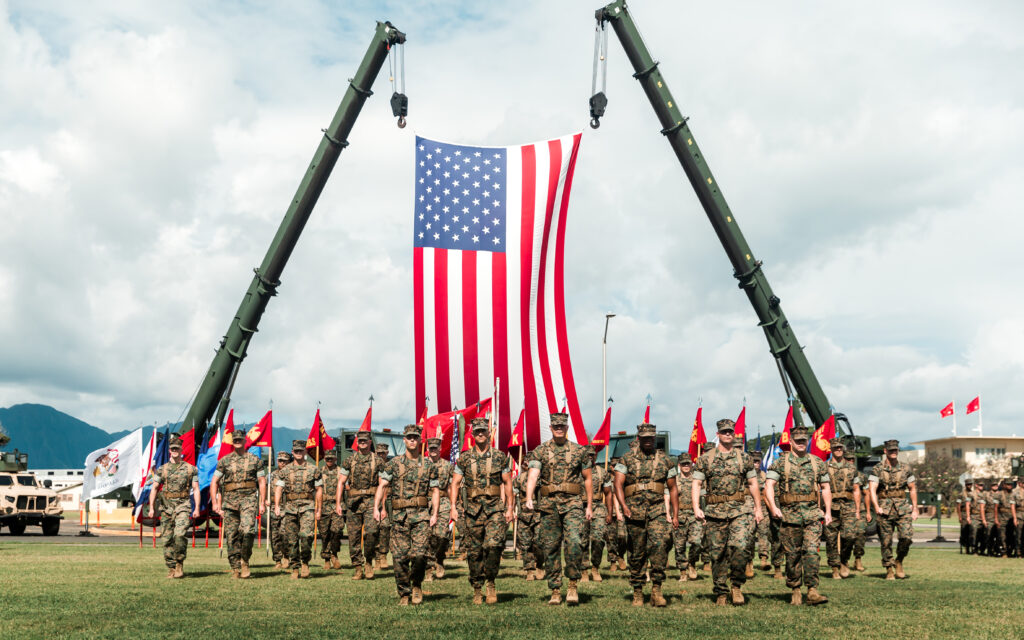
U.S. Marines with 3d Marine Littoral Regiment, 3d Marine Division march during the re-designation ceremony of 3d Marines to 3d MLR aboard Marine Corps Base Hawaii, March 3. U.S. MARINE CORPS / Cpl. Patrick King
ARLINGTON, Va. — The U.S. Marine Corps has taken another step in its ambitious force redesign to contend with near-peer militaries like China and Russia in the 21st century: Creating the first Marine Littoral Regiment.
After more than a year of planning, the 3rd Marine Regiment was redesignated the 3rd Marine Littoral Regiment in a ceremony at Marine Corps Base Hawaii, where the new regiment will continue to be headquartered.
While the 3rd MLR is not expected to be fully operationally capable for at least a year, its establishment demonstrates progress in the Marine Corps’ Force Design 2030 modernization effort, a key priority of Marine Corps Commandant David Berger’s 38th Commandant’s Planning Guidance.
“Marines on the leading edge of change is nothing new,” Maj. Gen. Jay Bargeron, commanding general of 3rd Marine Division, told attendees at the May 3 ceremony. “We are honing our capabilities to integrate and coordinate joint and combined fires and effects, extending the reach of and providing more options to our forces.”
The Marines’ evolving Expeditionary Advanced Base Operations concept envisions littoral operations by specialized mobile, low signature units within larger distributed maritime operations areas.
Marine Littoral Regiments will be uniquely designed to maneuver and persist inside a contested maritime environment. The MLR is organized, trained and equipped to support sea control and sea denial operations as part of a larger naval expeditionary force integrated with the joint force and allied and partnered forces.
Equipped with rockets, missiles and other long range fires, as well as sensors like the Ground/Air Task Oriented Radar, the MQ-9A Reaper unmanned aerial vehicle for extended range intelligence, surveillance and reconnaissance, long-range unmanned surface vessels and light amphibious warships to increase mobility in the littorals, EABO units will control access to choke points while limiting an adversary’s ability to target them.
The Marine Corps’ second in command, Assistant Commandant Gen. Eric Smith, also attended the re-designation ceremony. Before leaving Washington for Hawaii, Smith told a Feb. 28 reporters’ roundtable the Marines are “equipping, training and organizing [the MLRs] so they’re able to deploy tonight — and I mean tonight — to do what they need to do.”
The new MLR will be divided into three elements: a littoral combat team made up of a one infantry battalion equipped with a ship-killing missile battery, an anti-aircraft battalion and a combat logistics battalion. Unlike traditional Marine regiments that deployed with three large battalions, the new MLR will operate with much smaller groups, between 75 and 100 Marines, Smith said.
Plans call for two more infantry regiments, the 4th and 12th Marines to be converted to MLRs by 2030, but Smith told reporters the process could take longer than the 3rd MLR’s conversion did based on lessons learned going forward.
University of Maine Manufactures World’s Largest 3D-Printed Boat for Military
The University of Maine’s Advanced Structures and Composites Center in Orono has printed two of the largest 3D-printed vessels for the U.S. Marine Corps for testing. UNIVERSITY OF MAINE AT ORONO
ORONO, Maine — The world’s largest polymer additive manufacturing machine printed the world’s largest 3D printed vessel at the University of Maine’s Advanced Structures and Composites Center in Orono, Maine. In fact, it printed two of them.
The prototype vessels were built with Marines in mind. One of the two logistics support vessels can carry a pair of 20-foot shipping containers, while the other can transport a Marine rifle squad with three days of food, water and supplies.
This isn’t the first time the UMaine Composites Center printed a vessel. In 2019, the Center printed 3Dirigo and earned two Guinness World Records — the world’s largest 3D printed boat and the world’s largest 3D printed object. The 25-foot, 5,000-pound boat was printed in 72 hours. “Dirigo” is the motto of the State of Maine and means “I lead” in Latin.
The two new vessels are multi-material composites with engineering polymer and fiber reinforcement. The composites center fabricated and assembled one of the vessels in a month instead of up to year, which is typical using traditional methods and materials.
The university hosted a ceremony attended by the state’s two senators, Republican Susan Collins and Independent Angus King, along with representatives from the Defense Department on Friday, Feb. 25, to mark the production of the vessel. In a statement issued by the senators and university, the achievement was called “a significant milestone towards demonstrating advanced manufacturing techniques to rapidly constitute critical DoD assets closer to the point of need.”
Due to national security concerns, no photos or video of the boats was allowed.
‘The Future of Manufacturing’
“Marine Corps Systems Command’s Advanced Manufacturing Operations Cell, in collaboration with the UMaine Composites Center, used advanced manufacturing techniques to successfully develop the expendable polymeric composite ship-to-shore vessels,” the statement says. “The longer of the two vessels, the largest ever 3D-printed, simulates ship-to-shore movement of 20-foot containers representing equipment and supplies. The second vessel can transport a Marine rifle-squad with organic equipment and three days of supplies. The prototypes can be connected, maximizing the transport capability of a single-tow vehicle.”
“This is literally the future of manufacturing that’s happening right here at the University,” King said.
The Marine Corps established the Advanced Manufacturing Operations Cell in 2019 to support Marines with new advanced manufacturing and technologies and techniques, as well as to conduct testing, experimentation and analysis.
Multiple small logistics vessels will be needed by the Navy-Marine Corps team to support distributed maritime operations and expeditionary advanced base operations.
“This project demonstrates the art of the possible and the potential for AM [additive manufacturing] to fundamentally alter how we think about connectors and their role in mobility and distribution within a contested environment,” said Lt. Gen. Edward Banta, Deputy Commandant – Installation & Logistics, U.S. Marine Corps.
“The University of Maine is at the forefront of cutting-edge research and high-impact technologies, including advanced manufacturing, AI and 3D printing important for industries in Maine and beyond,” said University of Maine System Chancellor Dannel Malloy. “These prototype vessels are the latest innovations from the Composites Center that demonstrate the future of manufacturing.”
“Two years ago, we demonstrated that it was possible to 3D print a 25-foot patrol vessel in three days. Since then, partnering with the DOD, we have been improving material properties, speeding up the printing process and connecting our printer with high-performance computers that can monitor the print. With these tools in place, we have now printed a prototype vessel that will be tested by the U.S. Marine Corps.”
From the lab in Orono, the boats will travel next go to California for sea testing and evaluation.
NGC to Equip USMC with Next Generation Handheld Targeting Device
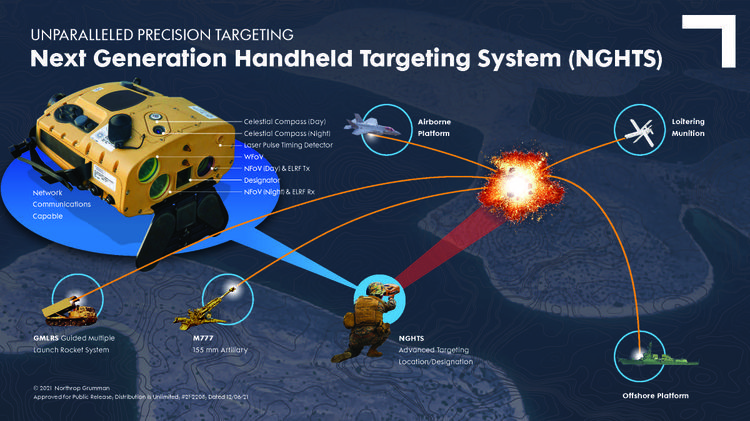
APOPKA, Fla. — Northrop Grumman Corp. has been selected to provide the U.S. Marine Corps with the Next Generation Handheld Targeting System (NGHTS). This compact targeting device provides unparalleled precision targeting and is capable of operation in GPS-denied environments, the company said in a Feb. 22 release.
“NGHTS will significantly enhance the ability of Marines to identify ground targets under a wide range of conditions,” said Bob Gough, vice president, navigation, targeting and survivability, Northrop Grumman. “Connected to military networks, NGHTS can provide superior situational awareness and accurate coordinates for the delivery of effects from beyond the line of sight.”
Northrop Grumman’s NGHTS is capable of performing rapid target acquisition, laser terminal guidance operation and laser spot imaging functions. Its high-definition infrared sensors provide accuracy and grid capability over extended ranges. Additional features include a high-definition color display and day/night celestial compasses.
Marine General: Exercises Don’t Pressure-Test Logistics for Real-World Operations
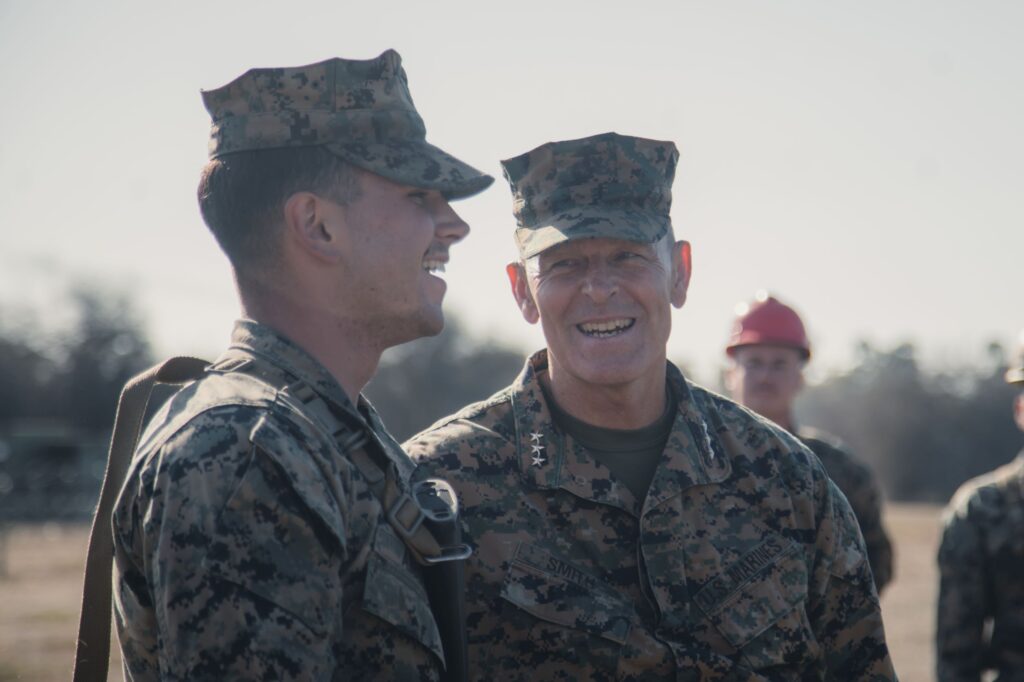
U.S. Marine Corps Lt. Gen. George W. Smith, commanding general of I Marine Expeditionary Force, speaks with Cpl. Brady Abbott, left, regarding I MEF Support Battalion’s Mission Readiness Exercise at Marine Corps Base Camp Pendleton, Dec. 8, 2021. U.S. MARINE CORPS / Lance Cpl. Gadiel Zaragoza
ARLINGTON, Va. — A Marine Corps general who commands one of the Corps’ three Marine expeditionary forces said logistics does not get a realistic challenge when military exercises are executed, primarily because of the short duration of the exercises.
“When I focus on a particular concern, I would offer that we’re not placing enough emphasis on logistics, and particularly logistics in a distributed and contested maritime environment,” said Lt. Gen. George Smith, commander of the I MEF, based in California, speaking on a panel of the West2022 conference sponsored by the U.S. Naval Institute and the Armed Forces Communications and Electronics Association.
“I say that because it [logistics] is hard to exercise,” Smith said. “Exercises truly aren’t long enough to truly exercise and pressure-test logistics. In the war games that I’ve participated in, far too often forces are where they ideally would like to be with a whole bunch of sustainment piled up. The war games don’t last long-enough to test logistics.”
Smith said “logistics is undoubtedly the pacing function when we talk about operations in the Pacific. When you look at the vast expanse of the Pacific, and all the attendant challenges, logistics is going to be that pacing function. So, as I MEF looks to shifting to the Pacific and get west of the IDL [International Date Line], our logistics team is looking really hard at updating and developing logistics nodes and distribution sites and looking at a whole new prepositioning constructs for the MEF so that we can seamlessly and effectively transition from competition steady-state campaigning to conflict. Without logistics, without that sustainment, we will not be able to do that.
“It must nest within INDO-PACOM’s [U.S. Indo-Pacific Command’s] larger logistics posture and I would add that we’re working hard to reduce what is already a strained TRANSCOM [U.S. Transportation Command] capacity and what the expectations of the joint force are,” he said.
Smith said the Corps is looking how to “bridge the gap of theater to operational to tactical logistics, often referred to as the last tactical mile,” which he said logisticians call the “‘last logistical mile.’”
The I MEF commander said his command would team with the Marine Corps Warfighting Lab to bring a stern-[ramp] landing vessel to the U.S. West Coast to exercise “as part of exercising that last tactical mile, that last logistics mile.”
Smith said exercising with the vessel “would help us in our future operating concepts to deliver that logistics to the warfighter in these distributed locations.”
The Navy is developing two new classes of ships to support Distributed Maritime Operations and Expeditionary Advance Base Operations. The light amphibious warship is being designed to support Marine littoral regiments and other forces and will have bow ramp for discharging personnel and vehicles on a shore. The next-generation logistics ship will be smaller and less expensive than the Combat Logistics Force’s replenishment ships.
USS Anchorage, 1st Marine Division Exercise Waterborne Capabilities of ACVs
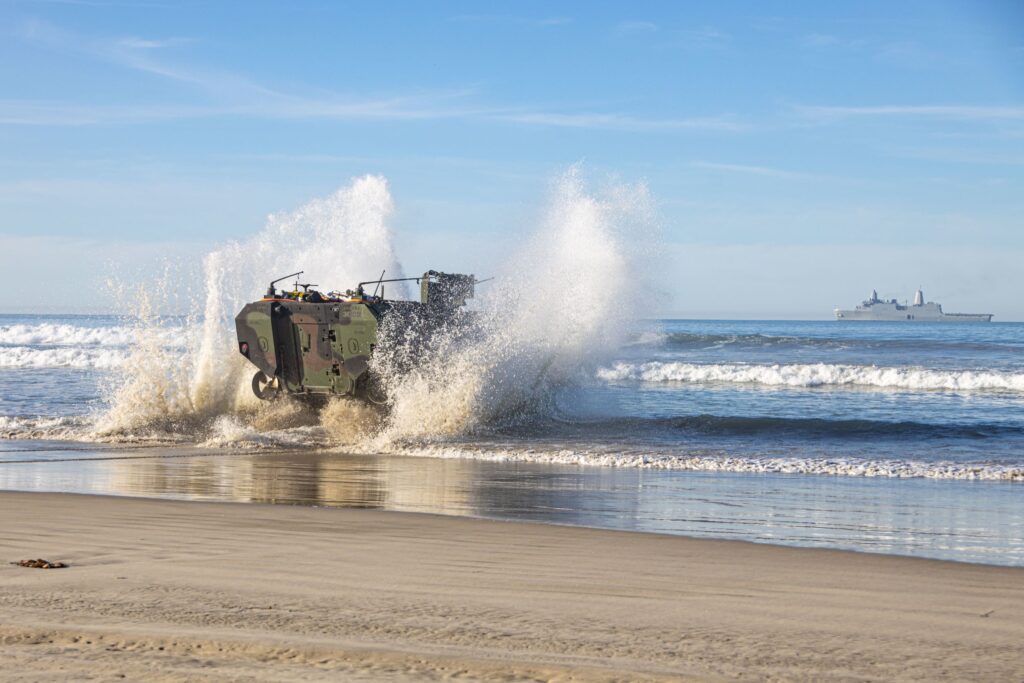
U.S. Marines assigned to the 3rd Assault Amphibian Battalion, 1st Marine Division, conduct waterborne training with an Amphibious Combat Vehicle from shore to loading amphibious transport dock ship USS Anchorage (LPD 23) at Marine Corps Base Camp Pendleton, California, Feb. 12. U.S. MARINE CORPS / Lance Cpl. Willow Marshall
PACIFIC OCEAN — U.S. Marines assigned to the 3rd Assault Amphibian Battalion, 1st Marine Division participated in a waterborne training evolution with Amphibious Combat Vehicles aboard amphibious transport dock ship USS Anchorage (LPD 23) in the Pacific Ocean, Feb. 12-13, Expeditionary Strike Group 3 said Feb. 15.
The two-day training evolution focused on the safety and ship-to-shore capabilities for both the Marine Corps and Navy, part of a larger training plan to refine tactics and doctrine for amphibious operations.
“The safety of our Marines and Sailors is a top priority, especially as we continue to test the capabilities of the newest Marine Corps platform,” said Rear Adm. Wayne Baze, commander, Expeditionary Strike Group 3. “The Sailors and Marines involved have received extensive training on operation of the craft, providing the Navy and Marine Corps team the opportunity to rehearse together for real-world events.”
During the evolution, the ACV demonstrated its survivability, maneuverability and robust swim capabilities by participating in a series of open-ocean swims between USS Anchorage and Marine Corps Base Camp Pendleton, California. USS Anchorage and designated safety boats remained in close proximity of the ACVs throughout the entirety of the amphibious operations, ensuring safety in all aspects of training.
“As we strengthen naval warfighting as a force and pivot to operating in a contested littoral environment, conducting safe, realistic training on this platform advances our ability to respond swiftly to global threats in austere maritime conditions,” said the commanding general of the 1st Marine Division, Maj. Gen. Roger B. Turner. “The Amphibious Combat Vehicle is purpose-built to provide expeditionary lethality for Marines on the move.”
The Marines with 3rd Assault Amphibian Battalion, 1st Marine Division worked alongside Anchorage’s crew to successfully demonstrate the ACV’s ability to launch and recover from the well deck.
“This underway period is a true testament of the rigorous training our Sailors and Marines are doing to prepare for ACV waterborne operations,” said Baze. “They spend countless hours preparing, which is evident in the professional manner in which they conducted themselves throughout this evolution. I could not be more proud of each and every one of them.”
The ACV is an eight-wheel drive, armored vehicle with open-ocean capabilities and land mobility. It’s a unique combination of previously fielded amphibious vehicles and new technological advances to the fleet’s capabilities. The ACV’s ability to use the ocean and waterways to carry Marines and equipment provides expeditionary readiness to Marines on the move, wherever their mission takes them, across a variety of operating environments.
Lockheed Martin Selected to Prototype Next-Generation USMC 5G Communications
ANNAPOLIS JUNCTION, Md. — The U.S. Department of Defense has awarded Lockheed Martin a $19.3 million prototype project agreement to create a 5G communications network infrastructure testbed for expeditionary operations experimentation for the Office of the Under Secretary of Defense for Research and Engineering and the U.S. Marine Corps.
The testbed, known as Open Systems Interoperable and Reconfigurable Infrastructure Solution, or OSIRIS, is a key initiative of Lockheed Martin’s 5G.MIL programs which are positioned to help its customers field, scale and integrate 5G technology rapidly and affordably across all operations on land, water, in air, space and cyber.
“OSIRIS will serve as a critical proof point of Lockheed Martin’s 5G.MIL capabilities,” says Deon Viergutz, vice president, Lockheed Martin Spectrum Convergence. “We are integrating the technical capabilities of 5G waveforms, software and hardware with higher bandwidth and low-latency data rates into our defense products to enhance their performance for our warfighters. We want to ensure that warfighters operating in communications contested and denied environments have resilient access to data to perform their missions anywhere in the world.”
The OSIRIS program will help address the need for test facilities that enable rapid experimentation and dual-use application prototyping. The testbed will identify areas for further compatibility between 5G network and DoD platforms that will enhance customer capabilities. The infrastructure will also allow for the connection of various 5G-ready user devices, sensors, vehicles and endpoints to explore the military utility of commercial 5G technologies and pave the way for onboarding of new technologies from other OUSD investments while addressing cybersecurity requirements. This capability will further enable and advance DoD’s joint all domain operations concept.
Teams from Lockheed Martin, along with subcontractors DISH Wireless, Intel, Radisys and Rampart Communications will create the 5G network testbed infrastructure at U.S. Marine Corps Base Camp Pendleton. The period of performance will begin immediately and conclude in September 2024.
U.S. Marine, British F-35Bs Flew Seamlessly with Israeli, Italian, Japanese F-35s during Queen Elizabeth Deployment
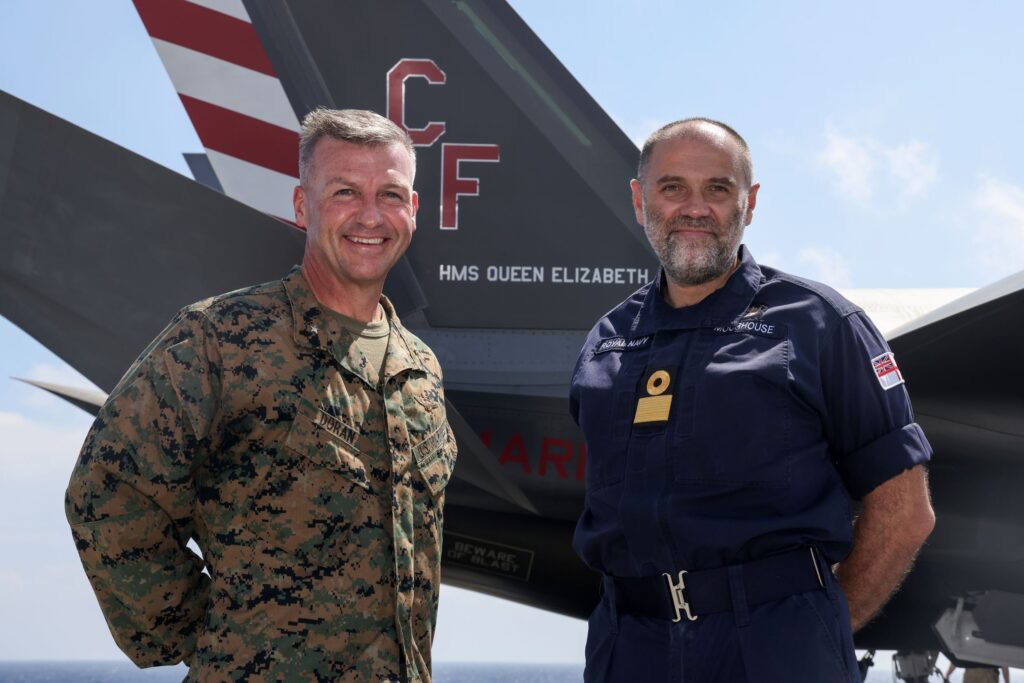
U.S. Marine Corps Brig. Gen. Simon Doran, U.S. Senior National Representative to the United Kingdom Carrier Strike Group 21, and Royal Navy Commodore Steve Moorhouse, commander of the CSG-21, stands in front of a Marine Fighter Attack Squadron 211 F-35B Lightning II aboard HMS Queen Elizabeth in the South China Sea Oct. 8, 2021. U.K. ROYAL NAVY / LPhot Unaisi Luke
ARLINGTON, Va. — The senior U.S. officer embarked on last year’s deployment of the Royal Navy aircraft carrier HMS Queen Elizabeth, who also flew the F-35B Lightning II strike fighters from the ship, praised the F-35B and the Marine Corps and Royal Air Force pilots who flew them and the crews who maintained them during the wide-ranging deployment and operated with F-35s from three other nations: Israel, Japan and Italy.
“It’s quite interesting having come from a background in F/A-18s to now be in the F-35 and to just see the manner in which this airplane can share information not just between U.S. and U.K. jets, but we had the opportunity to fly with Italian, Israeli and Japanese F-35s,” said Brig. Gen. Simon Doran, who served as U.S. senior national representative to Carrier Strike Group 21 (CSG-21), speaking to reporters during a Feb. 15 phone conference sponsored by Headquarters Marine Corps, along with Rear Adm. Steve Moorhouse, former commander of CSG-21, now the U.K. Royal Navy’s director of force generation.
“The manner in which this airplane processes information, … I can tell you, having flown it, it really does some tremendous things in the air that provides situational awareness that can be used by decision makers to hopefully give an advantage,” Doran said. “I truly do believe that in the world of aviation right now it’s an unmatched capability that was demonstrated by us moving around the world and operating with so many different nations — our allies and our partners.”
Moorhouse said the Queen Elizabeth’s F-35Bs operated over the Black Sea in support of a Royal Navy Type 45 destroyer and a Royal Netherlands Navy frigate and conducted sorties in support of Operation Inherent Resolve in Syria and Iraq.
Doran said the deployment was “a fantastic experience for us. We got to stress the system both in the material condition of the F-35, its ability to sustain sorties that were of longer duration, and also number of sorties per day. It was really interesting to see if we could demonstrate the unmatched capability of the F-35 against some of the Russian aircraft and we were quite fortunate in that we got to intercept and escort more Russian aircraft than any other deployments, certainly since the Cold War.
“It was a really good experience for our aircrew as well a great experience for our maintainers to really stress the system while at sea and demonstrate that capability, to not just talk about something but actually do it in some strenuous conditions, while still maintaining a level of professionalism,” he said.
Doran said that VMFA-211deploed with 10 F-35Bs and flew more than 1,200 sorties and more than 2,000 flight hours during the Queen Elizabeth’s 6.5-month, May to December 2021 deployment, which ranged over 40,000 nautical miles, operated with more than 40 nations, and participated in 17 operations and named exercises. The squadron interacted with 13 of those nations.
Doran, who was born in Liverpool, England, was an F/A-18 Hornet pilot for six deployments in U.S. Navy aircraft carriers and has since learned to fly the F-35B. He was frocked to brigadier general while at sea on the Queen Elizabeth. He flew both U.S. and U.K. F-35Bs during the deployment.
“Operating from Queen Elizabeth was not difficult whatsoever,” he said. “With a ship that is purpose-built for a particular airplane and with an airplane as advanced as the F-35, most of your training in the F-35 goes into using it as a weapon system or as a system to gather and disseminate information. The actual takeoff and recovery of the airplane is thankfully quite easy. It really was a pleasure to fly to and from that ship.”
While deployed, the F-35Bs on the Queen Elizabeth also operated from the U.S Navy’s amphibious assault ships USS America and USS Essex and the Italian aircraft carrier Cavour.
Doran said planning for the deployment began more than a decade ago, even while the Queen Elizabeth was under construction. VMFA-211 worked up on the carrier in 2020 well before deployment and completed a Red Flag exercise after shortly after 617 Squadron — the U.K. F-35B unit paired with VMFA-211 for the deployment — completed the exercise.
During the deployment, Doran served as adviser to then-Commodore Moorhouse and represented the U.S. geographic combatant commanders in maintaining operational control of all U.S. units assigned to the CSG. He also was on hand to address any issues that countered U.S. policy and could negotiate with the commodore “to make sure that everything complied with the guidance and intent that I was provided by the Office of the Secretary of Defense and the chairman of the Joint Chiefs of Staff.”
“I think having the sons and daughters of the U.S. and the U.K serving side-by-side around the world, especially sharing some of the hardships of operating while a global pandemic is going on has lasting friendships that will serve both nations quite well,” he said. “It was incredibly pleasing from a both a personal and professional level to see U.S. Sailors and Marines working alongside Royal Navy Sailors and airmen side-by-side over seven months and really learning how to operate at a very high level under some adverse conditions and still have a smile on their face and execute at a very professional level.”
The general said, “the return on the investment [of the deployment] from the U.S. point of view was really good when it came down to the tactical level of warfighting and training together.”
Doran said the visit of Queen Elizabeth II to her namesake ship “really cemented in our minds the importance of this deployment from the very beginning and what is does to reinforce the special relationship between our two nations to demonstrate that on the high seas is absolutely incredible.”
Navy, Marine Corps Labs Exploring How to Keep Advanced Bases Supplied and Safe
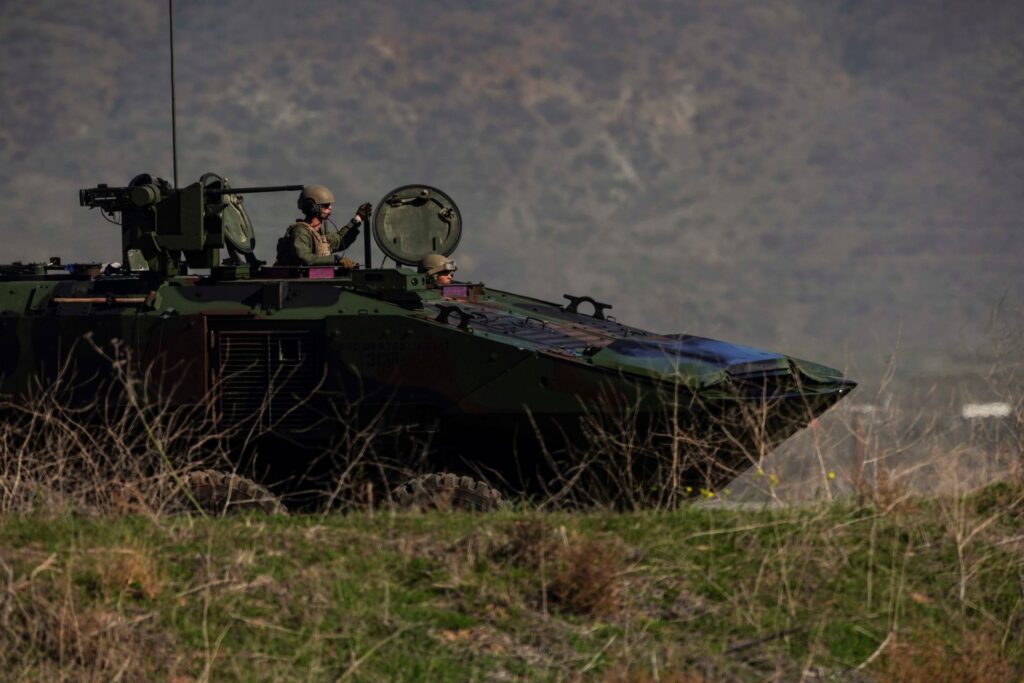
Marines hold a support-by-fire position in an amphibious combat vehicle during exercise Iron Fist, a joint amphibious exercise with Japan, at Marine Corps Base Camp Pendleton, California, Jan. 14. U.S. MARINE CORPS / Cpl. Sydney Smith
ARLINGTON, Va. — In addition to developing expeditionary warfare concepts like Marine Littoral Regiments and the light amphibious warship that would transport and supply them, the Office of Naval Research is looking into how to keep both safe and unseen by adversaries.
The first Marine Littoral Regiment, or MLR, an evolution of a traditional Marine infantry regiment, is being built in Hawaii and expected to be fully operationally capable next year for live force experimentation, complemented by war gaming and simulations, Marine Corps Brig. Gen. Benjamin Watson told the National Defense Industrial Association’s virtual Expeditionary Warfare Conference Feb. 10.
The light amphibious warship, an anticipated bridge between traditional big L-class amphibious warfare ships and smaller ship-to-shore connectors like the across-the-beach air cushioned landing craft, is still in the concept stage, said Watson, the commanding general of the Marine Corps Warfighting Laboratory/Futures Directorate and vice chief of the Office of Naval Research.
Both the MLR and LAW are expected to be key factors in the expeditionary advanced base operations concept, which envisions littoral operations by specialized mobile, low signature units within larger distributed maritime operation areas. Small, maneuverable expeditionary advanced bases will conduct sea control and denial operations using advanced sensors and long range missiles and artillery.
But the heat and radiation emitted by such high-powered platforms can be a liability in a very degraded and denied environment, said Marine Corps Col. William DePue Jr., ONR’s Expeditionary Portfolio director. “In this environment, if you emit, you’re a target. If you don’t, you’re blind,” he said.
ONR is working on technologies that will allow the expeditionary advanced base Marines to passively sense the environment and sense what adversaries are doing while managing their own signatures “so that we emit when it’s smart to do so and in ways that limit or avoid detection by the enemy,” DePue said.
Researchers are also working ways to reduce food and fuel demands, particularly the shipment of liquids to advanced bases that make them and their supply vessels vulnerable. How to access more energy is a multi-faceted problem, according to Watson.
“It’s one we really need industry’s help with,” he said. “You can’t just solve the problem with enhanced distribution and sustainment capabilities. You need to reduce demand.”