U.S. Marine Corps Awards Production Contract to Kongsberg for C-UAS Capability
Kongsberg’s RS6 remote weapon system for the Marine Air Defense Integrated System program. KONGSBERG
JOHNSTOWN, Penn. — The U.S. Marine Corps has awarded a production contract to Kongsberg Protech Systems USA to deliver remote weapon systems (RWS) as part of the Marine Air Defense Integrated System (MADIS) program, the company said Oct. 5.
The indefinite delivery / indefinite quantity contract has a ceiling of $94 million and includes a series of low-rate initial production systems and full-rate production units. This production contract award follows a September 2020 contract award from the Marine Corps to Kongsberg for test articles and activities, which included design verification testing.
The Kongsberg RS6 RWS for MADIS leverages technology and competence drawn from multiple counter-unmanned aircraft systems and air defense programs. The system leverages commonality with the family of Protector RWS delivered and fielded with the U.S. Army and Marine Corps and will be integrated on the Joint Light Tactical Vehicle together with external sensors and effectors.
The first 30mm remote weapon system to be qualified on the JLTV platform, the Kongsberg RS6 RWS for MADIS RWS includes the XM914E1 30mmx113mm DC driven cannon with a co-axial M240 (7.62mm) machine gun, an integration kit for the Stinger Air-To-Air Launcher and provisions for future C-UAS defeat systems.
“The MADIS program with Kongsberg’s RS6 30mm remote weapon system signifies a powerful lethality capability for the Marine Corps, initiating a new era in U.S. Marine Corps ground-based air defense operations,” said Pål E Bratlie, executive vice president, Kongsberg Defence & Aerospace.
Kongsberg has delivered more than 20,000 RWS units to more than 20 countries worldwide. The company also is the sole provider of RWS and remote turrets to the U.S. Army and U.S. Marine Corps. All RWS and remote turrets delivered to U.S. customers are manufactured in the Kongsberg Johnstown, Pennsylvania, facility.
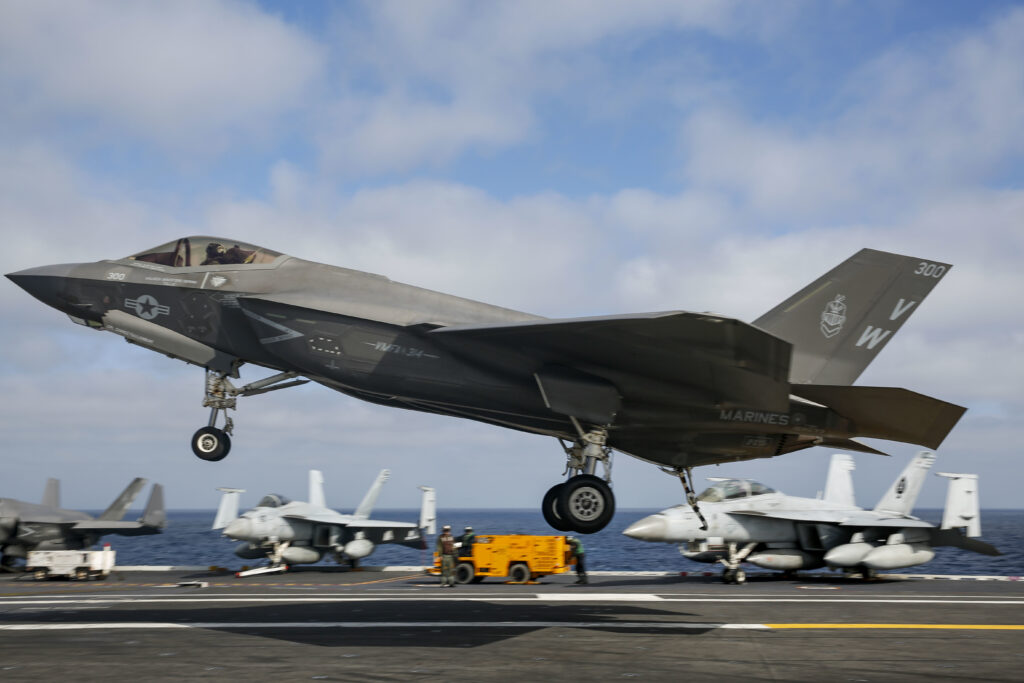
Marine Corps F-35Bs Conduct First Landing Aboard JS Izumo
A U.S. Sailor directs a Marine Corps F-35B Lightning II aircraft with Marine Fighter Attack Squadron (VMFA) 242 aboard the Japanese Ship Izumo off the coast of Japan, Oct. 3, 2021. U.S. MARINE CORPS / Lance Cpl. Tyler Harmon
MARINE CORPS AIR STATION IWAKUNI, Japan —At the request of the Japan Maritime Self-Defense Force (JMSDF), Marine Fighter Attack Squadron (VMFA) 242 successfully conducted the first landing of two F-35B Lightning II aircraft aboard the Japanese Ship Izumo on Oct. 3, Marine Aircraft Group 12 said in a release.
Following a series of modifications to the JS Izumo to enable short takeoff and vertical landing (STOVL) operations, a capability that the “B” variant of the F-35 specializes in, U.S. Marines embarked aboard the JS Izumo and worked directly with JMSDF personnel as part of a bilateral effort to ensure the capability test was both effective and safe.
“This trial has proved that the JS Izumo has the capability to support takeoffs and landings of STOVL aircraft at sea, which will allow us to provide an additional option for air defense in the Pacific Ocean in the near future,” said JMSDF Rear Adm. Komuta Shukaku, commander of Escort Flotilla One.
Japan is one of 14 nations that participate in the F-35 Lightning II Joint Strike Fighter program and announced in August 2019 it would purchase 42 F-35B aircraft from the United States.
“We have work to do until the day the JSDF can regularly employ STOVL aircraft at sea, but I am confident that the strong partnership and mutual trust between our two counties will result in its realization,” said Komuta.
The F-35 includes the latest stealth technology and has an advanced suite of sensors that enables it to create a dynamic awareness of the battlespace. The F-35 is then able to rapidly share this information with other aircraft platforms and command centers, including those operated by multinational allies and partners, creating greater situational awareness for commanders.
“We have the utmost confidence in the Joint Strike Fighter and are eager for our Japanese allies to have the same capabilities in their hands, which ultimately contributes to our shared goal of maintaining a free and open Indo-Pacific,” said Maj. Gen. Brian W. Cavanaugh, 1st Marine Aircraft Wing commanding general.
VMFA-242 is one of two F-35B squadrons permanently stationed at Marine Corps Air Station Iwakuni, Japan, and is one of the many forward-stationed units that routinely train with Japan Self-Defense Forces. The F-35B represents the United States’ rebalance to the Indo-Pacific and its commitment to the defense of Japan and regional security with the most capable and modern equipment in the U.S. inventory.
First Connecticut-Built Sikorsky CH-53K Helicopter in Hands of U.S. Marine Corps
Sikorsky, a Lockheed Martin company, celebrated the first Connecticut-built CH-53K helicopter in a ceremony at its Stratford facility. SIKORSKY
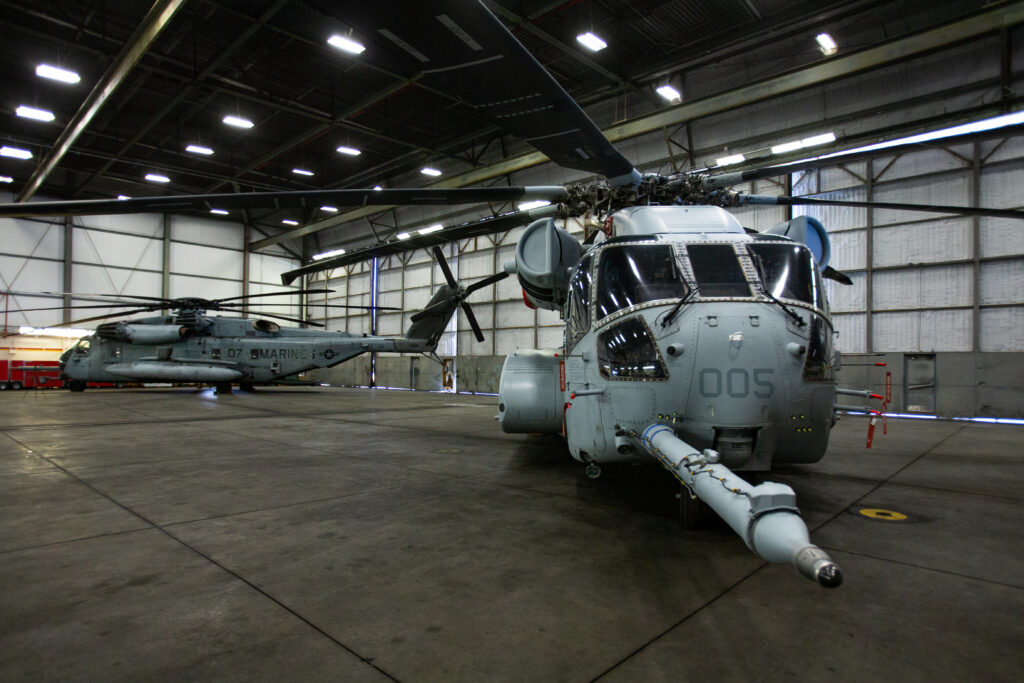
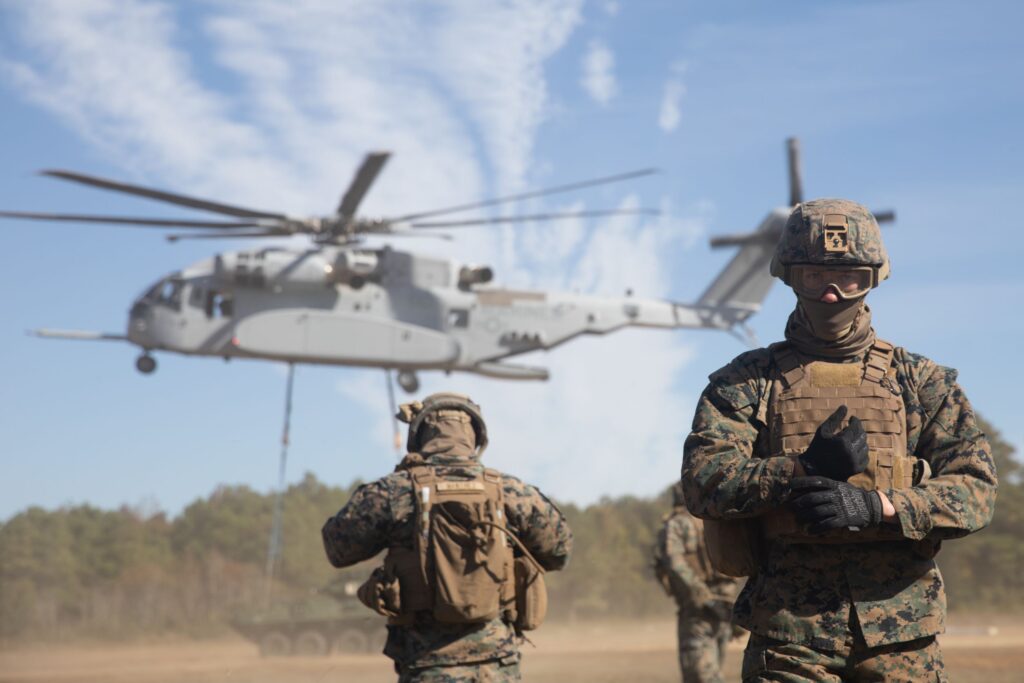
STRATFORD, Conn., Sept. 24, 2021 — Sikorsky today celebrated the first Connecticut-built CH-53K heavy-lift helicopter that will be delivered to the U.S. Marine Corps, parent company Lockheed Martin said Sept. 24. This helicopter, which moves more troops and cargo more rapidly from ship to shore, was the first all digitally designed helicopter.
The CH-53K’s digital thread runs from design through production, maintenance, and sustainment, increasing mission availability while reducing pilot and crew workload.
“This Connecticut-built CH-53K aircraft is a testament to the Sikorsky legacy of building safe, reliable rotorcraft for decades. But the way we design, test and build helicopters has transformed,” said Paul Lemmo, president of Sikorsky. “Our employees are using digital tools and other advanced technologies such as manufacturing simulation and 3-D laser inspection technology. This factory transformation is a model for all future helicopter programs at Sikorsky.”
This King Stallion helicopter will be stationed at Marine Corps Aviation Station New River in Jacksonville, North Carolina, where Marines will conduct training flights and support the fleet with heavy-lift missions with the aircraft in preparation for the CH-53K’s first deployment in 2024. This heavy-lift helicopter is part of a 200 aircraft program of record for the Marine Corps with a total of 33 aircraft currently on contract and an additional nine on contract for long-lead parts.
“The CH-53K helicopter provides advanced capabilities allowing Marines to get anywhere in the world where the mission requires heavy-lift logistics support,” said Lt. Gen. Mark R. Wise, deputy commandant for aviation, during a ceremony at Sikorsky. “This helicopter is a much safer aircraft because it can maneuver in low visibility environments. It will forward deploy Marines quickly and effectively.”
Ramping Up Production
The factory floor at Sikorsky is active with six CH-53K aircraft in build, and there are 36 more in various stages of production, including the nine for which the company is procuring long-lead parts. Sikorsky has made significant investments in workforce training, tooling, and machinery to increase the number of aircraft built and delivered year over year.
This is the first CH-53K helicopter to roll off the Stratford production line, with the next one set to be delivered in early 2022. Since October 2020, Sikorsky has delivered three operational CH-53K King Stallion heavy-lift helicopters to the U.S. Marine Corps in MCAS New River.
The CH-53K program entered initial operational test and evaluation in July. Four aircraft are now in the hands of VMX-1 operational and test evaluation squadron. Marine pilots and maintainers are operating the CH-53K in a fleet environment as part of the rigorous test program.
Marines are learning to fly and maintain the CH-53K using a suite of training devices developed by Sikorsky. Pilots receive hands-on training by experiencing a highly immersive virtual environment in the Containerized Flight Training Device (CTFD). The CFTD replicates the functionality, flight characteristics, mission profiles, and unmatched capabilities of the CH-53K helicopter. The device can replicate the various environmental conditions the aircraft is likely to fly in as well as a multitude of mission profiles in the operation of a true heavy-lift helicopter.
Maintenance personnel also prepare with a virtual aircraft environment through the Helicopter Emulation Maintenance Trainer. Marines train with an immersive experience to practice avionics and airframe maintenance in the schoolhouse in order to be fully prepared to perform maintenance on their fleet aircraft.
The CH-53K is the only sea-based, long range, heavy-lift helicopter in production and will immediately provide three times the lift capability of its predecessor.
The CH-53K will further support the U.S. Marine Corps in its mission to conduct expeditionary heavy-lift assault transport of armored vehicles, equipment and personnel to support distributed operations deep inland from a sea-based center of operations, critical in the Indo-Pacific region.
The new CH-53K has heavy-lift capabilities that exceed all other DoD rotary wing-platforms, and it is the only heavy-lifter that will remain in production through 2032 and beyond.
Navy Selects Kongsberg to Help Develop Autonomous Target Recognition for Marine Corps Weapon Systems
The announcement that Kongsberg would develop the Automated Remote Engagement System is a follow on to several Marine Corps programs within the last two years. KONGSBERG DEFENCE & AEROSPACE
JOHNSTOWN, PENN. — The U.S. Naval Surface Warfare Center, Dahlgren Division, (NSWCDD) and Kongsberg Defence & Aerospace have signed a cooperative research and development agreement (CRADA) to demonstrate a weapon system with autonomous target identification, recognition and engagement, the company said in a Sept. 23 release.
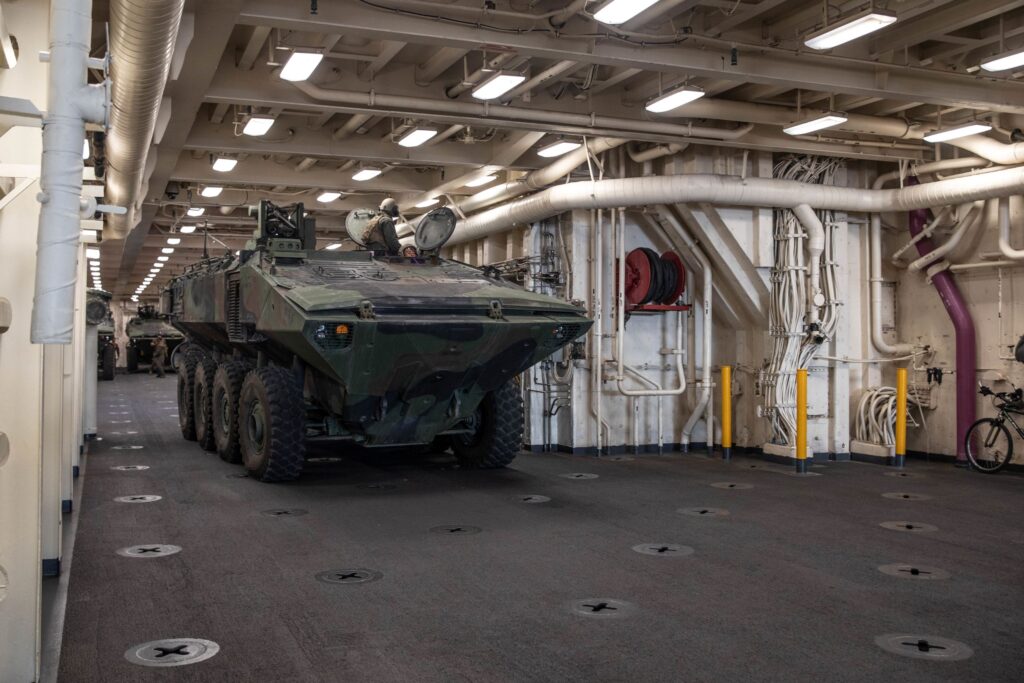
NSWCDD develops the Automated Remote Engagement System (ARES) that increases the efficiency of remote weapon systems and remote turrets, which will be integrated onto Kongsberg Remote Weapon Stations to evaluate technology performance at a system level and support the demonstration of a weapon system for autonomous target identification, recognition and engagement. The common goal is to demonstrate this performance on Kongsberg’s latest weapon systems that will be fielded in the Navy such as the Tech Refresh Common Remote Operation Weapon System (CROWS), the RT20 turret on the Amphibious Combat Vehicle (ACV) and the Marine Air Defense Integrated System (MADIS).
Kongsberg’s selection for the CRADA follows on the heels of several other Marine Corps programs started in the last two years. In addition to the fielding of CROWS on ACV and the Amphibious Assault Vehicle, Kongsberg’s RS6 30-by-113-millimeter Remote Weapon System (RWS) was selected for the MADIS program, its RT20 30-by-173-millimeter turret was selected as the ACV medium caliber weapon system, and various Kongsberg RWSs are the weapon systems on the prototypes selected for the Advanced Reconnaissance Vehicle. For the CRADA, Kongsberg is leveraging work it has already done as the remote lethality architecture provider for the U.S. Army’s Robotic Combat Vehicle program.
Kongsberg brings more than 20 years of remote-control weapon technology of different sizes, complexity and payloads and is an ideal partner for this co-development effort with NSWCDD. While continuing to perfect its systems, Kongsberg has developed a fire control system that can be wireless operated and controlled by a robotic operator. This independently funded fire control system for RWS and medium caliber turrets is capable of interacting with ARES and will be demonstrated through this CRADA.
Kongsberg has delivered nearly 20,000 RWS units to more than 20 countries worldwide. Kongsberg is also the sole provider of RWS and remote turrets to the U.S. Army and U.S. Marine Corps. All RWS and remote turrets bound for U.S. customers are manufactured in the Kongsberg Johnstown, Pennsylvania, facility.
Kaman Proposes KARGO UAV to Marine Corps for Autonomous Re-Supply
The Kaman KARGO UAV is designed to carry cargo in a conformal pod (right) or sling-loaded (left). KAMAN CORP.
ARLINGTON, Va. — Kaman Corp., builder of the K-MAX unmanned helicopter for the Marine Corps, is proposing an autonomous quadrotor unmanned helicopter for the Marine Corps to enhance its re-supply capabilities in expeditionary advanced based operations, the company said in a Sept. 21 press conference and news release.
The KARGO UAV is designed to be a robust, reliable, easy-to-operate UAV that can be shipped in a standard ISO container, quickly assembled by two personnel, and flown with internal pod-contained cargo or external sling-loaded cargo.
The KARGO UAV will be a quadrotor with a length and width of 24.4 feet, a height of 7.5 feet and a weight of 1,340 pounds. It will be powered up to a speed of 121 knots by a 300-shaft horsepower gas turbine engine to carry payload up to 800 pounds. Range will vary according to payload. For example, a 600-pound payload could be carried 143 nautical miles one way. The range with no payload is planned for 523 nautical miles.
“The Kaman KARGO UAV is the only system of its class that is purpose-built to provide deployed Marines, Sailors, Airmen, Soldiers and Coast Guard autonomous resupply in the lethal, fluid combat environment that future military operations will entail or for regular logistics missions. Our deployed service men and woman have persistent logistics challenges that we are answering with this reliable, maintainable and affordable solution,” said Ian Walsh, CEO of Kaman Corp., in the release.
Kaman has been flight-testing a 50%-scaled demonstrator UAV of the KARGO UAV to refine the design. The demonstrator was developed using Kaman’s internal research and development funds. The company plans to build a full-scale KARGO UAV and flight-test it in 2022.
Kaman has extensive experience in fielding autonomous cargo UAVs. Two of the company’s K-MAX UAVs were operated by the Marine Corps a decade ago in the mountains of Afghanistan. Romin Dasmalchi, senior director of business development, government, at Kaman, said in the press conference, said that the two K-MAX UAVs delivered accrued 4.5 million pounds of cargo and saved numerous lives by reducing the needs for vulnerable truck convoys. The two UAVs, designated CQ-24A by the Marine Corps, were stored for several years, but Kaman was contracted by the Corps to restore them to flight and upgrade them for more demonstrations of an autonomous cargo delivery capability.
Dasmalchi said that the KARGO UAV would reduce manpower and training requirements for the Corps and provide a self-deploying capability. He said the Marine Corps has not published requirements for a cargo UAV but are in the process of developing its requirements.
Walsh said the KARGO UAV has potential to serve as a vertical replenishment aircraft got the Navy’s at-sea logistics force.
He said the KARGO UAV is being designed with a gas turbine engine to meet a high technology readiness level to reduce cost and risk.
“The KARGO UAV leverages commercial off-the-shelf components as well as thousands of hours of automated and autonomous flight data from Kaman’s K-MAX TITAN program, to reduce schedule and technical risk,” Kaman said. “Kaman selected Near Earth Autonomy as a partner on the pilot KARGO UAV program. Leveraging ongoing and concurrent collaboration between the two companies on the U.S. Marines Corps K-MAX TITAN UAS, Near Earth will provide obstacle avoidance and other technologies such as precision landing, sense and avoid, and navigation in a GPS-denied environment.”
Marine Corps Harvest HAWK+ Reaches Full Operational Capability
A KC-130J Super Hercules with the Harvest Hawk+ sits staged on the flight line at Marine Corps Air Station Miramar, California. U.S. MARINE CORPS
PATUXENT RIVER, Md. — The Tactical Airlift Program Office (PMA-207) KC-130J integrated product team successfully completed full operational capability of the Harvest Hercules Airborne Weapons Kit (HAWK) Plus (HH+), Naval Air Systems Command said in a Sep. 20 release. The 10th and final aircraft modified to the HH+ configuration was delivered to the Fleet Marine Forces Aug. 26.
The aircraft modifications were part of the Marine Corps KC-130J Intelligence Surveillance and Reconnaissance (ISR) / Weapons Mission Kit program that began in 2015. The program improved the existing Marine Corp KC-130J Harvest HAWK system by integrating the MX-20 electro-optical/infrared multi-sensor imaging system and adding door-mounted missile employment capability.
Harvest HAWK+ aircraft modifications began in 2015 with the first aircraft delivering in October 2015. NAVAIR’s aircraft prototype systems division at Naval Air Station Patuxent River, Maryland, modified the first six aircraft while Sierra Nevada Corp. in Colorado Springs, Colorado, modified the last four aircraft.
Five HH+ aircraft were delivered to Marine Aerial Refueler Transport (VMGR) 352 in Miramar, California, and four aircraft were sent to VMGR-252 in Cherry Point, North Carolina. One HH+ aircraft will remain at VX-20 in Patuxent River for Block 8.1 and future HH+ testing.
“We are proud to provide the Marine Air-Ground Task Force with an updated intra-theater Close Air Support and Multi-Sensor Imagery Reconnaissance capability,” said Capt. Steve Nassau, PMA-207 program manager. “I couldn’t be prouder of my government and contractor team for delivering this critical weapon system to our warfighters.”
General: Marines Need to Be ‘Grander Thinkers’
Lt. Gen. Kevin M. Iiams, commanding general, Training and Education Command, during his frocking ceremony in Quantico, Virginia, Aug. 3. U.S. MARINE CORPS / Lance Cpl. Jesse Schremmer
ARLINGTON, Va. — In a potential future of distributed warfare, Marines on the scene need to be able to have a greater understanding of strategy and operations as well as tactics and technology, the Marine Corps’ training boss said.
“How do find Marines who are … ready to execute mission-type orders and have strategic level effect with tactical-level decision making?” asked Lt. Gen. Kevin Iiams, commanding general Training and Education Command, speaking Sept. 16 in a Defense One webinar.
“We need to be very, very deliberate in the way we groom our young Marines looking to the future and ensure that we imbue them with not only the right knowledge moving forward but the right education is important,” Iiams said. “We need to make them much grander thinkers, very good critical thinkers because what we’re going to expect them to do in some of these remote places.”
The general posited a case of a future young captain “with his MLR [Marine Littoral Regiment] force step off the light amphibious warship on some remote archipelago island. He will start to sense his surroundings, and then he’s going to have to start making decisions, because if he is in a denied, degraded, contested environment where [an enemy] is trying to ensure that he or she does not have all of the communications reach-back that one might need to make decisions, have we trained that individual properly?”
Iiams said “these decisions are going to be carried out in distributed maritime operations and expeditionary advanced base operations [EABO]. We’re just now starting to figure out what these actually mean as we look to the future. What does an EABO look like? How do we run one? How do we protect one?”
The general said one challenge is breeding a “new generation of Marines that are more tech-savvy,” but on the other hand, more maturity is needed in the traditionally young Marine Corps personnel.
“We need them to be older to make these mature decisions,” Iiams said, noting that recruiting, training and maturing the needed Marines is likely to be more costly.
He said the Corps needs to maintain an intellectual overmatch over the nation’s adversaries.
Bell Completes 100th Consecutive On-Time Delivery of AH-1Z to Marine Corps
A Bell AH-1Z conducts flight testing at Bell’s Amarillo Assembly Center before delivery to the U.S. Marine Corps. BELL TEXTRON / Anthony Boyer
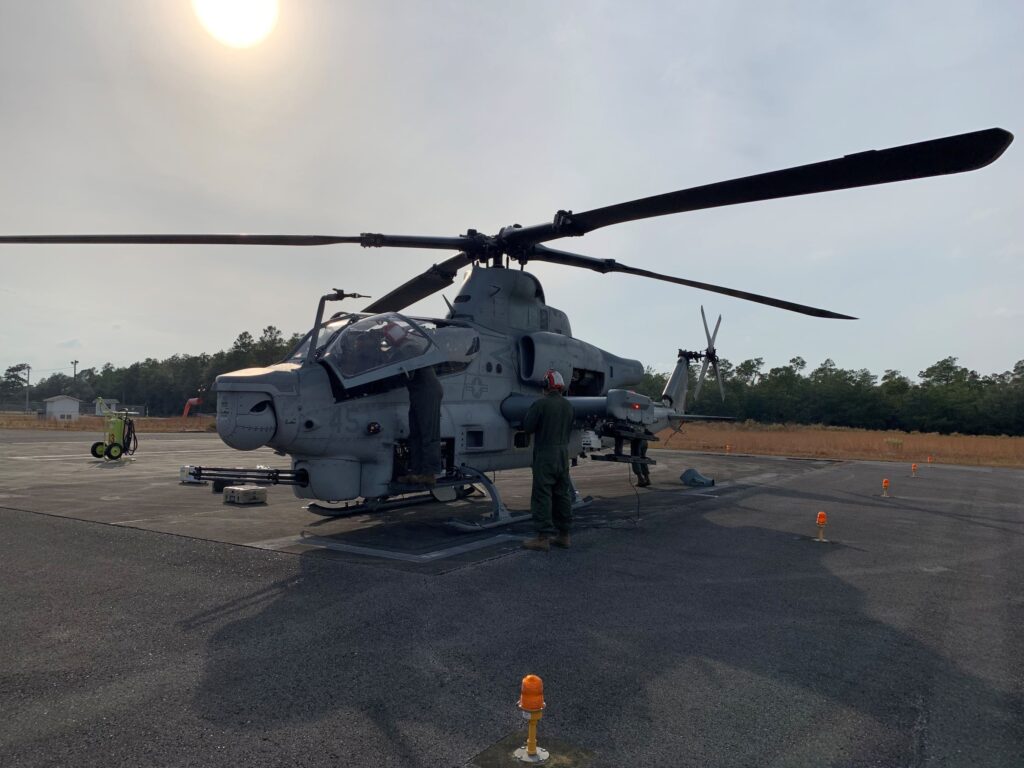
AMARILLO, Texas — Bell Textron, a Textron company, has successfully completed its 100th consecutive on-time delivery of the AH-1Z aircraft to the U.S. Marine Corps, which began nearly four years ago, the company said in a Sept. 14 release.
Bell accomplished this milestone through tight coordination with its manufacturing and assembly facilities, UAW 218, numerous suppliers, and government partners. The H-1 series consists of the AH-1Z Viper and UH-1Y Venom, which provide light attack and utility helicopter support to the Marines while maintaining a small logistical footprint through the 85% commonality between the airframes.
“Performance like this takes a lot of work, communication, and trust to ensure alignment between numerous partners, all working toward the same objective. I could not be more proud of our Bell employees.” said Mike Deslatte, Bell H-1 vice president and program director. “Our front line workers, engineers, and supply chain professionals all help support the Marines. Their work designing, manufacturing, and assembling critical components while ensuring quality parts reach the production line on time help the Marines ensure our nation’s security.”
Bell and its Team Viper/Venom partners collaborate with the U.S. Marine Corps H-1 Light/Attack Helicopter program (PMA-276) to provide integrated solutions and increase combat lethality and readiness. In addition to delivering production aircraft on time, Bell directly supports scheduled maintenance. The company is also working on new capability upgrades to equip the Marines with the most advanced technology available.
“This is a feat only possible through the determination of our production team and the program’s strong relationship with our industry partners and suppliers,” said Col Vasilios Pappas, PMA-276 program manager.
Bell is currently working toward the U.S. Marine Corps program of record and anticipates production of Marine Corps H-1 through 2022. The U.S. Marine Corps H-1 production contract is for 349 aircraft, consisting of 160 UH-1Y and 189 AH-1Z. Bell will continue manufacturing aircraft for foreign military customers including contracts for Bahrain AH-1Zs and a mixed Czech Republic fleet of both AH-1Zs and UH-1Ys.
CH-53K King Stallion Logs First Successful Fleet Mission
A Marine Corps CH-53K King Stallion lifts a Navy MH-60S Knighthawk helicopter from a draw in Mount Hogue, California, Sept. 5, 2021. The Knighthawk conducted a hard landing during a search-and-rescue mission, which resulted in no casualties or injuries of its crew. The two-day operation was the first official fleet mission for the CH-53K King Stallion, as it is currently undergoing an operational assessment while the Marine Corps modernizes and prepares to respond globally to emerging crises or contingencies. U.S. MARINE CORPS / Cpl. Therese Edwards
NAVAL AIR STATION PATUXENT RIVER, Md. — The CH-53K King Stallion successfully recovered a Navy MH-60S Knighthawk helicopter from Mount Hogue in the White Mountains of California on Sunday, Sept. 5, the Naval Air Systems Command said in a release.
The two-day operation was the first official fleet mission for the Marine Corps’ new heavy lift capability, which is in the midst of initial operational test and evaluation with Marine Operational Test and Evaluation Squadron One (VMX-1) at Marine Corps Air Ground Combat Center Twentynine Palms, California.
“VMX-1 received a request for assistance from the Naval Safety Center about an MH-60S Knighthawk that suffered a hard landing near Mt. Hogue [California], at an elevation of 12,000 feet mean sea level in July,” said Lt. Col. Luke Frank, CH-53K detachment officer in charge for VMX-1.
The MH-60S Knighthawk was sitting on a high-altitude ridge in very rugged terrain near the California-Nevada line on July 16 following a hard landing. The helicopter was supporting a search and rescue effort for a lost hiker. All four crewmembers survived without injury and were rescued the following day.
According to Frank, both the MH-60S unit and the Naval Safety Center had exhausted all other resources for recovery, including Army National Guard, Navy and Marine Corps fleet squadrons. “They all lacked the capability to lift the aircraft without an extensive disassembly,” he said.
VMX-1’s CH-53K detachment quickly examined the environmental conditions and conducted a quick feasibility assessment of support and determined that the CH-53K could conduct the lift. The CH-53K fulfills the heavy lift mission of the Marine Corps as it greatly expands the fleet’s ability to move equipment and personnel throughout its area of operations.
“After two weeks of exhaustive planning and assembling a team of more than 25 Marines and Sailors from VMX-1 and 1st Landing Support Battalion from Camp Pendleton, [California],. we deployed two CH-53Ks to Bishop, California, and got to work,” he said.
The CH-53K was designed to lift nearly 14 tons (27,000 pounds) at a mission radius of 110 nautical miles in high and hot environments, a capability that expands the service’s range in supporting joint and coalition forces against potential adversaries.
The MH-60S weighed approximately 15,200 pounds and was positioned in a tight ravine at nearly 12,000 feet mean sea level and needed to be transported over 23 nautical miles to the Bishop, California, airport.
“After six months of flight operations with the CH-53K, the detachment had every confidence in the aircraft’s abilities to conduct the mission safely. Our main concern was the environmental factors ground support personnel would have to endure,” said Frank.
“This is exactly what the K is made to do,” he said. “Heavy lift is a unique and invaluable mission for the Marine Corps. Horsepower is our weapon system and the CH-53K is armed to the teeth. The entire team of Marines at VMX-1, 1st Landing Support Battalion, and NAS Fallon Search and Rescue were extremely motivated to execute this mission and we are all very proud to have completed this one flawlessly.
“To be the first group of professionals to complete a real-world, heavy lift/high altitude mission in support of a unit who thought all options were off the table is extremely rewarding,” said Frank. “This is sure to be the first of what will be many, many successful missions for this aircraft and for heavy lift squadrons.”
Marine Corps’ First MQ-9A Reaper Delivered to 3rd MAW
U.S. Marine Corps Captain Joshua Brooks, an unmanned aircraft system representative, and Master Sergeant Willie Cheeseboro Jr., an enlisted aircrew coordinator with Marine Unmanned Aerial Vehicle Squadron (VMU) 1, prepare to launch and operate the first Marine Corps owned MQ-9A Reaper on Marine Corps Air Station Yuma, Arizona, Aug. 30, 2021. U.S. MARINE CORPS / Lance Cpl. Gabrielle Sanders
YUMA, Ariz. — Marine Unmanned Aerial Vehicle Squadron One (VMU-1), 3rd Marine Aircraft Wing procured the Marine Corps’ first MQ-9A Reaper remotely piloted aircraft after transitioning from contractor-owned, contractor-operated (COCO) to government-owned, contractor-operated (GOCO) at Marine Corps Air Station Yuma on Aug. 30, said Cpl. Levi Voss, a spokesperson for the wing.
To achieve the commandant of the Marine Corps’ vision of future force design, VMU-1 has transitioned from the RQ-21 Group 3 unmanned aircraft to the MQ-9A. Since 2018, flight operations of the MQ-9A have fallen under a COCO construct. However, the MQ-9A has since transitioned to a GOCO unmanned aerial system, signifying the Marine Corps’ ownership of these assets and progressing toward an organically trained and qualified aircrew. This noteworthy flight is the culmination of three years of training, safety, and operational planning, contractor maintenance, process development, and staff analysis of risk management to ensure complete procedural adherence to Navy and Marine Corps aviation policies.
“VMU-1 is living the commandant’s vision of Force Design 2030 and our unit is laying the groundwork for future squadrons to execute similar missions within INDOPACOM [U.S. Indo-Pacific Command] or anywhere else that we are needed,” said Maj. Keenan Chirhart, executive officer of VMU-1.
VMU-1’s procurement of the Marine Corps’ first MQ-9A evolves the service as a force, making it capable of further integration of operations in naval, ground, air, and cyber domains. As the Marine Corps transitions to government-owned, government-operated employment of the MQ-9A, Force Design 2030 presents opportunities for similar implementation across the globe. This transition gives VMU-1 the capability of piloting the forward-deployed MQ-9A that aligns with the Commandant’s directive for persistent intelligence, surveillance, and reconnaissance capabilities, which have supported daily combat operations around the world.
“The MQ-9A is a medium-altitude, long-endurance Group 5 remotely piloted aircraft capable of conducting multiple mission sets to include multi-sensor imagery reconnaissance, unmanned aerial escort, and electronic support,” said Chirhart.
Aside from being the first Marine Corps-owned MQ-9A flight in history, this flight is also a huge step toward verification of policies and procedures that have been developed by VMU-1. With this transition to the MQ-9A, VMU-1 is currently engaged in executing maritime domain awareness operations in highly-contested areas, providing friendly forces a multi-domain reconnaissance capability across the electromagnetic spectrum.
Moreover, it proves that VMU-1 is uniquely positioned to enable naval and joint force targeting from a remote location by a Marine aviator and sensor operator, while the aircraft is physically located within another combatant commander’s area of operation.
The MQ-9A was developed by General Atomics Aeronautical Systems. The remotely piloted aircraft capability revolutionizes military operations by allowing the system operator to operate from ship and shore and employ both collection and lethal payloads while integrating with command and control centers, allowing the synchronization of remotely piloted aircraft with ground and air assets.