Marine Corps Halts Waterborne Ops of New Amphibious Vehicle
U.S. Marines with Amphibious Vehicle Test Branch, Marine Corps Tactical Systems Support Activity, drive new Amphibious Combat Vehicles along the beach during low-light surf transit testing at AVTB Beach on Marine Corps Base Camp Pendleton, California, Dec. 18, 2019. U.S. MARINE CORPS / Lance Cpl. Andrew Cortez
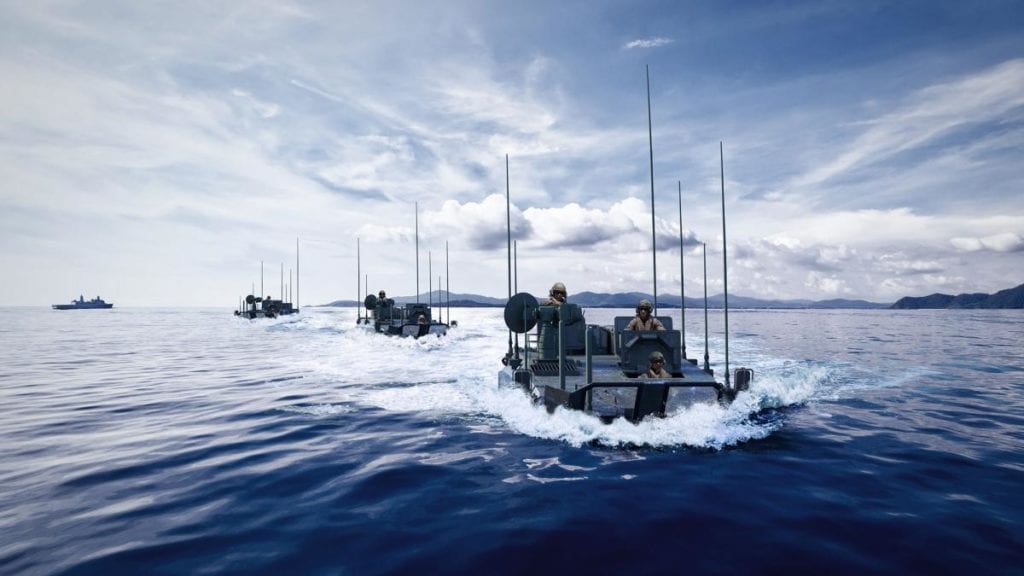
ARLINGTON, Va. — The U.S. Marine Corps has halted waterborne operations of its new amphibious armored vehicle pending resolution of a mechanical problem.
Maj. Jim Stenger, Marine Corps spokesperson, issued the following statement on Sept. 3:
“Out of an abundance of caution, the Marine Corps has suspended waterborne operations of the Amphibious Combat Vehicle [ACV] after identifying an issue with the towing mechanism. The Marine Corps is working on identifying and fixing the root cause of the problem. Realistic training is a vital component of readiness, and the Marine Corps is committed to ensuring Marines train under the safest conditions possible; this includes ensuring the functionality of vehicles and equipment.”
The ACV, built by BAE Systems, is replacing the AAV7 assault amphibious vehicle in Marine Corps service.
Northrop Grumman Ramps Up Production of Marine Corps’ G/ATOR Radar
The AN/TPS-80 Ground/Air Task Oriented Radar (G/ATOR) Active Electronically Scanned Array multi-mission radar system. U.S. MARINE CORPS
BALTIMORE — Northrop Grumman Corp has delivered its 15th AN/TPS-80 Ground/Air Task Oriented Radar (G/ATOR) Active Electronically Scanned Array multi-mission radar system to the U.S. Marine Corps, completing the low-rate initial production phase of the program, the company said in a Sept. 2 release.
The team recently fielded the first full-rate production system to the Marine Corps and will continue deliveries through 2024. Providing enhanced mission capabilities, software upgrades and logistics support are expected to continue through G/ATOR’s 30-year lifetime.
Marine F-35Bs to Operate from Japanese Aircraft Carrier, Commandant Says
The USS Ronald Reagan (CVN 76) sails alongside the Japan Maritime Self Defense Force helicopter destroyer JS Izumo (DDH 183) while conducting operations in the South China Sea in 2019. U.S. NAVY / Mass Communication Specialist 2nd Class Kaila Peters
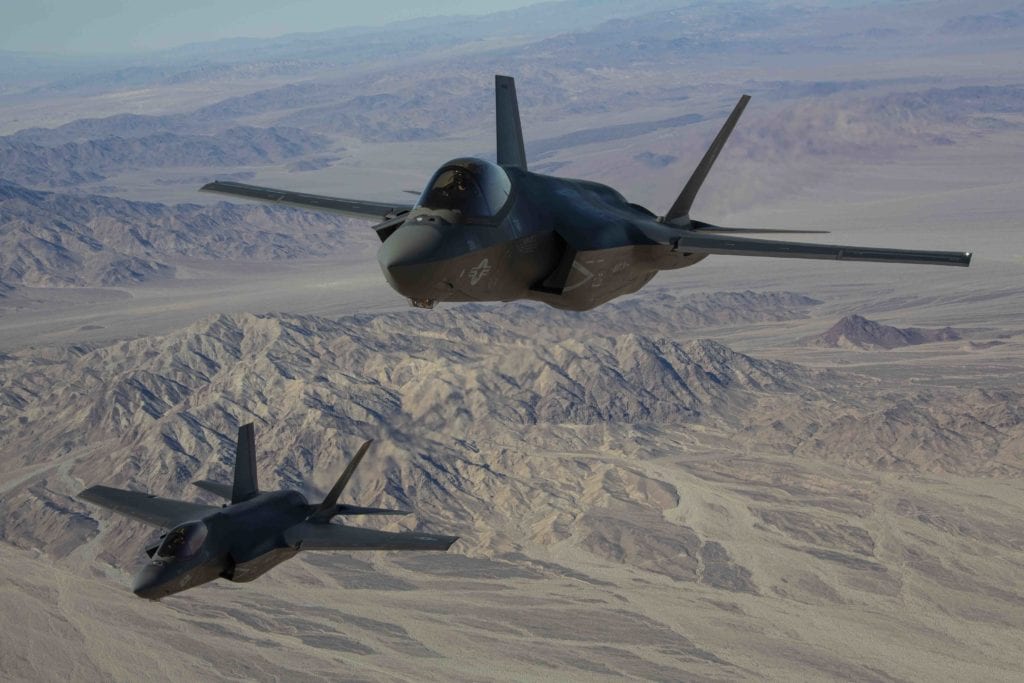
ARLINGTON, Va. — The Marine Corps will embark F-35B strike fighters on a Japanese aircraft carrier this fall, the service’s commandant said, a next step to match a current F-35B deployment on board a U.K. Royal Navy aircraft carrier.
“We’re actually going to fly U.S. Marine Corps F-35s off of a Japanese ship,” said Gen. David H. Berger, commandant of the Marine Corps, speaking Sept. 1 during a webinar conducted by the U.S. Naval Institute and the Center for Strategic and International Studies and sponsored By Huntington Ingalls Industries.
The Japanese Maritime Self-Defense Force operates the JS Izumo, commissioned a helicopter carrier in 2015 but under conversion to operate F-35Bs, of which Japan has ordered 40 from Lockheed Martin. A sister ship, JS Kaga, was commissioned in 2017 and also is planned for conversion to operate F-35Bs.
The U.S. Marine Corps operates two F-35B squadrons at Marine Corps Air Station Iwakuni, Japan: Marine Fighter Attack Squadron 121 (VMFA-121) and VMFA-242.
Berger pointed to the current deployment of F-35Bs of Marine Fighter Attack Squadron 211 (VMFA-211) together with Royal Air Force F-35Bs on board HMS Queen Elizabeth, which is operating in the Pacific region, as an example of how the United States and its allies are working together to solve operational details.
For one example he discussed, the British and Americans each have their own Special Compartmented Intelligence Facility, or SCIF, on the Queen Elizabeth to avoid complications of handling classified information.
Berger sees cooperation with such allies as the United Kingdom, Japan, and Australia as key to sharing information to countering the influence of China in the region. Enabling the F-35’s of each country to share data over networks is an important part of that cooperation.
Heckl Nominated for 3 Stars, Deputy Commandant for CD&I
Lt. Gen. Karsten S. Heckl. U.S. MARINE CORPS
ARLINGTON, Va. — Secretary of Defense Lloyd J. Austin III announced Aug. 6 that the president has made the following nomination:
Marine Corps Lt. Gen. Karsten S. Heckl for appointment to the rank of lieutenant general, and assignment as the deputy commandant for combat development and integration, Headquarters, U.S. Marine Corps; and commanding general, Marine Corps Combat Development Command, Marine Corps Base Quantico, Virginia. Heckl is currently serving as commanding general, I Marine Expeditionary Force, Marine Corps Base Camp Pendleton, California.
Below are excerpts from his official biography:
A native of Stone Mountain Georgia, Heckl graduated from Georgia State University and was commissioned in April 1988. He was designated an unrestricted Naval Aviator in September 1990.
Heckl commanded Marine Medium Tiltrotor Squadron 162, which included a combat tour in Iraq in 2008 and Marine Aviation Weapons and Tactics Squadron One (MAWTS-1) in 2010. From June 2018 to July 2020, he served as the commanding general, 2d Marine Aircraft Wing.
As a CH-46E pilot, Heckl deployed with Marine Medium Helicopter Squadron (HMM) 365 and HMM-263 and served as a CH-46E Instructor and Division Head at MAWTS-1, MCAS Yuma, Arizona. Additionally, he was assigned as one of the initial cadre of pilots with Marine Medium Tiltrotor Training Squadron 204 (VMMT-204).
Staff assignments include CH-46E and MV-22 Requirements Officer, Headquarters Marine Corps (HQMC) Aviation Department, Washington DC; J3 director of Operations, United States Forces-Afghanistan (USFOR-A), Kabul, Afghanistan; senior military assistant and Marine Aide to the secretary of the Navy; assistant deputy commandant for Aviation, HQMC Aviation Department, Washington DC; chief of staff, Naval Striking and Support Forces NATO (STRIKFORNATO), Lisbon, Portugal.
Heckl is a distinguished graduate of the Amphibious Warfare School (AWS) and the Naval War College.
USMC Force Changes ‘Wicked Hard,’ but Essential, Lt. Gen. Smith Says
Lt. Gen. Eric Smith discusses U.S. Marine Corps force design changes at Sea-Air-Space 2021. NAVY LEAGUE / Lisa Nipp
NATIONAL HARBOR, Md. – The Marine Corps’ drastic changes in force size, composition and weapons to meet the emerging threats, primarily from China, is going to be “wicked hard,” but the Corps’ top officer driving those changes said it is both essential and achievable.
“We have to find out how to go after a pacing threat that is moving. How a small force can hold something at risk. … We have divested what we can divest. We will produce the force we need by 2030,” Lt. Gen. Eric Smith, commanding general Marine Corps Combat Development Command and Deputy Commandant for Combat Development and Integration, said Aug. 3.
Smith added that the Marines’ effort to rebuild a smaller, more mobile but lethal force by the date set by Gen. David Berger, the Marine Corps Commandant, will depend on “stable funding.” A continuing resolution on defense funding, which is expected, “is a gift to an adversary,” he told Sea-Air-Space 2021.
Smith and the Marine Corps headquarters are rapidly shedding legacy systems, including the M-1 Abrams main battle tanks, much of its tube artillery and other heavy weapons to produce a much lighter force capable of sending small units into dispersed locations, most likely in western Pacific littoral regions, to counter China’s area-denial, anti-access capabilities that could nullify the Navy’s power projection efforts.
“The Corps’ purpose is to support the naval forces efforts,” Smith said. “It’s all about supporting the naval force in a conflict with a major adversary.”
Under intense questioning by moderator Dakota Wood, a retired Marine officer now a senior military analyst with the Heritage Foundation, Smith rejected the idea the Corps is sacrificing heavy systems, such as tanks, that would be useful in other parts of the world to focus solely on the Indo-Pacific theater and China. Smith noted recent experiments that used a mobile rocket artillery system mounted on a Humvee to hit distant targets.
“I can recreate the ability to kill armor,” he said. But “we have to get it there … we have to move things,” he said.
Challenged on how the Marines would support their dispersed light forces in a contested area, Smith said, “the first thing about having the logistical enterprise able to support you is need less. Why do I need water in the Indo-Pac theater?”
Smith was supported in his confidence in the Corps’ dramatic redesign efforts by William Williford, executive director of the Marine Corps Systems Command, which is fielding the new weapons and systems needed for the new force, and by Scott Lacy, executive director of the Marine Corps Warfighting Laboratory, which is running extensive wargames and experiments to develop and test the new formations and gear.
“Starting with the individual Marine, we are putting resources out there to make the Marine more lethal.” Wilford said.
“Don’t bet against us. If there is a concern it’s that the adversary will move faster than us,” Lacy said.
Smith also rejected Wood’s challenge the Corps is putting pressure on the other services to make up for the Marines’ cut in heavy forces, stating the Navy is all in on this and the Corps is working closely with the Army and Air Force to develop and field the right equipment. He also denied the Marines are sacrificing their ability to deal with current threats.
“You have to be able to fight today. I think we’re capable of doing that today,” he said, and noted that he and at least 14 other Marine generals, including Berger, “have skin in the game” by having sons currently serving in the Marines.
Marine Corps Selects Textron, GDLS for Advanced Recon Vehicle Prototypes
Concept art for Textron’s Advanced Reconnaissance Vehicle entry. TEXTRON SYSTEMS
QUANTICO, Va. — The Marine Corps selected Textron Systems and General Dynamics Land Systems for Advanced Reconnaissance Vehicle pre-award and will begin negotiations for Other Transaction Agreement awards of ARV prototypes, the Marine Corps said in a July 16 release.
Pending successful negotiations, Army Contracting Command–Detroit Arsenal will award the ARV OTAs utilizing the Ground Vehicle Systems OTA with the National Advanced Mobility Consortium.
A key Fleet Marine Force modernization initiative, the ARV Command, Control, Communications and Computers/Unmanned Aerial Systems will host a suite of C4 equipment, sensors, and operate both tethered and untethered UAS.
The ARV C4/UAS will employ an effective mix of reconnaissance, surveillance, target acquisition, and C4 systems to sense and communicate. These systems will enable ARV to serve as the manned hub of a manned/unmanned team and deliver next-generation, multi-domain, mobile reconnaissance capabilities.
Program Manager-Light Armored Vehicles (LAV), located at the Detroit Arsenal, Michigan, manages the ARV effort. PM LAV falls within the portfolio of programs managed by the Marine Corps’ Program Executive Officer-Land Systems, Quantico, Virginia.
The period of performance for the agreements is 22 months, with prototype delivery expected in the first quarter of fiscal year 2023 and six months of government evaluation that will complete in the third quarter.
The Marine Corps is working to validate the ARV requirement to serve as a mobile protected hub of manned capability with the C4 to effectively operate robotic autonomous systems-enabled teams through a competitive prototyping effort with multiple industry partners.
The effort gained momentum following an industry engagement held in December 2020. PM LAV solicited proposals for prototypes through the consortium on March 30, 2021. The Marine Corps received responses on May 3 and promptly began evaluations.
In parallel to competitive prototyping, the Marine Corps is also pursuing an effort to define the trade space of a government off-the-shelf solution using the Amphibious Combat Vehicle. The data from the ARV competitive prototyping efforts and the ACV study will jointly inform a Marine Corps decision point in fiscal year 2023.
First USMC F-35C squadron Declares Full Operational Capability
U.S. Marines with Marine Fighter Attack Squadron 314 and Marine Aerial Refueler Transport Squadron 352, Marine Aircraft Group 11, 3rd Marine Aircraft Wing, conduct a new expeditionary landing demonstration with M-31 arresting gear Interim Flight Clearance (IFC), on Marine Corps Air Ground Combat Center Twentynine Palms, Calif., Dec. 3rd, 2020. U.S. MARINE CORPS / Cpl. Leilani Cervantes
MARINE CORPS AIR STATION MIRAMAR, Calif. — As the Marine Corps continues to make changes to meet the demands of the rapidly evolving future operating environment, Marine Fighter Attack Squadron (VMFA) 314 has reached a new milestone in Marine Corps history as they declare their full operational capability (FOC) for the F-35C Lightning II, according to 3rd Marine Aircraft Wing (MAW) spokesman 1st Lt. Charles Allen in a July 1 release.
“VMFA-314 is the first F-35C squadron in the Marine Corps to declare FOC. They are now full up round and bring the incredible 5th generation capability to 3rd MAW. They will deploy as part of a Carrier Strike Group next year.” said Maj. Gen. Christopher Mahoney, 3rd MAW commanding general. “FOC for the Black Knights is yet another step forward in achieving Force Design objectives. The Black Knights are ready- 3rd MAW is ready.”
FOC is significant in its confirmation that VMFA-314 is fully prepared and equipped successfully deploy aboard U.S. Navy aircraft carriers, marking the first FOC declaration for Marine Corps. This inaugural event is met after VMFA-314 received their first F-35C on January 21, 2020, when their first jet arrived at Marine Corps Air Station (MCAS) Miramar from Naval Air Station Lemoore.
“Many hours were spent maintaining aircraft, launching and recovering aircraft in Miramar, at other military facilities, and aboard the ship to conduct the training required to meet these goals,” said Major Derek Heinz, VMFA-314 operations officer. “The Marines of VMFA-314 have gained confidence in fighting this aircraft and feel confident we can do so in combat if called upon.”
VMFA-314 is currently continuing its preparations toward future deployments by conducting tailored ship’s training availability (TSTA), marking the first F-35C squadron to conduct TSTA in the Marine Corps. This training will consist of communication rehearsals, medical drills, flight operations, and shipboard drills conducted while underway, ensuring the squadron is prepared to deploy in support of maritime campaigns.
CH-53K Helicopter Cost Trending Downward, Marine General Says
U.S. Marine Corps Maj. Gen. Michael S. Cederholm flies the CH-53K “King Stallion” at Marine Corps Base Camp Lejeune, North Carolina, June 12, 2021. U.S. MARINE CORPS / Cpl. Yuritzy Gomez
ARLINGTON, Va. — The unit cost of the Marine Corps’ new heavy-lift helicopter is trending in the right direction as the helicopter prepares for its Initial Operational Test and Evaluation (IOT&E), a senior Marine Corps officer told Congress.
Rep. Vicki Hartzler, R-Missouri, during a June 30 hearing of the subcommittee on Tactical Air and Land Forces for the House Armed Services Committee, asked Lt. Gen. Mark Wise, the Corps’ deputy commandant for aviation, about the cost of a CH-53K King Stallion being $125 million, more than the cost of an F-35 strike fighter. She noted the proposed 2022 budget requested nine CH-53Ks, down from the 11 planned earlier for 2022. She also asked if the Marine Corps’ requirement for 200 CH-53Ks would be reduced in light of the Corps’ planned reduction of heavy helicopter squadrons from eight to five.
Wise replied that unit cost for the CH-53Ks in Low-Rate Production Lot 5 in fiscal 2021 was $97 million and for Lot 6 in fiscal 2022 was projected to be $94 million, lower than the cost of an F-35, “and trending in the right direction.”
The general also said the Corps originally determined the requirement for CH-53Ks to be about 220 aircraft but reduced the official number to 200 because of affordability. He said the requirement will remain at 200 aircraft for the foreseeable future.
“If there is a reduction, it will probably be less than we would normally think had we actually bought the program of record that was the requirement to begin with,” Wise said. “As we get to determining what that number is, any reduction would not happen until the end of program buys. That would reduce the likelihood that the cost would rise, depending on the last lot buys.”
The general noted the 200 number was based on an projected attrition rate that had not been updated.
“So, it could go below 200 — and it ma y— but I’m not sure it’s going to go grossly below” 200, he said.
Wise said progress has been made through risk-reduction initiatives in dealing with technical issues such as engine gas re-ingestion.
“As we get ready to start into IOT&E — we’re actually starting next month — we’re seeing some fairly impressive readiness rates for the test birds that are going to be doing that operational test,” he said.
ONR Awards Charles River Analytics Contract to Bring Intelligent Adaptive Training to Marines
Charles River Analytics was awarded a contract to develop Marine Adaptive Schoolhouse Training with eLearning Repetition Technology (MASTERY). CHARLES RIVER ANALYTICS
CAMBRIDGE, Mass. — Charles River Analytics was awarded a contract of approximately $1 million from the U.S. Navy Office of Naval Research to develop Marine Adaptive Schoolhouse Training with eLearning Repetition Technology (MASTERY), the company said in a June 30 release.
MASTERY brings principles of intelligent tutoring and learning sciences to Marine Corps courses, with an adaptation engine that quizzes students as they learn, monitoring knowledge acquisition and tailoring the presentation of content to focus students on the material they haven’t yet mastered.
MASTERY is designed to interface with the existing Marine Corps Learning Management System (LMS), which gives students access to online course materials, quizzes, and course examinations. MASTERY will allow an instructor to easily apply intelligent, adaptive training to existing content in the LMS and seamlessly incorporates the student’s results into existing instructor and student workflows.
Marine Corps Retires UC-35C Operational Support Airlift Jets
A UC-35C operational support airlift jet, now retired. FLICKR / Cliff1066
ARLINGTON, Va. — The Marine Corps has retired its two UC-35C operational support airlift (OSA) jets.
Last month, the two UC-35Cs — military versions of the Cessna Citation V Ultra business jet — were sent to Davis-Monthan Air Force Base to be placed in storage.
The UC-35Cs, were based at Naval Air Station Joint Reserve Base New Orleans, Louisiana, and were “responsible for the transport of high-priority passengers and cargo with time, place or mission sensitive requirements,” according to the Naval Air Systems Command said.
The first UC-35C was delivered on Nov. 22, 1999. The aircraft replaced Beech UC-12B Huron turboprop aircraft in the OSA role.
Ten of 11 UC-35D Citation Encore versions continue in service with the Marine Corps in the operational support airlift role.