USMC Seeks to Jettison Some Weapons Platforms to Invest in Mobility, High Tech

Landing Craft Utility (LCU) 1661 deploys a Utility Tactical Vehicle from the 24th Marine Expeditionary Unit during CONTEX-PHIBEX, a bilateral amphibious exercise between the U.S. and Portuguese naval services, May 9, 2021. U.S. MARINE CORPS / 1st Lt. Mark Andries

ARLINGTON, Va. — The U.S. Marine Corps plans to shrink its force and divest itself of heavy weapons platforms such as tanks and towed artillery to pay for new investments in cyber space, artificial intelligence and high mobility, according to new budget documents and briefings.

The Department of the Navy, including the Marine Corps, is seeking $211.7 billion from Congress in its fiscal 2022 budget request. The Marines would get $47.98 billion, an increase of 6% over their 2021’s enacted budget, “with real growth in their operational, maintenance and procurement accounts,” Adm. John Gubleton, the deputy assistant secretary of the Navy for budget, told a Pentagon briefing at the Defense Department budget rollout May 28.

Overall, the Navy “realigned tens of billions of dollars towards higher priority programs and divested of legacy capabilities,” Gubleton said. For the Marine Corps those divestments include the Corps’ Abrams main battle tanks and towed artillery, to pay in part for a lighter, swifter widely dispersed force with the right skills for future challenges such as distributed operations, crisis response, and electronic, information and cyber warfare, according to budget documents.

Force Design

As part of that modernization, included in the Force Design 2030 plan announced in March 2020, the current budget request calls a reduction of 2,700 enlisted Marines, from 159,716 in 2021 to 156,650 in fiscal 2022. With the addition of 366 new officers to the existing officer corps, the total force in fiscal 2022 would be 178,500.

In the months leading up to the budget announcement, Marine Corps Commandant Gen. David Berger has stressed the Marines are divesting 20th century weaponry, like main battle tanks and towed artillery, to make room for capabilities that are unique to the threat posed by China, which Pentagon leadership has identified as the number one pacing challenge, a near-peer competitor that is catching up. But Berger has also stressed the Marine Corps has to be ready for other contingencies like natural disaster relief and rapid response across the globe.

“We’re willing to trade things like heavy armor for capabilities I think are unique to the Marine Corps, that provide a unique contribution to the combatant commander to the Joint Force,” Berger told a live-streamed forum at the Brooking Institution 10 days before the budget release. “And that is the expeditionary, the amphibious, the parts that we do better than anybody else.”

Berger said he was “willing to trade capacity, end strength, for quality,” adding, “we’ll have a slightly smaller Marine Corps in terms of end strength, but they will be more senior and better trained. So that’s a trade I’m willing to make.”

U.S. Marine Warrant Officer Zachary DeLong, a defensive cyber weapons officer with 7th Communication Bn., III Marine Expeditionary Force Information Group, demonstrates Defensive Cyberspace Operations-Internal Defensive Measures capabilities during a virtual training session with members of the Philippine Marine Corps on Camp Hansen, Okinawa, Japan, April 19, 2021. U.S. MARINE CORPS / Cpl. Nicholas Filca

Procurement

The fiscal 2022 request includes $3 billion in procurements, up from $2.7 billion enacted in 2021, including key Marine Corps development programs such as the Ground Based Anti-Ship Missile (GBASM), Ground/Air Task Oriented Radar, CH-53K King Stallion helicopter and the Amphibious Combat Vehicle.

Procurement requests include 17 short take off and vertical landing F-35B Lightning II joint strike fighter aircraft and six KC-130 aerial refueling tankers.

The request calls for replacing the CH-53 Sea Stallion, the ship-board compatible heavy-lift helicopter the Marines have been operating since the early 1980s, with the CH-53K King Stallion. The fiscal 2022 request seeks nine King Stallions.

The fiscal 2022 request would procure 613 Joint Light Tactical Vehicle (JLTV) vehicles, 139 less than fiscal 2021, and associated kits. The kits will support the baseline vehicle by providing the warfighter the ability to augment the vehicle’s configuration in order to respond to environmental conditions or threat situations. Kit procurement provides up to 75 individual kit options.

For the Amphibious Combat Vehicle, which will replace the legacy Assault Amphibious Vehicle in the Assault Amphibious battalions, the request is for a second full-rate production lot of 92 vehicles (20 more than FY 2021), plus procurement of related items such as production support, systems engineering/program management, engineering change orders, government furnished equipment, and integrated logistics support.

Fiscal 2022 funding seeks eight Ground/Air Task-Oriented Radar (G/ATOR) systems as well as the initiation of radar decoy procurement capabilities to support air defense, air surveillance, and counterbattery/target acquisition.

The Marines are asking for $47.9 million to begin the procurement of the initial capacity Naval Strike Missiles in support of the GBASM/Remotely Operated Ground Unit Expeditionary (ROGUE) Fires Vehicle for the Marine Littoral Regiment.

For the High Mobility Artillery Rocket System, a C-130 transportable, wheeled, indirect fire, rocket/missile launcher, the Marines are also seeking funding to procures launchers, carriers and equipment to support the continued expansion of marine Corps launcher capacity, and the procurement of Reduced Range Practice Rockets for tactical training, classroom training, and handling exercises.


Berger Says Supporting a Widely Distributed Maritime Force Will Be a Challenge

U.S. Marines load into combat rubber raiding crafts for a night mission at Marine Corps Base Camp Pendleton, Calif., April 7, 2021. U.S. MARINE CORPS / Cpl. Seth Rosenberg

ARLINGTON, Va. — The biggest problem facing U.S. Navy and Marine Corps plans to deter great power competitors is how to supply a widely distributed maritime force in a contested environment, the commandant of the Marine Corps says.

With his Force Design 2030 plan, Gen. David Berger, seeks to reshape the Corps so it can operate and survive inside the area of operations of a peer competitor equipped with advanced manned and unmanned aerial systems and cruise missiles.

“For the first time in a generation, we have a strategic competitor and that is China,” Berger said May 12 at the McAleese Associates FY2022 Defense Programs Conference webinars. “I think our force must be lighter, must be more mobile, has to be more expeditionary. We’ve got to be able to operate from a variety of platforms.”

Marines will be trained and equipped as a naval expeditionary force-in-readiness, prepared to operate inside actively contested maritime spaces in support of fleet operations. Berger’s plan calls for both force structure and operational changes, including dispersing smaller and highly mobile Marine expeditionary units — carried by smaller, cheaper and more numerous surface vessels

“Of all the things we’re working on in the naval force, and narrowly within the Marine Corps, this is the hardest problem going forward: logistical sustainment in a distributed environment, in a contested environment,” said Berger, noting, “nobody has contested our supply lines in 70 years.”

He added that this was an area where industry could help. The planned light amphibious warship (LAW), designed to complement and fill a gap in capability between the Navy’s large, multi-purpose amphibious warships and shorter range landing craft, is “going to give us the organic mobility that we so desperately need in the littorals anywhere in the world,” the commandant said.

He emphasized the driving force behind LAW’s concept is mobility, not creating an offensive weapons platform. “Perhaps at some point it would make sense to integrate some type of naval strike missile on a light amphibious warship, that’s not the driver,” Berger said. “My focus is on the mobility of it.”

He noted with its shallow draft, lower heat signature and organic mobility allowing it to remain forward deployed, the LAW gives commanders “the  ability to move the force around in a littoral environment.”

Unmanned systems in the air, and both on and beneath the sea will also play a “central, more prominent role” in the Marines, Berger said. “We’re doubling the inventory of our unmanned aerial squadrons,” he said.

Berger speculated that future platforms could be designed specifically for undersea warfare, carrying weapons systems, sonobuoys or sensor packages, and conventional amphibious ships with well decks might deploy unmanned surface vessels, possibly for a subsurface fight. “I think within a decade, half of our aviation, half of our logistics will be unmanned,” he added.


Flight Testing Soon for Upgraded Marine Corps K-MAX UAS

The Marine Corps’ first two Kaman K-MAX Helicopters arrived at Marine Corps Air Station Yuma, Ariz., Saturday, May 7, 2016. The K-MAX will be added to MCAS Yuma’s already vast collection of military air assets, and will utilize the station’s ranges to strengthen training, testing and operations across the Marine Corps. U.S. MARINE CORPS / Pfc. George Melendez

ARLINGTON, Va. — Kaman Air Vehicles, a division of Kaman Aerospace Corp., has conducted the first flight of the upgraded heavy-lift K-MAX unmanned rotorcraft — the K-MAX Titan — and expects to fly the two Marine Corps similarly upgraded K-MAX aircraft this month, the company said in a release. 

“We are excited to reach this major milestone on K-MAX Titan — watching this capability take to the skies and knowing that we are going to solve some of the toughest challenges for our commercial and military customers,” said Roger Wassmuth, senior director, Business Development, Air Vehicles Division, in the release. 

The new K-MAX Titan system will be available for existing K-MAX aircraft as well as on new production K-MAX helicopters, the company said. The K-MAX is a rugged, low-maintenance aircraft that features a counter-rotating rotor system and is optimized for repetitive external load operations. The aircraft can lift up to 6,000 pounds (2,722 kilograms) with unmatched performance in hot and high conditions. 

At the same time, Kaman is upgrading the autonomous capabilities of the two Marine Corps K-MAX air vehicles through a funded government contract. The two air vehicles are being upgraded with the K-MAX Titan unmanned system and Near Earth Autonomy’s sensor-based autonomy suite. 

Flight-testing of the upgraded Marine Corps K-MAX air vehicles is expected to start in May 2021.  

The Marine Corps’ acquired two K-MAX systems as cargo resupply UAS, which it designated as CQ-24As. The system consists of two unmanned K-MAX helicopters, main operating base and forward operating base ground control stations, and associated ground support equipment and spares. The Marine Corps conducted evaluations of the K-MAX to fill an urgent requirement for an unmanned ability to deliver/retrograde cargo to forward operating bases while avoiding the use of convoys over dangerous routes.  

In November 2011, the Marine Corps deployed the CQ-24A as a government-owned, contractor-operated system into Afghanistan for a six-month evaluation in combat conditions. The deployment was extended through May 2014. The two K-MAX aircraft, along with the rest of the system, were delivered to Marine Operational Test And Evaluation Squadron One (VMX-1) in 2016 to support further cargo UAS experimentation and concept of operations development. In April 2019, Kaman was awarded a contract to replace the avionics in the CQ-24s and return them to flight status. 


Textron Submits Concept for Marine Corps Advanced Recon Vehicle

Textron Systems’ Cottonmouth concept for the Marine Corps’ Advanced Reconnaissance Vehicle. TEXTRON SYSTEMS

ARLINGTON, Va. — Textron Systems has submitted to the Marine Corps its proposal for the competition to build the Advanced Reconnaissance Vehicle (ARV), a Corps requirement for an amphibious scout vehicle that will serve as a sensor node in the Corp’s planned modernization to meet the challenges of great power competition with expeditionary advanced base operations in the Indo-Pacific region.  

The ARV proposal, called Cottonmouth by Textron, is designed to be a “next -generation Naval Sensor Node,” fitted with “cutting edge sensor technology,” the company said in a May 4 release. “Cottonmouth delivers advanced maneuverability and a synergized sensor system to enhance reconnaissance operations.” 

The Cottonmouth has a 6×6 compact build that will allow four ARVs to fit on an LVAC 100-class ship-to-shore connector, also built by Textron. The Cottonmouth would be “equipped with multi-spectrum sensors, providing seamless communication between the Navy and Marine Corps to employ unmanned systems and joint-warfighting weapons systems. This provides the next-generation decision dominance needed to defeat threats beyond line of sight.” 

The Cottonmouth’s sensors would include Elbit Systems of America’s IronVision, “which uses “see-through” technology to provide the vehicle with advanced visibility and 360-degree situational awareness,” the release said.  

The Cottonmouth is a six-wheeled vehicle designed to operated by two personnel and to carry five additional mission personnel. It is designed for rugged land operations and water operations — using waterjets — in waves of 2 to 3 feet. 

Dave Philips, Textron System’s vice president for Land Systems, said the ARV would serve as a “quarterback” of a new platoon concept, which may include five other variants of the ARV. He said company is focused on Cottonmouth as a naval sensor node, but the company expects to build an infantry fighting vehicle version of the vehicle equipped for direct and indirect fire in the future.  

Marketing imagery of the vehicle shows a notional weapon system mounted atop the vehicle, in this case a remote-operated Kongsberg CROWS-J with a .50-caliber machine gun and an anti-tank missile system, said Luke Wright, Textron’s ARV program manager.  

For the prototype, the government is providing the competing contractors Lockheed Martin Stalker unmanned aerial vehicles to be integrated within their vehicles.  

The Marine Corps plans to replace its fleet of approximately 600 LAV-25 Light Armored Vehicles with 500 ARVs. 

The Cottonmouth Alpha purpose-built, open-architecture prototype was developed using more than $6 million so far, Philips said, and is a vehicle not required by the initial phase of the program, which is being put through requirements validation testing at the National Automotive Test Center in February 2021. Amphibious capabilities are being evaluated during the current quarter. As of May 3, the vehicle had logged 748 hours of operation in testing. 

Philips said the Marine Corps will select up to three competitors for the prototype phase of the ARV program. Up to two contractors will be chosen for the engineering and manufacturing development (EMD) phase. He estimates the EMD phase will be conducted in 2024. 


Milestone KC-130J Super Hercules Delivery Includes Capability Upgrade

The 60th USMC KC-130J aircraft takes off from Lockheed Martin production facilities in Marietta, Georgia, on March 31 on its way to VMGR-252 in Cherry Point, NC. U.S. NAVY

PATUXENT RIVER, Md. — The U.S. Marine Corps received its 60th KC-130J aircraft in March; the aircraft includes improved navigational performance, a modernized cockpit, and other key upgrades, the Naval Air Systems Command said in an April 29 release. 

The Tactical Airlift Program Office (PMA-207) accepted delivery of the aircraft outfitted with the Block 8.1 updated cockpit and AN/AAQ-24 DoN Large Aircraft Infrared Countermeasure (DoN LAIRCM). These upgrades address obsolescence issues and improve survivability. 

Produced by Lockheed Martin, the KC-130J aircraft have undergone numerous adaptations since entering Marine Corps service in September 2000. 

The Block 8.1 cockpit upgrade includes a new flight management system that complies with Communications, Navigation, Surveillance and Air Traffic Management mandates. It also boasts enhanced GPS capabilities, improved communications systems, and improvements to the KC-130J’s friend-or-foe identification technology. 

The addition of DoN LAIRCM, a laser-based self-protection system designed to defend against surface-to-air infrared missile threats, increases survivability of the aircraft and aircrew in the event of an airborne attack. 

“Both these systems increase the aircraft’s combat effectiveness to perform the KC-130J core mission essential tasking,” said Navy Capt. Steve Nassau, PMA-207 program manager. “The KC-130J is a global workhorse, and the Block 8.1 upgrade clears the path for the aircraft to have world-wide access, while the DoN LAIRCM allows the aircraft to operate under expanded threat environments.” 

The aircraft will become part of Marine Aerial Refueler Transport Squadron (VMGR) 252 at Marine Corps Air Station Cherry Point, North Carolina. 

“Our team has worked hard to make sure the Marine Corps is ready to utilize and support this aircraft,” said Joanna Sockoloskie, PMA-207 KC-130J integrated product team lead. “We have been involved from the start and it is our mission to ensure our Marines have the latest and finest equipment available.” 

The Marine Corps will receive the remaining 26 aircraft over the next five years reaching their program of record 86 KC-130Js. 


Berger Touts Vehicle-Mounted Naval Strike Missile for Marine Corps

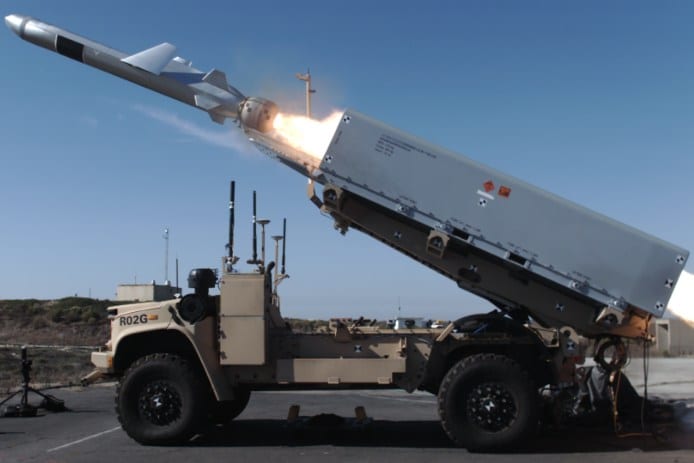
A Naval Strike Missile being fired from a modified, unmanned Joint Light Tactical Vehicle. U.S. NAVY

ARLINGTON, Va. — The vehicle-mounted Naval Strike Missile was highlighted by the Marine Corps’ commandant as an example of rapid development to meet the challenges of great power competition and enable the Corps to hold enemy naval units at risk from expeditionary bases.   

While testifying April 29 before the defense subcommittee of the House Appropriations Committee, Gen. David H. Berger, commandant of the Marine Corps, held up a recently released photo of a Naval Strike Missile (NSM) being fired from a modified unmanned Joint Light Tactical Vehicle (JLTV) known as ROGUE. 

The Navy Marine Expeditionary Ship Interdiction System, or NMESIS, successfully fired a Naval Strike Missile off the California coast, the system’s builder, Raytheon Missiles & Defense, a Raytheon Technologies business, said in an April 28 release. “The inaugural test proved the system’s ability to fire a Naval Strike Missile, or NSM, from a U.S. Marine Corps ground launcher and score a direct hit against a surface target at sea. The Marines will use NMESIS to support the U.S. Navy from the shore against enemy ships. NMESIS is comprised of the Raytheon Missiles & Defense-made NSM and a Remotely Operated Ground Unit for Expeditionary (ROGUE) Fires vehicle, produced by Oshkosh Defense.” 

“Our Naval Strike Missile is a vital weapon for denying enemies the use of key maritime terrain,” said Kim Ernzen, vice president of Naval Power at Raytheon Missiles & Defense. “This test further demonstrates our partnership for advancing the Marine Corps’ modernization priorities of enabling sea control and denial operations.” 

“Our role in contributing to [freedom of the seas] is, where [sea] denial, where [sea] control has to happen from a tactical to operational perspective, we can do that by moving the capability around that hold an adversary’s navy at risk from sip and from shore,” Berger said.  

“This is the speed at which we have to develop a capability like that,” he said. “This is the brilliance of a couple of young officers and Oshkosh [Defense], and a few other people creating other capabilities long before they’re even thought all the way through. This Joint Light Tactical Vehicle is unmanned. The people at Oshkosh and these two [Marine Corps] majors thought, ‘We can do this.’ They took the cab off the back and they put [the NSM] on the back and a fire control system. Now we can move this around on vessels, put it ashore, and hold an adversary’s navy at risk in order to ensure that the lines of the sea are kept open. 

“Our job is to support the fleet commander,” Berger said. “The fleet’s job is to support the joint force commander.”  

Berger also said a benefit of the NSM is that it is common to the Navy and Marine Corps and can be shifted to where it is needed most. 


Elbit Awarded $41M Order as Part of the Night Vision Goggles IDIQ Contract for U.S. Marine Corps

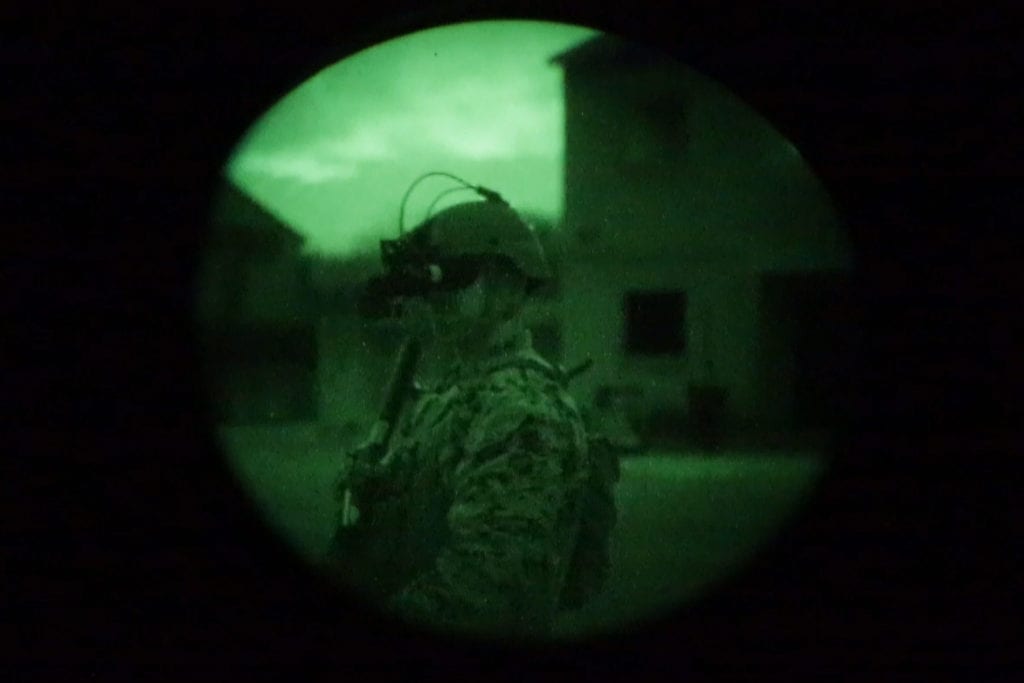
A view of a Marine through the Squad Binocular Night Vision Goggle at night. In January 2020, a group of Marines with The Basic School assessed the Squad Binocular Night Vision Goggle night vision system comprising an image-intensifier binocular and enhanced clip-on thermal imager. U.S. MARINE CORPS / Sgt. Kirstin Spanu

HAIFA, Israel — Elbit Systems Ltd.’s U.S. subsidiary, Elbit Systems of America LLC, has been awarded a delivery order valued at approximately $41 million for the supply of night vision systems and various spare components to the U.S. Marine Corps, the company said in an April 20 release. The order will be executed in Roanoke, Virginia, and will be supplied through March 2022. 

This order is part of a $249 million five-year Squad Binocular Night Vision Goggles indefinite delivery indefinite quantity (IDIQ) contract from Sept. 6, 2019, under which the U.S. Marine Corps are supplied with Squad Binocular Night Vision Goggle (SBNVG) systems consisting of high-performance, white phosphor image intensifier binoculars, modular uncooled thermal imaging sensors and common external power supplies — providing Marines improved mobility and situational awareness during night operations. 

“Marines need to quickly understand their surroundings and act to engage their targets — no matter the light conditions — and Elbit Systems of America’s SBNVG provides this power in a lightweight, adjustable system that is an ideal upgrade,” said Raanan Horowitz, president and CEO of Elbit Systems of America. 


Five Marine Officers Nominated, Renominated to Lt. General

Lt. Gen. David G. Bellon, reappointed to the grade of lieutenant general and assigned as commander, Marine Forces Reserve, one of several nominations announced April 16. U.S. MARINE CORPS

ARLINGTON, Va. – Secretary of Defense Lloyd J. Austin III announced April 16 that the president has made the following nominations: 

Marine Corps Lt. Gen. David G. Bellon for reappointment to the grade of lieutenant general, and assignment as commander, Marine Forces Reserve; and commander, Marine Forces South. Bellon is currently serving as commander, U.S. Marine Forces Reserve, New Orleans, Louisiana. 

Marine Corps Lt. Gen. George W. Smith Jr. for reappointment to the grade of lieutenant general, and assignment as commanding general, I Marine Expeditionary Force. Smith is currently serving as the deputy commandant for plans, policies, and operations, Headquarters, U.S. Marine Corps, Washington, D.C. 

Marine Corps Maj. Gen. Edward D. Banta for appointment to the grade of lieutenant general, and assignment as deputy commandant for installations and logistics, Headquarters, U.S. Marine Corps. Banta is currently serving as commander, Marine Corps Installations Command; and assistant deputy commandant for installations and logistics (facilities), Headquarters, U.S. Marine Corps, Washington, D.C. 

Marine Corps Maj. Gen. Kevin M. Iiams for appointment to the grade of lieutenant general, and assignment as commanding general, Training and Education Command. Iiams is currently serving as the assistant deputy commandant for combat development and integration; and deputy commanding general, Marine Corps Combat Development Command, Marine Corps Base Quantico, Virginia. 

Marine Corps Maj. Gen. William M. Jurney for appointment to the grade of lieutenant general, and assignment as commanding general, II Marine Expeditionary Force. Jurney is currently serving as commanding general, Marine Air Ground Task Force Training Command; and commanding general, Marine Corps Air Ground Combat Center, Twentynine Palms, California. 


Boeing to Sustain Compact Lasers for Marines

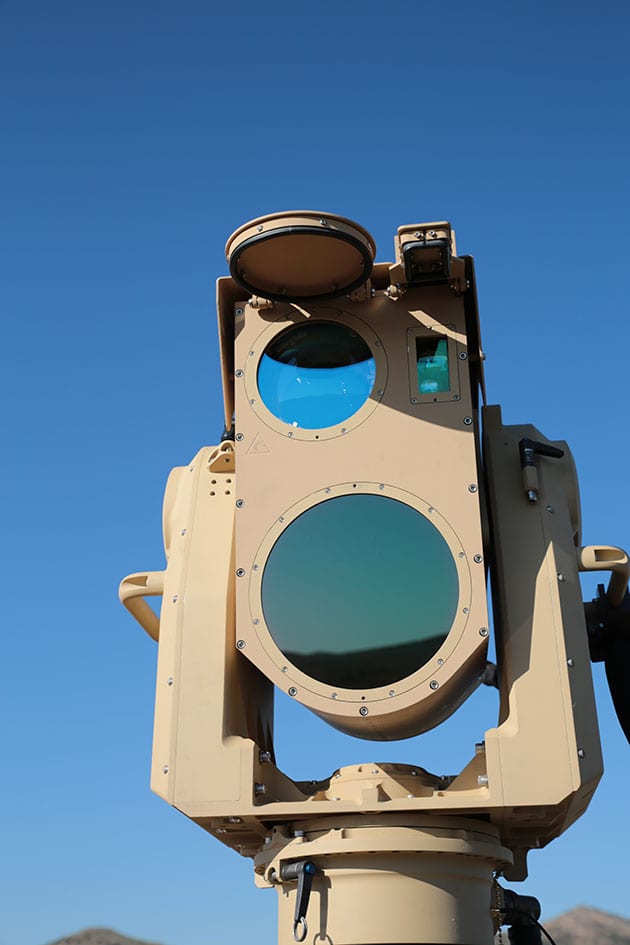
A Boeing CLWS unit. THE BOEING CO.

ST. LOUIS — Boeing was awarded a $2.5 million contract by the U.S. Marine Corps to sustain the service’s Compact Laser Weapon System (CLWS) units, the company said in a March 29 release. 

The five-year contract includes maintenance services for the Boeing-built CLWS units defending against hostile unmanned aerial systems in theater. Each CLWS unit is equipped with a best-in-class beam director and acquisition, tracking and pointing software to deliver precision protection. 

“We’re honored to continue our partnership with the Marine Corps,” said Kurt Sorenson, Boeing program manager for CLWS. “This will ensure that their systems continue to operate at the highest levels in defense of our warfighters.” 

Boeing recently increased the maximum beam power and reliability of the CLWS units – providing enhanced protection against larger and more numerous threats at greater range, as well as enabling them to defeat threats more quickly and efficiently. 

Boeing has more than 40 years of innovation and experience building directed energy systems, and has produced laser weapons for use in the air, on land and at sea. 


Iwo Jima ARG and 24th MEU Deploy After Redefining Integrated Training

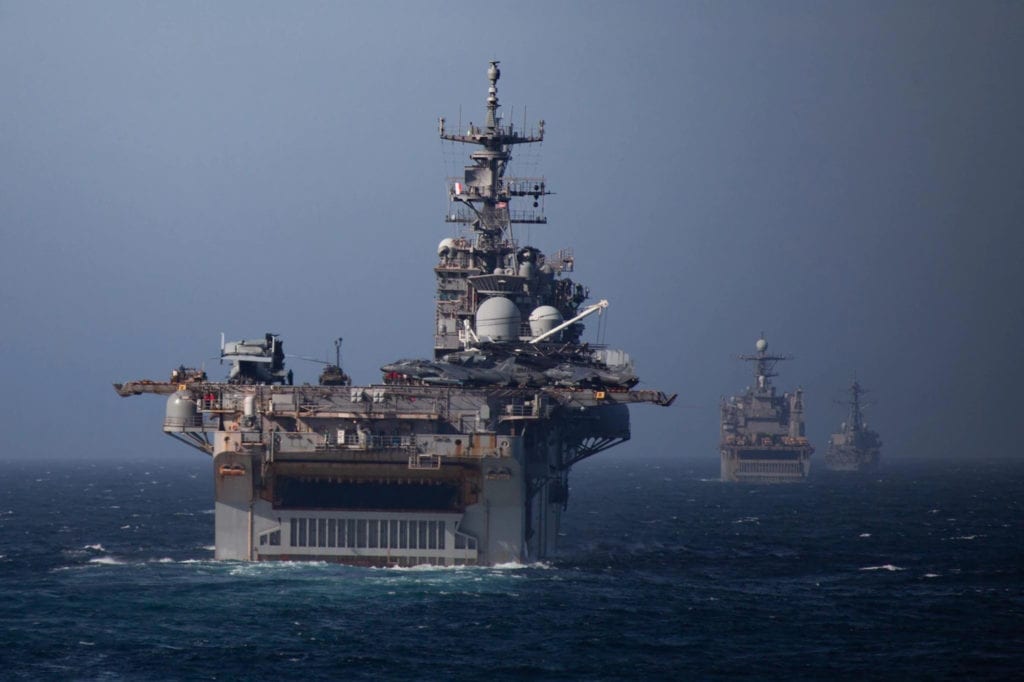
The amphibious assault ship USS Iwo Jima (LHD 7) and ships of the Iwo Jima Amphibious Ready Group (ARG), embarked with the 24th Marine Expeditionary Unit, simulate a strait transit during a composite unit training exercise (COMPTUEX) off the Atlantic coast, March 1, 2021. COMPTUEX is a month-long training event designed to test the ARG-MEU’s capabilities against the full spectrum of military operations. U.S. MARINE CORPS / Lance Cpl. Davis Harris

NORFOLK, Va. — The Iwo Jima Amphibious Ready Group (ARG) and the 24th Marine Expeditionary Unit (MEU) deployed March 25 after completing an intensive, month-long composite training exercise (COMPTUEX) and brief in-port maintenance period, the U.S. 2nd Fleet said in a release. 

 The ARG-MEU’s COMPTUEX was designed to fully integrate roughly 3,700 Sailors and Marines into one cohesive contingency force while testing the units’ abilities to carry out sustained operations from the sea. During the exercise, the Blue-Green team executed virtual and live evolutions challenging every major warfare area, including responses to surface and subsurface contacts, electronic attacks, surface and air amphibious assaults, and precision airstrikes. 
 
COMPTUEX was led by Commander, Carrier Strike Group (CSG) 4 and Expeditionary Operations Training Group (EOTG) staff, during which both groups of assessors provided training and mentorship while evaluating the warfighting capabilities of all units. There were two distinct phases of training that increased in complexity and intensity over time. 
 
At sea, simulated attacks by hostile aircraft, ships, and submarines required active responses by the ARG-MEU in real-time. Additionally, there were several live visit, board, search, and seizure (VBSS) exercises those fully integrated elements of the ARG and MEU at the tactical team level. 
 
On shore, the landing force conducted raids in daytime and nighttime urban environments. They executed multiple tactical recoveries of aircraft and personnel missions, utilizing Navy as well as Marine aviation assets. 
 
The ARG-MEU team was also assessed on their ability to integrate Navy and Marine Corps forces in a variety of warfare areas, essential to ensuring readiness in a variety of joint mission sets. 
 
“The ARG-MEU proved we are adaptable and can respond to a variety of complex and rapidly changing situations,” said Capt. Darren Nelson, commodore of Amphibious Squadron (PHIBRON) 4. “Our success depended on being innovative, thinking strategically, planning operationally, and acting tactically. The training we completed is unique in that only an ARG-MEU conducts this type of combined training in the military.” 
 
The 24th MEU, based out of Camp Lejeune, North Carolina, is the first East Coast MEU to embark ships with the Department of Defense’s new Joint Light Tactical Vehicle (JLTV). The JLTV is a versatile ground transport vehicle now used by all ground-based elements within the MEU, providing state-of-the-art protection and technology to troops in tow. 
 
Additionally, in response to the commandant of the Marine Corps’ new force design, the MEU embarked with a robust Light-Armored Reconnaissance detachment. 
 
“As the nation’s crisis response force, the ARG-MEU team must remain ready to respond at a moment’s notice when crises arise,” explained Col. Eric D. Cloutier, commanding officer, 24th MEU. “This exercise gave our team the opportunity to train how we fight across a range of military operations, providing a force-in-readiness to the fleet that is prepared to decisively engage when called upon.” 
 
Emphasizing flexibility during the month-long evolution, this Marine Air-Ground Task Force (MAGTF) conducted a company-sized amphibious live-fire raid event. During this raid, nearly 100 Marines and Sailors converged on targets at Camp Lejeune’s newest range. Finally, the month of ship-to-shore operations culminated with an amphibious assault by a fighting force of nearly 600 Marines and Sailors. 
 
Driving the ARG-MEU’s broad spectrum of expeditionary capabilities is its overall readiness as a fighting force. Most notably, this Navy-Marine Corps team took a deliberate approach to maximizing readiness through pre-deployment training while also joining forces to combat COVID-19, using coordinated mitigation procedures before their final at-sea period. In addition to conducting a restriction-of-movement (ROM) prior to embarking for the training exercise and adhering to 100% mask-wearing and other health and safety mitigations, the ARG-MEU were among the first units prioritized to receive the COVID-19 vaccines once they were approved for emergency use across the Department of Defense. 
 
“The entire ARG-MEU is estimated to have over 90% voluntarily immunized once the last few people receive their second dose underway,” said Nelson. “The impressive number was achieved by making the vaccine available to everyone and by doing everything possible to educate our Sailors and Marines about the vaccine.” 
 
The ARG consists of the amphibious assault ship USS Iwo Jima (LHD 7), transport dock ship USS San Antonio (LPD 17), and dock landing ship USS Carter Hall (LSD 50). Embarked detachments for the Iwo Jima ARG include PHIBRON 4, Fleet Surgical Team (FST) 6, Helicopter Sea Combat Squadron (HSC) 26, Tactical Air Control Squadron (TACRON) 21, Naval Beach Group (NBG) 2, Beach Master Unit (BMU) 2, Assault Craft Unit (ACU) 2 and 4, and Sailors from Amphibious Construction Battalion (ACB) 2. Also, joining the training were USS Arleigh Burke (DDG 51) and USS The Sullivans (DDG 68). 
 
The 24th MEU consists of a ground combat element, Battalion Landing Team (BLT) 1/8, a logistics combat element, Combat Logistics Battalion (CLB) 24, and an aviation combat element, Medium Tilt-Rotor Squadron (VMM) 162 Reinforced. 
 
The Iwo Jima ARG-MEU team is manned, trained and equipped to fulfill amphibious requirements in support of maritime security and stability. Amphibious ready groups and larger amphibious task forces provide military commanders a wide range of flexible capabilities including maritime security operations, expeditionary power projection, strike operations, forward naval presence, crisis response, sea control, deterrence, counter-terrorism, information operations, security cooperation and counter-proliferation, and humanitarian assistance and disaster relief.