Marine Corps to Procure 18 MQ-9 Reapers to ‘Close Kill Chain,’ General Says
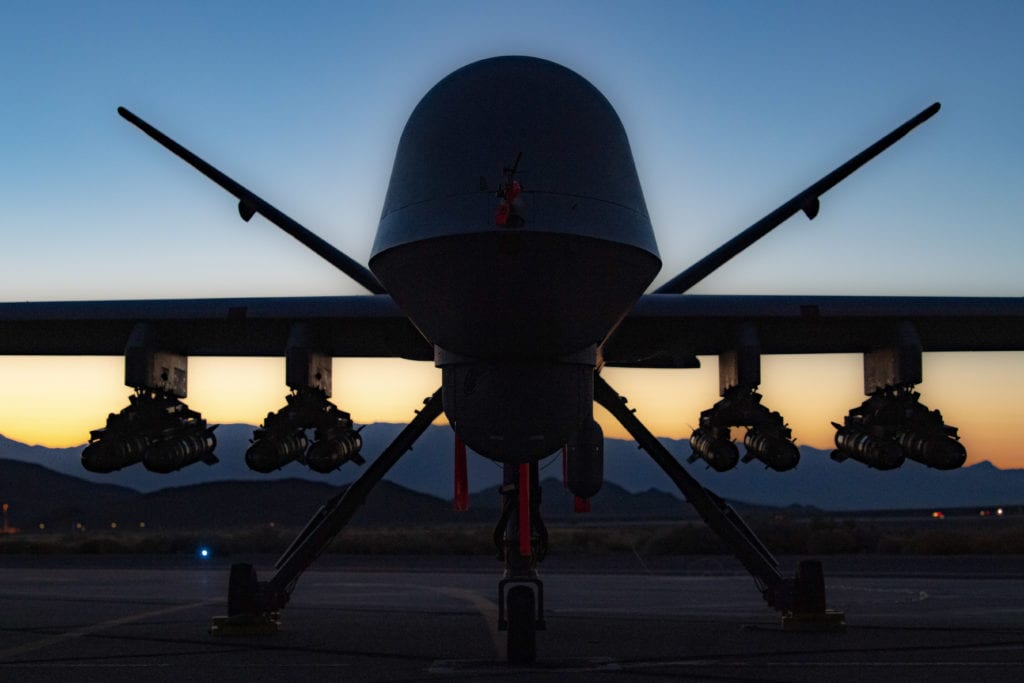
An MQ-9A Reaper assigned to the 556th Test and Evaluation Squadron sits on the ramp at Creech Air Force Base carrying eight Hellfire missiles. U.S. Air Force / SrA Haley Stevens
ARLINGTON, Va.—The Marine Corps plans to procure a total of 18 MQ-9A extended range Reaper unmanned aerial vehicles to operate in support of distributed maritime operations and expeditionary base operations, particularly in the Indo-Pacific region.
The Corps currently operates two MQ-9As in the U.S. Central Command area of responsibility. The two are operated by a Marine UAV squadron (VMU).
“We will procure 16 more for a total of 18,” said Lt. Gen. Eric M. Smith, commanding general, Marine Corps Combat Development Command, testifying March 18 before the Seapower and Projection Forces Subcommittee of the House Armed Services Committee. “That’s three [VMU] squadrons of six [each].”
The Reapers — built by General Atomics Aeronautical Systems — being procured have the Block 5-20 upgrades, which will be updated because of the open architecture of the system and will be able “to keep pace with or outpace the threat,” Smith said, who noted that the Reapers have on board “systems that give both inflight protection and protection from tampering.”
Smith said the Reapers could operate from a variety of locations, including the continental United States, Hawaii, Guam, or a partner nation.
The MQ-9A is incredibly important to us to pass data across the battlefield, the closer of the maritime kill chain as we operate underneath an alternate precision navigation and timing network,” Smith said. “That system has the duration and the range to be operated from those bases that we do control and still give us the loiter time that we need to both close the kill chain and to move that asset around something as vast as the Indo-Pacific theater.”
Earlier, the Corps garnered extensive experience with the Reaper by using ISR (intelligence, surveillance and reconnaissance) services provided by General Atomics in support of Marine forces in Southwest Asia.
SECDEF Announces Marine General Promotions
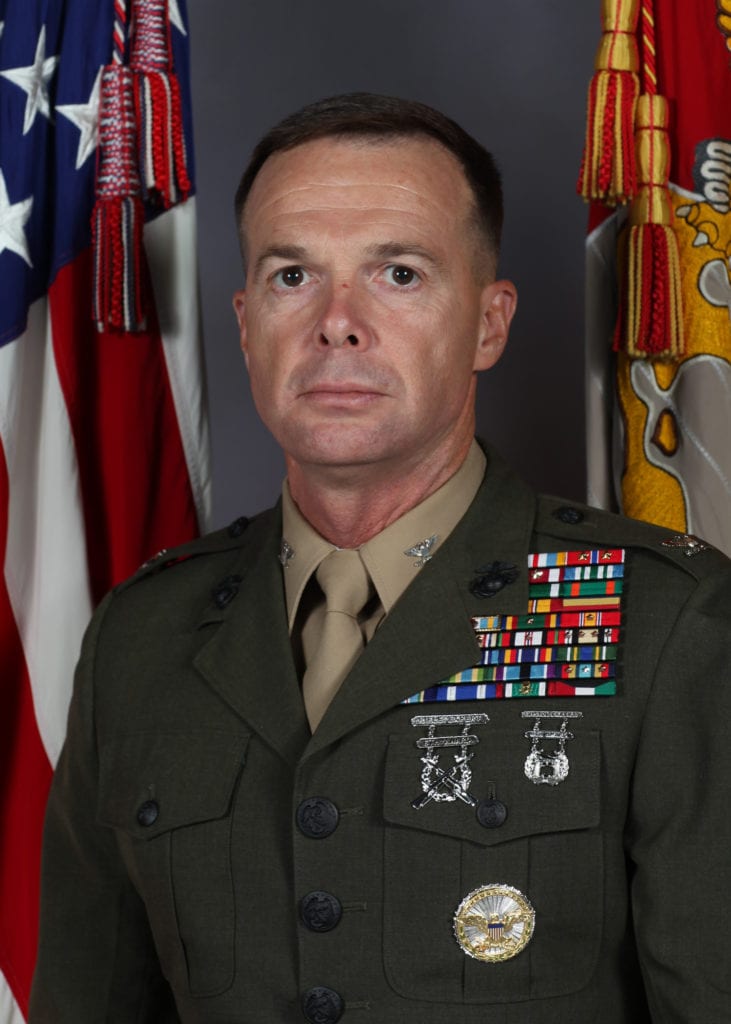
Brig. Gen. Jay M. Bargeron, nominated for appointment to the rank of major general, one of several flag officer nominations announced March 4. U.S. Marine Corps
ARLINGTON, Va. — Secretary of Defense Lloyd J. Austin III announced on March 4 that the president has made the following nominations:
Marine Corps Brig. Gen. Jay M. Bargeron has been nominated for appointment to the rank of major general. Bargeron is currently serving as president, Marine Corps University, Training and Education Command, Quantico, Virginia.
Marine Corps Brig. Gen. Brian W. Cavanaugh has been nominated for appointment to the rank of major general. Cavanaugh is currently serving as assistant deputy commandant, programs and resources, Headquarters, U.S. Marine Corps, Washington, D.C.
Marine Corps Brig. Gen. Dimitri Henry has been nominated for appointment to the rank of major general. Henry is currently serving as director, J-2, U.S. Central Command, MacDill Air Force Base, Florida.
Marine Corps Brig. Gen. Ryan P. Heritage has been nominated for appointment to the rank of major general. Heritage is currently serving as commanding general, Marine Corps Recruit Depot San Diego; and commnding general, Western Recruiting Region, San Diego, California.
Marine Corps Brig. Gen. Christopher A. McPhillips has been nominated for appointment to the rank of major general. McPhillips is currently serving as commanding general, 1st Marine Aircraft Wing, Okinawa, Japan.
Marine Corps Brig. Gen. Robert B. Sofge Jr. has been nominated for appointment to the rank of major general. Sofge is currently serving as deputy commander, U.S. Marine Corps Forces Pacific, Camp Smith, Hawaii.
Marine Corps Brig. Gen. Matthew G. Trollinger has been nominated for appointment to the rank of major general. Trollinger is currently serving as deputy director, Politico-Military Affairs (Middle East), J-5, Joint Staff, Washington, D.C.
Marine Corps Col. Joseph R. Clearfield has been nominated for appointment to the rank of brigadier general. Clearfield is currently serving as assistant chief of staff, G-3, U.S. Marine Corps Forces Cyberspace Command, Fort George G. Meade, Maryland.
Marine Corps Col. Mark H. Clingan has been nominated for appointment to the rank of brigadier general. Clingan is currently serving as chief of staff, III Marine Expeditionary Force, Okinawa, Japan.
Marine Corps Col. Simon M. Doran has been nominated for appointment to the rank of brigadier general. Doran is currently serving as special assignment officer, Royal Air Force, British Armed Forces, London, United Kingdom.
Marine Corps Col. Walker M. Field has been nominated for appointment to the rank of brigadier general. Field is currently serving as military fellow, Council on Foreign Relations, New York, New York.
Marine Corps Col. Anthony M. Henderson has been nominated for appointment to the rank of brigadier general. Henderson is currently serving as director, concepts and plans, Marine Corps Warfighting Laboratory, Marine Corps Base Quantico, Virginia.
Marine Corps Col. Michael E. McWilliams has been nominated for appointment to the rank of brigadier general. McWilliams is currently serving as executive assistant for deputy commandant, installations and logistics, Headquarters, U.S. Marine Corps, Washington, D.C.
Marine Corps Col. Matthew T. Mowery has been nominated for appointment to the rank of brigadier general. Mowery is currently serving as operations and readiness branch head, Aviation Plans, Programs, Joint/Congressional Matters, Doctrine and Budget Branch, Aviation Branch, Headquarters, U.S. Marine Corps, Washington, D.C.
Marine Corps Col. Andrew M. Niebel has been nominated for appointment to the rank of brigadier general. Niebel is currently serving as chief of staff, Marine Corps Installations Command, Headquarters, U.S. Marine Corps, Washington, D.C.
Marine Corps Col. Ahmed T. Williamson has been nominated for appointment to the rank of brigadier general. Williamson is currently serving as military assistant, Office of the Assistant Commandant of the Marine Corps, Headquarters, U.S. Marine Corps, Washington, D.C.
Marine Corps Reserve
Marine Corps Reserve Brig. Gen. Mark A. Hashimoto has been nominated for appointment to the rank of major general. Hashimoto is currently serving as commanding general, Force Headquarters Group, U.S. Marine Forces Reserve, New Orleans, Louisiana.
Marine Corps Reserve Col. Sean N. Day has been nominated for appointment to the rank of brigadier general. Day is currently serving as deputy commander, Force Headquarters Group, U.S. Marine Corps Forces Reserve, New Orleans, Louisiana.
Admiral Praises Marine Corps’ Last Hornet Carrier Deployment
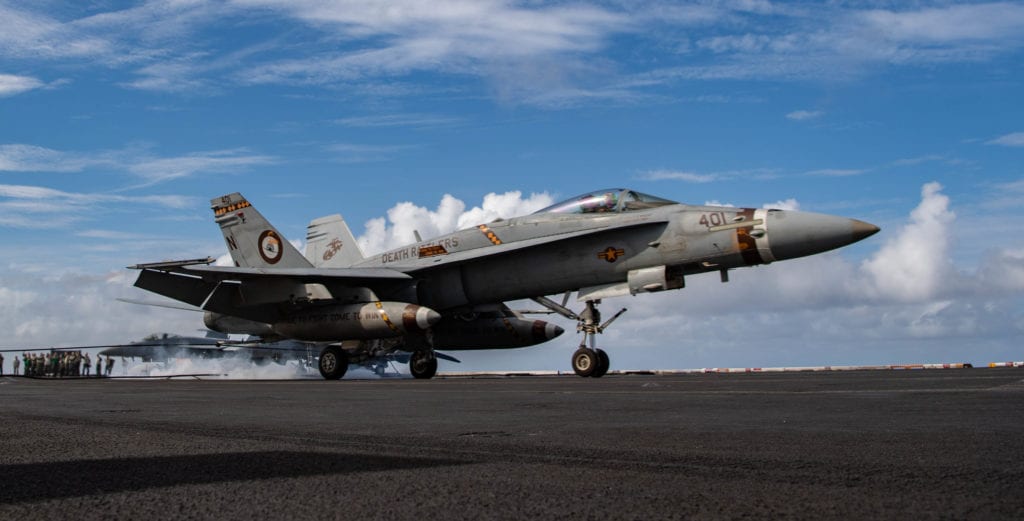
An F/A-18C Hornet, from the “Death Rattlers” of Marine Fighter Attack Squadron (VMFA) 323, makes an arrested landing on the flight deck of the USS Nimitz (CVN 68). Nimitz, flagship of Nimitz Carrier Strike Group, is currently conducting routine operations in U.S. 3rd Fleet. U.S. Navy / Mass Communication Specialist 3rd Class Charles DeParlier
ARLINGTON, Va.—The last deployment of the F/A-18C Hornet on an aircraft carrier ended last week with the return of the “Death Rattlers” of Marine Fighter Attack Squadron 323 (VMFA-323) from a deployment with Carrier Air Wing 17 on board USS Nimitz (CVN 68).
The Death Rattlers returned to their home base, Marine Corps Air Station Miramar, California on Feb. 25, the day before Nimitz arrived at San Diego to offload CVW-17 personnel before heading to is homeport of Bremerton, Washington.
Rear Adm. James Kirk, commander, Carrier Strike Group 11 and the Nimitz Carrier Strike Group, told reporters in a Feb. 26 teleconference that VMFA-323, despite flying the oldest jets deployed on a carrier, “performed fantastic yeoman work. Obviously with older aircraft, they do have challenges, but they rose to those challenges. Those maintainers did a great job, and those Marine pilots executed those missions, whether it was in support of Operation Inherent Resolve, Operation Octave Quartz, or Operation Resolute Support, or the just-presence missions we did or the operations we did during dual-carrier ops in the South China Sea with the Ronald Reagan Strike Group of the TR [Theodore Roosevelt] Strike Group.
“That Marine squadron met the mark, hit the mission,” Kirk said.
The deployment of Marine Corps F/A-18A and F/A-18C squadrons on carriers over the last two decades was a manifestation of the TACAIR Integration Plan, originally designed to provide one Marine VMFA squadron for each of 10 carrier air wings. Because of heavy commitments to wars in Afghanistan and then Iraq, the plan never fielded more than four VMFAs in the carrier air wings. With the transition of some VMFA squadrons to the F-35B and F-35C Lightning II strike fighters, the number of VMFAs on carriers dwindled to just one, VMFA-323.
The program is alive, however, with VMFA-314 — the Corps’ first F-35C squadron — preparing to deploy with a carrier air wing in 2022. The Corps is procuring 67 F-35Cs, a number that will allow it eventually to field four VMFAs equipped with the type in carrier air wings.
VMFA-323 will continue to operate the F/A-18C and will from a fleet replacement detachment to assume the role of training pilots and maintainers for Marine Corps F/A-18C/D squadrons after the fleet replacement squadron, VMFAT-101, is deactivated during fiscal 2023, as the Hornet training load decreases as the type is retired in 2030. According to the Marine Corps’ latest training plan, promulgated in 2019, VMFA-323 will be the Corp’s last active-duty Hornet squadron and will upgrade to the F-35B.
The Death Rattlers were activated in 1943 with F4U Corsair fighters and flew combat missions against Japanese forces during World War II. They flew Corsairs again in the Korean War and F-4B Phantom II fighters in the Vietnam War. They flew Phantoms from carriers after the Vietnam war and were one of the Corps’ first Hornet squadrons. Together with VMFA-314, they made the Corps’ first carrier deployment in the type, flying in combat from USS Coral Sea (CV 43) in 1986 against Libyan targets during Operations Prairie Fire and El Dorado Canyon.
The last F/A-18C carrier deployment of a Navy squadron ended in April 2018 with the return of Strike Fighter Squadron 34 (VFA-34) with Carrier Air Wing Two from USS Carl Vinson (CVN 70). VFA-34 was the Navy’s last active-duty deploying squadron to operate the legacy Hornet and has since upgraded to the F/A-18E Super Hornet.
The Navy is divesting itself of the legacy Hornets as fast as procurement of the F/A-18E/F and F-35C permit. The Blue Angels flight demonstration squadron recently completed the transition to the Super Hornet and soon the Navy’s sole reserve VFA squadron will make the transition.
15th MEU Supports Operation Inherent Resolve from Makin Island ARG
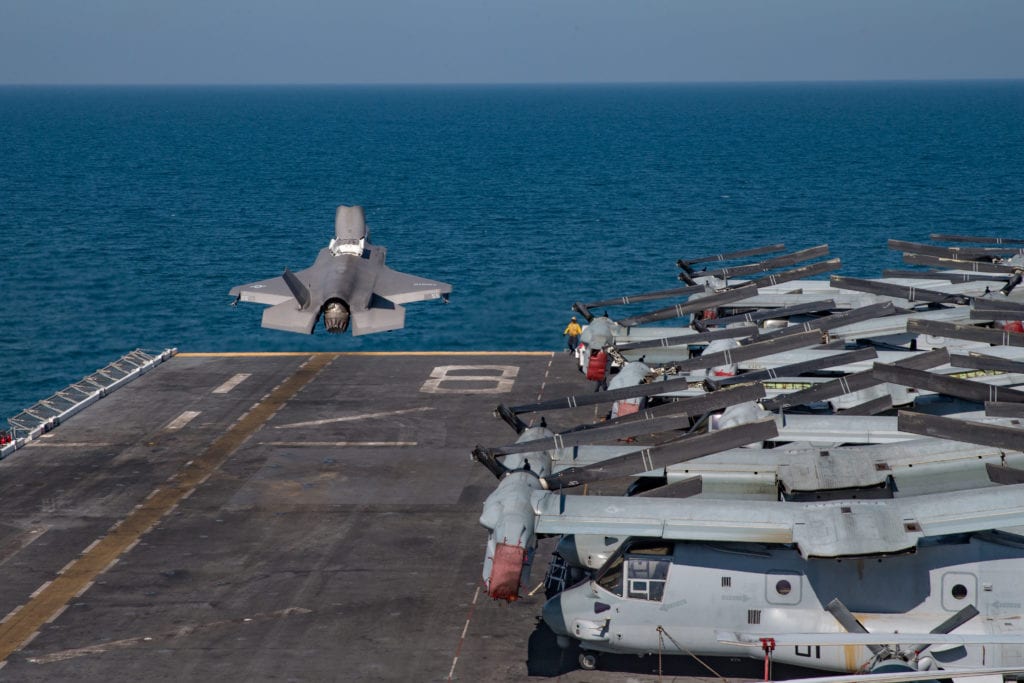
A Marine Corps F35B Lightning II assigned to Marine Medium Tiltrotor Squadron 164 (Reinforced), 15th Marine Expeditionary Unit (MEU), launches from the flight deck of the amphibious assault ship USS Makin Island (LHD 8) during flight operations in support of Operation Inherent Resolve, Feb. 13. U.S. Marine Corps / Sgt. Sarah Stegall
PERSIAN GULF — The Makin Island Amphibious Ready Group (ARG) and the 15th Marine Expeditionary Unit (MEU) began air operations in support of Operation Inherent Resolve (OIR), Feb. 13, the 15th MEU Public Affairs said in a Feb. 16 release.
Close air support operations and defensive counter air support operations were carried out by Marine Medium Tiltrotor Squadron (VMM) 164 (Reinforced), the aviation combat element of the 15th MEU, as part of broader U.S. Central Command counterterrorism operations in the region.
U.S. Marine Corps F-35B Lightning II aircraft departed from the amphibious assault ship USS Makin Island (LHD 8), flagship of the Makin Island Amphibious Ready Group, to execute the long-range strike.
“Long range F-35B Lightning II strike operations demonstrate the ARG/MEU’s ability to project air power well beyond the shore,” said U.S. Marine Corps Col. Christopher J. Bronzi, the 15th MEU commanding officer. “We look forward to exercising the capabilities in our arsenal while in theater and remain ready to deliver those capabilities at any time if called upon.”
The Makin Island ARG transited through the Strait of Hormuz and into the Arabian Gulf on Feb. 8. The Makin Island ARG and 15th MEU’s presence in the U.S. 5th Fleet area of operations demonstrates the U.S. and its regional partners’ commitment to the free flow of commerce, regional maritime security and freedom of navigation.
“This mission is a strong example of the value a deployed naval expeditionary force brings to combatant commanders and joint partners in the region,” said U.S. Navy Capt. Stewart Bateshansky, Makin Island ARG commodore. “The MEU’s ability to source combat sorties from the Makin Island, while simultaneously supporting training and operations, is a testament to the flexibility and responsiveness of our Navy and Marine Corps team.”
The Makin Island ARG and embarked 15th MEU provide the combatant commander with a responsive, flexible and forward-deployed asset capable of maritime power projection, contingency operations and crisis response, shaping the operational environment to protect the United States and allied interests in any threat environment.
“We are proud and excited to be able to support missions in areas of the world where we are most needed,” said U.S. Marine Corps Lt. Col. Christopher Kelly, VMM-164 (Rein.) executive officer. “Conducting a long range strike mission with fifth generation F-35B fighters from amphibious assault ships demonstrates the versatility this platform brings to the joint force.”
The U.S. 5th Fleet AOO encompasses about 2.5 million square miles of water and includes the Persian Gulf, Gulf of Oman, Red Sea and parts of the Indian Ocean. The expanse is comprised of 20 countries and includes three critical choke points at the Strait of Hormuz, the Suez Canal and the Strait of Bab al Mandeb at the southern tip of Yemen.
First ACV Command Variant Delivered to Marine Corps for Testing
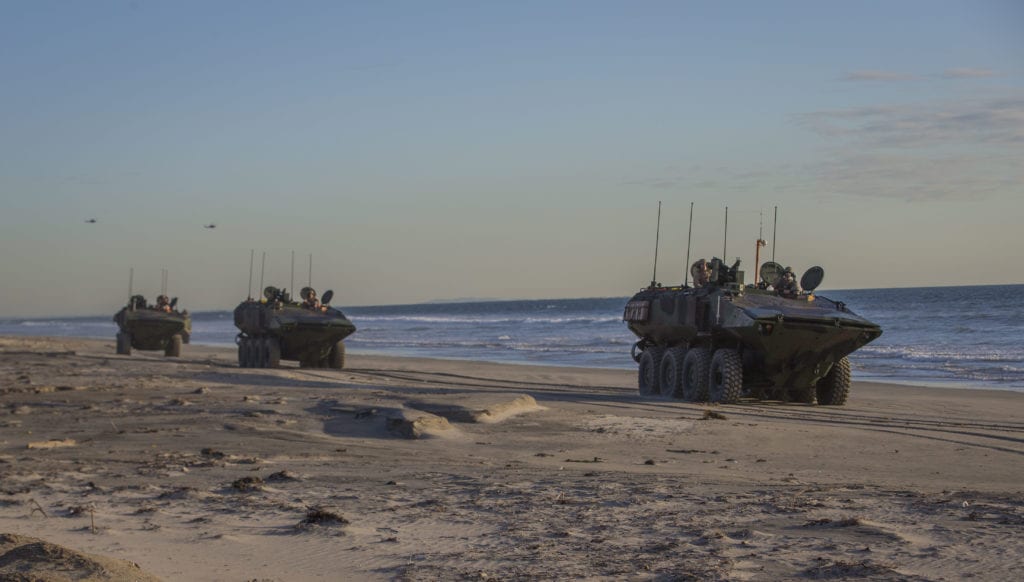
U.S. Marines with Amphibious Vehicle Test Branch, Marine Corps Tactical Systems Support Activity, drive new Amphibious Combat Vehicles along the beach during low-light surf transit testing at AVTB Beach on Marine Corps Base Camp Pendleton, California, Dec. 18, 2019. U.S. Marine Corps / Lance Cpl. Andrew Cortez
STAFFORD, Va. — BAE Systems has handed over the first of a new variant of the Amphibious Combat Vehicle to the U.S. Marine Corps for testing, the company said in a Feb. 18 release. The Command variant (ACV-C) is designed to provide the highest levels of communications, coordination, and analysis on the battlefield to support command and control.
BAE Systems is under contract to deliver two variants to the Marine Corps under the ACV Family of Vehicles program: the ACV personnel carrier (ACV-P) and the ACV-C. A 30mm cannon (ACV-30) is currently under contract for design and development and a recovery variant (ACV-R) is also planned.
The ACV-C employs multiple workstations for Marines to maintain and manage situational awareness in the battle space. The workstations access independent networks for advanced digital communications while on the move. This capability supports immediate information synchronization in the application of combat power.
“This ACV’s base design for payload makes it a uniquely adaptable platform for the integration of numerous mission capability sets,” said John Swift, director of amphibious programs at BAE Systems. “The delivery of the first ACV-C for testing is significant as it provides Marines with advanced operational control for defeating adversaries. Marines will be able to quickly receive and analyze data, coordinate battlefield functions, and transmit information to provide terminal mission control rapidly from the mobile protected ACV-C.”
The ACV platform was designed to grow and adapt to mission needs, allowing space for new capabilities as technology evolves such as turreted, reconnaissance, electronic warfare, anti-air, and UAS systems integration.
The Marine Corps and BAE Systems entered full-rate production on the ACV program with a contract award in December, achieving its most significant milestone to date along with the Marine Corps’ decision to declare initial operational capability. Work is currently underway on the ACV-30 variant.
ACV production and support is taking place at BAE Systems locations in Stafford, Virginia; San Jose, California; Sterling Heights, Michigan; Aiken, South Carolina; and York, Pennsylvania.
U.S. Marine Corps Awards BAE Systems $184 million for Additional ACVs
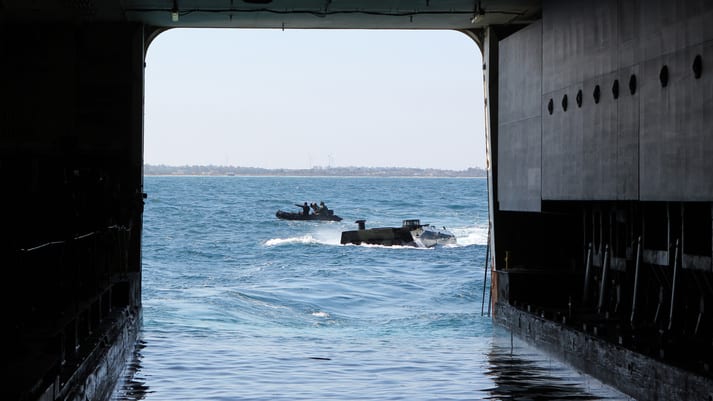
Amphibious Combat Vehicles undergoing sea tests in Italy. BAE Systems
STAFFORD, Virginia – BAE Systems has received a $184 million contract option from the U.S. Marine Corps for 36 additional Amphibious Combat Vehicles (ACVs) under full-rate production, the company said in a Feb. 11 release. The order demonstrates the Marine Corps’ confidence in a program that is on track to deliver this critical capability to the Marines.
This contract award will cover production, fielding, and support costs for the ACV personnel carrier (ACV-P) variant. BAE Systems was awarded the first full-rate production contract option in December for the first 36 vehicles. This option on that contract increases the total number of vehicles under full-rate production to 72, for a total value of $366 million.
“The exercising of this option validates years of teamwork in partnership with the Marines to provide the most adaptable amphibious vehicle possible to meet their expeditionary needs,” said John Swift, director of amphibious programs at BAE Systems. “The ACV was designed to meet the Marines’ needs of today while allowing for growth to meet future mission role requirements.”
The ACV is a highly mobile, survivable, and adaptable platform for conducting rapid ship-to-shore operations and brings enhanced combat power to the battlefield. BAE Systems is under contract to deliver two variants to the Marine Corps under the ACV Family of Vehicles program: the ACV-P and the ACV command variant (ACV-C). A 30mm cannon (ACV-30) is currently under contract for design and development and a recovery variant (ACV-R) is also planned.
The Marine Corps selected BAE Systems along with teammate Iveco Defence Vehicles for the ACV program in 2018 to replace its legacy fleet of Assault Amphibious Vehicles (AAVs), also built by BAE Systems. BAE Systems was also recently awarded an indefinite delivery indefinite quantity contract worth up to $77 million for the ACV program that includes the provision of spare and replacement parts, testing equipment, and other services.
ACV production and support is taking place at BAE Systems locations in Stafford, Virginia; San Jose, California; Sterling Heights, Michigan; Aiken, South Carolina; and York, Pennsylvania.
Oshkosh Defense Celebrates Production of the 10,000th JLTV
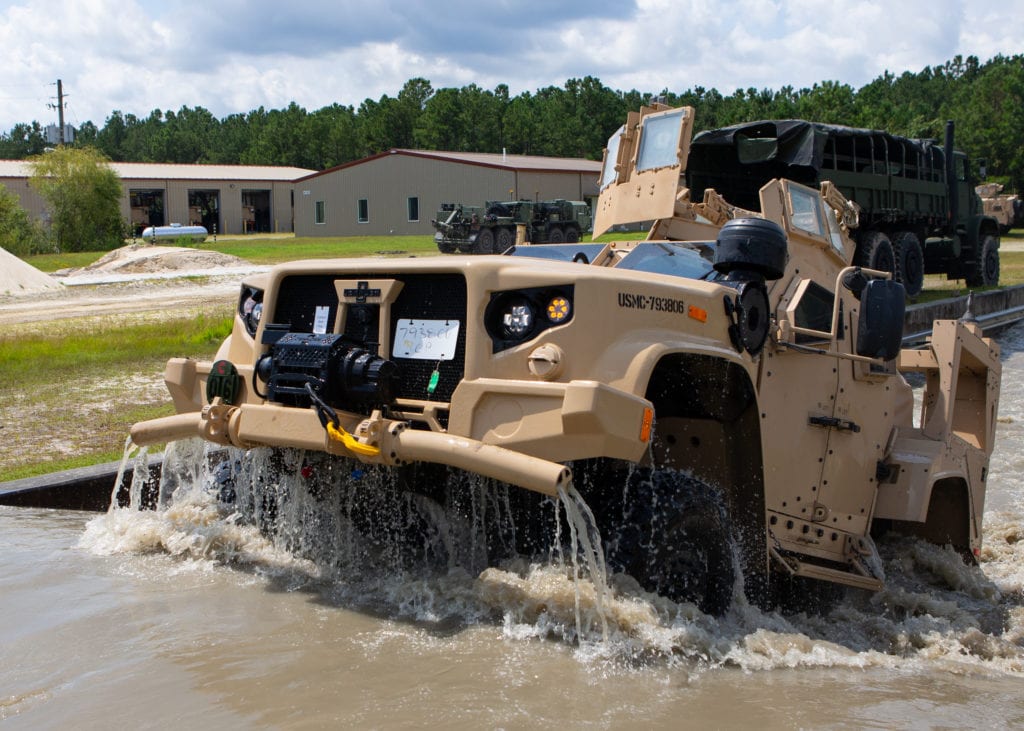
A joint light tactical vehicle with Marine Wing Support Squadron 271 emerges from a fording pit at Camp Lejeune, North Carolina, Sept. 2, 2020. U.S. Marine Corps / Lance Cpl. Elias E. Pimentel III
OSHKOSH, Wis. — Oshkosh Defense LLC, an Oshkosh Corp. company, recently produced the 10,000th Joint Light Tactical Vehicle (JLTV), the company said in a Feb. 9 release.
This significant milestone represents over a decade of proprietary experience in designing, building, and delivering the world’s most capable light tactical vehicle. Since the program was awarded to Oshkosh Defense in August 2015, the company has built a robust, dependable supply chain; optimized its manufacturing process and maximized efficiencies; and provided JLTVs at a contractual price substantially lower than the government cost estimate.
“This milestone is a true testament to the pride and dedication that our team members have in the JLTV program which has become a central piece of the U.S. military’s ground force,” said George Mansfield, vice president and general manager of Joint Programs for Oshkosh Defense. “Producing the 10,000th JLTV in under five years is further evidence of our ability to meet the demands of our domestic and international customers by providing the world’s most capable light tactical vehicle at a great price. We’re excited to continue working with our military customer to further refine and expand the platform.”
To date, Oshkosh Defense has received orders for 18,126 JLTVs for a total contract value over $6 billion. Over 6,500 of those vehicles have been fielded with warfighters around the globe, including over 30 U.S. and international military installations. The U.S. Army and U.S. Marine Corps are the customers for the majority of the JLTVs ordered so far.
International interest in the Oshkosh Defense JLTV also continues to grow. Oshkosh Defense has received orders or commitments from seven NATO and non-NATO allies including United Kingdom, Belgium, Montenegro, Slovenia, Lithuania, Brazil, and North Macedonia.
NAVAIR Orders Five VH-92 Presidential Helicopters from Sikorsky
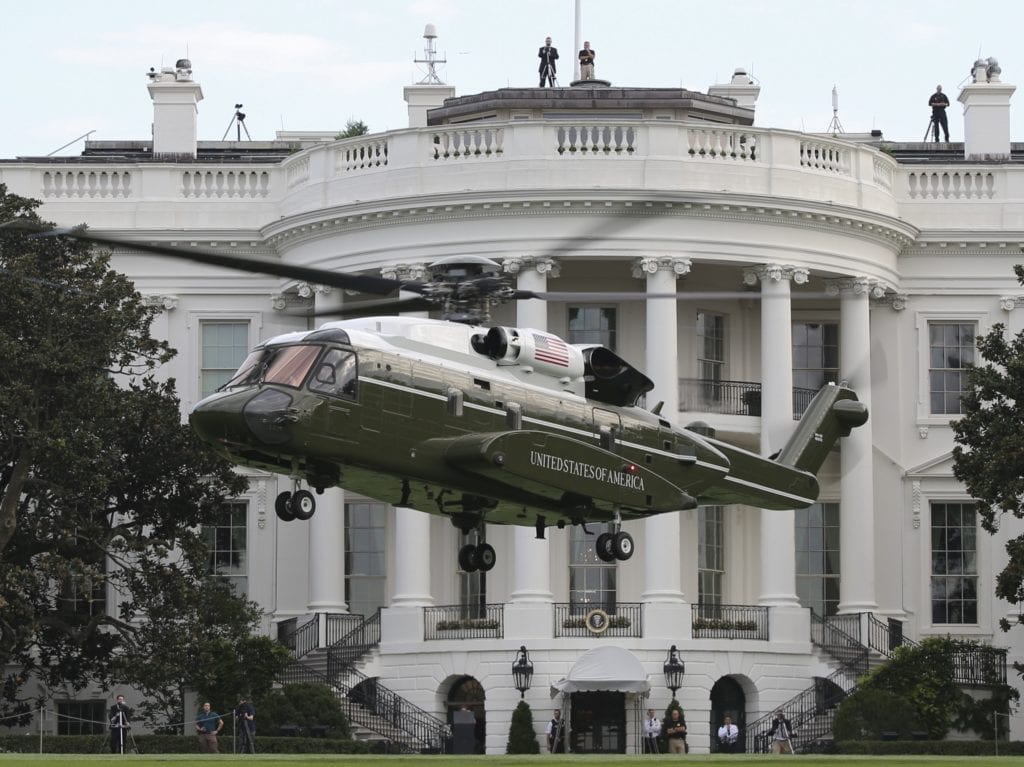
Marine Helicopter Squadron (HMX) 1 conducts test flights of the new VH-92A helicopter over the South Lawn of the White House, Sept. 22, 2018, in Washington, D.C. U.S. Marine Corps / Sgt. Hunter Helis
ARLINGTON, Va. — Naval Air Systems Command has awarded Sikorsky a third production contract to build five VH-92A helicopters for the U.S. Marine Corps.
The Naval Air Systems Command awarded Sikorsky Aircraft Corp. — a Lockheed Martin company — a $478.6 million firm-fixed-price contract modification to build five Low-Rate Initial Production Lot III VH-92As, according to a Feb. 5 Defense Department announcement. The award also includes orders for “interim contractor support, two cabin interior reconfiguration kits, support equipment, initial spares and system parts replenishment,” the release said. Work on the contract is expected to be completed by December 2023.
The VH-92A was selected in 2014 to provide transport for the president of the United States, the vice president and other high-level government officials. The helicopter will replace the 19 VH-3D Sea King and VH-60N “White Hawk” helicopters operated by Marine Helicopter Squadron One. The Corps plans to acquire a total of 23 VH-92As, 21 for operations and two for testing. The May 2014 engineering and manufacturing development contract procured two test aircraft and four production aircraft. Six VH-92As were ordered in June 2019, followed by six more in February 2020.
The presidential helicopter fleet is operated by Marine Helicopter Squadron One, based at Marine Corps Air Station Quantico, Virginia, with a detachment at Joint Base Anacostia-Bolling in Washington.
“Government testing to validate system performance and prepare for Initial Operational Test and Evaluation is progressing on schedule and will support an Initial Operational Capability (IOC) planned for July 2021,” a Navy spokeswoman said. “The VH-92A will enter service post IOC at the determination of the White House Military Office.”
Marine Corps Adds 5th F-35B Squadron to its Force
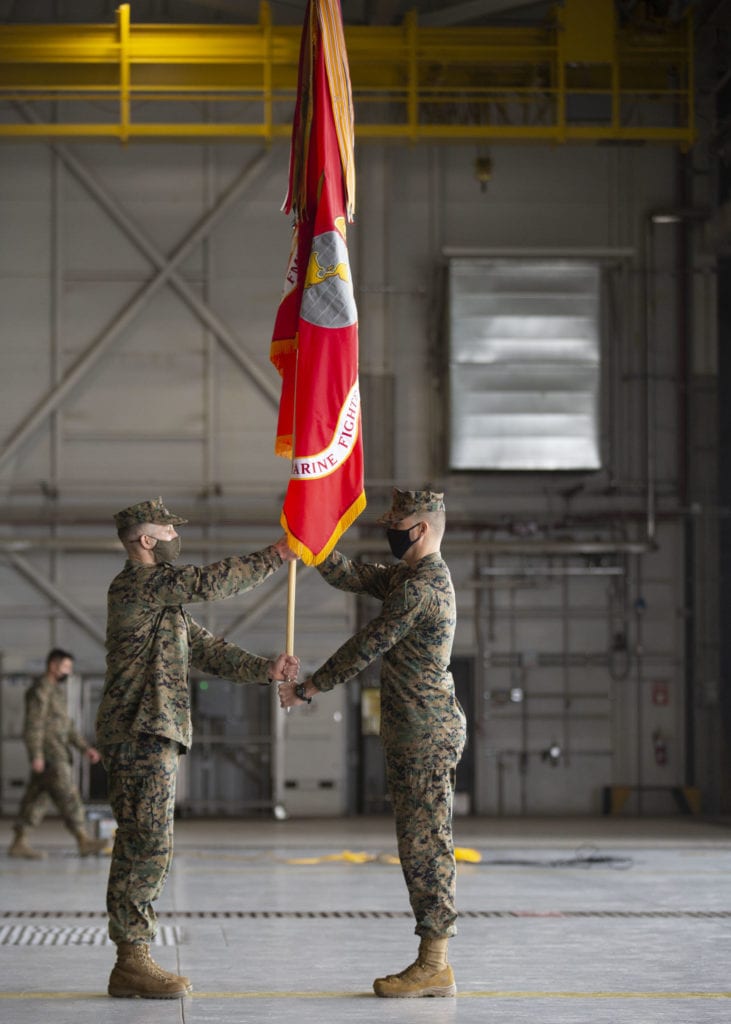
U.S. Marine Corps Lt. Col. Alexander Goodno, the incoming commanding officer, left, and Sgt. Maj. Collin Barry, the incoming sergeant major, with Marine Fighter Attack Squadron (VMFA) 225, Marine Aircraft Group 13, 3rd Marine Aircraft Wing, exchange the organizational colors during the redesignation and assumption of command ceremony at Marine Corps Air Station Yuma, Ariz., Jan. 29, 2021. U.S. Marine Corps / Lance Cpl. Juan Anaya
ARLINGTON, Va. — The Marine Corps is converting a fifth squadron to the F-35B Lightning II strike fighter.
In a Jan. 29 ceremony at Marine Corps Air Station (MCAS) Yuma, Arizona, the “Vikings” of Marine All-Weather Fighter Attack Squadron 225 (VMFA(AW)-225) were re-designated Marine Fighter Attack Squadron 225 (VMFA-225) as they engaged in the process of learning to operate and maintain the F-35B version of the Lightning II, according to a release from the 3rd Marine Aircraft Wing.
The squadron retired its last F/A-18D Hornet strike fighter a year ago, on Jan. 23, 2020.
VMFA-225 follow VMFAs 121, 211, 122, and 242 as the Corps’ fifth operational F-35B squadron. VMFA-225 moved from MCAS Miramar, California, to MCAS Yuma, Arizona, to join 211 and 122, both of which have flown combat missions in the Middle East. VMFAs 212 and 242 are based at MCAS Iwakuni, Japan.
“It’s an exciting day for [VMFA-225],” said Lt. Col. Alexander Goodno, the commanding officer of VMFA-225, in the release. “We will grow over the next 18 to 24 months to a full, combat-ready, capable squadron and be ready to do the nation’s bid in the war.”
“We have aircraft afloat right now from VMFA-122; we’re flying combat missions,” said Col. Benjamin Hutchins, commanding officer of Marine Aircraft Group 13, in the release. “We have VMFA-211 getting ready to deploy on [HMS Queen Elizabeth]. This is a busy business, this is our nation’s business, this is our Corps’ business.”
The Corps’ single F-35C squadron, VMFA-314, is scheduled to be ready for a deployment on the USS Carl Vinson in early fiscal 2022.
Marine Corps Commandant wants Marines to trust technology
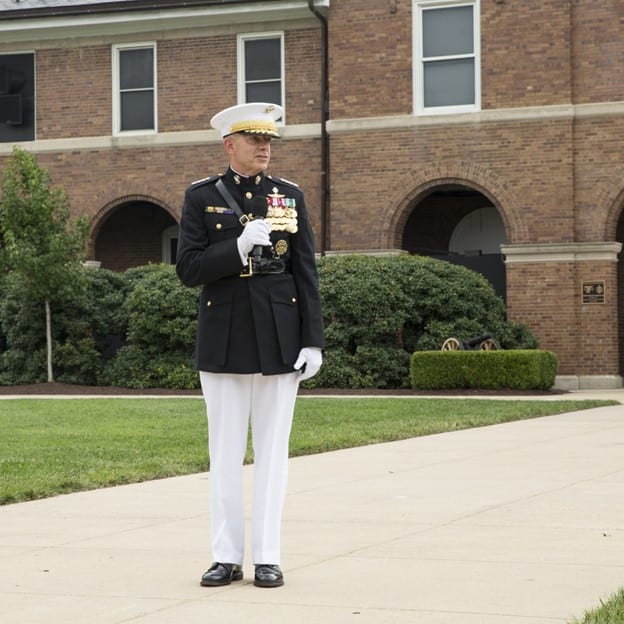
Commandant of the Marine Corps Gen. David H. Berger addresses the crowd during a change of command ceremony at Marine Barracks Washington, D.C., July 11, 2019. U.S. Marine Corps / Lance Cpl. Morgan L. R. Burges
Commandant of the Marine Corps Gen. David Berger said cooperation, innovation and trust are keys to future success for the sea services.
“Going forward in a great power competition, no single service is going to keep our advantage,” said Berger, speaking at the National Defense Industrial Association’s virtual Expeditionary Warfare Symposium, being held Feb. 2-3. “Only by the Marine Corps and the Navy working together as a naval force will we be able to maintain our margin. Add the innovative technologies, that’s how you get an asymmetric advantage against a near peer or a peer adversary.”
Berger said despite the arrival of a new administration, the premise or foundation of the current National Defense Strategy — to discourage malignant military countries that want to challenge the international security environment — is solid.
In his view, the future operating environment is going to be characterized by a maturing and more proliferating precision strike regime in a maritime region. That’s going to require the Marine Corps, as the Joint Force’s stand-in force, to be forward deployed and distributed.
“If a conflict comes, then I think that our near peer competitors are not going to allow us to build up and set the theater and take a couple of months to do that,” said Berger. “Where you start from in a great power competition is where you were the day before. They’re not going to allow a flow of forces, because the know how that’s going to work. So, our forward standing in forces have to be ready immediately respond to a crisis. If we don’t start posturing and strengthening the naval services today, we’re going to fall behind. And that’s not going to happen.”
Altering our trajectory
Innovation is being driven by the threat, and by available resources.
“All of us in the Navy and Marine Corps recognize the same challenges in the emerging operating environment that’s before us. There is an urgent need for innovation and rapid change,” said Berger. “We are being driven by a pacing threat. We have to do it with no additional funding or resources.”
Berger expressed confidence in the force structure changes as set out in the Marine Corps Force Design 2030 effort, which examines the right mix of hardware, but also unmanned systems, artificial intelligence and sophisticated and survivable networks. “That’s how our force in readiness will alter our trajectory to create an advantage for the fleets and the overall force.”
“That force design — the major overhaul of the Marine Corps — provides the nation a force that’s capable of denying key maritime terrain to an adversary because of our forward presence, and its going to force our competitors to think twice before challenging our interests,” Berger said. “That is the essence of deterrence.”
To achieve that, Berger said the service needs to reset is systems and equipment.
“The Marine Corps has to modernize, not just our equipment, but we’ve got to modernize our training, our forces and our equipment. I am convinced that yesterday’s force will not compete effectively with tomorrow’s adversary, especially in the maritime gray zone. Putting it bluntly, just making our legacy platforms better, or just making more of them available will not allow us to maintain an advantage against either China or Russia in the maritime domain.”
Berger said that Marines operate in an expeditionary distributed operational environment, and operating in that environment with repurposed kit or repurposed equipment would be “irresponsible, and it’s not good enough. We can’t continue to invest in programs that don’t support force design and where we’re going.”
This is where Berger said he needs help from industry to “creatively find the solutions that will get us there. I’m not just talking about a better version of what we’ve got, but how can we disrupt; how can we deter an adversary — especially on the high end. A new and improved version of the light armored vehicle is not going to solve the problem. We have to look at building totally new capabilities, and use technologies in new ways to solve these complex future problems,” he said. “We have to outthink and outmaneuver a pretty capable adversary.”
Confidence and trust
“I’m a believer in manned and unmanned teaming,” Berger said. “That’s where we’re headed. But technology is not going to replace the individual Marine, of course. It will enable the Marine to be more lethal.”
Berger said it’s a matter of confidence and trust. In some instances, Berger said we don’t trust the machines.
“There are systems that offer fully automated sensor to shooter targeting, but we don’t trust the data,” he said. “We still ensure there is human intervention, which adds more time and opportunities for mistakes.”
Berger talked about emergency medical evacuations, which are today conducted using manned helicopters to get a wounded Marine from the battle front to a medical facility safely in the rear. He alluded to expensive manned helicopters, such as the CH-53K helicopter, which may be too big to risk in a hostile environment, but there are unmanned options, like the unmanned K-Max helicopter, that have been demonstrated to carry patients to safety.
“In the same way a squad leader has to learn to trust his or her Marines, a squad leader is going to have to learn to trust the machines.”