HMS Queen Elizabeth Assumes Role as Royal Navy’s New Fleet Flagship
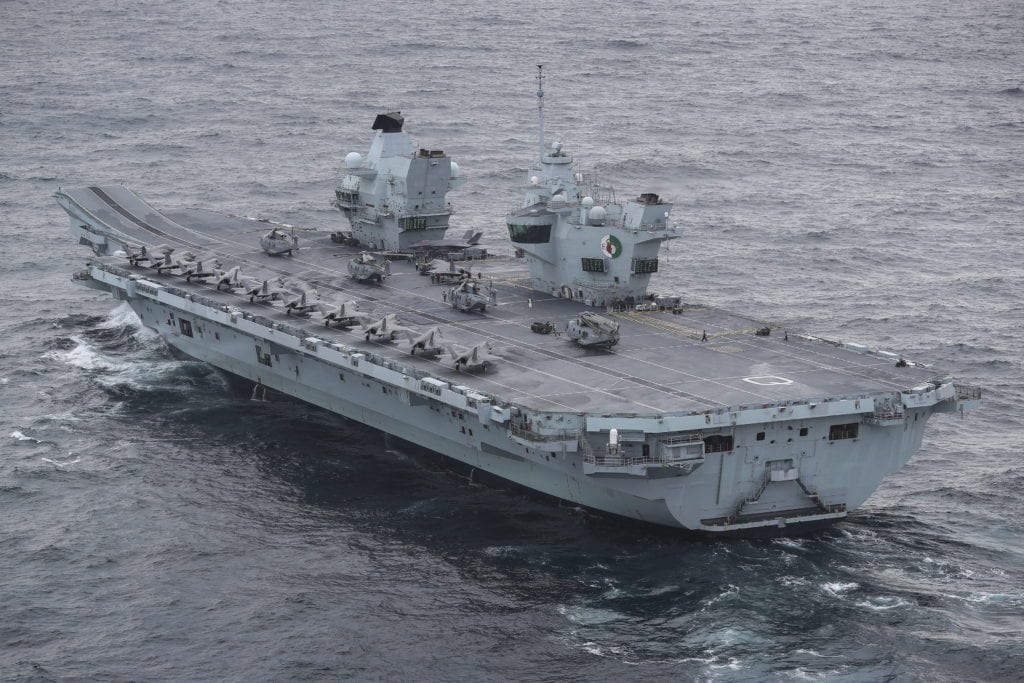
The full U.K. Carrier Strike Group assembled for the first time during Group Exercise 2020 on Oct. 4. Aircraft carrier HMS Queen Elizabeth leads a flotilla of destroyers and frigates from the U.K., U.S. and the Netherlands, together with two Royal Fleet Auxiliaries. It is the most powerful task force assembled by any European Navy in almost 20 years. Royal Navy
LONDON — HMS Queen Elizabeth assumed the role of fleet flagship as the Royal Navy moves closer to deploying the world’s most technologically advanced carrier strike group, the U.K. Ministry of Defence said in a Jan. 29 release.
Fleet Commander Vice-Admiral Jerry Kyd was received on the aircraft carrier to mark the transfer of the role from HMS Albion, while Royal Navy ships and shore establishments were informed by a signal at 1330.
The First Sea Lord, Admiral Tony Radakin, said: “The position of fleet flagship is a symbol of HMS Queen Elizabeth’s importance to the nation, not just in restoring our carrier strike capability, but as a rolling statement of British commitment to global security, prosperity and trade.
“It’s right that we bestow such a historic title now. In the coming months HMS Queen Elizabeth will lead the most ambitious Royal Navy deployment in decades,” Radakin said. She will be a focal point as we look forward to an extraordinary year.”
It was announced last week that the United Kingdom’s new flagship and Lightning Force of F-35B stealth strike fighters will also be complemented by a detachment of the fifth-generation aircraft from the U.S. Marine Corps, and a U.S. Navy destroyer during her first operational strike group deployment.
HMS Queen Elizabeth and her strike group will spend time developing collective war-fighting skills when NATO navies gather for exercise Strike Warrior off Scotland during the spring, before departing for the Mediterranean.
“It is a fantastic privilege for Queen Elizabeth to be made the fleet flagship as we prepare to sail at the heart of U.K.’s very high readiness Carrier Strike Group,” said Capt. Angus Essenhigh, commanding officer of the Queen Elizabeth. “We look forward to doing the nation proud as we deploy on operations for the first time.”
Last year, Prime Minister Boris Johnson confirmed that HMS Queen Elizabeth will be at the center of a carrier strike group deployment to the Mediterranean, the Indian Ocean and East Asia. She will embark F-35B from 617 Squadron (the “Dambusters”), Royal Navy Merlin helicopters, and be escorted and supported by Royal Navy Type 45 destroyers, Type 23 frigates and support ships of the Royal Fleet Auxiliary.
Assault ship HMS Albion had been flagship since March 2018, deploying to the Indo-Pacific for 10 months; to the Baltic for major multi-national exercises; and latterly to the Mediterranean leading NATO security patrols and experimental warfare trials. Her sister ship, HMS Bulwark, previously led the Fleet for four years.
“While it is with some sadness that we hand over the responsibility to HMS Queen Elizabeth, we are proud to be part of the transfer which marks a new era for the Royal Navy and the nation,” said Capt. Simon Kelly, commanding officer of HMS Albion.
Metal Shark Developing Autonomous Naval Defense System for Marine Corps
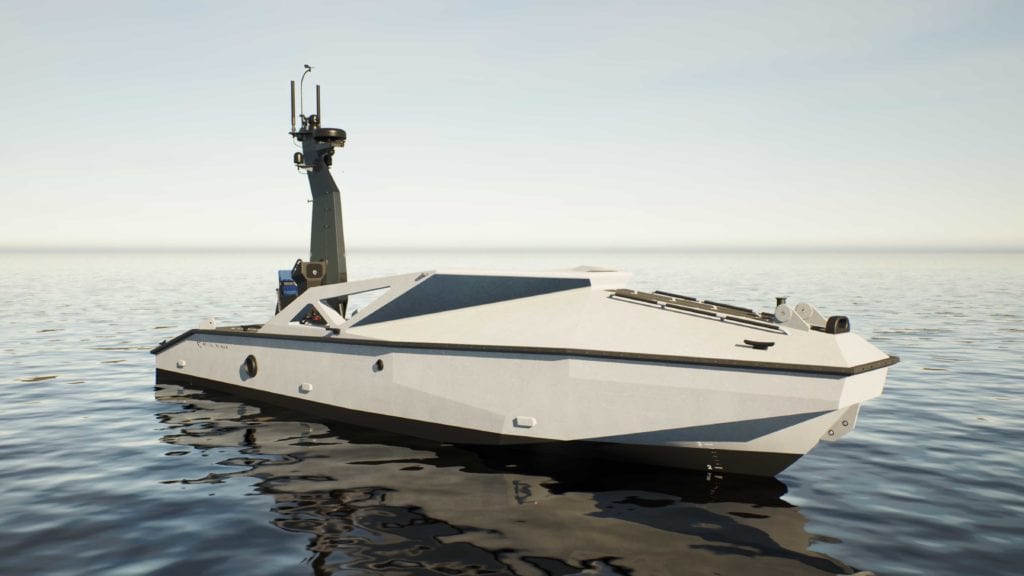
Louisiana-based shipbuilder Metal Shark is developing the Long Range Unmanned Vessel (LRUSV), a tiered, scalable weapons system, for the United States Marine Corps. Metal Shark
Jeanerette, La. — Louisiana-based shipbuilder Metal Shark has been selected to develop and implement the Long-Range Unmanned Surface Vessel (LRUSV) System for the U.S. Marine Corps, the company said in a Jan. 25 release.
The LRUSV System will usher in a new era of naval technology while increasing the lethality of U.S. forces, with a network of unmanned vessels traveling autonomously for extended ranges and transporting loitering munitions to address targets at sea and on land.
This tiered, scalable weapons system will provide the ability to accurately track and destroy targets at range throughout the battle space. While fully autonomous, the vessels may be optionally manned and they will carry multiple payloads, which they will be capable of autonomously launching and retrieving.
Metal Shark has enlisted autonomous technology developer Spatial Integrated Systems (SIS), recently acquired by Huntington Ingalls Industries, to provide the autonomy solution for the LRUSV system. SIS is a leader in the development of multi-vessel collaborative “swarming” autonomous capabilities, sensor fusion and perception.
Under an Other Transaction Authority (OTA) agreement with Marine Corps Systems Command, Metal Shark will design, build, test and implement the vessels and handle the integration of the autonomy system and an advanced command and control (C2) software suite.
In addition to the autonomous LRUSV, Metal Shark will also produce manned support vessels for the LRUSV system using its 40 Defiant military patrol craft platform, which the builder is currently producing to create the U.S. Navy’s new 40 PB patrol boat fleet.
“The LRUSV program represents a significant milestone for autonomous technology, for the defense world, and for the entire shipbuilding industry,” said Chris Allard, Metal Shark’s CEO. “We are thrilled to be integrating advanced autonomy and command and control capability into these highly specialized surface vessels to provide the Marine Corps with a next-generation system.”
Under the OTA, Metal Shark will also provide the Marine Corps with associated program management, system engineering, configuration management, quality assurance, logistical support, and the development of technical publications and manuals in support of the LRUSV program.
The LRUSV program is the latest success for Metal Shark’s Sharktech Autonomous Vessels division, a wholly owned subsidiary launched in 2018 and specifically focused on the advancement of unmanned vessel technology.
In September, it was announced that the U.S. Coast Guard had selected a 29-foot Sharktech autonomous test vessel, equipped with autonomy by Boston-based technology developer Sea Machines, for evaluation by the USCG Research and Development Center.
In 2019, Metal Shark was selected by US Navy PMS 406 (Naval Sea Systems Command’s Unmanned Maritime Systems division) for the Unmanned Family of Systems Multi Award IDIQ, a blanket Navy contact covering multiple topics in the autonomous space.
As a brand-agnostic technology integrator actively engaged with multiple developers in the unmanned space, Metal Shark’s Sharktech division has also produced and delivered autonomous vessels equipped with autonomy solutions from L3 Harris (previously ASV Global).
“Metal Shark has designed, built, and delivered over 400 autonomous and remotely operated vessels to date,” Allard said. “As we develop and deploy the LRUSV system for the Marine Corps, we will continue to work with clients across government and commercial markets, integrating the systems of multiple technology partners into our boats, solidifying our leadership position in the autonomous vessel space, and streamlining the path to autonomy.”
US DoD, UK Defence Ministry Sign Accord for Joint Carrier Strike Group Deployment
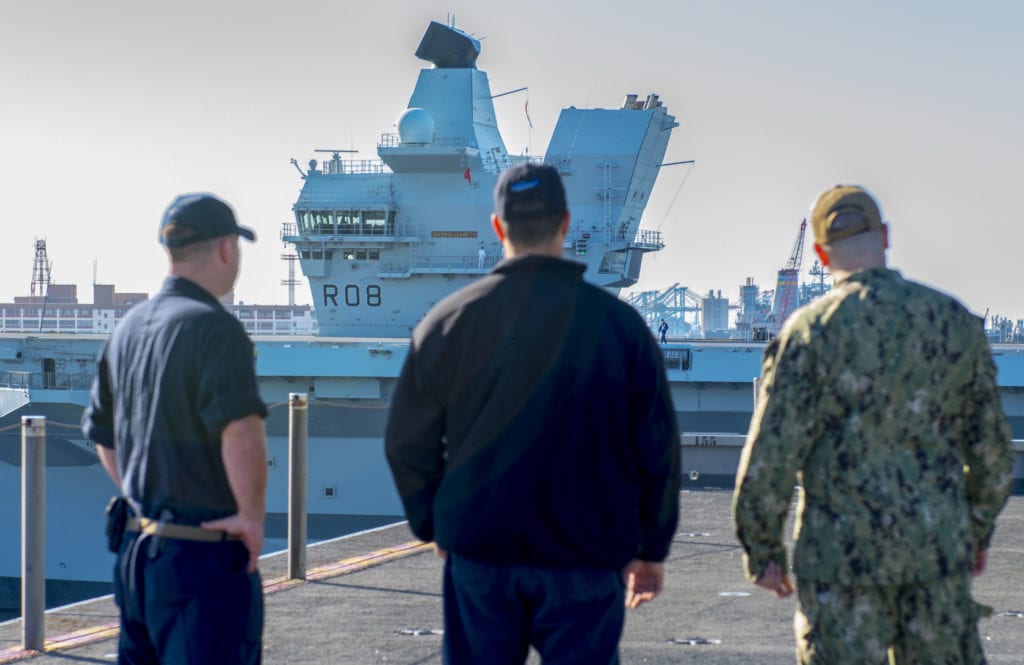
Sailors observe the Royal Navy aircraft carrier HMS Queen Elizabeth II (R08) from aboard the aircraft carrier USS George H.W. Bush (CVN 77) in this 2018 photo. U.S. Navy / Mass Communication Specialist 3rd Class Kallysta Castillo
LONDON and ARLINGTON, Va. — Acting Secretary of Defense Christopher C. Miller and U.K. Secretary of State for Defence Ben Wallace have cosigned the Joint Declaration for the Carrier Strike Group 2021 deployment.
The Joint Declaration enables the deployment of U.S. Marine Corps and U.S. Navy personnel and equipment, including a detachment of U.S. Marine Corps F-35B Lightning II aircraft and the Navy’s Arleigh Burke-class guided-missile destroyer USS The Sullivans (DDG 68), as part of a U.K.-U.S. combined carrier strike group, led by the United Kingdom’s aircraft carrier HMS Queen Elizabeth.
“This deployment underscores the strength of our bilateral ties and demonstrates U.S.-U.K. interoperability, both of which are key tenets of the U.S. National Defense Strategy,” Miller said in a release.
The leaders look forward to seeing the culmination of nearly a decade of U.S.-UK carrier cooperation when Carrier Strike Group 2021 sets sail from Portsmouth, United Kingdom, later this year.
“This joint declaration paves the way for the U.S. Navy and Marine Corps to be joining the HMS Queen Elizabeth Carrier Strike Group this year for the inaugural Carrier Strike 21 deployment,” Wallace said in a release. “I am delighted that the U.K. now possesses a 21st century Carrier Strike capability, which has been greatly assisted by the unswerving support and cooperation of the United States at all levels over the past decade. This deployment embodies the strength of our bilateral ties and reflects the depth and breadth of this vital defense and security partnership.”
The U.K. reached a major milestone in December when it declared its carrier strike program had achieved initial operating capability following a series of multinational exercises throughout 2020. This joint declaration paves the way for a successful inaugural operational deployment of the U.K. Carrier Strike Group alongside its allies.
BAE Systems to Support U.S. AV-8B Harrier II Fleet to 2029
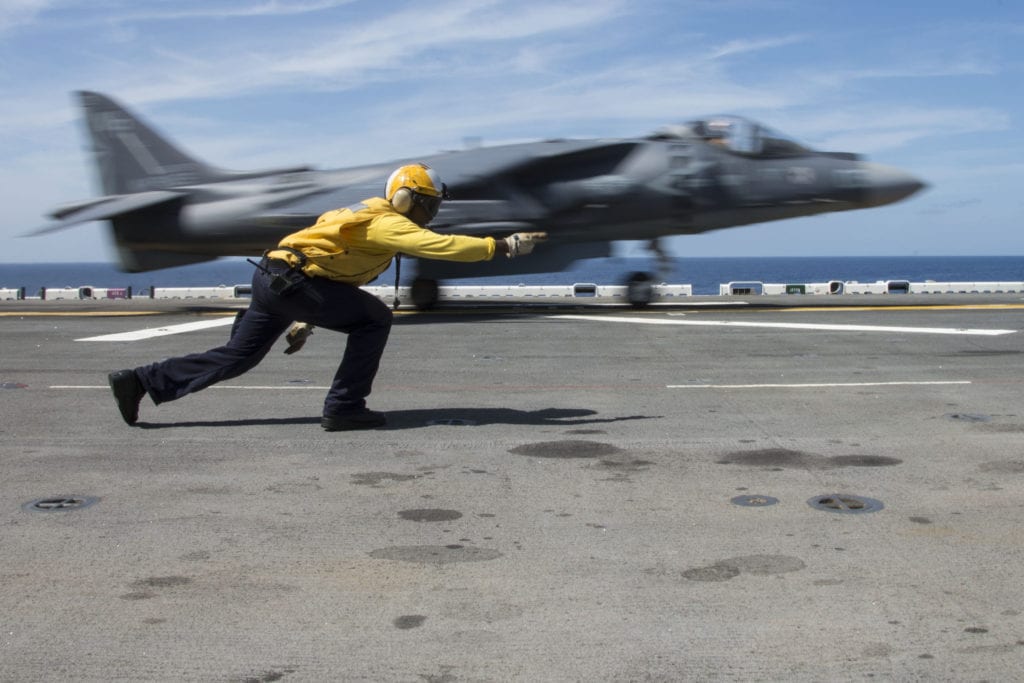
Aviation Boatswain’s Mate (Handling) 2nd Class Jarrel Bullock launches an AV-8B II Harrier off the flight deck of the amphibious assault ship USS Wasp (LHD 1) in this 2013 photo. U.S. Navy / Mass Communication Specialist Seaman Michael T. Forbes II
LONDON — BAE Systems and Vertex Aerospace have signed a nine-year agreement to enhance availability of the U.S. Marine Corps’ AV-8B Harrier II fleet, the company said in a Jan. 12 release.
The U.S. Department of the Navy awarded Vertex Aerospace LLC the $123 million contracted maintenance, modification, aircrew and related services (CMMARS) task order in July 2020 to provide aircraft maintenance and contractor logistics support services for the U.S. Marine Corps’ AV-8B Harrier fleet.
Vertex Aerospace selected BAE Systems as a subcontractor for the new logistics support contract, which will ensure increased efficiency of maintenance operations for the Harrier fleet using predictive maintenance techniques and smart stock optimization tools. Together, BAE Systems and Vertex Aerospace will support the crucial training and combat operations conducted from U.S. Navy’s aircraft carriers, amphibious assault ships, and forward operating bases.
This contract builds on BAE Systems’ existing role in maintaining the AV-8B Harrier’s reaction control system and providing engineering and technical support. Engineers from BAE Systems will work alongside Vertex and the U.S. Marine Corps at stations in Cherry Point, North Carolina; Yuma, Arizona; and Madison, Mississippi. They will be supported by a specialist team in the U.K. with a proven pedigree of delivering maintenance and support contracts for the Royal Air Force.
“The Harrier is one of the most iconic military aircraft ever created, with its British designed short take-off and vertical landing technology,” said Tom Fillingham, senior vice president – U.S. Programs, BAE Systems Air.“Our expertise with the aircraft goes back 40 years and this new contract with Vertex Aerospace ensures we can continue to apply our expertise to support the U.S. Marine Corps in their crucial operations.”
Dave Nagy, director of flight solutions, BAE Systems Inc. Intelligence & Security, said, “We’re proud to support our customer’s mission through the AV-8B Harrier program. We are ensuring these aircraft maintain availability until the F-35 replaces the AV-8B. Working together with Vertex as a trusted partner on various U.S. Marine Corps programs, we are demonstrating our capabilities in aircraft modernization, countermeasure system upgrades, and integration activities.”
“Extending our partnership with BAE Systems to support our U.S. Marine Corps’ important AV-8B pilot training mission just made sense,” said John “Ed” Boyington, CEO and president, Vertex Aerospace. With a combined 100 plus years of aerospace and defense experience, we understand the challenges warfighters face and remain keenly committed to improving aircraft readiness while maximizing efficiencies.”
Marine Corps Presidential Helicopter Testbed Retired
Glenn Perryman, deputy program executive officer for Air Anti-Submarine Warfare, Assault, and Special Mission Programs, stands in front of Sikorsky NVH-3A Sea King BuNo 150614, which his father flew as commanding officer of Marine Helicopter Squadron (HMX) 1. The helicopter subsequently served Air Test and Evaluation Squadron (HX) 21 as a testbed for 32 years before making its last flight in October 2020. NAVAIR
PATUXENT RIVER, Md. — After a 32-year career supporting the development of new technologies for the fleet, a historic Sikorsky NVH-3A Sea King helicopter assigned to Air Test and Evaluation Squadron (HX) 21 at Naval Air Station Patuxent River has flown its last mission — and a program executive with a special tie to the aircraft is hoping it will soon find a new permanent home where its story can be shared, the Naval Air Warfare Center Aircraft Division said in a Jan. 6 release.
The dark-green Sea King, known universally as “614” — in reference to its military serial number, 150614 — rolled off the Sikorsky Aircraft assembly line in 1962 as a Sikorsky HSS-2 (later redesignated SH-3A). A decade later, the aircraft was assigned to Marine Helicopter Squadron (HMX) 1, where it was redesignated VH-3A and served for four years as a presidential helicopter for Presidents Richard Nixon and Gerald Ford. After a brief stint with Helicopter Combat Support Squadron (HC) 6, the Marine Corps transferred 614 to the Military Aircraft Storage and Disposition Center at Davis-Monthan Air Force Base in Arizona. There it rested for seven years, after accumulating a mere 4,500 hours of flight time.
Then, in 1984, the aircraft was pulled out of storage and underwent depot maintenance, and in 1988 arrived at the then-Naval Air Test Center (NATC) at NAS Patuxent River. Given the one-of-a-kind designation NVH-3A, 614 spent the next 25 years as a testbed for innovations in sensors, avionics, radios, computer hardware and software, composite rotor blades, and more. It even hosted the Navy’s first successful demonstration of satellite Wi-Fi in a rotary wing aircraft.
After 614 was stripped to its metal bones in 2013 for a cockpit modernization project that was canceled before the aircraft could be refitted, HX-21’s Presidential Helicopter Maintenance Team and flight test team undertook an unprecedented effort to return the aircraft to service as a VH-3D testbed. They installed a new power plant, drivetrain, rotors, and landing gear, as well as new electrical, avionics and fuel systems, and machined more than 200 custom parts. On April 4, 2017, the fully rebuilt aircraft took to the air once again.
For three more years, 614 flew in support of a wide range of innovative test programs at NAS Patuxent River, including secure wide-band line-of-sight communications technologies, night vision equipment for the executive transport mission, high-speed rotor and engine shaft track and balance functions, and test flight exercises with U.S. Naval Test Pilot School students. But on Oct. 22, 2020, 614 made its final flight and the aircraft now rests inside one of HX-21’s hangars, awaiting the next chapter in its storied life.
While 614 is well-loved by the men and women of HX-21, the aircraft has a uniquely special meaning to Glenn Perryman, deputy program executive officer for Air Anti-Submarine Warfare, Assault, and Special Mission Programs (PEO(A)). From 1971 to 1974, Perryman’s father, Col. James Perryman Jr., served as commanding officer of HMX-1, and flew 614. In fact, Col. Perryman flew President Nixon twice on 614.
The elder Perryman served two combat tours in Vietnam before joining HMX-1 — and 614 was the first VH-3A he flew at his new squadron. (“How cool is that?” the younger Perryman remarked.) By the time he completed his squadron commander tour, Col. Perryman had made 48 flights in 614 totaling just over 66 hours’ flying time. Col. Perryman passed away on New Year’s Eve 2013, at the age of 80 — the same year that the younger Perryman joined PEO(A) as its deputy program executive officer.
Bringing his family history full circle, Perryman had an opportunity to fly in 614 in January 2018, not long after the newly refurbished aircraft had been returned to service with HX-21. Vice Adm. Dean Peters, commander of Naval Air Systems Command, was also on board for that flight, Perryman recalls.
“It was phenomenal,” Perryman said. “To have the opportunity to fly in the same helicopter that my father flew almost 50 years ago, to sit in the same cockpit where he sat, is something that I’ll never forget, quite frankly. Not everyone gets that kind of opportunity.”
Perryman said his father’s time at HMX-1 was the source of many childhood memories for him. “The squadron dominated our lives, as you can imagine,” he said. “Wherever the president went, my dad would have to go. My brother and I thought it was the neatest thing in the world that our dad flew the president.”
It was this combination of the aircraft’s unique history and his personal connection to it that spurred Perryman to action when he heard HX-21 planned to retire the aircraft. “It’s a piece of history,” he said. “It has served unique missions in its lifetime — presidential helicopter, developmental test aircraft for many new technologies. Not every aircraft has this kind of history attached to it.”
Perryman believes 614 hasn’t used up all of its nine lives yet.
“It’s in superb mechanical condition right now, and if it can be preserved in some way, it will last even longer,” Perryman said. “I’m doing everything I can to facilitate that. I would be happy to donate my father’s log books to go along with the aircraft. I have some Nixon memorabilia, too. Wherever it ends up, I hope that it will be preserved.”
“I cannot think of a more symbolic representation of what we do at the Presidential Helicopters Program than aircraft 614,” stated Col. Eric Ropella, program manager of the Presidential Helicopters Program (PMA-274). “This aircraft gives a full, rich history as both a no-fail mission aircraft that flew Presidents Nixon and Ford, and as a test bed for delivering the newest capabilities to the presidential fleet. It seems only fitting that we try and find a place of honor for 614 and its 32 years of service here in front of the Presidential Helicopters Support Facility as a static memorial and display.”
Marines Use Sensor Buoys to Better Understand Ocean Battlespace
U.S. Marines with Marine Medium Tiltrotor Squadron 163, Marine Aircraft Group 16, 3rd Marine Aircraft Wing, prepare to deploy an oceanographic sensor at the Pacific Ocean, Calif., Oct. 13, 2020. U.S. Marine Corps / Lance Cpl. Juan Anaya
ARLINGTON, Va.—Flying several thousand feet above the Pacific Ocean, an air crew and a scientist from Woods Hole Oceanographic Institution tossed cylindrical floats from a U.S. Marine Corps MV-22 Osprey aircraft. Packed with data-gathering sensors to measure underwater conditions, the floats fell fast before orange parachutes opened to ease splashdown.
The action marked the first time such sensor-laden profiling floats, also called buoys, were deployed from a Marine Corps aircraft. This will increase naval knowledge of the ocean battlespace — including the littorals (areas of water close to shoreline), which are crucial to expeditionary and amphibious operations.
The Office of Naval Research (ONR) sponsored the effort, which involved Woods Hole and the Naval Oceanographic Office (NAVO) and occurred during this year’s Trident Warrior, a large-scale fleet exercise conducted by the Navy and Marine Corps to test technology and tactics.
NAVO collects global oceanographic and meteorological data to create ocean-prediction models to support naval operations.
“Deployment of these floats creates a more vivid picture of how the ocean and atmosphere interact, including wind speed and water temperature and salinity,” said Dr. Scott Harper, a program officer in ONR’s Ocean Battlespace and Expeditionary Access Department. “They’re critical for compiling an abundance of data for the most up-to-date prediction models.”
When dropped, the floats, which contain sophisticated scientific instruments, sink to a predetermined depth, rise to the surface, transmit data via satellite to NAVO and descend again. They do this repeatedly over multiple months.
Dr. Steven Jayne, a Woods Hole senior scientist, oversaw the float deployment, which originally was supposed to occur during this summer’s Rim of the Pacific exercise (RIMPAC), the world’s largest international maritime warfare exercise. Unfortunately, because of the COVID-19 pandemic, RIMPAC dramatically scaled down its scope, and Jayne and his team had to wait until Trident Warrior in the fall to conduct their research.
Traditionally, oceanographic sensor floats are deployed in deeper water from naval ships or aircraft like C-130s or P-3s. But greater naval focus on the littorals in recent years sparked discussions about using Marine Corps assets like the Osprey.
“Ospreys go wherever Marines go,” said Jayne. “Using them for sensor deployment expands both the versatility of naval oceanographic tools and the expeditionary capabilities of the Marine Corps.”
The sensor floats will drift for several months and provide real-time data to NAVO, which is working with the Naval Research Laboratory to create ocean-prediction models for the Navy and Marine Corps.
In addition to the littorals, ONR sponsors Jayne’s research using sensor floats for hurricane forecasting and studying polar conditions.
The U.S. Navy, Marine Corps and Coast Guard released a new tri-service maritime strategy, directing the services to deepen their integration and pursue modernization. U.S. Navy / Mass Communication Specialist 3rd Class Haydn N. Smith
WASHINGTON — The U.S. Navy, Marine Corps, and Coast Guard released a new tri-service maritime strategy, entitled Advantage at Sea, the Navy said in a Dec.17 release.
The document provides strategic guidance on how the sea services will prevail in day-to-day competition, crisis, and conflict over the next decade. It also directs the services to deepen tri-service integration, aggressively pursue force modernization, and continue robust cooperation with allies and partners.
“Our integrated Navy, Marine Corps, and Coast Guard must maintain clear-eyed resolve to compete with, deter, and, if necessary, defeat our adversaries while we accelerate development of a modernized, integrated all-domain naval force for the future,” wrote Chief of Naval Operations Adm. Michael M. Gilday, Marine Corps Commandant Gen. David H. Berger, and Coast Guard Commandant Adm. Karl L. Schultz in the strategy’s forward. “Our actions in this decade will shape the maritime balance of power for the rest of this century.”
Advantage at Sea places particular focus on China and Russia due to their increasing maritime aggressiveness, demonstrated intent to dominate key international waters and clear desire to remake the international order in their favor.
“China’s and Russia’s revisionist approaches in the maritime environment threaten U.S. interests, undermine alliances and partnerships, and degrade the free and open international order,” the document states. “Moreover, China’s and Russia’s aggressive naval growth and modernization are eroding U.S. military advantages.”
The strategy also emphasizes the maritime domain is integral not only to America’s security and prosperity but to those of all nations. The oceans connect global markets, provide essential resources, and link societies and businesses. Shared interests create opportunities for greater cooperation with allies and partners.
“As Sailors, we are on the leading edge of great power competition each and every day,” said Gilday. “Sea control, power projection and the capability to dominate the oceans must be our primary focus. Our forces must be ready today, and ready tomorrow, to defend our nation’s interests against potential adversaries at any time. This strategy helps us do exactly that.”
The strategy directs the services to pursue an agile and aggressive approach to force modernization and experimentation. The future fleet will combine legacy assets with new, smaller ships, lighter amphibious ships, modernized aircraft, expanded logistics, resilient space capabilities, and optionally manned and unmanned platforms. To succeed in a dynamic operating environment, the services will also invest in warfighter development, delivering innovative training and education to ensure our Sailors, Marines, and Coast Guardsmen remain the world’s premier naval force.
Advantage at Sea also reflects the dual roles of the service chiefs: advising on the employment of forces in day-to-day competition, crisis and conflict, and developing a modernized future force that deters potential adversaries and advances and defends U.S. interests.
“The Marine Corps is conducting a sweeping force design transformation to fulfill our role as the Nation’s expeditionary force-in-readiness while simultaneously modernizing the force in accordance with the operating environment described in the National Defense Strategy and the tri-Service maritime strategy. We must embrace new ways of operating within the concepts of integrated U.S. naval power to deter future adversaries and generate better strategic choices,” said Berger.
As the services pursue greater integration, to include training and education; capabilities and networks; plans, exercises, and experiments; analysis and wargaming; investments and innovation; and force design, Advantage at Sea states they will collaborate with allies and partners to build capability, enhance interoperability, and generate unity of effort. Alongside allies and partners, the services will be able to establish sea denial and sea control where and when needed, project power, and hold critical adversary targets at risk.
“As the only military service in the Department of Homeland Security, the U.S. Coast Guard provides unique multi-mission and intelligence capabilities to complement the ability of our Marines and Navy to protect our national interests when necessary and deliver lethality across the globe,” said Schultz. “Our hallmark is working daily with partner agencies, sister sea services, and international navies and coast guards to counter maritime coercion and uphold the rules-based order – partnerships work.”
Marine Corps Begins Fielding Amphibious Combat Vehicle
An Amphibious Combat Vehicle. U.S. Marine Corps / Lance Cpl. Andrew Cortez
Marine Corps Base Quantico, Va.—The Marine Corps’ new Amphibious Combat Vehicle has achieved two new major milestones, the Program Executive Office – Land Systems said in a Dec. 10 release.
On Nov. 13, the Marine Corps’ Capabilities Development Directorate approved the Initial Operational Capability (IOC) of the ACV. Marines with 1st Marine Division aboard Marine Corps Base Camp Pendleton, California, were the first to receive the vehicle.
The Program Manager Advanced Amphibious Assault program office at Program Executive Officer (PEO) Land Systems manages the system.
“We’re providing Marines with a modern, armored personnel carrier that offers tremendous capability with respect to survivability,” said Col. Kirk Mullins, program manager for Advanced Amphibious Assault at PEO Land Systems. “The ACV gives the Marine Corps a capable platform operational across the full-range of military operations.”
Then, on Dec. 8, Assistant Secretary of the Navy (Research, Development and Acquisition) James Geurts approved the vehicle for Full-Rate Production (FRP). This means the Marine Corps can build and field higher quantities of the ACV at a sustained rate over the next several years.
The ACV is a next-generation, eight-wheeled vehicle designed to move Marines from ship to shore. The vehicle will be the primary means of tactical mobility for the Marine infantry battalion at sea and ashore, replacing the Corps’ aging Assault Amphibious Vehicle.
The ACV provides organic, direct fire support to dismounted infantry. The vehicle’s ability to leverage waterways to carry Marines and equipment make it well-suited for various operating environments, including Expeditionary Advanced Base Operations. It is net-ready, secure, interoperable, operationally effective and built for future growth. In the future, the Corps intends to develop, procure and field three additional variants that specialize in command and control, recovery operations and increased firepower.
“The fielding of the ACV is significant because we’re replacing the AAV, which has been effective for decades but was fielded in 1972,” Mullins said. “We’re providing Marines with a modern, more capable combat vehicle that is more adaptable to today’s battlefield.”
Col. David G. Bardorf, the director of Ground Combat Element Division at the Marine Corps’ Capabilities Development Directorate, said the ACV has progressed significantly since its initial requirements discussions in 2014. Combat Development and Integration was responsible for developing the requirements set that would be needed to replace the older platform.
“Reaching IOC is a testament to those involved in this program and the constant communication between the stakeholders: requirements, program managers, and [the vendor],” said Bardorf. “In the end, the Marine Corps is receiving an upgrade in capability ahead of schedule. We look forward to the program moving forward towards Full Operational Capability [FOC].”
Mullins said the vehicle is projected to reach FOC in fiscal year 2028.
In 2019, PEO Land Systems oversaw extensive testing involving the ACV that confirmed the vehicle’s ability to not only take on challenging surf, but also complete a long swim from ship to shore. The testing also indicated that the ACV has greater survivability and mobility than the AAV.
In 2020, Marine Corps Operational Test and Evaluation Activity performed independent operational testing involving the ACV’s achieved suitability, effectiveness and survivability. Results from the assessments, as well as feedback from Marines trained to employ the vehicle, came back positive.
Mullins believes the ACV achieving IOC and FRP is a significant achievement for the Marine Corps, as Marines will receive an innovative vehicle that further supports their missions in various combat environments for years to come.
“As program manager, I’ve spent a lot of time speaking with Marines who have trained with this vehicle in a variety of test environments,” said Mullins. “The feedback we’ve consistently received has been overwhelmingly positive. Marines seem to really love the vehicle.”
First Marine Corps F-35C Squadron Achieves Initial Operational Capability
Marine Fighter Attack Squadron (VMFA) 314 declares their initial operational capability (IOC) for the F-35C Lightning II, having met the standards set forth by Headquarters Marine Corps. U.S. Marine Corps / Lance Cpl. Juan Anaya
MARINE CORPS AIR STATION MIRAMAR, Calif. — In a time characterized by rapidly evolving tactics and modernized equipment, the Marine Corps has taken the next step in maintaining air superiority as Marine Fighter Attack Squadron (VMFA) 314 declares its initial operational capability (IOC) for the F-35C Lightning II, 1st Lt. Charles Allen, a spokesman for the 3rd Marine Aircraft Wing (MAW), said in a Dec. 1 release.
Initial operational capability declaration marks a significant accomplishment for 3rd Marine Aircraft Wing (MAW), enabling VMFA-314 to deploy the F-35C onto aircraft carriers where they will be able to support combat operations anywhere in the world.
“The F-35 is an expeditionary platform that extends the reach of our Marines and machines,and increases our ability to support joint and allied partners at a moment’s notice,” said Maj. Gen. Christopher Mahoney, 3rd MAW commanding general. “By effectively employing the F-35, MAGTF [Marine Air-Ground Task Force] commanders have the potential to dominate our adversaries in a joint battlespace, in the air and out at sea.”
Having the most advanced stealth fighters in the world is only the beginning. A strategic and tactical understanding of how to operate and properly maintain the F-35 and its advanced capabilities is essential to its employment in an increasingly non-permissive maritime domain.
To receive this qualification, squadrons must meet the Headquarters Marine Corps standards, which define the minimum number of trained Marines, mission ready aircraft and trained pilots needed in order for a squadron to become IOC complete.
“Our maintenance department was critical to the success of IOC. In addition to accepting and inspecting the multiple aircraft that arrived throughout the year, the Marines maintained a high level of aircraft readiness,” said Lt. Col. Duncan French, VMFA-314 executive officer. “Those mission capable aircraft allowed the pilots to train in the appropriate missions required of IOC, as well as contributed towards the readiness metrics of IOC.”
The F-35’s ability to combine advanced stealth capabilities, integrated avionics and the most powerful sensor package the Department of Defense has ever seen allows it to operate in contested areas and gives the Marine Corps an unparalleled ability to maintain air superiority in dynamic, unpredictable and competitive environments.
French continued, “VMFA-314’s declaration of IOC is a significant milestone not only for 3rd MAW but also the Marine Corps. VMFA-314 is the first F-35C squadron in the Marine Corps. The F-35C’s unique capabilities, compared to the F-35B and legacy aircraft, provide the Marine Corps with a complementary increase in combat projection and the ability to operate from the U.S. Navy’s aircraft carriers.”
As tactics and equipment used in the current battlespace continuously change, 3rd MAW commander’s willingness to develop their understanding of emerging technologies and to utilize them empowers the Marine Air Combat Element with the flexibility to solve dynamic problems that Marines will face in the future.
“This achievement ultimately would not have been possible without the hard work and dedication of the Marines, Sailors, and civilian contractors assigned to VMFA-314,” said Lt. Col. Brendan Walsh, VMFA-314 commanding officer. “The successful transition of the Black Knights to the F-35C culminating in this IOC declaration is a testament to the squadron’s distinguished legacy of pioneering new aircraft.”
The capability to employ the F-35 alongside 3rd MAW’s other capabilities further enables support of fleet Marines and joint and allied partners preserves 3rd MAW’s ability to dominate the battlespace for the MAGTF and joint commanders.
Marines’ Presidential Helicopter Headed for IOC in July
Marine Helicopter Squadron (HMX) 1 conducts test flights of the new VH-92A helicopter over the South Lawn of the White House, Sept. 22, 2018, in Washington, D.C. U.S. Marine Corps / Sgt. Hunter Helis
ARLINGTON, Va. — The next generation of executive transport helicopter for the president of the United States is planned for Initial Operational Capability (IOC) in July 2021, a Navy spokeswoman said, but the decision of when to place the aircraft in service will be determined by the White House.
The VH-92A, built by Sikorsky Aircraft Corp., a Lockheed Martin company, was selected in 2014 to replace the VH-3D and VH-60N helicopter fleet used to transport the president and other government executives. Six VH-92As were ordered in 2019. Followed by six more in February 2020. Total inventory will be 23 VH-92A aircraft, comprised of 21 operational fleet aircraft and two test aircraft.
The presidential helicopter fleet is operated by Marine Helicopter Squadron One, based at Marine Corps Air Station Quantico, Va., with a detachment at Joint Base Anacostia-Bolling in Washington.
“Government testing to validate system performance and prepare for Initial Operational Test and Evaluation is progressing on schedule and will support an Initial Operational Capability (IOC) planned for July 2021,” the Navy spokeswoman said. “The VH-92A will enter service post IOC at the determination of the White House Military Office.”