BAE to Install Infrared Countermeasures on Marine KC-130J Aircraft
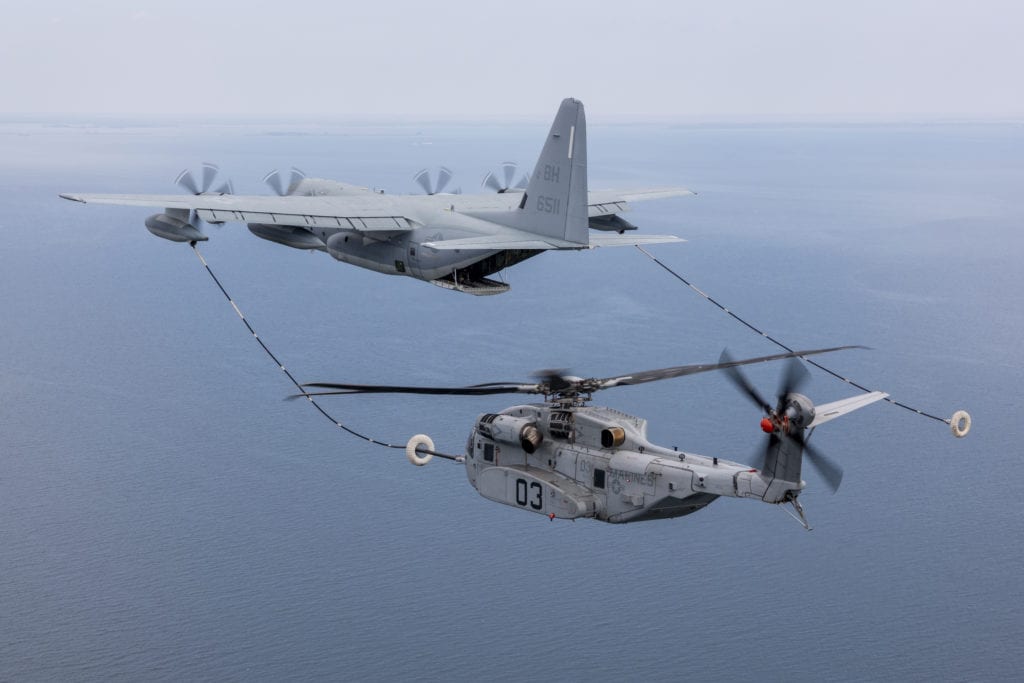
A CH-53K King Stallion helicopter plugs into a drogue towed behind a KC-130J tanker during an aerial refueling test in April. Marine KC-130Js are getting an infrared countermeasures system. Lockheed Martin/Dane Wiedmann via U.S. Marine Corps
ARLINGTON, Va. — The Marine Corps’ KC-130J Super Hercules tanker/transport aircraft is getting an infrared countermeasures system at last.
The U.S. Navy’s Naval Air Warfare Center Aircraft Division’s Aircraft Prototyping Systems Division has awarded BAE Systems a prime position on a $26.7 million task order to install, integrate and test the Large Aircraft Infrared Countermeasures (LAIRCM) system on KC-130Js.
The LAIRCM system, built by Northrop Grumman, is a tail-mounted pod with a turreted laser system that “improves aircraft capability and survivability by countering advanced infrared missile system threats,” according to a BAE Systems release.
The LAIRCM uses laser beams to detect and disable the seekers of incoming infrared-seeking missiles.
Until now, Marine Corps KC-130Js have operated in combat zones such as Afghanistan and Iraq but without a defensive countermeasures system. Some KC-130Js have operated in direct combat with the Harvest HAWK system, which includes Hellfire, Griffin and Viper Strike missiles for close air support missions.
David Nagy, director of flight solutions for BAE, told Seapower that the LAIRCM systems procured from Northrop Grumman will be provided by the government to BAE for installation on the aircraft. BAE will install the LAIRCM systems in up to 19 KC-130Js under the contract over the next five years, if all options are exercised.
The work will be performed in Crestview, Florida, in partnership with Vertex Aerospace Aircraft Integration and Sustainment Division. Under previous contracts, the BAE-Vertex team has installed LAIRCM systems on Air Force and foreign military aircraft,
“The BAE Systems turnkey solution provides program management, inventory control, engineering support, installation, and system testing of the DoN [Department of the Navy] LAIRCM upgrade,” the release said. “Aircraft maintenance and support activities will also be provided as required. This is the second task order awarded to BAE Systems under the Prototyping and Limited Production indefinite delivery indefinite quantity contract.”
“The program office looks forward to working with BAE Systems on the DoN LAIRCM installations,” said Navy Capt. Steven Nassau, program manager for Naval Air Systems Command’s PMA-207, as noted in the BAE Systems release.
“This competitive award will allow the Marine Corps to move from government depot installation to industry without a gap in services. It is a great reflection on the dedication of the KC-130J Mission Systems Team and the contracts office. It also speaks to the flexibility of both the Navy and industry.”
MCSC, ONR and CD&I Collaborating to Inform Armored Vehicle’s Path
Marines fire rounds from a Light Armored Vehicle during Exercise Northern Screen at Setermoen, Norway, in 2018. The Marines’ modern ARV in development would be the legacy LAV’s replacement. U.S. Marine Corps/Cpl. Ashley McLaughlin
MARINE CORPS BASE QUANTICO, Va. — Marine Corps Systems Command (MCSC) is working toward the next phase of replacing the legacy Light Armored Vehicle (LAV) with a modern Advanced Reconnaissance Vehicle (ARV), the command said in a release.
Armored reconnaissance was the subject of a capability-based assessment, the results of which were summarized in a 2019 Joint Requirements Oversight Council-validated initial capabilities document produced by the Marine Corps’ Combat Development and Integration (CD&I). The assessment pitted light armored reconnaissance (LAR) battalions against a peer threat and identified shortfalls and gaps in capability.
CD&I emphasized the need for a modern, purpose-built ARV. As the core-manned, next-generation system, ARV must possess transformational capabilities to enable LAR battalions to gain contact with and collect on peer-threat forces. It must accomplish this goal without becoming decisively engaged, while also successfully waging the counter-reconnaissance fight.
After the analysis and various other supporting activities, the ARV concept emerged as a transformational required capability. The characteristics differentiating the ARV from current systems include a battle management system, enhanced vision technologies for increased situational awareness and target tracking and engagement capabilities.
The program manager for light armored vehicles (PM LAV) is pursuing this capability to support LAR battalions, provide them with additional capabilities and set the conditions to transform the way they fight.
“Any ARV path forward will continue to be informed by the ongoing [Office of Naval Research] technology demonstrator effort, the ARV Analysis of Alternatives, Phase III Force Design outputs, additional government [requests for information], senior leadership direction and industry feedback,” said John “Steve” Myers, program manager for MCSC’s LAV portfolio.
A collaborative effort
In the early planning stages, the U.S. Marine Corps envisioned the ARV as a replacement combat vehicle for the LAV. Over time, officials began to view the ARV as a vehicle platform equipped with a suite of advanced reconnaissance capabilities, with an open-system architecture that can sense, shoot, move, communicate and remain transportable as part of the Naval expeditionary force. PM LAV is leading the acquisition planning effort to help realize this next-generation reconnaissance vehicle.
The portfolio is collaborating with the ONR and the Capabilities Development Directorate of Headquarters Marine Corps, CD&I.
Capitalizing on their Detroit arsenal location, PM LAV is working with Combat Capabilities Development Command Ground Vehicle Systems Center to update the ARV concept as a tool to analyze impacts of capability changes.
Recognizing commonalities exist among the ARV and the optionally manned fighting vehicle, the U.S. Army, Navy and Marine Corps are working together to ensure collaboration for those capability gaps.
ONR is conducting research on advanced technologies to inform requirements, technology readiness assessments and competitive prototyping efforts for the ARV. In 2019, ONR selected two vendors to design, fabricate and test full-scale technology demonstration platforms.
Both platforms are expected to be ready for government evaluation in the fourth quarter of fiscal 2020. Through ONR’s efforts, the Ground Combat Element Division of CDD has been refining a set of requirements for the ARV to meet the future reconnaissance mission of the Marine Corps. PM LAV will leverage this information in a performance specification to be released to industry partners to build the ARV.
The collaboration between PM LAV, ONR and CD&I is crucial to the success of the ARV.
“Effective collaboration between the materiel developer, technologist and combat developer is essential to achieving the next-generation capabilities required to transform legacy armored reconnaissance into a modern, combat credible force,” said Kurt Koch, Ground Combat Equipment Division, CDD.
Koch noted how the strong partnerships forged over the last three years set the conditions to develop the core of a next-generation, combat vehicle system —mobile on land and water —to serve as a manned hub coordinating the actions of unmanned ground and aerial robotic sensor, and weapon systems.
The path forward
PM LAV has taken several steps to ensure the success of the ARV. In 2019, PM LAV released a Request for Information to industry comprising a set of attributes for a transformational vehicle. Based on responses to the RFI, the program office met with several vendors interested in becoming a prime vendor for ARV. PM LAV originally planned to hold an industry day in May 2020 for the competitive prototyping phase. However, the ongoing COVID-19 pandemic caused the event to be rescheduled to the fourth quarter of fiscal 2020.
“We still want to hold an industry day so we can have an open discussion with industry, provide more clarification and answer any questions from our industry partners,” said Maryann Lawson, MCSC’s project lead for ARV.
In addition to industry engagements, the evaluation of science and technology efforts as well as ongoing [capabilities design document] and performance specification refinement should yield the information necessary to move into the competitive prototyping phase.
“PM LAV will focus efforts targeted on industry RFIs and strategic small group engagements,” Myers said.
The Marine Corps plans to use the ground vehicle systems other transaction agreement with the National Advanced Mobility Consortium (NAMC) to release a draft request for prototype proposal (RPP) for the ARV base variant in the fourth quarter of fiscal 2020. The government is interested in industry feedback and collaboration to shape the requirement and statement of work for the final RPP release in spring 2021. Industry partners are encouraged to periodically check Beta.SAM.gov and engage with the NAMC for future RFIs and program updates.
Marine Cyber Official: ‘Our Networks Are Resilient’ in COVID-19 Environment
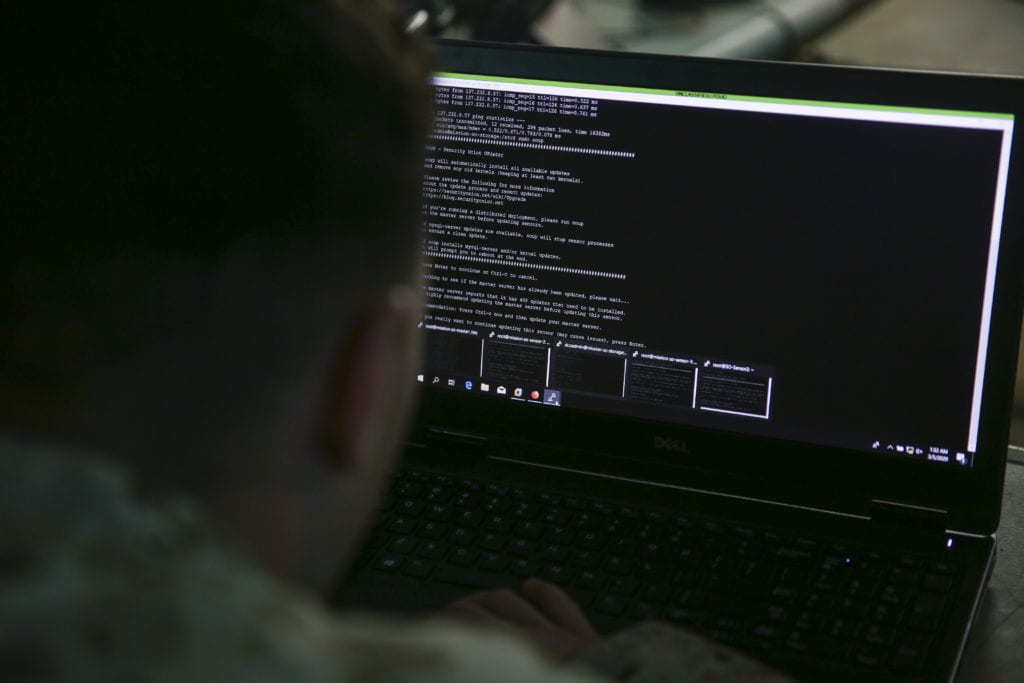
A U.S. Marine assess data during an exercise, Native Fury 20, in the United Arab Emirates on March 5. U.S. Marine Corps/Sgt. Alexis Flores
ARLINGTON, Va. — The U.S. Marine Corps’ cyber networks are being defended and upgraded even as the COVID-19 pandemic forces ad hoc adaptation in their operation, a senior Marine Corps official said.
“Our networks are good, and they are operating at a good capacity and are resilient,” said Gregg Kendrick, executive director of Marine Corps Forces Cyberspace Command, speaking April 17 in a webcast for Navy League’s Sea-Air-Space 2020: Virtual Edition.
To register and then watch this Sea-Air-Space 2020: Virtual Edition webinar live online, click here.
“We’re pleased with our effective efforts in our ability to support the force as it has gone to ad hoc telework or alternate work sites and maintain our capacity and, more importantly, our operational capability to support our warfighters and our commanders that are out there deployed in harm’s way.”
Kendrick said the Corps is monitoring its networks differently in the current environment.
“We do look at our virtual private networks and then we look at our physical and transport layer, our network stack from Layer 1 to Layer 4, so from that perspective we’re focused on those types of metrics and really watching our latency,” he said.
“So, we are very focused on the security. Every decision we have made in regards to supporting the ad hoc telework option has really [been] focused. We’ve had a fundamental security look, and we’ve really looked at our modernization efforts to ensure that we are aware of any of the advanced persistent threats and/or capabilities that are out there to ensure that we have a good, resilient as well as available network.”
“We’re pleased with our effective efforts in our ability to support the force as it has gone to ad hoc telework or alternate work sites and maintain our capacity.”
Gregg Kendrick, Marine Corps Forces Cyberspace Command
Kendrick said his force is looking at “which applications are in use the most, which are stressed the most at the highest capacity, what exactly are our latent measures, … and our overall bandwidth [including] by bandwidth region. Everything [security metrics] is funneled through our enterprise security desk so that we can rapidly pull metrics and shift resources as needed to support our Marine warfighters.”
He said Cyberspace Command is starting to see trends in the pandemic environment, “but we are definitely waiting for this to evolve and then we will be able to draw conclusions, but at the same time we don’t want to let a trend propagate to a point where we have to go into a different work cycle.”
“The bad guys are always looking at what we’re doing, and they are looking to do harm,” Kendrick said. “We protect our workforce. We secure, operate and defend the Marine Corps enterprise networks.”
Kendrick said that through the Corp’s new command-and-control network structure the service is bringing a “unity of command that provides a much clearer readiness picture of our network, our resiliency picture, and then a better overall visualization of the data flow from the end points all the way to the data centers and then back out where they need to go.”
The executive director said the Corps is adopting Microsoft Office 365 to achieve a more efficient capability combined with a hybrid cloud architecture, aiming for higher velocity.
“In the end state the adversary gets a vote,” he said. “They move at speed unconstrained by rules of engagement or the laws of nation states. We need to implement the best infrastructure, the best applications, the best operational processes as efficiently as possible so that we can modernize, provide the best capability to the warfighter, at the same time ensuring security from adversary actions and resiliency across the networks.”
Marine Corps CH-53K Passes Air Refueling Tests
A CH-53K King Stallion heavy lift helicopter refuels from a KC-130J over the Chesapeake Bay on April 6. Sikorsky
NAVAL AIR STATION PATUXENT RIVER, Md. — The CH-53K King Stallion aced an air-to-air refueling test this week, successfully demonstrating long-range logistics support capabilities for the U.S. Marine Corps, Naval Air Systems Command said in a release. The 4.5-hour test was accomplished over the Chesapeake Bay with a KC-130J aerial refueling tanker.
“The aircraft went to the tanker this week and it was very successful, proving it is a long-range vertical logistic workhorse,” said Marine Col. Jack Perrin, H-53 heavy lift helicopters program manager.
According to the CH-53K test team, the wake survey test assessed the performance of the aircraft when flying behind the tanker in strong, turbulent air. The aircraft’s crew successfully plugged the drogue, a funnel-shaped basket towed behind the KC-130J. These tests were performed at increasing closure rates to ensure the CH-53K can handle the forces on the refueling probe when contacting the drogue during aerial refueling.
“The aircraft was able to meet the desired performance for all engagements,” Perrin said. “The ‘K’ is the long-range enabler that we need now and into the future.”
The CH-53K King Stallion continues to execute within the reprogrammed CH-53K timeline, moving toward completion of developmental test, leading to initial operational test and evaluation in 2021 and first fleet deployment in 2023-2024.
“The successful air-to-air refueling test reinforces the superior capabilities of the CH-53K heavy lift helicopter and its ability to carry more Marines, cargo and equipment over longer ranges and in more challenging environments than any other rotorcraft in the world,” Bill Falk, Sikorsky program director, CH-53K, said in an April 10 release.
“As the only fully marinized heavy lift helicopter, it will allow the Marines the operational flexibility and reach to fly over open waters to complete long-range missions in support of expeditionary advanced base operations.”
Marines Grapple with Maintaining Readiness Amid COVID-19 Restrictions
Marine provost marshals take precautions against COVID-19 at Marine Corps Air Ground Center in Twentynine Palms, California. U.S. Marine Corps
ARLINGTON, Va. — Restrictions imposed by the battle against the coronavirus are presenting the U.S. Marine Corps with an array of new challenges — from maintaining grooming standards to how, when and where America’s force in readiness can train safely in a pandemic.
In a joint Pentagon press briefing on March 26 with Marine Commandant
Gen. David Berger, acting Navy Secretary Thomas Modly said the Marines have
scaled back training at Marine Corps Air Ground Combat Center, Twentynine Palms
and the Mountain Warfare Training Center, both in California. They also have
canceled training with foreign partners and much of the Headquarters Marine
Corps staff have been ordered to work from home.
Promotion boards can spread out over several rooms and
shooters can spread out on the firing line of a pistol range, but “in a live-fire
exercise you can only do so much to moderate social distancing,” Berger said.
“The Marine Corps is unique,” the commandant explained. “We
are mandated by law to be the nation’s most ready force.” He has given local
commanders leeway to operate as they see best depending on the local situation
rather than issuing a blanket, Corps-wide list of restrictions. When it comes
to training, Berger said, “commanders are taking measures that make sense but
also making sure their units are trained and ready to go.”
“This is a unique time. We’re trying to find unique answers. It’s not going to be the same as sitting in the bleachers at graduation. There’s no way to replicate that.”
Sgt. Major of the Marine Corps Troy Black
Basic training graduations have been closed to all
outsiders, including family, to prevent spreading disease. “It’s driving us to
be pretty creative,” Berger said. The ceremonies are now televised and
digitally recorded for each new Marine.
“This is a unique time. We’re trying to find unique answers,”
said Sgt. Major of the Marine Corps Troy Black, but he conceded “it’s not going
to be the same as sitting in the bleachers at graduation. There’s no way to
replicate that.”
Although leaders have halted face-to-face meetings between
recruiters and enlistment prospects, the Marines have not stopped training or
bringing new recruits to boot camps in California and South Carolina. Both facilities
have begun screening incoming recruits before they depart from processing stations
and when they arrive at the recruit depot. Any showing symptoms are isolated. At
least two have tested positive for the virus, but no drill instructors have,
Modly said.
“Everybody’s still getting their head shaved as long as the
barbers come to work,” Berger said, “but there will come that time when it gets
worse and worse and worse, where barbers won’t come to work. In that case we’ll
have to make a decision: ‘Do Marines cut Marines’ hair?’ Commanders at both of
our recruit depots have thought their way through it.”
Berger noted headquarters hasn’t said grooming standards are
relaxed for a given period. “What we have said is commanders have the latitude
to make adjustments based on what’s available at your location.”
Marine Force Design 2030: Reduce Tube Artillery, Increase Rockets, Missiles
Marines in an M1A1 Abrams main battle tank conduct a patrol during a predeployment training exercise at Marine Corps Air Ground Combat Center Twentynine Palms, California. Force Design 2030 dictates that the Corps reduce its investment in heavily armored ground combat systems. U.S. Marine Corps/Lance Cpl. Dalton S. Swanbeck
ARLINGTON, Virginia — The Marine Corps commandant has issued his plans for a major redesign of the Marine Corps’ force structure by 2030, with substantial reductions in some venerable weapon systems and increases in new systems.
For example, traditional tube artillery is under the gun, as are tanks, but rocket artillery and precision missiles are boosted in the plan.
Force Design 2030, signed out this month by Commandant Gen. David H. Berger, is aimed at more closely aligning the capabilities of the Corps with the National Defense Strategy, from a priority of confronting violent extremism to “great power/peer-level competition,” with emphasis on the Indo-Pacific.
“Such a profound shift in missions, from inland to littoral, and from nonstate actor to peer competitor, necessarily requires substantial adjustments in how we organize, train and equip our Corps,” Berger said in the document.
“A return to our historic role in the maritime littoral will also demand greater integration with the Navy and a reaffirmation of that strategic partnership. As a consequence, we must transform our traditional models for organizing, training and equipping the force to meet new desired ends, and do so in full partnership with the Navy.”
Berger, foreseeing flat future defense budgets, said he is “operating under the assumption that we will not receive additional resources, we must divest certain existing capabilities to free resources for essential new capabilities. … With the shift in our primary focus to Great Power Competition and a renewed focus on the Indo-Pacific region, the current force has shortfalls in capabilities needed to support emerging joint, naval and Marine Corps operating concepts.”
He said the Corps is over-invested in heavily armored ground combat systems (tanks), towed cannon artillery and short-range, low endurance unmanned aerial systems (UAS) incapable of employing lethal effects.
Accordingly, Berger plans to, among other initiatives, to reduce the number of tube artillery batteries from 16 to five. These units are armed with the M777 towed cannon built by BAE Systems.
In contrast, the Corps plans to increase its rocket artillery batteries from 7 to 21. These batteries are equipped with the Lockheed Martin-built M142 HIMARS (High-Mobility Artillery Rocket System). The Corps intends to create batteries of anti-ship missiles such as the Raytheon’s Tomahawk Maritime Strike Missile and the Kongsberg/Raytheon Naval Strike Missile. These missiles will enable Marine expeditionary forces to operate in contested littoral environments.
“This investment provides the basis, over time, for generating one of the fundamental requirements for deterrence, and ultimately successful naval campaigns — long-range, precision expeditionary anti-ship missile fires,” Berger said. “This requirement is based on one of the more well-supported conclusions from wargaming analysis conducted to date.”
The Corps also plans to eliminate its fleet of M1A1 main battle tanks, divesting its “entire capacity of seven companies and prepositioned capacity,” he said.
“We have sufficient evidence to conclude that this capability, despite its long and honorable history in the wars of the past, is operationally unsuitable for our highest-priority challenges in the future,” Berger said. “Heavy ground armor capability will continue to be provided by the U.S. Army.”
Because the Corps plans to reduce its active-component infantry battalions from 24 to 21, its amphibious assault requirements will be lessened. Accordingly, two of the six amphibious assault companies are slated for the cut. The units operate the AAV7 assault amphibious vehicle and the new Amphibious Combat Vehicle, both built by BAE.
The Corps is looking at increasing force structure of light armored reconnaissance companies from nine to 12.
“While I have repeatedly stated that all-domain reconnaissance and counter-reconnaissance will be a critical element of any future contingency, I remain unconvinced that additional wheeled, manned armored ground reconnaissance units are the best and only answer — especially in the Indo-Pacific region,” Berger said.
“We need to see more evidence during Phase III [of the study] to support this conclusion before engaging in an expansion of our existing capacity, or committing billions of dollars in procurement funds towards the acquisition of an Advanced Reconnaissance Vehicle (ARV).”
Marine Corps to Double UAS Squadrons, Reduce Rotary Squadrons by 2030
An RQ-21A Blackjack UAS attached to Marine Medium Tiltrotor Squadron 163 sits on a launcher aboard the amphibious transport dock ship USS John P. Murtha. U.S. Marine Corps/Cpl. Adam Dublinske
ARLINGTON, Va. — The U.S. Marine Corps is planning to change its aviation community significantly as part of a long-range effort to align its force structure more with the National Defense Strategy, including doubling the number of unmanned aerial system (UAS) squadrons and deactivating three rotary-wing squadrons.
In a March 23 release, the Marine Corps Combat Development Command (MCCDC) announced that it was redesigning its force “for naval expeditionary warfare in actively contested spaces, fully aligning the Service with direction of the National Defense Strategy. The Marine Corps has identified areas of modernization and realignment to meet these demands.”
Among several initiatives planned for execution by 2030, the MCCDC said it would “double the number of UAS squadrons and austere lethal unmanned air and ground systems, enhancing our ability to sense and strike.”
The Corps fields four Marine UAV squadrons (VMUs) — three in the active component and one in the reserve component. All four operate RQ-21A Blackjack UAS and one, VMU-2 at Marine Corps Air Station (MCAS) Yuma, Arizona, operates two MQ-9 Predator UAVs under a contractor arrangement. The Corps intends to procure six MQ-9s for its VMU squadrons under current planning.
MCCDC also announced plans to deactivate three rotary-wing squadrons by 2030. They include:
Marine Medium Tiltrotor Squadron 264 (VMM-264), based at MCAS New River, North Carolina and one of 19 MV-22B squadrons in the Corps.
Marine Heavy Helicopter Squadron 462 (HMM-462), based at MCAS Miramar, California and one of eight CH-53E squadrons in the Corps.
Marine Light Attack Helicopter Squadron 469 (HMLA-469), based at MCAS Camp Pendleton, California, and one of nine squadrons in the Corps operating the AH-1Z and UH-1Y helicopters.
In addition, the Corps plans to deactivate HMLA-367 at MCAS Kaneohe Bay, Hawaii, and relocate the squadron to Camp Pendleton, presumably for reactivation.
The Corps also plans to reduce the number — Primary Aircraft Authorized — of F-35Bs in some of its Marine Fighter Attack Squadrons (VMFAs). The original plan was to field 10 F-35Bs in some squadrons and 16 in others, with the extra six used to deploy as detachments on board amphibious assault ships. The F-35C squadrons also would be limited to 10 aircraft.
Marine Corps Orders More Amphibious Combat Vehicles From BAE Systems
Marines and Sailors watch on Jan. 28 as Marines maneuver an ACV onto the well deck of the amphibious transport dock ship USS Somerset as part of the vehicle’s developmental testing off the shore of Marine Corps Base Camp Pendleton, California. U.S. Marine Corps/Lance Cpl. Drake Nickels
STAFFORD, Va. — BAE Systems has received a $113.5 million contract from the U.S. Marine Corps for an additional 26 Amphibious Combat Vehicles (ACV) under the low-rate initial production (LRIP) phase of the program, the company said in a release. This award brings the total vehicle orders for the ACV to 116 and moves the program closer to full-rate production.
The ACV is a mobile, survivable and adaptable platform for conducting rapid ship-to-shore operations and brings enhanced combat power to the battlefield. BAE has been in low-rate production since 2018 on the personnel carrier variant in the ACV family, which is envisioned to consist of additional variants such as command and control, 30 mm medium caliber turret and recovery.
“The ACV provides the most survivable and mobile amphibious vehicle to the U.S. Marines Corps for supporting the warfighters’ ability to successfully execute their unique expeditionary missions,” said John Swift, director of amphibious programs at BAE Systems.
The BAE team and the Marines have made significant strides to reach full-rate production, including the completion of logistics demonstration as a critical enabler for the program to move into initial operational test and evaluation (IOT&E) with trained Marine maintainers. This and other major milestones such as operator training and additional testing will take place before full-rate production.
The Marine Corps selected BAE along with teammate Iveco Defence Vehicles for the ACV program to replace its legacy fleet of Assault Amphibious Vehicles, which have been in service for decades and also were built by BAE Systems.
ACV production and support is taking place at BAE locations in Stafford, Virginia; San Jose, California; Sterling Heights, Michigan; Aiken, South Carolina; and York, Pennsylvania.
NAVAIR Orders Six VH-92 Presidential Helicopters From Sikorsky
Marine Helicopter Squadron One runs test flights of the new VH-92A over the south lawn of the White House in September 2018. U.S. Marine Corps/Sgt. Hunter Helis
ARLINGTON, Va. — Naval Air Systems Command has awarded Sikorsky a second production contract to build VH-92A helicopters for the U.S. Marine Corps, the company said in a release.
The VH-92A has been selected to provide transport for the president of the United States, the vice president and other high-level government officials. The helicopter will replace the 19 VH-3D Sea King and VH-60N “White Hawk” helicopters operated by Marine Helicopter Squadron One. The Corps plans to acquire a total of 23 VH-92As.
Under the $470.8 million low-rate initial production (LRIP) Lot II contract, Sikorsky, a Lockheed Martin company, will deliver six VH-92A helicopters in 2022 and 2023.
“All six of the production aircraft from the first [LRIP] contract are undergoing modifications at Sikorsky’s Stratford, Connecticut, plant and are on schedule to begin deliveries in 2021,” Sikorsky said in the release.
Five VH-92As have been assigned to government testing at Naval Air Station Patuxent River, Maryland, the release said. A sixth is going through modification and will enter the test program this spring. The modification includes a mature mission and communications system. Initial operational test and evaluation is scheduled for later this year.
Sikorsky said the aircraft in testing have accrued more than 1,000 test hours.
The company and the U.S. Navy integrate mature mission and communications systems into the aircraft.
“The program continues to progress on budget and within our planned acquisition timeline,” Marine Col. Eric Ropella, the Navy’s presidential helicopter program manager, said in the release.
“Now that we are ramping up production, the VH-92A program is gaining momentum,” Dave Banquer, Sikorsky VH-92A program director, said in the release.
“This second contract award demonstrates the confidence the U.S. Marine Corps has in Sikorsky’s proven ability to deliver and support the next-generation presidential helicopter. The men and women of Sikorsky treasure our legacy of building and providing helicopter transportation for every president and commander in chief since Dwight D. Eisenhower. We are proud to continue that legacy with the VH-92A helicopter.”
Oshkosh Defense Receives $407.3 Million Order for JLTVs
Master Gunnery Sgt. Kiel Allen directs a JLTV out of the well deck of the Wasp-class amphibious assault ship USS Kearsarge. U.S. Navy/Mass Communication Specialist 3rd Class Jacob Vermeulen
OSHKOSH, Wis. — Oshkosh Defense said the U.S. Army Contracting Command-Detroit Arsenal has placed an order for 1,240 Joint Light Tactical Vehicles (JLTVs) and associated kits. The U.S. Marine Corps also will use the JLTV.
In addition to the Marines, this order includes JLTVs for Slovenia and Lithuania and kits for the Marines, the Army and the two foreign countries.
“We work side-by-side with the Joint Program Office to give the military the necessary technological edge to compete with and defeat the most advanced adversaries,” said George Mansfield, vice president and general manager of joint programs for Oshkosh Defense. “Without sacrificing mobility or transportability, the JLTV can accommodate over 100 mission package configurations, a true testament to its agility and modularity.”
The JLTV’s digital architecture allows incorporation of advances in weapons, lasers, sensors, networking and communications. Additionally, foreign interest in the highly capable JLTV platform continues to grow. The award includes orders for JLTVs to Slovenia and JLTVs to Lithuania through the Foreign Military Sales process.
“We are proud of our vehicle and proud of this program,” Mansfield said. “The JLTV stands out as one of the few major programs delivering on its promises — it is on time, on budget, and delivering against all program requirements. Our mission is to enable the brave men and women of our Armed Forces and our allies to complete their missions and return home safely.”