Transportation Secretary Announces Over $220 Million in Grants for America’s Ports
Ports in 16 states and territories, including the Port of Los Angeles, shown here, will share in $220 million worth of discretionary grant money to improve facilities. Port of Los Angeles
WASHINGTON – U.S. Department of Transportation Secretary Elaine L. Chao announced in an Oct. 15 release the award of more than $220 million in discretionary grant funding to improve port facilities in 16 states and territories through the Maritime Administration’s (MARAD’s) Port Infrastructure Development Program.
“This $220 million in federal grants will improve America’s ports with nearly half the projects are located in Opportunity Zones, which were established to revitalize economically distressed communities,” Chao said.
U.S. maritime ports are critical links in the U.S. domestic and international trade supply chain and this funding will assist in the improvement of port facilities at or near coastal seaports. The Port Infrastructure Development Program aims to support efforts by ports and industry stakeholders to improve facility and freight infrastructure to ensure our nation’s freight transportation needs, present and future, are met. The program provides planning, operational and capital financing, and project management assistance to improve their capacity and efficiency.
Of the 18 projects that were awarded grants, eight are located in Opportunity Zones, created to revitalize economically distressed communities using private investments.
“This critical investment demonstrates the Trump Administration’s commitment to supporting our nation’s ports and maritime industry,” said Maritime Administrator Mark H. Buzby. “These grants will help our nation’s economy and ensure that America’s ports can continue to operate effectively in the competitive global marketplace.”
Ports provide countless jobs for Americans and are key to a nation that heavily relies on its maritime services. By providing the funding to support the improvement of this critical infrastructure component, MARAD and the Department of Transportation are ensuring these services will succeed during the nation’s ongoing economic recovery.
Wärtsilä Voyage Simulators Selected by Maritime for Remote Learning
Massachusetts Maritime Academy cadets are receiving remote training via Wartsila’s cloud-based simulation systems. Massachusetts Maritime Academy.
HELSINKI — Wärtsilä Voyage will supply two of its advanced cloud-based simulation solutions to the Massachusetts Maritime Academy (MMA) in the United States under a one-year agreement, the company said in an Oct. 12 release.
This will allow cadets at the Academy to continue receiving safe and effective navigational training, despite restrictions imposed because of the Covid-19 pandemic. The agreement was signed in September 2020 and was the first application of Wärtsilä’s cloud simulation technology in the US.
By adding cloud simulation, MMA can maintain total class volume but offer the same instruction either in the physical classroom or online, by shifting to a blended method of delivery as needed. The online simulator utilizes the same content as deployed in the on-campus classroom, allowing for quick implementation, while providing the flexibility needed to help in overcoming scheduling challenges. The cloud infrastructure also provides a ready-to-go solution as part of contingency planning in case of heightened restrictions being necessitated in the future.
“Wärtsilä’s cloud simulation solution solves our immediate needs to offer expanded online content due to Covid-19. It also gives us a long-term platform for simulation in blended learning that will allow MMA to continue leading the industry with innovative technologies for our students,” said John Belle, Associate Professor at the Academy.
“Remote learning is a growing trend that is especially valuable in times like these, and it is important that the training of future maritime officers can continue with or without classroom attendance. The approved courses can carry on just as before, the only difference being the delivery method. This is a prime example of Wärtsilä’s success in developing smart technologies that enhance the efficiency and safety of maritime operations,” said Neil Bennett, director of Global Simulation Sales, Wärtsilä Voyage. The Wärtsilä scope under this agreement includes the company’s Navi-Trainer Professional Marine Navigation Cloud Simulation software, two classrooms and TADS navigational charts.
Massachusetts Maritime Academy is a fully accredited, four-year, co-educational state university offering Bachelor and Master of Science degrees for maritime cadets. The Academy is an established customer of Wärtsilä Voyage and utilizes a number of the company’s simulator solutions in its training program.
MARAD Launches New Marine Highway Module of Port Planning, Investment Toolkit
A cargo ship unloads at the Port of New Orleans. Gnovick / Wikipedia
WASHINGTON—The U.S. Department of Transportation’s Maritime Administration (MARAD) announced in an Oct. 8 release the launch of a new Marine Highway module of the Port Planning & Investment Toolkit (Toolkit), which helps U.S. ports plan, evaluate, and finance freight transportation projects.
This easy-to-read, easy-to-understand, and easy-to-execute Toolkit, which was produced as part of a cooperative agreement between MARAD and the American Association of Port Authorities (AAPA), helps guide ports toward fruitful investments.
“This Toolkit will help the development of future port projects and improve the nation’s long-term efficiency and economic competitiveness,” said U.S. Transportation Secretary Elaine L. Chao
The goal of the Port Planning & Investment Toolkit is to provide U.S. ports with a common framework and examples of best practices. The analytical tools and guidance contained in this comprehensive resource are designed to aid ports in developing “investment-grade” project plans and obtaining capital for their projects in a variety of ways, including: (1) assisting metropolitan and regional planning organizations and state agencies in qualifying for formula funding or aid; (2) better positioning marine highway projects for federal aid; and (3) assisting ports in obtaining private sector investments.
“By working together, we are helping to support investments in our ports that will pay dividends for years to come,” said Maritime Administrator Mark H. Buzby. “I am pleased that the new module of the Toolkit focuses on investments in America’s Marine Highways, which can help reduce traffic congestion and related pollution by moving cargoes off our crowded highways and onto to our Nation’s navigable waterways.”
The marine highway module of the Port Planning & Investment Toolkit provides an overview of America’s Marine Highway Program and educates readers on how marine highway services can become designated projects by USDOT. It explains how to plan a new marine highway service, determine its feasibility, and identify possible funding mechanisms. This module of the Port Planning & Investment Toolkit will be updated periodically as new regulations and policies affecting marine highway planning, feasibility, and investment requirements related to the applicable laws discussed in the document are developed.
Navy League VP Kaskin: More Tankers Needed to Support a Pacific War
Gunner’s Mate 2nd Class Joshua Davis fires a shot-line aboard the guided-missile destroyer USS Paul Hamilton during a replenishment-at-sea with the Military Sealift Command fleet replenishment oiler USNS Walter S Diehl on July 8. U.S. NAVY / Mass Communication Specialist 3rd Class Matthew F. Jackson
ARLINGTON, Va. — The United States needs a larger merchant fleet, including ships available for sealift and tankers to meet the challenges of the new era of “great power competition,” particularly a conflict in the Pacific, said a senior Navy League of the United States official.
Jonathan Kaskin, who spoke July 14 during a webinar, NatSec 2020: Coronavirus and Beyond, co-sponsored by the Navy League, the Association of the United States Army and Government Matters, said the “fleet itself just needs to grow.”
Kaskin, a former Navy logistics official, said “we in the Navy League would like to … advocate for a much larger Merchant Marine in order to support the tenets of the Merchant Marine Act of 1936, which says that we should have a [merchant] fleet large enough to support not only our domestic trade but a portion of our international trade to be able to maintain our commerce at all time in peace and war. I don’t think we have adequate capability in both areas right now.”
Maritime Administrator Mark Buzby, a retired Navy admiral and former commander of Military Sealift Command (MSC), also spoke during the webinar.
“We need more ships,” Buzby said, noting that about 50 more vessels are needed for sealift; 87 U.S.-flag international-trading cargo ships (of which 60 are enrolled in MARAD’s Maritime Security Program, a stipend paid to keep ships available for sealift), available for mobilization for military use; and 99 large Jones Act ships.
Buzby said that the nation’s Merchant Mariner workforce is short about 1,800 personnel for a sustained sealift mission.
He said he prefers to have more commercial ships operating rather than Reserve ships tied up at the pier, because they would be more ready and would have trained mariners already on board and qualified.
Kaskin said that there are two ways to grow the merchant fleet, one being an expansion of the Maritime Security Program. The other is a MARAD proposal to create a Tanker Security Program “to help mitigate a shortfall of tankers required to support a war in the Pacific.”
He said only six U.S-flag international trade tankers are available for use by the military — and three of those are already leased by the Navy to support current operations.
“The requirement that U.S. Transportation Command has shown — and earlier studies have shown — that we need more than 78 tankers. Adding 10 is not going to be sufficient,” he said. “So, what we really need to do is find ways of utilizing the tankers that we have in the domestic fleet — the Jones Act [ships] — to be able to support wartime operations.”
Jones Act Defenders Challenge Economic Arguments for Repealing Century-Old Law
The usefulness today of the 100-year-old Jones Act was the main topic of discussion during a webinar aired on April 14 as part of the Navy League’s Sea-Air-Space 2020: Virtual Edition.
ARLINGTON, Va. — The 100-year-old Jones Act is far from an outdated law that keeps shipping prices high and hurts the nation’s economy, a panel of maritime policy experts argued on April 14.
“The biggest misconception of the Jones Act is the cost impact, the final cost to delivered goods,” John McCown, founder of Blue Alpha Capital, a maritime financial services firm, said on a webcast for Navy League’s Sea-Air-Space 2020: Virtual Edition. “Many of the critics have distorted what that number is, cherry picked it, taken it out of context,” McCown added.
To register and then watch this Sea-Air-Space 2020: Virtual Edition webinar live online, click here.
The Jones Act — also known as the Merchant Marine Act of 1920 — bars foreign-built, foreign-owned or foreign-flagged vessels from conducting coastal and inland waterway trade within the United States and between the United States and some of its territories such as Puerto Rico. The law also generally applies restrictions that effectively prohibit Jones Act-compliant ships from being overhauled at foreign shipyards. Ship crews must be composed of U.S. citizens or legal U.S. residents.
John McCown, founder of Blue Alpha Capital, a maritime financial services firm, joined the discussion on the Jones Act during a webcast for the Navy League’s Sea-Air-Space 2020: Virtual Edition.
Opponents say it’s time to repeal the law because it has led to higher shipping costs, which pass along higher prices to vendors, retailers and consumers. They also maintain higher costs have driven the commercial shipbuilding industry overseas, leading to a smaller pool of qualified U.S. merchant mariners.
That claim has turned the Jones Act into a scapegoat for “all sorts of economic ills,” McCown said. He noted that after Hurricane Maria devastated Puerto Rico in 2017, critics claimed the Jones Act was strangling Puerto Rico’s economy and, without the law, there would be a 15% drop in consumer prices. Such a price cut “translates to $9 billion a year,” which, McCown said, was a ludicrous estimate many times the total annual revenue of the Jones Act.
“The biggest misconception of the Jones Act is the cost impact, the final cost to delivered goods. Many of the critics have distorted what that number is, cherry picked it, taken it out of context.”
John McCown, founder of Blue Alpha Capital
U.S. Navy and Coast Guard officials have defended the law, saying that without it, there would be no pool of U.S. noncombat ships — or trained American seafarers to man them — in a war or other national emergency. If cost becomes the deciding factor in maritime trade, leading to elimination of the Jones Act, then commerce on U.S. coastal waters and internal waterways like the Mississippi River would be taken over by another nation, most likely China, the second-biggest economy and shipbuilder in the world, and a “Great Power” competitor, proponents of the law argue.
Given medical supply shortages in the current COVID-19 pandemic, dependence on foreign vessels and foreign crews could pose not just a national security risk, but economic and homeland security risks if the U.S. remains dependent on foreign supply chains, especially for medical equipment and pharmaceuticals, noted former Oklahoma Rep. Ernest Istook, a senior fellow at the Frontiers of Freedom, a conservative think tank. “If they decide to do something that might cut us off, then we are at their mercy,” he added.
MARAD’s Buzby: Readiness of Sealift, Ready Reserve Force Suffering
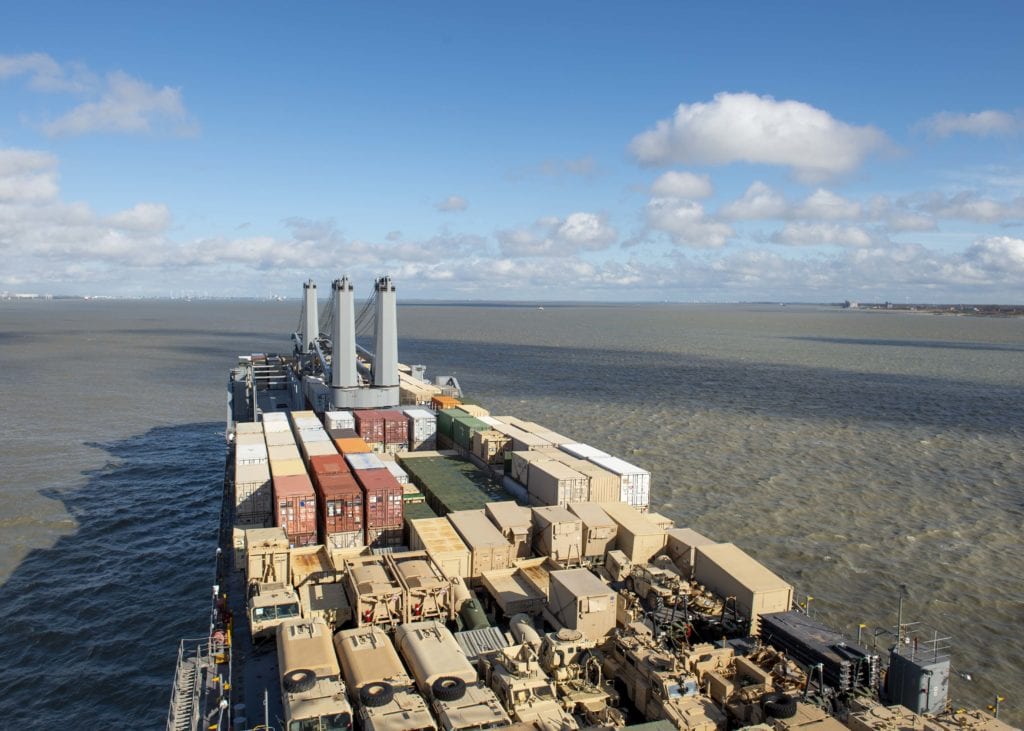
The U.S. Military Sealift Command large, medium speed roll-on/roll-off ship Benavidez transits the English Channel. U.S. Navy/Mass Communication Specialist 3rd Class Jordan R. Bair
ARLINGTON, Va. — U.S. strategic sealift fleets need recapitalization and some increased manning to achieve the readiness that the nation needs to sustain its maritime power, the U.S. maritime administrator said April 14.
“The readiness is suffering,” a fact that sealift stakeholders recognize, Maritime Administrator Mark H. Buzby said during a webcast that is part of the Navy League’s Sea-Air-Space 2020: Virtual Edition.
To register and then watch this Sea-Air-Space 2020: Virtual Edition webinar live online, click here.
Buzby pointed out that rusting ships, obsolete equipment, unavailable parts and repairing and replacing ships are the materiel challenges faced by the Maritime Administration (MARAD) and the U.S. Navy’s Military Sealift Command (MSC).
MARAD’s Ready Reserve Force of 46 ships and MSC’s 15 sealift ships all need recapitalization, Buzby added.
He said the federal government is taking three approaches to recapitalizing the fleets and that a combination of those “will help us renew the fleet”:
Extending the service lives of some existing ships to possibly 60 years.
Replacing 25 to 26 ships with new or converted used vessels.
Procuring built-for-purpose sealift ships “from the keel up.”
Recruiting and retaining enough mariners remains a challenge as well, Buzby said. Commercial mariners in the U.S. Merchant Marine — including those in the Ready Reserve Force, on Maritime Security Program ships available for mobilization and the declining U.S.-flag merchant fleet — and the government’s civilian mariners who work for the MSC are part of the pool that man the sealift ships.
Maritime Administrator Mark H. Buzby participates in a webcast for the Navy League’s Sea-Air-Space 2020: Virtual Edition
He said that 24 ships in the Ready Reserve Force are steam-powered, operated by a shrinking pool of technicians qualified to operate and maintain the obsolete propulsion system.
Buzby said the mariner pool is “enough for a steady state today” but inadequate for a substantial mobilization requirement.
Of help would be to place more merchant ships “under the U.S. flag so it gets the pool … where it needs to be,” he added.
Building up the U.S.-flag merchant fleet is a considerable challenge, he said, because competitors such as China that have state-run enterprises can undercut the U.S. in terms of lower-cost shipbuilding and manning and can therefore compete more effectively for cargo business.
“We’re asking our merchant marine to play on an unlevel playing field,” he said.
Philly Shipyard Selected to Build NSMV
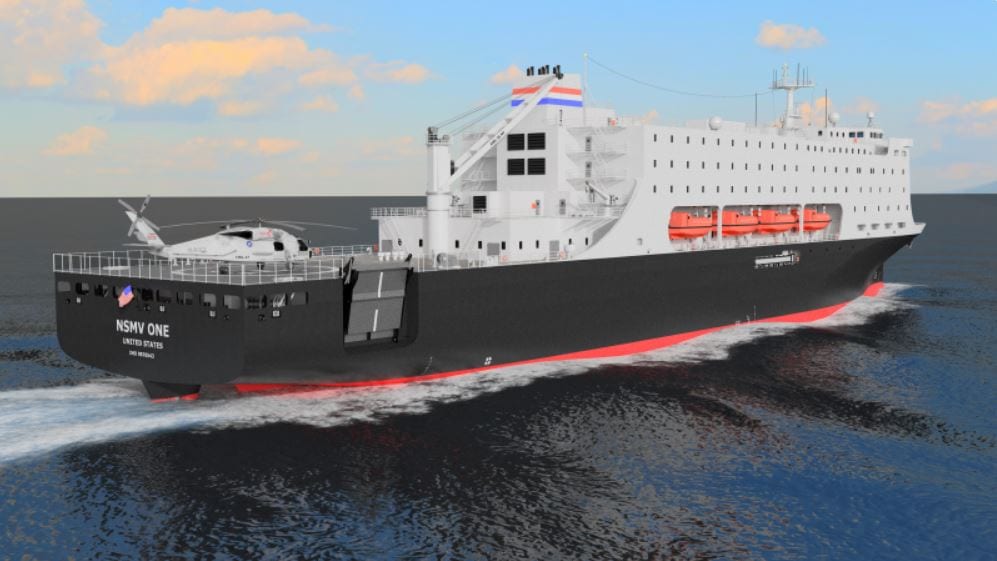
An artist’s rendering of the National Security Multi-Mission Vessel (NSMV). MARAD
WASHINGTON — TOTE Services has selected Philly Shipyard Inc. of Philadelphia to build the newest class of training ship, the National Security Multi-Mission Vessel (NSMV), the Maritime Administration (MARAD) announced April 8.
The shipyard will construct up to five new ships to provide maritime training for America’s future mariners and to support humanitarian assistance and disaster relief in times of need.
“This new world-class vessel, constructed at an American shipyard, is part of our much-needed program to replace the aging training vessels currently operated by state maritime academies,” Transportation Secretary Elaine L. Chao said.
Last May, TOTE contracted with MARAD as the vessel construction manager to deliver one to five NSMVs. This occurred after Congress required that the NSMVs be procured using commercial design and build practices.
Following construction and delivery of the ships to TOTE, the vessels will be transferred to MARAD for their mission of training future licensed mariners at state maritime academies and responding to humanitarian and natural disasters.
“Investing in maritime education creates more American jobs,” Maritime Administrator Mark H. Buzby said.
The NSMV will feature numerous instructional spaces and a full training bridge and have space for up to 600 cadets to train in an at-sea academic environment.
In its role as a National Defense Reserve Fleet vessel, the NSMV will incorporate medical capabilities, a command-and-control platform and berthing for up to 1,000 first responders and recovery workers. The vessel’s roll-on/roll-off ramp and crane to facilitate container storage capabilities will enable it to provide critical support equipment and supplies to those in need during a disaster.
Chao, Buzby Conference With Maritime Industry Leaders Over COVID-19
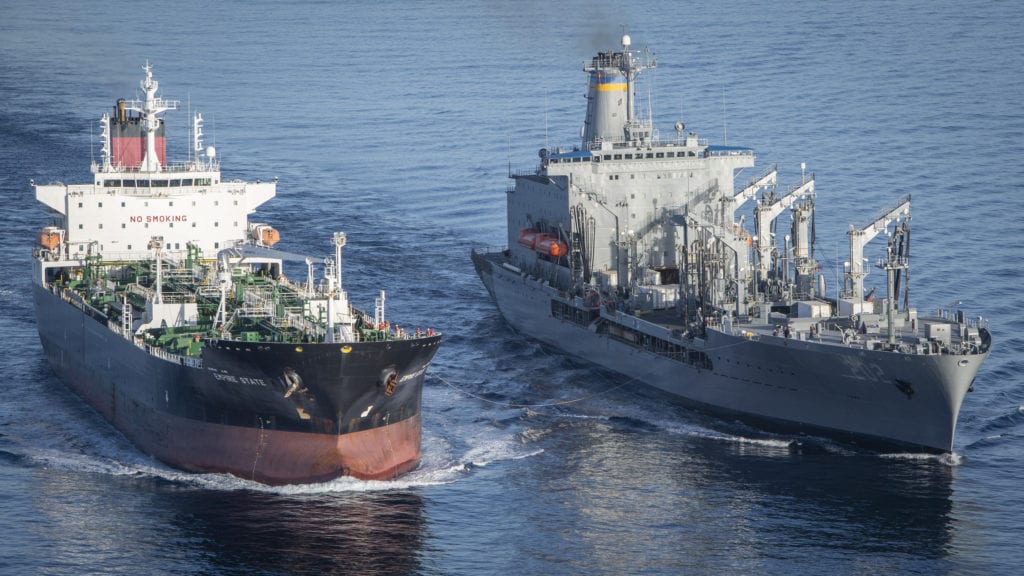
The Henry J. Kaiser-class underway replenishment oiler USNS Yukon prepares to conduct a loading with the commercial tanker MT Empire State. U.S. Navy/Mass Communication Specialist 1st Class Patrick W. Menah Jr.
WASHINGTON — Transportation Secretary Elaine L. Chao and Maritime Administrator Mark H. Buzby held a teleconference with maritime industry leaders on April 2 to discuss the effects of the COVID-19 outbreak on the industry, according to an April 2 MARAD release.
Chao and Buzby discussed the crisis with chief executive officers, presidents and other senior officials of the industry.
“During the call, Secretary Chao voiced her support for the maritime industry and the challenges they face at this time,” the release said.
Did you know there are about 70 civilian mariners aboard the USNS Comfort supporting the Navy doctors, nurses, and other health care professionals. Andrew Chen, chief mate, helps guide the ship from the bridge as it arrives in New York City. pic.twitter.com/ED4Qu2IBJP
— DOT Maritime Administration (@DOTMARAD) April 2, 2020
“Secretary Chao and Administrator Buzby briefed maritime industry partners on departmental activities concerning COVID-19 and provided industry leaders the opportunity to share their insights, questions and concerns with the secretary, [Department of Transportation], MARAD and other government interagency Partners. Topics discussed included the overall status of maritime industry operations, including personnel [staff/contractors], any disruptions, and [the outbreak’s] impact on the cargo movement in the U.S. and overseas.”
2nd Fleet Conducts Convoy Exercise in Atlantic
A convoy made up of the guided-missile cruiser USS Vella Gulf (foreground), the vehicle carrier MV Resolve (center) and the MSC cargo ship USNS Benavidez steam in formation. U.S. Navy/Mass Communication Specialist 3rd Class Andrew Waters
NORFOLK, Va. — U.S. 2nd Fleet, on behalf of U.S. Naval Forces Europe (NAVEUR) and with Military Sealift Command (MSC), is conducting convoy operations across the Atlantic, employing the guided-missile cruiser USS Vella Gulf alongside USNS Benavidez, MV Resolve and MV Patriot, the 2nd Fleet said in a release.
Sealift remains the primary method for transporting military equipment, supplies and materiel around the world. With the return of peer competition and access to sea lanes no longer guaranteed, the Navy and MSC train together to ensure successful delivery and sustainment of combat power.
“In a real-world conflict, much of the military equipment must still go by sealift, which makes convoy operations a critical skill set to maintain and practice,” said Capt. Hans E. Lynch, commodore of MSC Atlantic. “In the last five years, there has been an increased emphasis on including Merchant Marine shipping in large-scale exercises to enhance tactical proficiency. Exercises that incorporate convoy operations are an extension of that ongoing tactical training.”
This exercise is simulating an opposed transit, testing the fleets’ abilities to safely cross the Atlantic and new ways of conducting a convoy in today’s environment. Convoy operations were critical during World War I and World War II as the primary method for moving troops and military equipment, supplies and materiel to Europe. After WWII, convoys became less prevalent in the Atlantic theater, although still practiced in other areas of operation.
“In a real-world conflict, much of the military equipment must still go by sealift, which makes convoy operations a critical skill set to maintain and practice.”
Capt. Hans E. Lynch, commodore of MSC Atlantic
“The Atlantic is a battlespace that cannot be ignored,” said Vice Adm. Andrew Lewis, commander of the 2nd Fleet. “We need to be prepared to operate at the high end alongside our allies, partners and adversaries alike as soon as we’re underway.”
During its operations in the Atlantic, Nimitz-class aircraft carrier USS Dwight D. Eisenhower, along with P-8s from VP-4 and a U.S. submarine, cleared the maritime battlespace prior to the transit of the Vella Gulf-escorted MSC convoy.
“This exercise allows us to sharpen our ability to move critical resources across the Atlantic, from the United States to Europe,” said Adm. James G. Foggo III, commander of NAVEUR.
Foggo added: “The transatlantic bridge is just as important today for moving troops and military equipment, supplies and materiel from the United States to Europe as it has been at any point in history.”
The 2nd and 6th fleets work together to ensure the security of sea lanes of communication in the Atlantic. If called upon, the Pentagon’s sealift transportation fleet expects to move about 90% of required assets from the U.S. to the conflict theater. The safest and quickest way to get needed materials to the front lines is via maritime convoy.
“We, as a Navy, are inherently linked with the broader maritime industry, and this exercise provides a great opportunity to train like we fight,” said Capt. Andrew Fitzpatrick, the Vella Gulf’s commander. “Practicing convoy operations flexes a blue-water, high-end skill for the first time in many years, enabling us all to operate on, above and below the sea in a contested environment.”
MSC operates about 110 noncombatant, civilian-crewed ships that replenish Navy ships, conduct specialized missions, strategically preposition combat cargo at sea around the world and move military cargo and supplies used by deployed U.S. forces and coalition partners.
C2F tests operational authorities over assigned ships, aircraft and landing forces on the East Coast and the Atlantic Ocean. When directed, C2F conducts exercises and operations within the U.S. European Command area of responsibility as an expeditionary fleet.
N.S. Savannah Returns from Dry Dock
NS Savannah reaches the Golden Gate Bridge in 1962 en route to the World’s Fair in Seattle. U.S. government archives
WASHINGTON — The N.S. Savannah, the world’s first nuclear-powered merchant ship, was to begin its journey back on Feb. 13 from dry-docking in preparation for decommissioning, the Maritime Administration said in a release.
Having spent the last few months at Northeast Ship Repair in Philadelphia undergoing maintenance, the ship will be back at home at the Canton Marine Terminal in Baltimore by Feb. 14.
The only U.S.-built, nuclear-powered merchant ship, the Savannah was in Philadelphia for general inspection, repairs and structural modifications. The ship was a demonstration project for the potential use of nuclear energy and was named after the SS Savannah, the first steamship to cross the Atlantic Ocean.
The N.S. Savannah, which was deactivated in 1971, was in service between 1962 and 1972 as one of only four nuclear-powered cargo ships ever built. Soviet icebreaker Lenin, launched in 1957, was the first nuclear-powered civil ship.
While the last nuclear fuel was removed from the Savannah nearly 50 years ago, there are still components of the nuclear power plant that need to be removed to support its decommissioning. A contract for decommissioning the vessel’s nuclear plant is expected to be announced later this year.
Once the ship is back in Baltimore, it will be open for limited tours.