Austal USA Starts Construction on T-ATS 13

MOBILE, Ala. – Austal USA has started construction on the future USNS James D. Fairbanks (T-ATS 13), the third of five steel U.S. Navy Navajo Class Towing, Salvage, and Rescue Ships Austal USA has under contract with the Navy. Construction is well underway on both the future USNS Billy Frank Jr. (T-ATS 11) and USNS Solomon Atkinson (T-ATS 12).   

“It’s exciting to see another ship begin traveling down the steel production line which has been busy since we opened it just a little over two years ago,” Austal USA Vice President of New Construction Dave Growden said. “I’m proud of how well our workforce is handling the diversity of work we have taken on since the steel line became active.” 

The ship’s namesake, James D. Fairbanks, was a Camp Pendleton Marine who also served in the Navy, where he became a prominent figure in the Seabees. Fairbanks grew up on the White Earth Indian Reservation in northern Minnesota and went on to compile an impressive service record. He first served with Second Battalion Eleventh Marines (2/11) at Camp Pendleton and then did two tours in the Navy. The first included service during Operation Iraqi Freedom, where he was awarded the Bronze Star. Fairbanks also was hailed for his service in the Seabees, the Navy’s storied construction battalion. 

T-ATS will provide ocean-going tug, salvage, and rescue capabilities to support U.S. Navy fleet operations and will be a multi mission common hull platform capable of towing heavy ships. These ships will also support several missions, including oil spill response, humanitarian assistance, and wide area search and surveillance.  


June 20 Central Command Update

From U.S. Central Command 

June 20, 2024

TAMPA, Fla. – In the past 24 hours, U.S. Central Command (USCENTCOM) forces successfully destroyed four Iranian-backed Houthi uncrewed surface vessels (USV) in the Red Sea, and two uncrewed aerial systems (UAS) over the Red Sea. 

There were no injuries or damage reported by U.S., coalition, or merchant vessels.  

It was determined these systems presented an imminent threat to U.S. forces, coalition forces, and merchant vessels in the region. These actions were taken to protect freedom of navigation and make international waters safer and more secure for U.S., coalition, and merchant vessels. 


SECNAV: Hanwha Group’s Acquisition of Philly Shipyard a ‘Game Changer’

From SECNAV Public Affairs 

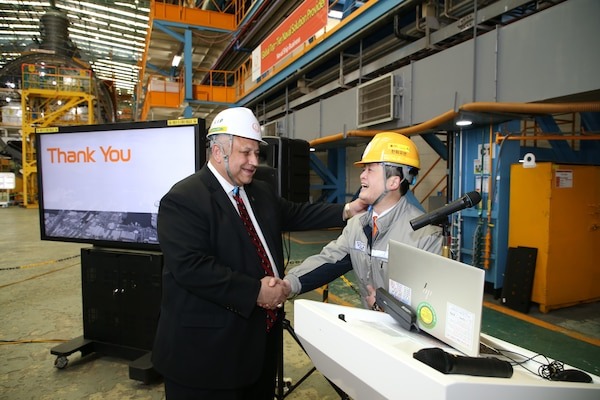
ARLINGTON, Va.– In February 2024, Secretary Del Toro traveled to Korea and Japan to meet with key shipbuilding executives. While in Korea, he toured Hanwha and HD Hyundai shipyards and met with company leaders. In his meetings with Hanwha Vice Chairman Dong Kwon Kim and his tour of their Geoje Island shipyard, he witnessed the Hanwha Group’s expertise, cutting-edge technology, and best practices, which will energize the American shipbuilding landscape. They bring world-class leadership, fostering renewed competition through innovation and industrial capacity.  

Del Toro released the following statement: 

“Hanwha’s acquisition of Philly Shipyard is a game-changing milestone in our new Maritime Statecraft. This will bring good paying union jobs to Philadelphia, a city with a 250-year relationship with the U.S. Navy.  Knowing how they will change the competitive U.S. shipbuilding landscape, I could not be more excited to welcome Hanwha as the first Korean shipbuilder to come to American shores—and I am certain they will not be the last.”  

Secretary Del Toro has made Maritime Statecraft and restoring the comprehensive maritime power of the United States a key component of his tenure as Secretary of the Navy. This acquisition aligns with both the Maritime Statecraft initiative and the Department of Defense’s National Defense Industrial Strategy. The Department of the Navy looks forward to collaborating with Hanwha Group in the future to ensure the continued strength of the American maritime industry. 


U.S. Navy Efforts Aid in Baltimore Channel Reopening

BALTIMORE (May 13, 2024) A Naval Sea Systems Command Supervisor of Salvage and Diving harbor boat secures the area around the Francis Scott Key Bridge and the M/V Dali cargo vessel before a highly controlled demolition. (U.S. Navy photo by Lt. Jason Showmaker)

By Naval Sea Systems Command Office of Corporate Communications SUPSALV 

June 12, 2024 

BALTIMORE — The U.S. Navy’s Supervisor of Salvage and Diving (SUPSALV) led critical efforts in support of the Unified Command in clearing the Port of Baltimore’s Fort McHenry Federal Channel, following the M/V Dali’s collision into the Francis Scott Key Bridge. 
 
“In the aftermath of the tragic accident and profound sadness experienced by the City of Baltimore and indeed the nation, I am proud of the extraordinary work and professionalism displayed by our Sailors and civilians, under the supervision of Capt. Sal Suarez, in support of the Key Bridge Response Unified Command,” said Secretary of the Navy Carlos Del Toro. “Our Navy and Marine Corps Team remains critical to defending our economic security, including the crucial efforts of our Navy’s diving and salvage experts to keep our waterways open.” 
 
SUPSALV arrived within hours after tasking by the U.S, Army Corps of Engineers to support the Unified Command by leading the clearing of the Baltimore Harbor waterway. The team, along with several private maritime salvage companies, mobilized resources to the site and worked to remove debris, support truss cuts, rigging and bridge sections. Their efforts also included controlled explosions that allowed the Dali to be refloated and moved back to port. 
 
“SUPSALV expertise is recognized throughout the U.S. Navy, Department of Defense and other federal agencies,” said Capt. Sal Suarez, commander, Supervisor of Salvage and Diving. SUPSALV provides technical, operational, and emergency support in marine salvage, towing, pollution control and abatement, diving and diving system safety and certification, diving and salvage equipment procurement, and underwater ship husbandry. Its expertise in marine salvage has been leveraged globally removing a sunken dredge barge in Alexandroupoli, Greece, in 2019, and recently clearing Louisiana waterways impacted by Hurricane Ida in 2021. 
 
“SUPSALV supports other federal agencies and the country with its national response capability, including active duty and contractor salvage experts,” said Paul Hankins, director, Salvage Operations at SUPSALV. “We have resources and support agreements in place so we can immediately respond with our expertise and resources when called upon.” 
 
Throughout the entirety of the process SUPSALV was responsible for managing all on-scene assets tasked with debris removal and channel clearing effort. Each day began at 06:30 a.m. to coordinate assets, align on objectives and finished daily at 5:30 p.m. to share what was accomplished that day and what they plan to accomplish next. 
 
SUPSALV provides technical, operational, and emergency support in marine salvage, towing, pollution control and abatement, diving and diving system safety and certification, diving and salvage equipment procurement, and underwater ship husbandry. 


June 18/19 U.S. Central Command Update

From U.S. Central Command 

June 19,2024

TAMPA, Fla. – In the past 24 hours, U.S. Central Command (USCENTCOM) forces successfully destroyed two Iranian-backed Houthi uncrewed surface vessels (USV) in the Red Sea. 

Separately, USCENTCOM forces successfully destroyed one ground control station and one command and control node in a Houthi controlled area of Yemen. 

It was determined these systems presented an imminent threat to U.S. forces, coalition forces, and merchant vessels in the region. These actions were taken to protect freedom of navigation and make international waters safer and more secure for U.S., coalition, and merchant vessels. 

June 18, 2024

TAMPA, Fla. – In the past 24 hours, U.S. Central Command (USCENTCOM) forces successfully destroyed eight Iranian-backed Houthi uncrewed aerial systems (UAS) in a Houthi controlled area of Yemen. 

Additionally, partner forces successfully destroyed one Houthi uncrewed aerial vehicle (UAV) over the Gulf of Aden. There were no injuries or damage reported by U.S., coalition, or merchant vessels.  

It was determined these systems presented an imminent threat to U.S., coalition forces, and merchant vessels in the region. These actions were taken to protect freedom of navigation and make international waters safer and more secure for U.S., coalition, and merchant vessels. 


L3Harris and Startup Accomplish Milestone in Proving Resilient, Distributed Maritime Autonomous Operations

MELBOURNE, Fla., June 18, 2024 — L3Harris Technologies (NYSE:LHX) joined maritime startup Seasats to successfully test the advanced capabilities of an autonomous surface vessel (ASV) in the Pacific Ocean.  

Seasats and L3Harris demonstrated reliable, resilient and effective operations off the coast of Hawaii with a surfboard-size ASV after completing a 2,500-mile journey from San Diego, California, to Pearl Harbor, Hawaii. The 10-week voyage also proved the ASV’s seaworthiness while continuously operating in challenging conditions.  

“The ability of ASVs to prove their prolonged and reliable operations in the ocean is critical for establishing their effectiveness as a hard-to-detect, autonomous and affordable platform for L3Harris’ collaborative network payloads – essential for military effectiveness in contested environments,” said Andrew Puryear, Vice President and Chief Technology Officer, L3Harris. “We are committed to collaborating with promising startups on innovative solutions that will make an impact in supporting the U.S., its allies and partners.”  

Seasats manufactures ASVs under the product name Lightfish, which operate autonomously in all maritime environments for up to six months. 

“We were extremely pleased how well the Lightfish navigated the challenges of an open ocean environment during our transit to Hawaii,” said Mike Flanigan, CEO and President, Seasats. “We see ASVs as a force multiplier and another way to affordably and quickly grow U.S. naval presence around the world.” 

Seasats is a privately-owned company that designs and produces solar-powered maritime ASVs for military and commercial use. L3Harris strategically invested in Seasats in 2022 as part of its ongoing strategy to adopt emerging technologies that address customers’ growing requirements for innovative, agile solutions that can be fielded rapidly.  


SECNAV Names Ship in Honor of Narragansett Tribe of Rhode Island

From SECNAV Public Affairs 

18 June 2024 

Secretary of the Navy Carlos Del Toro announced today that a future Navajo-class Towing, Salvage, and Rescue (T-ATS) ship will be named USNS Narragansett in honor of the Narragansett Indian Tribe of Rhode Island, June 18. 

WASHINGTON – Secretary of the Navy Carlos Del Toro announced today that a future Navajo-class Towing, Salvage, and Rescue (T-ATS) ship will be named USNS Narragansett in honor of the Narragansett Indian Tribe of Rhode Island, June 18. 

Secretary Del Toro made the announcement on the 90th Anniversary of the Indian Reorganization Act. 

The Indian Reorganization Act, signed by President Franklin D. Roosevelt, was aimed at decreasing Federal control of Native American Indian Affairs. The Act presented a major reversal of federal policy toward Native Americans and provided them greater control over their lands, allowing the formation of legally recognized tribal governments and decreasing pressure toward assimilation. 

The naming selection of the future USNS Narragansett (T-ATS 14) follows the tradition of the Navajo-class of naming towing, salvage and rescue ships after prominent Native Americans or Native American tribes. Secretary Del Toro has previously named three Navajo-class ships: USNS Billy Frank Jr., USNS Solomon Atkinson, and USNS James D. Fairbanks. 

“Native Americans have been integral to the history of our Nation; however, historically, the rights of Native Americans have been drastically impacted in negative ways,” said Secretary Del Toro. “Today, on the 90th Anniversary of the Indian Reorganization Act, I am honored to announce the name of our newest Navajo-class T-ATS, the future USNS Narragansett (T-ATS 14).”  

Prior to European contact, the Narragansett were a powerful Algonquian-speaking warrior tribe that occupied most of present-day Rhode Island from the Narragansett Bay in the east to the Pawcatuck River in the West. They first encountered European explorers in the 1520s when Giovanni de Verrazano visited the region and provided land to Roger Williams in 1636 to establish the settlement of Providence. 

Increasing tensions with colonists led the Narragansett tribe to unite with other tribes during King Philip’s War. Their territory was gradually reduced to a 15,000-acre reservation and the Narragansett people were officially recognized by the federal government as the Narragansett Indian Tribe in April 1983. 

There are currently approximately 2,400 members of the Narragansett Indian Tribe living primarily in Rhode Island. Five naval vessels have been named in honor of the Narragansett people: a screw sloop (1859-1875), a troop transport (SP 2196) (1918-1919), a ferry boat (YFB 1163) (1918-1944), a fleet tug (AT 88) (1943-1946), and a fleet ocean tug (T-ATF 167) (1979-2002). 

Navajo-class ships will provide ocean-going tug, salvage, and rescue capabilities to support Fleet operations. The current capabilities are provided by Powhatan-class T-ATF Fleet Tugs and Safeguard-class T-ARS Rescue and Salvage vessels. Navajo-class ships will be capable of towing U.S. Navy ships and will have 6,000 square feet of deck space for embarked systems. 

More information on our towing, salvage, and rescue ship programs can be found here


June 17 Central Command Update

From U.S. Central Command 

June 17, 2024 

TAMPA, Fla. – In the past 24 hours, U.S. Central Command (USCENTCOM) forces successfully destroyed four Houthi radars and one uncrewed surface vessel (USV) in Houthi-controlled areas of Yemen. 

Additionally, USCENTCOM forces successfully destroyed one Iranian-backed Houthi uncrewed aerial vehicle (UAV) over the Red Sea. There were no injuries or damage reported by U.S., coalition, or merchant vessels.  

It was determined these systems presented an imminent threat to U.S. forces, coalition forces, and merchant vessels in the region. These actions were taken to protect freedom of navigation and make international waters safer and more secure for U.S., coalition, and merchant vessels. 


CNO, CMC Sign Amphibious Warfare Ship Terms of Reference, Strengthening Navy-Marine Corps Team

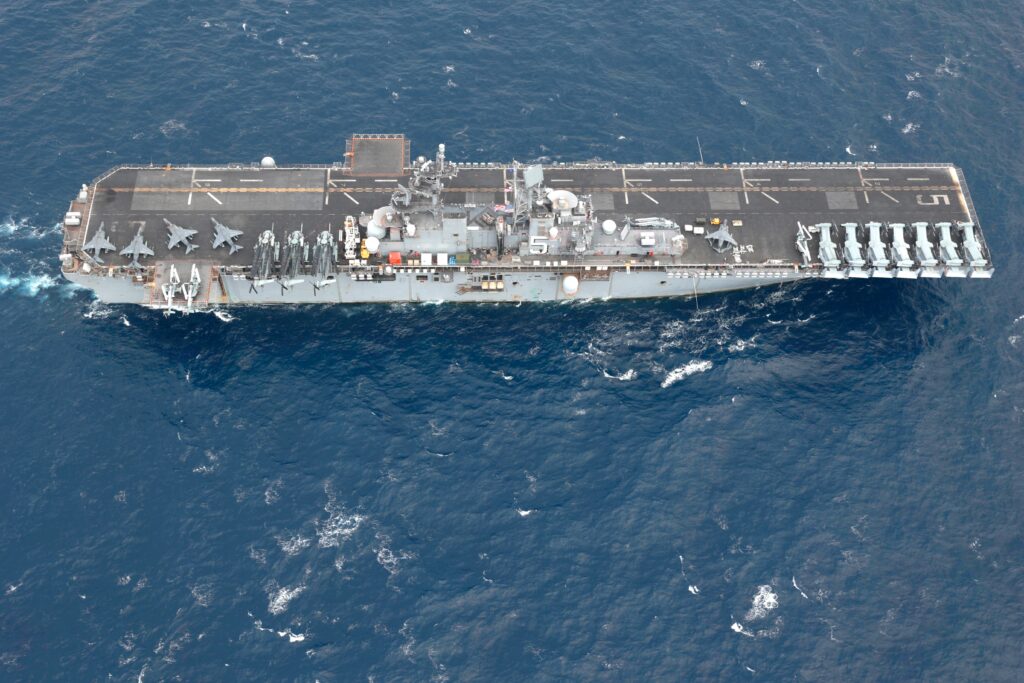
MEDITERRANEAN SEA (Feb. 26, 2024) The Wasp-class amphibious assault ship USS Bataan (LHD 5) transits the Mediterranean Sea during a photo exercise, Feb. 26, 2024. (U.S. Navy photo by MC2 Riley Gasdia) 

17 June 2024 

Chief of Naval Operations (CNO) Adm. Lisa Franchetti and Commandant of the Marine Corps (CMC) Gen. Eric Smith signed a Memorandum of Understanding (MOU) on Amphibious Warfare Ship Terms of Reference, June 12, 2024, demonstrating Navy and Marine Corps full alignment and commitment to amphibious ship readiness.   

WASHINGTON, (June 17, 2024) – Chief of Naval Operations (CNO) Adm. Lisa Franchetti and Commandant of the Marine Corps (CMC) Gen. Eric Smith signed a Memorandum of Understanding (MOU) on Amphibious Warfare Ship Terms of Reference, June 12, 2024, demonstrating Navy and Marine Corps full alignment and commitment to amphibious ship readiness.   

The signing follows the CNO and CMC’s letter earlier this year to their three-star officers who oversee plans and operations, calling for a deep dive on ship readiness and requirements for the training and certification of Amphibious Ready Groups.  

“The Marine Expeditionary Unit is our crown jewel, and our Amphibious Warfare Ships are the most versatile, adaptable naval platforms in our inventory,” said Smith. “This MOU ensures consistency and uniformity in how each service talks about amphibious force readiness so we can better plan and execute naval operations. Ultimately, this creates a stronger Navy/Marine Corps team for all our Marines, Sailors, and the American people.”  

The CNO echoed CMC’s sentiment emphasizing that above all else, these new terms are intended to aid in better joint risk decisions between Navy and Marine Corps commanders and ensure the Navy remains ready and prepared to support contingency operations with the Marine Corps.  

“Our Navy – Marine Corps team generates combat power with global impact – unmatched by any other naval force every day,” said Franchetti. “We stand ready to preserve the peace, respond in crisis, and win decisively in war, if called to do so. This MOU will ensure the ARG-MEU team remains the centerpiece of our naval expeditionary warfare presence, forcible entry, and sea basing capabilities.”  

The new terms of reference serve as supplemental guidance to existing readiness reporting criteria and will ensure consistency and uniformity in Navy and Marine Corps amphibious force planning, assessment, and operational mission execution.  

The Department of the Navy is committed to reducing maintenance delays and is heavily investing in readiness in the Fiscal Year 2025 Presidential Budget.  

The joint MOU was signed during the 2024 Naval Board. Guided by the CNO and CMC’s priorities, the Naval Board provides a regular forum for senior leaders to consider naval policy and guidance that affects warfighting issues, and works with type commanders to identify solutions for remediating those deficiencies.   

Further remarks from the CNO and CMC on the MOU can found in this video


X-Bow Systems to Build Mk 72 and Mk 104 Standard Missile Rocket Motors for US Navy

PHILIPPINE SEA (April 5, 2024) The Arleigh Burke-class guided-missile destroyer USS Higgins (DDG 76) launches a Standard Missile (SM) 2 from a forward launcher while operating in the Philippine Sea, April 5, 2024. (U.S. Navy photo by MC1 Hannah Fry) 

ALBUQUERQUE, N.M., June 18, 2024 – X-Bow Systems Inc. (X-Bow), the nation’s leading new 3rd supplier and advance manufacturer of solid rocket motors (SRMs) and defense technologies, today announced that the United States Navy has awarded it both the Mk 72 booster and Mk 104 dual-thrust solid rocket motor (SRM) development contracts to further enhance performance and increase capacitance for the service’s Standard Missile program.  These awards represent the 7th and 8th SRMs to be under development and or awarded to X-Bow in the last 8 months. X-Bow is under contract to supply new SRM’s in both strategic and tactical sizes to multiple armed services and commercial customers, while also developing the world’s most affordable production giga-campus for SRMs.  

“X-Bow Systems is proud to be a partner in addressing the Nation’s critical need for more solid rocket motors.  We have assembled a nationwide, experienced and talented team that is revolutionizing the approach to conventional manufacturing: enabling performance, flexibility, scaling, affordability, and reliability” said Jason Hundley, X-Bow CEO. 

Under these two contracts, X-Bow Systems will develop new designs for the Mk 72 and Mk 104 SRMs using its state-of-the-art design tools and unique patented advanced manufacturing approaches  for the first and second stage propulsion of the Navy’s Standard Missiles (see recent followonAFRL REARM contract awardfor more detail).  

The efforts are in collaboration with the Navy’s Program Executive Office Integrated Warfare Systems (PEO IWS) 3.0, Naval Air Warfare Center – Weapons Division at China Lake, Naval Surface Warfare Center at Indian Head and John Hopkins University Applied Physics Lab.  

The current contracted efforts are for development of an additional motor supplier to transition to production in the upcoming months.  X-Bow Systems is the only supplier to be awarded contracts for both the Mk 72 and Mk 104.