Aircraft Carrier Suppliers Alarmed at Navy’s Planned Delay of CVN 82
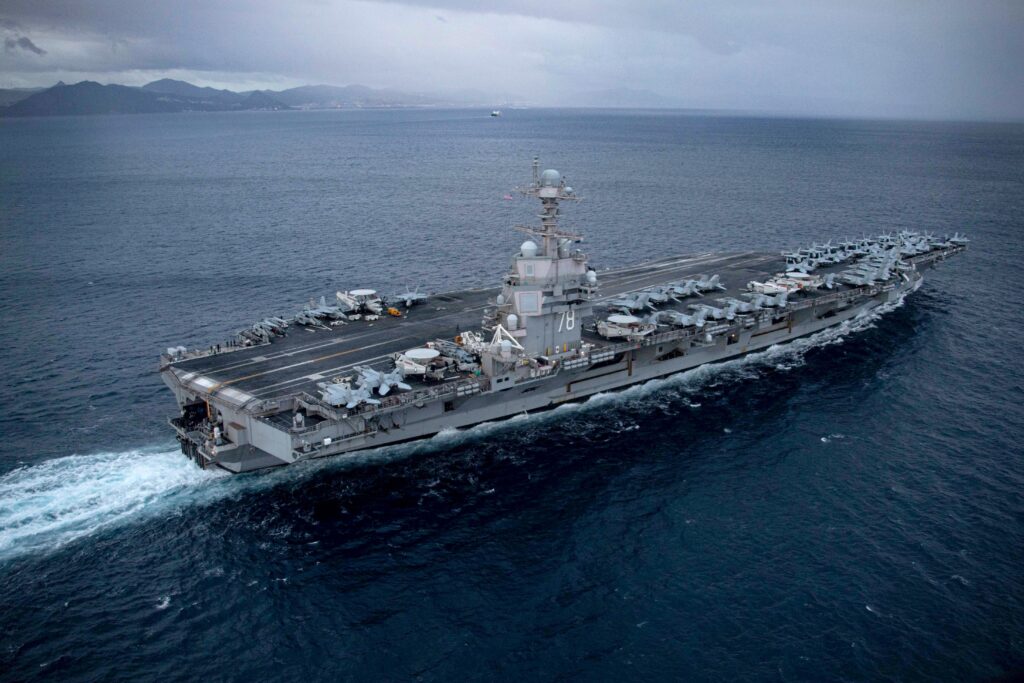
STRAIT OF GIBRALTAR (Jan. 5, 2024) The world’s largest aircraft carrier USS Gerald R. Ford (CVN 78) transits the Strait of Gibraltar, Jan. 5, 2024. (USN photo by MC2 Jacob Mattingly)

By Richard R. Burgess, Senior Editor 

ARLINGTON, Va. — The coalition of suppliers of components, parts, and services for the construction of the U.S. Navy’s aircraft carriers (CVNs) is alarmed at the proposed two-year delay of authorization for CVN 82 — the fifth Gerald R. Ford-class CVN — and the potential disruption to the supplier base for the ships. 

Lisa Dante Papini, chair of the Aircraft Carrier Industrial Base Coalition (ACIBC), which represents more than 2,000 businesses, said she is “extremely concerned” about the proposed delay for CVN 82 from 2028 to 2030, noting that 40% of the suppliers said in a survey that they would be negatively affected by the delay. 

Papini said the delay likely would involve worker layoffs, production lines going cold, and suppliers de-prioritizing military requirements and seeking more work in other sectors. She noted that re-starting cold production lines and hiring or re-hiring workers is a lengthy and expensive process. The skills needed — such as welding — are in high demand in other industries as well, complicating the attraction of new workers.  

“That’s why we’re concerned about going cold,” she said.  

She also explained the need for advance funding for supplying aircraft carrier construction three years in advance of construction start. 

“We’re so far to the left of those delivery dates,” she said. That’s why we ask for advance funding.”    

Papini, like her counterparts in the Amphibious Warfare Industrial Base Coalition and the Submarine Industrial Base Coalition, emphasizes that stability and predictability of shipbuilding helps the supplier base “level-load their work;” recruit, train, and retain their workers; reduce costs, and deliver products on time.  

The ACIBC met with senators and congressmen on March 20 on Capitol Hill to explain its concerns and priorities.

Kratos Receives $57.6 Million Navy Contract for 70 BQM-177A Aerial Targets 

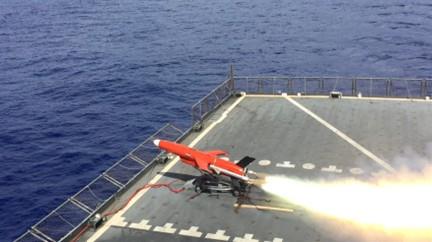
Kratos BQM-177A shipboard Launch

March 18, 2024  

SAN DIEGO, March 18, 2024 (GLOBE NEWSWIRE) – Kratos Defense & Security Solutions, Inc. (NASDAQ: KTOS), a Technology Company in the Defense, National Security and Global Markets and industry-leading provider of high-performance, jet-powered unmanned aerial systems, announced today that its Unmanned Systems Division has received a $57,673,542 modification to a previously awarded firm-fixed-price contract.  

This modification exercises options to procure full rate production Lot Five of the BQM-177A Surface Launched Aerial Targets to provide for the production and delivery of 70 BQM-177A Surface Launched Aerial Targets and 70 Rocket-Assisted Takeoff attachment kits, as well as associated technical and administrative data in support of weapons system test, and evaluation and fleet training for the Navy. 

Steve Fendley, President of Kratos Unmanned Systems Division, said,“It’s exciting to be a major part of this critically important capability for the U.S. Navy with our BQM-177A Sub-Sonic Aerial Target (SSAT) aircraft system (target). The 177A continues to push the envelope delivering leading edge realistic threat-representative capabilities to support today’s peer-level threat environment. We look forward to the increased production rate and continuing to evolve the system with our customer as the threats evolve.” 

Greg Crewse, Program Manager for the Navy’s Aerial Targets program office (PMA-208), said, “In partnership with the Navy Aerial Targets program office, Kratos Defense and the BQM-177A Air Vehicle are true assets to the Navy and, together, we have the opportunity to engage in critical training exercises that will prepare our personnel to face a multitude of scenarios in a challenging, cost-effective test environment prior to engaging real-world threats, should the need arise. As recent real-world events have proven, these target presentations are growing ever more critical to prepare our warfighters to go into harm’s way – and prevail.” 


Secretary of the Navy Carlos Del Toro Hosts Maritime Industry Roundtable 

WASHINGTON – Secretary of the Navy Carlos Del Toro hosted maritime industry executives from major ship repair companies in the Pentagon, March 18. 

The Secretary invited industry leaders to participate in a roundtable discussion focused on surface ship repair and modernization initiatives under the aegis of his efforts on Maritime Statecraft.   

Navy and Marine Corps leaders have expressed that repair process improvements are critical to meeting the needs of worldwide combatant commanders.  

“The maritime industry is a strategic sector critical to our economic and national security,” said Secretary Del Toro. “As a collective force, our combined structure plays a vital role maintaining the open sea lines of communication that sustain the U.S. and world economy.”  

The roundtable featured open and transparent dialogue between government and industry representatives covering issues including maintenance delay days, contract award timelines, repair yard efficiencies, performance to plan initiatives, maritime training programs, and the impacts of a fiscally constrained environment.  

Discussions further revolved around recent successes in surface ship maintenance and modernization, and collaboration on ideas for continued improvement.  

For example, 41% of Chief of Naval Operations maintenance availabilities were completed on time in Fiscal Year 2023, up from 37% in FY22.  The number of maintenance delay days decreased over the same period – 2,136 in FY23, down from 2,483 in FY22. 

In addition to the Secretary, nearly one dozen government representatives attended the roundtable, including leaders across the Navy, Marine Corps, Coast Guard, and MARAD.   

“I launched the Government Shipbuilders Council in November 2023 with these types of discussions in mind – bringing in stakeholders from across the whole of government and fostering a robust dialogue with our partners in industry.  This is what Maritime Statecraft is all about,” said the Secretary.  “We’re all going to walk out of this room better informed and better able to make the strategic decisions required of each of us.” 


March 18 Red Sea Update 

USCENTCOM, March 18, 2024 
 

TAMPA, Fla.  – On March 18, between 1:00 p.m. and 7:40 p.m. (Sanaa time) United States Central Command (CENTCOM) forces successfully engaged and destroyed seven anti-ship missiles, three unmanned aerial vehicles (UAV), and three weapons storage containers in Houthi-controlled areas of Yemen in self-defense. It was determined these weapons presented an imminent threat to merchant vessels and U.S. Navy ships in the region. 

These actions are taken to protect freedom of navigation and make international waters safer and more secure for U.S. Navy and merchant vessels. 


Rite-Solutions Awarded $60 Million NUWC Division Newport IT Services Contract

MIDDLETOWN, R.I. (March 18, 2024) — Rite-Solutions was recently awarded a $60.7 million, five-year contract to support NUWC’s Activity Chief Information Officer (ACIO)/Information Technology (IT) division, which is responsible for strategic planning, operations, maintenance, and compliance of the center’s IT systems and infrastructure. 

The company will provide IT services in several areas including software engineering, system administration, cybersecurity, client support services/help desk, Navy Marine Corps Intranet (NMCI) support, IT governance and application portfolio management support, and more. 

“Cybersecurity touches every one of these areas,” notes Rocky Reeves, Rite-Solutions Sr Vice President and Director of IT Services. Over one-half of the personnel supporting this contract must meet the Navy’s strict Cybersecurity Workforce requirements. “This was a major reason Rite-Solutions won the contract. Many of our employees have degrees in cybersecurity or computer science as well as security and operating system certifications.”  

“We are honored that NUWC chose to renew the contract with us,” says Rite-Solutions co-founder Joe Marino. “While we are rapidly expanding into new technologies that give the Navy an Information Advantage, IT services and security remain a critical component of what we offer.” 

The company is the prime contractor on the project and will work with subcontractors including SAIC, McLaughlin Research Corporation, Mikel, and others.  

Rite-Solutions will support NUWC headquarters in Newport, R.I. as well as NUWC locations in Connecticut, Virginia, Florida, and the Bahamas.


SECNAV Announces General, Flag Officer Nominations

March 18, 2024 

Secretary of Defense Lloyd J. Austin III announced today that the president has made the following nomination: 

Marine Corps Lt. Gen. James F. Glynn for appointment to the grade of lieutenant general, with assignment as commander, U.S. Marine Corps Forces Pacific; and commanding general, Fleet Marine Forces Pacific. Glynn is currently serving as the deputy commandant for Manpower and Reserve Affairs, Quantico, Virginia. 

Navy Rear Adm. (lower half) Joseph B. Hornbuckle for appointment to the grade of rear admiral. Hornbuckle is currently serving as commander, Fleet Readiness Centers, Naval Air Systems Command, Patuxent River, Maryland.


March 15-16 Red Sea Update

USCENTCOM 

March 16, 2024 
 

TAMPA, Fla. –  On March 16, between 7:50 a.m. and 8:15 a.m. (Sanaa time), Iranian-backed Houthis launched two unmanned Aerial vehicles (UAV) from Houthi-controlled areas of Yemen toward the Red Sea. United States Central Command (CENTCOM) forces successfully engaged and destroyed one UAV and the other is presumed to have crashed into the Red Sea. There were no reports of damage or injuries from ships in the vicinity. 

Between 9:00 p.m. and 10:30 p.m. (Sanaa time), CENTCOM destroyed five unmanned surface vessels and one UAV in Houthi-controlled areas of Yemen in self-defense. It was determined these weapons presented an imminent threat to merchant vessels and U.S. Navy ships in the region. These actions are taken to protect freedom of navigation and make international waters safer and more secure for U.S. Navy and merchant vessels. 

March 15, 2024  

TAMPA, Fla. – Between approximately 8:30 and 10:50 p.m. (Sanaa time) on March 15, Iranian-backed Houthi terrorists fired three anti-ship ballistic missiles from Houthi-controlled areas of Yemen toward the Red Sea. There were no injuries or damage reported by U.S., coalition, or commercial ships. 


Navy Narrows Fiscal 2025 Aircraft Procurement to Five Types

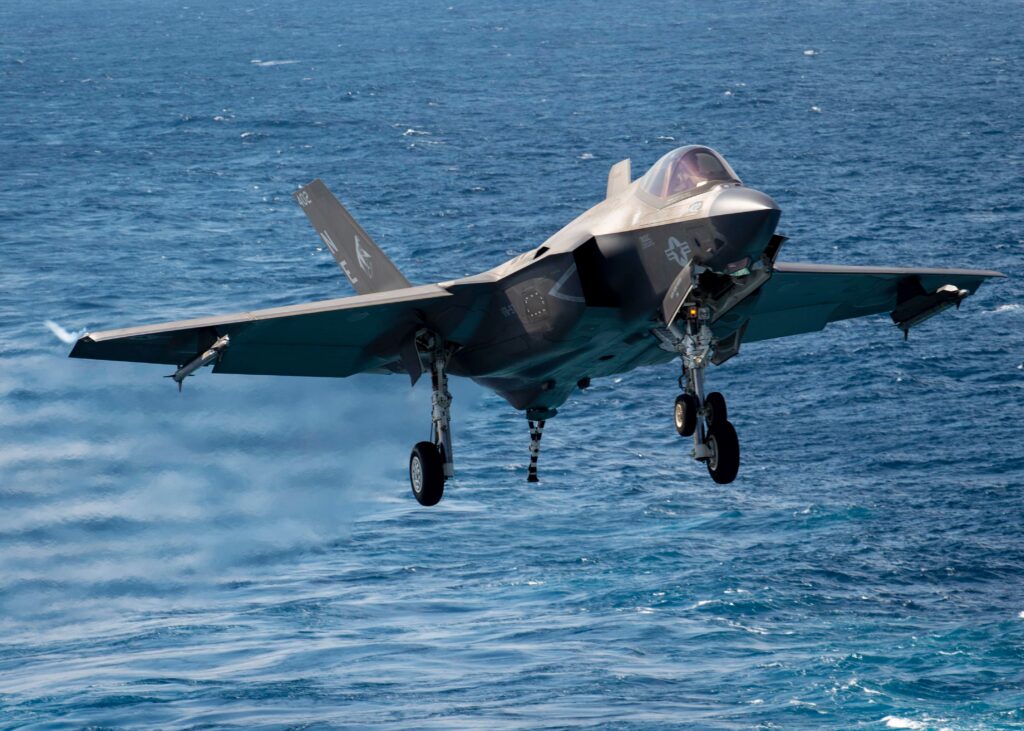
PHILIPPINE SEA (Jan. 29, 2024) An F-35C Lightning II from the “Warhawks” of Strike Fighter Squadron (VFA) 97 prepares to recover on the flight deck of Nimitz-class aircraft carrier USS Carl Vinson (CVN 70). (U.S. Navy photo by Mass Communication Specialist 2nd Class Isaiah B. Goessl)

By Richard R. Burgess, Senior Editor 

ARLINGTON, Va. — The Department of the Navy is proposing to procure 75 aircraft with $16.2 billion in the fiscal 2025 budget, but those 75 are divided among only five types. 

The 2025 budget proposed funding 13 F-35B Lightning II strike fighters for the Marine Corps; 13 F-35C carrier-based variants for the Navy and Marine Corps; 19 CH-53K King Stallion heavy-lift helicopters for the Marine Corps, 27 T-54 multi-engine training aircraft for the Navy, and three MQ-25A Stingray unmanned aerial refueling aircraft for the Navy. 

The budget is noteworthy in that the 2025 procurement funding of such types as the F/A-18E/F Super Hornet strike fighters, EA-18G Growler electronic attack aircraft, E-2D Advanced Hawkeye radar warning aircraft, MH-60R/S helicopters, MV-22B and CMV-22B Osprey transport aircraft, AH-1Z Viper and UH-1Y Venom helicopters, P-8A Poseidon maritime patrol aircraft, MQ-4C Triton and MQ-9A Reaper unmanned surveillance aircraft, and TH-73A Thrasher training helicopters — barring adjustment by the Congress — has been completed, although in some cases deliveries are ongoing. In some cases, the production lines will remain open for some time, building aircraft for foreign customers and which could resume production for the Navy and Marine Corps if needed.  

The only new types on the five-year horizon are a replacement for the T-45 Goshawk training jet and a replacement for the E-6B Mercury strategic communications aircraft, planned to be a version of the C-130J Super Hercules.  

Procurement of the KC-130J Super Hercules tanker/transport for the Marine Corps is being gapped for four years, with one planned for fiscal 2029. The fact that C-130Js are in production for other services and nations means that this gap does not have major implications for the Lockheed Martin production line. 

The 2025 Future Years Defense Plan lists planned Department of the Navy procurement for 2026 through 2029 as 58, 67, 77, and 90 aircraft, respectively. 

Noteworthy is — as of this writing — that the fiscal 2024 defense budget still is mired in the Congress. 


Navy to Christen Submarine Idaho

MARCH 15, 2024 

The Navy will christen its newest Virginia-class attack submarine, the future USS Idaho (SSN 799), during a 10 a.m. EDT ceremony March 16, at General Dynamics Electric Boat, in Groton, Connecticut.  
  
The Honorable Nickolas H. Guertin, Assistant Secretary of the Navy (ASN) for Research, Development, and Acquisition (RDA), will deliver the ceremony’s principal address. Senior representatives from the Navy, the shipbuilders, Congress, and the state of Idaho are also expected to speak. 

In a twist on the time-honored Navy tradition of breaking a bottle of sparkling wine across the bow, the Submarine’s Sponsor, Ms. Teresa Stackley, will christen the boat with water she has collected from several lakes in Idaho. Stackley is the daughter of a Navy Sailor and is the spouse of the Honorable Sean Stackley, a former Naval officer who served as ASN (RDA) from 2008 to 2017. 

The submarine, which began construction in 2017, will be the 26th Virginia-class fast attack submarine and the fifth U.S. Navy ship to be christened with the name Idaho. The last ship named Idaho was battleship BB 42, commissioned in 1919.  

Though landlocked, the state of Idaho prides itself in its rich Naval history and continuing contributions to the fleet. The Navy’s Acoustic Research Detachment on Lake Pend Oreille, Idaho’s largest and deepest body of water, is a state-of-the-art facility that supports research, development, testing, and evaluation of submarine acoustic stealth technology and propulsor design. Lake Pend Oreille is a critical body of water to the U.S. Submarine Force. 

Virginia-class submarines are built to operate in the world’s littoral and deep waters while conducting anti-submarine warfare; anti-surface ship warfare; strike warfare; special operations forces support; intelligence, surveillance and reconnaissance; irregular warfare; and mine warfare missions. This next-generation attack submarine provides the Navy with the capabilities required to maintain the nation’s undersea superiority well into the 21st century. 


March 14 Red Sea Update

RED SEA (March 05, 2024) An F/A-18E Super Hornet attached to Strike Fighter Squadron (VFA) 131 and an F/A-18E Super Hornet attached to VFA-105 prepare for launch aboard the Nimitz-class aircraft carrier USS Dwight D. Eisenhower (CVN 69) in the Red Sea, March 5, 2024. The Dwight D. Eisenhower Carrier Strike Group is deployed to the U.S. 5th Fleet area of operations to support maritime security and stability in the Middle East region. (Official U.S. Navy photo)

USCENTCOM, March 14, 2024 

 
TAMPA, Fla. – Between 6:50 a.m. on March 14 and 12:40 a.m. on March 15 (Sanaa time), Iranian-backed Houthi terrorists fired two anti-ship ballistic missiles (ASBMs) from Houthi-controlled areas of Yemen toward the Gulf of Aden and two additional ASBMs towards the Red Sea. There were no injuries or damage reported to U.S. or coalition ships. 

Additionally, United States Central Command successfully engaged and destroyed nine anti-ship missiles and two unmanned aerial vehicles in Houthi-controlled areas of Yemen. It was determined these weapons presented an imminent threat to merchant vessels and U.S. Navy ships in the region. These actions are taken to protect freedom of navigation and make international waters safer and more secure for U.S. Navy and merchant vessels.