Navy Reserve Receives Its First P-8A Poseidon Maritime Patrol Aircraft
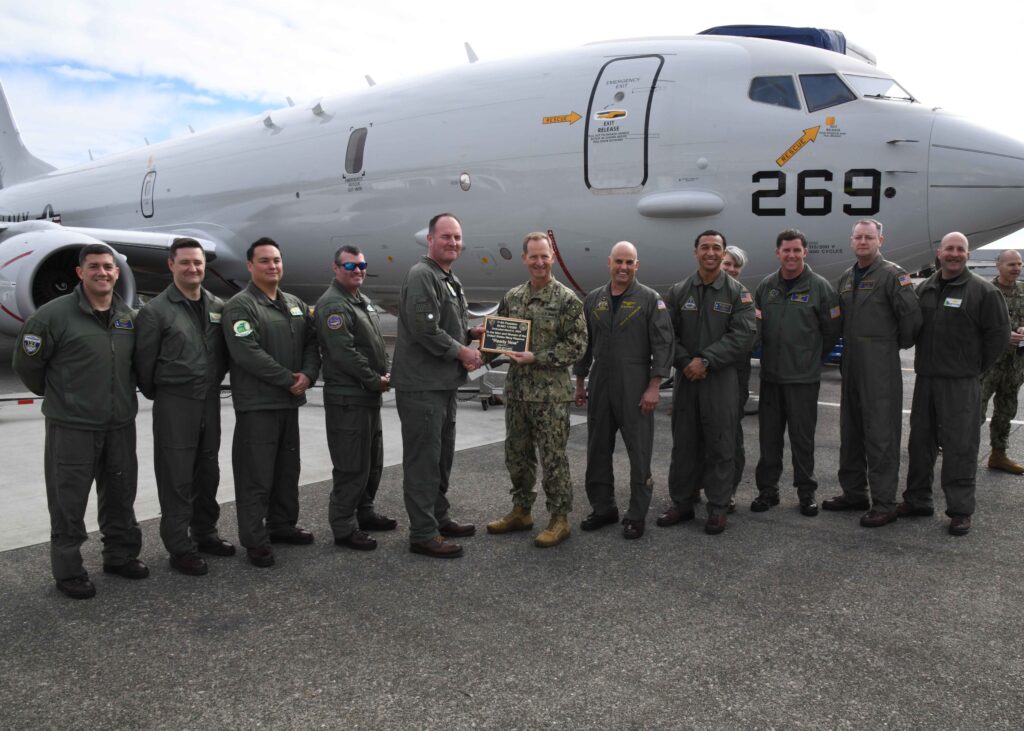
TUKWILA, Wash. (March 6, 2024) Cmdr. James Tilden (fifth from left), executive officer of Patrol Squadron 62, presents a dedication plaque to Vice Adm. John B. Mustin (sixth from left), chief of Navy Reserve and commander of Navy Reserve Force, after taking delivery of the first new P-8A Poseidon for the Naval Air Force Reserve during a ceremony at Boeing Military Delivery Facility in Tukwila, Washington, March 6, 2024. (U.S. Navy photo by Mass Communication Specialist 1st Class Harry Andrew D. Gordon)
By Richard R. Burgess, Senior Editor
ARLINGTON, Va. — The first Boeing P-8A Poseidon maritime patrol aircraft for the Navy Reserve has been delivered to Patrol Squadron 62 (VP-62).
In March 6 ceremonies at the Boeing Military Delivery Facility in Tukwila, Washington, Vice Adm. John B. Mustin, chief of Navy Reserve and commander of Navy Reserve Force, was on hand for the delivery, where a dedication was presented to him by Cmdr. James Tilden, executive officer of VP-62.
VP-62, based at Naval Air Station Jacksonville, Florida, is one of two Navy Air Reserve patrol squadrons. It formerly operated the P-3C Orion maritime patrol aircraft. The transition brings the Navy closer to full operational capability with the P-8A. The other reserve VP squadron, VP-69 at Naval Air Station Whidbey Island, Washington, also will be equipped with the P-8A.
Coast Guard offloads $4.5 million in seized cocaine, transfers custody of 2 smugglers to federal law enforcement in Mayaguez, Puerto Rico
March 8, 2024
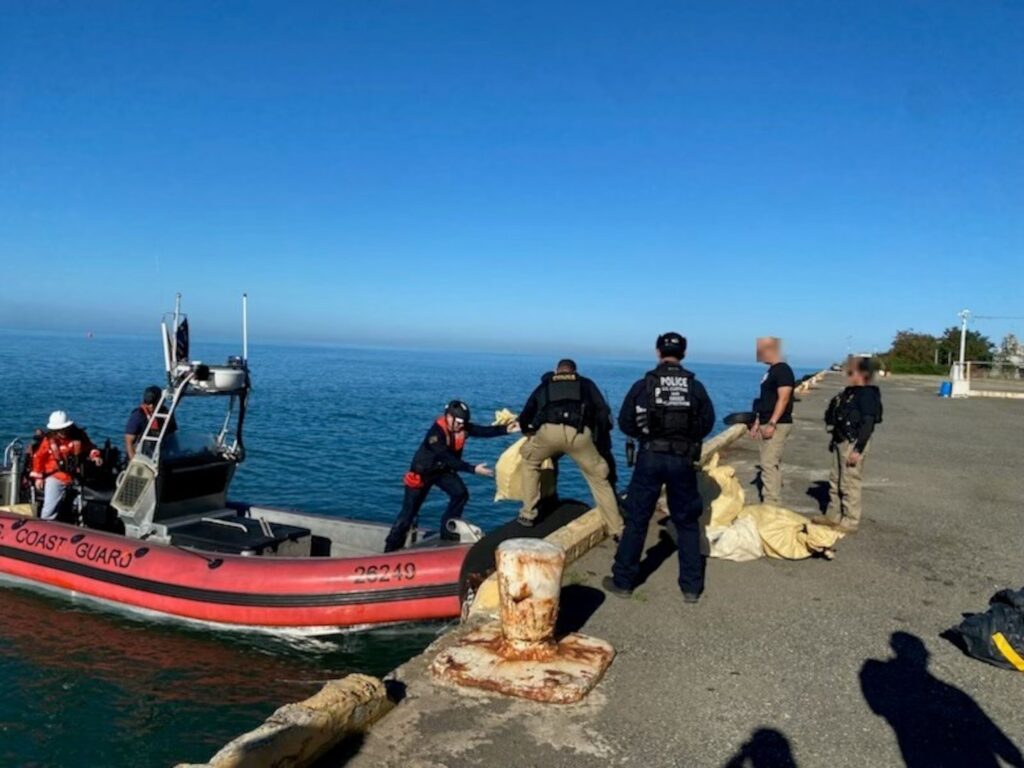
SAN JUAN, Puerto Rico — The crew of Coast Guard Cutter Joseph Napier offloaded 182 kilograms of cocaine and transferred custody of two male smugglers to federal law enforcement authorities in Mayaguez, Puerto Rico, Friday.
The British Royal Navy HMS Trent (P224), operating with a Coast Guard LEDET onboard, seized the contraband and apprehended two smugglers, Dominican Republic nationals, following the interdiction of a go-fast vessel in Caribbean Sea waters southwest coast of Cabo Rojo, Puerto Rico, March 3, 2024.
The interdiction is a result of interagency efforts in support of the Coast Guard’s Western Hemisphere Strategy and Operation Unified Resolve. The Drug Enforcement Administration is leading the investigation in this case.
“We appreciate the work and collaboration of our British Royal Navy partners in stopping drug smuggling vessels in the high seas,” said Cmdr. Gerard Wenk, Coast Guard Sector San Juan chief of response. “The work we do together daily with our federal and local and regional partners helps protect and bring stability to the Caribbean region from this threat.”
“Drug smuggling organizations pose the greatest threat to the safety and health of our citizens,” said DEA’s Caribbean Division Special Agent in Charge Denise Foster. “The dedication of all maritime surveillance assets is crucial to the success of the mission at hand, we will continue to work with our counterparts and allocate all our law enforcement resources to make a greater impact in vulnerable areas where criminal organizations dedicated to drug trafficking are causing greater damage.”
The Coast Guard’s efforts under Operation Unified Resolve contribute to the interagency results being achieved daily under Operation Caribbean Guard, which coordinates efforts between the Coast Guard, DHS, and Commonwealth and Territorial law enforcement partners, who are working diligently to deter, detect and disrupt illicit maritime trafficking to Puerto Rico and the U.S. Virgin Islands.
Detecting and interdicting illegal drug traffickers on the high seas involves significant interagency and international coordination. The Joint Interagency Task Force South in Key West, Florida conducts the detection and monitoring of aerial and maritime transit of illegal drugs. Once interdiction becomes imminent, the law enforcement phase of the operation begins, and control of the operation shifts to the U.S. Coast Guard throughout the interdiction and apprehension. Interdictions in the Caribbean Sea are performed by members of the U.S. Coast Guard under the authority and control of the Coast Guard’s Seventh District, headquartered in Miami.
Under Secretary Raven Visits United Kingdom and Norway to Discuss Regional Security, Highlights Importance of Interoperability
March 8, 2024
From Under Secretary of the Navy Public Affairs
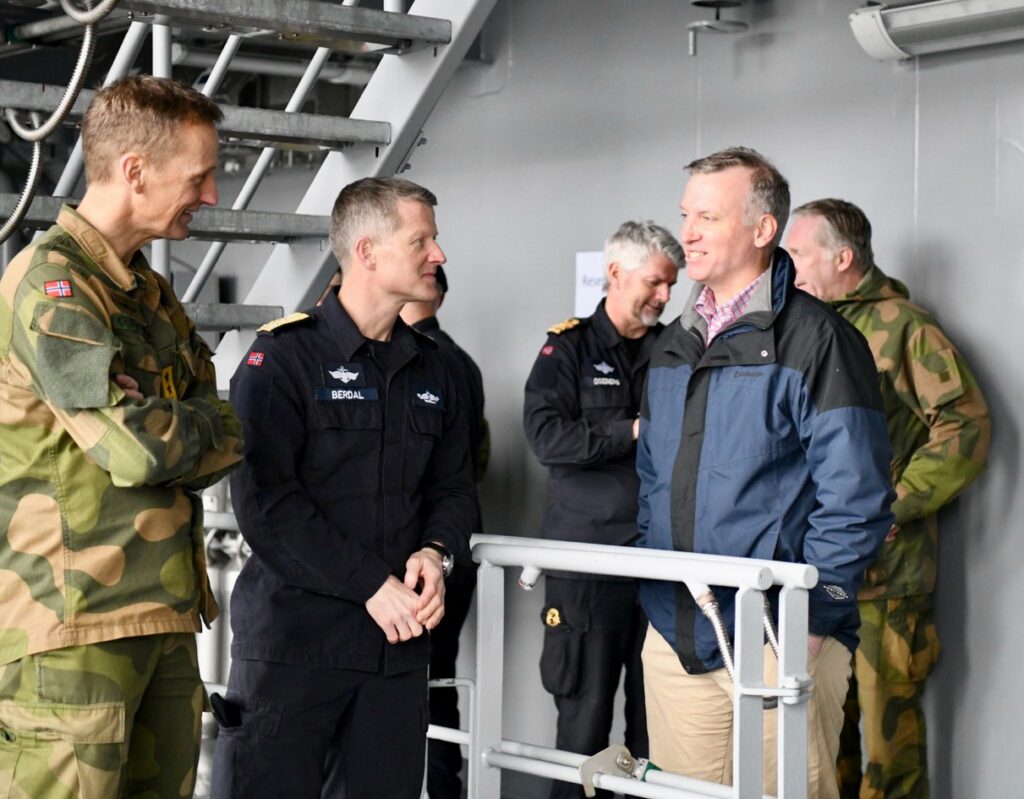
OSLO, Norway – The Under Secretary of the Navy Erik Raven visited the United Kingdom and Norway, March 3-8, to meet with partner navies, government and military leaders, Sailors and Marines, and to observe a NATO arctic exercise.
The international trip began in London, and was followed by visits to Oslo, Trondheim, Evenes, and Alta in Norway.
In London, Raven met with First Sea Lord and Chief of the Naval Staff of the United Kingdom Adm. Sir Ben Key, Minister of the Armed Forces James Heappey, and Chief Defence Nuclear Maddie McTernan where they discussed Ukraine, U.S.-UK Carrier Cooperation, and AUKUS progress.
The Under Secretary visited Barrow-In-Furness to speak with Royal Navy leaders, Sailors, and industry partners about undersea warfare, to include progress made on implementing AUKUS Pillar I. He toured shipyard facilities, a dry-dock, and the Submarines Academy for Skills and Knowledge.
“I want to thank Admiral Key and the Royal Navy for their global contributions to maritime security and stability,” said Raven. “We fly, sail, and operate on a daily basis with the United Kingdom, and together our strong partnership helps us to ensure security, stability, and prosperity.”
In Norway, Raven met with Norwegian Minister of Defense State Secretary Anne-Marie Aanerud, Chief of Defense Staff Lt. Gen. Ingrid Gjerde, Chief of Staff, Chief of Defense General Erik Kristofferson, and Norwegian Intelligence Service Vice Adm. Andreas Stensønes.
Discussions focused on military capabilities, maritime surveillance, security challenges in the Nordic region, and ways to further increase cooperation and interoperability.
“The Arctic is a region of strategic importance,” said the Under Secretary. “Working together, the Navy and Marine Corps are supporting maritime statecraft while maintaining freedom of navigation and adhering to the rules-based international order.”
“Working with our Allies and partners, we will preserve the Arctic as a space free of conflict, where nations act responsibly, and where economic and energy resources are developed in a sustainable, transparent manner.”
Raven toured the Marine Corp Prepositioning Program-Norway in the Frigaard Cave in Trondheim, Norway. At Evenes, he observed a combat craft demonstration in the Norwegian fjords and met with U.S. Navy Seabees providing maritime support.
The trip concluded with the observation of the NATO-led arctic exercise Northern Response 24, in Alta. Nordic Response 24 is hosted by Norway and supported by Commander, U.S. Naval Forces Europe and U.S. Marine Corps Forces Europe, along with contributions from all U.S. military services. This is one of a long list of impactful engagements underscoring the longstanding alliance between Norway and the United States. With diplomatic relations forged nearly 120 years ago in 1905, the two nations and their militaries remain strategically and operationally synchronized.
“The rules-based international order depends on free and open oceans, and the militaries and service members of the European nations participating in this exercise have an instrumental role in upholding that standard,” said Raven. “Realistic exercises like Northern Response 24 allow us to work with like-minded nations to strengthen our partnerships and ensure we are trained, ready, and interoperable for crises or conflict.”
More than 20,000 service members from 14 nations are participating in Nordic Response 24. Participating nations include: Belgium, Canada, Denmark, Finland, France, Germany, Italy, Netherlands, North Macedonia, Norway, Poland, Sweden, United Kingdom, and the United States.
The trip marked Raven’s second to the United Kingdom and his first to Norway.
NAVAIR returns V-22 Osprey to flight status
Mar 8, 2024
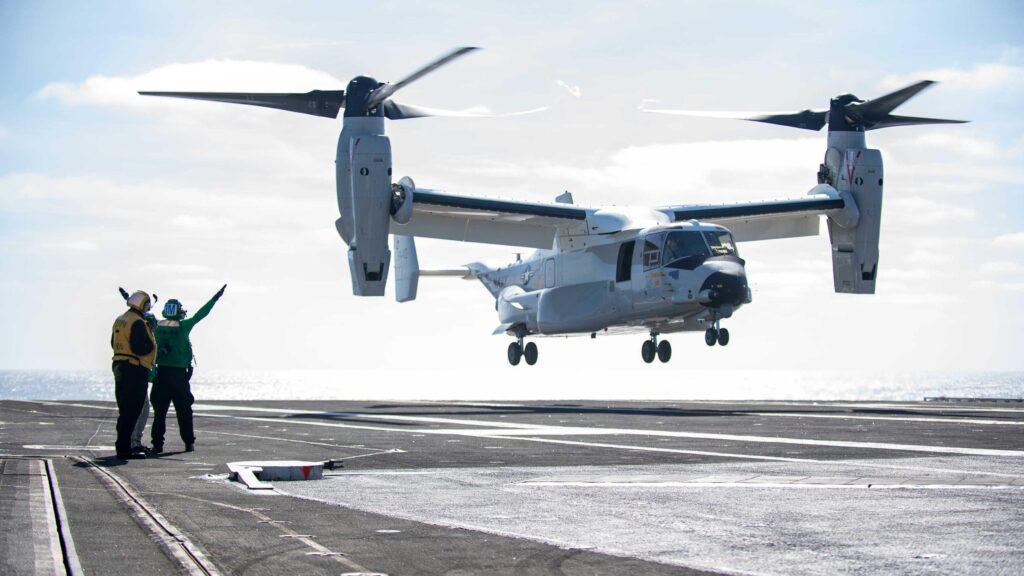
Naval Air System, PAX River — Effective March 8, 2024 at 7 a.m. EST, Naval Air Systems Command is issuing a flight clearance for the V-22 Osprey thereby lifting the grounding. This decision follows a meticulous and data-driven approach prioritizing the safety of our aircrews.
A U.S. Air Force investigation began following the tragic loss of eight Airmen during the November 29, 2023, mishap off Yakushima, Japan. Our thoughts and prayers are with the families of the fallen.
In response to the preliminary investigation indicating a materiel failure of a V-22 component, the V-22 grounding was initiated on December 6, 2023. The grounding provided time for a thorough review of the mishap and formulation of risk mitigation controls to assist with safely returning the V-22 to flight operations.
In concert with the ongoing investigation, NAVAIR has diligently worked with the USAF-led investigation to identify the materiel failure that led to the mishap. Close coordination among key senior leaders across the U.S. Navy, U.S. Marine Corps, and U.S. Air Force has been paramount in formulating the comprehensive review and return to flight plan, and this collaboration will continue.
Maintenance and procedural changes have been implemented to address the materiel failure that allow for a safe return to flight. The U.S. Navy, U.S. Marine Corps, and U.S. Air Force will each execute their return to flight plans according to service specific guidelines.
NAVAIR remains committed to transparency and safety regarding all V-22 operations. The V-22 plays an integral role in supporting our Nation’s defense and returning these vital assets to flight is critical to supporting our nation’s interests. NAVAIR continuously monitors data and trends from all aircraft platforms, so service members are provided the safest, most reliable aircraft possible.
The safety of our pilots, aircrew and surrounding communities remains of paramount importance.
Amphib Warship Part Suppliers Press Congress for Stability in Shipbuilding
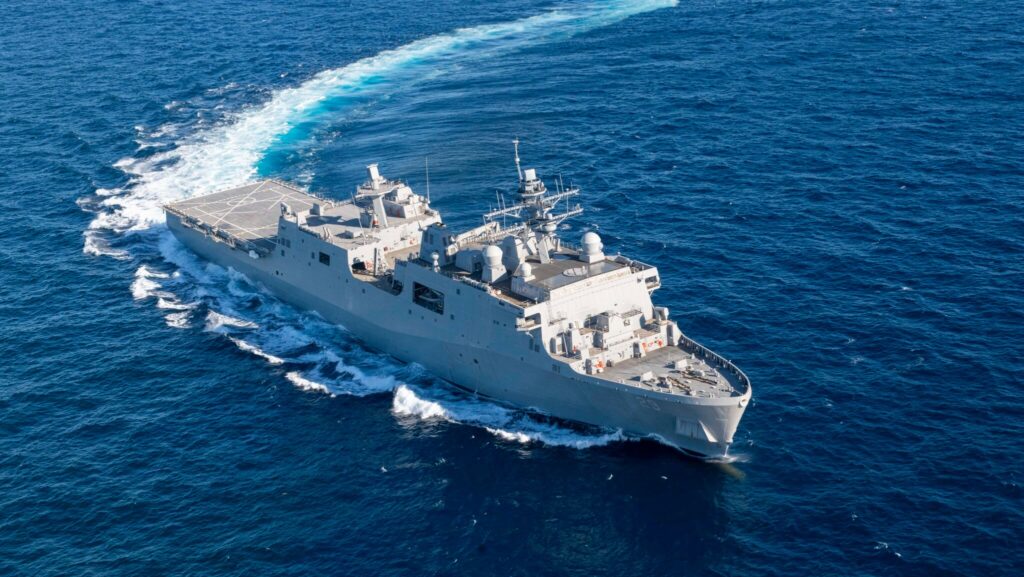
The future USS Richard M. McCool Jr. (LPD 29), the Navy’s next Flight I San Antonio-class amphibious transport dock ship, seen on sea trials. (HII)
By Richard R. Burgess, Senior Editor
ARLINGTON, Va. — The U.S. companies that supply components and parts for the U.S. Navy’s amphibious warfare fleet expressed support for the Marine Corps baseline requirement of 31 large and medium amphibious warfare ships in the U.S. fleet and the industry’s need for stability and predictability in schedules.
Retired Coast Guard Capt. Paul J. Roden, chairman of the board of the Amphibious Warfare Industrial Base Coalition (AWIBC), which represents approximately 650 companies throughout the United States, told Seapower that the Marine Corps has stressed that “ready and available” 31-ship requirement is “not a ceiling, it’s the floor.”
Roden stressed the point that it is difficult for suppliers to produce efficiently when production schedules are unpredictable. He said that the stability needed is best achieved when the large-deck amphibious assault ships (LHAs) are built with construction intervals of four-year centers and the amphibious platform dock ships (LPDs) are built with intervals of two-year centers.
Full funding by Congress for LPD 33 in the fiscal 2025 defense budget is a priority for the AWIBC, he said.
AWIBC recently conducted a survey of its member companies.
Regarding the shipbuilding intervals, “50% of the survey respondents replied that extending those would result in an increase in cost of their products and services. When you are throwing uncertainty to any procurement, then there is risk, and risk is addressed by cost, so it is really in the Navy’s best interest to maintain those centers.”
Roden said that if an LHA or LPD were delayed by a year or more, “40% of all of our members [companies] would anticipate needing to lay off workers due to uncertainty and not having full capacity in plants of the AWIBC suppliers. About a third said they would have to explore commercial contracts as well as de-prioritize shipbuilding, but in many cases, there is just not a commercial market.”
He said that “about 70% of our respondents said that the most helpful thing that the government could do is provide predictability and stability.
“One way of going about that — that has been proven successful in other programs—is through multi-ship and multi-year procurement strategies,” he said.
Roden also said that “just over 50% of the suppliers that contribute to both amphibious warship and submarine programs … said that steady amphib contracts benefit their company’s capacity and capability to deliver on submarine programs. Having predictability and stability in shipbuilding programs allows suppliers to make investments. If they know the business is coming, they can make investments in work force training, enhancing work force, investing in equipment, investing in other infrastructure that would improve the quality and on-time delivery of products.”
Houthis Kill Innocent Civilians with Missile Attack
USCENTCOM
March 6, 2024
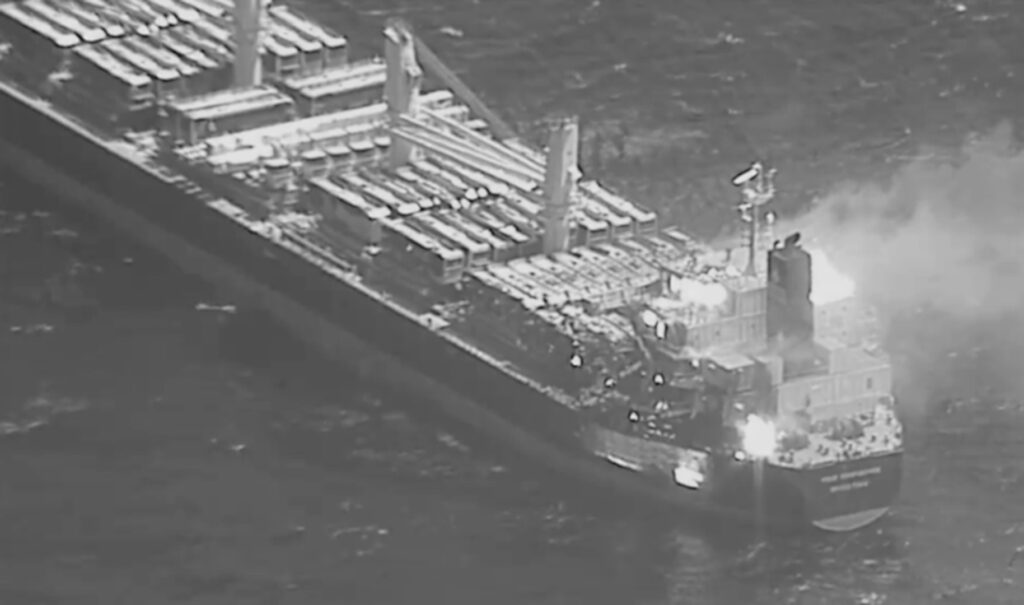
TAMPA, Fla. – At approximately 11:30 a.m. (Sanaa time) March 6, an anti-ship ballistic missile (ASBM) was launched from Iranian-backed Houthi terrorist-controlled areas of Yemen toward M/V True Confidence, a Barbados-flagged, Liberian-owned bulk carrier, while transiting the Gulf of Aden. The missile struck the vessel, and the multinational crew reports three fatalities, at least four injuries, of which three are in critical condition, and significant damage to the ship.
The crew abandoned the ship and coalition warships responded and are assessing the situation.
This is the fifth ASBM fired by Houthis in the last two days. Two of these ASBMs impacted two shipping vessels – M/V MSC Sky II and M/V True Confidence – and one ASBM was shot down by USS Carney (DDG 64).
These reckless attacks by the Houthis have disrupted global trade and taken the lives of international seafarers.
March 6 Red Sea Update
TAMPA, Fla. –At approximately 7:14 p.m. (Sanaa Time) March 6, United States Central Command conducted self-defense strikes against two unmanned aerial vehicles in a Houthi controlled area of Yemen that presented an imminent threat to merchant vessels and U.S. Navy ships in the region.
These actions are taken to protect freedom of navigation and make international waters safer and more secure for U.S. Navy and merchant vessels.
VCNO Visits Newport News; Discusses Maintenance, Quality of Service
07 March 2024
WASHINGTON – Vice Chief of Naval Operations Adm. Jim Kilby visited HII’s Newport News Shipbuilding, in Virginia, to discuss submarine and aircraft carrier maintenance and Quality of Service in the shipyard, March 5.
Kilby began his visit receiving updates from the shipyard’s leadership on the shipyard’s major programs, infrastructure investments and workforce developments.
NNS is the sole designer, builder and refueler of the Navy’s aircraft carriers and one of two builders of nuclear-powered submarines.
“This is where the current and future of our Navy’s air and undersea dominance starts,” said Kilby. “It’s an immense undertaking to build these nuclear-powered platforms, and we must continue to work closely together and continually improve processes and deliver these carriers and submarines time and on budget.”
The shipyard is building the Navy’s newest Ford-class aircraft carriers. The future USS John F. Kennedy (CVN 79) began its topside testing of the electromagnetic aircraft launch system last month. EMALS, first integrated into USS Gerald R. Ford (CVN 78), replaces the existing steam catapults currently in use on the Nimitz-class aircraft carriers.
Kilby also toured manufacturing facilities where NNS is building modules for the new Columbia-class submarines. The Columbia-class will replace the Ohio-class as the Navy’s contribution to the nuclear triad, which remains the most survivable leg of the U.S. strategic nuclear deterrent force.
“The partnership we have with this shipyard and its suppliers is critically important to our Navy, our nation and our national defense,” said Kilby. “The future of our nation’s sea-based deterrent starts here.”
During the visit, Kilby focused on the Sailors’ Quality of Service during the maintenance periods on the shipyard, with stops at Sailor housing, dining and medical facilities, and spoke with leadership from USS John C. Stennis (CVN 74), currently undergoing a refueling and complex overhaul.
Kilby also met with carrier and submarine leadership from other crews in the shipyard
“Every Sailor has volunteered to be in the Navy and we need to make sure we’re supporting their quality of life and work,” said Kilby. “This means access to quality food, housing, medical care and a command they can trust to take care of them.”
The Navy has taken a critical eye on Sailors’ Quality of Service, especially while in a maintenance period. Commander, Navy Installations Command, Vice Adm. Scott Gray joined Kilby on the trip. Gray leads the Navy’s Quality of Service Cross Functional Team.
“I am incredibly thankful for the commitment NNS and the city of Newport News has made to improve our Sailors’ Quality of Service,” said Gray. “The Navy recognizes we need to do better and we can’t do this without the support from industry, our Navy communities and Congress.”
Specific focus on NNS includes off-site housing options for Sailors undergoing maintenance, improved access to medical care, expanded access to healthy food options and improving WiFi connectivity. This includes free, high speed WiFi aboard Stennis’ berthing barge.
The Navy launched a WiFi pilot program in January at 12 permanent party unaccompanied housing located onboard Naval Station Norfolk, Naval Medical Center Portsmouth, and Norfolk Naval Shipyard.
The Wi-Fi pilot is part of a new and larger program called the Virtual Single Sailor Program, which directly supports the Quality of Service of Sailors.
Kraken Robotics Signs Cooperative Research & Development Agreement with US Navy for next Generation Synthetic Aperture Sonar Beamforming
ST. JOHN’S, NEWFOUNDLAND, 04 March 2024 /GLOBE NEWSWIRE/ — Kraken Robotics Inc. announces that its wholly owned subsidiary, Kraken Robotic Systems Inc., has signed a Cooperative Research and Development Agreement (CRADA) with Naval Undersea Warfare Center Division, Newport (NUWCDIVNPT). The objective of this CRADA is to conduct joint research into advanced signal processing techniques for the current and future generation of Synthetic Aperture Sonar (SAS) sensor technologies. This also includes exploration into enhanced image processing techniques such as data fusion, image registration, multi-spectral image enhancement and automated target recognition.
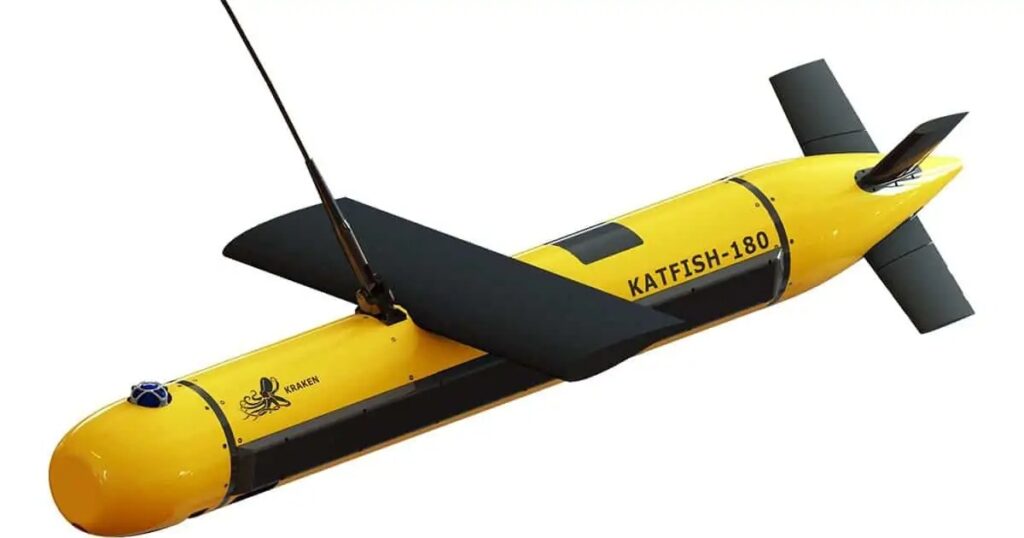
Kraken Robotics has engaged in several CRADA’s with US government agencies since 2012, including NUWC Division Newport, NOAA’s Office of Ocean Exploration and Research (OER) as well as the Battery Certification and Integration Branch, Code 636 of NSWC Carderock. These CRADA’s have provided invaluable testing and evaluation for Kraken’s portfolio of underwater technology solutions, including Kraken’s Synthetic Aperture sonar, KATFISH Actively Controlled Towed sonar, and Pressure Tolerant Subsea Batteries.
These CRADAs have showcased a strong track record of proven technology solutions and collaboration between Kraken’s world-leading technical team and the US Navy’s Centers of Excellence. They have allowed Kraken to test technology solutions with subject matter experts from the US Navy, providing invaluable feedback on performance and capabilities. Kraken can then point to the publicly-releasable results of our collaborative testing under the CRADA as objective evidence when bidding on opportunities domestically or internationally with other Five Eyes or NATO countries.
Greg Reid, Kraken President and CEO said “We are pleased to enter another CRADA with NUWC Division Newport. Since that first CRADA in 2012, Kraken has gone on to deliver our technology solutions to NATO allies across the globe, and the results from each CRADA have been a valuable ground truth for our customers worldwide.”
David Shea, Kraken CTO said “Innovation is a core tenant of Kraken. Entering into this new Cooperative agreement with NUWC will ensure our science and technology is being evaluated by the best and brightest inside the US Navy, and this allows us to deepen our collaboration on the next generation of seabed intelligence solutions. With several of our sensors now in active use within the US Navy, we are excited to deepen our focus into data enhanced processing techniques that will benefit both new and existing sensors, leveraging the latest developments in machine learning.”
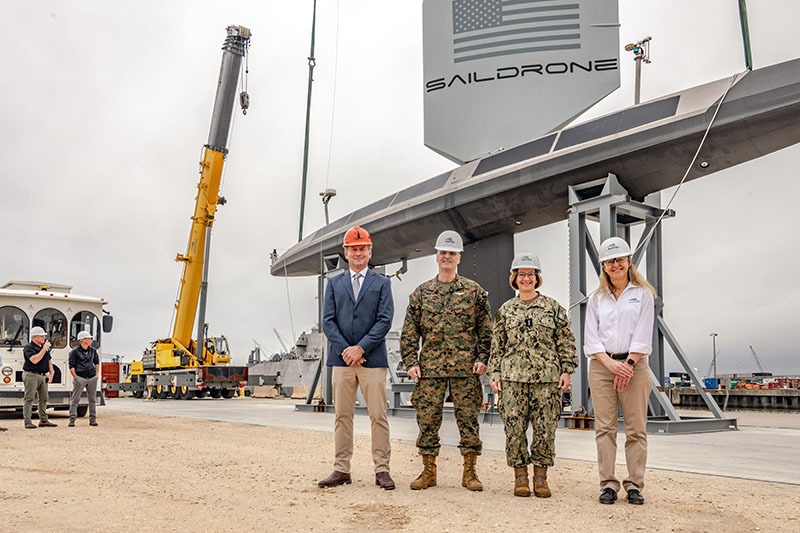
Saildrone Launches First Production Surveyor off the Manufacturing Line at Austal USA
MOBILE, Ala., March 6, 2024 — Today, Saildrone announced it has launched the first aluminum Surveyor unmanned surface vehicle (USV) off the Austal USA production line in Mobile, Ala. Chief of Naval Operations (CNO) Admiral Lisa Franchetti was on site Monday to inspect the vehicle, ahead of these new USVs being tested under contract to the US Navy.
Primarily designed for ocean mapping and maritime domain awareness, the Saildrone Surveyor USV is powered by wind, solar, and a diesel generator for long-range, long-endurance missions in the open ocean.
The Surveyor carries the latest multibeam sonar equipment for seafloor mapping to depths of 11,000 meters (36,000 feet) and purpose-built defense and security payloads for accurate, dynamic, and confident decisions and responses to the full spectrum of maritime threats and challenges. Upcoming Navy missions will focus on the ability of the Surveyor to deliver both surface and undersea intelligence for a range of high-priority applications, including anti-submarine warfare (ASW).
To meet the increasing demand for Surveyor USVs, Saildrone partnered with Austal USA to leverage their advanced manufacturing production techniques and rapid assembly capabilities. Austal is currently producing one Surveyor every six weeks, with the ability to scale up production as demand requires.
“It is tremendous to see the first vehicle launched of many that will be produced here in Alabama,” said Saildrone founder and CEO Richard Jenkins. “We are honored to have Admiral Franchetti here in person to witness the start of the creation of a new fleet of USVs alongside traditional manned ships. Everyone at Saildrone is very proud to be supporting the US Navy and contributing to our defense and national security.”
At 20 meters long (65 feet) and weighing 15 tons, the Surveyor classifies as a medium USV, built to American Bureau of Shipping (ABS) Light Warship code. These first Surveyors are contracted to the US Navy for the initial testing and evaluation of Surveyor-class vehicles in multiple environments.
“Using unmanned assets helps put more players on the field by freeing up manned assets for more specific and important tasks,” said Franchetti. “It’s good to see high tech industry partnering with the traditional shipbuilding industrial base to rapidly deliver cutting-edge products at scale.”
Franchetti was joined on the tour by Assistant Commandant of the Marine Corps (ACMC) Gen. Christopher J. Mahoney, Sen. Roger Wicker (R-Miss.S), ranking member of the Senate Armed Services Committee, and Rep. Jerry Carl (R-Ala.).
March 4 and 5 Red Sea Update
USCENTCOM
March 5, 2024 TAMPA, Fla. – On March 5, between the hours of 3 p.m. and 5 p.m. (Sanaa time), U.S. Central Command (CENTCOM) forces shot down one anti-ship ballistic missile and three one-way attack unmanned aerial systems launched from Iranian-backed Houthi controlled areas of Yemen toward USS Carney (DDG 64) in the Red Sea. There are no injuries or damage to the ship.
Later between 8:45 p.m. and 9:40 p.m., CENTCOM forces destroyed three anti-ship missiles and three unmanned surface vessels(USV) in self-defense.
The missiles and USVs were located in Houthi-controlled areas of Yemen.
CENTCOM forces identified the missiles, UAVs, and USVs and determined that they presented an imminent threat to merchant vessels and to the U.S. Navy ships in the region. These actions are taken to protect freedom of navigation and make international waters safer and more secure for U.S. Navy and merchant vessels.
March 4, 2024 TAMPA, Fla. – On March 4, at approximately 2:15a.m. (Sanaa time), Iranian-backed Houthi terrorists fired an anti-ship ballistic missile from Yemen into the southern Red Sea. The missile impacted the water with no reported damage or injuries to commercial or U.S. Navy ships.
Between the hours of 3:50p.m. and 4:15p.m. (Sanaa time), Iranian-backed Houthi terrorists fired two anti-ship ballistic missiles from Yemen into the Gulf of Aden at M/V MSC SKY II, a Liberian-flagged, Swiss-owned container vessel. One of the missiles impacted the vessel causing damage. Initial reports indicate there were no injuries; the ship did not request assistance and continued on its way.
At 8 p.m. (Sanaa time), CENTCOM forces conducted self-defense strikes against two anti-ship cruise missiles that presented an imminent threat to merchant vessels and U.S. Navy ships in the region. These actions are taken to protect freedom of navigation and make international waters safer and more secure for merchant and U.S. Navy vessels.