Raytheon Doubled ESSM Production in 2025
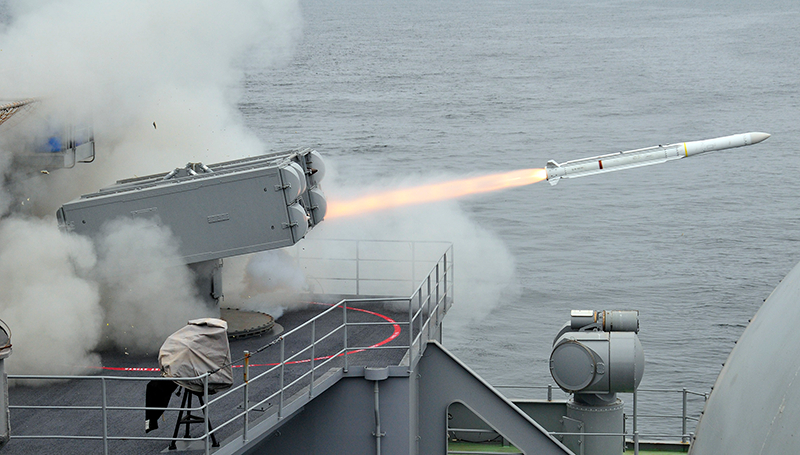
An Evolved SeaSparrow Missile is launched from a Mk 29 launcher aboard USS Carl Vinson (CVN 70) in 2010. (CREDIT: U.S. Navy | Mass Communication Specialist 3rd Class Patrick Green)

By Richard R. Burgess, Senior Editor 

Raytheon Missiles & Defense (Booth 911) doubled production of the Block II RIM-162 Evolved SeaSparrow Missile (ESSM) in 2025 as it addressed the increased demand from the U.S. Navy and its partners in the NATO consortium, a company official told Seapower

“Last year, we produced over 350 ESSM missiles, which more than doubled what we were able to deliver in 2024,” said Misty Holmes, vice president for the Shipboard Organization within the Naval Power division. Her portfolio includes the ESSM, the Rolling Airframe Missile and the Standard family of surface-to-air missiles. She noted Raytheon delivered the 500th Block II version of the ESSM last September. 

“We’re continuing to increase production this year to deliver over 400 all-up rounds, and we have a North Star in terms of our production capacity to go beyond 700 per year to meet that increased demand signal and service the needs of all of our customers’ navies,” Holmes said. 

The ESSM, which became operational in 2004, is a short-to-medium shipboard surface -to-air missile deployed on several classes on U.S. Navy ships, including many guided-missile destroyers, aircraft carriers and amphibious assault ships. The missile is designed to counter advanced, highly maneuverable threats, and features a warhead specifically designed to defeat hardened anti-ship cruise missiles. In 2007, a surface-to-surface/anti-low-velocity air threat capability was introduced on the missile. The missile was developed by a consortium of 12 NATO nations and has been acquired by Japan through direct commercial sales. 

“I believe that gives ESSM a unique and a distinct advantage in today’s munitions programs over those that are solely developed and managed by one nation,” Holmes said. “The consortium is NATO’s largest and most successful cooperative weapons project, and it’s been together for over 15 years supporting international military industrial cooperation. 

The Block II ESSM, which became operational in 2020, features an active guidance system in addition to semi-active guidance, reducing the need for shipboard radar illumination.  

“This particular capability does come with significant digital processing margin,” Holmes said, “[A]s we are focused on innovation, [we] can continue to upgrade this capability to keep it ahead of pace with the threat to ensure that we’re keeping our ships and our Sailors, both U.S. and international allies, safe and coming home.” 

Recent conflicts in Ukraine and the Red Sea have spurred demand for such weapons as the ESSM, which was fired against Houthi missiles and drones during 2023 and 2024. 

“I do see this as a multi-factor issue, Holmes said. “We are seeing increase in the defense budget across numerous of our customers largely in Europe as well as others due to the threats, the war in Ukraine, the realization of expenditures in the Red Sea and others. So, we are seeing that increased demand signal come in pretty globally.” 

Holmes said Raytheon is focused on the increased demand signal.  

“This production really does showcase exceptional program performance that has been heavily supported by a very robust supply chain that’s been meeting and exceeding targets, and that supply chain is extremely diverse and global, she said. “Our suppliers, in ESSM’s case, are not just suppliers, there are partners, international industrial-based partners. Two areas that have been really big on this production are our industrial partners delivering on their contracts to make all those components ready for integration, and then the dedicated action by the Raytheon factory teams to improve throughput and remain focused on the goal that we have to meet and exceed our production targets. We’ve been working on test efficiencies, optimization and throughput to ensure we can continue to improve on our delivery.” 

Is Raytheon working on a Block III ESSM? Holmes would only say, “We are working on enhanced kinematics and maneuverability, things that will keep this weapon system ahead of the threat for the next few decades. But we’re eager to participate with the U.S. in the consortium in their next significant variant. 

“We don’t sit back and rest on our laurels that what we’ve delivered is good enough,” she said. “We’re constantly adding capability to the suite of capabilities to make sure [that we are] staying ahead of the threat and those are investments we’re making in future ESSM capabilities as well in terms of funding new research and development ahead from government requirements.” 


HII Moves Further into Physical AI for Shipbuilding

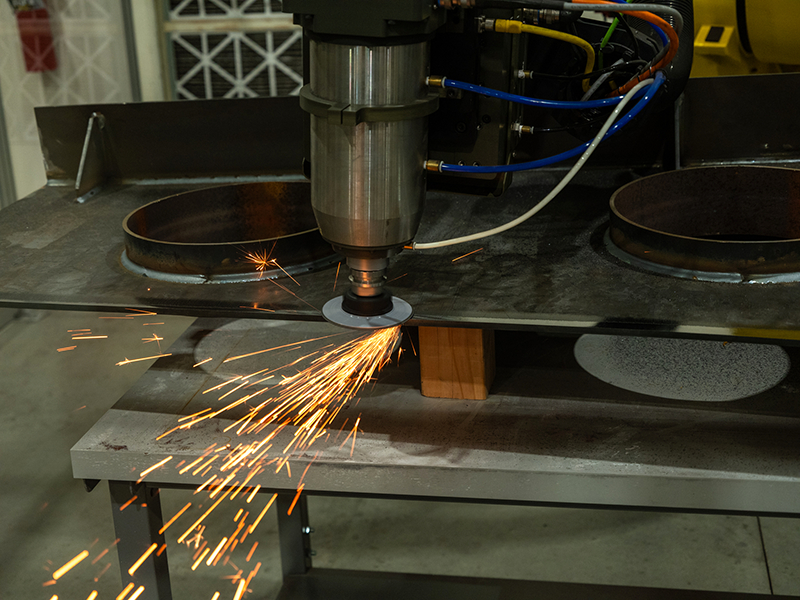
 A GrayMatter Robotics technology performs autonomous grinding to an HII foundation project that used internal research and development funds.

By Brett Davis 

Shipbuilding giant HII (Booth 923) has added another artificial intelligence partner to its shipbuilding program, taking another step toward adding “physical AI” to the process of constructing Navy ships. 

In early April, the company announced it signed a memorandum of understanding with Carson, California-based GrayMatter Robotics to explore integrating GMR’s physical AI into shipbuilding operations, including for surface preparation, coating and inspection. 

The companies will identify and potentially pursue future opportunities in four areas that include autonomous shipbuilding capability development; integration of GMR technologies with other shipbuilding technology initiatives; workforce training to extend automation; and acceleration and scaling of unmanned system production.  

“Our shipbuilding throughput was up 14% in 2025 and we are looking for an additional 15% increase in 2026,” said Eric Chewning, HII’s executive vice president of maritime systems and corporate strategy. “By working with new partners like GMR we can further augment our workforce and speed up U.S. Navy shipbuilding production.” 

This follows on to a similar announcement from February, when HII signed an MOU with Ohio-based Path Robotics to incorporate physical AI for welding.  

HII said much of the work that would be pursued by these companies currently is “hands-on and highly skilled,” but AI-driven technologies “offer promising opportunities to support these critical processes by reducing repetitive work and improving consistency to help accelerate delivery timelines and meet the U.S. Navy’s growing demand.” 

Chewning said the introduction of physical AI is just one step of a series of actions HII is taking to improve shipbuilding, from increasing its supplier base to hiring and retaining new workers to making capital investments. 

“And finally, what brings us here today, we are investing in new industry 4.0 technologies like digital engineering, additive manufacturing, enterprise AI and physical AI to drive overall shipyard efficiency,” he told reporters in a call about the announcement. “By working with new physical AI partners like GrayMatter Robotics and integrating them into our high-yield production robotics initiative, or HYPR, we can further augment the AI workforce and speed up the shipbuilding process by bringing automation into more areas of production.” 

So far, shipyard automation remains limited to repeatable activities, where one robot might do a single task 100,000 times, but “there’s a broader set of industrial use cases where we need a single robot to do a hundred thousand tasks just once,” Chewning said. “And that’s where physical AI is a game changer and our partnership with GrayMatter Robotics is so important.” 

Ariyan Kabir, GrayMatter Robotics’ CEO and cofounder, said his company’s technology will help HII do the work it needs at a time when there aren’t enough skilled workers to do it. 

“These are physically brutal tasks,” he told reporters on the press call. “These require incredible precision and we don’t have enough people, skilled people anymore in the U.S. to do these jobs, who are capable of doing these jobs. And that is the problem we solve at GrayMatter Robotics. We build physical AI systems that learn how to perform these skilled manufacturing tasks autonomously — no pre-programmed robots — robots that understand complex material physics and environmental physics, the physics of force friction, contact tool wearing out, temperature and humidity affecting the material behavior, so on and so forth.” 

HII will discuss its physical AI efforts at 1:30 p.m. today at its booth, along with the CEOs of its new physical AI partners. 


Navy Awards Marinette Marine $30 million Contract toward Medium Landing Ships 

Navy Awards Marinette Marine $30 million Contract toward Medium Landing Ships 

By Richard R. Burgess, Senior Editor 

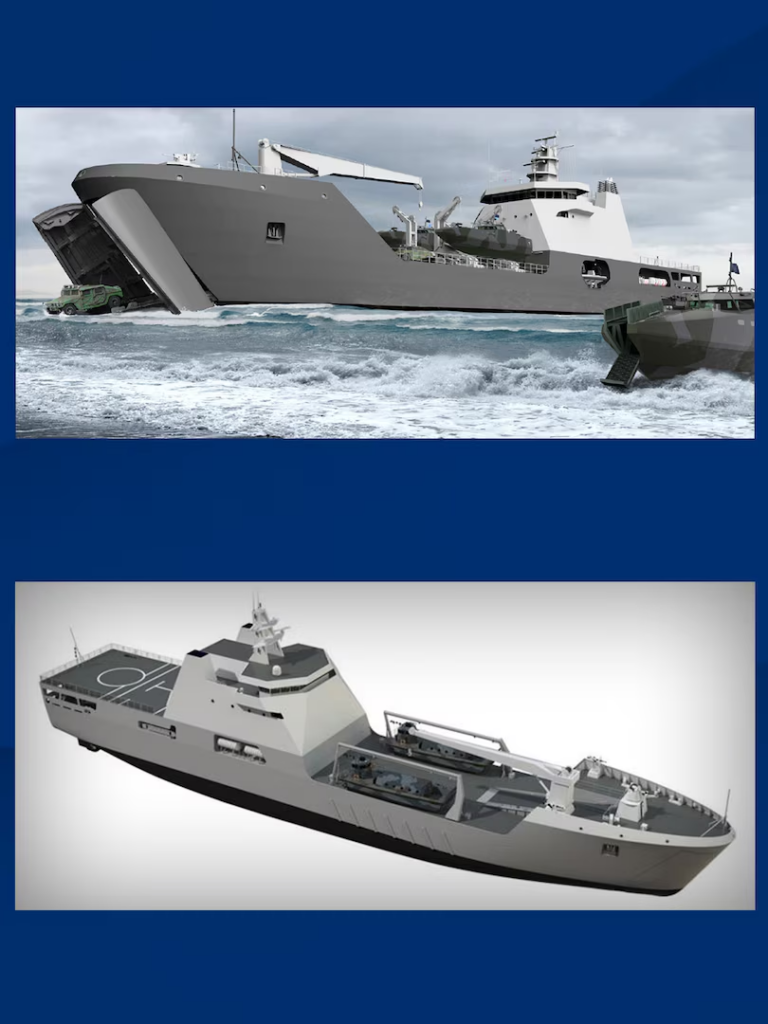
ARLINGTON, Va. — The U.S. Navy has awarded a contract to a shipbuilder for materials and engineering activities for the first four Block 1 medium landing ships (LSMs). 

“Marinette Marine Corp., Marinette, Wisconsin, is awarded a $30,000,000 not-to-exceed undefinitized contract action for advance procurement of long lead time material and associated engineering and design activities in support of four Medium Landing Ship Block 1,” the Department of War said in an April 14 contract announcement. 

Marinette Marine Corp. is a unit of Fincantieri Marine Group FMG), which also is building two Constellation-class guided-missile frigates for the U.S. Navy. The Naval Sea Systems Command obligated $15 million of fiscal 2025 funda at the time of the contract award. 

The Navy plans to procure 35 LSMs to support the Marine Corps’ expeditionary advance base operations. 

“Enhancing our maritime dominance depends on a modernized fleet and a strong industrial base, and today’s contract helps with both — it reduces schedule risk and enables our shipbuilders to rapidly transition to ship construction,” said Secretary of the Navy John C. Phelan in a post on X that also announced the contract award.  

“Work will be performed in Marinette, Wisconsin (46%); De Pere, Wisconsin (39%); and Kenner, Louisiana (15%),” the Department of War’s announcement said. “Work is expected to be completed by September 2027.” 

In December 2025, the Navy and Marine Corps jointly announced Damen Naval’s LST 100 landing ship would serve as the baseline to field a “proven, non-developmental design – would serve as the baseline to help rapidly field LSM capability,” according to the Naval Sea Systems Command. “The LSM will fill the capability gap between smaller, short-range landing craft and the Navy’s long-duration, multi-purpose amphibious warfare ships. It is essential for the maneuver and sustainment of Marine forces, providing the critical littoral mobility required in contested environments. The program will deliver a 35-ship fleet that enhances expeditionary agility and supports the Marine Corps’ concept of distributed maneuver and logistics.”   

Key points made in Fincantieri’s follow-up email announcement included the following:  

  • The contract supports long‑lead materials procurement and early engineering and production readiness activities, enabling a potential start of construction as early as Q4 2026.  

  • The LSM program is a foundational element of U.S. Navy and Marine Corps force design, with up to 35 vessels planned; FMG is designated to build at least the initial four.  

  • The award builds on more than $800 million in U.S. shipyard investments by Fincantieri over the past decade, supporting long‑term naval and industrial capacity.  


Navy Announces Commissioning Date, Location for the Future USS Cleveland  

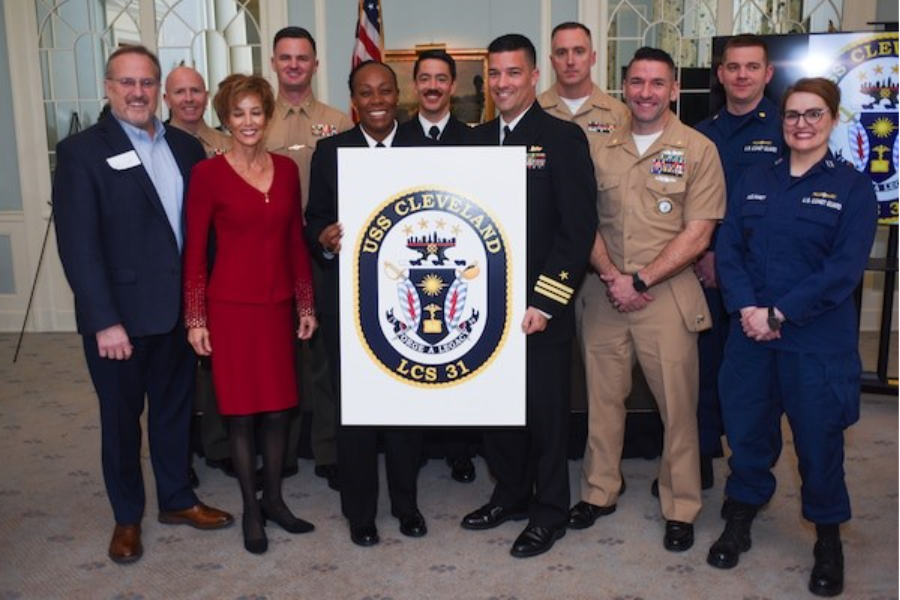
Cmdr. Bruce Hallett, commanding officer of the Freedom-class Littoral Combat Ship USS Cleveland (LCS-31) and Command Master Chief Carla Bellamy take a group photo with the Cleveland Legacy Foundation and active duty service members after revealing the ships crest with Friday, April 5, 2024.

From U.S. Fleet Forces Command, 14 April 2026 

The U.S. Navy will commission the future Freedom-variant Littoral Combat Ship USS Cleveland (LCS 31) on May 16, 2026, in Cleveland, Ohio. 

Cmdr. Bruce Hallett, commanding officer of the Freedom-class Littoral Combat Ship USS Cleveland (LCS-31) and Command Master Chief Carla Bellamy take a group photo with the Cleveland Legacy Foundation and active-duty service members after revealing the ships crest with Friday, April 5, 2024. 

The commissioning marks the completion of the final Freedom-variant Littoral Combat Ship construction phase, a sustained acquisition effort between the Navy and industry partners for two decades. 

The sponsor of LCS 31 is Robyn Modly, the wife of former Acting Secretary of the Navy Thomas Modly. In keeping with Navy tradition, Modly will give the order during the ceremony to “man our ship and bring her to life!” At that moment, the commissioning pennant will be hoisted, and USS Cleveland will officially enter the fleet. 

The ship’s motto, “Forge a Legacy,” honors Cleveland’s industrial history and the strength of its citizens. The ship’s crest features an anvil and a red stripe, symbolizing the city’s steel manufacturing roots, and sixteen rays of sun representing USS Cleveland as the sixteenth Freedom-class ship. It is the fourth U.S. Navy ship to bear its name. 

Following its commissioning, LCS 31 will be homeported at Mayport, Florida. Littoral combat ships are fast, optimally manned, mission-tailored surface combatants that operate in both near-shore and open-ocean environments, countering 21st-century coastal threats. LCS ships integrate with joint, combined, manned, and unmanned teams to support forward presence, maritime security, sea control, and deterrence missions around the globe. 

The commissioning ceremony for the future USS Cleveland (LCS 31) will be livestreamed at http://www.dvidshub.net/webcast/37601. The webcast is scheduled to begin at 9:45 a.m. EST, and the ceremony begins at 10 a.m. EST on May 16. 

The mission of Commander, Naval Surface Force, U.S. Pacific Fleet (CNSP) is to man, train, and equip the Surface Force to provide fleet commanders with credible naval power to control the sea and project power ashore. 


Australia, Philippine, U.S. forces conduct multilateral Maritime Cooperative Activity 

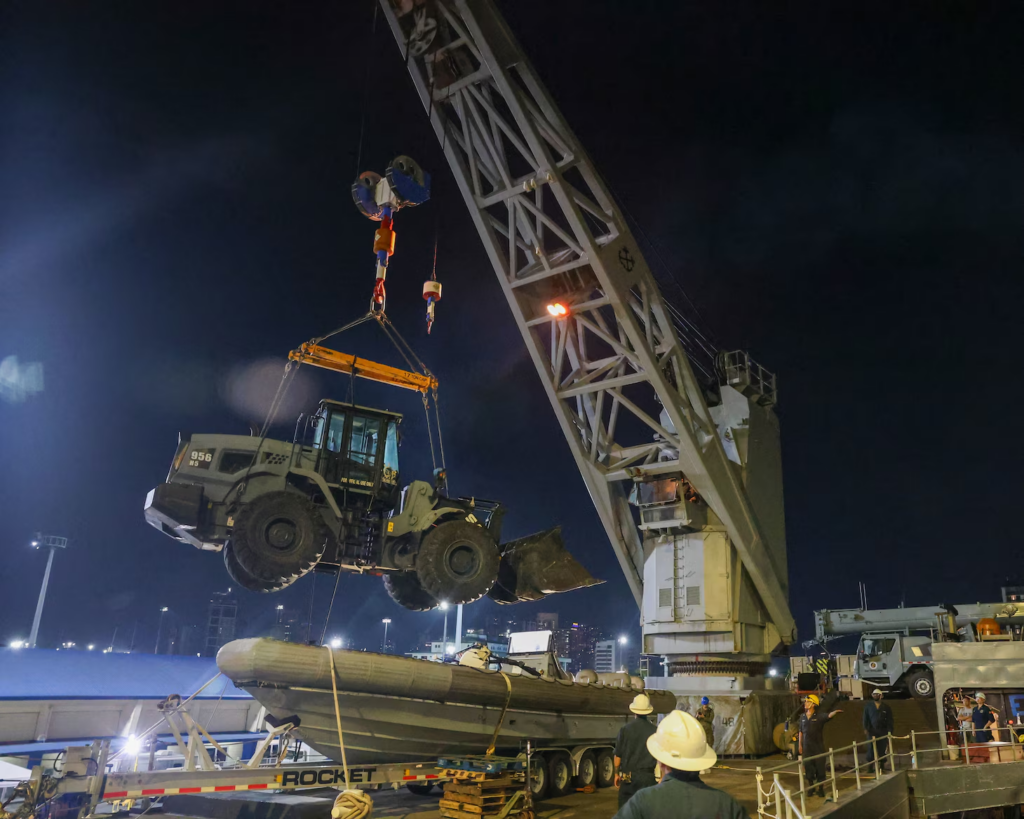
Sailors assigned to Whidbey Island-class dock landing ship USS Ashland (LSD 48) uses the ship’s 60-ton crane to lift an excavator from the Philippine Navy 3rd Naval Combat Engineer Battalion onto Ashland as part of multilateral Maritime Cooperative Activity (MCA) with the Armed Forces of the Philippines and Royal Australian Navy in Manila, Philippines, April 9, 2026. (U.S. Navy photo by MC1 John B. Hetherington)

From By Commander, U.S. 7th Fleet Public Affairs, April 12, 2026 

SULU SEA — The combined forces of Australia, the Philippines and the United States conducted a multilateral Maritime Cooperative Activity (MCA) within the Philippine Exclusive Economic Zone, April 9-12, 2026. This activity demonstrated a collective commitment to strengthening regional and international cooperation in support of a free and open Indo-Pacific. 

Sailors assigned to Whidbey Island-class dock landing ship USS Ashland (LSD 48) uses the ship’s 60-ton crane to lift an excavator from the Philippine Navy 3rd Naval Combat Engineer Battalion onto Ashland as part of multilateral Maritime Cooperative Activity (MCA) with the Armed Forces of the Philippines and Royal Australian Navy in Manila, Philippines, April 9, 2026. The U.S. Navy routinely operates with the Armed Forces of the Philippines and partners and allies through MCAs to continually develop, exercise and enhance multi-domain tactical interoperability to uphold peace and security in the region. (U.S. Navy photo by Mass Communication Specialist 1st Class John B. Hetherington) 

As the fifth MCA of 2026, these regular at-sea events strengthen the interoperability of our respective military doctrines, tactics, techniques, and procedures. This multilateral MCA focused on critical maritime skills, including communication drills, maritime domain awareness activities and supporting equipment offload from Manila to Puerto Princesa, Philippines. 

“We embrace any chance to conduct at-sea operations with our allies, Australia and the Philippines, and reinforce our commitment to security in the region,” said Cmdr. Adam Peeples, commanding officer of U.S. Navy Whidbey Island-class dock landing ship USS Ashland (LSD 48). “These exercises provide an opportunity to strengthen our bonds, hone our skills and interoperability, and demonstrate the resilience of our crews. Our Sailors are dedicated to ensuring a free and open Indo-Pacific and deterring aggression.” 
 

MCAs are conducted in a manner consistent with international law and with due regard to the safety, navigational rights, and freedoms of all nations. 

Participating units included Royal Australian Navy Anzac-class frigate HMAS Toowoomba (FFH 156) with an embarked MH-60R helicopter; Philippine Navy Rajah Sulayman-class offshore patrol vessel BRP Rajah Sulayman (PS 20) with an embarked AW109 helicopter; Philippine Air Force FA-50 fighter jets, A-29B Super Tucano, C-208B Grand Caravan EX aircraft, a Sokol search and rescue helicopter; Philippine Coast Guard Teresa Magbanua-class patrol vessel BRP Melchora Aquino (MRRV 9702); and U.S. Navy’s Ashland. 

The U.S., along with our allies and partners, upholds the right to freedom of navigation and overflight and other lawful uses of the sea and international airspace, as well as respect for maritime rights under international law. 

U.S. 7th Fleet, the U.S. Navy’s largest forward-deployed numbered fleet, routinely operates with allies and partners in preserving a free and open Indo-Pacific. 


USS Harvey C. Barnum Jr. Commissioned

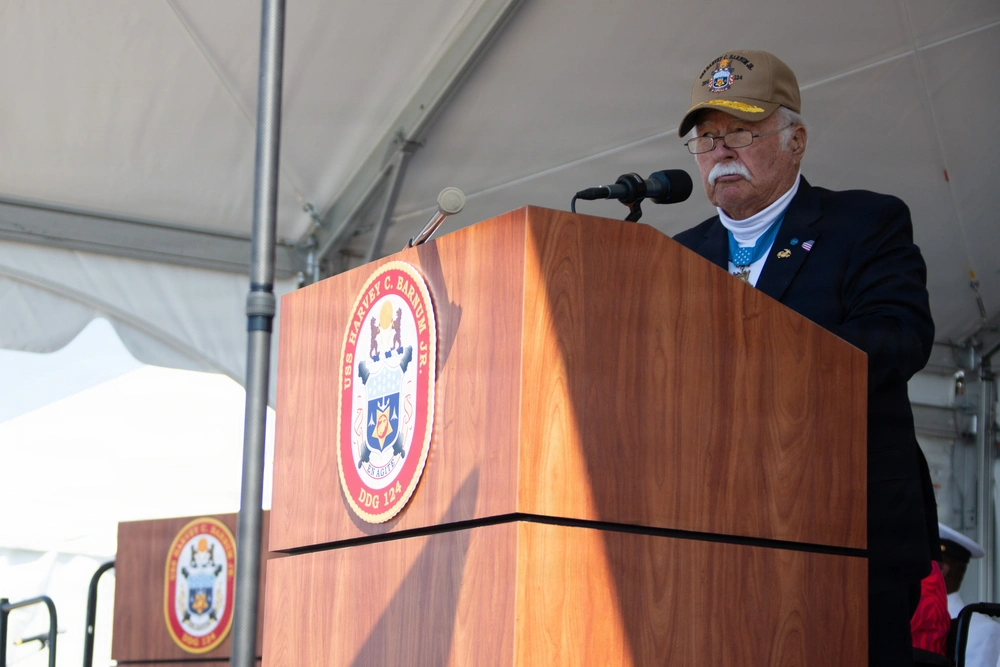
NORFOLK, Va.– U.S. Marine Corps retired Col. Harvey C. Barnum Jr., a Medal of Honor recipient, delivers remarks during the commissioning ceremony of Arleigh Burke-class guided-missile destroyer USS Harvey C. Barnum Jr. (DDG 124) in Norfolk, Virginia, April 11, 2026. The U.S. Navy named the warship in Barnum’s honor for his extraordinary heroism during the Vietnam War. (U.S. Marine Corps photo by Cpl. Ellen Guo)

NORFOLK, Va. — The U.S. Navy commissioned the future USS Harvey C. Barnum Jr. (DDG 124) on April 11, 2026, in Norfolk, Virginia. 

The Arleigh Burke-class guided-missile destroyer is the first ship to bear the name of Medal of Honor recipient, U.S. Marine Corps Col. Harvey Curtiss “Barney” Barnum Jr. The ship honors Barnum’s gallantry and intrepidity at the risk of his life beyond the call of duty during the Vietnam War. 

On Dec. 18, 1965, then-1st Lt. Barnum assumed command of his company after the commander was mortally wounded. With two armed helicopters under his control, he moved fearlessly through deadly fire to lead air attacks against the enemy’s well-entrenched positions while directing one platoon in a successful counterattack on key positions. Having cleared a small area, he requested and directed the landing of two transport helicopters to evacuate the deceased and wounded. He then assisted in seizing the battalion’s objective. He is among the few living namesakes to witness his ship’s commissioning. 

The sponsor of DDG 124 is Barnum’s wife, Martha Hill. Since the ship’s keel laying ceremony in 2021, Barnum and Hill have maintained a close relationship with the crew. In keeping with Navy tradition, she gave the order during the commissioning to “man our ship and bring her to life!” At that moment, the crew hoisted the commissioning pennant, and USS Harvey C. Barnum Jr. became a warship and enter the fleet. 

DDG 124 is homeported at Naval Station Norfolk. 

Arleigh Burke-class guided-missile destroyers are the backbone of the U.S. Navy’s surface fleet. DDG 124 is a Flight IIA destroyer equipped with Aegis Baseline 9, which provides Integrated Air and Missile Defense capabilities, increased computing power, and radar upgrades that improve detection range and reaction time against modern air warfare and Ballistic Missile Defense threats. These highly capable, multi-mission ships provide a wide range of warfighting capabilities in multi-threat air, surface, and subsurface environments. 


HII Hosts PAE Maritime Christopher Miller at Ingalls Shipbuilding 

From HII 

PASCAGOULA, Miss., April 09, 2026 (GLOBE NEWSWIRE) — HII (NYSE: HII) hosted Christopher Miller, the U.S. Navy’s portfolio acquisition executive for maritime (PAE Maritime), at its Ingalls Shipbuilding division Wednesday. During the visit, Miller met with company leadership and received updates on current ship programs, facility investments and Ingalls’ expanding production capacity to support the Navy’s current and future fleet requirements. 

“Ingalls is fully committed to our partnership with the Navy and the Marine Corps and our shared mission to strengthen the fleet with urgency,” Ingalls Shipbuilding President Brian Blanchette said. “The skill and determination our shipbuilders apply to every destroyer and amphibious ship are essential to that mission, and we were honored to show Mr. Miller firsthand the commitment they bring to accelerating the Navy’s needs.” 

HII has invested more than $1 billion in infrastructure, facilities and advanced tools at Ingalls to prepare for next‑generation shipbuilding requirements. These investments, combined with the shipyard’s expanding distributed shipbuilding network across the Gulf Coast, ensure Ingalls is ready to support the Navy’s “Golden Fleet” of advanced surface combatants while continuing to deliver destroyers and amphibious assault ships. 

The visit marked Miller’s first trip to Ingalls since assuming the PAE Maritime role in March 2026. In addition to meeting with leadership, he toured several areas of the shipyard, including amphibious transport dock Harrisburg (LPD 30), currently under construction. 

“The critical work happening at Ingalls reflects the strength and technical expertise of our nation’s shipbuilding industrial base,” Miller said. “As the Navy prepares for future demands, our industry partners and their experienced workforce are pivotal to delivering the platforms and capacity needed. The maritime industry is critically important to our national defense and I am committed to supporting the industrial base efforts needed to deliver at speed and scale.” 

Miller also visited HII’s Newport News Shipbuilding division at the end of March, where he met with leadership and toured construction progress on aircraft carrier programs at the shipyard. Together, the visits reinforced the shared commitment between HII and Navy leadership to deliver the platforms that strengthen the fleet, advance future capability and ensure sailors and Marines have the ships they need. 


Virginia Senators Encourage Navy to Work with Virginia’s Ship Repair Industry to Balance Delayed Workloads 

From the office of Senator Mark R. Warner, D-Virginia 


WASHINGTON – In light of the extended deployment of Virginia-based Navy ships, including the USS Gerald R. Ford, U.S. Sens. Mark R. Warner and Tim Kaine (both D-VA) sent a letter to U.S. Secretary of the Navy John Phelan encouraging him to use the appropriate tools and authorities to ensure ship repair workloads in the Commonwealth remain level, and that the Navy works with industry to prepare for upcoming maintenance demand. The Ford’s near historic deployment, emergency repairs, and compressed maintenance cycle have disrupted the ship’s scheduled servicing, which also impacts Virginia’s skilled tradespeople who repair and modernize ships.  

The senators began, “We write to request, in light of the Navy’s surge of deployments in the Caribbean and to the Middle East, that your Department utilize all appropriate tools and authorities to manage resulting maintenance needs, and work with industry to appropriately align demand with repair yard planning and capacity.” 

The senators encouraged the Navy to coordinate closely with industry to balance foreseeable demand and award contracts for known but stalled maintenance periods to mitigate delays that may result from the changes to operational schedules. The Navy should work with industry on the planning, ship checks, purchasing long-lead time materials, and any prefabrication efforts to ensure ships get back into operations quickly.   

The senators continued, “Virginia is home to a storied shipbuilding and repair industry, one that has created and sustained many of America’s greatest military and merchant ships. Virginia remains an ideal partner for the Navy to build and repair these ships, with capable shipyards and repair facilities, a talented and agile workforce, and a robust industrial base dedicated to keeping the military, maritime industry, and American economy afloat.  Please keep the yards level-loaded and our tradespeople working without fear of layoffs during this significant operational period for our Navy.” 

Read the full letter here and below. 

Dear Secretary Phelan, 


We write to request, in light of the Navy’s surge of deployments in the Caribbean and to the Middle East, that your Department utilize all appropriate tools and authorities to manage resulting maintenance needs, and work with industry to appropriately align demand with repair yard planning and capacity. 


This operational tempo has had repercussions on the fleet, with the USS Gerald R. Ford now on a ten-month deployment, missing her original maintenance window and needing emergency repairs after an onboard fire. Deployments approaching historic lengths, compressed maintenance cycles, and ongoing operational demands have disrupted scheduled ship repairs in Virginia, as well as across the country. Not only do these extended deployments impact our servicemembers and their families, but we also note that these disruptions are borne by thousands of skilled tradespeople, regional economies, and the maritime industrial base across the country who repair and modernize our ships and get them ready to fight.  


We encourage the Navy to be forward leaning in its strategy to manage this foreseeable demand, and work closely with industry to prepare for and balance the workload. To the greatest possible extent, the Navy should be utilizing available authorities and flexibilities to award contracts for known but delayed maintenance periods to mitigate delays that may result from the changes to operational schedules. The Navy should use this time to work with industry on the planning, ship checks, purchasing long-lead time materials, and any prefabrication efforts to ensure these ships get back into operations quickly.   


Virginia is home to a storied shipbuilding and repair industry, one that has created and sustained many of America’s greatest military and merchant ships. Virginia remains an ideal partner for the Navy to build and repair these ships, with capable shipyards and repair facilities, a talented and agile workforce, and a robust industrial base dedicated to keeping the military, maritime industry, and American economy afloat.  Please keep the yards level-loaded and our tradespeople working without fear of layoffs during this significant operational period for our Navy.  


We urge you to continue to coordinate closely with ship repair industry leaders, and please do not hesitate to bring us into conversation to ensure the Navy and Virginia’s ship repair industry has the authority, funds, and policies in place to support sustained, balanced, and coordinated ship repairs for the Navy. 


HURREX 2026: U.S. Navy Launches Major Hurricane Drill to Test Fleet and Shore Readiness 

From U.S. Fleet Forces Command, April 10, 2026 

WASHINGTON, D.C. – U.S. Fleet Forces Command (USFFC) and Commander, Navy Installations Command (CNIC) will launch their annual hurricane preparedness and disaster response exercise, HURRICANE EXERCISE/CITADEL GALE (HURREX/CG) 2026, from April 13-24. 

The two-week exercise ensures the Navy’s severe weather readiness and exercises response protocols to damaging weather events along the U.S.’s Southern and Eastern coasts. It provides a focused training event for afloat and shore-based commands using simulated hurricane scenarios to prepare for the upcoming hurricane season, ensuring the fleet remains ready for global tasking and a credible deterrent. 

Ensuring the resilience of our assets ashore is a critical component of national defense. HURREX/CG 2026 demonstrates the Navy’s commitment to maintaining uninterrupted operational readiness, ensuring that our forces can deploy worldwide, undeterred by environmental threats. The exercise sends a clear message to any potential adversary: the U.S. Navy is resilient, protected, and always ready. 

“Naval power underpins national security and economic prosperity. That strength begins at our homeports, where a warship’s readiness is forged from our shore-side infrastructure and the dedicated professionals who sustain it during calm weather and heavy storms,” said Adm. Karl Thomas, commander, U.S. Fleet Forces Command. “HURREX/CG 26 ensures we can harden our installations to protect them and our personnel during the upcoming hurricane season, and to ensure our forces remain ready for global tasking regardless of the environment.” 

A new element for this year’s exercise is the focus on public works scenarios designed to test the Navy’s recent Shore Command and Control Realignment. This realignment places Public Works Departments directly under Installation Commanding Officers and CNIC for immediate operational response and maintenance. NAVFAC retains its role focusing on large-scale restoration, major construction, and technical acquisition. HURREX 2026 will be the first exercise to test this new integrated command structure, with scenarios challenging CNIC-led installation teams to respond to infrastructure damage and exercise energy resilience capabilities, such as coordinating the refueling of critical generators. 

“Our installations are the bedrock that enables naval power projection, and this year’s exercise places that foundation under a microscope,” said Vice Adm. Scott Gray, Commander, Navy Installations Command. “By stress-testing our new command and control structure for public works, we are validating our capacity to maintain essential services like power and water in a crisis. This proves our shore enterprise is more than just infrastructure; it is a resilient and indispensable component of the Navy’s warfighting team, enabling our Sailors and civilians to remain focused and ready.” 

The exercise is structured in two distinct phases. The first week focuses on preparedness and response, simulating an approaching hurricane to drill decision-making timelines for setting Tropical Cyclone Conditions of Readiness (TCCOR), evacuating aircraft, and, if necessary, issuing sortie orders for ships to get underway. 

The second week shifts to recovery operations. Following the simulated storm’s passage, commands will exercise post-storm damage assessments, mustering personnel via the Navy Family Accountability and Assessment System (NFAAS), and restoring base operations. This phase heavily emphasizes coordination with local, state, and federal partners to ensure a unified recovery effort. 

Our people are our greatest warfighting advantage, and Sailors and their families are at the center of this readiness effort. All personnel are encouraged to log into the Navy Family Accountability and Assessment System (NFAAS) at https://navyfamily.navy.mil to verify and update their contact information, which is essential for personnel accountability in a crisis. 

While measures have been taken to minimize disruptions, the public may notice increased activity on and around naval installations as commands execute their response plans. 

For more details on any potential local impacts, residents are encouraged to visit their respective Navy installation’s website and social media channels. 


Ecuador and U.S. Navies Conduct Bilateral Maritime Engagement in Pacific Ocean

 Ecuadorian navy Esmeralda-class missile corvettes BAE Manabi (CM 12) and BAE Loja (CM 16) conduct formation maneuvering alongside Nimitz-class aircraft carrier USS Nimitz (CVN 68) and Arleigh Burke-class guided-missile destroyer USS Gridley (DDG 101), part of Nimitz Carrier Strike Group (NIMCSG), in the Pacific Ocean, April 8, 2026. (U.S. Navy photo by MC3 Class Gina Gallia) 

From the U.S. 4th Fleet, April 9, 2026 

PACIFIC OCEAN – The Ecuadorian and U.S. Navies conducted a bilateral maritime engagement as part of U.S. Naval Forces Southern Command/U.S. 4th Fleet’s Southern Seas 2026 deployment in the Pacific Ocean, April 7-8. 

The engagement, focused on increasing interoperability between the two navies, included participation by the Ecuadorian Esmeraldas-class missile corvettes BAE Manabi (CM 12) and BAE Loja (CM 16), Ecuadorian A-29 Super Tucano aircraft, Nimitz-class aircraft carrier USS Nimitz (CVN 68), Arleigh Burke-class guided-missile destroyer USS Gridley (DDG 101), and F-18 Super Hornets and MH-60 Sea Hawks assigned to Carrier Air Wing (CVW) 17. 

“Engaging with partners like Ecuador ensures that when the need arises, we can work together as a proficient warfighting team, built with trust and experience,” said Rear Adm. Cassidy Norman, commander of Carrier Strike Group 11. “Training on the high seas with Ecuadoran naval forces gave us the chance to hone our critical skills while also continuing to build a relationship that is already strong and enduring.” 

Training conducted included subject matter expert exchanges, simulated maritime interdiction operations scenarios, a live-fire gunnery exercise, maneuvering in formation and an air defense exercise. 

Nimitz also hosted a visit of senior Ecuadorian government and military leaders including Minister of Foreign Affairs Gabriela Sommerfeld, Minister of Defense Giancarlo Loffredo, and Chief of Defense Gen. Henry Delgado. The delegation was accompanied by U.S. Charge d’Affaires a.i. in Ecuador Lawrence Petroni. 

The visit was one of many planned opportunities for distinguished visitors to observe aircraft carrier operations during Southern Seas 2026. 

While aboard, the Ecuadorian delegation met with Norman and Capt. Joseph Furco, commanding officer of Nimitz. The leaders discussed the Southern Seas 2026 mission and the strong security partnership between Ecuador and the U.S. 

Visitors also observed flight operations and an air power demonstration from Nimitz’ flight deck. 

The visit and bilateral training demonstrated the Southern Seas 2026 mission to strengthen existing regional partnerships and encourage the establishment of new relationships through the exchange of maritime mission-focused knowledge and expertise. 

Southern Seas 2026 marks the 11th iteration of the exercise to the region since 2007. Like the previous deployments, Southern Seas 2026 is designed to foster goodwill, strengthen maritime partnerships to counter threats, and build the U.S. Navy’s team alongside partner nation maritime services. 

During the deployment, Nimitz Carrier Strike Group (NIMCSG) is scheduled to conduct passing exercises and operations at sea with partner nation maritime forces as the ships circumnavigate the continent of South America. 

NIMCSG consists of Nimitz, Carrier Air Wing (CVW) 17, Destroyer Squadron (DESRON) 9, and Gridley. 

USNAVSOUTH/FOURTHFLT is the trusted maritime partner for Caribbean, Central and South America maritime forces improving regional unity and security.