SECNAV Del Toro Announces Effort to Deter Adversarial Foreign Investment Risks, Protect Innovation and Technology
22 February 2024
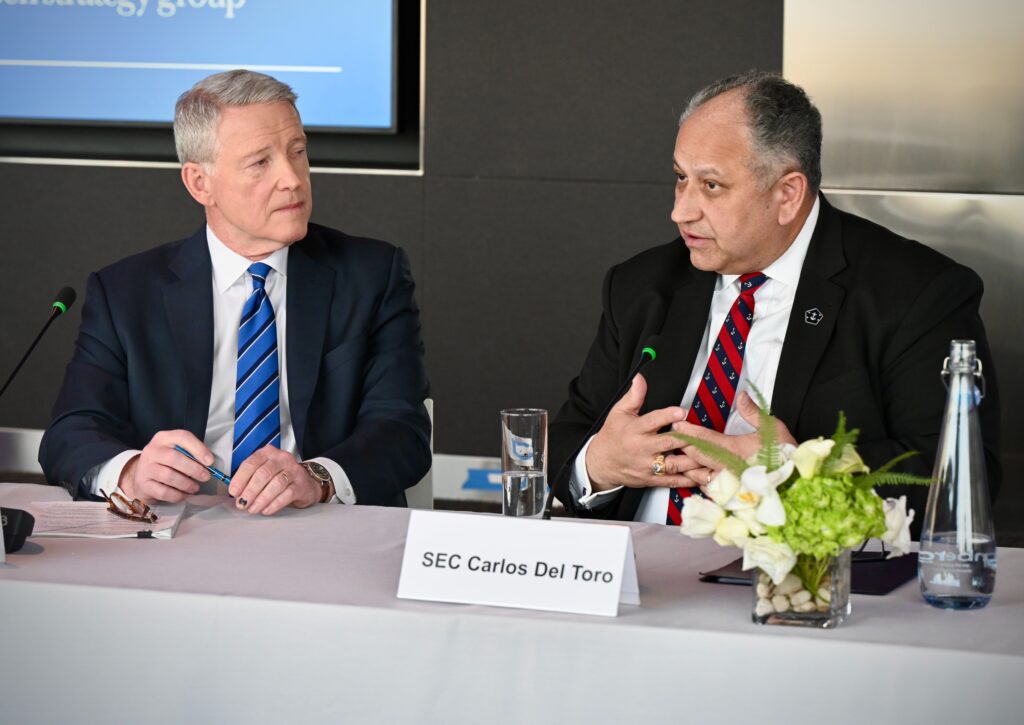
Secretary of the Navy Carlos Del Toro announced the formation of the Department of the Navy (DON) Maritime Economic Deterrence Executive Council (MEDEC) during a panel discussion hosted by the Aspen Institute and powered by the Bloomberg Foundation, Feb. 22.
MEDEC, co-chaired by our Principal Military Deputy to the Assistant Secretary of the Navy for Research, Development, and Acquisition (RD&A), Vice Admiral Francis Morley, and Chief of Staff Chris Diaz, will focus on mitigating adversarial foreign investment risks, innovation and technology protection, supply chain integrity initiatives, and coordination and protection of research efforts.
MEDEC is DON’s acknowledgement of these risks and represents a commitment to identify and address them early, for the safety of our personnel, as well as the security of our allies and partners, depends on us getting this right.
“MEDEC’s work is more than just preserving military advantages for our Sailors, Marines, and civilians. It is an effort to better support the business and investment communities that we rely on to design, test, and build the technologies and capabilities we adopt and field. The risks posed by adversarial capital investments and intellectual property theft affect all of us – from investors and industry leaders to our present-day Sailors, Marines, and civilians who support the DON,” said Secretary Del Toro.
MEDEC, empowered to act by authorities already granted to the DON, is a component of Secretary Del Toro’s whole-of-government national Maritime Statecraft approach, which calls for building up industries that are vital to our nation’s efforts to re-build and sustain our comprehensive maritime power.
“It is imperative to bring together representatives from within the defense industrial ecosystem in a unified, focused council to address Maritime Economic Deterrence within our department, allowing the DON to better synchronize our efforts and be leaders in the larger Department of Defense (DoD) Economic Deterrence initiative,” said Secretary Del Toro.
As the DON broadens its engagements with investment and business communities that are responsible for driving advances in critical technologies, MEDEC’s work becomes more important to ensure that the companies with which engage are properly shielded from adversarial influence.
SECNAV Del Toro Names Ship in Honor of Force Master Chief Petty Officer of the Seabees James D. Fairbanks
21 February 2024
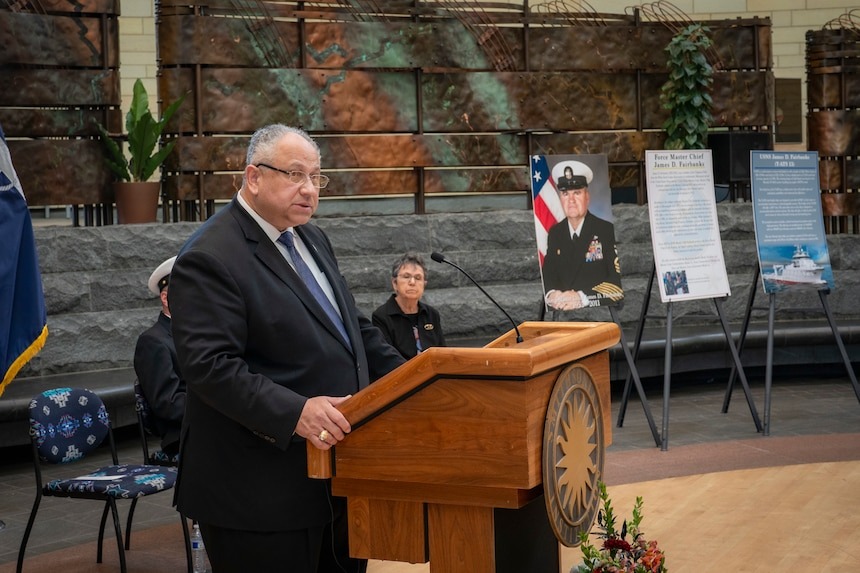
Secretary of the Navy Carlos Del Toro announced that the future Navajo-class Towing, Salvage, and Rescue (T-ATS) ship will be named in honor of James D. Fairbanks, member of the Chippewa Tribe and the 13th Force Master Chief Petty Officer of the Seabees.
Secretary Del Toro made the announcement during a ship naming ceremony at the National Museum of the American Indian, Feb. 21.
The naming selection of the future USNS James. D. Fairbanks (T-ATS 13) follows the tradition of naming towing, salvage and rescue ships after prominent Native Americans or Native American tribes.
“The names of thousands of indigenous heroes who have served with distinction in our military – and especially our Navy and Marine Corps – echo and inspire us still,” said Secretary Del Toro. “This Navajo-class ship bearing the name James D. Fairbanks will carry his legacy of service forward and symbolize his dedication to the Seabees and our Nation.”
Minnesota Governor Tim Walz and Chairman of the White Earth Indian Reservation Michael Fairbanks joined Secretary Del Toro for the ceremony honoring James D. Fairbanks, who was born and raised on the White Earth Indian Reservation in Northern Minnesota. Both spoke about the honor and meaning behind the naming of the Navy’s newest T-ATS.
“What the Navy knows, and what White Earth [Nation] knows, is that stories matter. That history matters. That traditions matter. Honoring warriors like FORCM Fairbanks matters,” said Governor Walz.
“Force Master Chief James Fairbanks was in our language an Ogiichidaa, a Warrior for our People – the Anishinaabeg, and the citizens of the United States. He served with distinction and valor with great honor,” said Michael Fairbanks, Chairman of the White Earth Indian Reservation. “A Warrior in Native American culture holds a great deal of respect by tribal members. James Fairbanks was a true Warrior that represented the White Earth Nation and the U.S. Navy with honor. He unknowingly became a great role model for not only White Earth youth, but for all Native youth. Due to his exemplary leadership, he has earned the right to have a ship named in his honor.”
Born Jan. 9, 1952, James D. Fairbanks served in both the U. S. Navy and Marine Corps. He enlisted in the Marine Corps in 1970 and served as an ordnanceman with 2nd Battalion, 11th Marines, until he was honorably discharged in 1972. He then worked as a civilian welder until 1977 before enlisting in the Navy. Fairbanks served with an amphibious construction battalion (ACB) until his honorable discharge in 1979. In 1986, he resumed Naval service as a Seabee. While deployed to Iraq during Operation Iraqi Freedom, Fairbanks received the Bronze Star for meritorious leadership under proximate enemy fire and threat of enemy attack. From 2005 to 2008, Fairbanks served as the 13th Force Master Chief for the Seabees, the highest-ranking enlisted Seabee and first Native American to hold this position.
Along with the ship’s name, Secretary Del Toro also announced the sponsors for the future USNS James D. Fairbanks as Paulette Fairbanks Molin, the late Fairbanks’ sister, and Mrs. Susan Sharpe, the spouse of the 19th Force Master Chief Petty Officer of the Seabees. They, in their role as sponsors, will represent a lifelong relationship with the ship and crew.
“The USNS James D. Fairbanks is the namesake of a great leader, one who worked selflessly and tirelessly to serve our great country throughout his extraordinary career,” said Fairbanks Molin. “He was a builder, but not just any builder, he was a Seabee.”
Navajo-class ships will provide ocean-going tug, salvage, and rescue capabilities to support Fleet operations. The current capabilities are provided by Powhatan-class T-ATF Fleet Tugs and Safeguard-class T-ARS Rescue and Salvage vessels, which began reaching the end of their expected service lives in 2020. Navajo-class ships will be capable of towing U.S. Navy ships and will have 6,000 square feet of deck space for embarked systems.
HII Begins Topside EMALS Testing on John F. Kennedy (CVN 79) at Newport News Shipbuilding
John F. Kennedy CVN 79 Dead Load Testing
NEWPORT NEWS, Va., Feb. 21, 2024 (GLOBE NEWSWIRE) — HII (NYSE: HII) announced today that its Newport News Shipbuilding division (NNS) recently began topside testing of the electromagnetic aircraft launch system (EMALS) on aircraft carrier John F. Kennedy (CVN 79).
EMALS, first integrated into USS Gerald R. Ford (CVN 78), replaces the existing steam catapults currently in use on the U.S. Navy’s Nimitz-class aircraft carriers.
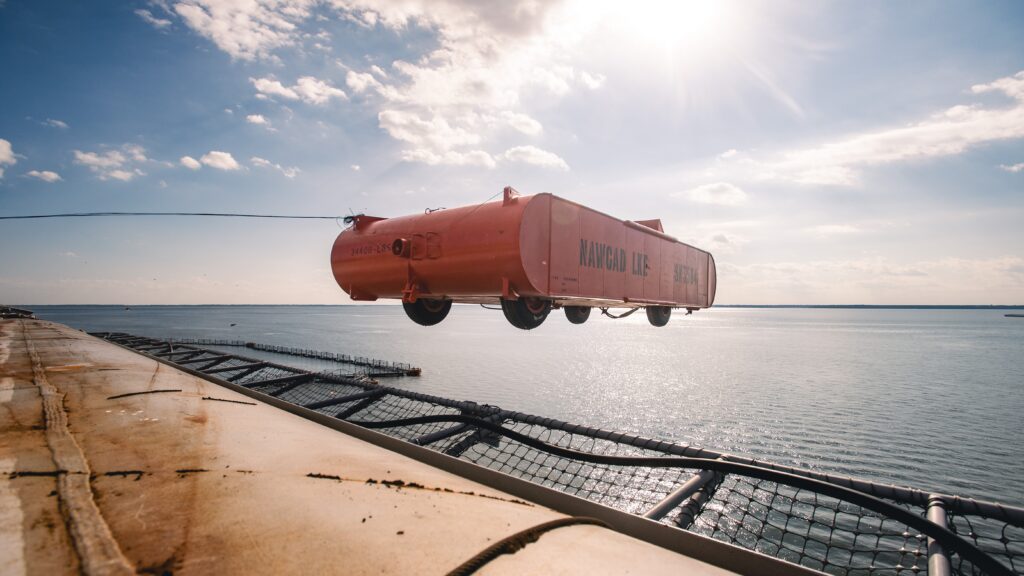
Following successful “no-load” testing on catapults one and two, known as the ‘bow cats,’ the NNS team, alongside the John F. Kennedy crew, has now started “dead-load” testing. In this phase, large, wheeled, car-like structures of graduated weights up to 80,000 pounds to simulate the weight of actual aircraft are launched off the carrier’s bow into the James River. They are then retrieved and relaunched until the conclusion of the test program to ensure the catapults are ready for their primary intended purpose: to launch all carrier-based fixed wing aircraft flown by the U.S. Navy.
The first dead loads used in this testing have special significance. Family members of shipbuilders signed them with messages of congratulations and gratitude during the shipyard’s Family Day held in October.
“As we make sustained progress in the construction, testing and turnover of John F. Kennedy, reaching the dead load testing phase is a visual demonstration of how far we’ve come,” said Lucas Hicks, vice president, John F. Kennedy (CVN 79) new construction aircraft carrier program. “It is evident from the thousands of written messages that our shipbuilders and their families appreciate and understand the significance of our work. We are proud of the incredible teamwork that has brought us to this point, and remain committed to delivering this mighty aircraft carrier to the fleet so the crew can carry out the important mission ahead.”
“The first dead-load launch off the flight deck is a historic moment for PCU John F. Kennedy, and a testament to the power of great teamwork between our JFK crew, HII team, and NAVAIR engineers,” said CAPT Colin Day, commanding officer, PCU John F. Kennedy (CVN 79). “I’m particularly proud of our Air Department and the hard-working Aviation Boatswain Mates who worked tirelessly alongside the engineering and testing teams to get us to this critical moment.”
Traveling more than 300 feet down the catapult track at more than 150 miles per hour, EMALS provides expanded operational capability at reduced costs, higher launch-energy capacity, and more accurate end-speed control, with a smooth acceleration at both high and low speeds. The launch profiles have been optimized to reduce stress on the aircraft, in contrast to the sudden acceleration of steam catapults.
Kennedy is the second Gerald R. Ford-class aircraft carrier under construction at NNS, which is the nation’s sole designer, builder and refueler of nuclear-powered aircraft carriers. In addition to Kennedy, two other Ford-class carriers are under construction at NNS: Enterprise (CVN 80) and Doris Miller (CVN 81).
Cubic Awarded Contract from NAVAIR for KnightLink Systems
SAN DIEGO, February 20, 2024 (Newswire.com) – Cubic Defense has secured an Indefinite-Delivery/Indefinite-Quantity (IDIQ) contract to maintain, upgrade and support deployment of the Full Motion Video (FMV) System, known as KnightLink, for the Naval Air Systems Command’s (NAVAIR) MH-60 Sierra (MH-60S) helicopter fleet.
“The KnightLink system for the MH-60S is a testament to the continued success of our low-rate production program and how the system enables mission capability at the highest level, thanks to robust hardware advancements that provide improved FMV acquisition and dissemination,” said Russ Marsh, Vice President and General Manager of Secure Communications, Cubic Defense. “Our mission is to support and empower the warfighter with state-of-the-art tools to maintain vital communications.”
The KnightLink software provides a wide range of capabilities and video support including operational, vendor, flight test, laboratory aid and maintenance. The KnightLink hardware includes the KnightLink Weapons Replaceable Assemblies (WRAs) and applicable cabling, as well as the procurement of additional hardware, interim sparing and Peculiar Ground Support Equipment (PGSE) to support fleet introduction.
The contract will provide several categories of deliveries, including software enhancements, hardware reinforcement and general maintenance. The sustainment of the FMV system and overall product improvement will lead to enhanced operations and fleet operability. KnightLink systems are already being developed and delivered from Cubic’s Huntsville, Alabama, site.
USS Delbert D. Black Returns To Homeport Following A Surge Deployment
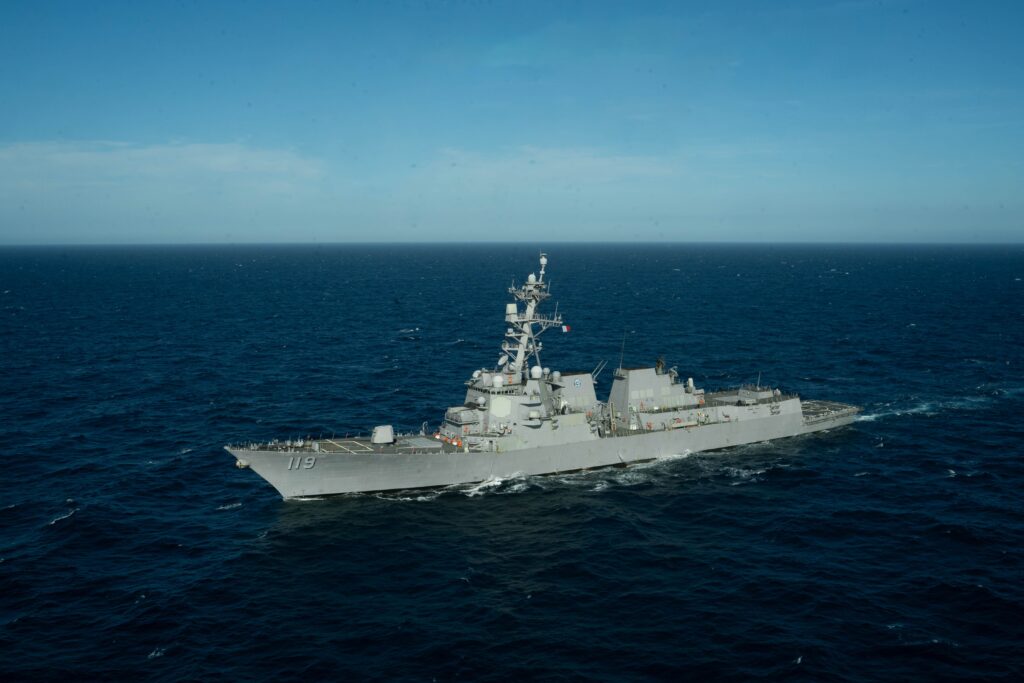
NAVAL STATION MAYPORT, Fla. — USS Delbert D. Black (DDG 119) returned to its homeport of Naval Station Mayport, February 18, 2024, following a near 3-month surge deployment.
The ship deployed Dec. 1 to the U.S. Naval Forces Europe area of operations as part of deterrence efforts in the region following the outbreak of conflict in Israel.
Deploying with Mayport sister ship USS The Sullivans (DDG 68), Delbert D. Black demonstrated the operational practicality of relieving carrier strike group warships while on station. Upon entering the Mediterranean Sea, Delbert D. Black and The Sullivans relieved USS McFaul (DDG 74) and USS Thomas Hudner (DDG 116) and joined the Gerald R. Ford Carrier Strike Group. Drawing on crew proficiency and lessons from a Pre-Deployment Emergent Integrated Training event, Delbert D. Black was immediately capable of performing escort, screening, and warfare commander functions expected of Carrier Strike Group units.
“The seamless integration of Delbert D. Black into ongoing operations established proof of concept for sustained and continuous combat operations at sea, which enhancing the surface Navy’s ability to fight and win,” said Cmdr. Adam Stein, commanding officer of Delbert D. Black.
Following the departure of Gerald R. Ford, Delbert D. Black continued presence operations in the Mediterranean Sea, enabling options and flexibility to operational commanders in theatre. Delbert D. Black went on to integrate operations with elements of Standing NATO Maritime Group Two, conduct joint training evolutions with the Italian Navy, and provide ballistic missile defense to the European continent.
“For many Delbert D. Black Trailblazers, departing for a surge deployment can be jarring, but I quickly learned how resilient the Sailors of this command were,” said Master Chief Keona Johnson, Command Master Chief (CMC) of Delbert D. Black. “We were ready for anything on this deployment, but still maintained high morale while answering our nations call. This crew was able to maximize qualifications and become stronger warfighters. I am a proud CMC because of this team and look forward to sailing safe again with all of my Sailors!”
During the 79 days underway, the ship’s crew conducted seven underway replenishments, logged more than 180 flight hours, sailed more than 21,000 nautical miles, and safely transferred 1.2 million gallons of fuel with zero mishaps. The crew operated at sea for a continuous period of 46 days through the holidays. Delbert D. Black’s Morale, Welfare, and Recreation (MWR) team hosted multiple events to help the crew keep their spirits up while away from their families.
“With the surge deployment, the crew spent the holidays at sea, but that did not stop the holiday spirit,” said Ens. Rachel Anthony, Delbert D. Black’s MWR Fun Boss. “While underway the crew enjoyed 20 MWR events, which included redecorating the main deck in holiday decorations, a lip sync battle and some delicious grilled cheese made by the command triad.”
USS Delbert D. Black commenced their trans-Atlantic voyage the beginning of February to return to Mayport, coming home to a warm reception by friends and family on the pier.
“I was fortunate to return home from deployment on my birthday this year and was greeted by my family,” said Damage Controlman 1st Class Tyler Pascale. “Seeing the birthday signs and welcome home signs along with my nephews smiles makes it all worth it.”
Delbert D. Black is an Arleigh Burke-Class destroyer named for the first Master Chief Petty Officer of the Navy (MCPON), the Navy’s most senior enlisted rank. MCPON Black is known as a trailblazer for his initiatives that improved quality of life for the Navy’s junior ranks, and established the importance and value of having an empowered enlisted force in the Navy.
USS John L. Canley Commissioning Recognizes Legacy of Vietnam Veterans and Medal of Honor Recipient
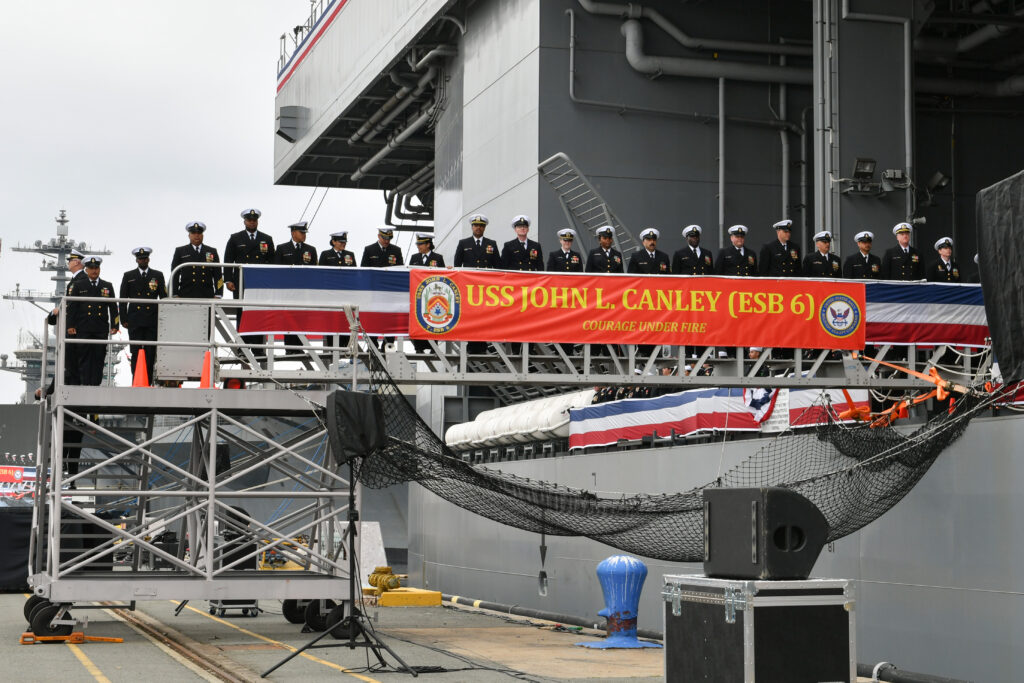
NAVAL BASE CORONADO (Feb. 17, 2024) – The crew of the expeditionary sea base USS John L. Canley (ESB 6) mans the ship during its commissioning ceremony on Naval Base Coronado Feb. 17, 2024. The ship is named for Medal of Honor recipient John Lee Canley, a retired Marine Corps Sergeant Major and Vietnam war veteran. (U.S. Navy photo by Mass Communication Specialist 1st Class Claire M. DuBois)
From Commander, Naval Surface Force, U.S. Pacific Fleet Public Affairs
CORONADO, CALIFORNIA (Feb. 17, 2024) – Expeditionary Sea Base (ESB) USS John L. Canley (ESB 6) commissioned at Naval Air Station North Island in Coronado, California, Feb. 17.
The first of its name, ESB 6 honors United States Marine Corps Sgt. Maj. John L. Canley, Ret., who was awarded the Medal of Honor 50 years after his actions during the Battle of Hue City. Canley served as Company Gunnery Sergeant, Company A, First Battalion, First Marines, First Marine Division (Alpha/1/1) in the Republic of Vietnam from Jan. 31 to Feb. 6, 1968. Sgt. Maj. Canley passed away in Bend, Oregon on May 11, 2022.
During the ceremony guest speaker, Honorable Carlos Del Toro, Secretary of the Navy reflected on the importance of what matters to the future. “As the world’s problems grow increasingly more complex and stability more uncertain, we need to tap into America’s most precious resource—its people—to solve the issues of the future. Because better technology and more ships will go to waste without the courageous Americans who will answer the call to service to their country.”
In office when Canley received the Medal of Honor, General Joseph P. Dunford, Jr., 19th Chairman of the Joint Chiefs of Staff and 36th Commandant of the Marine Corps began by honoring Medal of Honor recipients Colonel Robert J. Modrzejewski, USMC (Ret.) and Colonel Jay R. Vargas, USMC (Ret.), seated in the front row.
“In our initial engagement, I was struck by Sgt. Maj. Canley’s sincerity, and his humility. In time, I gained an appreciation for his commitment to service, and his character as well,” Dunford recalled. “In addition to being understated, Sgt. Maj. Canley was uncomfortable in being singled out for his actions in Vietnam. He was also offended by the lack of recognition Vietnam veterans received when they returned home.”
“In addition to recognizing Sgt. Maj. Canley’s heroism, I’d like to recognize the broader legacy of John Canley and his fellow Vietnam veterans,” said the former Commandant. “Our Vietnam veterans have left us a very proud and rich legacy.”
Sergeant Major Carlos Ruiz, Sergeant Major of the Marine Corps, focused on the totality of Canley’s service, in and out of uniform, and what it means. “Sgt. Maj. Canley earned this honor over seven days, but he had 15 years of building Marines. Of making warriors. Getting them ready for the fight. On the back end of the seven days, he spent another decade, plus, continuing to serve in uniform.”
Ruiz relayed how Canley influenced Marines today. While those seven days helped to name the ship, it’s the 30 years that brought this group together. “He showed us how to show courage. How to do the right thing. He would walk with such calmness to pull his Marines out of danger. Those who were wounded; to get them out.”
“There’s this generation that keeps building on each other,” he continued. “They do some of the very similar things that John Canley did. And that’s care for each other. Not that long ago, you saw Marines being exactly like John Canley taught them to do. Standing on a wall looking through a sea of people, trying to find anyone else that they could save.”
Ship’s sponsor Ms. Patricia A. Sargent and Sgt. Maj. Canley’s daughter said, “To be able to give the order to bring this ship to life, I need to give you some information in regards to my father. My father understood that greatness is not achieved by the individual; it is achieved by the courageous acts of the many. The Marines of Alpha Company 1/1 are an example of that in what they achieved in the Battle of Hue City. In that battle, my father earned their Medal of Honor, which now resides on the USS John L. Canley.”
“This ship will achieve greatness, but it will only do that by the courageous actions of the many,” said Sargent. “It is in honor of my father, my family, members of the 1/1, and the great people of the United States that I give the command: Officers and Crew of the USS John L. Canley, man our ship and bring her to life!”
Capt. Thomas Mays, the commanding officer, thanked Alpha/1/1, Sgt. Maj. Canley’s unit at Hue City, for keeping the gunny’s legacy alive, and working to see that he received the recognition this nation owed him. He also thanked Sargent and maid of honor, granddaughter, Viktoria Sargent for the esteem and care they have given the Sailors before having a “personal conversation” with the crews – gold, blue, and civilian mariners.
“Our vessel’s footprint upon the seas is not the extent of her reach, nor the measure of her impact upon this world,” he said. “The length, breadth, and endurance of that impact rests solely with you and I, with how we back one another, with how we handle our charge to care for this vessel, and with how we approach our sacred duty to defend these United States.
“Her spirit lived upon this earth for 83 years before her first plank was laid, imbued with honor, courage, and selfless sacrifice by her namesake. But the lifeblood that pumps through her veins, that makes her move, that faces down the threats our nation is confronted by, that lifeblood is you.”
Four of USS John L. Canley’s crewmembers later reenlisted aboard the new warship.
Mr. David Carver, President of General Dynamics NASSCO reminded everyone of ESB 6’s “remarkable capabilities that will allow our servicemen and women to carry out a wide variety of missions, including mine counter measures, counter piracy operations, maritime security operations, humanitarian aid, disaster relief missions, special operations, and Marine Corps crisis response.
“The ship is designed to support nearly every rotary wing aircraft in the DoD inventory,” he continued, “as well as allied aircraft, all while serving off the fleet’s third largest flight deck. Canley has substantial residual space, weight, and power to accommodate a wide range of current and future, manned and unmanned, surface, aerial, and undersea systems across multiple warfighting functions. This is a massive, capable, flexible warship that gives fleet commanders decision space they need throughout their operating theaters.”
The mission of CNSP is to man, train, and equip the Surface Force to provide fleet commanders with credible naval power to control the sea and project power ashore.
SCHIEBEL WINS CAMCOPTER S-300 CONTRACT FOR SOUTH KOREAN NAVY
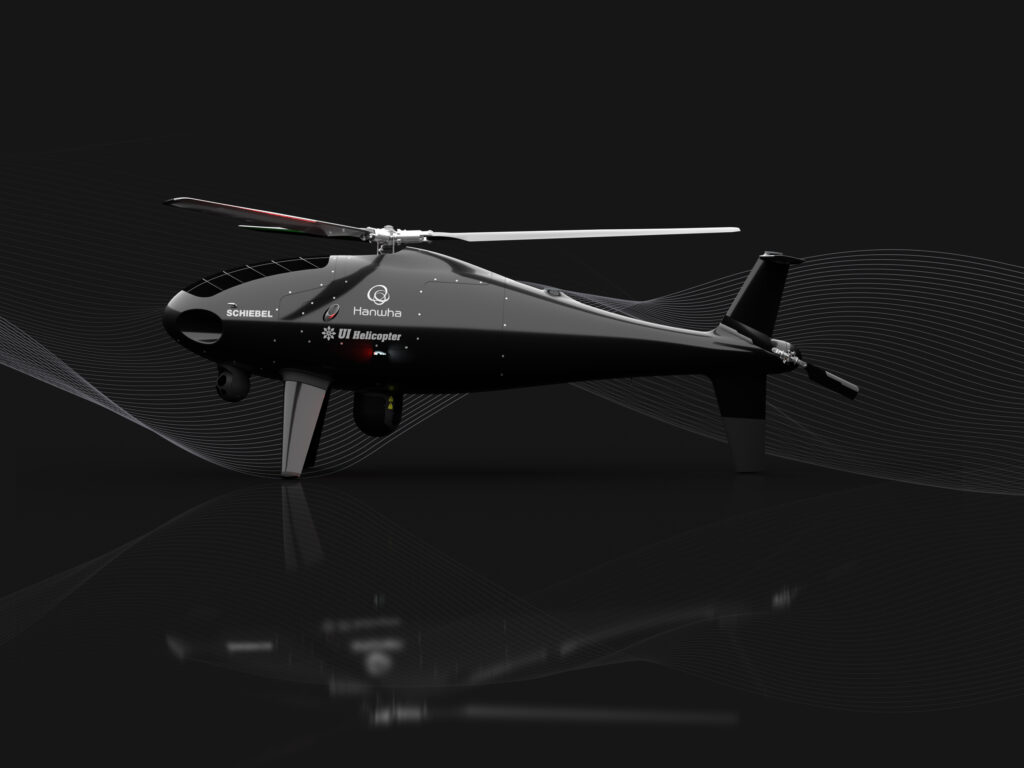
Vienna, 20 February 2024 – Schiebel, together with Korean based defence solutions companies Hanwha Systems and UI Helicopter, has been awarded a contract by the Defence Acquisition Programme Administration (DAPA) for the development and delivery of the Vertical Take-off and Landing (VTOL) CAMCOPTER S-300 Unmanned Air System (UAS), to be operated by the South Korean MOD.
The contract was signed with Hanwha Systems for the supply of the S-300 for Intelligence, Surveillance, Target Acquisition and Reconnaissance (ISTAR) missions for the South Korean Navy and Marine Corps.
The South Korean Navy has been a Schiebel customer for over 10 years, regularly carrying out maritime ISR operations with its CAMCOPTER S-100 UAS fleet. The changing geo-political situation and North Korean threat call for an expansion of their UAS fleet, adding larger and heavier UAS with greater capability.
“We are extremely excited that the South Korean Navy and Marine Corps is building on its extensive experience and success with the S-100 by awarding Hanwha the contract for Schiebel’s new long-endurance, heavy-lift-capable UAS. The S-300 marks a major milestone in the company’s history,” said Hans Georg Schiebel, Chairman of the Schiebel Group.
The STANAG-compliant and fully certifiable S-300 has an endurance of up to 24 hours and operates at an altitude of up to 21,000 feet, offering a persistent loiter capability for ISTAR operations. The heavy-lift UAS carries payloads of up to 250 kg, making it an ideal cargo delivery solution over long distances in complex and high altitude terrain. The versatility and flexibility of the S-300 also allows for the release of payloads such as dropping multiple sonar-buoys for Anti-Submarine Warfare (ASW) operations.
To ensure maximum mission versatility and cost effectiveness, the heavy-lift-capable S-300 can be controlled by the same proven Ground Control Station used by the CAMCOPTER S-100. Schiebel’s ‘system of systems’ approach ensures the interoperability of its unmanned fleet for many years to come building on its experience derived from over 20 years of building a robust and proven VTOL core system.
Schiebel recently announced the expansion of its Abu Dhabi facility extensively increasing its global footprint for the CAMCOPTER S-300. However, the new platform’s open architecture will also ensure it will be able to meet countries’ sovereignty and offset requirements.
New Dry Dock Project at Pearl Harbor Naval Shipyard Reaches Early Milestone
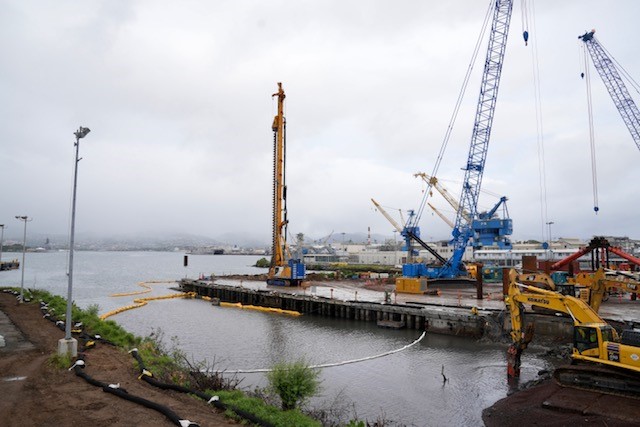
Caption: PEARL HARBOR, Hawaii – Contractors work on the construction of Dry Dock 5 at Joint Base Pearl Harbor-Hickam Dec. 18, 2023. Dragados/Hawaiian Dredging/Orion JV (DHO JV), under contract with Naval Facilities Engineering Systems Command, is conducting major in-water construction for a new dry dock at Pearl Harbor Naval Shipyard and Intermediate Maintenance Facility (PHNSY & IMF). The $3.4-billion graving dock project, the first new dry dock in Pearl Harbor since 1943, will support PHNSY & IMF’s ability to continue maintaining and modernizing the U.S. Navy’s nuclear-powered submarines into the future. U.S. Navy photo by Joel Onemu
From Pearl Harbor Naval Shipyard Public Affairs, Feb. 16, 2024
PEARL HARBOR, Hawaii – Dragados/Hawaiian Dredging/Orion JV (DHO JV), under contract with Naval Facilities Engineering Systems Command (NAVFAC), has begun major in-water construction for a new dry dock at Pearl Harbor Naval Shipyard and Intermediate Maintenance Facility (PHNSY & IMF).
Dry Dock 5 construction commenced after a traditional Hawaiian blessing ceremony on Aug. 19, 2023, and the project has reached the milestone of starting the installation of foundational piles that will essentially anchor the new graving dock.
The Navy will commemorate this significant, early-phase construction milestone at the Dry Dock 5 Anchoring Ceremony scheduled for Feb. 24, 2024, at 10 a.m. at PHNSY.
U.S. Senator Mazie Hirono, Adm. Samuel Paparo, Commander, U.S. Pacific Fleet, and Gerry Majkut, president of Hawaiian Dredging Construction Company, Inc., are scheduled to speak at the ceremony.
“This milestone is a testament to the hard work various organizations have put into the project and a reminder of the steadfast commitment to our community here in Hawai’i,” said Capt. Richard Jones, PHNSY & IMF commander.
The $3.4-billion graving dock project will support PHNSY’s ability to continue maintaining and modernizing the U.S. Navy’s nuclear-powered submarines into the future. It will include the necessary support facilities and the new dry dock will have a 150-year service life. Dry Dock 5 will replace Dry Dock 3, one of four existing dry docks at PHNSY & IMF. Dry Dock 3 is the smallest dry dock and is incapable of docking the current Virginia-class of Navy submarines. The last dry dock to be constructed in Pearl Harbor was in 1943.
To oversee the project, Naval Facilities Engineering Systems Command (NAVFAC) commissioned its newest command, Officer in Charge of Construction, Pearl Harbor Naval Shipyard (OICC PHNSY) in March 2023. OICC PHNSY provides robust quality assurance, contract administration, and command-level accountability for construction of DD5 and the broader once-in-a-generation recapitalization of PHNSY under the Navy’s Shipyard Infrastructure Optimization Program (SIOP).
“Setting the conditions for full-scale construction on a project of this magnitude took a robust team of professionals in both government and industry,” said OICC PHNSY Commanding Officer Capt. Stephen Padhi. “Logistics, permits, monitoring, site preparation, work planning and controls had to set the stage for production for the next four years. As major activities are underway, we look forward to confidently meeting our targets for schedule, quality, safety, cost, and ethics.”
Leading the construction is contractor DHO JV. “We’re extremely excited to work on a project of this scale with the U.S. Navy,” said Gerry Majkut, president of Hawaiian Dredging Construction Company, Inc. “Not many companies get the chance to be part of a major project like this, so having the opportunity to build this dry dock is extremely rewarding.”
Over the course of construction, which is scheduled to finish in 2027, DHO JV expects to draw from many local and small businesses in Hawaii to support the project, in close coordination with local unions. Overall, the project is expected to provide approximately 2,500 jobs locally.
Navy to Commission Future Expeditionary Sea Base USS John L. Canley
FEB. 16, 2024
The Navy will commission the future USS John L. Canley (ESB 6) as the newest Expeditionary Sea Base ship (ESB) during a 10:00 a.m. PST ceremony on Saturday, Feb. 17, in Coronado, California.
The commissioning ceremony’s principal address will be delivered by the Honorable Carlos Del Toro, Secretary of the Navy. Remarks will also be provided by General Joseph P. Dunford, Jr., 19th Chairman of the Joint Chiefs of Staff and 36th Commandant of the Marine Corps; Sergeant Major Carlos Ruiz, Sergeant Major of the Marine Corps; and Mr. David Carver, President of General Dynamics NASSCO. The ship’s sponsor is Patricia Sargent, Sgt. Maj. Canley’s daughter.
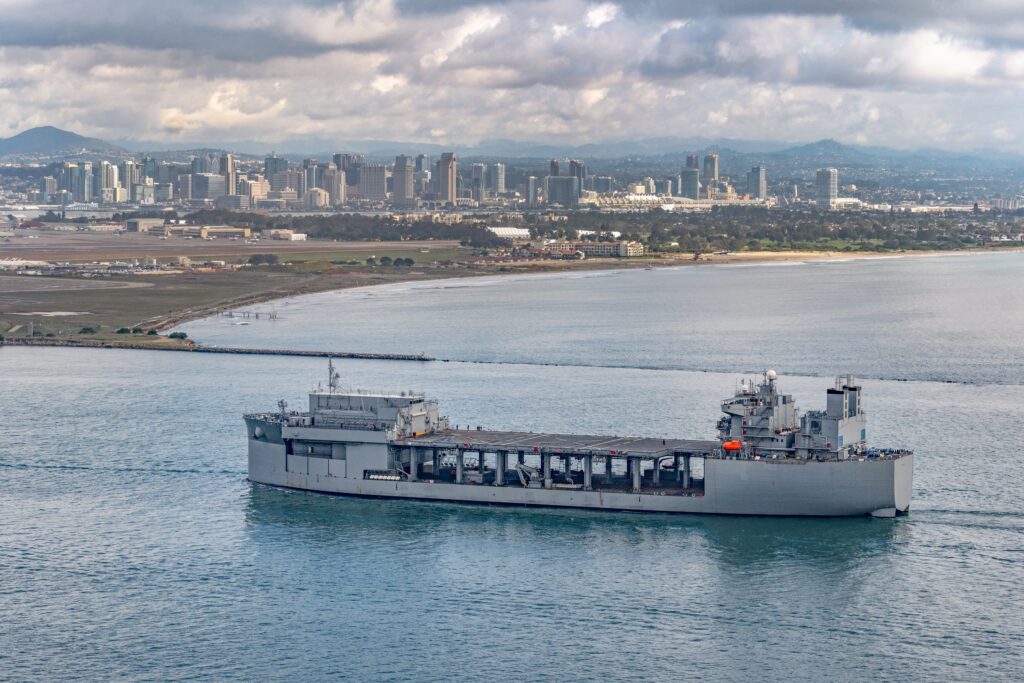
Built by General Dynamics NASSCO, currently there are six delivered ships across two variants: Expeditionary Transfer Dock (ESD) and Expeditionary Sea Base. The future USS John L. Canley (ESB 6) is a highly flexible platform used across various military operations. When commissioned, the ship will be employed as a mobile sea-based asset. It will be a part of the critical access infrastructure supporting the deployment of forces, equipment, supplies, and warfighting capability.
The first of its name, the ship honors United States Marine Corps Sgt. Maj. John L. Canley, Ret., who was awarded the Medal of Honor 50 years after his actions during the Battle of Hue City. Canley served as Company Gunnery Sergeant, Company A, First Battalion, First Marines, First Marine Division in the Republic of Vietnam from Jan. 31 to Feb. 6, 1968. Sgt. Maj. Canley passed away in Bend, Oregon May 11, 2022.
ESB 6 joins the USS Lewis B. Puller (ESB 3), USS Hershel “Woody” Williams (ESB 4), USS Miguel Keith (ESB 5) which support a variety of maritime-based missions, including Special Operations Forces (SOF) and Airborne Mine Counter Measures (AMCM). ESBs have a four-spot flight deck, mission deck, and hangar, designed around four core capabilities: aviation facilities, berthing, equipment staging support, and command and control assets. Follow-on ships Robert E. Simanek (ESB 7) and Hector A. Cafferata Jr. (ESB 8) are under construction. The commissioning of ESBs provides combatant commanders greater operational flexibility to employ this platform in accordance with the laws of armed conflict.
The ceremony will be live streamed at https://www.dvidshub.net/webcast/33415. The link becomes active approximately ten minutes prior to the event at 09:50 a.m. PST.
WEST 2024: Naval Special Warfare a Force Multiplier for Fleet, Prioritizing Reintegration with Joint Force
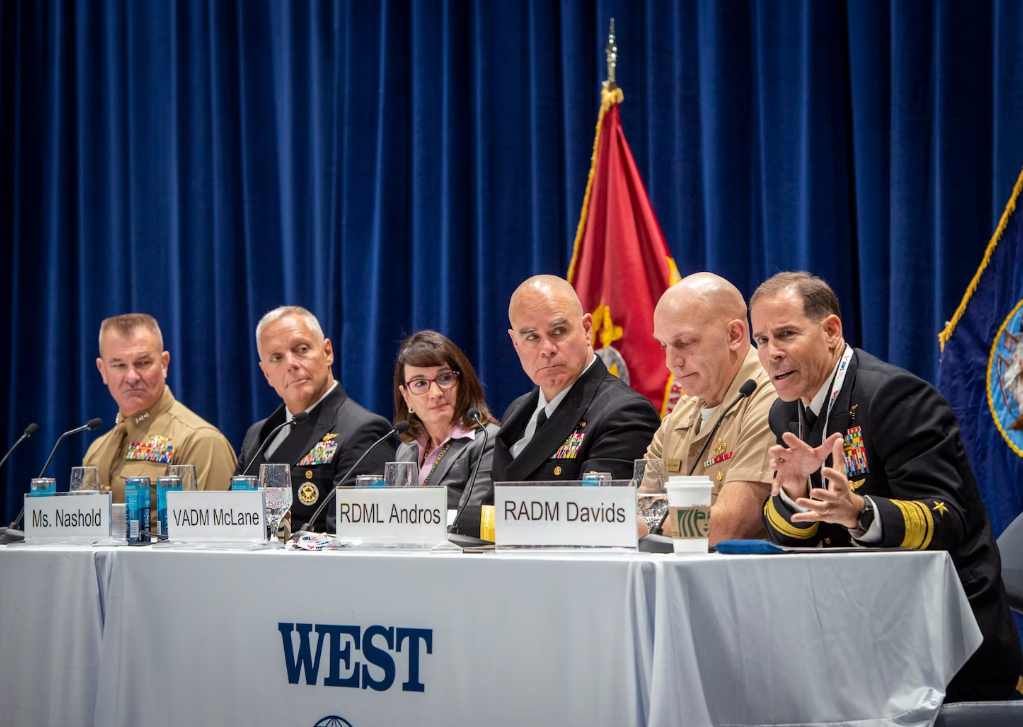
Rear Adm. Keith Davids, commander, Naval Special Warfare Command (NSWC), answers questions during the WEST 2024 convention held at the San Diego Convention Center. U.S. Navy | Mass Communication Specialist 2nd Class Kyle Fiori
SAN DIEGO – Rear Adm. Keith Davids, commander, Naval Special Warfare Command (NSWC), attended and participated in AFCEA-USNI WEST (WEST) 2024 conference, Feb. 13-15.
WEST, the premier naval conference and exposition on the West Coast, brings military and industry leaders together to discuss new technologies and capabilities. The theme of the 34th iteration of the event was, “Are Acquisition and Readiness on Pace to Meet Global Security Demands?”
Davids participated in a panel discussion alongside six leaders from sea service warfare communities to discuss acquisition and readiness and address the question, “What Changes are Community Leaders Making to Meet Global Security Demands?”
“Over the past two decades, the focus of Naval Special Warfare (NSW) has been primarily on counterterrorism,” said Davids. “Now, we are prioritizing integration with the Fleet and Joint Force. We can operate forward in contested areas that enhances warfighting lethality in unique ways. ”
Davids emphasized that conventional response methods have grown ineffective in addressing contemporary conflicts and diverse threats across the globe. To counter the instability and distinct challenges to U.S. warfare capabilities, Davids called on industry to support NSW’s value proposition.
“We’re interested in leveraging our maritime access and placement to deliver asymmetric effects for the Fleet. Therefore, we need industry’s help to enhance our stealth, precision, scale, and decision advantage,” said Davids. “We are eager to collaborate with many of you on new ideas and concepts.”
Joining Davids on the panel was Rear Adm. Brad Andros, commander, Navy Expeditionary Command, Lt. Gen. Karsten Heckl, commanding general, Marine Corps Combat Development Command, Vice Adm. Brendan McLane, commander, Naval Surface Forces, Vice Adm. Daniel Cheever, commander, Naval Air Forces and Elizabeth Nashold, deputy commander, Naval Information Forces. Retired Vice Adm. Peter H. Daly, former CEO and Publisher, U.S. Naval Institute, moderated the discussion.
AFCEA, which stands for the Armed Forces Communications & Electronics Association, and the U.S. Naval Institute (USNI), sponsor WEST each year. The conference is organized into a main program and three engagement theaters – Marine, General, and Information Warfare.
Along with exhibits, keynote speakers and panel discussions, WEST also gives attendees a chance to hear from the Secretary of the Navy, the Chief of Naval Operations, the Commandants of the Marine Corps and Coast Guard, the Sea Service Chiefs, and various industry leaders.
WEST 2024 also featured a Department of the Navy (DON) Information Technology (IT) conference, an Innovation Showcase, and awards announcements recognizing individual and group winners in categories such as Emerging Leaders, a USNI essay contest, and women’s appreciation.
Naval Special Warfare is the nation’s elite maritime special operations force, uniquely positioned to extend the Fleet’s reach and gain and maintain access for the Joint Force in competition and conflict.