Flag Officer Announcements 

JAN. 9, 2024 

Secretary of Defense Lloyd J. Austin III announced today that the president has made the following nominations: 

Navy Captain Douglas J. Adams for appointment to the grade of rear admiral (lower half).  Adams is currently serving as deputy, Program Executive Office, Undersea Warfare Systems, Washington, D.C.    

Navy Captain Todd F. Cimicata for appointment to the grade of rear admiral (lower half).  Cimicata is currently serving as chief of staff, Naval Air Forces/Naval Air Force, U.S. Pacific Fleet, San Diego, California.  

Navy Captain Frankie J. Clark for appointment to the grade of rear admiral (lower half).  Clark is currently serving as executive assistant to the commander, U.S. Pacific Fleet, Pearl Harbor, Hawaii. 

Navy Captain David G. Duff for appointment to the grade of rear admiral (lower half).  Duff is currently serving as commanding officer, USS HARRY S. TRUMAN (CVN 75), Norfolk, Virginia. 

Navy Captain Daniel W. Ettlich for appointment to the grade of rear admiral (lower half).  Ettlich is currently serving as fleet maintenance officer, U.S. Pacific Fleet, Pearl Harbor, Hawaii. 

Navy Captain Todd M. Evans for appointment to the grade of rear admiral (lower half).  Evans is currently serving as vice commander, Naval Air Systems Command, Patuxent River, Maryland. 

Navy Captain Todd A. Figanbaum for appointment to the grade of rear admiral (lower half). Figanbaum is currently serving as director, Submarine Officer Career Management and Distribution Division (PERS-42), Navy Personnel Command, Millington, Tennessee. 

Navy Captain Bret M. Grabbe for appointment to the grade of rear admiral (lower half).  Grabbe is currently serving as chief of staff, Submarine Force, U.S. Pacific Fleet, Pearl Harbor, Hawaii.  

Navy Captain Brian A. Harding for appointment to the grade of rear admiral (lower half).  Harding is currently serving as information warfare commander, Carrier Strike Group THREE, Bremerton, Washington. 

Navy Captain Jeffrey L. Heames for appointment to the grade of rear admiral (lower half).  Heames is currently serving as director, Surface Warfare Officer Career Management and Distribution Division (PERS-41), Navy Personnel Command, Millington, Tennessee. 

Navy Captain John W. Hewitt for appointment to the grade of rear admiral (lower half).  Hewitt is currently serving as chief of staff, Navy Installations Command, Washington, D.C. 

Navy Captain Liam M. Hulin for appointment to the grade of rear admiral (lower half).  Hulin is currently serving as commanding officer, U.S. Special Operations Command Forward, MacDill Air Force Base, Florida. 
  
Navy Captain Marcos A. Jasso for appointment to the grade of rear admiral (lower half).  Jasso is currently serving as director, Maritime Operations Center, U.S. Pacific Fleet, Pearl Harbor, Hawaii. 

Navy Captain Matthew J. Kawas for appointment to the grade of rear admiral (lower half).  Kawas is currently serving as principal military assistant to the Deputy Secretary of Defense, Washington, D.C. 
  
Navy Captain Justin A. Kubu for appointment to the grade of rear admiral (lower half).  Kubu is currently serving as commander, Amphibious Squadron SEVEN, San Diego, California.   

Navy Captain Robert E. Loughran Jr. for appointment to the grade of rear admiral (lower half).  Loughran is currently serving as branch head, Carrier Strike Aircraft and Weapons, N98, Office of the Chief of Naval Operations, Washington, D.C. 

Navy Captain Philip S. Miller for appointment to the grade of rear admiral (lower half).  Miller is currently serving as branch head, Carriers, N98, Office of the Chief of Naval Operations, Washington, D.C. 

Navy Captain Brian T. Mutty for appointment to the grade of rear admiral (lower half).  Mutty is currently serving as commanding officer, Surface Warfare Schools Command, Newport, Rhode Island. 

Navy Captain Tuan Nguyen for appointment to the grade of rear admiral (lower half).  Nguyen is currently serving as a maritime cooperation and competition director, U.S. SEVENTH Fleet, Yokosuka, Japan. 

Navy Captain Cassidy C. Norman for appointment to the grade of rear admiral (lower half).  Norman is currently serving as chief of staff, Naval Air Force Atlantic, Norfolk, Virginia.  

Navy Captain Erin P. Osborne for appointment to the grade of rear admiral (lower half).  Osborne is currently serving as executive assistant to the Vice Chief of Naval Operations, Washington, D.C. 

Navy Captain Bartley A. Randall for appointment to the grade of rear admiral (lower half).  Randall is currently serving as assistant deputy director for Global Operations, Joint Staff, Washington, D.C. 

Navy Captain Craig C. Sicola for appointment to the grade of rear admiral (lower half).  Sicola is currently serving as assistant chief of staff for Education, Training, and Planning, Naval Air Forces/Naval Air Force, U.S. Pacific Fleet, San Diego, California. 

Navy Captain Peter D. Small for appointment to the grade of rear admiral (lower half).  Small is currently serving as project manager, Program Executive Office, Attack Submarines, Washington, D.C. 

Navy Captain Melvin R. Smith Jr. for appointment to the grade of rear admiral (lower half).  Smith is currently serving as executive assistant to the commander, U.S. Indo-Pacific Command, Camp H.M. Smith, Hawaii.  

Navy Captain Vincent S. Tionquiao for appointment to the grade of rear admiral (lower half).  Tionquiao is currently serving as director, Maritime Operations Center, U.S. Fleet Cyber Command/U.S. TENTH Fleet, Fort Meade, Maryland. 
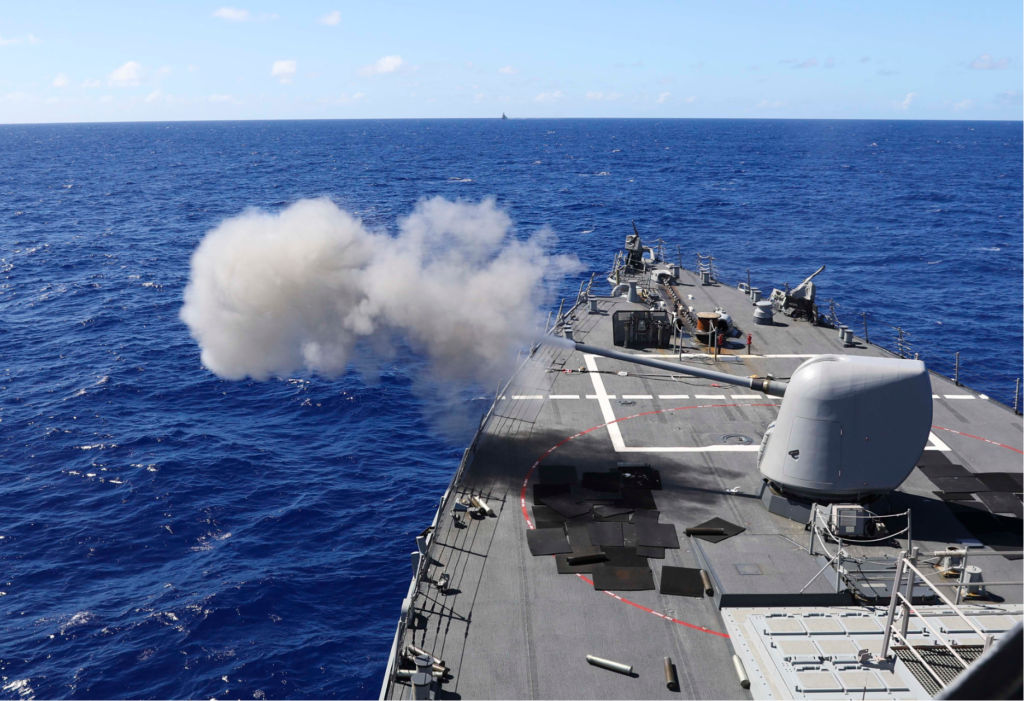


BAE Systems to provide critical Mk 45 naval gun systems upgrade to Australian Navy frigates  

PHILIPPINE SEA (March 5, 2021) The Arleigh Burke-class guided-missile destroyer USS Benfold (DDG 65) fires its MK45 5-inch gun for a live-fire exercise during the annual U.S.-Japan Bilateral Advanced Warfighting Training (BAWT) Exercise. BAWT focuses on joint training and interoperability of coalition forces, and enables real-world proficiency and readiness in response to any contingency. (U.S. Navy photo by Mass Communication Specialist 2nd Class Deanna C. Gonzales)

Release from BAE Systems 

***** 

LOUISVILLE, Ky. — Jan. 8, 2024 — BAE Systems was awarded a contract by the Commonwealth of Australia to upgrade existing Mk 45 Mod 2 naval gun systems on Anzac class frigates with a Common Control System (CCS). The upgrade modifies existing Mk 45 systems to eliminate obsolescence issues and extend the life of the gun system.   

The CCS upgrade replaces electronics on earlier Mk 45 Mod 1 and Mod 2 gun systems to be compatible with the Mk 45 Mod 4, the latest configuration used by the U.S. Navy. In addition to delivering commonality and interoperability with the U.S. Navy’s gun systems, the upgrade will equip the Mk 45s with the capability to integrate future extended-range precision guided munitions, such as the hypervelocity projectile. 

“The Common Control System upgrade is the most cost-effective way to extend the life of Mk 45 gun systems, enabling them to provide critical ship naval fires and creating a configuration that allows for the integration of future precision guided munitions,” said Brent Butcher, vice president of weapon systems at BAE Systems. “We are committed to modernizing and equipping allied nations with enhanced Mk 45 gun systems to address current and future threats.” 

The cost-effective CCS upgrade ensures that Mk 45 gun systems remain supportable for decades to come and ready to integrate the latest, most innovative technology features to support advanced munitions and future mission capabilities for a significantly lower cost than a new gun.   

Work on the contract will take place at the BAE Systems production facility in Louisville, Kentucky with the first delivery planned in early 2026.  


HII Touts Banner Year, but Carrier Scheduling Doubts Loom

A Pre-Commissioning Unit Gerald R. Ford (CVN 78) arrives at Naval Station Norfolk in 2017. Delays to contracting for a follow-on ship of the class could cause supply chain trouble, according to shipbuilder HII. U.S. Navy | Mass Communication Specialist 2nd Class Kristopher Ruiz

ARLINGTON, Virginia ꟷ Shipbuilding giant HII had higher than usual growth through the third quarter of fiscal 2023, but a potential delay in contracting for two new aircraft carriers could lead to supply chain disruptions, the company CEO said in a media briefing on Jan. 8 in advance of the Surface Navy Association symposium this week.

“The company’s actually doing pretty great,” said CEO Christopher D. Kastner, who took over the company reins in March 2022. HII racked up 5% growth through Q3 of fiscal 2023, higher than its historical average of 3%.

“We’ve had a very solid 2023, we’ve grown at about 5% year-over-year through Q3, raised guidance on our top line for sales and free cash flow on our Q3 earnings call, so … we’re kind of at an inflection point from a growth standpoint,” he said.

Kastner said some company priorities appear to be supported in the pending fiscal 2024 defense authorization, including the LPD 33 amphibious warship. “Keeping the amphib line is very important to Ingalls” shipbuilding, Kastner said.

The company’s two shipyards have 41 ships in production and its Mission Technologies division, which builds and develops unmanned systems, AI systems and others, had more than $5 billion in awards during the year, including a $350 million contract for small unmanned underwater vehicles.

Seventeen submarines will go under contract in the next year to 18 months, and progress is being made on the AUKUS program to provide Australia with nuclear-powered submarines.

“We expect revenue to flow in 2024,” Kastner said. “We don’t believe it will be financially material in ’24, but there could be revenue flowing in ’24.”

Carrier Schedule

One potential fly in the ointment is the possibility of the next two-ship aircraft carrier buy being shifted by a year or two, from 2028 to 2029 or even 2030. In 2019, the Navy contracted for two carriers, CVN 80 and 81, the future Enterprise and Doris Miller.

“I think there’s a broad understanding that the supply chain is a material risk to achieving the production schedules on future Navy programs. And our job as shipbuilders is to manage risk,” Kastner said. “If we can eliminate one of those risks, or significantly reduce one of those risks by getting advanced procurement in place, well ahead of the ship being ordered, it only makes sense to do it. We know the ships are going to be built, they have broad support, so let’s eliminate risk, let’s get the major suppliers under contract early enough so they can plan and they can make their production schedules.”

A Newport News Shipbuilding executive, who asked not to be named, said the company is promoting a 2-3-4 concept for USS Gerald Ford-class aircraft carriers to create a “stable, predictable and consistent cadence within our industrial base.” That means a two-ship buy; at least three years of advanced procurement funding; and four-year build intervals between ships. “I believe the 2-3-4 strategy needs to be codified as the standard moving forward,” he said.

A delay in the procurement of CVN 82 is “extremely disappointing,” and could break the momentum of a rebuilding carrier production line “and have a detrimental impact on the entire nuclear shipbuilding industry, including submarine construction,” he said.


Admiral James Kilby Assumes Role as Vice Chief of Naval Operations

***** 

By VCNO Public Affairs 

Chief of Naval Operations Adm. Lisa Franchetti welcomed Adm. James Kilby as the 43rd Vice Chief of Naval Operations in a ceremony at the Pentagon, Jan. 5.  

Kilby most recently served as the deputy commander, U.S. Fleet Forces in Norfolk, Virginia. He is a native of Pound Ridge, New York, and a 1986 graduate of the United States Naval Academy. He has commanded at unit and strike group levels and is the recipient of the Vice Adm. James B. Stockdale Award for inspirational leadership. 

“Adm. Kilby is an exceptional leader who is truly committed to our Sailors and meeting the needs of the Fleet,” said Franchetti. “His extensive operational experience combined with his deep requirements and force development expertise will help accelerate change across the force. I am thrilled to have him on board as we lead the Navy through this decisive decade, and I am grateful that he and his family continue to serve the Navy.” 

Kilby was promoted to the rank of admiral prior to the assumption of office. 

“I am honored and humbled to assume this position at such a critical time for our Navy and our nation,” said Kilby. “I am excited at the opportunity to support our CNO to ensure the Navy remains the most capable and powerful maritime force in the world.” 

His biography and photo can be found here: https://www.navy.mil/Leadership/Flag-Officer-Biographies/BioDisplay/Article/2236251/admiral-james-kilby/ 


Houthi Explosive USV Detonated in Red Sea Attack

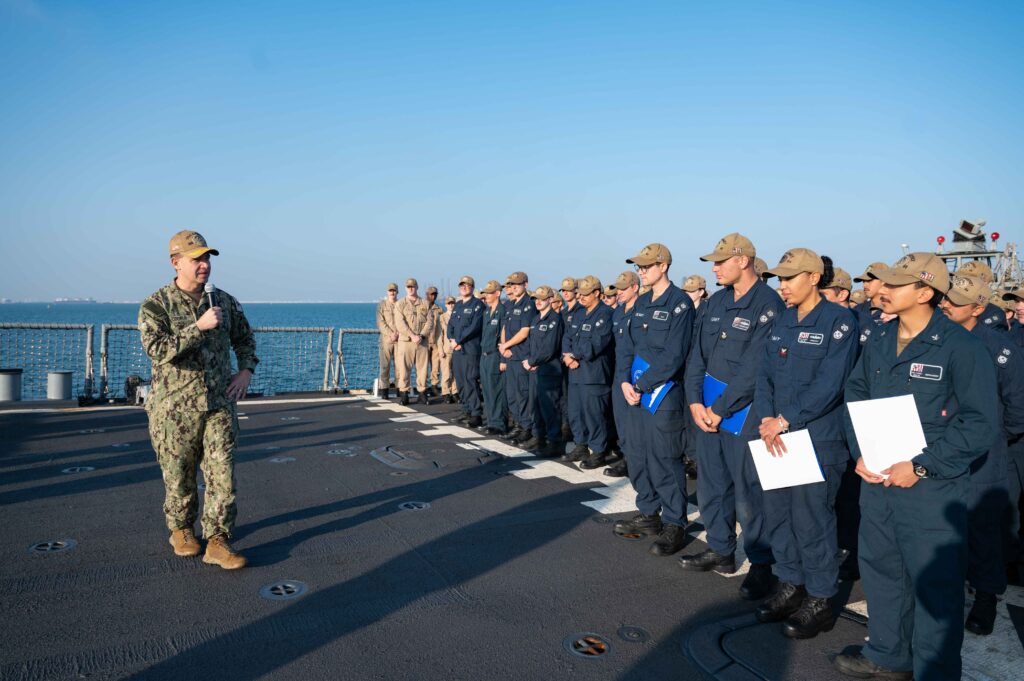
BAHRAIN (Jan. 2, 2024) Vice Adm. Brad Cooper, commander of U.S. 5th Fleet, speaks with Sailors aboard the Arleigh Burke-class guided-missile destroyer USS Carney (DDG 64) after presenting combat medals to Sailors while the ship is in Bahrain, Jan. 2, 2024. Cooper also recognized the whole Carney crew with the Combat Action Ribbon. On Dec. 16, Carney Sailors shot down 14 Houthi unmanned aerial vehicles in the Red Sea. (U.S. Navy photo by Mass Communication Specialist 2nd Class Jacob Vernier) 

By Richard R. Burgess, Senior Editor 

ARLINGTON, Va.—An uncrewed surface vessel (USV) was detonated in the international shipping lanes Jan. 4 in the latest attack launched from Yemen by Houthi rebels. 

“Fortunately, there were no casualties, and no ships were hit, but the introduction of a one-way attack USV is of concern,” said U.S. Navy Vice Admiral Brad Cooper, commander, U.S. Fifth Fleet and commander, U.S. Naval Forces Central Command, and commander, Combined Maritime Forces, speaking to reporters in a June 4 teleconference. 

The attack was the 25th against merchant ships in the Red Sea since mid-November.  

In response to the attacks, Secretary of Defense Lloyd J. Austin III on Dec. 18 launched Operation Prosperity Guardian, a multinational effort to protect shipping through the Red Sea and Bab-el-Mandeb Strait. The Combined Maritime Forces under Commander, Task Force 153, are conducting the operation.  

Cooper said that the coalition forces had shot down 11 drones, two cruise missiles, and two antiship ballistic missiles launched from Yemen since the operation began. In addition, three of four Houthi attack boats, which fired on U.S. Navy helicopters, were then destroyed by U.S. Navy MH-60 helicopters from the Arleigh Burke-class guided-missile destroyer USS Gravely and the aircraft carrier USS Dwight D. Eisenhower. 

Cooper said a total of 61 drones and missiles had been shot down by U.S. Navy destroyers and F/A-18 Super Hornet strike fighters over the last two months. Other drones and missiles have been shot down by ships of the Royal Navy and French Navy. 

Cooper made three key points in the conference: 

“By number one, the number of nations participating has grown. Their contributions are meaningful, and our partners are doing great work at sea. Number two, about 1,500 merchant ships have safely transited the waters of the Red Sea since the operation began. And then number three, our collaboration with the maritime shipping industry has increased dramatically. We’re reassuring them through persistent communications that are characterized as two-way, both before and during transits, so that’s going well. 

“Now, having said this, the Houthi ruthless attacks have continued, as you know, and there are no signs their irresponsible behavior is abating,” he said. 


SAIC to Support the U.S. Navy’s Hypersonics Advanced Concepts and Strategic Missions Programs

Release from SAIC 

***** 

January 4, 2024

Company will provide research, development, test and evaluation for Strategic Systems Programs and the Naval Surface Warfare Center Crane 

RESTON, Va.–(BUSINESS WIRE)– Science Applications International Corp. (NYSE: SAIC) has been awarded a $63 million contract from the U.S. Navy to support hypersonics advanced concepts and strategic mission solutions for the Navy’s Strategic Systems Programs (SSP) and the Naval Surface Warfare Center (NSWC) Crane, Ind., Strategic Systems Hardware Division (GXW). 

“Every day, SAIC provides expertise in systems integration and delivery solutions in support of the U.S. Navy’s strategic priorities,” said Barbara Supplee, senior vice president, Navy Business Group at SAIC. “We look forward to furthering the full lifecycle of research and development, technology maturation, test and evaluation and eventually the insertion of next-generation technology for hypersonics through our work at the Navy’s Crane facility and other key performance locations.” 

Under the new contract, SAIC will enhance hypersonics advanced concepts and strategic missions focused on next-generation systems, subsystems, components, features and technologies to include Hardware-in-the-Loop (HWIL) and Software-in-the-Loop (SWIL) simulations, manufacturing techniques and other strategic mission areas. 

SAIC’s continuing support to NSWC Crane will also include developing unique test capabilities, assessing and addressing technology gaps, recommending requirements and solutions for hypersonics advanced concepts and strategic mission areas, identifying critical enabling technologies and assessing a technology’s suitability for specific applications including flight qualification. SAIC will assist SSP and NSWC Crane in driving quick-reaction analysis and rapid engineering principals across Department of Defense hypersonic advanced concepts and strategic mission initiatives to enable continued technological superiority. 

Additional support by SAIC will include developing improvements to leading-edge technologies, including new technical approaches and opportunities for technology transfer and integration, as well as inserting, enhancing, modernizing and sustaining state of the art hypersonics advanced concepts and strategic mission technologies to keep pace with continually emerging and evolving threats. 


Military Sealift Command Celebrates ’75 Years of Maritime Excellence’ 

MSC 75th Anniversary Seal

Release from Military Sealift Command 

***** 

NORFOLK, Va. – This year, Military Sealift Command will celebrate its 75th anniversary. Since 1949, MSC, originally Military Sea Transportation Service (MSTS), has been at the forefront of maritime logistics supporting the nation’s joint warfighters around the world. Over the decades, the command has evolved into an agile fleet of more than 135 civilian-crewed ships that replenish U.S. Navy ships at sea, conduct specialized missions, preposition combat cargo at sea around the world, perform a variety of support services, and move military equipment and supplies to deployed U.S. forces. 
 
Today, MSC’s workforce includes more than 7,000 civil service and contract mariners, shore staff and active duty and reservist service members; deployed in regions all over the world. Throughout 2024, the command will be remembering its history, honoring its legacy and celebrating the contributions of its Civil Service Mariners, civilians and military members – past and present – through various community outreach, observances and other special events to reflect on “75 Years of Maritime Excellence.” 
 
“The prosecution of war requires the use of a tremendous number of noncombatant vessels. In all our history, we have never had a sufficient number of ships to meet the voracious appetite of war. Even with its service Force vessels, the Navy does not have enough ships to serve the mobile logistic support needs of the combatant fleets. In any war, therefore, the Armed Forces need the help and the close cooperation of the merchant marine. The groundwork for wartime cooperation with the merchant marine must be laid in times of peace. It would be dangerous to delay such cooperation until the outbreak of war for the complexities of ocean transportation cannot be learned overnight.” 
– Vice Adm. William Callahan, Commander, Military Sea Transportation Service, 1952. 
 
The idea of creating an all-encompassing component responsible for water transportation of the military, in both peace and wartime was suggested as early as 1847 by the Quartermaster General of the Army, Brig. Gen. Thomas S. Jesup who had competed with the Navy for the chartering of American merchant ships. However, it would be another century before the idea would began to become reality. The division would continue through the early 1900s and the Spanish-American War and both World Wars. 
 
During World War II, four different government agencies competed to utilize the commercial merchant marine – the Naval Transportation Service, the Army Transport Service, the U. S. Maritime Commission’s War Shipping Administration, and the Fleet Support Services. To oversee these organizations, the Joint Chiefs of Staff established the Joint Military Transportation Command. 
 
On Dec. 15, 1948, the Secretary of Defense James Forrestal issued a statement, “all military sea transport including Army transports would be placed under Navy command.” With the decision made, discussions began on the details of the actual transfer and scope of the new command. 
 
While the Army and Air Force agreed in the transfer of sealift functions to the Navy, the services could not agree on how to distribute the costs. The services thought was the Navy should pay for the operations of the vessels, while the Navy believed that the services wanting to ship items should provide the necessary funds. This issue was not resolved until the new Secretary of Defense, Louis Johnson, issued a memorandum July 12, 1949 that spelled out the financing, purpose and responsibilities of the MSTS. The new command opened for business October 1, 1949 – the birth of Military Sealift Command. 
 
The initial MSTS fleet consisted of six troop transports, three attack transports, 12 attack cargo ships, and 16 tankers, commissioned vessels in the U.S. Navy and manned by military crews. During the Vietnam War, MSTS was renamed Military Sealift Command. 
 
“MSC has been conspicuous because its people and ships generally have been where the action has been.” 
– Rear Adm. Bruce Keener III, Commander, Military Sealift Command, 1981. 
 
Since its inception MSTS/MSC has been present during every major conflict since World War II, providing vital logistic and operational support to the warfighters on the front line. MSTS responded to the challenge of the Korean War within nine months deploying the 24th Infantry Division from Japan followed by the 25th Infantry Division and 1st Cavalry Division. In three years, MSTS transported more than 54 million tons of cargo, nearly 5 million troops and passengers and more than 22 million long tons of petroleum. 
 
Between 1965 and 1969, MSC transported nearly 54 million tons of combat equipment and supplies and nearly 8 million tons of fuel to Vietnam. MSC ships also transported troops to Vietnam which marked the last use of MSC troop ships. Now, U.S. troops are primarily transported to theater by air. 
 
During the first Persian Gulf Wars, Operations Desert Shield and Desert Storm, MSC distinguished itself as the largest source of defense transportation delivering more than 12 million tons of wheeled and tracked vehicles, helicopters, ammunition, dry cargo, fuel and other supplies and equipment. At the height of the war, MSC managed more than 230 government-owned and chartered ships. 
 
Following the attacks of 9/11, MSC ships delivered more than 25 billion gallons of fuel and moved 126 million square feet of combat equipment and supplies to U.S. and coalition forces engaged in operations supporting Iraq and Afghanistan. 
 
In March of 2003, on the heaviest day of delivering combat gear to Kuwait for Operation Iraqi Freedom, MSC operated 167 ships that stretched from the U.S. East and Gulf Coasts to Kuwait, the equivalent to one ship every 50 miles, a constant stream of combat material, supplies, vehicles and helicopters delivered to U.S. forces in the Middle East. 
 
Throughout its existence, the MSC combat logistics force has continued to provide fuel, ordnance, food, parts, and supplies via underway replenishment to carrier strike groups and amphibious ready groups, independent deployers and ships from allied and partner nations. 
 
“In peacetime, during conflict, responding to natural disasters and now during this global pandemic, our mariners and their teammates ashore remain steadfast and committed to provide agile logistics to our Navy, support joint warfighters forward and help defend our nation.” 
– Rear Admiral Michael Wettlaufer, Commander, Military Sealift Command, 2023. 
 
The key for MSC’s longevity has always been its Civil Service Mariners (CIVMARs). Merchant mariners have courageously supported the nation’s warfighters, and they have a tradition of going in harm’s way to deliver equipment and personnel, wherever and whenever called upon. 
 
There is no better display of the spirit and versatility of the merchant mariner than the “Taluga Tigers.” In 1972, a group MSC civil service mariners did something many naval leaders didn’t think was possible when they took a decommissioned Navy oiler and converted it into MSC’s first fleet service oiler. 
 
The experimental project, Charger Log II, tested MSC’s ability to man a fleet oiler with a minimum crew of mariners. The goal was to test the viability of operating an aging Navy ship with a civilian crew. 
 
The recently decommissioned Cimarron-class oiler, USS Taluga (T-AO 62), was turned over to MSC, and after an overhaul, USNS Taluga (T-AO 62) became the first MSC fleet support oiler. Manned with a crew of 105 CIVMARs and a 16-member military detachment to handle communications, Taluga would conduct 875 underway replenishments with the Seventh Fleet over three and a half years. 
 
The Tigers proved that mariners could conduct underway replenishments repurposing a Navy oiler and their efforts set a new course for the Navy. It was a cost-saving alternative that preserved the operational lifetime of numerous naval vessels. 
 
With the success of Taluga, the Naval Fleet Auxiliary Force grew from one ship to 22 T-AOs, eight T-AEs and three supply ships purchased from the British Ministry of Defense recommissioned as Sirius-class T-AFS ships. Then, in 1987, the USNS Henry J. Kaiser (T-AO-187) was introduced to the fleet in 1987 becoming the first of a 15-ship class of replenishment vessels designed from the beginning to be operated by civilian mariners. 
 
“Through innovation, adaptability and a commitment to success, we will continue Military Sealift Command’s legacy of Maritime Excellence for another 75 years.” 
– Rear Adm. Philip Sobeck, Commander, Military Sealift Command, 2024. 
 
As the Henry J. Kaiser-class fleet oiler era ends, the John Lewis-class era begins, and MSC continues to adapt to an ever-evolving maritime environment. The Navy accepted delivery of USNS John Lewis (T-AO 205) in July 2022. It is the first of 20 in the class – USNS Harvey Milk (T-AO 206) was delivered in May 2023. 
 
The new oilers have the capacity to carry 156,000 barrels of oil, including biofuels. They are fitted with a helideck with the capacity to conduct refueling for helicopters, and they can hold more dry cargo than their predecessors. The vessels can also be armed with a close-in weapon system anti-ship missile defence system for detecting and destroying anti-ship cruise missiles. 
 
Twelve new classes of vessels are scheduled to come online over the next decade, and 20 new ships will be delivered to the fleet in the next five years, all with modernized systems. MSC is also focusing on emerging capabilities such as new connectors, unmanned aerial resupply and expeditionary munitions reload to better support distributed maritime logistics. 
 
For 75 years, MSC has provided agile logistics, strategic sealift and specialized missions to the Department of Defense and has kept warfighters equipped and ready. Now, they are looking forward to another 75! 


USS Ford CSG Redeploys To Homeport

***** 

Jan. 1, 2024 

By NAVEUR/NAVAF/SIXTH FLEET Public Affairs 

NAPLES, Italy  –  Immediately following HAMAS’s brutal attack on Israel, the USS GERALD R. FORD Carrier Strike Group was ordered to the eastern Mediterranean to contribute to our regional deterrence and defense posture.  In the coming days, the USS Gerald R. Ford Carrier Strike Group will redeploy to its home port as scheduled to prepare for future deployments.  

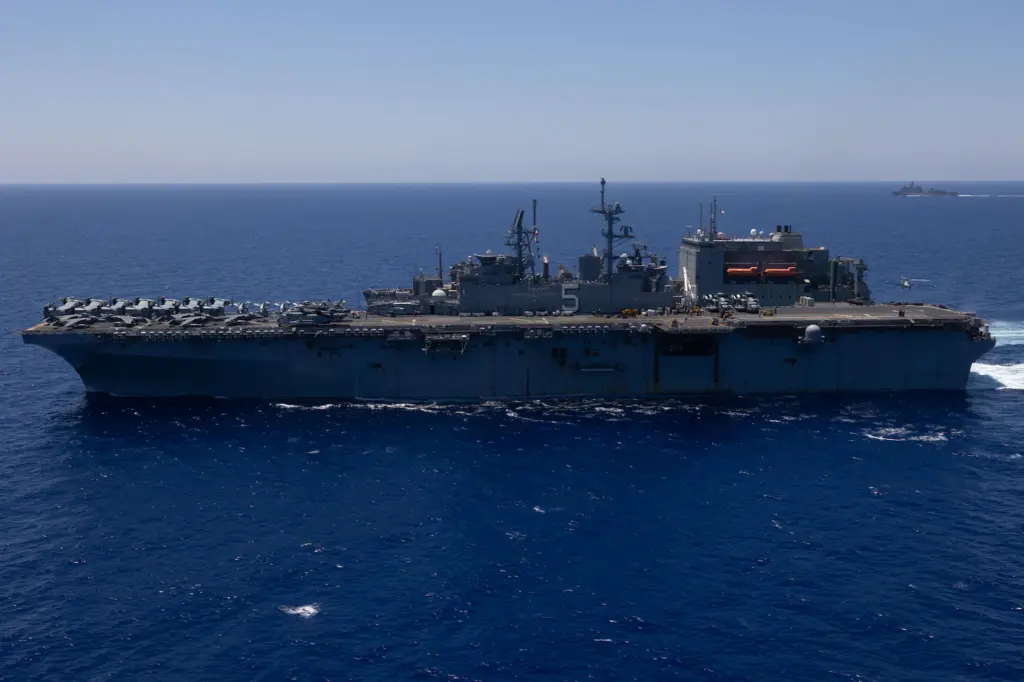
The Department of Defense continually evaluates force posture globally and will retain extensive capability both in the Mediterranean and across the Middle East.  This includes the current deployment of the USS DWIGHT D. EISENHOWER Carrier Strike Group to the Middle East, the deployment of additional cruisers and destroyers in the Mediterranean and Middle East, and the recent arrival of the Wasp-class amphibious ship USS Bataan (LHD 5) and the Harpers Ferry-class dock landing ship USS Carter Hall (LSD 50) in the eastern Mediterranean Sea.  The USS Bataan and USS Carter Hall join the San Antonio-class amphibious transport dock ship USS Mesa Verde (LPD 19) and, with the embarked 26th Marine Expeditionary Unit (MEU), these ships have re-aggregated as the Amphibious Ready Group (ARG) in the eastern Mediterranean. The ARG/MEU consists of three ships and approximately 2,000 Marines that provide sea-based expeditionary forces capable of supporting a wide range of missions. 

Also, we are collaborating with Allies and partners to bolster maritime security in the region. DoD will continue to leverage its collective force posture in the region to deter any state or non-state actor from escalating this crisis beyond Gaza. And we continue to extend our appreciation to the U.S. service members still abroad, and their families and loved ones at home, in support of our steadfast commitment to global security. 


USS Bataan and USS Carter Hall Transited to the Eastern Mediterranean Sea 

***** 

Dec. 28, 2023 

By U.S Naval Forces Europe/Africa 

NAPLES, Italy  –  The Wasp-class amphibious ship USS Bataan (LHD 5) and the Harpers Ferry-class dock landing ship USS Carter Hall (LSD 50) transited Dec. 28, 2023, from the Red Sea to the Eastern Mediterranean Sea and will join the San Antonio-class amphibious transport dock ship USS Mesa Verde (LPD 19). With the embarked 26th Marine Expeditionary Unit (MEU), these ships will re-aggregate as the Amphibious Ready Group (ARG) in the eastern Mediterranean. 


Carl Vinson Carrier Strike Group Conducts Maritime Operations in South China Sea

***** 

27 December 2023 

From Ensign Valentine Mulango

Carrier Strike Group 1, led by its flagship, Nimitz-class aircraft carrier USS Carl Vinson, is operating in the South China Sea following a scheduled port visit to the Republic of Singapore. 

While in the South China Sea, the strike group is conducting maritime security operations, which include flight operations with fixed and rotary wing aircraft, maritime strike exercises, and coordinated tactical training between surface and air units. Carrier operations in the South China Sea are part of the U.S. Navy’s routine presence in the Indo-Pacific. 
 
“The United States will continue to fly, sail, and operate safely, wherever international law allows—so that all nations can benefit from use of the maritime commons. This includes the South China Sea, where nearly $4 trillion in trade transits each year and it has some of the world’s richest fishing grounds that employ an estimated 3.7 million people,” said Rear Adm. Carlos Sardiello, commander, CSG-1. “Since transiting the Pacific from San Diego into the South China Sea, we’ve participated in multilateral, trilateral and bilateral training exercises in the Indo-Pacific region to increase our combined readiness with like-minded allies and partners to demonstrate our shared commitment to the rules-based international order.” 
 
CSG 1 consists of CVN 70, Carrier Air Wing (CVW) 2, Ticonderoga class guided-missile cruiser USS Princeton (CG 59) and Destroyer Squadron (DESRON) 1, which includes Arleigh Burke-class guided-missile destroyers USS Hopper (DDG 70), USS Kidd (DDG 100), USS Sterett (DDG 104), and USS William P. Lawrence (DDG 110). 
 
Prior to entering the South China Sea, CSG-1 participated in a trilateral maritime exercise with the Japan Maritime Self-Defense Force (JMSDF) and Republic of Korea Navy. The exercises provided an opportunity for the three maritime forces to sail together and conduct enhanced planning and advanced maritime communication operations. 
 
The Vinson strike group departed San Diego Oct. 12 for a scheduled deployment to the Western Pacific. Since entering the U.S. 7th Fleet area of operations, the group participated in the Multi-Large Deck Event and Annual Exercise 2023 in the Philippine Sea. These exercises provided opportunities to collaborate with allied forces such as the Royal Australian Navy, Royal Canadian Navy, and JMSDF, to further strengthen regional cooperative efforts. 
 
CSG-1 is a multiplatform team of ships and aircraft, capable of carrying out a wide variety of missions around the globe from combat missions to humanitarian assistance and disaster relief response. CSG-1 is currently deployed to U.S. 7th Fleet area of operations in support of a free and open Indo-Pacific. 
 
U.S. 7th Fleet is the U.S. Navy’s largest forward-deployed numbered fleet and routinely interacts and operates with allies and partners in preserving a free and open Indo-Pacific region. 
 
For more news from CSG 1, visit http://www.dvidshub.net/unit/CSG1