BlastOne Commissions State-of-the-Art Blast and Paint Facility at Fincantieri Marinette Marine

Release from BlastOne 

***** 

Premier shipbuilder launches facility to accelerate delivery of new Constellation-Class Frigates to US Navy 

COLUMBUS, Ohio, Dec. 13, 2023 /PRNewswire-PRWeb/ — BlastOne International, a leader in industrial sandblasting and coating solutions, announces the completion of its advanced naval blast and paint booths for Fincantieri Marinette Marine (FMM) in Wisconsin. The new facility significantly enhances FMM’s shipyard efficiency as it was designed to specifically eliminate the most pervasive bottleneck in production: the surface preparation and coating phase. 

The state-of-the-art installation delivers the highest blast and paint capacity in North American shipyard manufacturing, which now boosts FMM’s delivery of Constellation-Class frigates to the maritime defense capabilities of the US Navy. The Constellation-Class Frigates embody the United States’ dedication to modernize the American Fleet. 

BlastOne’s role in helping FMM expedite the delivery of these vessels as quickly as possible is a proud achievement , as expressed by CEO Matthew Rowland: “As speed and deliverability are critical to FMM’s success, contracting BlastOne in a Design-Build capacity allowed us to streamline processes and deliver the facility at a 25% lower cost and in a 30% faster time-frame than traditional Design-Bid-Build projects. The faster we delivered for them, the faster they can continue to deliver for the US Navy.” 

Key Features of the Modernized Blast and Paint Facility: 

  • Optimized Space: 25,000 square feet of climate-controlled finishing space with two dedicated painting bays and two blast and paint combination bays. 
  • Maximum Output: Capacity for 16 blasters and eight paint sprayers across four modules. 
  • Enhanced Safety: Each of the four process areas are equipped with state-of-the-art ventilation systems with continuous air quality monitoring as well as camera systems to increase the safety of FMM personnel. 
  • Maximum Energy Efficiency: Utilization of heat from the compressed air plant for winter heating. 

Pierroberto Folgiero, CEO of Fincantieri, highlights the facility’s impact: “This improved facility allows for larger portions of ships to be prepared and painted with modern environmental controls, ensuring our shipyard remains one of the safest, most efficient, and environmentally responsible in America.” 

The deployment of Constellation-Class Frigates, equipped with cutting-edge technology, helps deliver on the Navy’s commitment to ensure global peace and stability. 


AUKUS-Related Foreign Military Sales Case Goes to Congress

***** 

Release from NAVSEA Office of Corporate Communications and AUKUS Integration and Acquisition Program Office Public Affairs 

Dec. 11, 2023 

By NAVSEA Office of Corporate Communications and AUKUS Integration and Acquisition Program Office Public Affairs 

WASHINGTON – The Department of State endorsed, and the Defense Security Cooperation Agency delivered congressional notification of, a proposed Foreign Military Sales (FMS) Case for submarine training devices, personnel training, planning, and nonrecurring engineering (NRE) services in support of the AUKUS Pillar One Optimal Pathway. The case will span nine years and have a ceiling of $2 billion pending passage of several legislative proposals. 

“The submarine trainers are the same ones used by U.S. crews assigned to Virginia Class boats,” said Capt. Lincoln Reifsteck, the AUKUS Integration and Acquisition (AUKUS I&A) Program Manager. “The systems will be used by Australian submariners and U.S. crews on boats assigned to HMAS Stirling in Western Australia as part of Submarine Rotational Force – West (SRF-W) which will be established as early as late 2027. The Royal Australian Navy will utilize the trainers to train its crews ahead of buying and operating their own Virginia Class submarines.” 

The United States, with Congressional approval, will sell three Virginia Class submarines to Australia starting in the early 2030s with the potential of increasing the total number to five. The training devices will be used for the life of the Australian-flagged Virginia Class SSNs.   

The FMS case also provides the mechanism to train Australian civilians and contractors at United States Naval Shipyards. Pending Congressional approval, the first Australian submarine maintainers will begin training at Pearl Harbor Naval Shipyard & Intermediate Maintenance Facility (PHNSY & IMF) in the second quarter of calendar year 2024. 

“Right now we have Australian Maintenance Personnel, or AMPs, observing how we plan and execute SSN maintenance at PHNSY & IMF,” said Reifsteck. “They’re also laying the ground work to have up to 75 Australians per quarter living and training in Hawaii so we can bring them over as soon as we’re able to so.” 

The AUKUS partnership is a strategic endeavor that strengthens the three nations’ national security and promotes peace and stability in the Indo-Pacific region. Australia will acquire conventionally armed SSNs for the Royal Australian Navy under AUKUS Pillar One via the Optimal Pathway announced by the heads of the three partner nations on March 13, 2023. AUKUS I&A is responsible for executing the trilateral partnership to deliver conventionally-armed, nuclear-powered attack submarines to the Royal Australian Navy at the earliest possible date while setting the highest nuclear stewardship standards. 


SECNAV Del Toro Establishes DON Office of Strategic Assessment

Release from SECNAV Public Affairs 

***** 

11 December 2023 

Secretary of the Navy Carlos Del Toro today announced the establishment of the Department of the Navy Office of Strategic Assessment (DON OSA).  

ShapeA cornerstone of the Secretary’s Maritime Statecraft initiative, DON OSA will inform the development of guiding principles and priorities to promote a modernized and more lethal force that stands ready to deter high-end conflict while simultaneously protecting and advancing the global maritime interests of the Nation.  

DON OSA will provide the Secretary independent, data-driven assessments and recommendations that will help drive smart choices for the Department of the Navy to balance current readiness investments and future modernization, enhancing the Department’s competitiveness against the pacing threat. OSA demonstrates the Secretary’s commitment to ensure the DON is the best possible steward of taxpayer dollars.   

“The Office of Strategic Assessment will provide a critical capability ensuring that we are ready to build upon our maritime supremacy across the globe today while also preparing for the dynamic challenges of the future,” said Secretary Del Toro. “Data-driven assessments looking strategically across the entire DON enterprise in support of the Joint Force will help us make smarter choices as we balance investments in current readiness and future modernization in order to enhance the Department’s competitiveness against the pacing threat.” 

Additionally, Secretary Del Toro appointed Dr. Cara LaPointe to serve as the first Director of Strategic Assessment. A U.S. Naval Academy graduate, LaPointe brings more 25 years of national security, technology policy, and leadership experience to the position. LaPointe’s deep background of government service includes service as a Naval Surface Warfare Officer and experience within the acquisition community as an Engineering Duty Officer. She also has served within the Executive Office of the President under three administrations, including as a Senior Advisor. Most recently, LaPointe came from Johns Hopkins University, where she was a founding Co-Director of the Institute for Assured Autonomy. She has also served as an expert advisor for global emerging technology initiatives at both the United Nations and the Organization for Economic Cooperation and Development, as well as an inaugural member of the DON Science and Technology Board.   

“I am deeply honored to serve in this new role as Director of OSA.  I look forward to collaborating with the Navy and Marine Corps as well as with our other key partners across the Department of Defense, academia, and industry as we collectively chart a course for the future of the DON in the face of dynamic global change,” said LaPointe.  “In close partnership with our One Navy-Marine Corps Team, OSA will build on the transformational paths the Services have charted to advance the Department’s enduring priorities.”  

By aligning investments and actions to the Department’s enduring priorities of strengthening maritime dominance, building a culture of warfighting excellence, and enhancing strategic partnerships, OSA will ensure the Department continues to field the world’s most dominant maritime force.  


Saab has received a contract from the U.S. Navy for a Double Eagle Semi-Autonomous Remotely Operated Vehicle (SAROV) for the Kuwait Naval Force.  

The Double Eagle Systems are in operation with many Navies around the world.

Release from SAAB 

***** 

The Double Eagle family of undersea vehicles is a safe and operationally proven ROV system, used by navies around the world supporting mine countermeasure (MCM) missions. In the SAROV configuration the vehicle can be used both as an Autonomous Underwater Vehicle (AUV) for detection, classification and identification, and as an ROV for mine disposal. The U.S. Navy is procuring this system as a Foreign Military Sales (FMS) program for the State of Kuwait’s Naval Force. 

Developed and produced at Saab in Linköping, Sweden, this sale represents a milestone in expanding the production of this Swedish technology to the U.S. Saab, Inc.’s Autonomous and Undersea Systems Division will produce parts of this system in close collaboration with other production sites in Sweden, the United Kingdom and Denmark.   

“We’re excited to introduce production of this undersea vehicle capability to the United States. The Autonomous and Undersea Systems team has established both a highly experienced team of undersea vehicle experts and significant new production capabilities for Saab that position us for greater U.S. market expansion,” said Erik Smith, President and CEO of Saab in the U.S. 

These highly maneuverable vehicles can be launched from any type of ship, from the shore, or from a craft of opportunity. All Double Eagle systems can be housed in a standard container, providing a deployable solution across a variety of platforms enabling rapid response to mine threats. 


USS Mount Whitney Returns to Homeport

Release from Commander, U.S. 6th Fleet 

***** 

Dec. 8, 2023 

By Mass Communication Specialist 2nd Class Mario Coto, USS Mount Whitney (LCC 20)

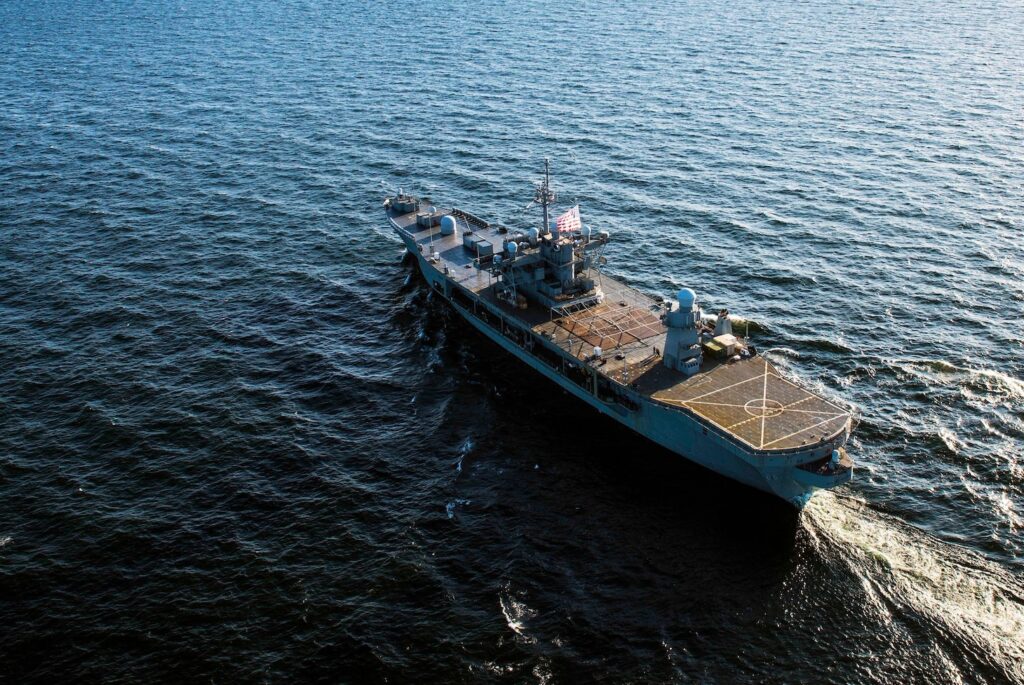
GAETA, Italy  –  The U.S. 6th Fleet Blue Ridge-class command and control ship USS Mount Whitney (LCC 20) returned to homeport in Gaeta, Italy, Dec. 8, following support of U.S. operations in the eastern Mediterranean Sea since October.

While at sea, Mount Whitney worked with allied and partner navies and visited ports, including Larnaca,  Republic of Cyprus and Souda Bay, Republic of Greece. These engagements strengthened regional security and stability and enhanced enduring relationships. 

Mount Whitney, homeported in Gaeta, Italy, operates with a combined crew of U.S. Sailors and Military Sealift Command civil service mariners in the U.S. 6th Fleet area of operations in support of U.S. national security interests in Europe and Africa. 

U.S. Sixth Fleet is permanently assigned to U.S. Naval Forces Europe-U.S. Naval Forces Africa (NAVEUR-NAVAF) and employs maritime forces through the full spectrum of joint and naval operations. Also Headquartered in Naples, Italy, NAVEUR-NAVAF operates U.S. naval forces in the U.S. European Command (USEUCOM) and U.S. Africa Command (USAFRICOM) areas of responsibility.

U.S. Naval Forces Europe-U.S. Naval Forces Africa has forged strategic relationships with allies and partners, leveraging a foundation of shared values to preserve security and stability for over 80 years.


Stand-off Offensive Sea Mine Capability Needed, Former Vice Chairman Said

***** 

By Richard R. Burgess, Senior Editor 

WASHINGTON — The United States needs a more capable and expanded offensive sea mine capability in order to deter China and defend Taiwan, said a retired former admiral who served as vice chairman of the Joint Chiefs of Staff. 

“Mine warfare is going to be very important in a future conflict, especially if we can do it quickly after the start of the fight,” said retired Adm. James A. Winnefeld Jr., a former naval aviator, speaking Dec. 7 on a panel at the Defense Forum Washington of the U.S. Naval Institute and sponsored by Lockheed Martin and HII.  

“Mine warfare has a key role to play — if you think of the Chinese military as a center of gravity — but also has a key role to play if you think of the Chinese leadership as a center of gravity — by shutting down all of their ports fairly quickly,” Winnefeld said. “You can do that to counter a military … but also in legal terms understand that commerce can be a collateral damage associated with that. 

“Frankly, we’re just not there,” the admiral said. “We are terribly short in numbers and technology of those systems. “There are some actions we can take—very quickly—at least partially rectify that. There are some technical actions we can take in the mid-term that would make it even better, but unless we focus on that, we will not be where we need to be. 

Winnefeld pointed out that there is no community of offensive mine warfare officers in the Navy, and no champion of offensive mine warfare among flag officers, and he attributed that shortcoming as a reason for a lack of program support for offensive mine warfare. He noted that mine warfare and counter-mine warfare are “dramatically different from each other, and we need to have that community of offensive mine warfare.”  

He referred to the occasions when U.S. ships were sunk or damaged by enemy mines in various conflicts and that the United States aircraft and submarines used offensive mining with great success against Japanese shipping and ports during World War II. 

The principal U.S. mine is the Quickstrike, a conventional 500- or 1,000-pound bomb with a fuse and a Joint Direct Attack munition kit for precision guidance. It can be fitted with a wing kit that allows deployment at a standoff range of about 35 miles away from the aimpoint. 

Because only a few aircraft types can deliver those mines close to China and survive the mission, Winnefeld recommends a small propulsion engine such as a rocket motor be attached to the mines to allow the mines to be launched from a longer distance and in larger quantities. 

“You could shut down every single Chinese port almost overnight if you did that,” Winnefeld said. “That’s powerful. That will strike fear into their hearts.” 

Speaking later in the forum was Rep. Rob Wittman, R-Virginia, who said that offensive mine warfare “was a great capability that we have undersold through the years. If you look at our adversaries, they have very advanced mining technology.” 

Wittman pointed out that mines are inexpensive and can be deployed with latency and activated when desired. They can be replenished relatively quickly. When combined with a more robust sensor networks, “we can have a tremendous deterrent effect at a very low cost per weapon.” 


New Chaplain Pin Making Waves Across the Surface Force

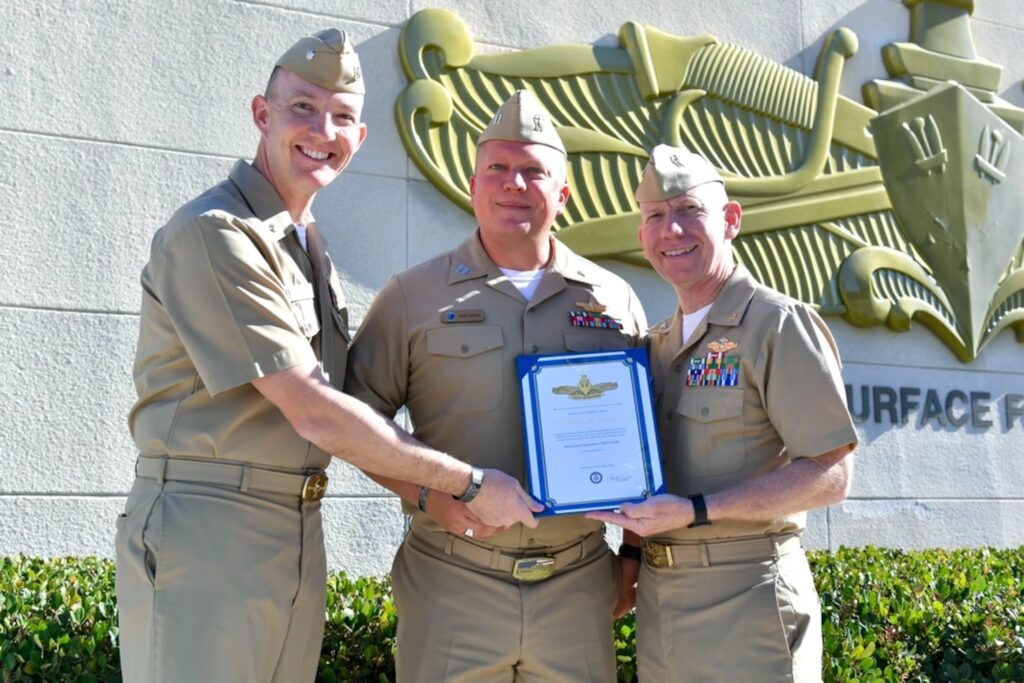
NAVAL BASE CORONADO (November 2, 2023) Lt. Ross Engel receives the Surface Chaplain Officer (SCO) warfare pin during a ceremony held at Commander, Naval Surface Forces, U.S. Pacific Fleet. The Surface Chaplain Officer pin is a newly introduced warfare pin for members of the surface chaplain corps. The qualification insignia was approved this year and made available in Navy Exchanges around the world last week after being approved by the Navy Uniform Board. Nearly 70 Chaplains fleet-wide have earned the qualification to-date. (U.S. Navy photo by Mass Communication Specialist 2nd Class Mikal Chapman)

Release from Commander, Naval Surface Force, U.S. Pacific Fleet 

***** 

By Commander, Naval Surface Force, U.S. Pacific Fleet 

07 December 2023 

SAN DIEGO — Chaplains have been working side by side with Sailors since 1775, keeping to their core principle “to promote the spiritual, religious, moral, and personal well-being of the members of the Department of the Navy.” Now, after close to 250 years of service, they are getting their own surface warfare device. 
 
For the first time, chaplains who serve on a surface ship are eligible to receive the Surface Chaplain Officer (SCO) pin. Like every warfare pin in the Navy, chaplains have to complete a personal qualification standard (PQS) and pass multiple oral boards prior to earning the device. 
 
According to Force Chaplain, Capt. Scott Cauble, and his deputy, Cmdr. Justin Bernard, the introduction of a surface warfare device for chaplains helps them integrate with their crews and gain trust that enables chaplains to better serve alongside Sailors. 
 
This new qualification standard gives chaplains a better understanding of how ships operate and what sailors do professionally. Bernard is one of the chaplains that completed the PQS prior to the pins introduction, and it’s clear that the process granted him deeper insight into the technical aspects of being a Navy Sailor. 
 
“I was going from space to space, not only counseling Sailors, but asking them pointed questions about the nuances of their job and equipment,” said Bernard. “This fostered a cooperative environment between myself and the sailors and broadened my perspective as to their lifestyle.” 
 
The Navy will be giving more chaplains the chance to qualify for the SCO pin as they continue to integrate with individual ships rather than just at a squadron level. “As of December we will have a chaplain on half of all destroyers. Our goal is to get a chaplain on every ship over the next few years,” Cauble explains. 
 
Having more chaplains dedicated to one ship will give them the chance to develop closer bonds with a single crew, rather than being stretched across up to 10 ships. 
 
“Often times you connect with a group of Sailors, then leave and go support another crew. That can be incredibly difficult for the crew and chaplain alike,” said Bernard. According to Bernard, it’s immensely important for a ship to have the chaplain. For leadership, they use the chaplain as a confidant who can serve as a spiritual advisor when making challenging decisions. For Sailors, chaplains are the ones they can turn to during dark moments in their life and know that they will be supported. 
 
The job of a chaplain is unique in its depth and breadth of reach―tasked with counseling junior enlisted to senior officers often in the same day. For Capt. Cauble, it was a moment on his first assignment with a destroyer squadron that helped solidify his desire to stay in the Chaplain Corps. 
 
“I was sent out to ride a ship in the U.S. Fifth Fleet, and I remember going up to the bridge at 9:30 p.m. to give evening prayer thinking, “there is really nothing else I would rather be doing right now than being a chaplain on this warship.” Those five minutes spent on the intercom can put a crew at ease in the midst of the chaos of ship life. 
 
In contrast to the serenity of the evening prayer, surrounded by the inky blackness of the Atlantic Ocean, Bernard found himself in a position that all sailors dread―man overboard. Suddenly, the ship was thrust into the chaos of searching for the lost Sailor, ships rushing to lend help from the surrounding area. 
 
“This went on for a few hours and I spent the majority of my time walking the deck plates and encouraging sailors that we would find their shipmate―their friend. I spent time in the pilot house with the commanding officer praying and hoping for the safe return of the service member,” said Bernard. 
 
Around midnight, hours into the ordeal, Bernard began shifting from the mentality of lending encouragement to providing grief counsel―words of prayer swimming in his mind. Then, in the eleventh hour, a call came over the ship that a man was found in the water. He was loaded into the back of a helicopter to be transported to a hospital, in what can only be described as a miracle. 
 
“The crew really bonded over the experience and the celebration of a life saved by their hard work. That is something you can’t get anywhere else.” 
 
Spiritual readiness is key for every sailor to be ready for the high-stress moments that are inevitable in the armed forces, and chaplains are critical for fostering spiritual readiness on ships. As Cauble explains, spiritual readiness enhances readiness by strengthening the connection between warfighters and their purpose. 
 
“We talk about spiritual readiness as a connection to divine participation in the community of faith, sacrifice for the greater good, and the pursuit of meaning, value and service,” says Cauble. “We as chaplains facilitate for others, we care for everyone, and all those capabilities work towards the development of spiritual readiness.” 
 
The Chaplain Corps has a rich history built on a rock-solid foundation set by the example of members within its ranks. Chaplains like Cauble, Bernard, and even further back, Lt. Vincent Capodanno. Nicknamed “The Grunt Padre” because he was so beloved by his Marines, Capodanno was awarded Medal of Honor on Jan. 7, 1969 for his actions during the Vietnam War. On a steamy September day in the Que Son Valley, Capodanno’s battalion was ambushed by a large North Vietnamese Army force. The Navy chaplain ran through intense enemy gunfire to administer last rites and give medical aid. 
 
Despite being struck by shrapnel in the upper arm, Capodanno came to the aid of five wounded Marines and even dragged one man, Sergeant Howard Manfra, to safety. As his last act, Capodanno raced to the side of a fallen corpsman, and was killed instantly by enemy machine gunfire. His legacy was not only celebrated with the Medal of Honor, but the warship USS Capodanno bore his name for over twenty years―a testament to his strong example. 
 
The introduction of the SCO pin is both a recognition of the warfighting necessity of chaplains and a new era of closer integration with the Sailors whom they serve. The addition of chaplains on destroyers is hopefully just the start according to Cauble. He already envisions chaplains embarked on the newest frigate models when they hit the fleet, ready to bolster spiritual readiness for warfighters like they have for the past 248 years. 


NAVAIR STATEMENT ON V-22 Osprey Grounding

Release from Naval Air Systems Command 

***** 

06 December 2023 

From NAVAIR Public Affairs 

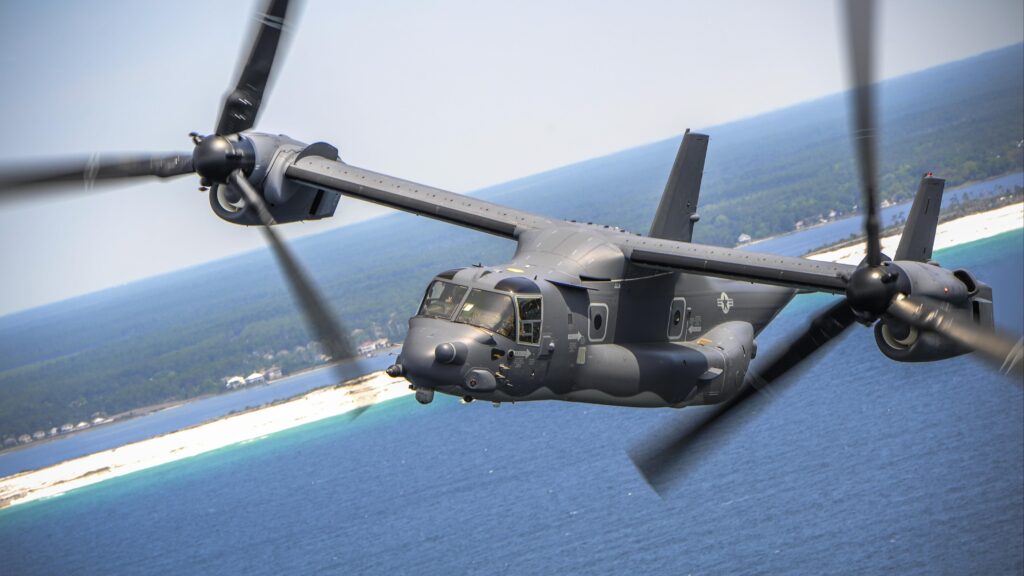
Out of an abundance of caution, following the AFSOC operational stand down, NAVAIR is instituting a grounding bulletin for all V-22 Osprey variants Dec. 6. This decision comes after the V-22 Osprey mishap on Nov. 29, off the shore of Yakushima, Japan. 

Preliminary investigation information indicates a potential materiel failure caused the mishap, but the underlying cause of the failure is unknown at this time. While the mishap remains under investigation, we are implementing additional risk mitigation controls to ensure the safety of our service members. 

The Joint Program Office continues to communicate and collaborate with all V-22 stakeholders and customers, including allied partners. 

The safety of pilots and air crews is our number one priority. For more information, please contact, NAVAIR Public Affairs: [email protected]


NOAA, U.S. Navy award construction contract for new NOAA Marine Operations Center

Release from NOAA 

***** 

BY Keeley Belva, Dec. 5, 2023 

Today, the U.S. Navy, on behalf of NOAA, has awarded $146,778,932 to Skanska USA, from New York, to design and build a new NOAA facility on Naval Station Newport in Rhode Island. This facility will eventually be the new home of NOAA’s Marine Operations Center – Atlantic.  

While the details of the facility’s design are still being finalized, requirements include having a pier that will accommodate four large vessels, a floating dock for smaller vessels, space for vessel repairs and parking and a building to be used for shoreside support and as a warehouse. Construction is anticipated to be completed by 2027.  

 “The Biden-Harris Administration’s Inflation Reduction Act, a key pillar of Bidenomics, has made it possible for NOAA to make more crucial investments in infrastructure over the coming decade,” said U.S. Secretary of Commerce Gina Raimondo. “As we work to combat the climate crisis, building climate resilient facilities, like this one in Rhode Island, is critical to ensuring our infrastructure stands the test of time.” 

The design and construction of the facility is funded in part by the Inflation Reduction Act — a historic $3.3 billion investment to help communities, including tribes and vulnerable populations, prepare, adapt and build resilience to weather and climate events in pursuit of a climate-ready nation. The act also supports improvements to weather and climate data and services, and strengthens NOAA’s fleet of research airplanes and ships.  

“By co-locating with Naval Station Newport, we are able to make our ship operations more efficient and increase long-term cost savings through sharing common capabilities,” said NOAA Corps Rear Admiral Nancy Hann, director of NOAA Marine and Aviation Operations and the NOAA Commissioned Officer Corps. “We are excited to take this step in creating a state-of-the-art marine operations center for NOAA in Rhode Island.” 

“Naval Station Newport looks forward to continuing its support for the missions of NOAA from our installation waterfront,” stated Capt. Henry Roenke, the installation commander. “An expanded NOAA footprint here punctuates the value and diversity of the missions and partners at the base and makes the Naval Station a vital community and asset for military and non-military operations.” 

The center and ships are an operational component of NOAA Marine and Aviation Operations. The ships in NOAA’s Atlantic fleet collect data essential to protecting marine mammals, coral reefs and historic shipwrecks, managing commercial fisheries, understanding climate change and producing nautical charts that help keep mariners safe. NOAA ships also deploy and help maintain buoys that gather oceanographic and weather information and warn of tsunamis. 

“I’ve been proud to work with Secretary Raimondo and her predecessors over several years to secure the commitment and the funding to create this hub for ocean research at Naval Station Newport. This announcement marks another win for the Ocean State, for NOAA, and for local workers as we develop our Blue Economy. Soon we’ll be able to put steel in the ground and put Rhode Islanders to work,” said Senator Reed, who has worked with NOAA for over a decade to develop a permanent NOAA homeport and marine operations center in Rhode Island.” 

“Thanks to Democrats’ Inflation Reduction Act and Senator Reed’s leadership, we’re bringing NOAA’s new Atlantic Marine Operations Center to beautiful Newport, Rhode Island,”  said Senator Sheldon Whitehouse. “This new facility will support our Atlantic fleet in the collection of data that protects marine animals and ocean ecosystems, and advances our understanding of the effects of climate change on the oceans.” 

“I am thrilled that a brand-new home for NOAA’s Atlantic Marine Operations Center is going to be right here in the First Congressional District on Naval Station Newport. This facility will be an economic boon to the Ocean State for years to come,” said Congressman Gabe Amo. “Due to the historic passage of the Inflation Reduction Act by Congressional Democrats, Rhode Island will accelerate its leadership in our nation’s efforts to combat climate change, build new climate resilient infrastructure, and improve our national security and non-military operations. I want to express my gratitude for the work of Senator Jack Reed and Secretary Gina Raimondo for helping to bring this new facility to our district. I am committed to continuing to work together to support this project as it moves forward.” 

This contract was awarded following a request for proposals that was open from January to August 2023.  

NOAA’s fleet of 15 research and survey ships are operated, managed and maintained by NOAA Marine and Aviation Operations. Ranging from large oceanographic research vessels capable of exploring the world’s deepest ocean, to smaller ships responsible for charting the shallow bays and inlets of the U.S. The fleet supports a wide range of marine activities, including fisheries surveys, nautical charting and ocean and climate studies. NOAA ships are operated by NOAA Corps officers and civilian professional mariners.  


Navy to complete rapid delivery of new counter-UAS system to Ukraine

Release from Naval Air Systems Command 

***** 

Dec 6, 2023 

NAVAL AIR SYSTEMS COMMAND, PATUXENT RIVER, Md.–The Navy will complete the delivery of a new Counter-Unmanned Air System (UAS) weapon system to Ukraine this month as part of the Department of Defense aid package. 

Last year, the contingency operations team for the Direct and Time Sensitive Strike program office (PMA-242) began working an urgent requirement to deliver rocket-launching platforms, known as Vehicle Agnostic Modular Palletized ISR Rocket Equipment (VAMPIRE) systems, to support wartime efforts in Ukraine. 

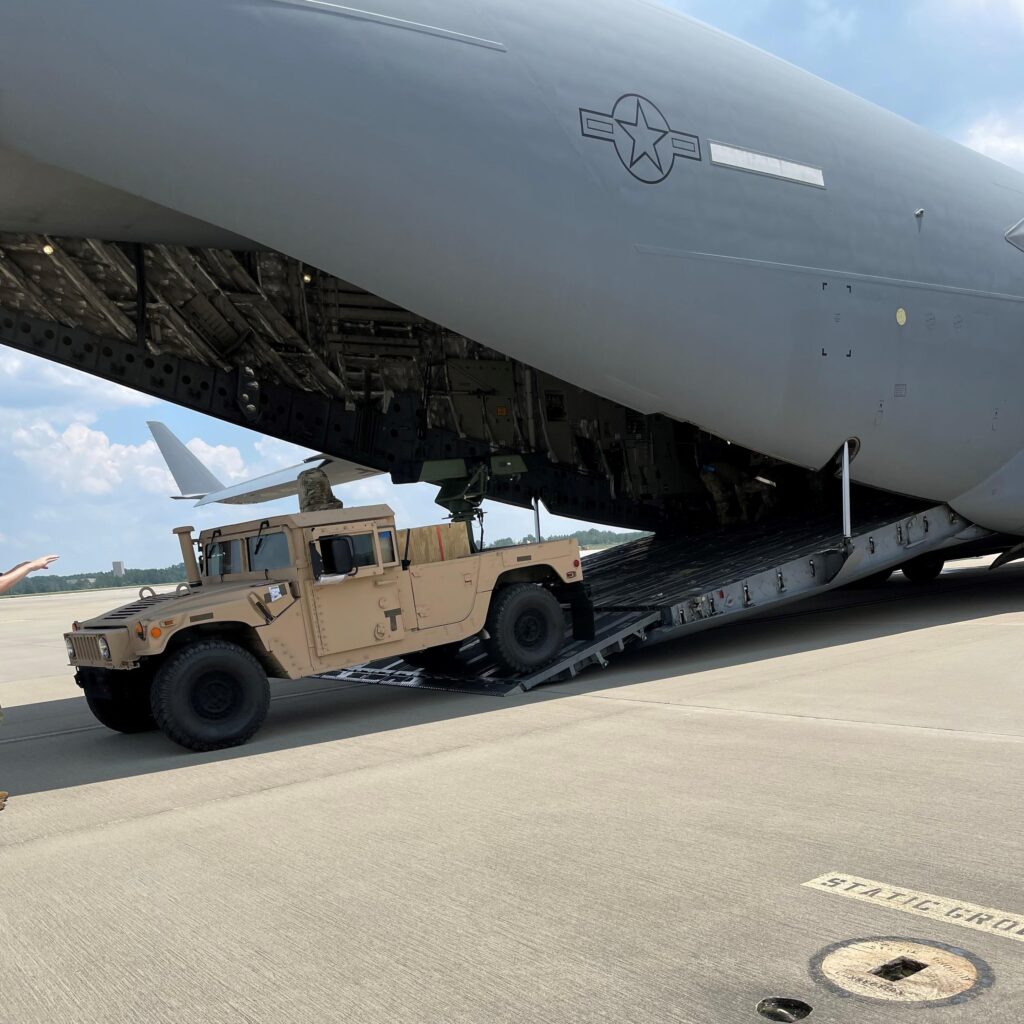
VAMPIRE is a compact, palletized rocket-launching platform that consists of a sensor ball and four-shot Advanced Precision Kill Weapon System (APKWS) launchers designed to mount to any truck with a flatbed.  The U.S. Navy and Army have traditionally against air-to-ground targets. With VAMPIRE, the laser-guided rocket can defend against unmanned aerial threats. 

“We delivered the first four systems in only six months by leveraging an innovative contracting strategy and working diligently to keep pace with the system’s rapid development,” said Cmdr. Kevin Raspet, PMA-242 foreign military sales deputy program manager. 

PMA-242’s Contingency Operations Case Manager Robert Galan said the team had placed a heavy emphasis on speed to the warfighter and was able to explore several contracting authorities to streamline the process and focus on building and delivering an operationally effective system. 

In coming weeks, the PMA-242 CO team also plans to deliver the first ever APKWS with proximity fuze warheads, a key enabling technology for the C-UAS mission, Galan said. The proximity fuze incorporates an RF sensor that enables APKWS to target Group 2 and Group 3 UAVs. 

“Early reports indicate the weapon system is having an immediate impact in the ongoing Ukrainian wartime effort,” said Capt. Alex Dutko, PMA-242 program manager. “This activity is another example of our team responding to urgent requirements with unprecedented speed and agility.” 

PMA-242 will deliver 14 VAMPIRE systems to Ukraine’s ground forces for targeting and neutralizing UAVs and defending against ground threats.