Navy to Christen Amphibious Assault Ship Bougainville
Release from the U.S. Department of Defense 

***** 

Dec. 1, 2023  

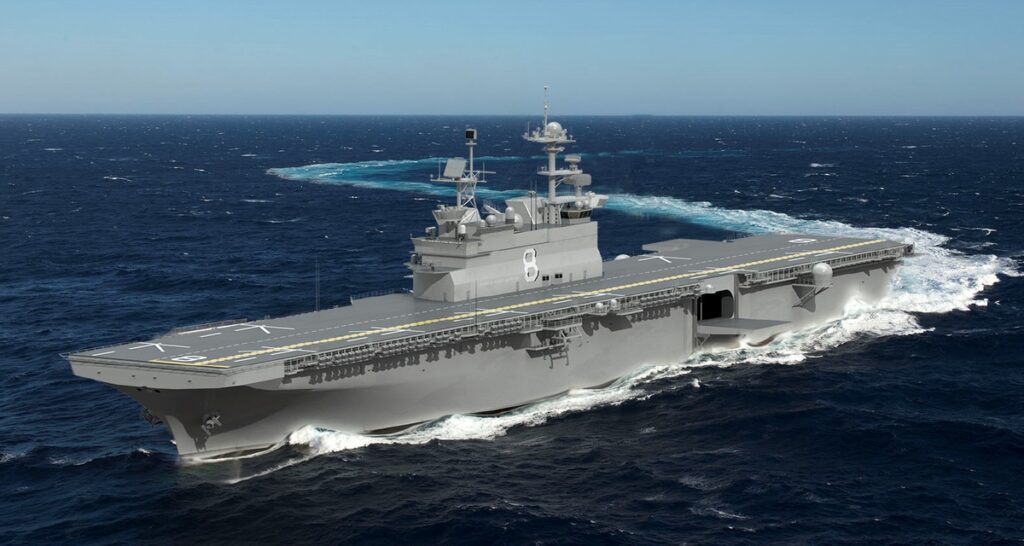
The Navy will christen its newest America-class amphibious assault ship, the future USS Bougainville (LHA 8), during a 9 a.m. CST ceremony Saturday, Dec. 2, in Pascagoula, Mississippi. 

Under Secretary of the Navy Eric Raven will deliver the christening ceremony’s principal address. Remarks will also be provided by Vice Adm. Del Crandall Jr., Judge Advocate General of the Navy, Maj. Gen. James H. Adams III and Mrs. Kari Wilkinson, Executive Vice President of HII and President of Ingalls Shipbuilding. The ship’s sponsor is Mrs. Ellyn Dunford, wife of Gen. Joseph F. Dunford Jr., USMC (Ret.), 19th Chairman of the Joint Chiefs of Staff and 36th Commandant of the Marine Corps. 

Bougainville is the third ship of the America-class of amphibious assault ships built to facilitate forward presence and power projection. LHA 8 is the first Flight I ship of the America-class with a reincorporated well deck to increase operational flexibility while maximizing the aviation capability inherent on the Flight 0 ships, USS America (LHA 6) and USS Tripoli (LHA 7).  

Designed to support the Marine Corps tenets of Operational Maneuver from the Sea and Ship to Objective Maneuver, America class ships are capable of rapid combat power buildup ashore. The America class also accommodates the Marine Corps’ Air Combat Element including F-35B Joint Strike Fighter and MV-22 Osprey, essential to maintaining power projection, air superiority and theater logistics.   

LHA 8 is the second Navy ship to be named Bougainville. The name honors and commemorates the site of a major World War II campaign during which Navy and Marine Corps forces captured the Island of Bougainville, isolating Japan’s Rabaul air base and assisting in providing an advantage to the Allied forces.  

The ceremony will be live streamed at: https://youtube.com/live/H-NPeY_NZ_I?feature=share and https://fb.me/e/3QC53JWbD. The links becomes active approximately 30 minutes prior to the event at 9:50 a.m. CST. 

Media may direct queries to the Navy Office of Information at (703) 697-5342. More information on the amphibious assault ship program can be found at: https://www.navy.mil/Resources/Fact-Files/Display-FactFiles/Article/2169814/amphibious-assault-ships-lhdlhar/ 


Combined Multinational Effort Averts Attempted Seizure in the Gulf of Aden

Release from U.S. Naval Forces Central Command Public Affairs  

***** 

By U.S. Naval Forces Central Command Public Affairs | November 30, 2023 

MANAMA, Bahrain – A combined naval effort between multiple nations thwarted an attempted seizure of an oil tanker in the Gulf of Aden, Nov. 26. 

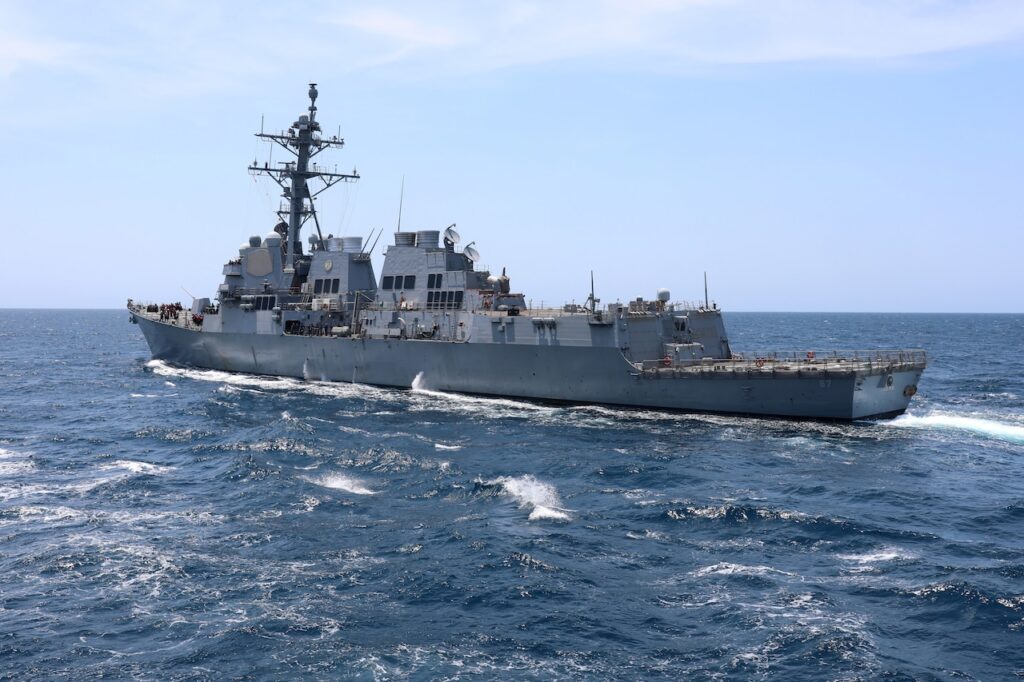
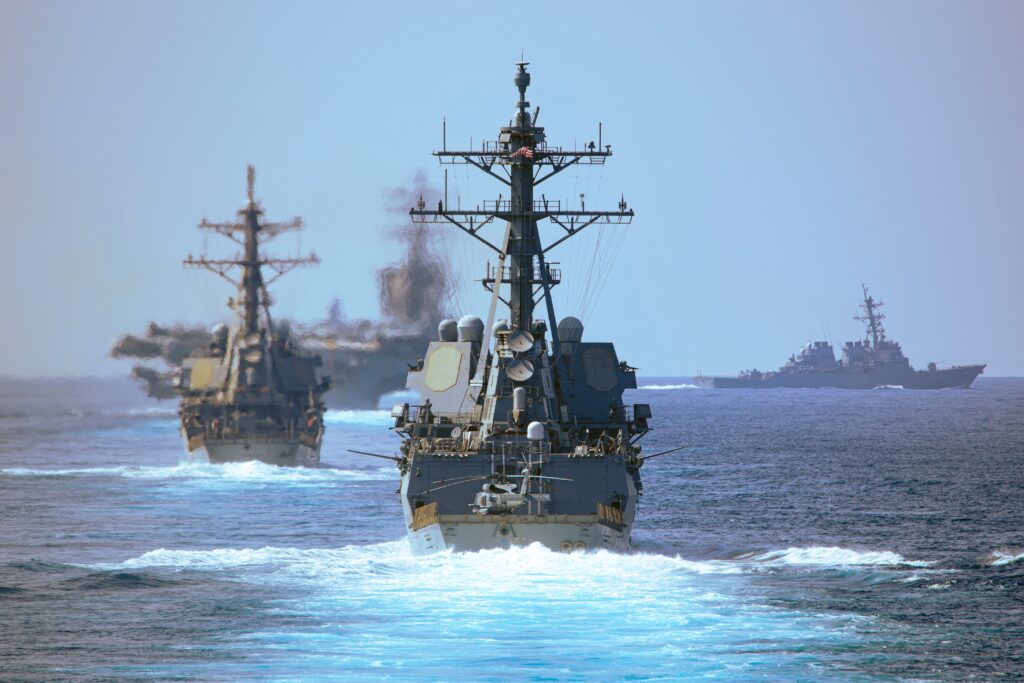
The Arleigh Burke-class guided-missile destroyer USS Mason (DDG 87) assigned to Task Force (TF) 55, a P8 patrol and reconnaissance aircraft from TF-57, a Japan Maritime Self-Defense Force destroyer JS Akebono (DD 108), a JMSDF P-3C maritime surveillance aircraft, and the Republic of Korea Navy destroyer ROKS Yang Man-chun (DDH 973), all working with Combined Maritime Forces’ Philippine-led Combined Task Force (CTF) 151, responded to reports of a seizure of the M/V Central Park, an oil tanker, as the ship was transiting in international waters. 

Working in coordination with U.S. Naval Forces Central Command, the aircraft kept a watchful eye on events until surface units could converge on Central Park’s location. After several hours the perpetrators, unable to gain control of the ship, abandoned the vessel and attempted to escape on their skiff. 

Tracking their movements, the international force cornered the skiff and the individuals surrendered to Sailors from Mason and were taken into custody in accordance with international law. 

“This was an international effort and the textbook definition of teamwork,” said Vice Adm. Brad Cooper, NAVCENT commander. “We remain deeply committed to ensuring maritime security to support the free flow of commerce and safe navigation.” 

U.S. Naval Forces Central Command/U.S. 5th Fleet’s area of operations encompasses about 2.5 million square miles of water area and includes the Arabian Gulf, Red Sea, Gulf of Oman, Gulf of Aden, Arabian Sea and parts of the Indian Ocean. This expanse, comprising 21 nations, includes three critical choke points at the Strait of Hormuz, the Suez Canal and the Strait of Bab al Mandeb. 


Iranian UAV Creates Safety-of-Flight Risk to IKE Carrier Strike Group in Arabian Gulf

***** 

U.S. Naval Forces Central Command public affairs 

MANAMA, Bahrain – Statement from the commander of U.S. Naval Forces Central Command, Vice Adm. Brad Cooper: 

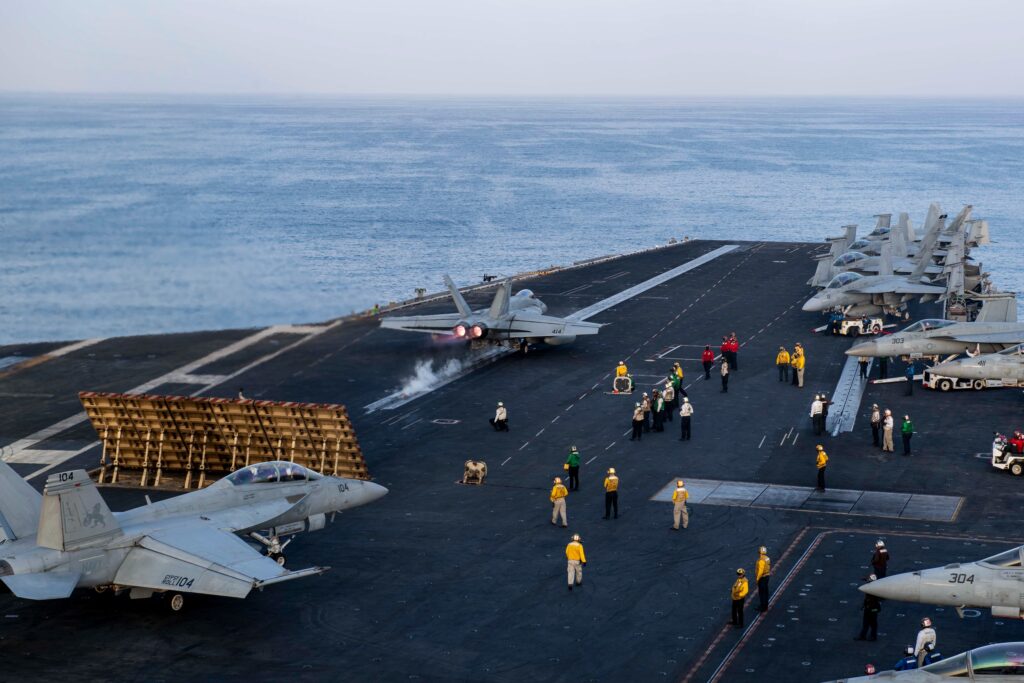
“Iranian unmanned aircraft took unsafe and unprofessional actions near USS Dwight D. Eisenhower (CVN 69) (IKE) during the course of routine flight operations in international waters, Nov. 28. 

“The Dwight D. Eisenhower Carrier Strike Group (IKECSG) was conducting routine flight operations in the international waters of the Central Arabian Gulf when it detected an unmanned aerial vehicle (UAV). The UAV was visually identified as Iranian. Its closest point of approach to IKE was approximately 1,500 yards. Multiple hails and warnings were ignored by Iran. 

“This Iranian action violated safety precautions outlined in a daily Notice to Airmen (NOTAM). The NOTAM directed manned and unmanned aircraft to remain greater than 10 nautical miles from the aircraft carrier in order to ensure safety of flight of military and civilian aviation. 

“No injuries were reported and no aircraft was damaged. 

“This unsafe, unprofessional, and irresponsible behavior by Iran risks U.S. and partner nation lives and needs to cease immediately. 

“U.S. naval forces remain vigilant and will continue to fly, sail and operate anywhere international law allows while promoting regional maritime security.” 


Littoral Combat Ship, Unmanned Systems Pair Up to Advance Lethality in the Middle East

Release from U.S. Naval Forces Central Command Public Affairs 

***** 

By Mass Communication Specialist 2nd Class Jacob Vernier | November 29, 2023 

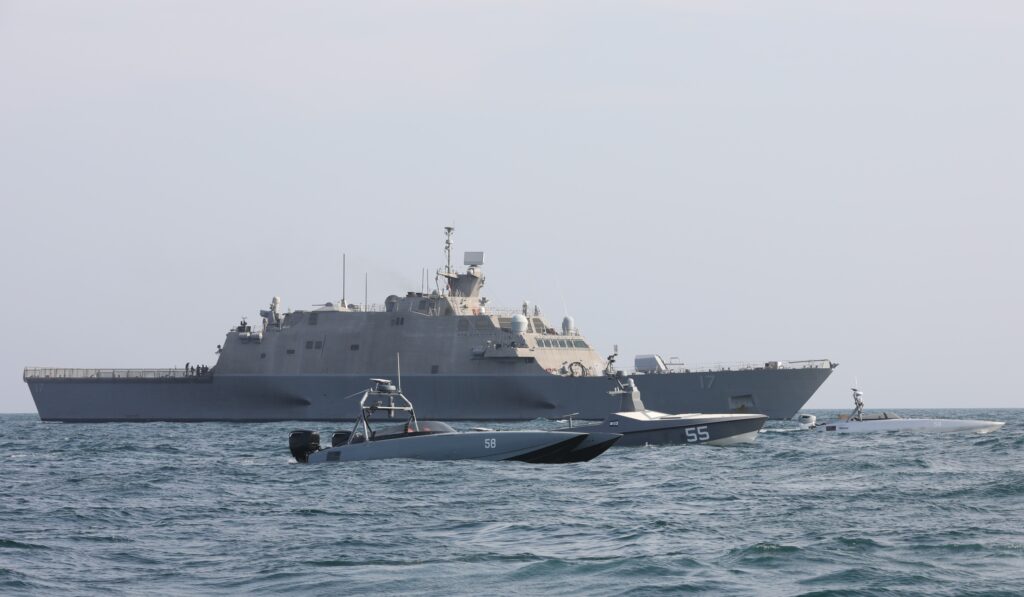
MANAMA, Bahrain — U.S. Naval Forces Central Command (NAVCENT) continues advancing lethality at sea, utilizing the Freedom-class littoral combat ship USS Indianapolis (LCS 17) as a staging base and command center for a host of unmanned systems during live weapons firing exercises in the international waters of the central Arabian Gulf, Nov. 27. 

Digital Talon 2.0, the second exercise of its type in as many months, showcased “manned-unmanned teaming” by meshing together Indianapolis, three unmanned surface vehicles, and an unmanned aerial vehicle to create a single common operating picture and what is known as a “mesh network” providing targeting data to all stations taking part in the exercise. 

NAVCENT’s Task Force 59 – the Navy’s first Unmanned and Artificial Intelligence Task Force – partnered with Indianapolis to demonstrate the ability of unmanned platforms to pair with traditionally crewed ships. The manned and unmanned teams identified, targeted, engaged and then destroyed simulated hostile forces at sea, represented through the use of a target boat. 

“This second iteration of Digital Talon continues building on our earlier successes,” said Capt. Colin Corridan, TF-59 commodore. “We keep progressing toward fulfilling NAVCENT’s priorities of deterrence and de-escalation by demonstrating live firing from a tight ‘manned-unmanned teaming’ model.” 

In multiple firing events, a T-38 Devil Ray unmanned surface vessel (USV), equipped with a Lethal Miniature Aerial Missile System, and successfully scored direct hits on the target boat each time. As with the previous Digital Talon exercise, a human operator ashore at TF-59’s Robotics Operations Center made the engagement decisions. 

The unmanned vehicles taking part in the exercise included a Flexrotor unmanned aerial vehicle; an Arabian Fox MAST-13 USV; and an additional T-38 Devil Ray USV. 

Digital Talon 2.0 took a significant step forward, Collidan said, noting the results from this event, “have proven these unmanned platforms paired with our manned combat ships can enhance fleet lethality. In doing so, we are strengthening regional maritime security and enhancing deterrence against malign activity.” 

U.S. Naval Forces Central Command/U.S. 5th Fleet’s area of operations encompasses about 2.5 million square miles of water area and includes the Arabian Gulf, Red Sea, Gulf of Oman, Gulf of Aden, Arabian Sea and parts of the Indian Ocean. This expanse, comprising 21 nations, includes three critical choke points at the Strait of Hormuz, the Suez Canal and the Strait of Bab al Mandeb. 


Kratos Supports Successful US Navy and MDA Intercept Test Against Multiple Ballistic Missile and Anti-Ship Cruise Missile Targets

Release from Kratos Defense & Security 

***** 

November 27, 2023 at 8:00 AM EST 

SAN DIEGO, Nov. 27, 2023 (GLOBE NEWSWIRE) – Kratos Defense & Security Solutions, Inc. (NASDAQ: KTOS), a Technology Company in the Defense, National Security and Global Markets, announced today that its Defense & Rocket Systems business supported the successful intercept test of two Short-Range Ballistic Missile (SRBM) targets, known as Aegis Readiness Assessment Vehicle (ARAV) by two Standard Missile 3 Block IA (SM-3 Blk IA) interceptors during the test event Vigilant Wyvern, also known as Flight Test Aegis Weapon System-48 (FTM-48). The successful test demonstrated the capability of a ballistic missile defense-configured Aegis ship to detect, track, engage and execute intercepts of two SRBM targets while concurrently demonstrating an Anti-Air Warfare (AAW) engagement of two subsonic anti-ship cruise missile drone targets. This live-fire, raid scenario represented one of the largest Integrated Air and Missile Defense (IAMD) events ever conducted in the U.S. Indo-Pacific Command Area of Responsibility and demonstrated for the first time a concurrent Ballistic Missile Defense and Anti-Air Warfare raid. 

The successful intercepts by the Arleigh Burke-class destroyer USS CARL M. LEVIN (DDG 120) were the highlight of the Vigilant Wyvern/FTM-48 event and the culmination of a four-week campaign during which Kratos Rocket Systems business, along with its government and industry partners, integrated and launched the two SRBM targets from the Pacific Missile Range Facility (PMRF) in Hawaii. Both ARAV target systems, which have a long-standing, successful, flight-demonstrated heritage on test and intercept missions for the U.S. Navy and MDA, executed nominal trajectories while meeting target requirements. 

“Our team works side-by-side with our government customers to deliver transformative and affordable target systems and vehicles from mission inception through successful launch operations. FTM-48, which was one of our largest recent mission campaigns, is just the latest example of this successful partnership,” said Dave Carter, President of Kratos Rocket Systems Division. “Kratos’ affordable systems allow our customers to cost effectively effect multi system raid scenarios like Vigilant Wyvern, and we are grateful to be able to continue supporting the U.S. DoD and its allies in this very important mission area.” 

The BQM is a sub-sonic aerial target, capable of speeds greater than .09 Mach and minimum altitude of 6.6 feet, and has no equal when it comes to delivering realistic anti-ship missile threat emulation. 

Kratos is a leading provider of products, solutions, and services supporting ballistic missile defense for Aegis Weapon System, hypersonic testing, atmospheric science research and technology maturation. 


Navy’s Second Ford CVN to Join the U.S. Pacific Fleet

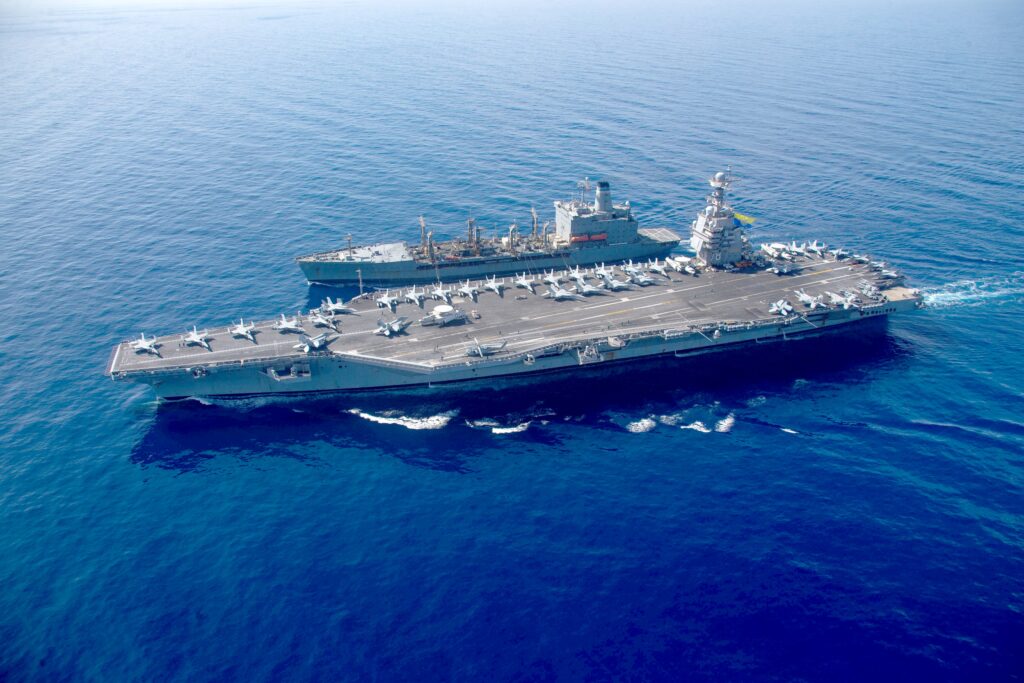
MEDITERRANEAN SEA (Oct. 11, 2023) The world’s largest aircraft carrier USS Gerald R. Ford (CVN 78) refuels from the underway replenishment oiler USNS Laramie (T-AO 203) in the eastern Mediterranean Sea, Oct. 11, 2023. The second Ford-class CVN, the future USS John F. Kennedy (CVN 79), will become a unit of the U.S. Pacific Fleet. (U.S. Navy photo by Mass Communication Specialist 2nd Class Jacob Mattingly)

By Richard R. Burgess, Senior Editor 

ARLINGTON, Va. — The Navy’s second Gerald R. Ford-class aircraft carrier, the future USS John F. Kennedy (CVN 79), will become a unit of the U.S. Pacific Fleet when it makes its first deployment.   

Captain Brian Metcalf, the Navy’s program manager for the Ford-class aircraft carriers, speaking Nov. 28 in a panel of the American Society of Naval Engineers’ Technology Systems and Ships seminar, said the Kennedy would be delivered to the Navy in 2025. After commissioning and training work ups, the carrier would make a deployment to the Indo-Pacific region and arrive at its new homeport on the U.S. West Coast, he said. 

Metcalf said the Kennedy is 90% complete at HII’s Newport News shipyard.  

He said that his program office plans to complete much of the Kennedy’s Post-Shakedown Availability (PSA) work — that on the USS Gerald R. Ford (CVN 78) was completed during its own PSA and added a year of delay to delivery to the fleet — would be completed on the Kennedy during its construction before commissioning and would enable the Kennedy to enter its basic training phase on time. 

The lead ship, Gerald R. Ford, is deployed to the eastern Mediterranean Sea and has had its deployment extended twice because of the Israel-Hamas War. Metcalf said the Ford’s systems, including the Electro-Magnetic Aircraft Launch System and the ship’s once-controversial weapon elevators were performing well. 

He said that maintenance and modernization work on the Ford planned for early 2024 would have to wait, given the Ford’s deployment extensions. 

The next two Ford-class CVNs—Enterprise (CVN 80) and Doris Miller (CVN 81)—did not start as a two-ship procurement but since have been combined as a program to achieve cost reductions. Metcalf said that his program office is working within the current Future Years Defense Plan to ensure that procurement of CVN 82 and CVN 83 is a two-ship procurement.   


U.S., Partner Nation Task Force Respond to Commercial Vessel Distress Call

Release from the U.S. Department of Defense 

***** 

Nov. 27, 2023 | By C. Todd Lopez  

This weekend, the USS Mason and partner nation naval vessels responded to a distress call from the commercial shipping vessel M/V Central Park, which had been boarded by five armed individuals while in transit in the Gulf of Aden near Yemen, said the Pentagon press secretary. 

“[The Central Park] was boarded by these five individuals. They attempted to access the crew cabin,” Air Force Brig. Gen. Pat Ryder said this morning during a meeting with the Pentagon press corps. “The crew, essentially, [was] able to lock themselves into a safe haven. These individuals attempted to access and take control of the ship.”  

The crew of the Central Park issued the distress call on the evening of Nov. 26. The distress call was responded to by the USS Mason, allied ships and associated aircraft which are part of Combined Task Force 151. That task force conducts counter-piracy missions.  

After the arrival of the USS Mason and partners with CTF 151, task force personnel demanded the release of the Central Park, Ryder said. The five armed individuals then disembarked the vessel and fled in a small boat.  

“After the five individuals fled, the Mason sent out a visit, board, search and seizure team on the water that stopped the small boat. They detained the individuals, and then … the VBSS team boarded the Central Park and cleared the vessel,” Ryder said, adding that the Central Park crew was found to be safe following the incident.  

While the identity of the five armed attackers was not yet confirmed at the time of the morning news briefing, Ryder said initial indications are that the individuals are Somali. All five are currently being held aboard the USS Mason.  

Hours later, early in the morning of Nov. 27, Yemen time, two ballistic missiles were fired toward the general location of the Mason and the Central Park.  

“Initial indications were that two ballistic missiles were fired from Houthi-controlled areas in Yemen, toward the general location of the Mason and the Central Park,” Ryder said. “The missiles landed in the Gulf of Aden, approximately 10 nautical miles from the ships. It is not clear at this time what they were targeting.”  

Ryder said that neither the USS Mason nor the Central Park were damaged by the missiles and that the Central Park is now back under power and on its way.  


Navy Defuels P-8A Poseidon in Kaneohe Bay

Release from Commander, 3rd Fleet Public Affairs 

***** 

28 November 2023 

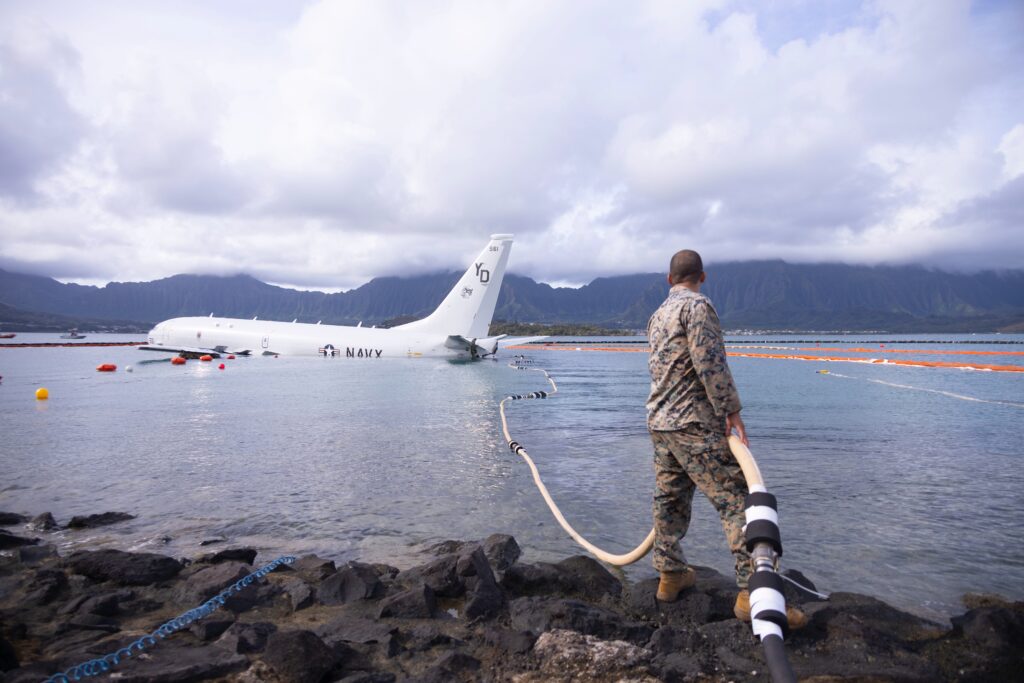
KANEOHE BAY, Hawaii —The Navy on Sunday completed a key first step in recovering its P-8A from the bay by removing much of the fuel from the jet aircraft, the on-scene commander told reporters today. 

“Yesterday, the team executed a slow and methodical defueling process,” said Rear Adm. Kevin P. Lenox, who is also commander of Carrier Strike Group 3. “This was done to minimize the risk of environmental harm in the follow-on salvage process. We estimated that the aircraft had just over 2,000 gallons of fuel on board andthe team extracted all the fuel that would come out.The process was completed successfully without any fuel being released into the bay.” 

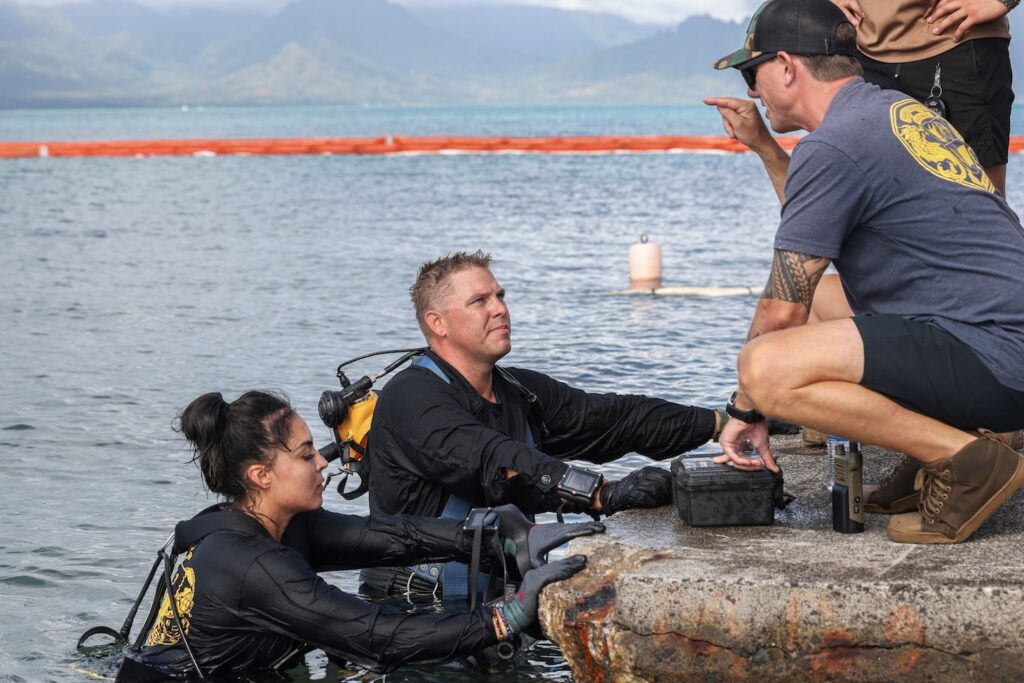
To prepare for that process, Navy divers went to Joint Base Pearl Harbor-Hickam to familiarize themselves with the P-8A Poseidonand practice connecting and disconnecting the fuel lines.The divers also conducted a hydrographic survey to better assess the coral and marine environment around the aircraft. 

“This team has been singularly focused on developing a salvage plan for this aircraft that prioritizes the safety of personnel and the environment here inKaneohe Bay,” said Lenox.“We tested the fuel today to make sure what came out didn’t have any water in it, and it was basically perfect fuel. We could actually put that in another plane and it would be good to go.” 

Col. Jeremy Beaven, commanding officer, Marine Corps Base Hawaii, and Cmdr. Mark Anderson, commanding officer, Mobile Diving and Salvage Unit 1, also addressed the media. 

“Within minutes [of the mishap] our Waterfront Operations team was postured and responding to ensure there were no deleterious effects on the environment,” said Beaven. “As the subsequent days have gone, our posture from the initial stages has just improved daily and that’s been in coordination with some of our state agencies helping us to get to what right looks like. 

”The on-scene commander also noted an Aviation Mishap Board is on site, and an administrative investigation led by a senior naval officer in the Maritime Patroland Reconnaissance Force from outside the chain of command of the aircraft crew in question, has been designated and began review of investigation materials. 

“The Navy is committed to learning from this investigation, regardless of the cause,” said Lenox.“Theselessons be valuable in preventing such incidents going forward and making us better.” 

The P-8A crew, assigned to Whidbey Island, Washington-based Patrol Squadron (VP) 4 “Skinny Dragons,” was on a detachment in support of maritime homeland defense. There were nine crewmembers on board –three pilots and six crewmembers (two officer and four enlisted). All crewmembers safely evacuated the aircraft and no injuries were reported. A P-8A and crew assigned to VP-40 “Fighting Marlins” arrived in Hawaii Nov. 22,to assume homeland defense coverage. 

More information will be released as it becomes available. 

The U.S. Navy fact file on the P-8A Poseidon can be found at the following link: https://www.navy.mil/Resources/Fact-Files/Display-FactFiles/Article/2166300/p-8a-poseidonmultimission-maritime-aircraft-mma/ 


IKE STRIKE GROUP TRANSITS THE STRAIT OF HORMUZ

Release from Commander U.S. Naval Forces Central Command Public Affairs 

***** 

27 November 2023 

ARABIAN GULF – The Dwight D. Eisenhower Carrier Strike Group (IKECSG) completed a scheduled transit through the Strait of Hormuz into the Arabian Gulf, Nov. 26. 

“Our passage through this important strait and continued presence in the area plays a critical role in maintaining the freedom of navigation that is key to regional security and stability,” said Rear Adm. Marc Miguez, commander, Carrier Strike Group (CSG) 2, IKECSG. “I am incredibly proud of the sustained professionalism of each IKECSG Sailor, especially in evolutions like a strait transit, where detailed planning, precision navigation and the proficiency of our warfighting teams are on full display.” 

The Strait of Hormuz is one of the busiest shipping lanes, with one-fifth of the world’s energy supply transiting through the strait annually. This waterway is critical to ensuring and safeguarding the stability of global commerce. 

More than 500 ships sail through the Strait of Hormuz in a typical week, a steady flow of maritime traffic crucial to the vitality of the nations in the Middle East region. 

The aircraft carrier USS Dwight D. Eisenhower (CVN 69) (IKE) passed through the strait with the guided-missile cruiser USS Philippine Sea (CG 58), guided missile destroyers USS Gravely (DDG 107) and USS Stethem (DDG 63), and French Navy destroyer FS Languedoc (D 653) along with air support from a French Navy E-2C Hawkeye and French Air Force Rafale strike aircrafts. 

“The Mighty IKE brings unmatched capabilities wherever it goes,” said Capt. Christopher Hill, commanding officer of IKE, flagship of IKECSG. “We place ourselves where our nation’s leaders need us to be and on time, in order to meet the full range of maritime security requirements of the mission at hand.” 

The IKECSG’s transit through the Strait of Hormuz marks the first aircraft carrier to operate in the Arabian Gulf since the Nimitz Carrier Strike Group in September 2020. IKECSG presence in the U.S. 5th Fleet area of operations, where it has operated since Nov. 4, demonstrates the U.S. and its partners’ commitment to the free flow of commerce, regional security and freedom of navigation. 

The Dwight D. Eisenhower Carrier Strike Group is deployed to the U.S. 5th Fleet in support of naval operations to ensure maritime stability and security in the Middle East Region. Along with IKE, deployed strike group assets include staffs, ships and aircraft of CSG 2, Destroyer Squadron (DESRON) 22, USS Philippine Sea (CG 58) and Carrier Air Wing (CVW) 3. 

IKECSG units departed their homeports of Norfolk, Virginia, and Mayport, Florida, on Oct. 13 and 14 for a scheduled deployment. 

U.S. Naval Forces Central Command/U.S. 5th Fleet’s area of operations encompasses about 2.5 million square miles of water area and includes the Arabian Gulf, Red Sea, Gulf of Oman, Gulf of Aden, Arabian Sea and parts of the Indian Ocean. This expanse, comprising 21 nations, includes three critical choke points at the Strait of Hormuz, the Suez Canal and the Strait of Bab al Mandeb. 


Update: P-8A Poseidon in Kaneohe Bay 

Release from U.S. Third Fleet Public Affairs 

***** 

By From U.S. Third Fleet Public Affairs 

KANEOHE BAY, Hawaii  – During the Thanksgiving holiday, Nov. 23, U.S. Navy Sailors from Mobile Diving and Salvage Unit 1 were busy in and around the downed P-8A Poseidon in waters just off the runway at Marine Corps Air Station Kaneohe Bay, Marine Corps Base Hawaii, as part of the ongoing efforts to assess, investigate, and plan the safe, expeditious and environmentally protective recovery of the aircraft. 

Divers from MDSU-1’s Company 1-3 were successfully able to recover the aircraft’s flight data recorder. While on shore, conducting an assessment, were members of the recently arrived Aircraft Mishap Board, assigned to investigate the incident to determine the cause and contributing factors of the mishap. 

MDSU-1 divers also conducted a hydrographic survey around the aircraft to help further evaluate the aircraft’s structural integrity, as well as better assess the coral and marine environment around the aircraft. The survey will help the Navy plan a recovery operation that minimizes any impact to the critical ecosystem of Kaneohe Bay. 

Personnel from Naval Sea Systems Command, Supervisor of Salvage and Diving, as well as contracted salvage masters from SMIT Salvage also arrived on Oahu Wednesday to assist with the recovery planning and execution. 

In addition to the environmental protection measures previously implemented by the Navy and base personnel, members from the State of Hawaii Department of Land and Natural Resources (DLNR) are assisting the efforts to continuously monitor the marine environment around the aircraft. 

With the utmost concern for mitigating any potential environmental impacts, some of the previously reported environmental protection measures employed or are at the ready include.  

  • Primary and secondary containment booms have been deployed, encircling the entire aircraft, to protect the surrounding marine environment.  
  • Hydrophobic absorbent material was also placed as a proactive preventative measure. This material not only helps absorb any potential pollutants but also serves as an effective indicator for the presence of petroleum products, allowing for swift identification and response. 
  • A skimmer is on standby, ready to swiftly respond. This proactive measure enhances the ability to quickly remove any pollutants from the water surface, minimizing impact on the marine environment. 
  • Specially trained base personnel continue to observe and monitor the area 24-hours-a-day to watch for any changes in the environment. In addition to looking for possible pollutants, personnel are also instructed to keep watch for wildlife and are trained to report any impacted wildlife or any species of interest that are observed in the vicinity 

The P-8A crew, assigned to Whidbey Island, Washington-based Patrol Squadron (VP) 4 “Skinny Dragons,” was on a detachment in support of maritime homeland defense. There were nine crewmembers on board – three pilots and six crewmembers (two officer and four enlisted). All crewmembers safely evacuated the aircraft and no injuries were reported. A P-8A and crew assigned to VP-40 “Fighting Marlins” arrived in Hawaii today to assume homeland defense coverage. 

More information will be released as it becomes available.  

The U.S. Navy fact file on the P-8A Poseidon can be found at the following link: https://www.navy.mil/Resources/FactFiles/DisplayFactFiles/Article/2166300/p8aposeidonmultimissionmaritimeaircraftmma/