Draper awarded contract to support development of next generation Trident II Weapon System Under $2.2B Navy Contract

Release from Draper 

***** 

TUESDAY, OCTOBER 17, 2023 

CAMBRIDGE, Mass.—Draper, a company with decades of service to the U.S. Navy, announced today a $2.2 billion contract to continue the support of the Trident II D5 weapon system while also beginning development on the next generation. Under the award, Draper will support the mission of the U.S. Navy Strategic Systems Programs to provide credible sea-based strategic deterrence. The company currently serves in that role as prime contractor for the Trident II D5 guidance system under a previous contract. 

Dr. Jerry M. Wohletz, President and CEO at Draper, remarked, “Draper is proud of its long-standing relationship with U.S. Navy Strategic Systems Programs, and is excited to strengthen that partnership by supporting the modernization of the Trident weapon system to ensure its effectiveness in an era of great power competition for generations to come.” 

Draper, as strategic guidance system prime contractor for Trident, provides critical domain knowledge and cradle-to-grave responsibility for the design, production, and sustainment of the Guidance component for both the U.S. and U.K. Submarine Launched Ballistic Missile Systems.  For more than 60 years Draper has played a critical part in ensuring that the Fleet Ballistic Missiles (FBMs) deployed by the Navy’s submarines are accurate, reliable and survivable to adversarial threats. Every FBM deployed by the Navy—from Polaris A1 to Trident II D5—has been equipped with Guidance Systems designed by Draper engineers.  

“This award enables us to continue to deliver on legacy while also marking the beginning of a multi-decade development for the next generation system that will ensure the nation has a credible nuclear deterrent for generations to come,” said Robert Bacon, Vice President of Navy Strategic Systems at Draper. “With an increasingly complex geopolitical environment our expertise will once again be called up to ensure we deliver credible capabilities that outpace the advancing threats from our adversaries”. 

Work will be performed in Cambridge, Mass.; Pittsfield, Mass.; Washington, D.C; Odon, Ind.; El Segundo, Calif.; Cape Canaveral, Fla,; and St. Petersburg, Fla; and is expected to be completed by October 2028. 

This contract is a sole source acquisition pursuant to 10 U.S.C. 3204(a)(1) and was previously synopsized on the Systems for Award Management website. Strategic Systems Programs, Washington, D.C., is the contracting activity. 
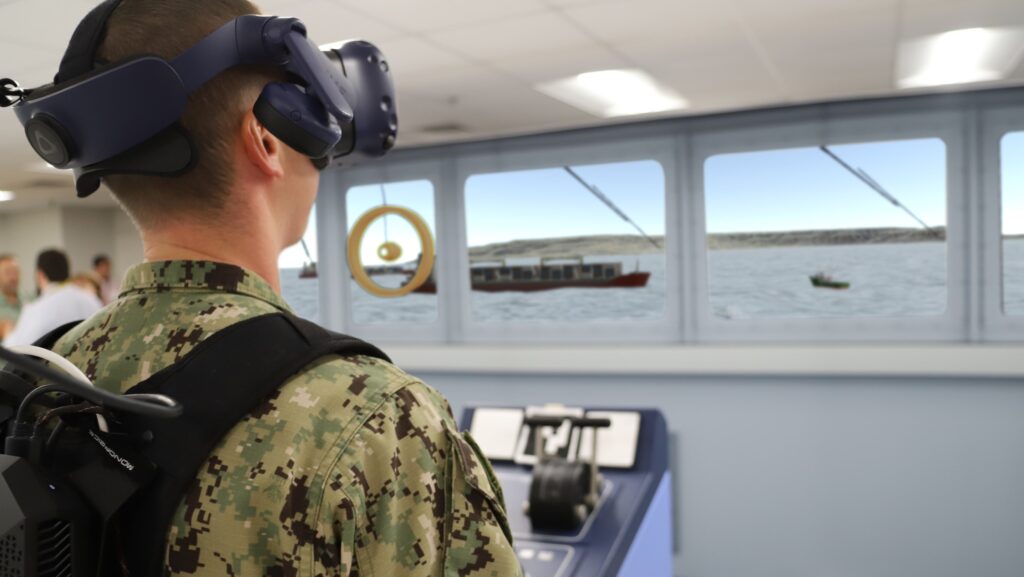


HII TO PROVIDE READINESS AND TRAINING SOFTWARE DEVELOPMENT SUPPORT FOR THE U.S. NAVY

Release from HII 

***** 

MCLEAN, Va., Oct. 19, 2023 (GLOBE NEWSWIRE) — HII’s (NYSE: HII) Mission Technologies division was awarded a $134 million contract to provide readiness and training software development support for the U.S. Navy. 

The task order was awarded under the Naval Sea Systems Command’s SeaPort Next Generation (SeaPort-NxG) contract to support the Naval Surface Warfare Center Dahlgren Division Dam Neck Activity (NSWCDD DNA). It has a one-year base period plus four one-year options. 

“Realistic training scenarios help prepare warfighters for any situation,” said Glenn Goodman, president of Mission Technologies’ LVC Solutions business group. “For more than 20 years, that has been the foundation of HII’s live, virtual and constructive training systems. We are proud to continue our support of the U.S. Navy, providing software development and engineering that contribute to combat readiness.” 

A photo accompanying this news release is available at https://hii.com/news/hii-to-provide-readiness-and-training-software-development-support-for-the-u-s-navy/ 

HII will provide requirements analysis, software engineering, development, integration and test support for the Advanced Training Domain (ATD), Battle Force Tactical Training (BFTT), BFTT Electronic Warfare Trainer (BEWT), Trainer Stimulator/Simulator Systems (TSSS) and the Combined Integrated Air and Missile Defense and Anti-Submarine Warfare Trainer (CIAT) platforms. 

In addition to this contract, HII was recently awarded the NSWCDD $242 million shore-based training, engineering and development support (SBEDS) contract. 


Autonomous Maritime Drone Manufacturer Ocean Aero Opens 63,000-Square-Foot Facility on Gulf Coast 

Release from Ocean Aero 

***** 

GULFPORT, Miss.–(BUSINESS WIRE)–Ocean Aero announces the opening of their new headquarters and manufacturing facility located at the Port of Gulfport on the Mississippi Gulf Coast. With 63,000 square feet of state-of-the-art production capacity, the new Ocean Aero facility represents America’s latest addition to the industrial manufacturing base. The facility opens with 60 employees and will hire another 15 full-time positions before the end of the year. 

Representing the first phase of Ocean Aero’s manufacturing expansions, the facility will enable the production of up to 150 Tritons per year. Annex options adjacent to the facility have the opportunity to produce another 450 Tritons per year. 

“We’re very proud of what the team has accomplished in our two years located in Mississippi and are looking forward to an even brighter future,” said Ocean Aero CEO Kevin Decker. “The timing couldn’t be better to add to our production base given the recent announcement of Replicator and other ongoing programs championed at both the U.S. Navy and DoD levels.” 

Ocean Aero has been consistently working with the U.S. Navy and many of its constituents around the world since moving to Mississippi. It is an international exporter and has engaged with NOAA as well as a number of universities to conduct scientific services. 

“The talent of our employees from the Mississippi area, the support we have received from the Gulf Blue ecosystem, and the unwavering dedication of the Mississippi elected officials have exceeded our expectations in every way. We’re honored to be citizens of the local community,” said Decker. 

The company drew support from a host of Mississippi’s political leadership, including the Mississippi Development Authority, the Harrison County Development Commission, Mississippi Power, the University of Southern Mississippi, and the Port of Gulfport. This opening culminates a years-long process championed by Senator Cindy Hyde-Smith and Senator Roger Wicker. 

“The opening of Ocean Aero’s state-of-the-art facility on the Mississippi Gulf Coast marks a significant milestone in the journey toward a sustainable and thriving blue economy. By harnessing the potential of our coastal resources, Ocean Aero exemplifies the spirit of innovation and environmental stewardship,” said Mississippi Development Authority Deputy Executive Director Laura Hipp. “The company’s commitment to advancing marine technology not only positions Mississippi as a leader within the blue economy, it underscores the crucial role of our oceans in R&D and in shaping the future of our economy as a whole. MDA congratulates the Ocean Aero team on the opening of this new facility and looks forwards to the company’s continued progress on the Gulf Coast.” 

About Ocean Aero 

Ocean Aero creates, manufactures, and distributes advanced unmanned ocean systems technology. Its signature product—The Triton—is the world’s first and only environmentally-powered Autonomous Underwater and Surface Vehicle (AUSV). The Triton both sails and submerges for unparalleled ocean data collection with ready-to-deploy packages and custom payloads for an array of applications. Ocean Aero brings the ocean and its data to you, with novel hardware and software that is revolutionizing maritime exploration. 


Service Chiefs from US Navy, Royal Navy, and US Marine Corps Sign Revised Strategic Charter, Strengthening the Special Relationship 

Release from Vice Chief of Naval Operations Public Affairs 

***** 

Oct. 18, 2023 

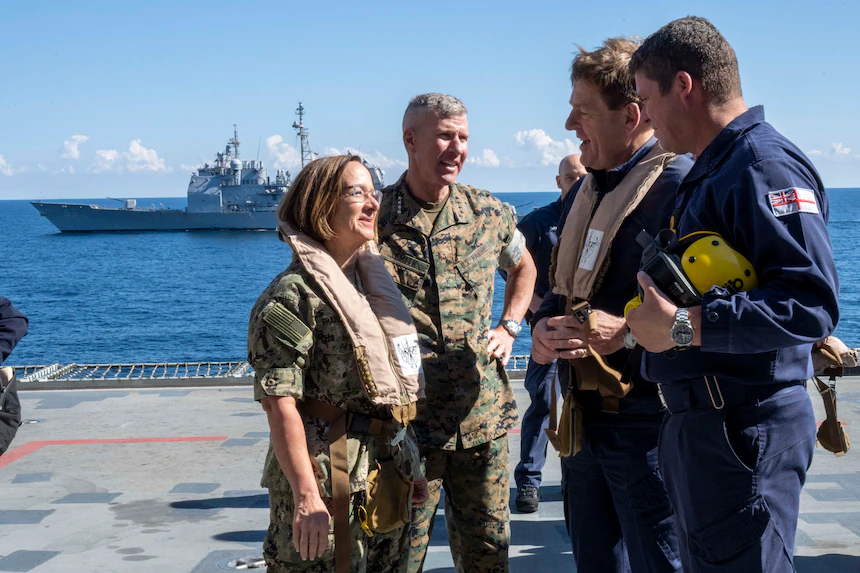
ATLANTIC OCEAN – Vice Chief of Naval Operations Adm. Lisa Franchetti and Commandant of the Marine Corps Gen. Eric Smith embarked HMS Prince of Wales (PWLS) and met with Royal Navy First Sea Lord and Chief of Naval Staff Adm. Sir Ben Key to sign an updated strategic charter, Oct. 18. 

The charter, known as “Delivering Combined Seapower” or DCS, is a bilateral tri-service strategic approach plan that supports cooperation, collaboration, and integration among U.S. and U.K. maritime services.  

First signed in 2014, DCS was introduced to build and sustain interoperability between the U.S. and U.K. fleets. 

The updated document includes a shared vision to enable the next level of interoperability the joint force requires, acceleration of U.S.-U.K. interchangeability, and underscores the collective dedication to safeguarding global maritime interests and promoting a rules-based international order. 

“‘Delivering’ is the key word here,” said Franchetti.  “The U.S. and U.K are providing real, operationally relevant capabilities that are making a difference on the oceans every single day.  This document reflects the significant progress we’ve made since the original charter nine years ago and clearly articulates how we will advance and expand our interchangeability and deliver combined seapower going forward.” 

Key emphasized the importance of this renewed alliance, “This Charter is testament to the enduring strength of the relationship between our navies and marines. By aligning our strategies and capabilities, we strengthen our ability to deter threats, respond to crises, and promote stability across the world’s oceans. This partnership will undoubtedly enhance our collective effectiveness, create opportunities to work ever more closely together, and promote our shared values.” 

Although the U.S. Marine Corps has participated in U.S.- U.K. DCS Strategic Dialogues, this revision marks the first time the U.S. Marine Corps has been formally incorporated into the charter. 

“I’m proud to be in this endeavor with Adm. Franchetti and Adm. Key,” said Smith. “Both countries’ Marines and Sailors have long-enjoyed a unique bond. We need to continue moving toward full interoperability, which includes maximizing our information sharing, training on each other’s platforms, and finding novel ways to integrate at the staff and warfighter level. This charter is a real step forward toward that goal.”  

 
Throughout the days’ events the leaders observed a demonstration of F-35B operations onboard HMS PWLS, and discussed maritime strategies, warfighting concepts, and future force design.  

The U.S. and U.K. naval forces regularly operate together around the globe, and Franchetti and Smith last met with Key in September at the 25th International Seapower Symposium in Newport, Rhode Island.  


USS Mount Whitney Departs Homeport for Eastern Mediterranean

Release from U.S. 6th Fleet 

***** 

By Mass Communication Specialist 2nd Class Mario Coto, USS Mount Whitney (LCC 20) 

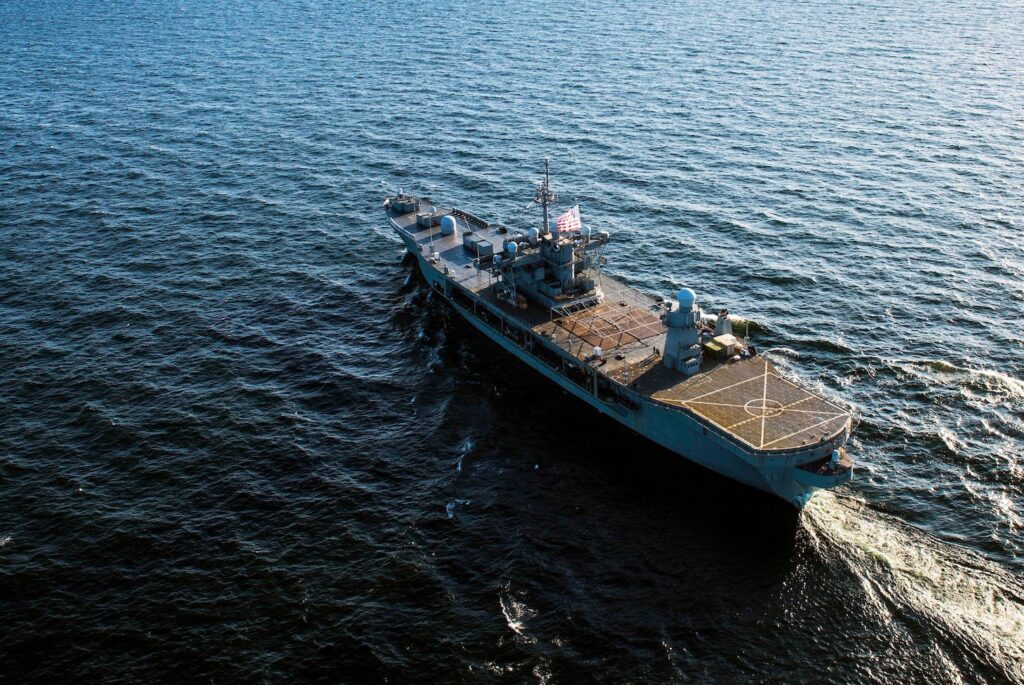
GAETA, Italy – The U.S. 6th Fleet Blue Ridge-class command and control ship USS Mount Whitney (LCC 20) departed Gaeta, Italy, Oct. 18, 2023, in support of U.S. operations in the eastern Mediterranean Sea. 

Mount Whitney is forward deployed to the U.S. European Command area of responsibility where it engages with Allies and partners in support of maritime operations, which encompasses naval diplomacy and national efforts to build comprehensive U.S. and Allied maritime power. 

The ship operates with a combined crew of U.S. Sailors and Military Sealift Command civil service mariners in the U.S. 6th Fleet area of operations in support of U.S. national security interests in Europe and Africa. 

Headquartered in Naples, Italy, NAVEUR-NAVAF operates U.S. naval forces in the U.S. European Command (USEUCOM) and U.S. Africa Command (USAFRICOM) areas of responsibility. U.S. Sixth Fleet is permanently assigned to NAVEUR-NAVAF, and employs maritime forces through the full spectrum of joint and naval operations. 

For more than 80 years, U.S. Naval Forces Europe-U.S. Naval Forces Africa (NAVEUR-NAVAF) has forged strategic relationships with our Allies and partners, leveraging a foundation of shared values to preserve security and stability. 


HII AWARDED $244 MILLION CONTRACT TO INTEGRATE MINOTAUR SOFTWARE PRODUCTS INTO MARITIME PLATFORMS

Release from HII

***** 

Contract Extends HII’s ISR Mission Support Across Domains 

MCLEAN, Va., (Oct. 17, 2023) — HII (NYSE: HII) announced today that its Mission Technologies division was awarded a $244 million task order to integrate Minotaur software products into maritime platforms for the U.S. Navy, U.S. Marine Corps and U.S. Coast Guard. 

HII was awarded this contract under the Department of Defense (DoD) Information Analysis Center’s (IAC) multiple-award contract (MAC) vehicle.  IAC MAC task orders are awarded by the U.S. Air Force’s 774th Enterprise Sourcing Squadron to develop and create new knowledge for the enhancement of the Defense Technical Information Center repository and the research and development and science and technology community. 

Under the Naval Air Systems Command task order, HII will perform research, development, test and evaluation to facilitate the integration of Minotaur Family of Services products into the services’ maritime platforms to meet intelligence, surveillance and reconnaissance warfighting requirements. 

Minotaur products support the warfighter by enhancing sensor performance and presenting data from multiple types of sensors, including radar and C5ISR equipment, into a single common operating picture and transmitting that data to other platforms and units during operations. 

HII has been the first and only industry prime developer of Minotaur since the program was first awarded to industry in 2020. 

The contract has a five-year period of performance, with work conducted at contractor facilities in various U.S. locations. 

“HII has been at the forefront of Minotaur software development for nearly a decade,” said Andy Green, executive vice president of HII and president of Mission Technologies. “It’s a privilege to continue this mission-critical work and to concurrently deliver the advantage to three branches of the Armed Forces.” 

“We are pleased that the Navy has selected this proven technology to meet the combined requirements of next-generation Navy, Marine Corps and Coast Guard ISR platforms,” said Todd Gentry, president of Mission Technologies’ C5ISR business group. “We have assembled an outstanding team and look forward to expanding our longstanding partnership with the Navy and supporting the tri-service maritime strategy.” 


General Dynamics Electric Boat Awarded $217 Million Contract for Virginia-Class Submarines

Release from General Dynamics Electric Boat 

***** 

Groton, Conn. (October 16, 2023) – General Dynamics Electric Boat, a business unit of General Dynamics (NYSE: GD), announced today it was awarded a $217 million contract for long lead time material associated with the construction of Virginia-class submarines SSN 814 and SSN 815. 

“This contract will enable Electric Boat to begin the acquisition of critical material and components for submarines that require substantial lead time to manufacture and deliver,” said Kevin Graney, president of General Dynamics Electric Boat. “Advanced procurement is essential to achieve the high-rate production the Navy requires of the submarine industrial base. A consistent demand signal is necessary for our suppliers to invest in and grow their operations.”      

General Dynamics Electric Boat is the prime contractor and lead design yard for the Virginia class and constructs the ships in a teaming arrangement with HII’s Newport News Shipbuilding in Virginia. 


C4F’S HYBRID FLEET COMPLETES TARGET DETECTION TEST

Release from USNAVSOUTH/4TH FLEET PUBLIC AFFAIRS 

***** 

C4F’S HYBRID FLEET COMPLETES TARGET DETECTION TEST 

By USNAVSOUTH/4TH FLEET PUBLIC AFFAIRS 

17 October 2023 

KEY WEST, Florida – Joint Interagency Task Force South (JIATF-South) and Saildrone successfully completed an evaluation of the unmanned surface vessel Saildrone Voyager’s radar and electronic sensors against surface targets in the vicinity of Key West September 29, 2023. 
 
Part of U.S. 4th Fleet’s campaign to inform the hybrid fleet, the evaluation looked at how many Saildrones the fleet would need to cover a given area of water and optimize the probability that the Saildrones would detect suspected drug runners at sea. 
  
“This successful detection test is the completion of one small step in our campaign to inform the hybrid fleet,” said Capt. David Fowler, U.S. 4th Fleet’s Maritime Operations Center Director. “This is the type of testing and development that we can conduct even as we move toward continuous hybrid operations in the Caribbean.” 
 
Right now continuous operations are underway with Operation Windward Stack. The U.S. 4th Fleet operation deploys long-dwell Saildrone unmanned surface vessels (USVs) to the Windward Passage in the Caribbean order to operationalize the combination of unmanned and manned systems in normal day-to-day operations. 
 
In the coming months, other long-dwell USVs, interceptor USVs, long range UAVs, and VTOL UAVs will join the Saildrones in Operation Windward Stack. These systems will combine with traditional naval surface vessels to expand maritime domain awareness (MDA) and define combinations of unmanned and manned forces that work best for specific operations. 
 
U.S. Naval Forces Southern Command/U.S. 4th Fleet supports U.S. Southern Command’s joint and combined military operations by employing maritime forces in cooperative maritime security operations to maintain access, enhance interoperability, and build enduring partnerships in order to enhance regional security and promote peace, stability and prosperity in the Caribbean, Central and South American region. 
 
Learn more about USNAVSOUTH/4th Fleet at https://www.fourthfleet.navy.mil, https://www.facebook.com/NAVSOUS4THFLT and @NAVSOUS4THFLT. 


DWIGHT D. EISENHOWER DEPARTS ON DEPLOYMENT

Release from Carrier Strike Group 2 Public Affairs 

***** 

By Carrier Strike Group 2 Public Affairs 

14 October 2023 

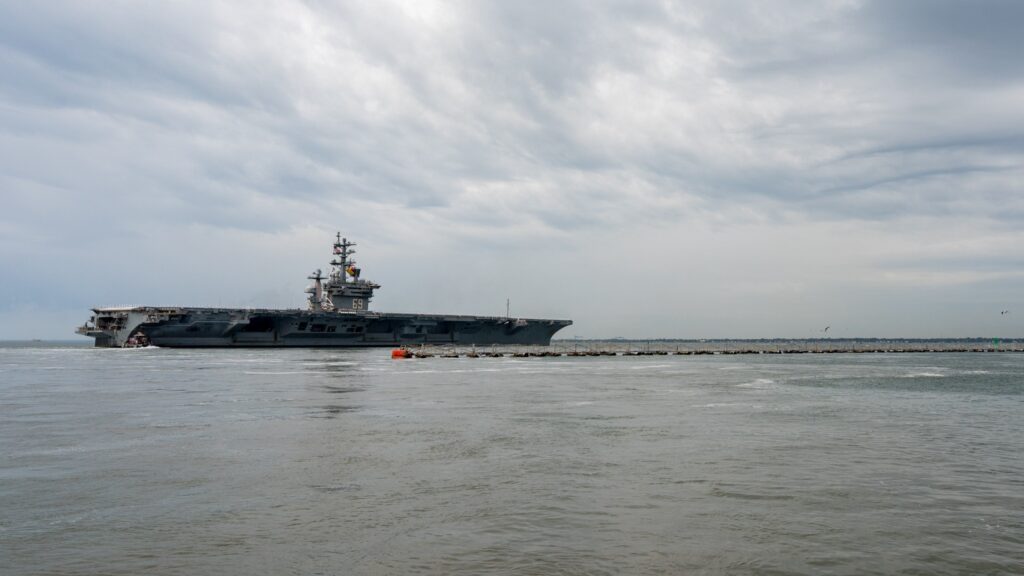
NORFOLK, Va. — Aircraft carrier USS Dwight D. Eisenhower (CVN 69) (IKE), departed on a scheduled deployment, Oct. 14. 

The strike group is scheduled to deploy to the U.S. European Command area of responsibility where it will engage with allies and partners in support of maritime statecraft, which encompasses naval diplomacy and national efforts to build comprehensive U.S. and allied maritime power. 

“Each entity that comprises IKECSG has worked exceptionally hard over the last several months, and we are ready to bring maritime power in support of any tasking,” said Rear Adm. Marc Miguez, commander, Carrier Strike Group (CSG) 2, IKECSG. “Our presence will undoubtedly strengthen relationships with our allies and partners, as we share the goal to deter aggression, and if required, deliver overwhelming combat power.” 

The flagship Dwight D. Eisenhower will join guided-missile cruiser USS Philippine Sea (CG 58) and guided-missile destroyer USS Gravely (DDG 107), who departed Naval Station Norfolk, and guided-missile destroyer USS Mason (DDG 87), who departed Naval Station Mayport, Oct. 13. 

The IKECSG is an integrated combat weapons system that delivers superior combat capability to deter, and if necessary, defeat America’s adversaries in support of national security. It is comprised of more than 5,000 Sailors of CSG-2 staff, commanded by Miguez; flagship Dwight D. Eisenhower, commanded by Capt. Christopher Hill; Carrier Air Wing (CVW) 3 squadrons, commanded by Capt. Mitch McCallister; Destroyer Squadron (DESRON) 22 staff and units, commanded by Capt. David Wroe; guided-missile cruiser USS Philippine Sea (CG 58), commanded by Capt. Michelle Nakamura; and the Information Warfare Commander, Capt. Mitchell Finke. 

“President Eisenhower once said, ‘never send a battalion to take a hill if a regiment is available.’ As the flagship of the strike group, the Mighty IKE is ready to provide overwhelming air power to deter aggression and promote world peace,” said Hill. “We trained rigorously for this deployment, and we are excited to celebrate the Navy’s 248th birthday by sending the best damn ship in the Navy to sea.” 

The strike group’s deployment coincides with the Navy’s birthday weekend, marking 248 years of power, presence, and protection. The aircraft carrier’s deployment coincides with President Eisenhower’s birthday on Oct. 14 and is days ahead of the aircraft carrier’s 46th year of commissioned naval service on Oct. 18. IKECSG’s deployment embodies the Navy’s historical and long-standing commitment to being forward deployed, highly trained, and dedicated to defending American interests at sea, on land, and in the sky. 

The Italian Navy Carlo Bergamini-class frigate ITS Virginio Fasan (F 591) will integrate with IKECSG during the deployment. IKECSG practiced interchangeability and transfer of authority with Fasan during CSG-4-led composite training unit exercise (COMPTUEX) in July. 

Squadrons of CVW-3 include the “Gunslingers” of Strike Fighter Squadron (VFA) 105, the “Fighting Swordsmen” of Strike Fighter Squadron (VFA) 32, the “Rampagers” of Strike Fighter Squadron (VFA) 83, the “Wildcats” of Strike Fighter Squadron (VFA) 131, the “Screwtops” of Carrier Airborne Early Warning Squadron (VAW) 123, the “Zappers” of Electronic Attack Squadron (VAQ) 130, the “Dusty Dogs” of Helicopter Sea Combat Squadron (HSC) 7, the “Swamp Foxes” of Helicopter Maritime Strike Squadron (HSM) 74 and the “Rawhides” of Fleet Logistics Support Squadron (VRC) 40. 

Ships of DESRON 22 include guided-missile destroyers Mason and Gravely. 

For more information about Dwight D. Eisenhower Carrier Strike Group, head to Facebook (/CSGTWO & /TheCVN69); Instagram (@CarrierStrikeGroupTwo & @TheCVN69); LinkedIn (Carrier-Strike-Group-TWO). 


General Dynamics Delivers Submarine Hyman G. Rickover (SSN 795)

Release from HII 

***** 

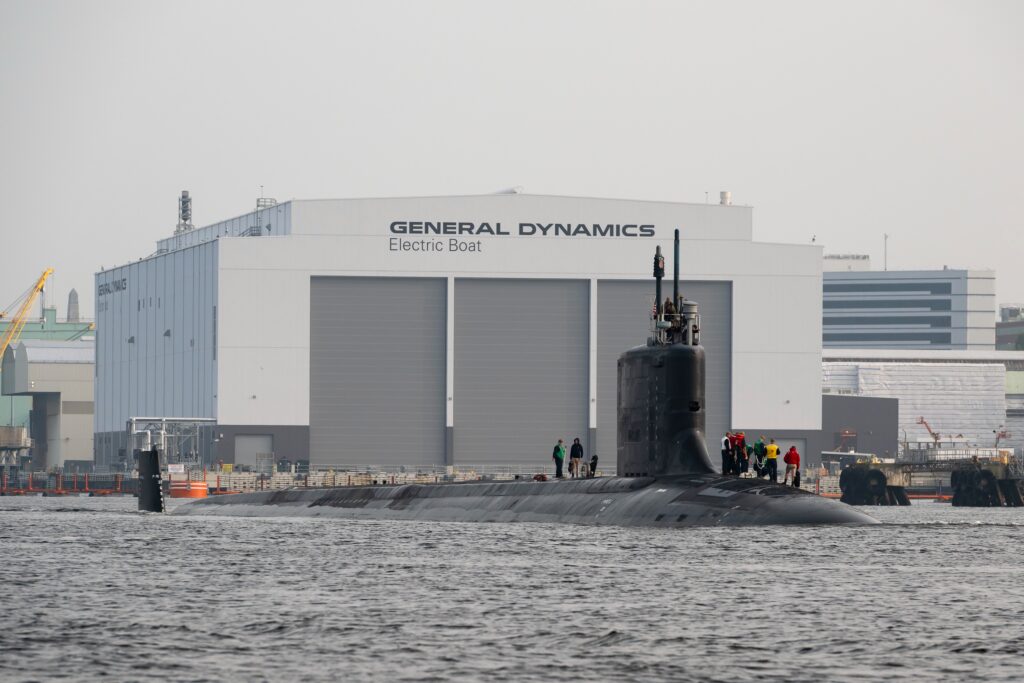
GROTON, Conn. (October 11, 2023) – General Dynamics Electric Boat announced today it delivered the nuclear-powered attack submarine Hyman G. Rickover (SSN 795) to the U.S. Navy. Electric Boat is a wholly owned subsidiary of General Dynamics (NYSE:GD). 

Hyman G. Rickover is the 22nd submarine of the Virginia Class, which provides the Navy with the capabilities required to retain undersea dominance well into the 21st century.  

“The shipbuilders of Electric Boat are proud to deliver Hyman G. Rickover, the second submarine to be named for the father of the United States Nuclear Navy,” said Kevin Graney, President, General Dynamics Electric Boat. “Admiral Rickover set excellence as the standard for the United States’ nuclear fleet, and we wish the Hyman G. Rickover and her crew a long and distinguished career that honors Admiral Rickover’s legacy.” 

Hyman G. Rickover is the fourth of the ten-ship group of Virginia-class submarines known as Block IV. These ships embody a Navy and industry commitment to deliver new submarines to the fleet with advantageous stealth and strike capacity. 

Virginia-class submarines displace approximately 7,000 tons, with a hull length of 377 feet and a diameter of 34 feet. Block IV Virginia-class submarines carry Mark 48 advanced capability torpedoes and Tomahawk cruise missiles. 

General Dynamics Electric Boat is the prime contractor and lead design yard for the Virginia class program and constructs the ships in a teaming arrangement with HII’s Newport News Shipbuilding in Virginia.